2027 Why Some Online MSW Programs Cost More Than Others

Co-Founder and Chief Data Scientist
Choosing an online MSW program is not just a question of finding the lowest tuition. The bigger decision is whether the program’s total cost, accreditation, field placement support, schedule, and licensure preparation fit your career goal and financial situation.
Online MSW prices can look confusing because schools calculate costs differently. One program may advertise a low per-credit rate but add technology, practicum, or online learning fees later. Another may charge more upfront but include stronger field placement coordination, live instruction, student support, or a more established alumni network.
This guide explains why online MSW programs vary so widely in cost, what expenses to check before enrolling, how accreditation affects licensure options, and how to evaluate tuition against career outcomes. The goal is to help you compare programs by real value—not just sticker price.
Key Things You Should Know
- Tuition differences in online MSW programs often reflect factors like accreditation status, faculty expertise, and program length, significantly impacting overall costs.
- Additional fees for practicum placements, technology, and administrative services cause some programs to charge 20-35% more than peers.
- In 2025, programs with specialized concentrations or dual degrees typically cost 15-25% more, reflecting the advanced curriculum and career potential.
Why do online MSW programs have varying costs?
Online MSW programs have different costs because schools use different pricing models, receive different levels of public funding, and invest in different levels of student support. Two programs may both lead to an MSW, but the total price can change significantly based on residency status, accreditation, field education, faculty structure, and institutional reputation.
Residency is one of the clearest cost drivers. At public universities, in-state students often pay between $15,000 and $35,000, while out-of-state students may face fees ranging from $30,000 to $55,000. These differences usually reflect state funding rules and whether a student qualifies for subsidized tuition.
Program design also affects the bill. Online MSW programs with clinical practice components may charge more because they must support field placements, supervision, liability requirements, and compliance with professional standards. Programs with live online classes, specialized software, digital libraries, or intensive student advising may also add technology or online learning fees.
Accreditation can influence cost as well. Council on Social Work Education (CSWE) accreditation signals that a program meets recognized social work education standards, including field education and curriculum expectations. Maintaining that level of quality requires faculty oversight, assessment, and administrative support, which can be reflected in tuition.
Institutional reputation is another factor. A well-known university may charge more because it offers broader faculty expertise, more established placement systems, stronger career services, or a larger professional network. A newer or less established program may cost less, but students should confirm that lower tuition does not come with weaker field placement support or limited licensure preparation.
Before comparing programs, students should separate sticker price from net price. Scholarships, graduate assistantships, employer tuition reimbursement, military benefits, and payment plans can change what a student actually pays. Students planning advanced study after the MSW may also want to compare long-term academic pathways, including an online doctor of social work.
What factors determine online MSW program tuition?
Online MSW tuition is determined by more than the advertised per-credit rate. The final cost usually combines base tuition, credit requirements, residency status, required fees, field education expenses, and program format.
For a typical 60-credit program, base tuition often starts around $25,000 but can rise to between $29,400 and $34,400 after required fees are added. That difference matters because a program that appears affordable at first may become less competitive once all mandatory charges are included.
Common added expenses include:
- Online program fees ranging from $3,000 to $6,000 to support virtual classroom technology and digital learning resources
- Clinical or practicum fees between $400 and $900 for placements, supervision-related costs, and liability insurance
- Technology levies of $1,000 to $2,500 for software licenses, learning platforms, and IT support
Regional pricing is another major reason costs differ. Public universities often charge lower rates to in-state residents, while private institutions and out-of-state public university options may cost more. Some schools use one flat online tuition rate for all students, while others keep separate in-state and out-of-state rates.
Program format can also change total cost. Accelerated tracks may reduce time in school but require an intense course load. Specialized concentrations may require additional faculty expertise, tailored field placements, or smaller classes. Advanced standing tracks can reduce cost for eligible students because they require fewer credits than traditional MSW tracks.
Students should ask each school for a complete written cost breakdown before applying. A useful comparison should include tuition, required fees, field placement costs, books or digital materials, residency rules, transfer credit policies, and whether tuition is locked or subject to increase. For cost-focused comparisons, Research.com’s guide to affordable online MSW programs can help identify lower-cost options.
How much do online MSW programs typically cost?
Online MSW programs typically cost from $10,000 to $60,000 overall, though the final amount depends on credit-hour price, number of required credits, residency status, fees, and whether the student qualifies for advanced standing. Tuition usually falls between $300 and over $1,000 per credit hour.
Credit requirements are one of the most important cost variables. Full MSW programs often require 30 to 60 credit hours. A lower per-credit rate may still lead to a high total cost if the program requires more credits, while a higher per-credit rate may be less expensive overall for students who qualify for an advanced standing track.
Advanced standing can create a major financial advantage for students who already hold a bachelor’s in social work. These tracks grant credit for prior social work coursework and reduce both the time and tuition required to graduate. For example, Western New Mexico University charges $371 per credit for non-resident students in its advanced standing track, resulting in total costs between $11,130 and $22,260 depending on credits completed.
Students should compare programs using total program cost rather than tuition alone. A strong cost comparison should include:
- The exact number of credits required for the student’s track
- The per-credit tuition rate and whether it differs by residency
- Mandatory online, technology, practicum, and student service fees
- Whether field placement support is included or requires additional costs
- Whether scholarships, grants, or employer reimbursement can reduce the net price
Public universities often offer lower tuition to in-state students, while private institutions may charge higher rates but offer different support structures, alumni networks, or specialization options. Neither public nor private status alone determines value; the better question is whether the program’s total cost aligns with licensure needs and expected career path.
Students evaluating return on investment should also review earning potential after graduation. Research.com’s LCSW salary data can help prospective students compare educational costs with possible post-graduation income.
Are all online MSW programs accredited the same?
No. Online MSW programs are not all accredited the same way, and this distinction can affect licensure eligibility, employer recognition, field education quality, and long-term career options. The most important accreditation for an MSW program is accreditation from the Council on Social Work Education (CSWE).
CSWE accreditation is the standard students should look for when evaluating online MSW programs. Only CSWE-accredited programs meet the professional education requirements expected for social work preparation in most states. A school may have regional or institutional accreditation, but that alone is not the same as CSWE accreditation for social work practice.
Cost differences often reflect the resources required to meet accreditation standards. Accredited advanced-track online MSW programs may charge as low as $33,634, whereas out-of-state traditional track programs with full accreditation can reach $181,140, influenced by fees related to technology and instructional delivery. These costs may include faculty oversight, curriculum assessment, field education coordination, online learning platforms, and student support systems.
Students should be careful with programs that appear inexpensive but do not clearly state CSWE accreditation. A non-CSWE program may limit eligibility for clinical practice, advanced credentials, or licensure-related pathways, even if it is offered by an otherwise accredited institution.
When reviewing accreditation, ask these questions before applying:
- Is the MSW program currently accredited by CSWE?
- Does the accreditation apply to the online format, not only the campus format?
- Does the program include the field education or clinical practicum hours required for licensure preparation?
- Are online, technology, field, and instructional delivery fees clearly disclosed?
- How does tuition differ between advanced standing and traditional tracks?
- How does tuition differ for in-state and out-of-state students?
According to US News data, these factors help explain why tuition varies across accredited online MSW programs. For students asking, “Is a degree in social work worth it?,” accreditation should be part of the answer because it directly affects whether the degree supports licensure and professional mobility.
What accreditation should online MSW programs have?
Online MSW programs should have Council on Social Work Education (CSWE) accreditation. This is the key programmatic accreditation for social work education and the standard most students need for licensure preparation, professional recognition, and future clinical opportunities.
CSWE accreditation confirms that the curriculum covers core social work competencies, ethics, policy, research, human behavior, practice methods, and supervised field education. It does not guarantee a specific job or license, but it helps ensure the degree meets the educational foundation expected by licensing boards and employers.
Institutional or regional accreditation is still important because it reflects the broader university’s academic legitimacy. However, for an MSW, institutional accreditation alone is not enough. A student should verify that the specific MSW program is CSWE-accredited, especially when comparing online formats, satellite programs, or newer tracks.
Cost and accreditation do not always move in the same direction. CSU-San Bernardino’s online MSW program, which maintains CSWE accreditation, charges between $10,000 and $16,000 annually at approximately $280 per credit. This shows that students can find CSWE-accredited options that are relatively affordable, especially at public universities.
Key points to remember:
- CSWE accreditation is required for licensure eligibility in most states.
- Non-CSWE programs may restrict career growth even if tuition is lower.
- Public, CSWE-accredited programs are often more affordable than private alternatives.
- Lower tuition at institutions such as CSU-San Bernardino does not automatically mean lower educational quality.
Students should verify accreditation directly through official sources before enrolling. This step is especially important for students planning to become licensed clinical social workers, move across state lines, or pursue roles that require recognized graduate social work training.
What are admission requirements for online MSW programs?
Admission requirements for online MSW programs usually include a bachelor’s degree from an accredited institution, academic transcripts, a resume or curriculum vitae, recommendation letters, and a personal statement. Many programs prefer applicants with a minimum GPA of about 3.0, although some consider lower GPAs when the applicant shows strong professional experience, clear goals, or academic improvement.
Most applications require two or three letters of recommendation from professors, supervisors, or professionals who can evaluate the applicant’s readiness for graduate-level social work study. The personal statement is also important because it explains the applicant’s motivation, commitment to social work values, relevant experience, and career goals.
GRE requirements vary. Some programs still ask for GRE scores, but many have waived this requirement in recent years. Applicants should check each school’s policy instead of assuming that standardized testing is required.
Relevant work or volunteer experience in human services, social services, healthcare, schools, community organizations, or advocacy settings can strengthen an application. For advanced standing or accelerated tracks, prior social work education and experience may be especially important because these pathways reduce time and financial investment.
Additional requirements may apply before field placement begins. These can include background checks, proof of immunizations, and other agency-specific documentation. Online students should also expect to show that they have reliable internet access, appropriate technology, and the time management skills needed for remote coursework and in-person field education.
Cost should be reviewed alongside admissions requirements. For example, the University of South Dakota charges about $340 per credit, with total annual costs ranging from $10,000 to $20,000. This ranks it third in affordability among top online MSW programs for 2024-2026.
Applicants should compare both eligibility and fit. A program may be affordable but require field placements that are hard to complete locally, or it may be flexible but lack the specialization a student needs. The best choice is one that matches the applicant’s academic profile, schedule, budget, and licensure goals.
How long do online MSW programs take to complete?
Online MSW programs usually take two to three years of full-time study, similar to many campus-based programs. Part-time students may take three or more years, especially if they are balancing employment, caregiving, or other responsibilities.
Some online MSW programs offer accelerated tracks that can be completed in as short as 12 to 18 months. These options may appeal to students who want to enter the workforce quickly, but they require a heavier workload and less schedule flexibility. Students should be realistic about weekly time commitments, field placement hours, and whether they can manage intensive coursework without affecting job performance or personal obligations.
Advanced standing can shorten the timeline for students who already hold a Bachelor of Social Work (BSW). These tracks may reduce the program length by up to one year because students receive credit for prior social work coursework. This can lower both tuition and opportunity cost.
Program length has a direct financial effect. More semesters can mean more tuition, fees, books, and time away from higher-level earning opportunities. However, a slower part-time pace may be financially necessary for students who need to keep working while enrolled.
For example, Concord University charges $485 per credit, resulting in annual tuition between $17,000 and $29,000. This positions Concord among the more affordable fully online MSW programs nationwide, according to research on affordable options.
When comparing timelines, students should ask whether the program offers full-time, part-time, accelerated, and advanced standing options; whether field placement can be completed near the student’s location; and whether course sequencing could delay graduation if a class is offered only once per year.
What curriculum do online MSW programs cover?
Online MSW programs cover the knowledge and practice skills needed for professional social work roles. Core coursework often includes human behavior and the social environment, social justice, research methods, social welfare policy, ethics, and social work practice with individuals, families, groups, organizations, and communities.
Advanced coursework usually depends on the program’s focus. Students may study clinical practice, community organizing, mental health, trauma-informed care, child welfare, healthcare social work, substance abuse counseling, or policy and administration. The best curriculum for a student depends on whether the goal is clinical licensure, school social work, nonprofit leadership, healthcare practice, or macro-level advocacy.
Field education is a central part of the MSW curriculum. Even in online programs, students typically complete supervised practicum or fieldwork in an approved agency or organization. This is where students apply classroom learning to real client, community, policy, or administrative settings.
Curriculum differences help explain cost differences. Programs with specialized tracks may need more faculty expertise, placement coordination, and tailored supervision. Programs with stronger field placement support may cost more, but that support can be valuable if a student lives far from campus or needs help securing an approved site.
Program reputation can also affect price. Aurora University’s online advanced standing MSW program totals around $18,000, while high-cost programs like USC’s exceed $100,000 annually. This price gap reflects resource allocation rather than curricular rigor, because all CSWE-accredited programs must meet Council on Social Work Education standards.
Students should review course catalogs before applying. Look for required courses, electives, concentrations, field placement expectations, licensure alignment, and whether the program’s online format includes live sessions, asynchronous coursework, or a mix of both. A lower-cost program can be a strong choice if it meets accreditation standards and supports the student’s intended career path.
What careers follow an online MSW degree?
An online MSW can prepare graduates for careers in clinical practice, healthcare, schools, child and family services, community organizations, government agencies, nonprofits, policy, and social service administration. The exact options depend on the program’s curriculum, field placements, specialization, state licensure rules, and post-graduation supervised experience.
Many graduates pursue direct practice roles. Clinical social workers provide therapy, counseling, case assessment, and support for clients experiencing mental health, addiction, family, trauma, or life-transition challenges. Medical social workers help patients and families navigate treatment plans, discharge planning, resource access, and emotional stress in healthcare settings. School social workers support students’ behavioral, emotional, and social needs while coordinating with families and educators.
MSW graduates may also move into administrative or macro-practice careers. These roles can include nonprofit program director, social service manager, community organizer, policy analyst, grant coordinator, or advocate focused on welfare reform, housing, public health, or community development.
Licensure matters for many career paths. An MSW combined with the required supervised hours and state licensure can lead to clinical private practice, which is often a major professional and financial goal. Students should confirm that their program’s field education and coursework align with the licensing board in the state where they plan to practice.
Cost should be weighed against career access. For example, in-state tuition at UNC-Charlotte is $7,214, making it one of the most affordable, high-value options for prospective students pursuing an MSW. A lower-cost CSWE-accredited program may offer strong value if it supports licensure, provides appropriate field placements, and fits the student’s target area of practice.
Specialized training areas such as geriatric care, substance abuse counseling, and child welfare are increasingly in demand. Students who know their preferred career path should look for matching electives, field sites, faculty expertise, and licensure preparation rather than choosing a program based on tuition alone.
What is the salary outlook for MSW graduates?
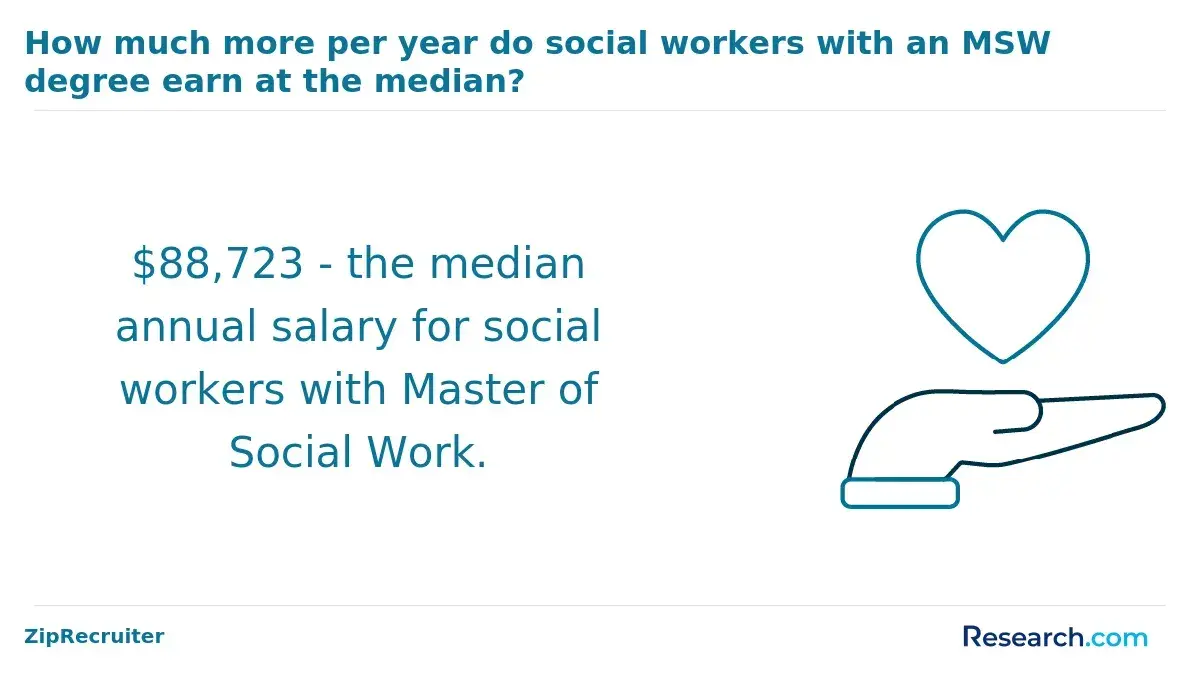
The salary outlook for MSW graduates varies by location, experience, licensure, specialization, and work setting. Entry-level social work professionals typically earn between $45,000 and $60,000 annually. With experience or specialized skills, salaries can increase to $65,000-$90,000 or more.
Work setting makes a meaningful difference. Healthcare, government, and private practice roles tend to offer higher pay than many nonprofit positions. Clinical social work and school social work specializations may also support stronger compensation, depending on local demand and licensure requirements.
Licensed clinical social workers often have access to higher-paying roles and private practice opportunities. However, licensure usually requires more than graduation. Students should expect state-specific requirements, supervised post-degree hours, exams, and ongoing continuing education.
Geography also affects salary. Metropolitan areas and states with higher living costs may offer higher wages, although those gains can be partly offset by housing, transportation, taxes, and other expenses. Students should compare salary expectations in the state or region where they plan to work, not only national figures.
The return on an MSW depends heavily on net cost. Private programs might have sticker prices from $45,000 to over $80,000 before aid. Scholarships, grants, employer reimbursement, and other funding sources can reduce actual costs and may make a higher-priced program more affordable than it first appears.
MSW graduates may also increase income over time through supervisory roles, policy work, advanced certifications, agency leadership, or clinical specialization. Before enrolling, students should compare program cost, licensure alignment, local salary data, and the type of social work career they want to pursue.
Other Things You Should Know About Social Work
In 2027, the cost of online MSW programs may vary based on geographic location due to differences in cost-of-living, regional demand for social workers, and state-specific educational resources. Institutions in higher-cost areas may charge more, reflecting operating expenses and faculty salaries.
Yes, many online MSW programs provide specialization tracks such as clinical social work, school social work, or community practice. These specializations allow students to focus their studies on particular areas that align with their career goals. Program availability for certain concentrations may affect tuition costs and study duration.
Online MSW students can access various types of financial aid, including federal loans, grants, and scholarships specific to social work education. Many schools offer scholarships designated for online learners or students pursuing social work degrees. Prospective students should explore all options early to maximize funding opportunities.
Graduating from an accredited MSW program, whether online or on-campus, is a key step toward social work licensure in most states. Candidates must also fulfill supervised post-graduate experience hours and pass the Association of Social Work Boards (ASWB) exam. Licensing requirements vary by state, so graduates should consult their state's licensing board for specific regulations.
References
- MSW Tuition: What to Expect | University of Nevada, Reno https://onlinedegrees.unr.edu/online-master-of-social-work/msw-tuition
- How Long is a Master of Social Work Program? Length of MSW Programs https://www.masterofsocialwork.com/faqs/length-of-msw-programs
- Social Work Salaries - How Much Do Social Workers Make? https://www.onlinemswprograms.com/careers/social-worker-salaries/
- Online MSW Admissions Requirements | Tulane School of Social Work https://socialwork.tulane.edu/msw-programs/admissions/
- Social Work Salaries https://www.socialworkers.org/careers/career-center/kickstart-your-job-hunt/social-work-salaries
- 6 Best Remote Jobs for Social Workers | HireBasis https://www.hirebasis.com/blog/6-best-remote-jobs-for-social-workers
- Social Work Master's Degree Prerequisites https://www.psychology.org/social-work/masters/
- Social Work (MSW) https://www.wlu.ca/programs/social-work/graduate/social-work-msw/index.html
- Most Affordable Online MSW Programs: Review Low-Cost Options https://www.degreesforgood.org/online-degrees/social-work-programs/masters-msw/most-affordable/
- How Long Does it Take to Become a Social Worker? https://socialworklicensemap.com/become-a-social-worker/how-long-does-it-take/