2027 Most Affordable Advanced Standing Online MSW Programs

Co-Founder and Chief Data Scientist
Advanced standing online MSW programs are designed for students who already hold a Bachelor of Social Work from a CSWE-accredited program and want to earn the MSW faster than a traditional two-year pathway. For these students, the main decision is not whether online study is possible; it is how to choose a program that is accredited, affordable, licensure-aware, and realistic to complete while working or managing other responsibilities.
Cost matters because graduate tuition can quickly reduce the financial benefit of an accelerated degree. The strongest advanced standing options recognize prior BSW preparation, shorten the curriculum, support local field placements, and help students move toward clinical, community, policy, or administrative social work roles without paying for coursework they have already completed.
This guide explains what advanced standing online MSW programs are, how much they cost, what admissions teams usually require, how long completion takes, why CSWE accreditation is essential, and how to compare programs based on career goals, licensure preparation, field education, and total value.
Key Things You Should Know
- Advanced standing MSW programs in 2026 offer significant tuition savings, often 25%-50% lower than traditional tracks, making graduate education more accessible for qualified BSW holders.
- Most affordable programs emphasize online delivery, enabling flexibility and accommodating working professionals while maintaining CSWE accreditation and rigorous field placement requirements.
- Completion time for advanced standing online MSW programs averages 12-18 months, facilitating faster entry or advancement in social work careers amid growing demand for licensed practitioners.
What are advanced standing online MSW programs?
Advanced standing online MSW programs are graduate social work programs for students who have already completed a Bachelor of Social Work from a CSWE-accredited institution. Because these students have completed foundational social work coursework, programs may waive introductory MSW classes and allow them to move directly into advanced practice courses.
In practical terms, this can shorten a traditional two-year MSW to about one year or 12 to 18 months online, depending on the school, enrollment pace, field placement schedule, and concentration. These programs are not usually intended for students with bachelor’s degrees outside social work; those applicants typically need a traditional MSW track instead.
Advanced standing online MSW programs commonly include graduate-level study in clinical practice, policy, research, ethics, assessment, administration, and specialized social work methods. Students may choose pathways such as clinical social work, school social work, social policy practice, healthcare social work, behavioral health, child welfare, or community practice, depending on the institution.
Although coursework is online, field education remains a core requirement. Students usually complete supervised practicum hours in approved agencies near their location, while participating in online seminars, faculty advising, case discussions, and digital collaboration with classmates.
Before applying, students should confirm three essentials:
- BSW eligibility: The bachelor’s degree usually must come from a CSWE-accredited program, often within a specified time frame set by the school.
- Academic readiness: Programs commonly review BSW GPA, field evaluation history, research preparation, and professional recommendations.
- Licensure alignment: Students seeking clinical licensure should verify whether the curriculum and field placement support the requirements in the state where they plan to practice.
Data from the Bureau of Labor Statistics Occupational Employment and Wage Statistics highlight that in 2025, MSW graduates from affordable Southern programs like Troy University earned median starting salaries of $62,000, about 18% above the national average for entry-level social workers. This demonstrates why a shorter, affordable pathway can matter: entering the workforce sooner may improve the degree’s overall value.
Students who plan to move beyond the MSW into advanced practice, teaching, research, executive leadership, or policy roles may also want to compare doctorate social work programs after they understand the MSW pathway.
Which schools offer the most affordable advanced standing online MSW programs?
Some of the most affordable advanced standing online MSW programs are offered by public universities, especially when students qualify for in-state tuition, regional tuition agreements, or online tuition rates that are lower than private-school pricing. Public institutions in the Southeast are often cited for combining accredited MSW training with comparatively low tuition for eligible students.
Examples include the University of South Carolina, University of North Carolina at Chapel Hill, and Florida State University. These institutions combine cost efficiency with accredited online curriculums designed for advanced standing students. Tuition for in-state residents often remains below $12,000, making these programs highly competitive for qualified applicants.
Affordability, however, should not be judged by tuition alone. A lower-priced program may become less practical if field placements are difficult to arrange, required synchronous sessions conflict with work, or the concentration does not match the student’s licensure or career goal.
These top accredited online MSW advanced standing degrees feature strong employment outcomes, with a 92% rate of graduates employed within six months, according to the CSWE 2025 Annual Statistics Report. Demand for professionals in rural behavioral health contributes to these outcomes and makes program specialization an important factor in school selection.
When comparing affordable advanced standing online MSW options, focus on the following:
- Resident tuition rules: In-state versus out-of-state pricing can change the total cost substantially.
- Online tuition policy: Some schools charge a separate online rate, while others use standard resident and nonresident rates.
- Scholarships and assistantships: Ask whether advanced standing students are eligible, since accelerated students may have fewer semesters to use aid.
- Field placement support: A low tuition rate is less valuable if students must independently locate placements without meaningful assistance.
- Specialization fit: Rural behavioral health, clinical practice, school social work, or policy tracks should match the student’s intended career market.
- Completion format: Accelerated formats that allow completion within 12-18 months may reduce tuition exposure, commuting, and opportunity costs.
Students should request a full cost sheet from each school, including tuition, online fees, field placement fees, books, residency requirements, and any campus visits. To broaden the comparison, review additional online MSW programs that may fit different budgets, schedules, and career plans.
How much do advanced standing online MSW programs cost?
Advanced standing online MSW programs are often less expensive than traditional MSW pathways because they reduce the number of required credits for students who already completed accredited BSW training. Total tuition usually ranges from $10,000 to $30,000, with the final amount influenced by public or private status, residency rules, credit requirements, institutional fees, and program length.
Public universities often charge between $400 and $700 per credit, while private schools may range from $700 to $1,200 per credit. The lowest advertised tuition is not always the lowest total cost, so students should compare the complete price of attendance rather than the per-credit number alone.
Common cost categories include:
- Tuition: The largest expense and the easiest figure to compare across programs.
- Technology fees: These can range from $100 to $500 annually.
- Field education costs: Students may need to pay for background checks, liability insurance, health documentation, transportation, or placement-related requirements.
- Books and course materials: Online courses may still require textbooks, software, case materials, or assessment tools.
- Residency or campus requirements: Hybrid sessions can add travel and lodging costs if required.
Military social work tracks within these programs often provide scholarships and financial support, which have helped increase LCSW certifications by 25% among veterans' service providers, according to the National Association of Social Workers 2025 Workforce Study.
When budgeting, consider these decision points:
- In-state vs. out-of-state tuition differences that can reduce costs by up to 40% at public schools.
- Accelerated formats in advanced standing programs that shorten study time by about a year, lowering living and other expenses.
- Financial aid such as employer tuition reimbursement and federal aid that may offset costs.
- The number of credits actually required after advanced standing review.
- Whether the program’s field placement schedule allows you to continue working.
Students should ask each program for a written tuition breakdown before enrolling. A good comparison includes total tuition, mandatory fees, expected field costs, financial aid eligibility, and the realistic timeline to graduation. Prospective students interested in a fast track social work degree online should pay close attention to how accelerated pacing affects both affordability and workload.
What are the admission requirements for advanced standing MSW programs?
Admission to an advanced standing MSW program typically requires a completed Bachelor of Social Work from a CSWE-accredited institution. Schools use this requirement to confirm that the applicant has already completed foundational social work preparation in practice, policy, research, human behavior, ethics, and field education.
Most programs expect a minimum GPA of 3.0 to demonstrate readiness for graduate-level coursework. Some schools may review the overall GPA, the social work major GPA, or the final 60-credit GPA separately. Applicants with lower GPAs may still be considered at some institutions if they show strong field evaluations, professional experience, or evidence of academic improvement.
Common requirements for advanced standing MSW programs include:
- Official transcripts documenting the BSW degree and prerequisite social work coursework.
- Letters of recommendation from academic or professional references knowledgeable about the applicant's social work abilities.
- A personal statement explaining career goals, commitment to social work values, relevant experience, and reasons for choosing the advanced standing track.
- Relevant social work or related volunteer/work experience, often a minimum of 200 hours.
- GRE scores, although many programs waive this for those with significant professional experience.
- An interview to evaluate communication skills, judgment, professionalism, and readiness for advanced practice.
Applicants with international social work degrees must often provide credential evaluations to verify course equivalency. This step is important because advanced standing depends on whether prior coursework matches accredited BSW preparation in the United States.
Graduates from low-cost advanced standing MSW programs have demonstrated a 15% higher ROI over five years, with a lifetime earnings premium of $450,000. That makes careful application planning worthwhile, especially for students trying to reduce debt while entering the profession quickly.
To strengthen an application, request transcripts early, choose recommenders who can speak directly to social work competence, and write a personal statement that connects prior field experience to a clear MSW goal. Applicants should also check for program-specific requirements such as background checks, field readiness documentation, state authorization limits, or clinical hour minimums.
Students who do not meet advanced standing standards may still qualify for traditional MSW pathways. Those comparing less selective options can review online MSW programs with different admission flexibilities while still prioritizing accreditation.
How long do advanced standing online MSW programs take to complete?
Advanced standing online MSW programs generally take between 12 and 24 months. The exact timeline depends on whether the student enrolls full time or part time, how many credits the program requires, when field placements begin, and whether courses are offered in a lockstep cohort or a more flexible sequence.
Full-time students often finish in about a year. This option can be efficient for students who can reduce work hours, manage intensive field requirements, and handle a demanding graduate course load. Part-time students or working professionals may take up to two years, which can make the schedule more manageable but delays graduation and licensure progress.
Program structures vary. Some schools use cohort models with fixed course sequences, while others use modular formats that break courses into smaller units over time. Research from the Council on Social Work Education's 2025 Online Learning Outcomes Survey shows these modular formats had 28% higher completion rates for working parents compared to traditional models, making flexible pacing especially valuable for students balancing employment and caregiving.
Before choosing the fastest option, students should confirm:
- Field placement timing: Practicum hours can limit how quickly a student can progress, even when coursework is accelerated.
- Licensure requirements: Students pursuing clinical licensure should make sure the program supports state-specific education and supervised practice expectations.
- Course availability: Some required courses may be offered only once per year, which can affect graduation timing.
- Workload expectations: A 12-month plan may be difficult for students working full time.
- Transfer and waiver policies: Confirm whether any additional credits can be waived or accepted before enrolling.
Advanced standing online MSW programs can provide a faster route to the degree, but the best timeline is the one a student can complete successfully. A slightly longer part-time plan may be the better choice if it protects field performance, academic quality, employment stability, and personal well-being.
What accreditation is required for online MSW programs?
Online MSW programs should be accredited by the Council on Social Work Education (CSWE), the accrediting body recognized by the U.S. Department of Education for social work education. CSWE accreditation confirms that a program meets professional standards for curriculum, field education, faculty qualifications, assessment, and social work competencies.
This requirement matters because state licensing boards generally expect applicants to graduate from a CSWE-accredited MSW program, regardless of whether the program was delivered online, on campus, or in a hybrid format. Graduates from non-CSWE-accredited programs may face serious barriers when applying for licensure, clinical supervision, government positions, employer reimbursement, or doctoral study.
Advanced standing status also depends on accreditation. Because the pathway is built on prior BSW preparation, schools typically require the bachelor’s degree to come from a CSWE-accredited BSW program and the MSW itself to hold CSWE accreditation.
Cost savings can also be significant when students choose accredited programs that participate in tuition agreements. For instance, participants in the Western Regional Graduate Program benefited from average tuition savings of $12,000 by accessing in-state rates across participating states. This shows that students do not have to choose between affordability and professional credibility if they compare accredited options carefully.
Before applying, verify accreditation in two places:
- The program’s official accreditation disclosure page.
- The CSWE directory or accreditation resources.
Students should also confirm that the program is authorized to enroll online students in their state and that its field placement model can support licensure goals where they plan to practice. Accreditation is necessary, but it is not the only licensure factor; state boards may have additional rules for clinical hours, supervision, exams, and post-degree experience.
What is the curriculum in advanced standing online MSW programs?
Advanced standing online MSW programs build on BSW-level preparation and move students into advanced social work practice more quickly. Typically requiring 30 to 36 credit hours, these programs emphasize applied skills, ethical decision-making, policy analysis, research literacy, field education, and preparation for specialized practice.
Core courses often include advanced human behavior, social welfare policy, research methods, ethics, assessment, intervention planning, and social work practice with individuals, families, groups, organizations, or communities. Clinical tracks may place more emphasis on diagnosis, evidence-informed treatment, trauma, substance use, and mental health practice. Macro or leadership tracks may focus more on administration, program evaluation, advocacy, policy, and community systems.
Specialized electives allow students to tailor the degree toward areas such as mental health, child welfare, healthcare, substance abuse counseling, school social work, trauma-informed care, aging, military social work, or community practice. Some programs offer certificates or formal concentration tracks that can help students signal focused preparation to employers.
Field education remains essential even in an online program. Students usually complete supervised practicum experiences with approved agencies, often in or near their communities. These placements connect classroom learning to real client systems and are especially important for students pursuing clinical licensure.
Online delivery may include a mix of:
- Asynchronous lectures: Recorded content students can complete on a flexible schedule.
- Live class sessions: Real-time discussion, case review, and faculty interaction.
- Simulations: Practice-based learning for assessment, interviewing, crisis response, and ethical decision-making.
- Field seminars: Structured reflection connecting practicum experiences with professional standards.
- Group projects: Collaboration on policy, research, program planning, or case-based assignments.
Financially, programs costing under $25,000 total have shown a rapid 3.2-year payback on investment according to the American Enterprise Institute's 2025 Graduate ROI Index. For students comparing curricula, the best value is usually a program that combines affordable tuition with strong field placement support, licensure-relevant coursework, and a specialization aligned with the student’s intended career.
What careers can you pursue with an MSW degree?
An MSW degree can lead to clinical, administrative, community, school, healthcare, policy, and nonprofit leadership roles. The best career path depends on the student’s concentration, field placements, state licensure status, and whether they want to work directly with clients, manage programs, influence policy, or lead organizations.
Common MSW career options include:
- Clinical social worker: Provides assessment, therapy, treatment planning, and counseling in settings such as hospitals, clinics, community agencies, and private practice, depending on licensure.
- Healthcare social worker: Helps patients and families manage illness, discharge planning, care coordination, insurance barriers, and access to community resources.
- School social worker: Supports student well-being, family engagement, crisis intervention, attendance issues, and coordination with school teams.
- Child welfare social worker: Works with children and families on safety, permanency, family preservation, foster care, and protective services.
- Program director or supervisor: Manages staff, budgets, services, compliance, and outcomes for social service organizations.
- Policy analyst or advocate: Researches social issues, evaluates programs, develops recommendations, and works on legislative or systems-level change.
- Community organizer: Builds coalitions, supports grassroots initiatives, and addresses structural barriers affecting communities.
- Forensic social worker: Works at the intersection of social services and the legal or criminal justice system.
- Gerontological social worker: Supports older adults, caregivers, long-term care planning, and aging-related services.
Advanced standing MSW graduates see a 22% faster promotion to supervisory roles within two years, reflecting strong leadership potential in social services (NASW Center for Workforce Studies, 2025 Career Progression Data).
Licensing is a major career divider. An MSW may qualify graduates for many social work roles, but independent clinical practice and some therapy positions usually require LCSW licensure or the equivalent in the state of practice. Students should research state-specific requirements early and choose field placements that support their intended career direction.
Career planning should begin before enrollment. A student who wants private clinical practice may need a different concentration and practicum than someone aiming for nonprofit leadership, policy work, or school social work. Early clarity helps students choose the right electives, supervisors, field settings, and post-graduate licensure pathway.
What is the average MSW social worker salary and job outlook?
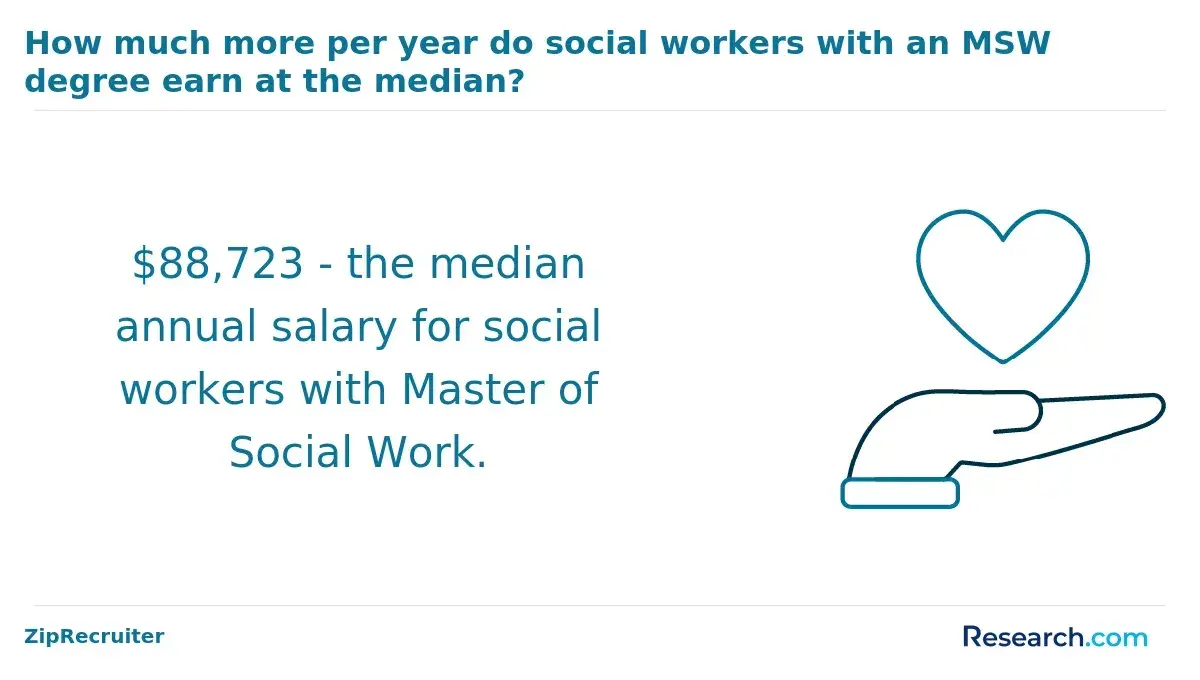
The average annual salary for licensed MSW social workers in the United States generally falls between $60,000 and $75,000. Entry-level professionals with an MSW often start near $55,000, while experienced social workers in clinical or administrative roles can earn over $85,000.
Salary depends heavily on licensure, location, employer type, specialization, and years of experience. Healthcare and school social work may provide higher compensation in some markets because of demand, staffing shortages, and specialized practice requirements. Clinical social workers in hospitals or private practice generally earn more than social workers in some community-based or school settings, although benefits, caseload expectations, and cost of living should also be considered.
The job market outlook is robust, with a projected growth rate of about 13% from 2024 to 2034, according to the U.S. Bureau of Labor Statistics. This growth is tied to demand for healthcare services, mental health support, aging-related services, and social programs serving families and communities.
Licensure plays a key role in career progression. Graduates from online MSW programs boast an 85% first-attempt pass rate on licensing exams, surpassing the national average by 12 points, as reported by the Association of Social Work Boards.
- Entry-level MSW salary: around $55,000 annually.
- Average licensed MSW social worker salary: generally between $60,000 and $75,000 annually.
- Experienced social worker salary: over $85,000 annually.
- Job growth: 13% projected increase over ten years.
- Licensing exam pass rate for online cohorts: 85%.
When comparing programs, students should review job placement data, licensure exam outcomes, employer partnerships, and field placement settings. A lower-cost MSW can offer strong value, but only if it prepares graduates for the roles and licenses that lead to sustainable employment.
How to choose the best advanced standing online MSW program?
The best advanced standing online MSW program is the one that is accredited, affordable, realistic to complete, and aligned with the student’s career and licensure goals. A program with low tuition is not automatically the best choice if it lacks field placement support, does not offer the right concentration, or cannot support licensure in the student’s state.
Start with CSWE accreditation. Accreditation by the Council on Social Work Education remains essential for licensure eligibility and assures that the program meets recognized professional standards. Then compare how each program fits your intended path, such as clinical social work, school social work, healthcare, administration, behavioral health, policy, or community practice.
Programs with hybrid options have demonstrated a 35% higher job placement rate for graduates working in multicultural settings, reflecting growing demand for culturally competent professionals. Students interested in diverse practice settings should look for culturally responsive practice electives, inclusive field placements, and faculty expertise in serving varied populations.
Use the following checklist when choosing a program:
- Confirm CSWE accreditation: This is essential for licensure readiness and professional credibility.
- Check state authorization and licensure fit: Make sure the school can enroll students in your state and that the curriculum supports your state’s licensing expectations.
- Compare total cost, not just tuition: Include fees, field placement costs, books, travel, and the number of required credits.
- Review field placement support: Ask whether the school helps secure placements or expects students to find their own sites.
- Evaluate flexibility: Part-time schedules, asynchronous coursework, and local practicum placements can be critical for working students.
- Look for relevant specializations: Choose electives or certificates that support your target role, such as clinical practice, rural behavioral health, school social work, or culturally responsive practice.
- Ask about outcomes: Review licensure pass rates, graduation rates, job placement statistics, and employer connections when available.
- Assess student support: Strong advising, career counseling, writing support, library access, and field education guidance can improve completion and employment outcomes.
- Match the timeline to your life: Advanced standing programs typically last 12 to 18 months depending on transferred credits and pacing, but the fastest route is not always the best route.
Cost evaluation should include financial aid availability and postgraduate return on investment. Students should compare scholarships, employer tuition reimbursement, federal aid eligibility, and whether the program’s schedule allows them to keep working.
A strong final shortlist should include only programs that meet four tests: CSWE accreditation, manageable total cost, licensure relevance, and dependable field placement support. Once those requirements are met, choose the program whose specialization, schedule, and student services best match your professional goals.
Other Things You Should Know About Social Work
Field placements are typically a mandatory component of all MSW programs, including advanced standing options, to provide practical, supervised experience in real social work settings. Many online programs coordinate local placements for students, ensuring compliance with accreditation standards. The exact number of required practice hours may vary, but students should expect to complete extensive fieldwork even in online formats.
Graduates of advanced standing online MSW programs generally need to obtain social work licensure to practice clinically or independently in most states. Licensing requirements differ state by state but usually include passing the Association of Social Work Boards (ASWB) exam and completing a specific number of supervised practice hours. Holding an MSW degree from an accredited program is a standard prerequisite for licensure eligibility.
Many advanced standing online MSW programs are designed with flexibility to accommodate working professionals. Part-time enrollment options and asynchronous coursework allow students to balance employment with education. However, students should consider the time commitments of field placements and coursework to ensure they can manage both successfully.
References
- All CSWE Accredited Online MSW Programs (2025 Update) https://www.masterofsocialwork.com/online-msw-programs
- Best Advanced-Standing Online MSW Programs https://www.onlinemastersdegrees.org/best-programs/social-work-msw/advanced-standing/
- Social Work Salaries https://www.socialworkers.org/careers/career-center/kickstart-your-job-hunt/social-work-salaries
- Advanced Standing Online MSW Programs https://socialworklicensemap.com/social-work-degrees/online-msw-programs/advanced-standing/
- Program Details: https://www.eastern.edu/academics/graduate-programs/master-social-work-msw-online
- 8 Career Paths You Can Pursue with a Social Work Degree https://www.sacredheart.edu/news-room/news-listing/8-career-paths-you-can-pursue-with-a-social-work-degree/
- What CSWE Accreditation Tells You About an MSW Program https://www.chamberlain.edu/blog/what-is-cswe-accreditation-and-what-are-its-benefits
- What Can I Do With An MSW Degree? https://www.psychology.org/social-work/alternative-jobs-with-a-social-work-degree/
- Advanced Standing MSW Programs: Complete 2026 Guide https://www.socialworkdegrees.org/program/advanced-standing-msw
- Online Master’s in Social Work Programs https://onlinecounselingprograms.com/online-counseling-degrees/cswe-accredited-online-msw-programs/