2027 Best Online MSW Programs With Strong Career Services

Co-Founder and Chief Data Scientist
The right online Master of Social Work program should do more than fit around your schedule. It should prepare you for supervised fieldwork, state licensure, specialization, and a realistic job search after graduation. For career changers, working adults, and BSW graduates pursuing advanced standing, career support can be the difference between earning the credential and turning it into a stable social work role.
This guide explains how online MSW programs work, what accreditation matters, what to expect from admissions and curriculum requirements, how long the degree may take, and how to compare cost against career outcomes. It also highlights the career services that make stronger programs stand out, including field placement help, licensure guidance, employer connections, resume support, and alumni networks.
Key Things You Should Know
- Online MSW programs with strong career services report a 15% higher employment rate within six months post-graduation compared to programs without dedicated career support (2025 data).
- Top programs integrate field placement assistance and employer networking, essential for securing relevant Social Work roles in diverse settings.
- Students benefit from personalized career counseling, resume workshops, and interview preparation, enhancing readiness for licensure and competitive job markets nationally.
What are the best online MSW programs?
The best online MSW programs combine CSWE accreditation, flexible online delivery, high-quality field placement support, licensure preparation, and career services that continue beyond graduation. A strong program should help students choose a specialization, complete required practicum hours, understand state licensing steps, and connect with employers in clinical, school, healthcare, nonprofit, policy, or community practice settings.
University of Michigan-Ann Arbor is one example of an online MSW program with strong reported career outcomes. According to the University of Michigan School of Social Work 2025 Outcomes Report, the program reported a 95% employment rate within six months of graduation, well above the national average. Outcomes like this are especially meaningful when they are supported by specialized career counseling, job placement assistance, alumni connections, and field education partnerships.
What to look for in a top online MSW program
- CSWE accreditation: This is the baseline requirement for most social work licensure pathways and many employers.
- Field placement support: Online students still need supervised in-person experience, so placement coordination matters.
- Licensure guidance: Strong programs help students understand LMSW, LCSW, and state-specific requirements without implying that graduation alone guarantees licensure.
- Career services for social work roles: Look for resume reviews, mock interviews, employer panels, alumni mentoring, and job boards focused on social services.
- Concentrations: Options such as mental health, child welfare, gerontology, healthcare, school social work, and community practice can make the degree more targeted.
- Flexible pacing: Working professionals may need part-time, full-time, or advanced standing formats.
Program quality should not be judged by reputation alone. Compare total cost, field placement expectations, course format, licensure exam support, graduate employment outcomes, and whether the program has relationships with agencies in your region. Students planning long-term academic or leadership careers may also want to compare online social work doctoral programs after completing the MSW.
How do online MSW programs work?
Online MSW programs deliver graduate social work coursework through a mix of asynchronous classes, scheduled live sessions, virtual discussions, case-based assignments, and local field placements. The academic portion can be completed online, but accredited MSW programs require supervised field education because social work is a practice-based profession.
Core courses usually cover human behavior, social welfare policy, social work research, ethics, diversity and inclusion, assessment, intervention, and practice methods. Depending on the program, students may then choose a concentration such as clinical social work, school social work, community practice, healthcare social work, or policy and administration.
Online learning format
- Asynchronous coursework: Students complete readings, recorded lectures, quizzes, and discussion posts on their own schedule.
- Synchronous sessions: Live virtual classes, webinars, supervision meetings, and group activities provide real-time interaction.
- Field placement: Students complete supervised practicum hours with an approved agency, often near where they live.
- Part-time and full-time options: Many programs allow students to complete the degree at a pace that fits work and family obligations.
Completion timelines commonly range from two to four years depending on enrollment pace, prior credits, and whether the student qualifies for advanced standing. Students are sometimes responsible for identifying possible field sites, but stronger online MSW programs provide placement coordinators or faculty support to help verify that sites meet program and accreditation requirements.
Career services can also shape the online experience. For example, Case Western Reserve University reported that 92% of its online MSW alumni secured clinical social work positions with starting salaries averaging $65,000, according to U.S. News & World Report. Students comparing programs should confirm CSWE accreditation, ask how local field placements are arranged, and review state licensing rules before enrolling.
Cost is also part of the decision. Students focused on value may want to compare lists of the cheapest online master's in social work while still checking accreditation, practicum support, and licensure alignment.
What accreditation do online MSW programs need?
Online MSW programs should be accredited by the Council on Social Work Education (CSWE). CSWE accreditation indicates that the program meets national standards for social work education, including curriculum quality, field education, ethics, practice competencies, and professional preparation.
For most students, CSWE accreditation is not optional. State licensing boards typically require a CSWE-accredited MSW for licensure eligibility, especially for credentials such as Licensed Master Social Worker (LMSW) or clinical licensure pathways that may lead to independent practice. A non-accredited MSW can create serious barriers to licensure, employment, reimbursement eligibility, and long-term career mobility.
Why CSWE accreditation matters
- Licensure eligibility: Many state boards require a CSWE-accredited degree before graduates can sit for licensing exams.
- Employer recognition: Agencies, hospitals, schools, and government employers often use accreditation as a screening standard.
- Field education quality: Accredited programs must include supervised practice experiences that align with social work competencies.
- Career portability: Accreditation helps graduates meet requirements if they move to another state, although licensing rules still vary.
Specialized tracks such as clinical social work, macro practice, or community leadership can add value, but they do not replace institutional program accreditation. For instance, Ohio State University-Columbus Ohio State's MSW grads from CSWE-approved pathways see a 15% higher return on investment compared to non-accredited options, with a lifetime earnings boost of $1.2 million versus bachelor's-level social workers, according to the CSWE 2025 Workforce Analysis Brief.
Before applying, verify accreditation directly through the program and through the relevant state licensing board. Students pursuing a masters degree in social work online should make CSWE accreditation one of the first filters in their search because it protects both the educational investment and the path to professional credentials.
What are MSW admission requirements?
MSW admission requirements usually include a bachelor's degree from an accredited institution, official transcripts, letters of recommendation, a personal statement, and a resume or CV. Some programs prefer applicants with social work, psychology, sociology, public health, education, or human services backgrounds, but many also admit career changers who can show strong motivation and relevant experience.
Most schools expect a minimum GPA around 3.0, although some review applicants holistically and may consider professional experience, volunteer work, upward academic trends, or additional writing materials. Applicants generally submit two or three letters of recommendation from professors, supervisors, fieldwork coordinators, or professionals who can speak to their academic readiness, ethics, communication skills, and fit for social work.
Common application materials
- Official transcripts: Schools use these to confirm degree completion, GPA, and prerequisite coursework if required.
- Personal statement: This should explain why the applicant is pursuing social work, what populations or issues they hope to serve, and how the MSW supports their goals.
- Resume or CV: Relevant experience may include case management, nonprofit work, advocacy, crisis support, healthcare, education, community service, or volunteer roles.
- Recommendations: Strong letters should address judgment, empathy, reliability, professionalism, and readiness for graduate study.
- Interview: Some programs use interviews to assess communication skills, motivation, and understanding of the profession.
GRE scores are optional or waived at numerous institutions, but policies vary by school. International applicants may need TOEFL or IELTS scores and credential evaluations to confirm English proficiency and academic equivalency.
Applicants interested in clinical licensure should look closely at field education structure, supervision quality, and licensing exam support. The University of Denver's online MSW program, for instance, achieved a 93% pass rate on the ASWB clinical exam, surpassing the national average by 12% (Source: Association of Social Work Boards 2025 Exam Performance Report). Students weighing the financial and professional payoff of the degree may also want to examine whether do social workers make good money before applying.
How long do online MSW programs take?
Online MSW programs generally take 2 to 3 years to complete. Full-time students often finish in about two years, while part-time students may need 3 or 4 years. The timeline depends on prior education, enrollment status, credit load, field placement scheduling, and whether the student qualifies for advanced standing.
Main timeline options
- Traditional online MSW: Designed for students without a BSW and typically follows the full curriculum.
- Advanced standing online MSW: Designed for students who already hold a Bachelor of Social Work and can build on prior accredited coursework.
- Part-time online MSW: Better for students balancing full-time employment, caregiving, or other commitments.
- Accelerated online MSW: Faster, but often more demanding because coursework and field requirements are compressed.
Credit requirements usually fall between 30 and 60 semester credits depending on prior education and program structure. Concentrations, electives, dual tracks, and field placement availability can also affect the pace. Students with a BSW may be able to complete accelerated online MSW paths in as little as 12 to 18 months, while students without a BSW typically follow the full 2- to 3-year curriculum.
Field education is often the biggest scheduling factor. Internships require 850 to 1,200 hours spread over multiple semesters and must be completed at approved agencies under qualified supervision. Before enrolling, students should ask whether field placements can be completed near their home, whether evening or weekend options are realistic, and how the program supports students if a placement falls through.
Career outcomes can also be connected to specialization and field experience. Howard MSW alumni working in public health roles earned median salaries of $78,500, 18% higher than generalist social workers, reflecting the value of specialized education and targeted field experience. This data is supported by the Bureau of Labor Statistics Occupational Outlook Handbook 2025 Update.
What is the online MSW curriculum?
The online MSW curriculum is designed to develop the knowledge, ethics, assessment skills, intervention methods, and field experience needed for professional social work practice. Students begin with foundation courses and then move into advanced coursework tied to a concentration or practice area.
Common foundation courses
- Human behavior and the social environment
- Social welfare policy
- Social work ethics and professional values
- Research methods and evidence-informed practice
- Diversity, equity, and culturally responsive practice
- Generalist practice with individuals, families, groups, organizations, and communities
Advanced and elective coursework
Advanced courses often focus on clinical assessment, diagnosis, intervention planning, trauma-informed care, substance abuse, child welfare, school social work, healthcare practice, gerontology, community organizing, administration, or policy advocacy. Some programs allow dual concentrations, which can help students keep options open across clinical and macro practice roles.
Online programs typically combine recorded lectures, live virtual sessions, case studies, simulations, group projects, and discussion-based learning. Many curricula now include training in telehealth, digital documentation, crisis response, interdisciplinary collaboration, and ethical decision-making in remote service environments.
Field education remains central. Students usually complete 900 to 1,200 hours of supervised fieldwork, coordinated locally when possible, so they can apply classroom concepts in real agencies. Strong field placements help students build skills in client assessment, intervention planning, advocacy, documentation, referral coordination, and professional communication.
Specialized coursework and career services can affect employment outcomes. Graduates of University of Georgia UGA's #1-ranked online MSW program achieve an 88% placement rate in trauma-informed roles within one year, demonstrating strong alignment with mental health workforce needs (Source: U.S. News & World Report 2025 Online MSW Rankings).
How much do online MSW programs cost?
Online MSW programs generally cost between $15,000 and $45,000 for the full degree, but total price varies by institution type, residency status, credit requirements, program length, and fee structure. Public universities often cost less, especially for in-state students, while private schools can charge upwards of $40,000.
Many programs charge by the credit. Per-credit tuition may range from $500 to $1,200, so a program's total credit requirement matters as much as the advertised tuition rate. Additional expenses, including technology fees, internship supervision costs, books, course materials, and other required fees, may add $1,000 to $3,000 to the overall expense.
Costs to compare before enrolling
- Tuition: Compare the full program cost, not just the per-credit rate.
- Fees: Ask about technology, student services, graduation, placement, and course-specific fees.
- Field placement costs: Transportation, background checks, immunizations, liability insurance, and lost work hours can affect affordability.
- Program length: Part-time study may be more manageable but can extend the time before graduation.
- Financial aid: Review federal aid, scholarships, assistantships, employer tuition assistance, and service-based funding options.
Students should request a complete cost breakdown from each school and ask whether field placement support is included in tuition. A lower-cost program may not be the best value if students receive little placement help or weak career support. Conversely, a higher-cost program may be more defensible if it offers strong licensure preparation, employer relationships, and measurable graduate outcomes.
Career outlook should be part of the affordability discussion. Indiana University's Advanced Generalist MSW graduates earn roughly 20% more in rural areas, with median salaries near $72,000, highlighting strong demand amid workforce shortages (National Association of Social Workers 2025 Compensation Survey).
What careers follow an MSW degree?
An MSW can lead to clinical, school-based, healthcare, nonprofit, government, policy, and administrative roles. The right path depends on specialization, field placement experience, state licensure, and whether the graduate wants direct practice, leadership, advocacy, or program development work.
Common MSW career paths
- Clinical social worker: Provides assessment, counseling, therapy, crisis intervention, and care coordination, often after meeting state licensure and supervised experience requirements.
- Healthcare social worker: Helps patients and families navigate treatment plans, discharge planning, insurance issues, grief, chronic illness, and community resources.
- School social worker: Supports students facing behavioral, emotional, family, attendance, or social challenges in educational settings.
- Child welfare social worker: Works with children, families, courts, and agencies on safety, permanency, prevention, and family support services.
- Substance abuse or mental health social worker: Supports clients dealing with addiction, trauma, psychiatric conditions, or co-occurring challenges.
- Program manager or administrator: Oversees services, staff, budgets, grants, compliance, and outcomes in nonprofits or public agencies.
- Policy or advocacy specialist: Conducts research, builds coalitions, analyzes legislation, and advocates for systems-level change.
Specialization matters because it shapes internships, licensure needs, employer expectations, and long-term earning potential. Students who want private practice or therapy roles should confirm that their program supports clinical preparation and that they understand post-graduation supervised hour requirements in their state.
Job retention data also shows the importance of program quality and career support. Research indicates that online MSW students specializing in clinical tracks at Rutgers University achieve an 85% job retention rate five years post-graduation, surpassing traditional campus peers' 70% retention (CSWE 2025 Online MSW Outcomes Study). Strong field advising, employer connections, and licensure preparation can help graduates enter roles that are a better fit and remain employed longer.
Licensure requirements vary by state and role but generally include supervised clinical hours and exams for clinical practice. Many graduates also pursue advanced certifications in areas such as gerontology, school social work, healthcare, or substance abuse to strengthen qualifications for specialized positions.
What is the MSW salary outlook?
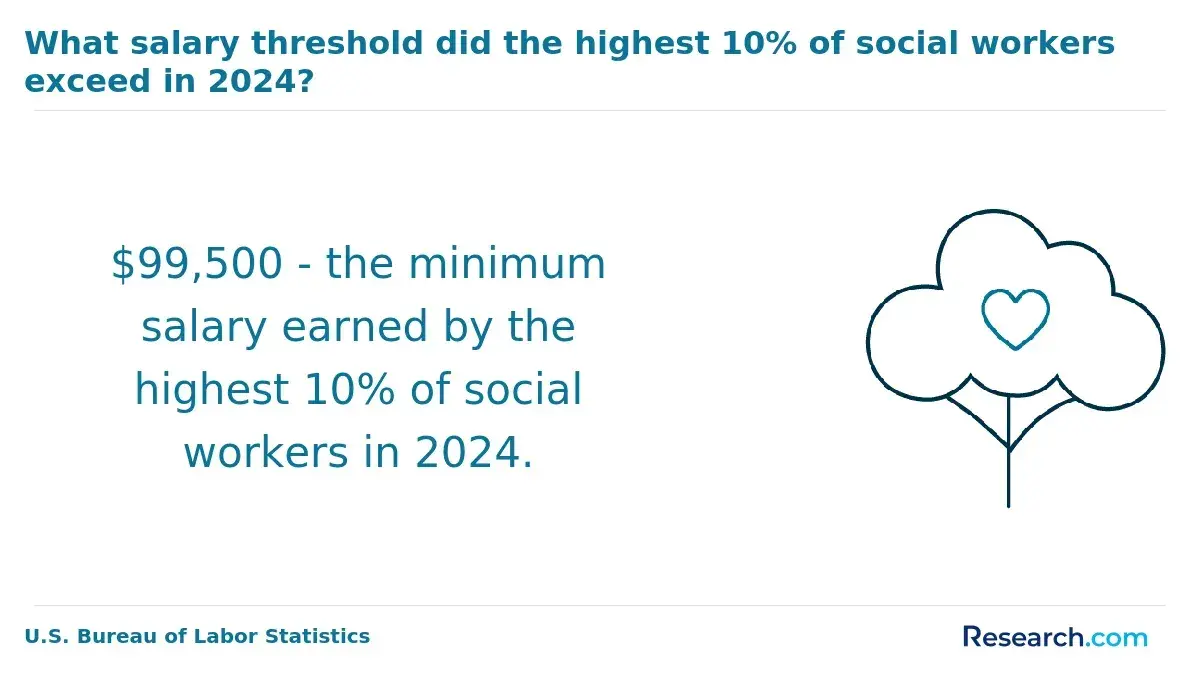
The MSW salary outlook depends on specialization, location, employer type, licensure, and years of experience. Entry-level social workers with an MSW typically earn between $50,000 and $60,000 annually, while clinical social workers and those working in healthcare settings may earn between $65,000 and $85,000. Management and supervisory roles often exceed $90,000, especially in urban areas where demand for social services is higher.
Promotion speed can also affect long-term earnings. University of Memphis MSW graduates demonstrate 25% faster promotion to supervisory roles, reaching this level in about 3.2 years, according to the NASW 2025 Career Progression Report. Earlier movement into supervision can open access to higher pay, leadership duties, and broader career options.
Factors that influence MSW pay
- Specialization: Clinical and healthcare roles often pay more than some community outreach or generalist roles.
- Licensure: Credentials such as LCSW can expand practice authority and may improve earning potential.
- Location: Urban centers and high-demand states may offer higher salaries, though cost of living should be considered.
- Experience: Earnings typically increase after gaining 3 to 5 years of field experience.
- Employer type: Hospitals, government agencies, schools, nonprofits, private practices, and managed care organizations may offer different compensation structures.
- Leadership responsibilities: Supervisory, administrative, and program management roles can raise pay but often require additional experience.
Students should review regional salary data before choosing a concentration because social work labor markets vary widely. A program with strong career services can help students identify higher-fit placements, build employer relationships, prepare for interviews, and plan the licensing steps needed for better-paying roles.
What career services do top MSW programs offer?
Top MSW programs offer career services that are specific to social work, not generic graduate advising. The strongest services begin before field placement and continue through licensure planning, job applications, interviewing, and early career development.
Career services to expect from strong programs
- Individual career advising: Advisers help students connect interests, concentrations, field placements, and licensure goals.
- Resume and cover letter support: Materials should be tailored to clinical, school, healthcare, nonprofit, government, or policy roles.
- Interview preparation: Mock interviews should address case-based questions, ethics scenarios, documentation, client boundaries, and supervision.
- Field placement assistance: Programs should help students find approved agencies that match their goals and meet accreditation standards.
- Employer networking: Partnerships with hospitals, schools, nonprofits, public agencies, and behavioral health organizations can improve access to internships and jobs.
- Licensure guidance: Students should receive clear information on exams, supervised hours, state board requirements, and post-graduation steps.
- Alumni mentorship: Alumni can offer practical insight into agencies, specialties, job search timelines, and early career challenges.
- Social work job boards and career fairs: Targeted hiring events are more useful than general university career fairs.
Some programs also help reduce the financial burden of fieldwork. For example, George Mason University's MSW program offers average stipends of $10,000 during field placements, boosting graduates' net return on investment by 28%, according to the Program 2025 Field Education Impact Report.
When comparing programs, ask specific questions: Who finds the field placement? How many placement options are available in your area? Does the program provide licensure exam preparation? Are career advisers trained in social work employment markets? Does the school track job placement, salary, retention, or licensure exam outcomes?
Career services should help students make informed choices across public, private, and nonprofit sectors. The goal is not just to get a first job, but to build a sustainable career path aligned with licensure plans, specialization, income goals, and the populations the graduate wants to serve.
Other Things You Should Know About Social Work
Top online MSW programs in 2027 with strong career services include the University of Southern California, the University of Denver, and Simmons University. These programs offer comprehensive career support, such as personalized career counseling, networking opportunities, and workshops to enhance employment readiness.
Yes, social workers can choose from various specializations such as clinical social work, child and family social work, school social work, healthcare social work, and geriatric social work. These specializations often require additional certifications or training beyond a general MSW degree, allowing professionals to focus on specific client needs or settings.
Licensure is typically required to practice as a professional social worker in the United States, especially for clinical roles. Requirements vary by state but generally include earning an MSW from an accredited program, completing supervised clinical hours, and passing a licensing exam. Maintaining licensure also involves continuing education.
Field placements in social work programs provide practical experience in settings like hospitals, schools, community organizations, mental health clinics, and child welfare agencies. These placements help students develop hands-on skills and apply classroom knowledge under the supervision of licensed social workers, which is essential for their professional development.
References
- The Pros and Cons of Online MSW Programs – Should I Pursue an MSW Online? https://www.masterofsocialwork.com/resources/pros-and-cons-online-msw-programs
- Social Work MSW (Online) https://www.fdu.edu/program/og-social-work-msw/
- Home https://www.onlinemswprograms.com/
- What Can I Do With An MSW Degree? https://www.psychology.org/social-work/alternative-jobs-with-a-social-work-degree/
- Pros and Cons of Online Master of Social Work Programs https://www.mswhelper.com/blog/applying-to-online-master-of-social-work-programs
- Social Work Salaries https://www.socialworkers.org/careers/career-center/kickstart-your-job-hunt/social-work-salaries
- Admission Requirements and Available Intakes https://www.uwindsor.ca/msw/401/admission-requirements
- Online Master of Social Work Programs in New York https://onlinedegrees.keuka.edu/online-master-social-work-programs-new-york
- Online Master’s in Social Work Programs https://onlinecounselingprograms.com/online-counseling-degrees/cswe-accredited-online-msw-programs/
- 10 Careers for Social Work Majors https://www.umassglobal.edu/blog-news/careers-for-social-work-majors