2027 Best Online MSW Programs With Multiple Start Dates

Co-Founder and Chief Data Scientist
Choosing an online MSW program is not only about finding a school that teaches social work theory online. For many applicants, the real issue is timing: when can you start, how quickly can you move through coursework and field education, and whether the program fits around work, caregiving, relocation, or a career change.
Online Master of Social Work programs with multiple start dates can reduce the wait between deciding to apply and beginning graduate study. Instead of being limited to one fall intake, students may be able to begin in spring, summer, fall, or through rolling and quarterly admissions calendars. That flexibility can matter if you are trying to qualify for licensure, move into clinical practice, change roles in human services, or complete a graduate credential without pausing your income.
This guide explains how to evaluate online MSW programs with flexible start dates, including accreditation, admissions, curriculum, field placement expectations, cost, completion time, career paths, salary outlook, and the practical questions to ask before enrolling.
Key Things You Should Know
- Multiple start dates in online MSW programs increase flexibility, accommodating working professionals and nontraditional students seeking career advancement without delaying enrollment.
- Accredited online MSW programs maintain rigorous standards, ensuring graduates meet licensing requirements in 48 states and achieve competitive job placement rates above 85%.
- Recent data shows the average online MSW tuition ranges widely, but numerous financial aid options and employer tuition assistance significantly reduce out-of-pocket costs.
What are the best online MSW programs with multiple start dates?
The best online MSW programs with multiple start dates combine three things: CSWE accreditation, a field education model that works in your location, and enrollment options that let you begin without waiting an entire academic year. Multiple starts are useful, but they should not outweigh accreditation, licensure alignment, practicum support, or total cost.
Several accredited online MSW programs accepting applications year-round use spring, summer, and fall intakes or rolling admissions calendars. The University of North Carolina at Chapel Hill, for example, allows students to begin in spring, summer, or fall. This can help working adults, military-connected students, caregivers, and career changers plan graduate study around real-life constraints rather than a single annual deadline.
Other programs use quarterly calendars or several cohort launches each year. Accelerated online MSW programs at institutions such as Simmons University and the University of Denver provide multiple start points annually, which can shorten the time between admission and enrollment. For students who already meet prerequisites, that can mean moving into coursework and field planning sooner.
When comparing programs, look beyond the number of start dates. A flexible program should also offer a realistic mix of full-time and part-time enrollment, clear field placement procedures, accessible faculty support, and course delivery that matches your learning style. Asynchronous coursework can help students who work irregular hours, while scheduled live sessions may offer more structure and peer interaction.
Career and earnings goals are also part of the decision. Data from the U.S. Bureau of Labor Statistics, Occupational Employment and Wage Statistics, show that social workers with an MSW earn a median annual salary of $61,330, which is 25% higher than those with a BSW at $49,060. That wage premium does not guarantee an individual salary, but it helps explain why many social work professionals pursue graduate education.
Before applying, confirm that the program is accredited, ask how field placements are arranged in your area, and compare each school’s admissions calendar against your work and financial timeline. Applicants considering future academic or leadership roles may also want to review online social work doctoral programs after understanding how an MSW fits into their longer-term plans.
Why choose online MSW programs with flexible start dates?
Online MSW programs with flexible start dates are designed for students who cannot put their lives on hold for a traditional academic calendar. Instead of waiting months for a fall cohort, applicants may be able to begin when their finances, job schedule, family obligations, or relocation plans make graduate school more manageable.
This flexibility is especially valuable for students who are already working in human services, education, healthcare, behavioral health, nonprofit administration, or case management. A delayed start can postpone eligibility for advanced roles, clinical supervision, or licensure steps. Multiple start dates can reduce that delay and help students maintain momentum after they decide to apply.
Flexible enrollment can also improve planning. Students may choose a start term that avoids a busy season at work, aligns with childcare availability, or gives them time to prepare financially. For some applicants, an extra few months before beginning may be useful; for others, the ability to start sooner is the main advantage.
Programs with several starts often pair that calendar flexibility with part-time options, asynchronous coursework, and the ability to pause or reduce course loads when needed. These features can support persistence because students are not forced into a pace that conflicts with employment or caregiving responsibilities.
Flexible formats can still lead to strong outcomes when the program is well designed. Graduates from Rutgers University's online MSW program had a 92% employment rate within six months of completion, surpassing the 85% rate of traditional on-campus programs (Rutgers School of Social Work Annual Outcomes Report 2025). This example shows that online flexibility does not have to come at the expense of workforce relevance.
Key advantages include:
- Shorter waiting periods between admission and the first term of enrollment.
- Better alignment with work schedules, caregiving demands, military service, or relocation.
- More control over whether to study full time, part time, or through an accelerated path.
- Potentially smoother reentry for students returning to school after time away.
- More opportunity to coordinate field placement timing with local agency availability.
The main caution is that flexibility should not be confused with lower expectations. Accredited MSW programs still require graduate-level coursework, supervised field education, and sustained professional commitment. Students comparing affordable online MSW degrees with multiple start dates can review the cheapest accredited online MSW programs while also checking accreditation, licensure alignment, and placement support.
How do online MSW programs ensure CSWE accreditation?
Online MSW programs ensure CSWE accreditation by meeting the same professional education standards expected of campus-based social work programs. The Council on Social Work Education evaluates whether a program prepares students for competent, ethical, evidence-informed social work practice across populations and settings.
Accreditation covers more than course titles. Programs must demonstrate that students learn core areas such as ethical practice, diversity, human behavior, social welfare policy, research methods, and practice with individuals, families, groups, organizations, and communities. Online delivery can change how students interact with faculty and classmates, but it does not remove the requirement for rigorous graduate preparation.
Field education is a central part of CSWE accreditation. Online MSW students must complete supervised, practice-based learning in approved agencies. Because students may live far from campus, strong online programs maintain systems for identifying, approving, and monitoring local field placements. This is one of the most important questions to ask before enrolling: whether the school finds placements, whether students must secure their own, and what happens if local options are limited.
The CSWE review process examines faculty qualifications, curriculum design, assessment of student competencies, program outcomes, and ongoing improvement. Programs may complete self-study reports, participate in site visits, and respond to feedback. Some online MSW programs use synchronous sessions, hybrid requirements, advising structures, or cohort models to strengthen engagement and faculty access.
Students should verify accreditation directly through the CSWE directory before applying or accepting admission. This is especially important for those pursuing licensure because many state licensing boards require graduation from a CSWE-accredited MSW program. Accreditation also affects employer confidence and the portability of the degree across jurisdictions.
Accredited online programs can also offer meaningful financial value when the fit is right. According to data from the Georgetown University Center on Education and the Workforce 2025 MSW ROI Analysis, the University of Denver Online MSW offers a 245% return on investment over 10 years post-graduation. That kind of outcome depends on cost, debt, specialization, location, and career path, but it underscores why accreditation and program quality matter. Students seeking a shorter route may also compare MSW accelerated programs that maintain CSWE standards.
What are admission requirements for online MSW programs?
Admission requirements for online MSW programs usually include a bachelor’s degree from an accredited institution, official transcripts, a personal statement, letters of recommendation, and evidence that the applicant is prepared for graduate-level social work study. Many programs expect a minimum GPA around 3.0, though requirements and review policies vary by school.
The personal statement is often one of the most important parts of the application. Strong essays explain why the applicant is pursuing social work, what populations or practice areas interest them, how their background has prepared them, and how the program supports their goals. Generic statements about wanting to help people are usually less effective than specific examples of experience, reflection, and readiness for ethical practice.
Most programs ask for two or three letters of recommendation. Good recommenders include professors, supervisors, volunteer coordinators, or human services professionals who can speak to your judgment, communication skills, reliability, academic readiness, and commitment to social work values.
Relevant experience can strengthen an application, even when it is not mandatory. Paid work, internships, AmeriCorps service, volunteer roles, case management, crisis line experience, school-based support, healthcare work, community outreach, or nonprofit service can show that the applicant understands the demands of the field.
Some schools require prerequisite coursework in areas such as psychology, sociology, statistics, or human development. Standardized test scores are becoming optional at many institutions, but certain programs may still request them. Applicants should check each school’s current policy rather than assuming tests are waived.
Background checks are also common because MSW students complete field placements with clients and communities that may include vulnerable populations. A prior criminal history does not automatically disqualify every applicant in every program, but it can affect field placement options and future licensure. Applicants should be honest, review state licensing rules, and ask admissions staff how disclosures are evaluated.
Because the program is online, students also need reliable internet access, comfort with learning management systems, and the ability to participate in video meetings, online discussions, and digital assignments. Prospective students looking for less competitive pathways can compare easy MSW programs, while still confirming accreditation and licensure relevance.
What does an online MSW curriculum typically cover?
An online MSW curriculum typically combines social work theory, policy, research, ethics, assessment, intervention methods, and supervised field education. The goal is to prepare students for professional practice with individuals, families, groups, organizations, and communities.
Most programs begin with foundation courses. These introduce human behavior in the social environment, social welfare policy, research methods, diversity and oppression, social work ethics, and generalist practice. Students learn how social systems, trauma, poverty, discrimination, health, family dynamics, and community conditions affect client well-being.
Advanced coursework is usually tied to a concentration or specialization. Common areas include clinical social work, mental health, substance abuse, child welfare, school social work, healthcare social work, community practice, policy, administration, and work with older adults. Students interested in therapy-focused roles should pay close attention to whether the curriculum supports clinical licensure preparation in their state.
Field education is the bridge between online learning and professional practice. Students complete supervised practicum experiences in agencies, schools, hospitals, clinics, community organizations, or public service settings. Even in an online program, fieldwork is typically completed in person at an approved site.
Many programs also emphasize trauma-informed care, cultural competence, advocacy, crisis response, interdisciplinary collaboration, and evidence-based interventions. Trauma-informed care, in particular, aligns with workforce demands and may lead to higher earnings-specialists in this area reported salaries about 15% above the average $78,500 for clinical MSW graduates (National Association of Social Workers, 2025 Compensation Report).
When reviewing curricula, ask these questions:
- Does the program offer the concentration you need for your intended career path?
- Are courses delivered asynchronously, synchronously, or in a hybrid format?
- How early does field planning begin?
- Does the curriculum align with licensure expectations in the state where you plan to practice?
- Are electives practical enough to support your target population or setting?
The best curriculum is not simply the one with the most electives. It is the one that connects coursework, field experience, faculty expertise, and licensure preparation to the type of social work you want to do.
How long do online MSW programs take with multiple starts?
Online MSW programs with multiple start dates usually take 2 to 3 years for full-time students. Part-time students often take 3 to 5 years, depending on course load, field placement scheduling, advanced standing eligibility, and whether the program offers an accelerated route.
Multiple start dates affect when you can begin, but they do not automatically shorten the degree. The total timeline depends on how many credits you must complete, how often required courses are offered, how field placements are sequenced, and whether you can sustain the required pace while working or managing other responsibilities.
For example, Texas State University offers a CSWE-accredited online MSW program that typically takes about 2.5 years full-time, with fall, spring, and summer start options. Part-time students often spend 4 to 5 years completing coursework and practicum requirements, with some programs permitting breaks or reduced course loads without penalty.
Accelerated options are available but less common, usually compressing the program into 12 to 18 months for students with relevant experience or undergraduate degrees. These pathways can be attractive, but they may be demanding because students must complete intensive coursework and field requirements in a shorter period.
Field placement timing is one of the most common reasons completion plans change. If an agency placement is delayed, if supervision is unavailable, or if a student’s work schedule conflicts with practicum hours, graduation may take longer. Students should ask how the school handles placement disruptions before enrolling.
Tuition also affects pacing decisions. The average total tuition for CSWE-accredited online MSW programs was around $35,000 in 2025, reflecting a 12% decrease from prior years due to increased competition in online social work education (Council on Social Work Education, 2025 Annual Program Survey). Even with lower average tuition, students should consider fees, books, travel to field sites, technology costs, and lost work hours.
- Multiple start dates can reduce the wait to begin the program.
- Full-time study usually moves faster but may be harder to balance with employment.
- Part-time study can make the workload more manageable but extends the timeline.
- Accelerated tracks can shorten completion for qualified students but require careful planning.
- Field placement availability can determine whether the published timeline is realistic.
What are tuition costs for top online MSW programs?
Tuition for top online MSW programs varies widely by institution, residency status, credit requirements, and whether the student qualifies for an advanced standing track. Public universities are often less expensive than private institutions, but the final cost depends on the school’s tuition model and the number of credits required.
Public universities typically charge between $12,000 and $30,000 for in-state online MSW students, while private or out-of-state tuition can exceed $40,000. Ohio State University, for instance, offers online MSW tuition ranging from approximately $18,000 to $25,000 for Ohio residents, positioning it competitively among public options.
Many programs charge tuition by the credit hour. Rates usually range from $600 to over $1,000 per credit, and most degrees require 30 to 60 credits depending on prior coursework and program track. Students with a qualifying BSW may need fewer credits through advanced standing, while students without that background typically complete the full program.
When estimating cost, do not look at tuition alone. Ask about technology fees, field placement fees, graduation fees, books, travel to practicum sites, background checks, liability insurance, and any required campus visits. A program with lower tuition may not be the cheapest option if fees are high or if field placement travel is significant.
Financial aid can reduce out-of-pocket costs. Students should complete the federal financial aid process if eligible and ask each program about scholarships, graduate assistantships, stipends, employer tuition reimbursement, public service incentives, and state or foundation grants tied to social work education.
- Multiple start dates usually improve scheduling flexibility but do not necessarily reduce tuition.
- Public institutions often provide lower tuition, especially for in-state students.
- Private programs may cost more but can offer strong advising, alumni networks, or specialized tracks.
- Advanced standing can reduce total credits and may lower total cost for eligible students.
- Employer reimbursement and scholarships can meaningfully change the net price.
Return on investment depends on debt, salary growth, licensure, specialization, and local labor demand. Ohio State University's 2025 Graduate Outcomes Study highlights that 68% of their online MSW graduates attained a salary increase of at least 30% within one year post-graduation, emphasizing the potential financial return on investment despite the upfront costs.
What careers can you pursue with an online MSW degree?
An online MSW degree can prepare graduates for roles in clinical practice, healthcare, schools, child welfare, behavioral health, community programs, policy, administration, and nonprofit leadership. The right path depends on your specialization, field placements, state licensure rules, and whether you want direct practice, macro-level work, or a mix of both.
Clinical social workers provide assessment, counseling, therapy, treatment planning, and crisis support in settings such as community mental health centers, hospitals, private practices, integrated care clinics, and substance use treatment programs. Many clinical roles require post-graduate supervised experience and state licensure after completing the MSW.
School social workers support students facing behavioral, emotional, academic, family, housing, or attendance challenges. Requirements vary by state and may include school social work certification or additional education-related credentials.
Healthcare social workers help patients and families navigate illness, discharge planning, insurance, rehabilitation, chronic disease, palliative care, and community resources. These roles often require strong interdisciplinary communication because social workers collaborate with physicians, nurses, case managers, and family caregivers.
Child welfare social workers focus on child safety, family preservation, foster care, adoption, and protective services. The work can be demanding, but it is central to public welfare systems and community protection.
Other MSW career paths include:
- Substance abuse and recovery counselor
- Behavioral health case manager
- Policy analyst or legislative advocate
- Program director or nonprofit administrator
- Community outreach coordinator
- Geriatric social worker
- Crisis intervention specialist
- Corrections or reentry social worker
The demand for professionals in behavioral health is growing rapidly. Indiana University data highlights a 22% increase in need for MSW-level mental health social workers by 2025 (Health Resources and Services Administration, 2025 Behavioral Health Workforce Report). Roles in crisis intervention, community outreach, and social work administration are also expanding.
Students should choose field placements and electives strategically. If you want clinical licensure, prioritize programs with strong clinical supervision pathways. If you want leadership or policy work, look for macro practice, administration, research, and advocacy opportunities. An online MSW can be flexible, but career outcomes depend heavily on how intentionally you use the curriculum and practicum experience.
What is the average MSW social worker salary and job outlook?
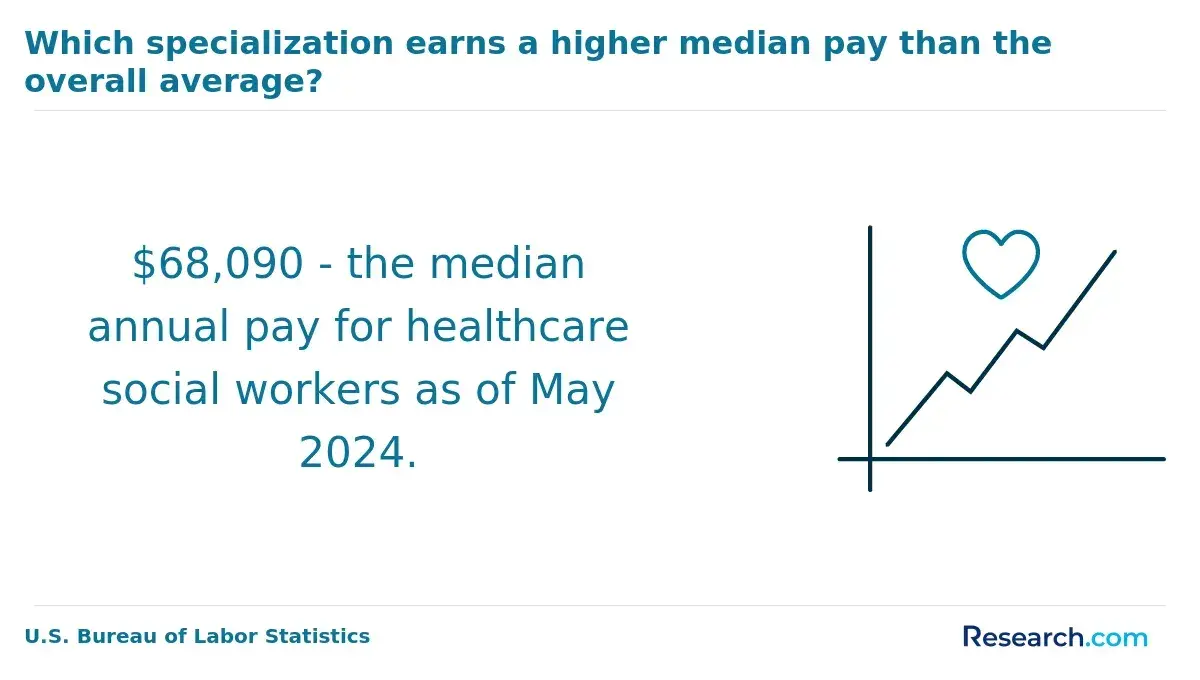
The average MSW social worker salary depends on role, license level, employer, state, and years of experience. According to the U.S. Bureau of Labor Statistics, the median salary is around $60,000, with clinical social workers frequently earning over $70,000. Higher salaries are common in healthcare, government roles, and educational systems, reflecting strong demand in these sectors.
Salary can vary substantially within the field. Social workers in clinical, healthcare, and government settings may earn more than those in some nonprofit or entry-level community roles. Licensure can also affect earning potential, especially for professionals who provide therapy, bill insurance, supervise others, or move into private practice.
Job prospects remain positive as the Bureau of Labor Statistics projects 12% growth for social work occupations from 2024 to 2034, outpacing the average for all jobs. Demand is supported by aging populations, greater attention to mental health, substance use treatment needs, school-based support services, healthcare navigation, and expanded community programs.
Specialization can influence both salary and stability. Clinical social work, child and family services, healthcare social work, behavioral health, geriatric practice, and substance use treatment may offer strong opportunities depending on the region. Local labor markets matter, so students should review openings and salary data in the state where they plan to work.
Investing in an MSW can offer a solid return when tuition, debt, and career goals are aligned. Accelerated online programs, such as those offered by Simmons University, demonstrated a payback period as short as 3.2 years, compared to the 4.5 years typical of traditional programs, according to the Institute for College Access & Success. Flexible formats and multiple start dates may help students begin sooner, complete the degree more efficiently, and enter advanced roles earlier.
Before choosing a program, compare regional salary expectations, licensure requirements, field placement options, and the cost of attendance. The best financial outcome usually comes from selecting a program that supports your target career path without taking on more debt than your likely earnings can justify.
How to choose the right online MSW program for your goals?
Choosing the right online MSW program starts with a clear career goal. A student who wants to become a licensed clinical social worker should evaluate programs differently from someone aiming for nonprofit leadership, school social work, policy advocacy, or healthcare administration.
CSWE accreditation should be the first nonnegotiable factor. Accreditation affects licensure eligibility, employer recognition, transferability of the degree, and the overall credibility of the program. After that, compare the program’s curriculum, concentration options, field education model, faculty expertise, and student support services.
Flexible start dates are valuable, but they should be considered alongside workload and placement requirements. A program that lets you start quickly may still be a poor fit if field placements are difficult to arrange in your area or if required live sessions conflict with your work schedule.
Use these questions to narrow your options:
- Is the program CSWE-accredited?
- Does it support the license or credential required in the state where you plan to practice?
- How many start dates are offered each year?
- Can you study part time, full time, or through an accelerated track?
- Who is responsible for finding field placements?
- Are placements available near your home or workplace?
- Does the curriculum match your intended specialization?
- What is the total cost, including fees and field-related expenses?
- What career services, alumni support, and licensure guidance are available?
- What outcome data does the program publish?
Cost should be weighed against career fit, not considered in isolation. A lower-cost program may be the best choice if it is accredited and provides strong placement support. A higher-cost program may be worth considering only if it offers advantages that matter for your goals, such as a specialized clinical track, strong employer partnerships, or better support in your state.
Outcome data can help, but it should be interpreted carefully. For instance, Black MSW graduates of Howard University's online program saw a 28% median salary increase, highlighting how online MSW programs can support equity in the profession (NASW Center for Diversity & Social Justice, 2025 Equity in Social Work Report). Ask whether outcome data reflects students like you, in your intended practice area and region.
The right program is the one that aligns accreditation, affordability, scheduling, field education, licensure preparation, and career support. Multiple start dates can make an MSW more accessible, but the strongest choice is the program that helps you complete the degree, meet professional requirements, and move into the social work role you actually want.
Other Things You Should Know About Social Work
Yes, many online MSW programs are designed to accommodate working professionals by offering flexible scheduling and multiple start dates. Students can often balance part-time or full-time employment with their studies, though managing workload and clinical field hours requires good time management skills.
Online MSW students are required to complete supervised field placements or internships that provide hands-on experience in settings such as schools, hospitals, community agencies, or social service organizations. These placements typically total several hundred hours, aligning with Council on Social Work Education (CSWE) standards, and are arranged locally to ensure practical, real-world training.
Yes, 2027 online MSW degrees are generally recognized by employers and licensure boards if they are from accredited institutions. Accreditation ensures that programs meet professional standards required for employment and licensing. Prospective students should verify that the program is accredited by organizations such as the Council on Social Work Education (CSWE).
Many online MSW programs include options to specialize in areas such as clinical social work, child and family social work, community practice, or policy analysis. These concentrations allow students to tailor their education to their career goals while acquiring in-depth knowledge and skills relevant to their chosen focus.
References
- The Benefits of Earning Your MSW Degree Online https://www.chamberlain.edu/blog/the-benefits-of-earning-your-msw-degree-online
- FAQ: Are there any two year online MSW programs? https://www.onlinemswprograms.com/faqs/two-year-online-msw-programs/
- 15 Best Online MSW Programs for 2026 - Social Work Education Center https://www.socialworkdegree.net/online-msw-programs/
- CSWE Accreditation Requirements and Standards https://lumivero.com/resources/blog/cswe-accreditation/
- Social Worker (LCSW, MSW) Salary Guide By State https://socialworklicensemap.com/social-work-careers/social-work-salary/
- Social Work (MSW) https://www.wlu.ca/programs/social-work/graduate/social-work-msw/index.html
- CSWE Accreditation for the UNE Online Master of Social Work Program https://online.une.edu/blog/cswe-accreditation-for-the-une-online-master-of-social-work-program/
- Social Worker Salary and Jobs in Social Work https://teach.com/online-ed/social-work-degrees/online-masters-social-work/salary-and-career-outlook/
- 5 High-Paying Jobs You Can Get with an MSW https://onlinedegrees.keuka.edu/blog/highest-paying-msw-jobs
- Pros and Cons of Online Master of Social Work Programs https://www.mswhelper.com/blog/applying-to-online-master-of-social-work-programs