A Guide to Online Proctoring Software: Features, Challenges, and What Institutions Should Evaluate

Co-Founder and Chief Data Scientist
As online learning and remote testing continue to expand at a remarkable pace, educational institutions and credentialing organizations face a growing challenge: how to protect assessment integrity without creating unnecessary friction for learners. The stakes have never been higher. With millions of students now completing coursework and earning credentials entirely online, the trustworthiness of digital assessments has become a cornerstone of institutional credibility.
According to recent market data, over 49% of students globally participated in online learning as of early 2025, driving unprecedented demand for secure, scalable, and learner-friendly proctoring solutions. For context on just how many students are now engaged in digital education, the latest online education statistics from Research.com show that 24.7% of higher education students were enrolled exclusively online in 2024, and graduate enrollment in fully online study reached 45% in 2024-2025, outpacing traditional classroom formats.
Online proctoring software has become a critical part of modern digital assessment strategies, helping institutions verify identity, monitor exams, and maintain trust in online credentials. However, not all proctoring solutions operate the same way. Differences in privacy practices, accessibility, review processes, and AI usage can significantly impact both the learner experience and the defensibility of exam outcomes.
For schools, universities, certification providers, and workforce training programs, choosing the right online proctoring platform requires more than comparing feature lists. It requires understanding how different systems approach security, fairness, usability, and trust.
This guide explores how online proctoring software works, the different types of proctoring technologies available today, the challenges institutions are navigating, and the key factors organizations should evaluate before selecting a platform.

What Is Online Proctoring Software?
Online proctoring software is technology designed to supervise exams remotely. It helps institutions confirm that the correct individual is taking an assessment and that testing conditions meet established integrity standards.
Depending on the platform, online proctoring systems may include features such as:
- Identity verification
- Browser or device monitoring
- Webcam and microphone monitoring
- Room scans
- Screen activity detection
- AI-powered flagging
- Live or recorded session review
- Incident reporting and audit logs
Online proctoring became especially widespread during the rapid shift to remote learning and online certification programs that followed the COVID-19 pandemic. Today, it is used across higher education, K-12 learning, professional certification, workforce compliance training, and licensing programs. Some of the most high-stakes examples in the United States include bar exams, medical licensing assessments, and financial certification programs, all of which now incorporate online proctored components.
The global online proctoring market continues to grow as organizations seek scalable ways to deliver secure assessments while supporting remote learners and distributed workforces. Market research indicates the online proctoring software market was valued at approximately $869 million in 2024 and is projected to reach over 2 billion by 2032, reflecting a compound annual growth rate (CAGR) of 15.5%. This robust expansion underscores the extent to which digital assessment has become a permanent fixture in education and professional credentialing.
Beyond the numbers, what drives this growth is a fundamental shift in how learning and credentialing happen. Online programs have moved from being a niche offering to the primary pathway for millions of learners worldwide. As a result, the infrastructure that protects the integrity of those learning experiences, including proctoring technology, has become mission-critical for institutions and employers alike.
Types of Online Proctoring
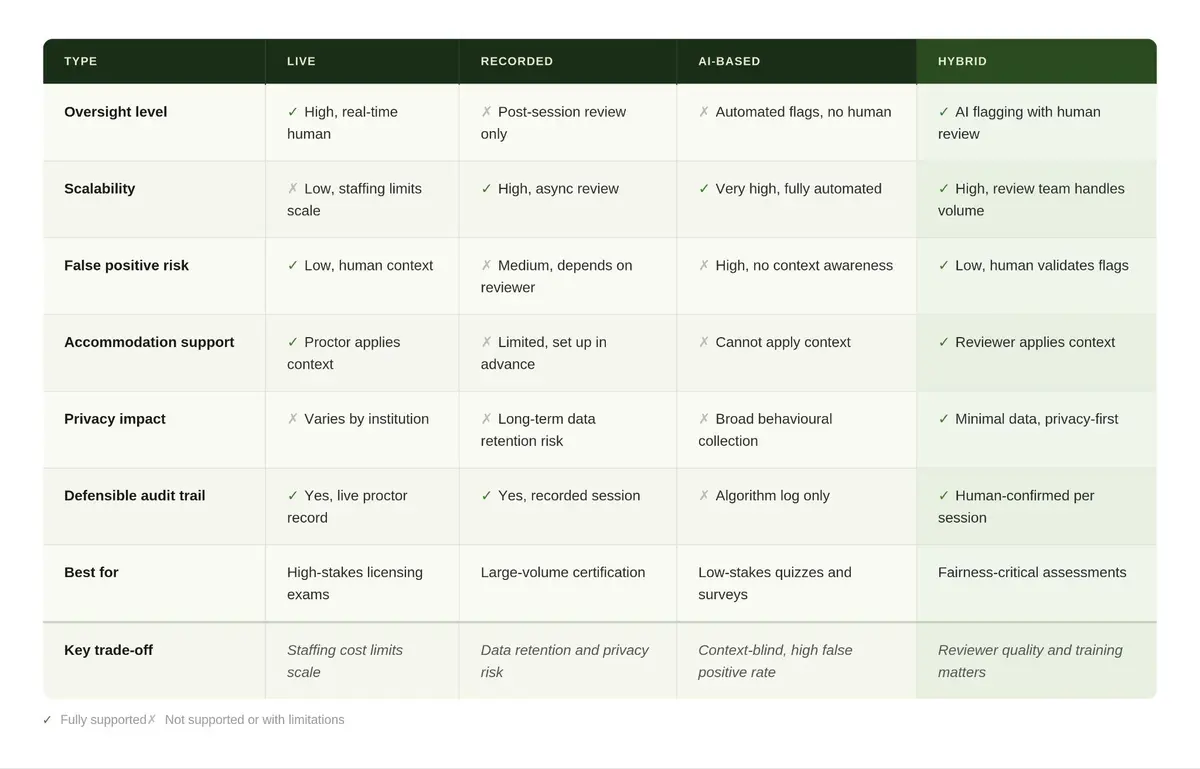
There are several approaches to online proctoring, each offering different levels of oversight and operational complexity. Understanding the differences between these models is essential for institutions making procurement decisions.
Live Online Proctoring
Live online proctoring involves a human proctor monitoring learners in real time during an exam. Proctors may observe one or multiple candidates simultaneously and can intervene if suspicious behavior occurs. This model provides direct human oversight but often requires more staffing and scheduling coordination.
Live proctoring is particularly common in high-stakes testing scenarios, such as professional licensing exams or credentialing programs where the consequences of academic dishonesty are severe. The presence of a live proctor can also be a deterrent in itself, and many test-takers report feeling that live oversight lends greater legitimacy to their exam outcome.
The primary trade-off with live proctoring is scalability. Staffing a team of trained human proctors to cover thousands of simultaneous exam sessions requires significant operational infrastructure, which is why many organizations are moving toward hybrid or AI-assisted models for large-volume assessments.
Recorded Online Proctoring
Recorded proctoring captures exam sessions for later review. Video, audio, screen activity, and system data are stored and evaluated after the assessment is complete. This approach offers flexibility and scalability, particularly for organizations managing large testing volumes.
Recorded proctoring reduces the need for live staffing during the exam itself, and sessions can be flagged algorithmically and reviewed by trained personnel afterward. This model works well for assessments where real-time intervention is not required, and where the primary goal is producing a defensible audit trail that can be reviewed if an outcome is challenged.
One important consideration with recorded proctoring is data retention. Institutions must have clear policies on how long recordings are stored, who has access to them, and how they are deleted once their usefulness has passed, particularly in light of data privacy regulations such as GDPR.
Automated or AI-Based Proctoring
AI-based proctoring systems use algorithms to detect potential anomalies or suspicious behaviors during an exam. These systems may flag behaviors such as:
- Multiple faces appearing on camera
- Frequent eye movement or gaze deviation
- Audio disturbances from voices or background noise
- Device switching or use of unauthorized applications
- Unusual browser activity or tab switching
AI can help identify patterns at scale that would be impossible for human proctors to monitor across thousands of simultaneous sessions. However, institutions are increasingly recognizing the limitations of relying solely on automated flagging systems.
Automated systems do not understand context. A student who lives in a small apartment with family members, or a learner who moves their eyes frequently due to a visual processing difference, may trigger false flags that reflect nothing more than a non-standard environment. These false positives can create real harm, from delayed results to unjust academic penalties, if they are not reviewed by a human with proper context.
Hybrid Proctoring Models
Many organizations are now adopting hybrid approaches that combine AI monitoring with human review. In these systems, AI helps identify potential incidents while trained reviewers validate flagged events before final determinations are made.
Hybrid models are increasingly viewed as the most defensible approach to online proctoring, because they pair the efficiency and scale of automation with the contextual judgment that only a trained human can provide. This is especially important in academic settings, where a false positive finding of academic dishonesty can have long-lasting consequences for a student's record and reputation.
Platforms that have adopted hybrid models, such as Integrity Advocate, are designed specifically to reduce false positive rates and provide more defensible outcomes when assessments are challenged or audited. As institutions face growing scrutiny over AI decision-making in high-stakes contexts, hybrid review models are becoming the industry standard rather than the exception.
The Growing Importance of Assessment Integrity in Online Learning
To fully appreciate why proctoring technology matters, it helps to understand the scale of online learning today. Research.com's comprehensive guide to distance learning notes that over 7.3 million students were enrolled in distance education courses at degree-granting postsecondary institutions as of 2019, a number that has grown substantially since the pandemic accelerated the adoption of online formats.
The value of a degree, a certification, or a professional license depends entirely on others believing that the person who holds it earned it fairly. When academic dishonesty goes undetected in online environments, it undermines not only the institution that issued the credential, but the entire ecosystem of trust that employers, licensing bodies, and the public rely upon.
This is why assessment integrity is not simply a technical problem to be solved with surveillance software. It is a governance challenge that requires institutional policies, thoughtful technology design, trained reviewers, and defensible processes that can withstand scrutiny from regulators, accreditors, and the public.
The rise of generative AI tools has made this challenge even more urgent. Students now have access to sophisticated tools that can produce essays, solve problems, and answer exam questions with minimal effort. Traditional cheating detection methods that look for suspicious eye movements or tab switching are not designed to catch AI-assisted responses. This has prompted many institutions to rethink their entire approach to online assessment, moving beyond surveillance and toward identity assurance, behavioral context, and comprehensive audit trails.
Key Features Institutions Should Evaluate
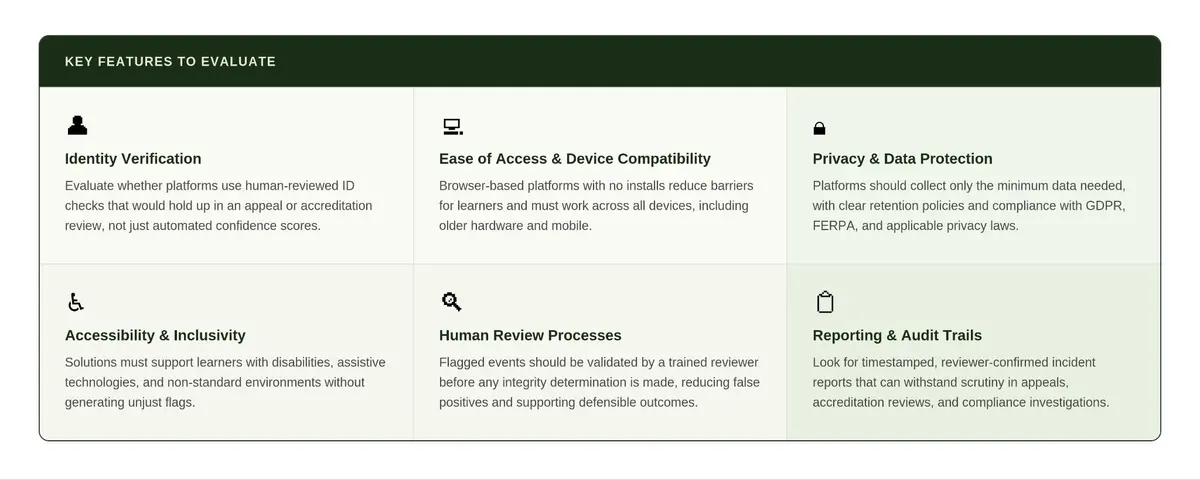
When selecting an online proctoring platform, institutions should look beyond basic monitoring capabilities and evaluate how the system supports the broader goals of trust, accessibility, and defensibility. The following areas deserve careful attention during any procurement process.
Identity Verification
Identity verification is one of the foundational components of online assessment security. Institutions should evaluate how platforms confirm learner identity and whether human oversight is involved in the verification process.
Some platforms rely entirely on automated confidence scores generated by facial recognition algorithms, while others incorporate human review to validate identity checks and session continuity. The question institutions should ask is not just whether the system can verify identity, but whether the verification process itself would hold up in an appeal or an accreditation review.
Biometric identity verification has become more sophisticated in recent years, with platforms now offering multi-factor approaches that combine photo ID matching, facial recognition, and behavioral biometrics. However, it is important to evaluate the accuracy and bias profile of any biometric system before deploying it, particularly in diverse learner populations where some systems have shown higher error rates.
Ease of Access and Device Compatibility
Complex setup requirements can create barriers for learners and increase support burdens for institutions. Modern browser-based platforms that do not require software downloads or browser extensions are often easier to deploy and support across large learner populations.
Institutions should also evaluate compatibility across the full range of devices, operating systems, browsers, and learning management systems (LMS) that their learners use. A proctoring solution that works perfectly on a high-end laptop but fails on a Chromebook or an older Windows machine will create inequitable testing conditions, potentially disadvantaging learners who rely on older or lower-cost hardware.
Given that LMS and eLearning data from Research.com shows approximately 45% of online learners access learning platforms from smartphones, institutions must ensure their proctoring tools are compatible with mobile devices for at least the setup and identity verification phases, even if the exam itself requires a desktop or laptop.
Privacy and Data Protection
Privacy concerns surrounding online proctoring have become increasingly important in recent years. Students and professionals are more aware than ever of how biometric data, recordings, and behavioral monitoring technologies are collected, stored, and potentially shared.
Institutions should seek clear answers to the following questions before adopting any proctoring platform: What specific data does the platform collect during a session? How long is that data retained, and under what conditions is it deleted? Is data shared with third parties, including law enforcement? Does the platform comply with applicable regulations such as GDPR, FERPA, or state-level privacy laws?
Privacy-first assessment models are becoming a growing priority for institutions seeking to maintain learner trust while protecting exam integrity. Platforms that collect the minimum data necessary to verify identity and monitor session integrity, and that offer transparent data governance documentation, are increasingly being preferred over solutions that engage in broad behavioral surveillance.
A useful framework for evaluating privacy practices is to ask whether the data collected is proportionate to the legitimate security need. Platforms that capture and store extensive biometric data, audio, and video for long periods of time beyond what is needed to review and close a session raise proportionality concerns that institutions should not ignore.
Accessibility and Inclusivity
Accessibility is one of the most significant and underappreciated considerations in digital assessment environments. Rigid monitoring systems that fail to account for diverse testing environments or learner needs can unintentionally create inequitable experiences that disproportionately affect already-marginalized students.
Institutions should ensure proctoring solutions support learners with disabilities, including those who use assistive technologies, require additional testing time, or cannot meet standard environmental conditions due to housing or caregiver circumstances. Proctoring software that flags a learner who uses text-to-speech software, or that penalizes a student because their small apartment means their background is not completely clear, is not a neutral tool.
Evaluating accessibility requires going beyond compliance checkboxes. Institutions should conduct usability testing with diverse learner groups before full deployment, and should have clear accommodation workflows that allow learners to request adjustments to standard monitoring conditions. Proctors and reviewers who make decisions about flagged sessions should receive training on recognizing behaviors that may reflect disability or environmental circumstances rather than dishonesty.
Human Review Processes
One of the most significant differentiators between proctoring platforms is how flagged events are handled. Automated systems may identify potential anomalies efficiently, but institutions are increasingly recognizing that context matters when making final determinations about potential integrity violations.
Human review processes can help reduce false positives and provide more defensible outcomes when assessments are challenged or audited. A trained reviewer can assess whether a flagged event, such as eye movement, background noise, or a momentary absence from the frame, is genuinely suspicious given the totality of the session context, or whether it reflects circumstances beyond the test-taker's control.
Platforms that offer transparent reviewer qualifications and clear escalation procedures are better positioned to support institutions in defending assessment outcomes. When a student appeals a finding of academic dishonesty, the institution must be able to demonstrate not only that technology flagged a behavior, but that a qualified human reviewed the flag and made a reasoned determination.
Reporting and Audit Trails
Assessment integrity extends beyond the moment an exam ends. Institutions should evaluate whether a platform provides detailed incident reports, reviewer notes, verified evidence, and audit-ready documentation that can support appeals, accreditation reviews, or compliance investigations.
The quality of an audit trail matters as much as its existence. Reports that include timestamps, reviewer identities, specific incident descriptions, and supporting evidence are far more defensible than summary flags with no contextual documentation. Institutions facing accreditation reviews or legal challenges need proctoring records that can withstand scrutiny from trained investigators.
Some platforms integrate directly with student information systems or learning management systems to ensure that proctoring records are automatically associated with the correct student and assessment, reducing the risk of documentation errors during high-volume testing periods.
Challenges in Online Proctoring
While online proctoring offers significant scalability and flexibility advantages over traditional in-person supervision, institutions continue to face important operational, ethical, and technological challenges. Understanding these challenges is essential to making informed platform decisions and developing institutional policies that support fair outcomes.
Balancing Security and User Experience
Highly restrictive testing environments can create stress and frustration for learners. Organizations must balance effective oversight with usability and fairness. Overly invasive systems may negatively impact learner trust and participation, particularly among students who are already anxious about high-stakes assessments.
Research has documented that some proctoring approaches produce significant student anxiety, with a notable share of test-takers reporting that the monitoring technology itself was a source of distraction during the exam. Institutions should consider how the design of their proctoring environment affects learner performance, and whether highly surveillance-intensive approaches may disadvantage already-stressed populations.
The ideal proctoring environment is one that learners barely notice, because the security infrastructure operates in the background while they focus on demonstrating their knowledge. Browser-based platforms with minimal setup requirements, clear instructions, and responsive technical support tend to produce better learner experiences than download-heavy, extension-dependent systems with complex configuration requirements.
AI Accuracy and False Positives
AI monitoring tools can help identify suspicious patterns efficiently, but algorithms may misinterpret legitimate behavior as suspicious activity. Environmental distractions, internet instability, varying lighting conditions, disabilities, and cultural differences can all affect how automated monitoring systems interpret learner behavior.
According to a survey cited in market research, 48% of students expressed discomfort with webcam-based monitoring during exams, reflecting not only privacy concerns but anxiety about being misidentified as a cheater. False positive rates are a legitimate concern, particularly for learners from non-standard testing environments.
As a result, many institutions are moving toward models where AI supports rather than replaces human judgment. This means using automated systems to triage large volumes of session data and surface potentially problematic events for human review, rather than allowing algorithms to make final determinations about academic integrity violations.
Institutions should ask prospective proctoring vendors directly about their false positive rates, how those rates are measured, and what processes exist to correct wrongful flags before they affect a student's record. Transparency about AI limitations is a mark of a mature, trustworthy platform.
Evolving Academic Integrity Risks
Generative AI tools and advanced cheating methods are changing the assessment landscape at a pace that technology alone cannot keep up with. Students now have access to sophisticated tools that can produce coherent, apparently original responses to exam questions, and sophisticated contract cheating networks can provide assistance that is indistinguishable from a student's own work.
Institutions are increasingly recognizing that assessment integrity cannot rely solely on detecting specific tools or behaviors. Instead, many are adopting broader approaches focused on identity assurance, behavioral context over time, and defensible review processes that create an overall record of a student's learning journey rather than attempting to police any single assessment event.
This shift also requires rethinking assessment design itself. Exams that test application, synthesis, and contextual judgment are harder to outsource or to answer with AI tools than those that test recall of factual information. Institutions that combine strong proctoring infrastructure with thoughtful assessment design are best positioned to maintain the integrity of their credentials over time.
Legal and Regulatory Compliance
Online proctoring intersects with a complex web of data protection, student privacy, disability accommodation, and consumer protection regulations that vary by jurisdiction. Institutions operating in multiple countries or states face the challenge of ensuring their proctoring practices comply with applicable law in every location where their learners sit exams.
GDPR compliance is a particular concern for institutions that serve European learners or that use platforms with data centers in jurisdictions that may not have equivalent data protection frameworks. FERPA protections apply to student records in the United States and have implications for how proctoring data is stored, shared, and retained. The Americans with Disabilities Act and equivalent legislation in other jurisdictions requires that assessment accommodations be available to eligible learners.
Institutions should work with legal counsel and their proctoring vendor to conduct a thorough compliance review before deployment, and should build compliance checkpoints into ongoing platform governance to ensure that evolving regulations are addressed promptly.
What the Future of Online Proctoring Looks Like
The future of online proctoring will increasingly focus on creating more balanced, transparent, and learner-centered assessment experiences. Several trends are shaping the next generation of assessment security, and institutions that understand these trends will be better positioned to make forward-looking platform decisions.
Privacy-First Technologies
The growing awareness of biometric data risks and the expansion of data protection regulations are accelerating demand for privacy-first proctoring approaches. Platforms that collect minimal data, process it locally rather than transmitting it to remote servers, and delete it promptly after review are increasingly preferred by institutions that want to demonstrate responsible data stewardship.
Some emerging approaches use on-device processing to verify identity and detect anomalies without transmitting raw video or audio to external servers, offering a potential path to robust proctoring with a significantly reduced data footprint. As these technologies mature, they are likely to become a baseline expectation rather than a differentiating feature.
Human-Reviewed AI Systems
As institutions become more sophisticated about the limitations of fully automated proctoring, hybrid human-AI models are becoming the expected standard for high-stakes assessments. The combination of AI efficiency with human contextual judgment is increasingly viewed as the only approach that is simultaneously scalable, fair, and defensible.
Future developments in this space are likely to focus on improving the accuracy of AI flagging, reducing false positive rates, and developing more sophisticated tools for training and quality-assuring human reviewers. Platforms that invest in reviewer quality and consistency will be better positioned to produce outcomes that hold up under scrutiny.
Frictionless, Browser-Based Environments
The trend toward browser-based testing environments that require no software downloads or browser extensions reflects both the diversity of learner devices and the growing institutional emphasis on access and equity. Platforms that can deliver robust monitoring through a standard browser without requiring IT support or administrative device privileges are becoming the preferred option for large-scale deployments.
Browser-based platforms also offer advantages for integration with learning management systems and student information systems, since they can be embedded directly in existing digital environments rather than requiring learners to switch between applications.
Improved Accessibility Standards
Accessibility in online proctoring is an area of growing focus as institutions face greater scrutiny over equitable assessment practices. Future platforms will need to demonstrate not only compliance with technical accessibility standards, but genuine usability for learners with diverse needs, including those who use assistive technologies, require environmental modifications, or need extended testing time.
Leading institutions are beginning to require prospective proctoring vendors to provide accessibility audit reports and to participate in usability testing with learners with disabilities before finalizing procurement decisions. This trend is likely to accelerate as disability rights advocacy organizations and regulatory bodies pay closer attention to the equity implications of digital proctoring.
Stronger Integration with Credentialing Systems
As digital credentials and micro-credentials become more prevalent across higher education and workforce training, proctoring platforms will need to integrate more deeply with credentialing and badging systems to provide verifiable links between the assessment event, the identity of the learner, and the credential issued.
Blockchain-based integrity records, which create immutable logs of exam events and outcomes, are beginning to gain traction as a tool for providing verifiable proof of assessment integrity that can travel with a credential and be audited by employers or licensing bodies. While still an emerging technology in this space, blockchain integration is worth monitoring as a potential differentiator for forward-looking platforms.
How to Evaluate and Select an Online Proctoring Platform
For institutions approaching a proctoring platform evaluation for the first time, or revisiting a current vendor relationship, the following framework can help structure the process.
Begin with a clear articulation of your institution's assessment security requirements. What types of assessments need proctoring? What are the stakes? Who are your learners, and what are their technical environments likely to look like? How many concurrent sessions do you need to support at peak? What data privacy obligations apply? The answers to these questions will shape your evaluation criteria.
Develop a structured RFP process that asks prospective vendors to address specific requirements rather than simply presenting feature lists. Request information about false positive rates, reviewer qualifications, data governance practices, accessibility accommodations, LMS integrations, and incident documentation procedures. Ask for case studies or references from institutions with similar learner populations and assessment types.
Conduct a pilot evaluation with a representative sample of your learner population before committing to a platform. Pay attention to the learner experience during setup and testing, the quality and timeliness of incident reports, the responsiveness of vendor support, and the defensibility of flagging and review decisions. Include learners with disabilities and those from non-standard testing environments in your pilot group.
Establish ongoing governance processes for your proctoring program, including regular reviews of false positive rates, accommodation workflows, data retention compliance, and vendor performance against contractual commitments. The proctoring landscape is evolving rapidly, and institutional governance should be designed to adapt as technology and regulations change.
Final Thoughts
Online proctoring software has become an essential component of modern digital assessment infrastructure. As the volume and diversity of online learning continues to grow, the demand for solutions that can deliver secure, fair, and defensible assessments at scale will only increase.
The most effective platforms balance security with usability, privacy with accountability, and scalability with fairness. They combine the efficiency of AI with the contextual judgment of trained human reviewers, and they produce audit trails that can support institutions in defending their assessment outcomes when challenged.
Selecting the right platform requires institutions to think carefully about their learners, their legal obligations, and the long-term integrity of their credentials. Platforms like Integrity Advocate have been designed from the ground up to address these challenges, combining privacy-first architecture with hybrid AI and human review to support institutions in building trustworthy, accessible, and defensible assessment ecosystems. As expectations around digital trust continue to evolve, institutions will increasingly prioritize solutions that produce not only secure assessments, but outcomes that learners, employers, accreditors, and the public can trust.
The investment in getting proctoring right is not just a technology decision. It is a statement about an institution's commitment to the integrity of the credentials it issues, and to the fairness of the learning environment it provides. In a world where online credentials are increasingly the currency of professional opportunity, that commitment matters more than ever.