11 Benefits of a 529 Plan for 2027

Student Finance & Loan Expert
The escalating cost of higher education presents a significant financial challenge for many families. While scholarships and grants can offer valuable assistance, a robust savings strategy remains essential to ensure educational accessibility.
The 529 plan is a powerful financial tool often underutilized in the quest for educational funding. However, to fully leverage its advantages and unlock its long-term benefits, a comprehensive understanding of the plan's features and functionalities is crucial.
In this guide, I will help you examine how 529 plans can transform your education savings approach from a reactive scramble into a proactive, tax-advantaged endeavor designed to achieve your long-term educational goals. By equipping you with a thorough understanding of this valuable tool, you will be ready to make informed decisions and utilize 529 plans as a strategic weapon in the battle against rising education costs.
Key Things You Should Know About the Benefits of a 529 Plan for 2027
- Earnings on contributions within a 529 plan grow tax-free as long as the money is used for qualified education expenses. This allows your savings to compound much faster than in a traditional savings account.
- When you withdraw funds from a 529 plan to pay for qualified education expenses, both the contributions and the earnings come out tax-free.
- Aside from traditional four-year colleges, 529 plans can be used for a wider range of qualified education expenses including K-12 tuition, apprenticeships, and even student loan repayments.
- What are the 11 benefits of a 529 plan for 2027?
- What are the federal tax benefits of contributing to a 529 plan?
- What are the key factors to consider when choosing a 529 plan?
- Are there any tax advantages to making lump-sum contributions to a 529 plan?
- What education expenses can I use 529 plan funds to pay for?
- What are the advantages and disadvantages of using a traditional savings account for education expenses?
- What types of investment options are typically offered by 529 plans?
- How do 529 plans help reduce my taxable estate for estate tax purposes?
- Are 529 Plans Effective for Funding Careers with High Earning Potential?
- How do 529 plans compare to other education funding strategies?
- Can a 529 Plan Support Competency Based Learning and Nontraditional Education Models?
- What Are the Fees and Expenses Associated with a 529 Plan?
- How Can 529 Plans Align with Broader Financial and Education Strategies?
- Does a 529 Plan Impact Financial Aid Eligibility?
- How Do State Policies Influence 529 Plan Benefits?
- How Can I Regularly Evaluate and Optimize My 529 Plan Strategy?
- What are the potential risks of investing in a 529 plan?
- How Can I Leverage a 529 Plan for Online Education?
- How Can I Optimize the Timing of 529 Plan Withdrawals Versus Student Loan Applications?
What are the 11 benefits of a 529 plan for 2027?
There were 16.25 million 529 savings accounts as of June 2023. 529 plans offer a number of advantages that make them attractive for saving for education expenses. These include:
- Tax-free growth: Contributions to a 529 plan grow tax-deferred, and earnings are tax-free when used for qualified education expenses. This means you get the benefit of compounded growth without having to pay taxes on the gains.
- State tax breaks: While contributions to a 529 plan are generally not deductible on federal taxes, many states provide tax breaks or credits for donations to their own 529 programs.
- Highly flexible: 529 plans can now be used for a wider range of qualified expenses than just traditional college tuition. This includes K-12 tuition (up to $10,000 per year), registered apprenticeship programs, and even some student loan repayments.
- Wide range of investment choices: 529 plans typically offer a variety of investment options, allowing you to choose a risk tolerance that aligns with your savings goals and time horizon.
- Open to all contributors: Anyone can contribute to a 529 plan, not just parents. This makes them a great option for grandparents, relatives, or friends who want to help with future education costs.
- Transferable: If the original beneficiary decides not to pursue higher education, you can usually change the beneficiary to another qualified family member without tax penalty.
- Rollover to Roth IRA: Under recent changes, up to $35,000 of unused 529 plan funds can be rolled over into a Roth IRA in the beneficiary's name, subject to certain limitations.
- Higher contribution limits: Unlike Coverdell Education Savings Accounts (ESAs), which have a lower annual contribution limit, 529 plans generally have much higher contribution limits, allowing you to save more aggressively.
- No income limits: There are no income restrictions for contributing to a 529 plan, unlike some scholarship programs that may have eligibility requirements based on family income.
- Greater flexibility in plan selection: You are not limited to your state's 529 plan. You can choose a plan from any state, allowing you to compare investment options and fees to find the best fit for your needs.
- Estate planning benefits: 529 plans can be a valuable estate planning tool, as contributions may be considered gifts for tax purposes, potentially reducing your taxable estate.
What are the federal tax benefits of contributing to a 529 plan?
One significant federal tax benefit of a 529 plan comes on the withdrawal side. When you use the money in the plan to pay for qualified education expenses, the earnings on those contributions grow tax-free. This means you get to keep all the investment gains without paying any federal income tax.
Among 529 plan benefits, the tax treatment of earnings also adds value. Unlike traditional savings accounts where interest earned is taxed as ordinary income, contributions to a 529 plan grow tax-free federally as long as the money is used for qualified education expenses.
This seemingly simple concept unlocks a powerful financial advantage—the compounding of tax-free growth. In fact, 17% of 529 plan investors believe it will cover 75-100% of a college education.
Imagine you contribute $1,000 to a 529 plan and earn a 7% annual return. In a traditional savings account, you'd pay taxes on that $70 of interest earned. In a 529 plan, however, the full $70 remains reinvested in the account, earning interest on itself in subsequent years. This snowball effect, fueled by tax-free compounding, can significantly accelerate the growth of your savings over time.
What are the key factors to consider when choosing a 529 plan?
Given the average college tuition, American families are increasingly taking advantage of 529 savings plans to save for education. According to a survey, 33% of Americans would save more if they understood how 529 plans may be used.
There are several key factors to weigh when selecting the best 529 plan for your needs:
- Expense ratio: This is an annual percentage fee that covers the cost of managing the plan's investments. Lower expense ratios are generally better.
- Sales charges: Some plans, particularly advisor-sold plans, may have sales charges upfront when you invest. Look for plans with no sales charges.
- Investment options: 529 plans typically offer a variety of investment options with different risk profiles. Consider your investment timeline and your risk tolerance when choosing an investment option.
- State tax benefits: While there is no federal tax deduction for contributions, many states offer tax deductions or credits for contributions made to their own 529 plans. If you plan to use the funds in-state for tuition, then your state's plan might be a good option.
- Investment performance: While past performance isn't a guarantee of future results, it can be helpful to compare the historical performance of different 529 plans. Look for plans with a strong track record of growth.
- Ease of use: Consider how easy it is to open an account, make contributions, and manage your investments online.

Are there any tax advantages to making lump-sum contributions to a 529 plan?
While making a lump-sum contribution has no direct tax benefit, there can be some advantages depending on your situation. When asked how they contribute to a 529 plan, 71% of investors said they make single contributions while 39% have automatic contributions.
In deciding how much to contribute to a 529, the main advantage of making a lump-sum contribution is that it starts working for you sooner. The earlier the money is invested, the more time it has to grow tax-free. This can be especially beneficial if you have a long investment time horizon before the funds are needed.
A lump sum allows you to potentially capitalize on a market downturn. By investing a larger amount at once, you can potentially buy more shares at a lower price, which could benefit you in the long run when the market recovers.
If you are contributing a large amount, you can take advantage of the annual gift tax exclusion. In 2024, for example, you can contribute up to $18,000 per beneficiary to a 529 plan without incurring any gift tax. For even larger contributions, you can use the five-year gift tax rule. This allows you to contribute up to five times the annual exclusion amount spread out over five years for a tax-free gift.
What education expenses can I use 529 plan funds to pay for?
When it comes to qualified education expenses, one of the 529 plan benefits is that it offers more flexibility. Among 529 plan investors, 35% cited flexibility as one major benefit of using 529 plans.
Here is a breakdown of what you can typically use them for:
- Traditional College Costs: This includes tuition, fees, room and board (including rent and meal plans if enrolled at least half-time).
- K-12 Tuition: Up to $10,00* per year can be used for qualified expenses at public, private, or religious elementary or secondary schools (K-12).
- Apprenticeship Programs: Registered apprenticeships certified by the Department of Labor qualify for up to $10,000 per year in 529 plan funds.
- Student Loan Repayments: You can use up to $10,000 in lifetime contributions from a 529 plan to pay off qualified student loans for the beneficiary or a sibling.
What are the advantages and disadvantages of using a traditional savings account for education expenses?
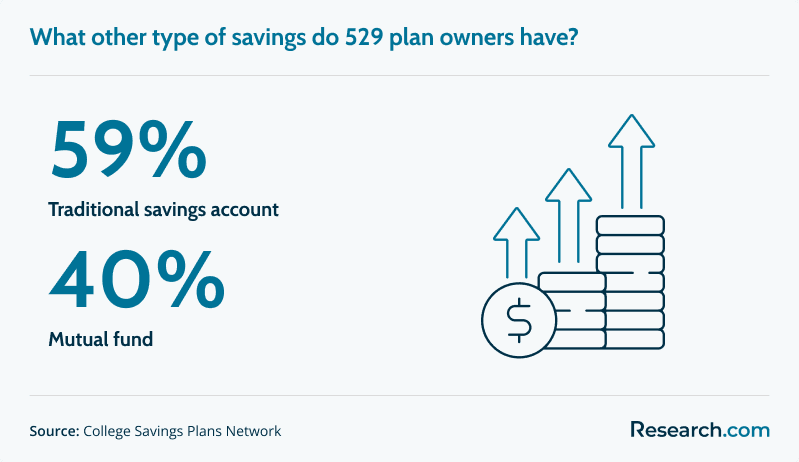
Traditional savings accounts can be a simple option for saving for education expenses, but they come with both advantages and disadvantages compared to dedicated education savings plans like 529s. Among 529 plan investors, 59% of respondents also save via a traditional savings account and 40% invest in a mutual fund.
Traditional Savings Account Advantages
- Easy Access: Your money is readily available for withdrawal at any time, which can be helpful for covering unexpected education costs or changing plans.
- Security: Funds are typically FDIC insured up to $250,000 per depositor, per insured bank, offering protection against bank failure.
- Familiarity: Many people are already comfortable using savings accounts and understand how they work.
Traditional Savings Account Disadvantages
- Low Interest Rates: This means your money may not grow much, especially when keeping pace with inflation, which can erode its purchasing power over time.
- No Tax Benefits: There are no federal tax deductions or benefits for contributions or earnings in a traditional savings account used for education.
- Limited Growth Potential: Compared to investment options in 529 plans, traditional savings accounts offer limited potential for growing your savings significantly over the long term.
What types of investment options are typically offered by 529 plans?
To pay for college, 34% of families used savings and investments in 2023. One of the 529 plan benefits is it offers a variety of investment options to cater to different risk tolerances and time horizons.
Static Asset Allocation Options
These are pre-defined investment portfolios with a fixed mix of asset classes like stocks, bonds, and cash. They come in various risk profiles, ranging from aggressive to conservative. These are a good option for those who prefer a "set it and forget it" approach.
Target-Date (Age-Based) Options
These portfolios automatically adjust their asset allocation over time as the beneficiary nears college. They typically start aggressively with a higher percentage of stocks for growth potential, then gradually become more conservative with a higher percentage of bonds to preserve capital closer to college.
Index Funds
These passively managed funds track a specific market index, like the S&P 500. They offer broad diversification and generally lower fees compared to actively managed funds.
Individual Underlying Investments
Some plans allow you to choose from a selection of individual stocks, bonds, or mutual funds. This offers more control over your investments but also requires more research and knowledge to manage effectively.
Managed Accounts
A small number of plans offer professionally managed accounts for a fee. This can be a good option for those who want a hands-off approach but may come with higher fees compared to other options.
How do 529 plans help reduce my taxable estate for estate tax purposes?
529 plans can be a valuable tool for reducing your taxable estate for tax purposes. When you contribute money to a 529 plan, it is considered a gift to the beneficiary. This means the money is removed from your taxable estate, potentially lowering your overall estate value and reducing your estate tax liability.
Unlike other gifting strategies, contributions to a 529 plan benefit the investor by reducing estate value without completely relinquishing control of the funds. You can still choose the investments, change beneficiaries under certain conditions, and ultimately decide how the money is used.
You can contribute up to the annual gift tax exclusion amount (currently $18,000 per beneficiary in 2024) to a 529 plan each year without incurring any gift tax. This allows you to gradually reduce your estate over time.
For larger contributions, you can take advantage of the five-year gift tax rule. This allows you to contribute up to five times the annual exclusion amount (currently $90,000 in 2024) spread out over five years for a tax-free gift.
Are 529 Plans Effective for Funding Careers with High Earning Potential?
Evaluating the long-term benefits of a 529 plan extends beyond recovering tuition costs; it also requires assessing the potential return on investment based on the chosen field of study. In planning education savings, aligning contributions with career paths that offer strong income prospects can significantly enhance financial outcomes. Financial strategists suggest that integrating future career earnings projections into your savings strategy is crucial for optimizing the benefits of a 529 plan. For instance, targeting academic programs that historically lead to high paying degrees can provide both a robust education and a pathway to greater financial stability over time.
How do 529 plans compare to other education funding strategies?
When assessing the benefits of a 529 plan, it's essential to compare it with other available educational funding strategies to determine which approach aligns best with your financial goals and circumstances.
Traditional Student Loans
While student loans can bridge the financial gap when savings fall short, they come with the burden of accrued interest, which can significantly increase the cost of borrowing. Unlike 529 plans, student loans do not offer tax advantages or the potential for investment growth. However, they do provide immediate access to educational funding when savings are insufficient. For individuals deciding on a funding strategy, it's worth exploring questions such as "Can you use student loans for living expenses?," to fully understand limitations and opportunities associated with student loans.
Coverdell Education Savings Accounts (ESAs)
Coverdell ESAs share similarities with 529 plans in terms of tax advantages; both allow tax-free growth and withdrawals for qualified education expenses. However, Coverdell accounts have lower annual contribution limits and restrict eligibility based on the contributor's income, making 529 plans a more flexible and inclusive option for many families.
Roth IRAs as Education Funding Tools
Roth IRAs are primarily intended for retirement savings but allow penalty-free withdrawals of contributions (not earnings) for qualified educational expenses. While their flexibility is a plus, withdrawals may reduce account growth potential for retirement, which is their primary purpose. In contrast, 529 plans are uniquely designed to target education funding goals and maximize savings through state and federal tax incentives.
Scholarships and Grants
Scholarships and grants offer "free money" for education and don't require repayment, making them ideal supplements to 529 plans or other savings strategies. However, they often depend on academic or financial need criteria, making them less predictable and reliable as standalone funding methods compared to the guaranteed growth and tax benefits offered by a 529 plan.
529 plans stand out for their specialized design, long-term growth potential, and tax advantages, cementing their place as a reliable and efficient strategy for addressing the rising costs of education.
Can a 529 Plan Support Competency Based Learning and Nontraditional Education Models?
Leveraging a 529 plan can extend beyond conventional degree programs to support evolving education models, including competency-based learning. Many institutions now offer rigorous programs where progress is measured by demonstrated skills rather than time spent in class. Exploring options like a competency based degree can provide a strategic path for students seeking flexible and accelerated education. Evaluate these programs based on accreditation, course outcomes, and long-term career alignment to ensure that nontraditional models complement your overall education savings strategy.
What Are the Fees and Expenses Associated with a 529 Plan?
A critical factor in evaluating a 529 plan is understanding its fee structure and associated expenses, which can affect net returns over time. Investors should review management, administrative, and underlying investment fees disclosed in the plan’s documentation. Differing fee levels can lead to considerable performance variation between similar plans, making side-by-side comparisons essential. Transparent fee disclosures help in selecting a plan that minimizes cost erosion of tax-advantaged growth while aligning with broader financial objectives. Evaluating fee efficiency is especially important when planning to support educational pathways, such as those offered by online colleges for working adults, where a lean fee structure can enhance overall savings performance.
How Can 529 Plans Align with Broader Financial and Education Strategies?
Integrating a 529 plan into your overarching financial strategy can amplify its impact, especially when paired with other funding options for education. Unlike traditional student loans, which often have variable interest rates and long repayment terms, a 529 plan front-loads your financial preparedness with tax advantages and investment growth potential. By thinking strategically, you can balance the use of a 529 plan, scholarships, and student loans to minimize debt obligations.
For instance, families aiming for predictability in financing might prioritize 529 plans for education costs while keeping modest borrowing reserved for unforeseen expenses. In such cases, understanding options like fixed rate student loans becomes essential for maintaining financial stability during repayment. Fixed rates provide certainty, safeguarding against market fluctuations when compared to variable rates.
Additionally, the flexibility of 529 plans aligns with tax-smart estate planning strategies, while simultaneously accounting for the reality that not all education paths will adhere to traditional college programs. Adjusting contributions, re-aligning investments within the plan, or even reallocating funds to another family member ensures optimal use of every financial resource, enhancing the potential outcomes of your education funding strategy.
Does a 529 Plan Impact Financial Aid Eligibility?
529 plans are considered in the financial aid formula, and their treatment can vary depending on account ownership. When owned by a parent, the assets are factored into the Expected Family Contribution at a lower rate compared to student-owned assets, usually around 5.64% of the asset’s value. However, misallocating funds or a sudden large withdrawal may alter the aid package calculation in the following year. To maintain predictable financial aid outcomes, it is essential to strategize contributions and distributions carefully. Additionally, evaluating all financing options—including exploring alternatives like student loans without cosigner—can further refine an optimal education funding plan while mitigating any adverse impact on aid eligibility.
How Do State Policies Influence 529 Plan Benefits?
State-specific rules play a critical role in shaping the overall benefits of a 529 plan. Many states offer unique tax deductions or credits, varying contribution limits, and distinct investment options that can alter the net advantage of participating in a plan. For instance, some states provide additional tax incentives only when you invest in an in-state plan, while others permit contributions to any qualified plan without forfeiting state benefits. Analyzing these regional differences is essential to match your savings strategy with the local fiscal environment and to ensure that you are maximizing potential advantages. Investors should assess fee structures, performance histories, and state-specific legislation changes when comparing plans. For a comprehensive approach to related education expenses, consider options available at the cheapest accredited online college.
How Can I Regularly Evaluate and Optimize My 529 Plan Strategy?
Regular performance assessments are essential to ensuring that your 529 plan continues to meet your evolving educational and financial objectives. Start by periodically reviewing asset allocation, fees, and historical returns against relevant market benchmarks. Adjustments in investment strategy may be necessary to respond to market volatility, inflation, or a change in educational goals. Compare your plan’s performance with benchmarks, including trends from the fastest degrees that pay well, to assess whether the growth of your investment aligns with prospective career outcomes. Professional financial advice can also provide tailored insights to optimize rebalancing and fine-tune contributions over time.
What are the potential risks of investing in a 529 plan?
While 529 plans offer compelling tax advantages and long‐term growth potential, they are not without risk. Investment fluctuations can affect account performance, and market downturns may reduce overall savings. In addition, strict rules governing qualified withdrawals can lead to penalties or unexpected tax liabilities when funds are used for non-qualifying expenses. Changes in state policies may also impact plan benefits over time. It is essential to continuously assess these risks in the context of your broader financial strategy and compare alternative funding options, such as student loan companies, to ensure the chosen approach remains aligned with your evolving needs.
How Can I Leverage a 529 Plan for Online Education?
Online education is emerging as a viable option for many students, offering flexibility and potential cost reductions without sacrificing academic quality. Investors and families should consider how a 529 plan can adapt to these evolving educational paths by reviewing the eligibility and accreditation criteria specific to online programs. Aligning your savings strategy with digital education requires understanding the requirements for enrollment and ensuring that funds are used in accordance with qualified educational expenses. Researching these prerequisites is essential to secure access to reputable online programs and maximize the benefits of your education savings. For guidance on the initial steps to transition to an online study model, refer to our article What do I need to start online school?
How Can I Optimize the Timing of 529 Plan Withdrawals Versus Student Loan Applications?
When planning your education funding strategy, synchronizing 529 plan withdrawals with the timing of alternative loan applications is crucial. Coordinated planning ensures that tax-advantaged funds are available when tuition payments are due, minimizing gaps in funding. Evaluating withdrawal processing times and aligning them with academic payment schedules helps prevent cash flow issues. Moreover, understanding application timelines for external financing—such as finding out how long to apply for student loan—can inform your decision as to when to supplement 529 resources with additional loans. This strategic alignment fosters a seamless transition between savings and borrowing, reducing last-minute financial stress while preserving the benefits of both funding sources.
Key Findings
- There were 16.25 million 529 savings accounts as of June 2023.
- 33% of adults would save more if they better understood how 529 savings could be used.
- 71% of investors said they make single contributions to their 529 plans while 39% have automatic contributions.
- Among 529 plan investors, 35% cited flexibility as one major benefit of using 529 plans.
- To pay for college, 34% of families used savings and investments in 2023.
Here’s What People Have to Say About 529 Plan Benefits
Saving for my twin granddaughters' college educations felt overwhelming at first. But then I learned about 529 plans. It's been amazing to see their college funds grow so much faster than a regular savings account, thanks to the tax-free advantage. Now, I'm stress-free knowing they'll have a head start on their futures, and that makes me incredibly happy. Susan
My daughter surprised us all by wanting to go to a vocational school for coding. I was worried our 529 wouldn't cover it, but luckily it did! The flexibility of the plan was a lifesaver. Now, she's launching her dream career debt-free, and we're so proud of her. 529 plans are definitely worth exploring for any kind of education path. John
Starting a 529 plan for my son early was the best financial decision we ever made. Even with small monthly contributions, the tax-free growth has really added up. It's a huge relief knowing a big chunk of his college expenses is already taken care of. Now we can focus on saving for that graduation trip to Europe he's been dreaming about! Lisa
References:
- College Savings Plans Network. (2023). 529 plan data.
- College Savings Plans Network. (2023). Mid-year infographic.
- Edward Jones. (2023). 529 survey.
- Edward Jones. (2023). Lowest level of awareness of 529 plans in a decade according to Edward Jones survey.
- ISS Governance. (2023). ISS Market Intelligence releases annual 529 industry analysis report.
Other Things You Should Know About 529 Plan Benefits
Taxpayers benefit from a 529 plan through tax-free growth and withdrawals for qualified education expenses. Many states also offer tax deductions or credits. Furthermore, the plans allow contributions to grow tax-deferred, maximizing savings over time, and often feature high contribution limits, accommodating substantial education savings. --- Now, here are the four selected questions from the PAA section regarding the 11 Benefits of a 529 Plan for 2027:
In 2027, if 529 plan funds are not used for education, withdrawing them may result in taxes and a 10% penalty on earnings. However, recent legislative changes could allow penalty-free withdrawals for student loan repayment or job training programs, depending on the current policies.
A 529 plan offers various benefits, including tax-free growth, high contribution limits, and estate planning advantages. Other perks are donor control, broad usage options, and flexibility in changing beneficiaries. Additionally, new provisions allow for loan repayments and Roth IRA rollovers, increasing a plan's utility for families.