
2027 Anesthesiology Careers: Skills, Education, Salary & Job Outlook

Co-Founder and Chief Data Scientist
Becoming an anesthesiologist is not a casual career choice. It usually means committing to years of science-heavy preparation, medical school, a four-year residency, licensing, and ongoing clinical accountability. The payoff can be substantial: anesthesiologists hold one of the highest-earning physician roles, with salary figures in this guide including a median near $437,000 annually and a national median salary of $339,470 per year. The trade-off is a long training timeline, high-stakes decision-making, and work that requires constant attention to patient safety.
This guide is for students comparing medical specialties, career changers researching healthcare paths, and future physicians who want a realistic view of anesthesiology careers. You will learn what anesthesiologists do, which skills matter most, what education and certifications are required, how salaries and job outlook look, and which related careers may fit if you want anesthesia-related work without becoming a physician anesthesiologist.
Key Things You Should Know About Anesthesiology Career
- Anesthesiologists in the United States typically earn between $400,000 and $450,000 annually, making it one of the highest-paying medical specialties.
- The demand for anesthesiologists remains strong and stable, driven by an aging population and the rising number of surgical procedures.
- Entering this field requires a medical degree (MD or DO), followed by a four-year anesthesiology residency and board certification.
- Success depends on advanced pharmacology and physiology knowledge, sharp decision-making, clear communication, attention to detail, and composure under pressure.
- Career growth can lead to leadership roles like department chief or medical director, as well as subspecialties such as pain management or critical care, with options for teaching and research.
What do Anesthesiologists do?
Anesthesiologists are physicians who manage anesthesia, pain control, and critical physiologic support before, during, and after medical procedures. Their work makes surgery and many invasive procedures possible by keeping patients unconscious, sedated, numb, comfortable, and medically stable when needed.
The role is broader than “putting patients to sleep.” Anesthesiologists evaluate medical risk, select the right anesthesia approach, monitor vital signs continuously, manage breathing and circulation, respond to emergencies, and guide patients through recovery. They often care for patients with complex conditions, including heart disease, lung disease, pregnancy-related complications, trauma, or chronic pain.
A Day in the Life of Anesthesiologists
A typical day may begin with reviewing the surgical schedule, checking patient histories, confirming allergies and medications, and discussing anesthesia risks with patients. In the operating room, the anesthesiologist works closely with surgeons, nurses, anesthesiologist assistants, nurse anesthetists, and other clinicians to keep the procedure safe.
During surgery, anesthesiologists monitor oxygen levels, blood pressure, heart rhythm, ventilation, temperature, and pain response. They adjust medications in real time and step in quickly if a patient becomes unstable. After the procedure, they help manage pain, nausea, breathing, and recovery in the post-anesthesia care unit.
The work can shift from routine scheduled cases to urgent emergencies in minutes. People who do well in anesthesiology tend to like precision, physiology, teamwork, and high-responsibility work that often happens behind the scenes.
What are the key responsibilities of Anesthesiologists?
Anesthesiologists are responsible for protecting patients through the full perioperative process: before surgery, during the procedure, and after anesthesia wears off. Their decisions affect pain control, airway safety, blood pressure, breathing, medication response, and recovery quality.
Core responsibilities typically include:
- Conducting preoperative assessments by reviewing medical histories, medications, allergies, prior anesthesia reactions, lab results, and procedure-related risks.
- Explaining anesthesia options and risks in clear language so patients understand what to expect before, during, and after the procedure.
- Developing individualized anesthesia plans based on the patient’s health, surgical procedure, age, airway status, pain needs, and risk factors.
- Administering anesthesia, which may involve general anesthesia, regional anesthesia, local anesthesia, sedation, or a combination of approaches.
- Managing the airway, ventilation, intravenous access, fluids, blood pressure, and emergency medications when needed.
- Continuously monitoring vital signs and adjusting anesthetic depth to maintain safety and stability.
- Documenting medications, dosages, events, complications, and patient responses throughout perioperative care.
- Providing post-operative care, including pain management, nausea control, respiratory monitoring, and coordination with other healthcare providers.
The Most Challenging vs. The Most Rewarding Tasks
The hardest part of anesthesiology is that critical events can happen suddenly. Airway obstruction, severe allergic reactions, unexpected bleeding, unstable blood pressure, or cardiac problems require immediate judgment. Anesthesiologists must stay calm, interpret data quickly, communicate clearly, and act before a complication worsens.
The most rewarding part is enabling patients to undergo surgery safely and with controlled pain. Many patients never see the full complexity of the anesthesiologist’s work, but the outcome is concrete: a patient gets through a procedure, wakes up safely, and recovers with appropriate pain control. If you are exploring healthcare credentials more broadly, reviewing medical certifications that pay well can help you compare anesthesia-related and clinical career options.
What are the key skills for Anesthesiologists?
Anesthesiology requires a rare combination of medical knowledge, technical accuracy, situational awareness, and communication. The best anesthesiologists are not only strong clinicians; they are disciplined monitors, fast problem-solvers, and reliable teammates under pressure.
Essential Skills
- Monitoring: Anesthesiologists must track vital signs continuously and recognize subtle changes before they become emergencies.
- Medicine and Dentistry: A strong command of pharmacology, anatomy, physiology, and procedural medicine is necessary to select and manage anesthetic agents safely.
- Critical Thinking: The role requires quick evaluation of incomplete information, especially when a patient’s condition changes unexpectedly.
- Complex Problem Solving: Anesthesiologists often create plans for patients with multiple health conditions, medication interactions, airway challenges, or unusual surgical risks.
- Attention to Detail: Small errors in medication dosing, equipment checks, documentation, or monitoring can have serious consequences.
- Manual and Technical Skill: Airway management, line placement, regional blocks, and equipment use require steady hands and repeated practice.
Key Soft Skills
- Active Listening: Patients may disclose fears, prior complications, or symptoms that materially change the anesthesia plan.
- Communication: Clear, concise communication with surgeons, nurses, and recovery staff is essential during routine care and emergencies.
- Teamwork: Anesthesiologists rarely work in isolation; patient safety depends on coordinated action across the surgical team.
- Judgment and Decision Making: The specialty requires rapid choices about medications, airway strategy, escalation, and when to delay or modify a procedure.
- Emotional Control: Staying composed during complications helps the team respond effectively and reassures patients and colleagues.
The One Overlooked Skill That Separates the Good from the Great
Practice management is often overlooked, but it can distinguish strong anesthesiologists from future leaders. This includes understanding operating room flow, staffing, scheduling, resource use, billing awareness, quality metrics, compliance expectations, and financial planning.
For example, an anesthesiologist who can help reduce operating room delays improves patient flow, lowers wasted time, and supports safer transitions between cases. These skills become especially valuable in leadership roles, group practice management, ambulatory surgery centers, and physician offices.
Advanced study is not always required for practice management, but physicians who want leadership roles may consider additional business, public health, or administrative training. If you are comparing graduate-level options, reviewing what's the easiest PhD to get may help you understand how different advanced degrees vary in structure and intensity.
Anesthesiology Careers: A Step-by-Step Guide to Getting Started
The path to becoming an anesthesiologist is long but structured. The main decision is whether you are prepared for the academic, financial, and personal commitment of becoming a physician. If you want a shorter anesthesia-related pathway, consider roles such as nurse anesthetist, anesthesiologist assistant, or anesthesia technician later in this guide.
To become an anesthesiologist, the typical sequence includes:
- Build a strong academic foundation. Focus on science coursework, especially biology, chemistry, physics, anatomy, physiology, and related pre-medical requirements.
- Complete medical school. Physician anesthesiologists earn a Doctor of Medicine (MD) or Doctor of Osteopathy (DO), building broad medical knowledge before specialty training.
- Gain clinical experience. Medical school rotations help students confirm whether anesthesiology fits their interests in acute care, physiology, procedures, and team-based medicine.
- Match into anesthesiology residency. A supervised four-year residency provides hands-on training in operating rooms, intensive care, pain management, and perioperative medicine.
- Meet licensing requirements. Physicians must satisfy state medical licensure requirements before practicing independently.
- Pursue board certification. Board certification is a major professional credential and is commonly expected by hospitals, groups, and many employers.
- Consider fellowship training. Fellowship can deepen expertise in areas such as pain medicine, critical care, pediatric anesthesiology, cardiac anesthesiology, or other subspecialties.
The biggest mistake is treating anesthesiology as only a high-salary career. Compensation is a major benefit, but long-term fit depends on whether you can handle emergency responsibility, early hours, constant monitoring, and the emotional weight of caring for patients during vulnerable moments.
What education, training, or certifications are required?
Physician anesthesiologists typically complete a bachelor’s degree, medical school, a four-year residency, medical licensure, and board certification. The core medical degree is either a Doctor of Medicine (MD) or a Doctor of Osteopathy (DO). Many students enter medical school with strong preparation in biology, chemistry, physics, and related sciences.
The main professional credential for physician anesthesiologists is American Board of Anesthesiology (ABA) Board Certification, which involves passing three rigorous exams. While board certification is separate from state licensure, it is an important signal of professional competence and is often expected in competitive clinical settings.
Anesthesiologist Assistants follow a different path. They typically earn a master’s degree in anesthesiologist assistance and obtain certification through the National Commission for Certification of Anesthesiologist Assistants. This role is anesthesia-focused but is not the same as becoming a physician anesthesiologist.
Hands-on training is essential. Physician anesthesiologists complete a four-year residency program that includes broad clinical exposure and focused anesthesiology training. Assistants receive clinical training as part of their graduate programs.
Are advanced degrees or niche certifications worth the investment?
Fellowships in areas such as pain management or critical care can add one to two years of training beyond residency. They may be worth it if you want a specialized clinical practice, an academic role, higher-demand niche expertise, or leadership opportunities in a particular care setting. The trade-off is clear: additional training delays full earning potential and extends an already demanding pathway.
Board certification is demanding, but it can strengthen employability, credibility, and long-term career flexibility. Almost 75% of physician anesthesiologists hold board certification, which shows how common and professionally important the credential is in the field.
When deciding whether to pursue fellowship or additional credentials, consider three questions: Do you enjoy the subspecialty enough to practice it for years? Will the credential improve your preferred job options? Does the added training justify the delayed income and lifestyle trade-offs? If you are evaluating graduate education from a return-on-investment perspective, this overview of what master degree makes the most money can provide useful context.
What is the earning potential for Anesthesiologists?
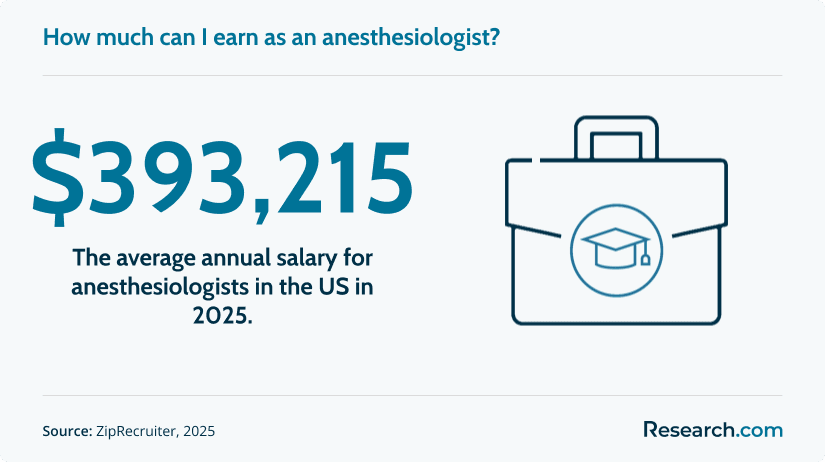
Anesthesiology is among the highest-compensated physician specialties. The national median salary for anesthesiologists is $339,470 per year. Salary figures can vary by data source, employer type, region, call burden, subspecialty, and practice model, which is why readers may also see salary references such as a median near $437,000 annually.
For 2025 salary planning, the entry level anesthesiologist salary 2025 averages around $400,000 per year, while senior-level anesthesiologists can earn closer to $450,000 annually. These figures reflect the high level of training, risk management, and clinical responsibility required in the specialty.
Several factors can raise or lower compensation:
- Location: Higher pay tends to appear in states like Alaska and North Dakota and in costly metropolitan areas.
- Practice setting: Hospitals, surgical centers, physician groups, and private practices may structure pay differently.
- Experience: Senior physicians may earn more as they take on complex cases, leadership duties, call coverage, or partnership roles.
- Subspecialty: Pain management and critical care can create additional income opportunities depending on market demand and practice structure.
- Schedule intensity: On-call work, nights, weekends, and high-acuity coverage can affect total compensation.
High income should be weighed against the cost and time of training. Medical school debt, residency years, delayed full-time earnings, malpractice considerations, and lifestyle demands all affect the real financial picture.
What is the job outlook for Anesthesiologists?
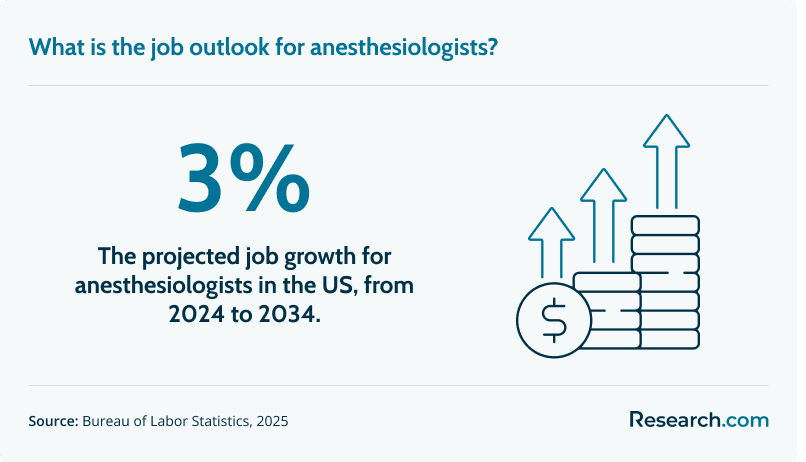
The projected growth rate for anesthesiologists is about 3% between 2023 and 2033. That is slower than the average growth rate of 5-6% for all occupations, but the field remains important because anesthesia is essential to surgery, pain procedures, emergency care, and many hospital-based services.
The Key Factors Shaping the Future Outlook
Several forces support continued need for anesthesiologists. An aging population tends to require more procedures and more complex perioperative care. Advances in surgical techniques and medical technology can increase the number of procedures performed in hospitals and ambulatory settings. At the same time, shortages of anesthesia providers in rural and mid-sized markets can create hiring demand and influence compensation.
The outlook is not the same in every market. Large academic centers, private groups, rural hospitals, and ambulatory surgery centers may have different staffing models and expectations. Future anesthesiologists should watch local demand, call requirements, payer mix, and the balance between physician anesthesiologists, nurse anesthetists, and anesthesiologist assistants.
If cost is a concern early in your education pathway, comparing online colleges accepting FAFSA may help you plan affordable prerequisite or undergraduate study before medical training.
What is the typical work environment for Anesthesiologists?
Anesthesiologists usually work in clinical settings where procedures are performed. Common environments include hospitals, operating rooms, outpatient surgery centers, pre-op areas, post-anesthesia care units, labor and delivery units, intensive care units, and pain clinics. Hospitals are the main employers, with ambulatory surgical centers also serving as a common setting.
The work environment is highly collaborative. Anesthesiologists coordinate with surgeons, nurses, other physicians, nurse anesthetists, anesthesiologist assistants, technicians, and recovery teams. They also communicate directly with patients and families, especially before procedures and during recovery planning.
The typical anesthesiologist work schedule can be demanding. Days may start before 6 a.m., and many roles include evenings, weekends, holidays, and on-call coverage. Emergency cases, labor and delivery coverage, trauma, and long surgeries can make schedules unpredictable. Some jobs offer more structured shift-based schedules, especially in certain outpatient or group practice settings, but remote work is generally not feasible because anesthesia requires direct patient care.
What are the pros and cons of Anesthesiologist careers?
Anesthesiology can be financially rewarding, intellectually engaging, and deeply meaningful. It can also be stressful, physically tiring, and emotionally demanding. The right fit depends on whether you are comfortable with high responsibility, rapid decisions, and a role where excellent work is often invisible when everything goes well.
Pros
- Strong earning potential: Anesthesiology offers high compensation compared with many healthcare and non-healthcare careers.
- Direct impact on patient safety: Anesthesiologists protect breathing, circulation, pain control, and comfort during critical procedures.
- Intellectually challenging work: The specialty combines pharmacology, physiology, emergency response, and procedural medicine.
- Team-based practice: Anesthesiologists work closely with surgical and perioperative teams, often forming strong professional relationships.
- Subspecialty options: Pain medicine, critical care, pediatric anesthesiology, cardiac anesthesiology, and other paths can shape a long-term career.
- Meaningful patient reassurance: Helping anxious patients feel safe before surgery is a real and often underappreciated part of the job.
Cons
- Long training pathway: Medical school, residency, licensing, and possible fellowship require major time and financial commitment.
- High-stakes responsibility: Anesthesiologists monitor and manage life-supporting functions, often under pressure.
- Irregular hours: Early mornings, long procedures, nights, weekends, holidays, and on-call duties can affect work-life balance.
- Emergency stress: Critical incidents require immediate action and can be emotionally difficult.
- Administrative burden: Documentation, compliance, quality reporting, and practice logistics are part of the job.
- Limited remote flexibility: Most anesthesiology work must happen in person because it involves direct procedural care.
For people who like focused, technical, high-responsibility work with limited long-term patient follow-up, anesthesiology can be an excellent fit. It may also appeal to those comparing top high paying introvert professions, although the specialty still requires strong communication and teamwork.
What are the opportunities for advancement for Anesthesiologists?
Anesthesiologists can advance by becoming more specialized, taking leadership roles, moving into academic medicine, managing clinical operations, or expanding into consulting and healthcare administration. Advancement does not always mean leaving patient care; many physicians build careers that combine clinical work with teaching, research, quality improvement, or departmental leadership.
How to get promoted as an anesthesiologist?
- Pursue fellowship training in areas such as Pediatric or Cardiac Anesthesiology to build niche clinical expertise.
- Develop a reputation for reliability, patient safety, strong communication, and effective crisis management.
- Take on departmental responsibilities such as scheduling, quality improvement, protocol development, or committee work.
- Teach residents, medical students, or anesthesia team members to build academic and leadership credibility.
- Contribute to research, presentations, publications, or clinical innovation when pursuing academic advancement.
- Obtain additional qualifications such as an MBA or MPH if your goal is executive leadership or health system administration.
- Participate in interdisciplinary initiatives that improve operating room efficiency, patient safety, perioperative outcomes, or cost management.
Advancement Paths and Specialization Options
- Attending anesthesiologist: Provides direct patient care in hospitals, surgical centers, labor and delivery units, or specialty clinics.
- Subspecialist: Focuses on areas such as Pain Medicine, Critical Care, or Neuroanesthesiology.
- Department leader: Moves into roles such as Chief of Anesthesiology, overseeing staff, clinical standards, scheduling, and quality improvement.
- Academic anesthesiologist: Combines patient care with teaching, research, mentorship, and institutional service.
- Executive physician leader: Progresses into senior roles such as Chief Medical Officer, where responsibilities extend across clinical operations.
- Consultant or industry advisor: Applies anesthesia expertise to medical technology, safety systems, perioperative operations, or healthcare organizations.
The strongest advancement strategy is to align your next credential or leadership step with a clear goal. Fellowship, administrative training, and academic work can all be valuable, but each requires time that should support the career you actually want.
What other careers should you consider?
If you are interested in anesthesia, surgery, pain control, or acute care but are unsure about becoming a physician anesthesiologist, several related careers may fit your goals. These roles differ in education length, autonomy, scope of practice, salary potential, and licensing requirements.
- Nurse Anesthetist: Provides anesthesia care and monitors patients during procedures. This path is suited to nurses who want advanced clinical responsibility in anesthesia.
- Anesthesiologist Assistant: Works as part of the anesthesia care team under anesthesiologist supervision, with training focused on anesthesia delivery and perioperative care.
- Anesthesia Technician: Supports anesthesia teams by preparing, calibrating, troubleshooting, and maintaining anesthesia equipment in operating rooms and procedural areas.
- Surgeon: Performs operations and collaborates closely with anesthesiology teams. This path involves its own long training timeline and high clinical responsibility.
- Physician Assistant: Practices medicine in a broad range of settings and may assist with surgical, perioperative, emergency, or specialty care depending on role and supervision.
When comparing these options, focus on four factors: how many years you are willing to train, how much independent decision-making you want, how comfortable you are with procedural risk, and what type of patient interaction motivates you. Anesthesia-related careers can be highly meaningful, but the best choice depends on your preferred scope of practice and long-term lifestyle.
Here's What Professionals Say About Their Anesthesiology Careers
- : "Every day I step into the OR, I remember why I chose medicine: to make a difference when the stakes are high. When I administer anesthesia, I am trusted with a patient’s safety and comfort during one of their most vulnerable moments. That responsibility is serious, but seeing a patient recover safely reminds me that the work matters. — Red"
- : "I still remember anesthetizing a premature infant in the NICU for the first time. The baby was so small that every decision felt critical, and I questioned whether I was ready. What helped was knowing I had an expert team behind me. The pressure is real, but the teamwork in anesthesiology creates a safety net when decisions have to be made quickly. — Nikki"
- : "What I enjoy most about anesthesiology is the immediate impact. You can see pain ease, vital signs stabilize, and anxiety decrease in real time. Tailoring the anesthetic plan to each patient’s fears and medical needs makes the work personal, even when the interaction is brief. Watching patients wake up safe and comfortable is why I stay in this specialty. — Harold"
Key Findings
- Anesthesiologists are physicians who manage anesthesia, pain control, airway safety, and physiologic stability before, during, and after procedures.
- The standard physician pathway includes medical school, a four-year residency, licensure, and often board certification through the American Board of Anesthesiology.
- The field offers strong compensation, with figures in this guide including a median near $437,000 annually, a national median salary of $339,470 per year, an entry level anesthesiologist salary 2025 around $400,000 per year, and senior-level earnings closer to $450,000 annually.
- The projected growth rate for anesthesiologists is about 3% between 2023 and 2033, compared with 5-6% for all occupations.
- Almost 75% of physician anesthesiologists hold board certification, making it an important credential for credibility and career mobility.
- The strongest candidates are comfortable with high-pressure decisions, technical procedures, continuous monitoring, teamwork, and irregular schedules.
- Related careers such as nurse anesthetist, anesthesiologist assistant, anesthesia technician, surgeon, and physician assistant may appeal to people who want anesthesia-adjacent or perioperative work with different training requirements.
Other Things You Should Know About Anesthesiology
In 2027, anesthesiologists must have strong critical thinking and decision-making skills to evaluate patients' needs quickly. Proficiency in advanced monitoring technologies and effective communication skills to interact with surgical teams and patients are vital. Additionally, adaptability to new medical technology is key in this evolving field.
In 2026, becoming an anesthesiologist typically takes around 12-15 years of education and training. This includes 4 years of undergraduate study, 4 years of medical school, followed by 4 years of residency in anesthesiology, and possibly additional fellowship training.
References
- Professional Growth Guide: How Anesthetists Can Advance Their Careers https://www.expertia.ai/career-tips/professional-growth-guide-how-anesthetists-can-advance-their-careers-52191q
- Soft Skills for Successful Anaesthesia Practice | Journal of Anaesthesia & Critical Care Case Reports https://jaccr.com/soft-skills-for-successful-anaesthesia-practice/
- Suggested Activities for Anesthesia Interest Groups https://www.asahq.org/education-and-career/asa-medical-student-component/aig/activities-for-aig
- Anesthesiology Recruiting Trends | AMN Healthcare https://www.amnhealthcare.com/amn-insights/physician/whitepapers/anesthesiology-supply-demand-recruiting-trends/
- Becoming an Anesthesiologist: Salary Information & Job Description https://learningpath.org/articles/Anesthesiologist_Career_Info.html
- How Much Does an Anesthesiologist Earn in 2025? https://blog.remitly.com/jobs-and-careers/anesthesiologist-salary/
- 5 Things I Wish I Knew Before I Became an Anesthesiologist https://www.thescopeofpractice.com/5-things-i-wish-i-knew-before-i-became-an-anesthesiologist/
- Chapter 1 – The ‘alternative career pathways’ https://anaesthetists.org/Home/Membership/SAS-doctors/The-SAS-handbook-2025/Chapter-1-The-alternative-career-pathways
- What do anaesthetists do? | The Royal College of Anaesthetists https://www.rcoa.ac.uk/training-careers/considering-career-anaesthesia/what-do-anaesthetists-do


