
2027 Early Childhood Education Degree vs. Certificate: Which Should You Choose?

Co-Founder and Chief Data Scientist
Choosing between an early childhood education degree and a certificate is mainly a decision about time, cost, career ceiling, and whether you need a credential for licensure or a specific classroom role. A certificate can help you build practical childcare and classroom-support skills quickly. A degree usually requires a larger investment, but it may qualify you for broader teaching, leadership, and advancement opportunities.
The difference matters because early childhood education employers often screen candidates by credential level. Early childhood education degree programs typically require two to four years of study, while certificate programs may be completed in months. Nearly 90% of employers in this field prefer candidates with a degree for leadership positions, although certificates remain useful for assistant, aide, and entry-level childcare roles.
This guide compares early childhood education degrees and certificates by program length, online availability, admissions, credits, tuition, accreditation, transfer options, jobs, and starting salary so you can choose the path that fits your goals, schedule, and budget.
Key Points About Early Childhood Education Degree vs. Certificate Programs
- An early childhood education degree typically offers deeper theoretical knowledge and broader skill development, supporting higher salary potential compared to certificates, which focus on practical skills for immediate workforce entry.
- Certificate programs usually require less time and financial investment, making them ideal for professionals seeking quick upskilling or career shifts without committing to full degree coursework.
- Degree holders often access more advanced roles and leadership opportunities, while certificate holders may need additional credentials for similar career growth in early childhood education settings.
What Are the Differences Between Early Childhood Education Degree and Certificate Programs?
The main difference is scope. An early childhood education degree provides broader academic preparation in child development, curriculum planning, assessment, family engagement, classroom management, and professional standards. A certificate is narrower and more job-focused, often designed to help students qualify for entry-level childcare work, meet employer training requirements, or add a specific credential to existing experience.
Neither option is automatically “better.” The right choice depends on the role you want, how soon you need to work, whether you plan to pursue licensure, and how much time and money you can invest.
Degree programs usually fit students who want long-term career mobility
- Broader preparation: Degree programs typically include general education courses, child development theory, instructional methods, observation, assessment, and supervised field experiences.
- More advancement options: A degree may be preferred or required for lead teacher, public pre-K, program leadership, or future graduate study.
- Longer commitment: Degree programs take more time and usually cost more, but they can support stronger career progression.
- Better transfer value: Credits from accredited degree programs often transfer more predictably than noncredit certificate training.
Certificate programs usually fit students who need targeted training quickly
- Faster completion: Certificates focus on essential early childhood education skills and can help students enter the workforce sooner.
- Lower overall time burden: Many certificate options are built for working adults, career changers, or current childcare employees.
- Practical focus: Coursework often emphasizes safety, child guidance, developmentally appropriate practice, and classroom support.
- More limited career ceiling: A certificate alone may not qualify you for lead teaching, public school teaching, or leadership roles that require a degree or state certification.
If your goal is quick entry into childcare, a certificate may be enough. If your goal is to become a lead teacher, move into administration, or keep graduate school open as an option, a degree is usually the stronger foundation.
How Long Does It Take to Complete a Early Childhood Education Degree vs. a Certificate Program?
Early childhood education certificates are usually much faster than degrees. Certificate programs typically take between 6 months to 1 year to complete, with many averaging around 8 to 12 months. Degree programs require a longer commitment: associate degrees usually take about 2 years for full-time students, while bachelor's degrees commonly take around 4 years.
The timeline can change significantly if you study part time, transfer credits, pause enrollment, or choose an accelerated format.
- Certificate timeline: A certificate may be the better fit if you want to start working quickly, already work in childcare, or need a credential for an assistant-level role.
- Associate degree timeline: An associate degree usually takes about 2 years full time, but part-time enrollment can extend completion to up to 4 years.
- Bachelor's degree timeline: A bachelor's degree usually takes around 4 years full time, but part-time students may take 6 to 8 years depending on course load and school policy.
- Course sequencing: Some programs require courses in a specific order. Missing a prerequisite or field placement deadline can delay graduation.
- Transfer credit and prior experience: Students with relevant coursework or professional experience may be able to shorten the path, depending on institutional policy.
For students focused on fast workforce entry, 6-month certificate programs can be an efficient option. For students who want more career flexibility, the longer early childhood education degree program duration may be worth the investment.
Can You Complete a Early Childhood Education Degree or Certificate Entirely Online?
You can often complete the academic coursework for an early childhood education degree or certificate online, but that does not always mean the entire credential is fully remote. Early childhood education is a practice-based field, so many programs require observation, fieldwork, practicum hours, student teaching, or an internship in an approved childcare center or school.
Some bachelor's programs, including options advertised by SUNY Empire and Eastern University, offer 100% online coursework. Even so, students should confirm whether field experiences must be completed in person near their location.
What “online” usually means in early childhood education
- Online coursework: Lectures, assignments, discussions, and exams may be completed remotely.
- Local field experience: Supervised practice may need to happen in an accredited school, childcare center, early learning center, or approved placement site.
- Hybrid requirements: Some programs describe themselves as online but still require in-person teaching practice, orientation, assessments, or internship components.
- Licensure limitations: If you want a teaching license, your state may require supervised teaching, approved placements, and specific program approval.
The University of Alabama's online bachelor's degree, for example, requires a semester-long internship. Most states also require supervised teaching for certification. This is why prospective students should not rely only on the word “online” in a program description. Ask the school where fieldwork takes place, who approves the placement, and whether the program meets requirements in your state.
An online certificate may be sufficient for some childcare and assistant roles that do not require a full teaching license. Students who want to become public school teachers should choose a degree program with the right field placement and licensure alignment. For readers comparing other accessible advanced study options, Research.com also covers easy PhD degree listings.
What Are the Admission Requirements for a Early Childhood Education Degree vs. a Certificate Program?
Admission requirements vary by school, credential level, and state rules. In general, degree programs ask for a broader academic application, while certificate programs may focus more on current employment, prior teaching status, or readiness for a specific credential pathway.
Before applying, verify whether the program is designed for new students, current childcare workers, certified teachers, or career changers. A program that sounds like a “certificate” may actually be a post-baccalaureate or licensure-focused credential with stricter entry requirements.
Admission Requirements for Early Childhood Education Degree Programs
- Educational Background: Most master's degree programs in early childhood education require a bachelor's degree from an accredited institution, though the field of study may vary by program.
- Cumulative GPA: A minimum GPA of 3.0 is common, but some programs accept applicants with GPAs between 2.85 and 2.99 under conditional admission.
- Standardized Test Scores: Submission of GRE or PRAXIS Core Exam results in reading, writing, and mathematics is often required.
- Teaching Certification or Subject Background: Some programs require New York State (NYS) teaching certification or proof of coursework in liberal arts and sciences, including mathematics, science, social studies, language, and humanities.
- Professional Materials: Official transcripts, letters of recommendation, a resume, and a personal statement or teaching philosophy are standard application components.
- Language Proficiency: International students must submit official TOEFL, IELTS, or Duolingo scores as proof of English proficiency.
Admission Requirements for Early Childhood Education Certificate Programs
- Teaching Experience or Certification: Applicants usually must already hold NYS teaching certification or be employed in a school district participating in an alternate route program.
- Professional Documentation: Proof of current employment in a relevant school district and completion of required pre-service workshops are necessary.
- Passing Exam Scores: Candidates must show passing scores on PRAXIS exams relevant to early childhood education content knowledge.
How to compare requirements before you apply
- Check the intended student profile: Some certificates are for beginners, while others are for licensed teachers seeking an added endorsement.
- Confirm state relevance: Requirements tied to NYS teaching certification or PRAXIS exams may not apply the same way in every state.
- Ask about conditional admission: If your GPA is below the standard threshold, find out whether conditional admission is available and what you must do to remain enrolled.
- Look beyond admission: A program may be easy to enter but not lead to the role or license you want.
Degree programs generally provide broader preparation and may support more career pathways. Certificate programs can be useful for targeted credentialing, especially for individuals who already work in schools or childcare settings. If you are considering graduate-level advancement, you may also want to review Research.com's guide to lucrative masters degrees.
How Many Credits Do You Need to Complete a Early Childhood Education Degree vs. a Certificate?
Credit requirements are one of the clearest differences between an early childhood education degree and a certificate. Degrees require more credits because they include general education, major coursework, electives, and often supervised field experiences. Certificates require fewer courses and typically focus on core early childhood education competencies.
- Associate degree: Usually requires about 60 college credit hours, including general education courses and specialized early childhood education coursework.
- Bachelor's degree: Typically involves around 120 college credit hours, combining broad academic subjects with advanced child development and education studies.
- Certificate, such as CDA: Often requires 120 clock hours of formal training, which are not the same as college credits, or completion of 12 to 18 college credit hours focused mainly on early childhood education content.
The distinction between clock hours and college credits matters. Clock hours document training time and may satisfy a credential or employer requirement, but they may not transfer into a college degree. College credits are more likely to apply toward an associate or bachelor's program, especially when earned from an accredited institution and matched to degree requirements.
A student pursuing an early childhood education certificate described the certificate path as manageable because it allowed him to balance work and study without taking on the longer credit load of a degree. He said, “The clock hours felt manageable, and I could focus on practical training right away.” He also noted that moving from theory to hands-on application took effort, but the shorter structure helped him stay motivated.
If you think you may pursue a degree later, ask whether the certificate uses college credits, whether those credits appear on an official transcript, and whether they can apply to a future early childhood education degree.
What Is the Average Tuition for a Early Childhood Education Degree vs. a Certificate?
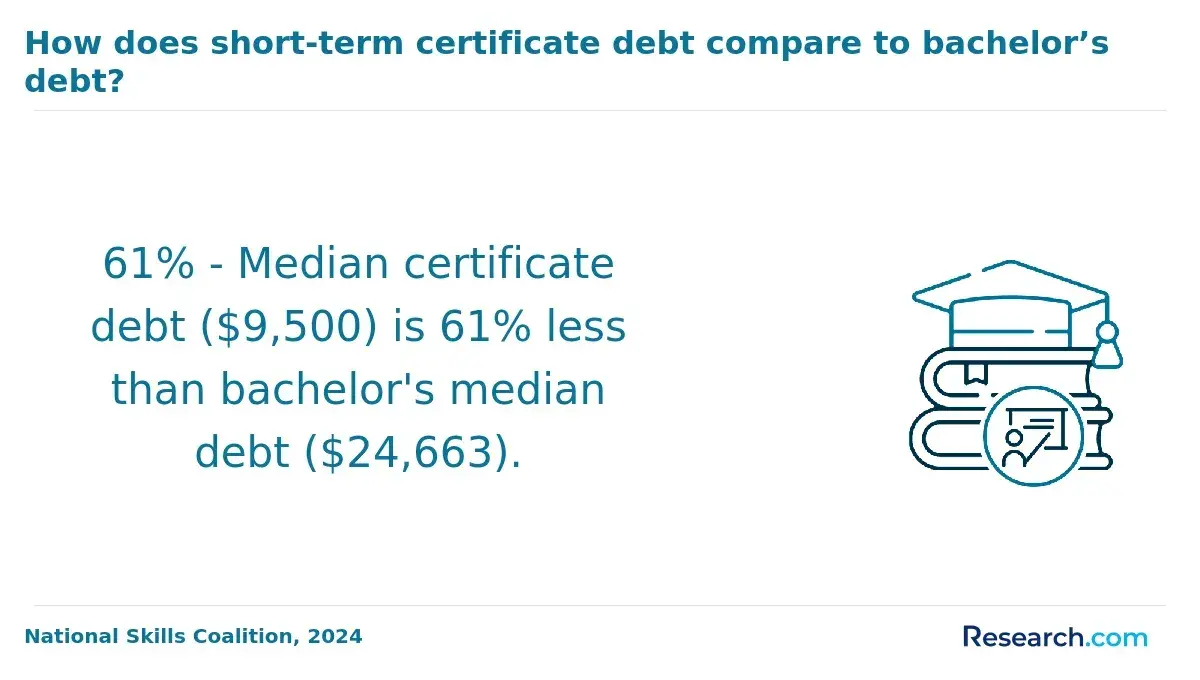
Early childhood education certificates usually cost less overall because they take less time and require fewer courses. Degrees cost more because they involve more credits, broader coursework, and a longer enrollment period. However, the cheaper option is not always the better value if it does not qualify you for the job, license, or advancement path you want.
Average Tuition for Early Childhood Education Degree Programs
- State Resident Tuition: The average undergraduate tuition and fees for early childhood education degree programs at public colleges is about $9,507 per year for state residents.
- Out-of-State/Private Tuition: For out-of-state students or those attending private institutions, annual tuition can average $25,226 or more, with some highly ranked private universities charging up to $60,000 per year.
- Program Length: Degree programs typically require 2 years for an associate degree or 4 years for a bachelor's degree, so total tuition depends heavily on how long you remain enrolled.
- Online vs. On-Campus: Online degree programs may offer lower tuition and fees than traditional on-campus options, but costs vary widely by institution.
- Additional Fees: Degree programs may include books, student teaching expenses, campus fees, technology fees, background checks, testing costs, and other required expenses that add to the total investment.
Average Tuition for Early Childhood Education Certificate Programs
- Certificate Tuition Range: Most early childhood education certificate program cost is between $10,000 and $30,000 total for the full program, which typically completes within one year.
- Shorter Program Duration: Certificates generally last a few months to one year, which can keep total tuition lower than multi-year degree programs.
- Public vs. Private Institutions: Certificate tuition is often lower at public community colleges than at private or for-profit schools, though prices vary.
- Online and Flexible Options: Many certificate programs are offered online or in hybrid formats, which may reduce commuting and campus-related costs.
- Focused Coursework: Certificate tuition usually covers core early childhood education content rather than a full set of general education requirements.
Cost questions to ask before enrolling
- What is the total program cost? Compare the full credential cost, not just per-credit or per-term tuition.
- Are fieldwork costs included? Ask about background checks, placement fees, transportation, testing, and materials.
- Does the program qualify for financial aid? Eligibility can depend on the school, credential type, enrollment status, and accreditation.
- Will the credential meet your employment goal? A lower-cost certificate may be a poor value if your target job requires a degree.
Students seeking flexible options with fewer upfront barriers can also review accredited online colleges with no application fee while comparing early childhood education certificate program cost and degree tuition.
Can You Transfer Certificate Credits Toward a Early Childhood Education Degree Later On?
You may be able to transfer certificate credits toward an early childhood education degree later, but transfer is never automatic. It depends on the school that issued the certificate, the school offering the degree, accreditation status, course content, grades earned, and whether the courses were recorded as college credit.
Credits from regionally accredited institutions with formal transfer agreements are more likely to be accepted. Courses that match foundational early childhood education requirements or general education requirements are also more likely to transfer than highly specialized, noncredit, or employer-specific training.
- Accreditation matters: Credits from accredited colleges usually carry more transfer value than training from non-accredited providers.
- Course match matters: A receiving school compares course descriptions, learning outcomes, and credit levels before approving transfer.
- Grades matter: Institutions generally require a minimum grade, often a C or higher, for transferred credits.
- Caps matter: Many bachelor's programs cap transfer credits to around 60.
- Timing matters: Asking about transfer after finishing a certificate can lead to lost time if the credits do not apply.
The safest approach is to contact the degree program before enrolling in a certificate. Ask for written guidance about which certificate courses may transfer, whether the certificate is credit-bearing, and how those credits apply to the degree plan.
One student who completed a certificate said she initially felt uncertain about whether her credits would count toward a bachelor's program. After speaking with an academic advisor, she learned that many core courses did transfer, helping her continue without repeating unnecessary coursework. Her experience shows why early advising can protect both time and tuition dollars.
Are Certificate Programs Accredited the Same Way as Early Childhood Education Degrees?
Certificate programs and degree programs are not always accredited in the same way. Degree programs, such as associate and bachelor's degrees, are commonly offered by institutions accredited by regional agencies such as the Southern Association of Colleges and Schools Commission on Colleges or the Higher Learning Commission. This type of institutional accreditation can affect financial aid eligibility, credit transfer, and employer recognition.
Certificate programs may also be offered by regionally accredited colleges, but some are recognized through professional or credentialing organizations instead. For example, the Council for Professional Recognition focuses on practical competency for credentials such as the CDA. These credentials may be valuable for childcare employment, but they do not always function like college degrees or transfer as academic credit.
Why accreditation should affect your decision
- Quality assurance: Accreditation helps confirm that a program meets standards for curriculum, faculty, student support, and outcomes.
- Financial aid: Access to federal financial aid often depends on institutional accreditation and program eligibility.
- Credit transfer: Accredited college credits are generally easier to evaluate for transfer than noncredit training hours.
- Employer acceptance: Employers may require credentials from accredited or recognized programs to satisfy licensing, compliance, or quality standards.
- Renewal requirements: Some certificates require periodic renewal and continuing education, while most degrees do not expire.
Before enrolling, verify the institution's accreditation through an agency recognized by the U.S. Department of Education or CHEA. Also ask whether the credential is credit-bearing, whether it supports state licensure or certification goals, and whether renewal requirements apply.
What Jobs Can You Get with a Early Childhood Education Degree vs. a Certificate?
An early childhood education degree generally opens access to roles with more instructional responsibility, while a certificate is more commonly used for support, aide, and childcare positions. Actual eligibility depends on employer requirements, state rules, licensure status, experience, and the age group you want to serve.
Jobs You Can Get with an Early Childhood Education Degree
- Preschool lead teacher: Plans classroom instruction, leads daily learning activities, supports social and emotional development, and may supervise assistant teachers.
- Assistant teacher: Supports the lead teacher with instruction, classroom routines, learning materials, and child supervision.
- Educational assistant: Provides instructional and classroom support, often helping individual children or small groups.
- Pre-kindergarten teacher: Teaches developmental and school-readiness skills to children typically aged 4-5 in public or private settings.
- Early elementary school teacher: Teaches foundational subjects, often from pre-kindergarten through fifth grade depending on local regulations and licensure.
- Head Start program teacher: Provides education and development services in federally funded early childhood programs for low-income families.
Jobs You Can Get with an Early Childhood Education Certificate
- Teacher's aide: Assists classroom teachers with materials, supervision, routines, and daily learning activities.
- Paraprofessional: Provides instructional or behavioral support under the direction of a certified teacher, including in early childhood or special education settings.
- Childcare worker: Cares for young children in daycare centers or private homes, with a focus on safety, routines, play, and basic developmental support.
- Assistant teacher: Helps lead teachers manage classroom tasks and supports children's learning, behavior, and social development.
- Support staff or floater in childcare centers: Moves between classrooms or duties as needed, helping with child supervision, transitions, and basic administrative tasks.
How to choose based on your target job
- Choose a certificate if you want a faster path into childcare, aide, or assistant roles and do not need a teaching license.
- Choose a degree if you want stronger eligibility for lead teaching, public pre-K, early elementary roles, or long-term advancement.
- Check state rules if your goal involves public schools, licensed teaching, Head Start, or regulated childcare center leadership.
What Is the Average Starting Salary for a Certificate vs. Early Childhood Education Degree Graduates?
Starting salary is usually higher for early childhood education degree graduates than for certificate holders, but pay varies by job title, state, employer type, experience, and licensure. Certificates can help you enter the field quickly, while degrees tend to provide stronger salary growth and advancement potential over time.
- Typical Salary Range for Certificate Holders: Graduates with an early childhood education certificate usually start with salaries between $25,000 and $30,000 per year. Hourly wages tend to range from $12 to $14, most commonly in roles such as child care worker or teaching assistant.
- Typical Salary Range for Degree Holders: Early childhood education degree holders often begin at $30,000 to $43,000 annually, with bachelor's degree holders and those in leadership or special education roles starting near or above $43,000.
- Influencing Factors: Geographic location, experience, additional certifications, employer type, and level of responsibility all affect starting salaries. Salaries are often higher in urban and coastal areas and lower in rural regions, with public institutions generally offering better pay than private childcare centers.
- Career Growth and Outlook: Degree holders usually have more opportunities to move into director, lead teacher, specialized education, or administrative roles. Certificate holders may face slower salary growth unless they add experience, credits, or a degree later.
- Industry Demand: Both pathways can lead to steady work in childcare and early education. Students comparing credential-based career routes may also find Research.com's guide to the best trade school jobs useful.
When comparing salary, look beyond the first job. A certificate may help you earn sooner, but a degree may offer better access to roles with higher responsibility and stronger long-term earnings.
Here's What Graduates of Early Childhood Education Programs Say About Their Degree or Certificate
-
: "Pursuing the early childhood education certificate was a game-changer for me because it provided a focused, accelerated learning experience. The program's shorter duration and lower cost made it accessible, and I was able to quickly apply what I learned to my work with children. For those deciding between a certificate and a degree, I'd say the certificate is perfect if you want practical skills fast without the longer time commitment.
Nathaniel"
-
: "Choosing the early childhood education degree gave me a comprehensive understanding and a broader range of career opportunities. The pace was more deliberate and allowed for deeper exploration, which I valued despite the higher tuition. Reflecting on it, the degree's investment paid off as it opened doors to leadership roles that a certificate alone wouldn't have. It's an important factor to weigh, especially balancing cost and long-term career goals.
Russell"
-
: "Completing both the early childhood education certificate and degree programs offered me the best of both worlds: swift foundational learning and extensive in-depth study. Managing the costs was challenging, but I appreciated how starting with the certificate helped ease me into the field before committing to the full degree. My advice is to consider your timeline and finances carefully; combining both gave me confidence and flexibility for advancement in my career.
Jose"
Other Things You Should Know About Early Childhood Education Degrees
In 2027, a degree in early childhood education may lead to roles like preschool director or educational consultant, offering greater career advancement than a certificate. Certificates generally prepare individuals for entry-level teaching positions, limiting progression compared to the broader opportunities a degree provides.
Financial aid options tend to be more abundant and varied for degree programs compared to certificate programs. Federal student aid, such as Pell Grants and federal loans, is usually more accessible to students enrolled in accredited degree programs, while some certificate programs may only qualify for limited institutional aid or employer reimbursement. Students should verify aid eligibility with specific institutions.
In 2027, many employers tend to value degrees higher than certificates for early childhood education roles due to the comprehensive training a degree offers. However, specific job requirements may vary, with some positions being open to candidates with certificates if they have relevant experience or skills.
In 2027, early childhood education certificates often serve as a foundation for a full degree. They can provide credits that transfer toward a degree program, allowing students to continue their education without starting from scratch, thus expediting career advancement.
References
- Early Childhood Education vs Education Support: Which Career Suits You? | AGA https://aga.com.au/early-childhood-education-vs-education-support-which-career-suits-you/
- Advantages of Obtaining an Early Childhood Education Certificate https://www.dean.edu/news-events/dean-college-blog/story/advantages-obtaining-early-childhood-education-certificate/
- How to Pick Degrees in Early Childhood Education | All Education Schools https://www.alleducationschools.com/teaching-degrees/early-childhood-education/
- What Degree Is Best for Early Childhood Education? https://www.cdicollege.ca/news/what-degree-is-best-for-early-childhood-education/
- How to Choose an Early Childhood Education Program https://www.early-childhood-education-degrees.com/how-to-choose-an-early-childhood-education-program/
- PART-TIME | INTERLAKE CAMPUS EARCP-DP Early Childhood Education https://catalogue.rrc.ca/Programs/GC/Parttime/EARCP-DP/TransferCreditOpportunities
- ECE Degrees & Certificates | Shasta College https://www.shastacollege.edu/academics/programs/early-childhood-education/degrees-certificates/
- How to Apply https://educ-earlychildhood-2019.sites.olt.ubc.ca/programs/certificates-diplomas/apply/
- Early Childhood Education Transfer Pathway Associates Degree Online https://www.southeastmn.edu/major/Early-Childhood-Education-Transfer-Pathway/
- Early Childhood Education https://www.monroeccc.edu/programs/early-childhood-education


