
2027 Environmental Health Practitioner Careers: Skills, Education, Salary & Job Outlook

Co-Founder and Chief Data Scientist
Becoming an environmental health practitioner is a practical career choice for people who want to use science, regulation, and fieldwork to protect communities from preventable health risks. The role sits at the intersection of environmental science, public health, biology, chemistry, epidemiology, inspection work, and compliance. That mix can make the path feel complicated, especially if you are trying to choose the right degree, understand certification requirements, or decide whether the career is worth the training investment.
This guide explains what environmental health practitioners do, the skills and credentials employers commonly expect, where the career can lead, and what trade-offs to consider before committing. It also covers salary expectations, job outlook, work settings, advancement paths, and related careers so you can compare this profession with similar options in health, safety, and environmental protection. The reported median annual salary in this guide is $130,295, with a salary range from about $108,000 for entry-level positions up to $180,000 for senior-level experts, making planning especially important if income potential is part of your decision.
Key Things You Should Know About Environmental Health Practitioner Career
- Environmental health practitioners typically earn around $130,295 annually, with most salaries ranging from $108,000 to $150,000; top professionals can make up to $180,000.
- The field is very active and growing, offering very good job prospects and strong demand over the next decade.
- A bachelor's degree in environmental health, public health, or a related science is generally required, while some advanced roles prefer or require a master's degree.
- Success relies on strong analytical thinking, attention to detail, clear communication, problem-solving, and a solid understanding of regulations and public health principles.
- Career growth can lead to senior specialist, supervisory, or management roles such as environmental health manager or director, with higher pay and responsibility after 5 to 10 years of experience.
What do Environmental Health Practitioners do?
Environmental health practitioners identify, assess, and help control environmental conditions that can harm human health. Their work may involve food safety, water quality, housing conditions, waste management, pollution, occupational hazards, disease prevention, and emergency response. In simple terms, they connect scientific evidence with practical action: inspecting environments, documenting risks, explaining requirements, and helping organizations correct unsafe conditions.
This career is important because many public health risks begin outside clinical settings. Contaminated food, unsafe drinking water, poor sanitation, hazardous workplaces, and pollution can affect large groups of people before anyone visits a doctor. Environmental health practitioners help prevent those problems or reduce their impact when they occur.
A Day in the Life of Environmental Health Practitioners
A typical day can shift between field inspections, office work, public communication, and urgent investigations. One day may involve visiting a restaurant, reviewing sanitation records, collecting samples, and explaining corrective actions to a manager. Another may involve investigating a complaint, coordinating with a laboratory, writing an enforcement report, or supporting a public health response.
The job is rarely limited to one setting. Practitioners may spend time in government offices, businesses, public facilities, residential properties, industrial sites, laboratories, or community meetings. The role rewards people who are comfortable applying regulations in real situations, communicating with people who may disagree, and documenting findings with enough precision to support public health decisions.
What are the key responsibilities of Environmental Health Practitioners?
Environmental health practitioners are responsible for finding health risks, determining whether laws or standards are being met, and helping reduce harm. Their responsibilities vary by employer and specialty, but most roles combine inspection, investigation, education, and enforcement.
- Inspect businesses, public spaces, facilities, and properties to evaluate compliance with health, safety, and environmental regulations.
- Investigate complaints, disease outbreaks, pollution incidents, unsafe housing conditions, or suspected environmental hazards.
- Collect samples, review records, interview affected parties, and document evidence that supports public health action.
- Monitor environmental hazards such as pollution, noise, radiation, sanitation issues, water contamination, or food safety risks.
- Advise businesses, agencies, and the public on how to meet regulations and reduce health risks.
- Issue warnings, notices, citations, or other enforcement actions when voluntary compliance is not enough.
- Prepare reports that may be used by supervisors, regulatory agencies, legal teams, or public health officials.
The Most Challenging vs. The Most Rewarding Tasks
One of the hardest parts of the job is enforcement. Practitioners may need to tell a business owner, property manager, or organization that they must correct violations, stop an activity, or face penalties. These conversations can become tense, especially when money, operations, or reputation are at stake. Strong documentation, calm communication, and sound judgment are essential because enforcement decisions may be challenged.
The most rewarding part is seeing prevention work. A corrected food safety problem, cleaner facility, improved safety process, or contained outbreak can protect people before they are harmed. For practitioners who value visible public impact, this is one of the clearest benefits of the career.
If you are already working and need a flexible path to build qualifications, researching fast adult degree programs online can help you compare options that may fit around employment and family responsibilities.
What are the key skills for Environmental Health Practitioners?
Environmental health practitioners need both technical competence and people skills. The technical side helps them recognize hazards and apply regulations correctly. The interpersonal side helps them gather information, explain requirements, de-escalate conflict, and persuade people to take corrective action.
Key Hard Skills
- Regulatory knowledge: Understand health, safety, sanitation, and environmental rules well enough to assess compliance and recommend corrective action.
- Inspection methods: Evaluate facilities, processes, records, and physical conditions in a consistent and defensible way.
- Sampling and data analysis: Interpret environmental samples, inspection findings, and trends to identify risk patterns.
- Investigative ability: Trace possible sources of illness, contamination, exposure, or unsafe conditions through interviews, records, and evidence.
- Report writing: Produce clear, accurate documentation that can support enforcement, public communication, or legal review.
Important Soft Skills
- Critical thinking: Weigh evidence, identify what matters most, and make decisions when information is incomplete.
- Communication: Explain technical requirements in plain language to business owners, residents, public officials, and community members.
- Attention to detail: Notice small violations, documentation gaps, or risk indicators that could affect public health outcomes.
- Interpersonal judgment: Build cooperation without ignoring violations or weakening professional standards.
- Professional composure: Stay calm during complaints, inspections, emergencies, or difficult enforcement conversations.
The One Overlooked Skill That Separates the Good from the Great
Project management is often underestimated. Environmental health work can involve multiple agencies, laboratories, business contacts, legal requirements, timelines, and public communication needs. Practitioners who can organize tasks, track deadlines, coordinate stakeholders, and keep records consistent are better prepared for outbreak investigations, large inspections, and program leadership.
For example, during an outbreak investigation, project management helps the practitioner coordinate interviews, lab results, site visits, communications, corrective actions, and follow-up inspections. Without that structure, important details can be missed and public health action may be delayed.
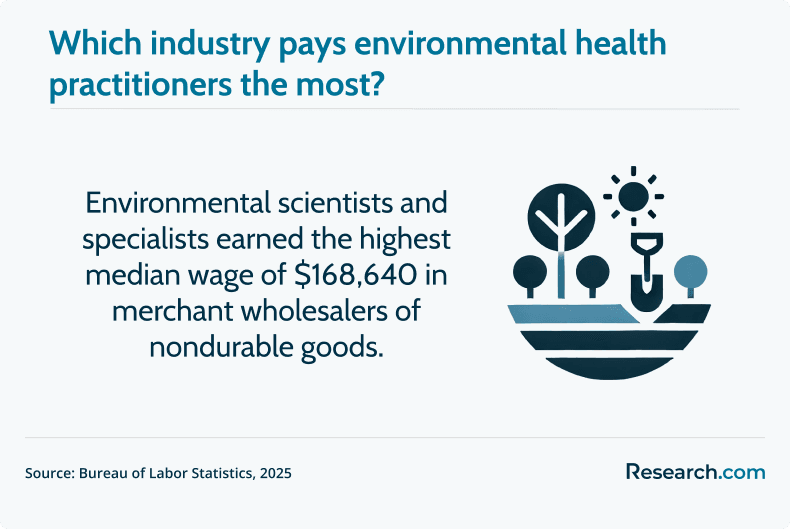
Professionals who combine technical expertise with project coordination are also better positioned for high-responsibility roles, including opportunities in Scientific Research and Development Services, identified here as the top-paying industry for this career path. If you are still choosing an undergraduate route, comparing an easy bachelor degree with more science-intensive options can help you balance flexibility, prerequisites, and long-term career fit.
Environmental Health Practitioner Careers: A Step-by-Step Guide to Getting Started
The path into environmental health practice is more manageable when you treat it as a sequence: education, experience, credentialing, specialization, and advancement. Requirements can vary by employer and state, so the safest approach is to check job postings and licensing expectations early, before committing to a program.
- Complete foundational education. Build a strong base in environmental health, biology, chemistry, environmental science, public health, epidemiology, and regulatory concepts.
- Gain practical experience. Use internships, practicums, volunteer roles, or entry-level public health positions to learn inspection procedures, documentation, sampling, and public communication.
- Pursue required credentials. Identify whether your target roles require certifications, registration, or state licensure, and plan coursework and experience around those requirements.
- Choose a specialization if needed. Focus on areas such as food safety, water quality, occupational health, hazardous materials, sanitation, housing, or environmental epidemiology.
- Keep developing professionally. Attend trainings, maintain credentials, build a professional network, and seek assignments that strengthen leadership and technical depth.
A strong early strategy is to review real job descriptions in your preferred location. Look for repeated requirements such as specific degrees, REHS/RS eligibility, inspection experience, data skills, or state credentials. That information can help you avoid paying for education that does not match the roles you actually want.
What education, training, or certifications are required?
The most recognized degree for becoming an Environmental Health Practitioner is a Bachelor of Science in Environmental Health, ideally EHAC-accredited. Other acceptable degree paths may include biology, chemistry, environmental science, or closely related fields, especially when the program includes enough physical and biological science coursework to meet employer or credentialing expectations.
Certification and licensure requirements depend on the role and location. A common professional credential is the Registered Environmental Health Specialist/Registered Sanitarian (REHS/RS), administered by the National Environmental Health Association. Some states also require a specific state licensure as an Environmental Health Practitioner, so it is important to confirm local rules before choosing a program or relocating.
Training is not only classroom-based. Many roles expect supervised field experience, internships, or structured orientation. EHAC-accredited pathways may involve a hands-on internship, usually about 180 hours. Employers may also require supervised inspections, agency-specific training, CPR, NIMS, or other practical certifications before a practitioner works independently.
Are advanced degrees or niche certifications worth the investment?
Advanced degrees can be valuable, but they are not always necessary for entry-level field practice. A Master of Public Health or PhD in Environmental Health may make sense if your goal is leadership, research, policy, academia, program administration, or specialized technical work. Niche certifications such as Certified Hazardous Materials Manager may also help when your work involves hazardous materials, complex compliance settings, or specialized industry roles.
The trade-off is cost and time. Advanced credentials can take years and require substantial tuition investment. For many inspection, compliance, or field-level roles, a bachelor's degree plus REHS/RS certification may be sufficient. The best return on investment is usually found when the credential is clearly connected to a promotion path, licensure requirement, salary increase, or specialized job market.
Before enrolling, compare program outcomes with your target roles. A broader college majors list and careers can also help you see how Environmental Health compares with adjacent fields in public health, science, safety, and environmental management.
What is the earning potential for Environmental Health Practitioners?
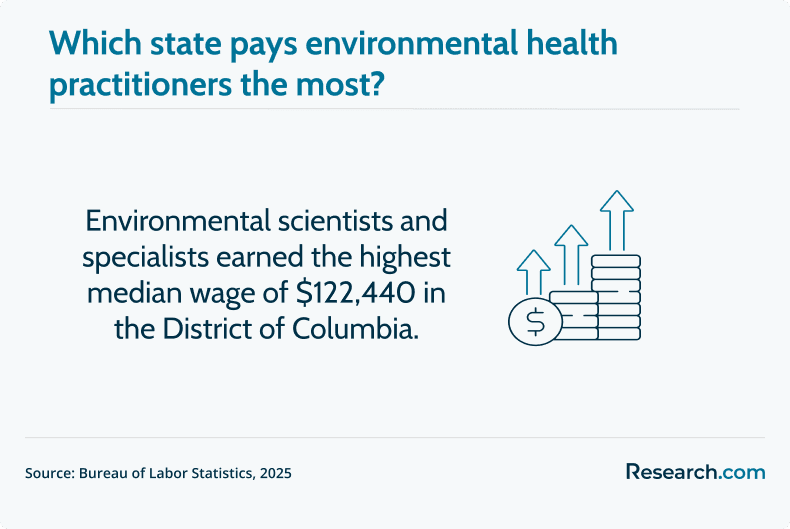
The median annual salary for an Environmental Practitioner in the U.S. is $130,295. This figure gives a midpoint reference, but actual earnings can vary significantly based on job title, employer type, location, credentials, experience, specialization, and leadership responsibility.
The environmental health practitioner salary range 2025 spans from about $108,000 for entry-level positions up to $180,000 for senior-level experts. Entry-level professionals should not assume they will immediately earn the median, especially if they still need supervised experience or credentialing. Senior-level salaries are more likely to be associated with advanced expertise, management duties, specialized industries, or hard-to-fill roles.
| Factor | How it can affect earnings |
| Location | Pay can differ by state, metro area, cost of living, and local demand for environmental health expertise. |
| Experience | Practitioners often earn more as they move from trainee or entry-level inspection roles into senior, supervisory, or specialized positions. |
| Credentials | REHS/RS certification, state licensure, or niche credentials can improve eligibility for certain positions. |
| Employer type | Government agencies, consulting firms, research organizations, and industry employers may have different pay structures. |
| Specialization | Expertise in areas such as hazardous materials, occupational health, environmental epidemiology, or compliance management may support higher compensation. |
What is the job outlook for Environmental Health Practitioners?
Employment of environmental scientists and specialists, including environmental health practitioners, is projected to grow 4% from 2024 to 2034, which is about as fast as the average for all occupations. That outlook suggests a stable career path rather than a rapidly expanding one. Demand is likely to remain tied to public health needs, regulatory compliance, environmental risk management, and replacement openings as experienced professionals leave the workforce.
The Key Factors Shaping the Future Outlook
Regulation is a major driver. Businesses, public agencies, and communities need professionals who understand how to monitor risks, interpret requirements, and document compliance. Environmental health practitioners are especially relevant when hazards involve food, water, sanitation, waste, pollution, workplace safety, or community exposure.
Technology is also changing the work. AI, IoT, and data analytics can improve monitoring, pattern detection, reporting, and risk assessment. These tools do not remove the need for professional judgment, but they do raise expectations for digital literacy. Practitioners who can use data responsibly and explain findings clearly may have an advantage.
Demographic shifts also matter. As experienced workers retire, employers may need new practitioners who can move into inspection, compliance, and program roles. Because awareness of the profession is relatively low, students and career changers who discover the field early may find opportunities in government, consulting, research, and specialized industry settings. If online study is part of your plan, reviewing accredited online universities with free admission process can help you identify accessible starting points.
What is the typical work environment for Environmental Health Practitioners?
Environmental health practitioners commonly work for local and state government agencies, though opportunities also exist in private consulting firms and specialized industry settings. The standard schedule is often about 40 hours per week during regular business hours. However, overtime, evenings, or weekend work may be required during emergency response, urgent complaints, public health investigations, or time-sensitive inspections.
The work environment usually combines office duties with fieldwork. Office tasks may include writing reports, reviewing records, entering data, analyzing sample results, preparing enforcement documents, and coordinating with other professionals. Fieldwork may involve restaurants, water systems, housing sites, workplaces, public facilities, industrial locations, or other settings where hazards may be present.
Some visits can involve unsanitary, uncomfortable, or potentially hazardous conditions. Practitioners may need protective equipment and must follow safety protocols. The role also requires frequent interaction with business owners, residents, government staff, lab personnel, community members, and other health or safety professionals. While some administrative tasks may be done remotely, on-site work is generally essential because inspections and environmental assessments require direct observation.
What are the pros and cons of Environmental Health Practitioner careers?
Environmental health practice can be a strong fit for people who want meaningful work with a scientific foundation and visible community impact. It is not ideal for everyone, however. The job can involve conflict, legal documentation, unpredictable complaints, and exposure to difficult conditions.
Pros
- Public impact: The work can prevent illness, reduce environmental hazards, and improve community safety.
- Varied duties: Practitioners may rotate among inspections, investigations, education, sampling, reporting, and emergency response.
- Applied science: The role uses biology, chemistry, environmental science, public health, and epidemiology in real-world settings.
- Career pathways: Experience can lead to senior practitioner, program manager, director, administrator, specialist, or consulting roles.
- Purpose-driven work: Many practitioners find satisfaction in preventing harm before it reaches the clinical or crisis stage.
Cons
- Enforcement conflict: Issuing citations, notices, or closure recommendations can create tension with businesses or individuals.
- Emotional strain: Complaints, outbreaks, unsafe living conditions, or hazardous environments can be stressful.
- Bureaucracy: Regulations, procedures, documentation, and agency processes can slow action even when risks are clear.
- Field exposure: Some inspections involve unsanitary, hazardous, or physically uncomfortable conditions.
- High responsibility: Errors in judgment or documentation can affect public health, legal outcomes, and agency credibility.
If you are comparing hands-on education options before committing to a degree pathway, the most popular accredited online trade schools may help you explore practical training alternatives and related career entry points.
What are the opportunities for advancement for Environmental Health Practitioners?
Advancement in environmental health can happen in two main ways: moving into leadership or developing a technical specialty. The best route depends on whether you prefer managing people and programs or becoming the person others rely on for complex technical problems.
Advancement Path
- Environmental Health Practitioner / Environmental Health Officer: Conduct inspections, investigate hazards, document findings, support compliance, and educate the public or regulated entities.
- Senior Environmental Health Practitioner / Senior Environmental Health Officer: Handle more complex investigations, mentor junior staff, review reports, lead projects, or manage a territory or program area.
- Environmental Health Manager / Director / Public Health Administrator: Oversee teams, budgets, policies, enforcement priorities, community programs, and interagency coordination.
Specialization Areas
- Food Safety and Protection: Focus on food establishment inspections, contamination prevention, outbreak investigations, and food safety policy.
- Water Quality and Sanitation: Monitor drinking water, wastewater, recreational water, sanitation systems, and related public health risks.
- Occupational Health and Safety: Address workplace hazards, safety programs, exposure risks, and regulatory compliance.
- Infectious Disease Control / Environmental Epidemiology: Investigate environmental sources of disease and support prevention strategies using public health data.
To improve promotion potential, build a record of accurate reports, sound enforcement decisions, strong communication, and reliable project follow-through. Leadership roles often go to practitioners who can train others, defend decisions with evidence, coordinate across agencies, and manage pressure without losing professional judgment.
What other careers should you consider?
If environmental health practice appeals to you, it is worth comparing it with related careers before choosing a degree or credential path. Many adjacent roles use similar interests in science, safety, compliance, public health, and risk prevention, but the daily work can differ significantly.
- Environment, Health and Safety Manager: Oversees environmental compliance and workplace safety programs, often within companies or industrial settings. This path may suit people who want management responsibility and organizational risk control.
- Health and Safety Specialist: Identifies hazards, recommends controls, and supports safer workplaces or public environments. This can be a strong fit for those who prefer occupational safety and prevention work.
- Food Safety Specialist: Focuses on food production, handling, contamination prevention, inspection, and compliance. This path is especially relevant for people interested in food systems and outbreak prevention.
- Consumer Safety Technician: Uses inspection and regulatory procedures to help ensure products meet health and safety standards. This may appeal to detail-oriented candidates who enjoy compliance verification.
- Epidemiologist: Studies disease patterns, analyzes public health data, and investigates causes of illness, including environmental contributors. This is a more data- and research-focused option for people who enjoy analytical work.
When comparing these careers, ask three questions: Do you want more fieldwork or more data analysis? Do you prefer enforcement, education, research, or management? Are you more interested in environmental conditions, workplace safety, food systems, products, or disease patterns? Your answers can help you choose the path that best matches your strengths.
Here's What Professionals Say About Their Environmental Health Practitioner Careers
-
: "I feel fortunate to work in a role where the impact is clear. I inspect airline food preparation areas to help make sure passengers are eating safely at 30,000 feet. The work can be detailed and demanding, but knowing that it helps prevent illness for thousands of travelers gives me a strong sense of purpose.
— Amina"
-
: "This career pushed me out of my comfort zone. Inspecting campus laboratories meant learning complex safety protocols, building relationships with lab managers, and coordinating with other departments. Support from coworkers helped me understand hazardous materials and compliance issues. The unpredictability of the work has made me more confident and more capable.
— Victor"
-
: "One of the most rewarding parts of my work has been seeing safety culture improve after new measures were put in place. Morale improved and injury rates dropped significantly, which showed that the work mattered. Hearing colleagues say they feel safer reminds me why the difficult days are worth it.
— Lina"
Key Findings
- Environmental health practitioners protect communities by identifying, investigating, and reducing environmental risks to human health.
- The career typically requires a strong science foundation, practical field experience, and, for many roles, credentials such as REHS/RS or state licensure.
- The median annual salary for an Environmental Practitioner in the U.S. is $130,295, with the environmental health practitioner salary range 2025 spanning from about $108,000 for entry-level positions up to $180,000 for senior-level experts.
- Employment of environmental scientists and specialists, including environmental health practitioners, is projected to grow 4% from 2024 to 2034.
- The role offers meaningful public health impact, varied work, and advancement potential, but it can also involve enforcement conflict, stressful investigations, and exposure to challenging field conditions.
- Strong candidates combine regulatory knowledge, inspection skills, data interpretation, report writing, communication, critical thinking, and project management.
- Related career options include Environment, Health and Safety Manager, Health and Safety Specialist, Food Safety Specialist, Consumer Safety Technician, and Epidemiologist.
Other Things You Should Know About Environmental Health Practitioner
In 2027, Environmental Health Practitioners need strong analytical skills, proficiency in using GIS and environmental monitoring tools, and a good grasp of regulatory knowledge. Communication skills are vital for presenting findings, while adaptability is crucial to keep pace with evolving public health challenges.
In 2027, the role of an environmental health practitioner is expected to evolve with a greater focus on sustainable practices and technology integration. Practitioners will likely need to balance traditional practices with innovative solutions, responding to emerging environmental challenges to protect public health effectively.
References
- Environmental health practitioner https://nationalcareers.service.gov.uk/job-profiles/environmental-health-officer
- Environmental health professional - career development https://www.whatuni.com/career-guides/environmental-conservation/environmental-health-professional/career-development/
- 10 June 2025 Understanding the Role of Environmental Health Practitioners: A short Career Guide https://www.gardenroute.gov.za/2025/06/10/10-june-2025-understanding-the-role-of-environmental-health-practitioners-a-short-career-guide/
- A day in the life: Environmental health officer | Interior Health https://www.interiorhealth.ca/stories/a-day-in-the-life-environmental-health-officer
- Environment and Public Health: REHS Salary Information https://cpe.rutgers.edu/environment-public-health/rehs-salary
- RAF Recruitment | Environmental Health Practitioner | Royal Air Force https://recruitment.raf.mod.uk/roles/roles-finder/medical-services/environmental-health-practitioner


