
2027 Epidemiology Careers: Skills, Education, Salary & Job Outlook

Co-Founder and Chief Data Scientist
Choosing an epidemiology career means deciding whether you want to work at the intersection of disease research, statistics, public health policy, and community protection. The field is rigorous: most roles require graduate-level training, comfort with data, and the ability to explain evidence clearly when decisions affect real people.
For the right person, that difficulty is also the appeal. Epidemiologists help identify why health problems occur, who is most at risk, and which interventions are likely to work. Demand is supported by global disease threats, stronger health surveillance systems, and wider use of data in healthcare and government decision-making. Starting salaries around $60,000 to $75,000 and senior roles exceeding $120,000 can make the path financially viable, though earnings vary by employer, location, education, and specialization.
This guide explains what epidemiologists do, the skills and credentials employers value, salary and job outlook, typical work settings, advancement paths, and related careers to consider before committing to this public health profession.
Key Things You Should Know About Epidemiology Career
- The typical earning potential for epidemiologists in the United States is around $83,980 per year, with specialized research roles and hospital positions offering median salaries up to $115,660 and $98,430 respectively.
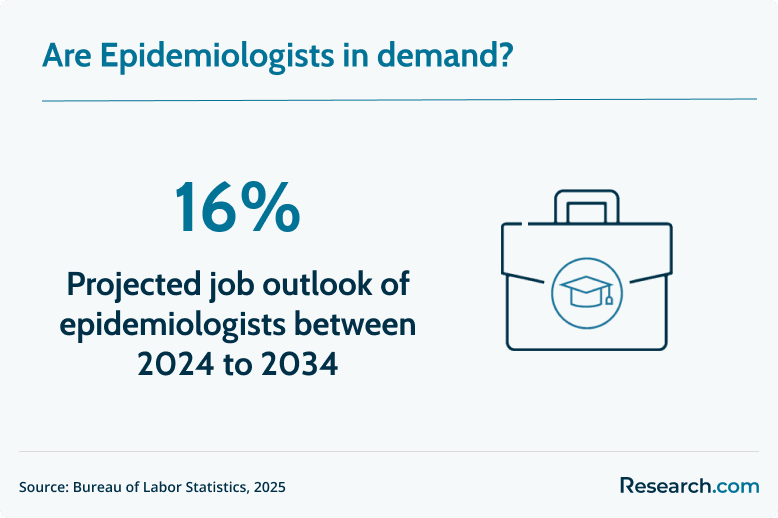
- This field is very stable and growing rapidly, with employment expected to increase by 16% from 2024 to 2034, much faster than the average for all occupations.
- A master's degree in public health or a closely related field is generally required to enter the profession, while advanced research or leadership positions often require a doctoral degree.
- Success depends on strong analytical and statistical skills, critical thinking, proficiency with data analysis tools, clear communication, attention to detail, and teamwork.
- Career advancement can lead from entry-level roles to senior epidemiologist, project manager, or program director, with further opportunities in academic research, policy advising, or executive leadership in public health agencies.
What do Epidemiologists do?
Epidemiologists study patterns, causes, and effects of diseases and health conditions in populations. Their work helps public health agencies, hospitals, universities, research organizations, and policymakers decide how to prevent illness, respond to outbreaks, allocate resources, and evaluate whether health programs are working.
The role is often described as “disease detective” work, but it is broader than outbreak response. Epidemiologists may examine infectious diseases, chronic illness, injuries, environmental exposures, maternal and child health, occupational hazards, or social factors that affect health outcomes. They use data to answer practical questions: Who is getting sick? Where are cases increasing? What risk factors matter most? Which intervention is likely to reduce harm?
A Day in the Life of Epidemiologists
A typical day depends on the employer and specialty, but most epidemiologists spend substantial time working with data, research protocols, and public health partners. They may clean datasets, run statistical analyses, review surveillance reports, write findings for decision-makers, or meet with clinicians, laboratory staff, community organizations, and government officials.
During an outbreak or urgent public health event, the work can become faster and more field-oriented. Epidemiologists may help define cases, investigate exposure histories, monitor trends, brief leadership, and recommend control measures. In quieter periods, the work often focuses on long-term studies, program evaluation, grant writing, academic publishing, or improving data systems.
What are the key responsibilities of Epidemiologists?
Epidemiologists turn health data into evidence that can guide prevention, treatment, policy, and emergency response. The exact responsibilities vary by setting, but most roles combine research design, statistical analysis, communication, and collaboration with public health or healthcare teams.
- Collect, clean, and analyze health data to identify disease patterns, risk factors, and outbreak causes.
- Design studies, surveys, surveillance systems, and observation protocols that produce reliable evidence.
- Calculate and interpret disease measures, such as incidence, prevalence, risk, and trends over time.
- Prepare technical reports, dashboards, research papers, policy briefs, and presentations for scientific and nontechnical audiences.
- Work with healthcare providers, laboratories, public health departments, and community partners to coordinate prevention and response efforts.
- Develop, monitor, and evaluate public health interventions, screening programs, vaccination efforts, or health education initiatives.
- Supervise staff, train data collectors, manage project timelines, and support quality control during investigations or studies.
The Most Challenging vs. The Most Rewarding Tasks
One of the hardest parts of epidemiology is making sound recommendations when data are incomplete, delayed, messy, or politically sensitive. During an emerging outbreak, evidence changes quickly, public concern is high, and decisions may need to be made before every uncertainty is resolved. Strong epidemiologists know how to communicate both what the data show and what they do not yet prove.
The most rewarding part is seeing evidence lead to action. A well-designed investigation can identify a preventable exposure, improve a hospital protocol, guide a vaccination campaign, or influence public health policy. For many professionals, the satisfaction comes from improving health at the population level rather than treating one patient at a time.
If you are still building toward graduate-level public health roles, short-term training can help you test your interest in health data, research, or healthcare operations. Reviewing the best 6 month certifications that pay well can be a practical way to compare faster credential options while planning a longer epidemiology path.
What are the key skills for Epidemiologists?
Epidemiology requires a blend of quantitative skill, scientific judgment, and clear communication. Employers look for professionals who can design credible studies, handle complex datasets, interpret results responsibly, and explain findings to people who may not have statistical training.
Technical Skills
- Data Analysis and Interpretation: Epidemiologists must be able to work with surveillance data, clinical records, survey results, laboratory data, or large public health datasets and translate patterns into defensible conclusions.
- Statistical Methods: Study design, sampling, regression, bias assessment, confounding, and measures of association are central to producing valid findings.
- Disease Surveillance and Management: Professionals track disease activity, detect unusual patterns, monitor outbreaks, and provide timely reports to stakeholders.
- Database Management: Reliable analysis depends on accurate, well-documented, and secure data. Epidemiologists often need to understand data cleaning, coding, quality checks, and privacy requirements.
Soft Skills
- Critical Thinking: Good epidemiologists question assumptions, evaluate alternative explanations, and avoid overstating what the evidence can support.
- Oral and Written Communication: Findings must be clear enough for policymakers, clinicians, community leaders, journalists, and the public to understand and use.
- Collaboration: Epidemiology is rarely solo work. Projects often involve statisticians, physicians, nurses, laboratory scientists, environmental specialists, informatics teams, and community organizations.
- Attention to Detail: Small errors in coding, case definitions, or interpretation can change conclusions and affect public health decisions.
The One Overlooked Skill That Separates the Good from the Great
Program management is often the skill that separates technically competent epidemiologists from those who can lead major public health initiatives. Analysis matters, but results only create impact when studies are completed on time, teams coordinate effectively, data systems function, and recommendations reach the right decision-makers.
For example, an epidemiologist supporting a vaccination campaign may need to align healthcare providers, data analysts, communications staff, procurement teams, and public health leaders. Strong program management reduces delays, prevents miscommunication, and helps evidence move into practice. This capability is especially valuable in complex research and public health environments, including the Scientific Research and Development Services sector, known as the top-paying industry for epidemiologists.
If you need to strengthen specific competencies before applying to graduate programs or more advanced roles, open enrollment college courses online can help you build targeted skills in statistics, public health, data management, or healthcare administration.
Epidemiology Careers: A Step-by-Step Guide to Getting Started
Becoming an epidemiologist is usually a staged process: build a science or public health foundation, complete graduate training, gain applied experience, and then specialize. The path is demanding, but it is manageable when you understand which step each credential or experience supports.
- Build a strong undergraduate foundation. Start with coursework in biology, statistics, public health, mathematics, social sciences, health sciences, or a related field. Use this stage to confirm that you enjoy both scientific questions and quantitative reasoning.
- Develop data and research skills early. Learn statistical software, research methods, literature review, and basic data visualization. Employers value candidates who can do more than understand public health concepts; they need people who can work with evidence.
- Pursue graduate training for professional roles. Most epidemiologist positions require advanced study in epidemiology, public health, biostatistics, or a closely related discipline. Graduate programs typically provide training in study design, epidemiologic methods, surveillance, and applied analysis.
- Gain hands-on experience. Look for internships, practicums, research assistantships, public health department placements, hospital quality projects, or nonprofit health research work. Practical experience helps you learn how real datasets, field investigations, and public health systems operate.
- Build professional credibility. Attend workshops, join public health associations, present research, seek mentorship, and consider relevant certifications when they align with your target role.
- Specialize or move into leadership. As you gain experience, choose whether to deepen expertise in a specific area, such as infectious disease, chronic disease, environmental health, or maternal and child health, or move toward program management, research leadership, or policy roles.
The core steps to become an epidemiologist are straightforward: earn the right education, prove you can work with health data, gain applied public health experience, and keep building specialized expertise. The best path depends on whether you want to work in government, hospitals, academia, research, consulting, or global health.
What education, training, or certifications are required?
Epidemiologists commonly begin with a bachelor's degree in Biology, Public Health, Human Physiology, Social Sciences, or a related field. While some entry-level research or public health support roles may be available with a bachelor's degree, most professional epidemiologist positions require graduate education.
Common graduate routes include a Master of Public Health (MPH), a Master of Science in Epidemiology, a PhD, or a Doctor of Public Health (DrPH). An MD with a focus on epidemiology is less common, but it can be valuable for professionals pursuing clinical research, academic medicine, hospital epidemiology, or senior health leadership.
Training is not only classroom-based. Many graduate programs include internships, practicums, capstone projects, or supervised fieldwork. These experiences are important because employers want evidence that you can apply epidemiologic methods in real settings, not just explain them in theory.
Relevant certifications include the Certified in Infection Prevention and Control (CIC) from the Certification Board of Infection Control and Epidemiology and the Certified in Public Health (CPH) from the National Board of Public Health Examiners. These credentials can strengthen a resume in certain roles, especially infection prevention, hospital epidemiology, and broader public health practice, but they are not universal requirements for every epidemiology job.
Are advanced degrees or niche certifications worth the investment?
Advanced degrees are often worth the investment if your goal is to qualify for epidemiologist roles, lead studies, manage programs, teach, or compete for senior research positions. A master's degree is commonly the practical entry point for professional practice, while doctoral training is more relevant for academia, principal investigator roles, advanced methodology, or executive-level public health work.
The trade-off is time, cost, and opportunity cost. Master's programs often require two years, and doctoral study usually demands a larger commitment. Before enrolling, compare program accreditation, faculty expertise, practicum opportunities, graduate outcomes, tuition, assistantships, and whether the curriculum matches your intended specialty.
Certifications such as CIC or CPH can be useful when they align with your target job, but they should not replace the core education and applied experience most employers expect. If doctoral study is part of your long-term plan, comparing affordable options such as low cost phd programs can help you manage the financial side of career advancement.
What is the earning potential for Epidemiologists?
Epidemiology can offer solid earning potential, especially for professionals who combine advanced education, strong analytical skills, leadership experience, and specialization. The median annual salary for epidemiologists across the U.S. is $83,980. This figure is a useful midpoint, not a guarantee of what any individual will earn.
The epidemiologist starting salary 2025 is around $61,550 per year, which reflects the lower end for many early-career roles. Senior-level epidemiologists can expect to earn upwards of $130,050 annually, especially when they move into advanced research, program leadership, specialized technical work, or higher-paying industries.
Several factors shape pay. Government agencies may offer stability, mission-driven work, and benefits, while scientific research institutions may offer higher compensation for specialized expertise. Hospitals, universities, consulting organizations, and biotechnology employers may value different combinations of clinical knowledge, statistical ability, publication record, and project management experience. Geographic location also matters because salaries often reflect local labor markets and cost of living.
To evaluate a specific offer, look beyond the base salary. Consider health benefits, retirement contributions, tuition support, remote work flexibility, promotion paths, grant funding stability, and whether the role builds marketable skills in data analysis, surveillance, leadership, or a high-demand specialty.
What is the job outlook for Epidemiologists?
The employment of epidemiologists is projected to grow 16% from 2024 to 2034, much faster than the average for all occupations, which is about 3%-4%. This outlook reflects the continuing need for professionals who can monitor health threats, analyze population-level data, evaluate interventions, and help organizations respond to public health risks.
The Key Factors Shaping the Future Outlook
Emerging and reemerging infectious diseases remain a major driver of demand. Public health systems need epidemiologists who can detect outbreaks, interpret surveillance data, trace patterns of spread, and recommend prevention strategies. The COVID-19 pandemic made this work more visible, but the need extends well beyond any single event.
Data science is also reshaping the field. Health systems, insurers, research organizations, and government agencies now collect large volumes of data, and they need professionals who can use those data responsibly. Epidemiologists with skills in analytics, data visualization, informatics, and artificial intelligence-supported methods may be especially competitive, provided they also understand study design, bias, ethics, and public health context.
Climate change is expanding the scope of epidemiology as well. Shifts in temperature, weather patterns, air quality, food systems, and vector habitats can affect disease patterns and health risks. Epidemiologists who understand environmental health, occupational exposure, disaster response, or climate-related health effects may find growing opportunities.
For professionals considering an accelerated advanced degree, a 1 year online doctorate may be worth comparing carefully with traditional options, especially in terms of accreditation, research expectations, faculty support, and whether the credential fits your career goals.
What is the typical work environment for Epidemiologists?
The epidemiology work environment and culture depend heavily on the employer. Many epidemiologists work in offices where they analyze data, write reports, design studies, and attend meetings. Others spend time in hospitals, laboratories, universities, field sites, community settings, or emergency operations centers.
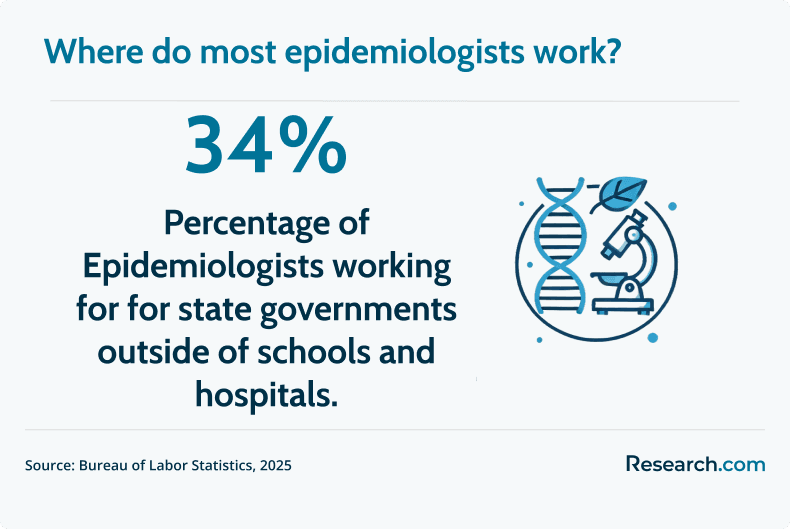
About 35% are employed by state and local government excluding education and hospitals, 18% work in hospitals, and 15% serve in colleges or universities. Government roles often focus on surveillance, outbreak response, program evaluation, and public reporting. Hospital roles may involve infection prevention, quality improvement, patient safety, or clinical research. University roles often emphasize research, teaching, grants, and publication.
The epidemiologist typical work schedule is most often standard office hours-Monday to Friday, nine to five. However, urgent public health events can require evenings, weekends, travel, or rapid response work. Field investigations and outbreak response may be less predictable than long-term research or academic roles.
Remote work is increasingly possible for tasks such as data analysis, report writing, literature review, and virtual collaboration. Still, some responsibilities require on-site presence, especially fieldwork, laboratory coordination, hospital-based infection control, community engagement, or emergency response.
What are the pros and cons of Epidemiologist careers?
An epidemiology career can be deeply meaningful, but it is not an easy path. The work rewards people who enjoy evidence, systems thinking, and public service. It can frustrate those who prefer quick answers, predictable workloads, or immediate individual patient outcomes.
Pros
- Population-level impact: Your work can influence policies, prevention programs, clinical practices, and community health outcomes.
- Intellectually engaging work: Epidemiology combines science, statistics, investigation, communication, and real-world problem-solving.
- Varied career settings: Opportunities exist in government, hospitals, universities, research organizations, consulting, nonprofits, and global health.
- Strong relevance: Disease surveillance, health data, and public health preparedness remain important across many sectors.
- Continuous learning: New methods, health threats, technologies, and policy questions keep the field evolving.
Cons
- High education requirements: Many desirable roles require graduate training, and advancement may depend on specialized experience or doctoral study.
- Complex data challenges: Real public health data can be incomplete, inconsistent, delayed, or difficult to interpret.
- Pressure during emergencies: Outbreaks and public health crises may require fast analysis under scrutiny and uncertainty.
- Communication demands: You must explain statistical findings in ways that decision-makers and the public can understand without oversimplifying the evidence.
- Potential field risks: Some roles involve travel, community investigations, or exposure concerns that require strict safety protocols.
This career is a strong fit if you like using evidence to improve systems and protect communities. If you want a faster credential route or are comparing health-related career options, a list of best paying certifications can help you evaluate alternatives before committing to a long graduate pathway.
What are the opportunities for advancement for Epidemiologists?
Epidemiologists can advance by moving into leadership, deepening technical specialization, publishing research, managing larger programs, or transitioning into policy, consulting, or executive public health roles. Promotion usually depends on a combination of education, applied experience, communication skill, and the ability to lead projects that produce measurable results.
Clear Advancement Pathways
- Entry-Level Epidemiologist: Early roles may include research assistant, surveillance analyst, data coordinator, or junior epidemiologist. These positions typically focus on data collection, analysis support, report preparation, and study operations.
- Mid-Level Epidemiologist / Program Manager: After 3-7 years, professionals may manage projects, supervise staff, lead surveillance activities, or coordinate public health programs. Titles may include Public Health Epidemiologist or Infectious Disease Analyst.
- Senior Epidemiologist / Principal Investigator: Senior professionals lead major studies, oversee large datasets, secure funding, publish findings, guide methodology, and advise organizational leadership.
- Chief Epidemiologist / Executive Roles: At the highest levels, epidemiologists may direct divisions, shape public health strategy, lead emergency response, or hold senior roles in organizations such as the CDC.
Specialization Opportunities to Enhance Growth
- Infectious Disease Epidemiology: Focuses on transmission, outbreak response, vaccination, antimicrobial resistance, and diseases such as influenza, HIV, or COVID-19.
- Chronic Disease Epidemiology: Studies long-term conditions such as heart disease, cancer, diabetes, and related risk factors.
- Maternal and Child Health Epidemiology: Examines health outcomes, interventions, and disparities affecting mothers, infants, children, and families.
- Environmental and Occupational Epidemiology: Analyzes how environmental exposures, workplace conditions, pollutants, and hazards affect health.
- Social and Behavioral Epidemiology: Investigates how policies, social conditions, behavior, and structural factors influence health outcomes.
To improve promotion prospects, build a portfolio that shows more than technical competence. Document projects you led, methods you used, findings you communicated, policies or programs you influenced, and teams you managed. Advancement is easier when employers can see both your analytical skill and your ability to turn evidence into action.
What other careers should you consider?
If you are interested in epidemiology but not sure it is the right fit, consider related careers that use similar skills in different ways. Comparing options can help you decide whether you prefer statistical modeling, program leadership, clinical research, consulting, animal health, or direct public health practice.
- Biostatistician: Focuses more deeply on statistical modeling, study design, and quantitative analysis. This path may fit you if you enjoy advanced math and methods more than field investigation or public health operations.
- Public Health Consultant: Helps organizations design, evaluate, and improve health programs. This role suits professionals who like strategy, communication, stakeholder management, and applied problem-solving.
- Clinical Research Coordinator: Manages the daily operations of clinical trials, including participant recruitment, documentation, compliance, and study logistics. It can be a strong fit for people who want to work closer to clinical care and research administration.
- Veterinary Epidemiologist: Studies disease patterns in animal populations and may work on zoonotic diseases, food safety, agriculture, or wildlife health. This option is ideal for those interested in the connection between animal and human health.
- Healthcare/Biotech Consultant: Applies analytical and strategic skills to healthcare delivery, biotechnology, product development, market access, or organizational improvement. This path may offer a faster-paced business environment than traditional public health agencies.
The best choice depends on the type of problems you want to solve. If you want to investigate health trends and influence population-level prevention, epidemiology is a strong match. If you prefer advanced statistics, clinical trial operations, business strategy, or animal health, a related role may align better with your strengths.
Here's What Professionals Say About Their Epidemiology Careers
-
: "Every dataset I analyze tells a story about the health of a community, and it is my responsibility to reveal that story accurately. During my time tracking infectious disease outbreaks, I realized how critical trustworthy interpretation is-it can actually shape policies that protect millions. Epidemiology feels like piecing together an intricate puzzle, where every detail matters and can lead to actionable solutions. Knowing that my work influences real-world decisions keeps me deeply engaged and committed.
— Lucas"
-
: "Starting out as a hospital epidemiologist was daunting, especially when challenging long-held practices seemed impossible. Being one of the few women in a male-dominated environment, I faced considerable resistance, but I learned to focus on strategic, precise interventions while leaning on supportive mentors. Building my own research networks was essential to overcoming skepticism and pushing change forward. The toughest periods taught me patience and resilience, and now those hard-earned lessons inform every decision I make.
— Hana"
-
: "Managing COVID-19 vaccination efforts within the healthcare system was my biggest professional test so far. Navigating layered bureaucracy while applying epidemiological expertise required constant adjustment and perseverance. Despite setbacks, I am proud to have contributed to protecting frontline workers during a critical time, and that accomplishment still feels rewarding every day. The experience sharpened my ability to handle complex public health challenges under pressure and confirmed that this is exactly where I belong.
— Elijah"
Key Findings
- Epidemiologists study disease and health patterns in populations, using data to guide prevention, response, policy, and program decisions.
- Most professional epidemiology roles require graduate education, commonly a Master of Public Health (MPH), Master of Science in Epidemiology, PhD, or Doctor of Public Health (DrPH).
- Core skills include data analysis, statistical methods, surveillance, database management, critical thinking, communication, collaboration, and attention to detail.
- The median annual salary for epidemiologists across the U.S. is $83,980, with the epidemiologist starting salary 2025 around $61,550 per year and senior-level earnings upwards of $130,050 annually.
- Employment of epidemiologists is projected to grow 16% from 2024 to 2034, compared with about 3%-4% for all occupations.
- Common workplaces include state and local government, hospitals, colleges, universities, research organizations, and public health agencies.
- The career offers strong public impact and intellectual challenge, but it also requires advanced training, comfort with uncertainty, and the ability to communicate evidence under pressure.
Other Things You Should Know About Epidemiology Careers
Many believe epidemiologists mainly work in labs or focus solely on infectious diseases, but the field is much broader. Epidemiologists analyze population data, develop health policies, and address issues like chronic diseases and environmental risks. Their preventive work has a large impact, though it is less visible, often leading to an undervaluation of their contribution to saving lives.
Becoming an epidemiologist in 2026 typically takes around 6 to 8 years. This includes completing a 4-year bachelor's degree, followed by 2 to 4 years for a master's or doctoral degree. Additional time may be needed for gaining relevant experience or certifications.
References
- Career Paths With an MPH in Epidemiology https://public-health.tamu.edu/degrees/mph/blog/epidemiology-jobs-that-make-a-difference.html
- 10 Pros and Cons of Being an Epidemiologist https://www.nursingprocess.org/epidemiologist-pros-and-cons.html
- Frequently Asked Questions about Epidemiologist Careers https://www.jobzmall.com/careers/epidemiologist/faqs
- Epidemiology Careers. https://www.bu.edu/sph/careers/for-students/the-search-process/exploring-public-health-careers/epidemiology-careers/
- Career - Epidemiology MPH - School of Public Health - University of Minnesota https://www.sph.umn.edu/academics/graduate/mph/epidemiology/career/
- Master of Epidemiology https://www.uantwerpen.be/en/study/get-to-know-uantwerp/testimonials/south-america/linda-chanam-pinedo/


