
2027 External Auditor Careers: Skills, Education, Salary & Job Outlook

Co-Founder and Chief Data Scientist
External auditing is a strong fit for people who want an accounting career with structure, mobility, and visible impact. The core decision is whether you are willing to build the education, certification, technical judgment, and client-facing discipline the role requires. Most external auditors start with a bachelor’s degree in accounting, finance, or a related business field, then strengthen their prospects through experience and credentials such as the CPA.
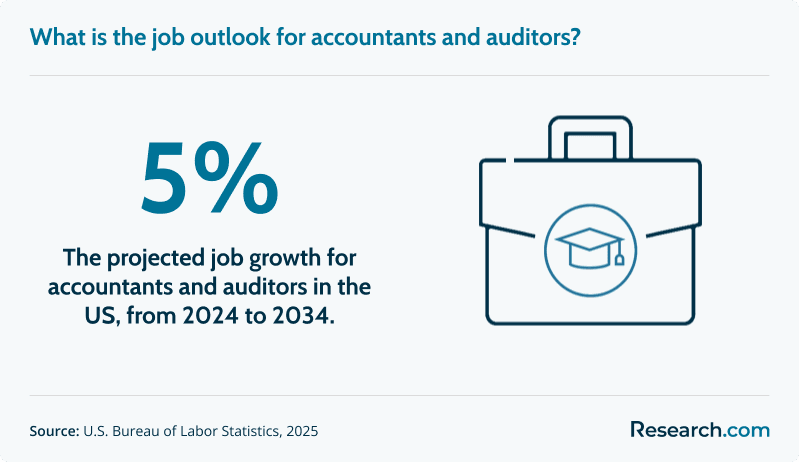
The appeal is clear: external auditors help organizations prove that their financial statements can be trusted. Demand remains steady, with 5% job growth projected through 2034 and a median annual wage of $81,680 for accountants and auditors. The work can be demanding, especially during busy seasons, but it can also lead to senior audit, controllership, consulting, forensic accounting, and executive finance roles.
This guide explains what external auditors do, the skills and credentials employers value, how much they can earn, what the work environment is like, and how to decide whether this career path matches your goals.
Key Things You Should Know About External Auditor Career
- The typical earning potential for external auditors in the United States is around $81,680 annually, providing a solid and competitive income compared to many other professions.
- This field is expected to grow 5% (specifically 4.6%) from 2024 to 2034, signaling steady demand and a reliable career path in accounting and auditing.
- A bachelor's degree in accounting or a related discipline is usually required to enter, with certifications like the CPA greatly enhancing job opportunities and credibility.
- Success depends on strong analytical skills, keen attention to detail, thorough knowledge of accounting principles, proficiency with financial software, and excellent communication abilities.
- Career progression often starts with junior roles and can lead to senior auditor, audit manager, audit partner, or chief audit executive positions with experience and certifications.
What do External Auditors do?
External auditors independently examine an organization’s financial statements, accounting records, controls, and supporting documentation. Their job is to determine whether the financial information is fairly presented, materially accurate, and prepared according to applicable accounting standards and regulations.
Unlike internal auditors, who work inside an organization and focus heavily on operational improvement and risk management, external auditors usually work for public accounting firms or audit service providers. They review a client’s financial reporting from an outside perspective and issue audit findings that investors, lenders, boards, regulators, and other stakeholders may rely on.
A day in the life of External Auditors
A typical day may include reviewing financial statements, testing transactions, meeting with client staff, documenting audit evidence, confirming balances with third parties, and discussing open issues with the audit team. During fieldwork, auditors may spend time at client sites. At other times, they may work from their firm’s office or remotely using audit software and secure client portals.
The role combines technical accounting, investigation, documentation, and communication. You need to be comfortable asking difficult questions, checking details that others may overlook, and explaining findings in a professional way. The work is not only about finding errors; it is about forming a defensible opinion based on evidence.
What are the key responsibilities of External Auditors?
External auditors are responsible for gathering enough reliable evidence to support an audit opinion. That requires more than checking numbers. Auditors must understand the client’s business, identify risks, test controls, examine transactions, and document every major judgment clearly enough for review.
Common responsibilities include:
- Planning audit engagements by learning the client’s industry, business model, accounting systems, and key financial reporting risks.
- Reviewing financial statements and accounting records to identify errors, unusual activity, fraud indicators, or material misstatements.
- Testing internal controls to determine whether processes for authorization, reconciliation, segregation of duties, and reporting are working as intended.
- Performing substantive audit procedures, such as sampling transactions, confirming balances, reviewing invoices, and tracing amounts to source documents.
- Assessing compliance with standards such as GAAP or IFRS, as well as relevant regulatory requirements.
- Documenting audit procedures, evidence, conclusions, and review notes in organized audit workpapers.
- Communicating findings to managers, partners, and client contacts in a clear and professional manner.
- Preparing or contributing to audit reports, management letters, and recommendations for improving financial controls.
The most challenging vs. the most rewarding tasks
The hardest part of external auditing is often working with incomplete records, tight deadlines, or client teams that are slow to provide documentation. Auditors must keep the engagement moving while maintaining independence, accuracy, and professional skepticism. That balance can be difficult, especially for new auditors who are still learning how to challenge information without damaging working relationships.
The most rewarding part is seeing how strong audit work improves financial reporting. A well-supported finding can help a client strengthen controls, reduce fraud risk, correct reporting issues, or give stakeholders greater confidence in the numbers. For learners who want a faster academic route into accounting or audit-related work, researching accelerated options such as one year degree programs can help clarify what is realistic.
What are the key skills for External Auditors?
Successful external auditors combine accounting expertise with judgment, discipline, and communication skills. Employers look for people who can analyze financial information, follow standards, manage deadlines, and explain issues without overstatement or ambiguity.
Key hard skills
- Financial analysis: Used to evaluate financial statements, identify trends, compare balances, and assess whether reported amounts make sense in context.
- Internal control analysis: Used to test whether a client’s processes reduce the risk of error, fraud, unauthorized transactions, or unreliable reporting.
- Auditing standards knowledge: Needed to perform procedures according to Generally Accepted Auditing Standards (GAAS), SOX requirements when applicable, and other relevant rules.
- Accounting standards knowledge: Essential for evaluating whether financial statements comply with GAAP, IFRS, or other applicable frameworks.
- Research: Important when resolving complex accounting questions, interpreting regulatory guidance, or supporting audit conclusions.
- Audit documentation: Critical because audit work must be clear, complete, traceable, and reviewable.
- Data and technology skills: Increasingly useful as firms rely on audit software, analytics tools, and automated testing to review large volumes of transactions.
Critical soft skills
- Written communication: Needed for audit workpapers, status updates, management letters, and final reporting.
- Verbal communication: Used when interviewing client staff, explaining evidence requests, presenting findings, and resolving questions with the audit team.
- Problem-solving: Helps auditors investigate discrepancies, determine root causes, and decide what additional evidence is needed.
- Attention to detail: Essential for identifying misstatements, inconsistencies, missing support, or unusual transactions.
- Time management: Important because audit engagements often involve multiple deadlines, changing priorities, and review cycles.
- Professional judgment: Required when deciding whether an issue is material, whether evidence is sufficient, and how findings should be escalated.
The one overlooked skill that separates the good from the great
Professional skepticism is one of the most important qualities in external auditing. It means auditors do not accept explanations, schedules, or reconciliations at face value. They ask whether the evidence is complete, whether management’s explanation is reasonable, and whether another conclusion may be better supported.
For example, an auditor may notice that revenue increased sharply near year-end while cash collections did not follow the same pattern. A checklist-focused auditor might accept the client’s explanation quickly. A skeptical auditor would request additional support, test cut-off, review contracts, and consider whether revenue was recorded too early. That mindset protects the audit opinion and the stakeholders who rely on it.
Mastering this full skill set can support advancement into higher-paying industries, including Securities, Commodity Contracts, and Other Financial Investments and Related Activities, where the highest pay resides. Students still comparing undergraduate options may also find it useful to review what is an easy bachelor's degree to get while keeping in mind that external auditing requires a rigorous accounting foundation.
External Auditor Careers: A Step-by-Step Guide to Getting Started
Becoming an external auditor is usually a staged process: build accounting knowledge, gain supervised experience, earn credentials, and then move into larger engagements or specialized audit work. The sequence below shows a practical path from student to experienced professional.
- Complete foundational education. Start with a bachelor’s degree in accounting, finance, business administration, economics, or a closely related field. Prioritize coursework in financial accounting, auditing, tax, business law, information systems, and data analysis.
- Gain early practical experience. Look for internships, accounting assistant roles, audit internships, or entry-level staff accountant positions. Experience with reconciliations, journal entries, financial statements, and documentation makes the transition into audit easier.
- Enter an entry-level audit role. Many external auditors begin as audit associates or junior auditors. At this stage, expect close supervision, detailed testing, workpaper preparation, and frequent feedback from seniors and managers.
- Work toward professional credentialing. If your target roles require or strongly prefer the CPA, plan early for education, exam, and supervised experience requirements. Requirements vary by state in the U.S., so verify rules before choosing courses or exam timing.
- Build technical range. Develop confidence in internal controls, sampling, audit evidence, accounting estimates, revenue recognition, inventory, and financial statement assertions.
- Advance into senior responsibilities. Senior auditors lead sections of engagements, review junior staff work, coordinate with clients, and help identify audit risks.
- Choose a long-term direction. You may stay in public accounting, specialize in areas such as financial services or forensic auditing, move into corporate accounting, or pursue leadership roles such as controller or CFO.
The key is to treat each step as evidence of readiness for the next one. Employers value degrees and certifications, but they also look for reliability, documentation quality, ethical judgment, and the ability to manage client relationships under pressure.
What education, training, or certifications are required?
The most common education for an External Auditor is a Bachelor of Science in Accounting or Finance. Degrees in Business Administration and Economics can also be relevant, especially when paired with substantial accounting coursework. Because external audit work depends on financial reporting rules, students should confirm that their program includes enough accounting credits for their target credential or employer.
Professional certification can significantly improve career options. The Certified Public Accountant (CPA), issued by state boards in the U.S., is one of the most recognized credentials for external auditors and is often expected for advancement in public accounting. The Certified External Audit Professional (CEAP) from the American Institute of Business and Management is another credential associated with audit knowledge. Requirements, recognition, and employer preferences can vary, so candidates should check job postings and state board rules before investing time and money.
Training also happens on the job. Internships, entry-level accounting roles, audit associate positions, and supervised professional experience help candidates learn how to document evidence, test controls, communicate with clients, and apply standards in real engagements. For the CPA, candidates commonly need 1-2 years of supervised training, depending on jurisdiction and board requirements.
Are advanced degrees or niche certifications worth the investment?
Advanced education can be worthwhile if it helps you meet CPA credit requirements, qualify for competitive firms, or move into leadership. A Master of Science in Accounting or an MBA with an accounting focus may be especially useful for candidates who did not complete enough accounting coursework as undergraduates or who want to move into management.
However, an advanced degree is not automatically necessary. Many external auditors build successful careers with a bachelor’s degree, strong experience, and the CPA. Before enrolling, compare the tuition cost, time commitment, exam eligibility benefits, employer reimbursement options, and likely career impact.
| Credential or education option | Best for | Key consideration |
| Bachelor’s degree in Accounting or Finance | Entry-level audit and accounting roles | Check whether coursework supports CPA eligibility. |
| CPA | Public accounting advancement and credibility | State requirements differ, including education and supervised experience. |
| Master of Science in Accounting | Meeting credit requirements or deepening technical accounting knowledge | Most valuable when linked to licensing or promotion goals. |
| MBA with accounting focus | Auditors aiming for management or broader finance leadership | May be less technical than a specialized accounting master’s. |
| Certified Internal Auditor (CIA) | Audit professionals interested in controls, risk, or internal audit roles | Useful for specialization, but not a substitute for employer-required credentials. |
Choosing the right credential is a career and financial decision. If you are still comparing degree pathways, reviewing bachelor's degrees with highest earning potential can help you evaluate accounting against other options.
What is the earning potential for External Auditors?
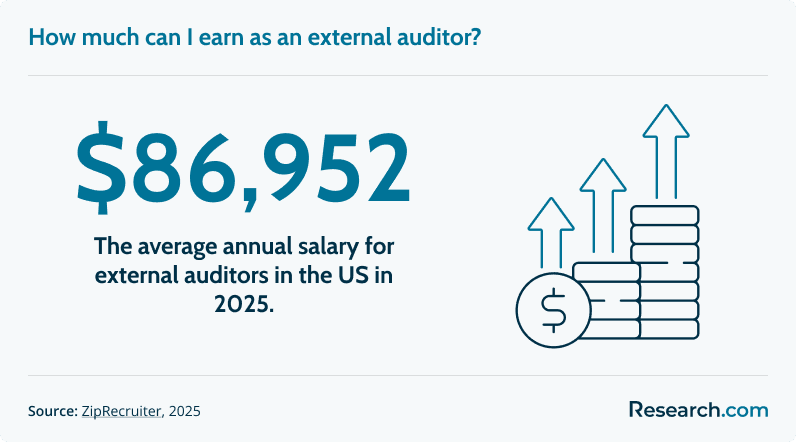
The earning potential for external auditors depends on experience, certification, employer type, location, industry, and the size of the engagements they handle. The median annual wage for accountants and auditors, which includes external auditors, is $81,680. This is a useful benchmark, but actual pay can differ significantly between entry-level staff roles and senior audit or leadership positions.
Entry-level positions start at about $51,670 per year. At this stage, auditors are usually building technical skills, learning audit methodology, and working under close supervision. With experience, auditors may move into senior, manager, or specialist roles. On the upper end, senior auditors can earn around $133,410 annually.
| Career stage | Typical earning reference | What usually drives pay growth |
| Entry-level auditor | About $51,670 per year | Internships, accounting coursework, software skills, and early audit experience |
| Accountants and auditors median | $81,680 | CPA progress, stronger technical judgment, and broader engagement experience |
| Senior-level potential | Around $133,410 annually | Leadership, specialization, client management, and complex audit responsibilities |
External auditor salary 2025 expectations should be treated as estimates, not guarantees. Metropolitan labor markets often pay more, but cost of living can offset the difference. CPA status, public accounting experience, industry specialization, and the ability to work on complex audits can improve earning potential over time.
What is the job outlook for External Auditors?
The employment of accountants and auditors, including external auditors, is projected to grow 5% through 2034. This is faster than the average for all occupations and points to continued demand for professionals who can support reliable financial reporting, compliance, and accountability.
The outlook is strongest for auditors who can combine traditional accounting knowledge with technology, data analysis, and regulatory awareness. Routine testing is increasingly supported by automation, but judgment-heavy work remains difficult to replace. Employers still need people who can evaluate risk, interpret evidence, challenge assumptions, and communicate conclusions responsibly.
The key factors shaping the future outlook
- Technology: Audit software, automation, and data analytics are changing how auditors test transactions and identify anomalies. Auditors who understand these tools will be better positioned.
- Regulation: Changing compliance expectations increase the need for professionals who can apply standards accurately and document decisions well.
- Talent supply: A shrinking talent pipeline can create opportunities for candidates with strong accounting preparation, CPA progress, and professional communication skills.
- Business complexity: Multinational operations, complex revenue models, cybersecurity concerns, and evolving reporting requirements add to audit risk and demand for skilled professionals.
For students who need a lower-cost route into the field, comparing cheap online schools that accept financial aid may help identify programs that make accounting education more accessible.
What is the typical work environment for External Auditors?
External auditors usually work in professional office settings, either at their own firm, remotely, or at client locations. The work environment can shift by season and engagement. One month may involve document review and virtual meetings; another may require onsite fieldwork, inventory observation, or frequent client check-ins.
Most external auditors work in accounting, tax preparation, bookkeeping, and payroll services (23%). Others work in government roles (8%), finance and insurance industries (8%), and companies and enterprises (6%). This variety gives auditors exposure to different industries, accounting systems, reporting risks, and business models.
The typical schedule is full time, but overtime is common during peak periods such as year-end audits, quarterly reporting deadlines, and major client engagements. Evenings or weekends may be necessary when audit deadlines are fixed and documentation is still incomplete. Remote work has become more common because of digital audit tools, but some responsibilities still require onsite presence, especially when observing physical inventory, meeting key client personnel, or reviewing sensitive documentation.
What the environment feels like in practice
- Structured but deadline-driven: Audit plans, checklists, and review processes provide structure, but timelines can be intense.
- Team-based: Junior auditors, seniors, managers, and partners typically coordinate closely throughout an engagement.
- Client-facing: Auditors must request information, clarify discrepancies, and discuss findings professionally.
- Detail-heavy: Much of the work involves documentation, testing, reconciliation, and review.
- Seasonal: Workloads can vary sharply between busy season and slower periods.
What are the pros and cons of External Auditor careers?
External auditing can be a rewarding career for people who like structure, analysis, financial reporting, and professional growth. It can also be stressful because deadlines, documentation standards, and client expectations are high. A realistic view of both sides will help you decide whether the role fits your personality and goals.
Pros
- Strong career foundation: Audit experience builds deep knowledge of financial statements, controls, business processes, and risk.
- Broad industry exposure: External auditors often work with clients in different sectors, which can help clarify long-term career interests.
- Clear advancement path: Public accounting firms usually have defined progression from associate to senior, manager, and beyond.
- Credibility: Audit experience and CPA progress can strengthen your profile for accounting, finance, consulting, and leadership roles.
- Purpose: Reliable audits support transparency, investor confidence, lender trust, and better financial governance.
Cons
- Long hours during peak periods: Busy season can involve extended workdays, weekend hours, and compressed deadlines.
- High documentation pressure: Audit files must support conclusions clearly, which can make the work time-consuming.
- Client friction: Some clients may be delayed, defensive, or disorganized when responding to audit requests.
- Repetitive testing: Entry-level work can involve detailed sampling and routine procedures before more complex judgment-based tasks are assigned.
- Responsibility and risk: Missing a material issue can have serious consequences for the audit firm, client, and stakeholders.
This career is best for people who can handle deadlines, stay organized, communicate diplomatically, and maintain skepticism without becoming adversarial. If cost is a concern while preparing for this path, comparing cheap bachelor degrees may help you find a more affordable starting point.
What are the opportunities for advancement for External Auditors?
External auditing offers several advancement routes. Some professionals climb within public accounting. Others use audit experience to move into corporate finance, internal audit, risk, compliance, consulting, forensic accounting, or executive roles. Your best path depends on whether you prefer client service, technical accounting, investigations, operations, or leadership.
Career advancement path
- Junior External Auditor: Entry-level role focused on testing transactions, preparing workpapers, supporting audit procedures, and learning firm methodology under supervision.
- Senior External Auditor: Leads audit sections, supervises junior staff, coordinates client requests, reviews workpapers, and handles more complex audit areas.
- Audit Manager: Oversees engagements, manages timelines, reviews major judgments, communicates with client leadership, and supports staff development.
- Senior Manager or Partner track: Focuses on client relationships, technical review, business development, risk management, and firm leadership.
- Financial Controller or CFO: Senior finance roles that use audit experience to strengthen reporting, controls, budgeting, compliance, and strategic decision-making.
Areas of specialization
- Financial Services Auditing: Focuses on banks, investment firms, insurance companies, and other financial institutions with complex regulatory and reporting requirements.
- Forensic Auditing: Involves investigating fraud, financial discrepancies, litigation support, and suspicious transactions.
- Healthcare Auditing: Centers on healthcare organizations, reimbursement issues, compliance obligations, and regulated financial processes.
- Manufacturing and Industrial Auditing: Covers inventory, cost accounting, supply chains, fixed assets, and production-related controls.
- Technology and data-focused auditing: Uses analytics, systems knowledge, and automated testing to improve audit coverage and identify unusual patterns.
Advancement is usually tied to a mix of technical quality, CPA progress or completion, leadership ability, client communication, and reliability under pressure. Auditors who can explain complex findings clearly and manage teams well often move faster than those who rely only on technical knowledge.
What other careers should you consider?
If you are interested in external auditing but unsure whether the lifestyle or client-service model fits you, several related careers use similar strengths. Comparing them can help you choose a path that matches how you prefer to work.
- Internal Auditor: Evaluates controls, risk management, compliance, and operations from inside an organization. This may appeal to people who want a long-term relationship with one employer rather than rotating among clients.
- Accountant: Prepares, analyzes, and reconciles financial records. This path can be a better fit if you prefer producing financial information rather than independently testing it.
- Financial Analyst: Uses financial data to evaluate performance, budgets, forecasts, investments, or business strategy. This role may suit people who enjoy forward-looking analysis more than compliance-focused review.
- Audit Consultant: Advises organizations on financial processes, controls, compliance, and audit readiness. This can offer more project variety and problem-solving work.
- FBI Agent (Financial Crimes/Forensic Accountant): Applies accounting and investigative skills to fraud, financial crimes, and complex records analysis. This path is best for people drawn to law enforcement, investigations, and evidence-based casework.
| Career | Best fit if you want | How it differs from external auditing |
| Internal Auditor | Risk and controls work inside one organization | More internal improvement focus, less independent financial statement opinion work |
| Accountant | Financial preparation and reporting | More ownership of records, less third-party verification |
| Financial Analyst | Forecasting, budgeting, and performance analysis | More decision support and strategy, less audit testing |
| Audit Consultant | Project-based advisory work | More recommendations and implementation support, depending on the role |
| FBI Agent (Financial Crimes/Forensic Accountant) | Investigations and fraud analysis | More legal and investigative work, often with a public service focus |
The best choice depends on what motivates you: independent assurance, operational improvement, financial planning, advisory work, or investigation. External auditing is a strong launchpad because it develops transferable accounting, control, documentation, and communication skills.
Here's What Professionals Say About Their External Auditor Careers
- : "Every completed audit reminds me that the work is bigger than a spreadsheet. When the evidence supports the opinion and the client strengthens its reporting, I know I have helped protect financial honesty for the people who rely on those statements. The deadlines can be tough, but the purpose behind the work makes it worthwhile. — Jewel"
- : "Busy season tested me early in my career. I had to learn how to manage several client timelines, follow up without sounding frustrated, and keep my documentation clean even when priorities changed. The pressure is real, but it also made me more organized and more confident. — Leslie"
- : "Some of my best days have come from difficult findings that led to real process improvements. I have also had assignments that took me into unexpected places, including vineyards during inventory work. The role has more variety and human interaction than many people expect. — Raj"
Key Findings
- External auditors independently review financial statements, records, controls, and evidence to assess whether financial information is materially accurate and reliable.
- The most common educational path is a bachelor’s degree in accounting or finance, followed by supervised experience and, for many roles, CPA preparation or completion.
- The median annual wage for accountants and auditors, including external auditors, is $81,680, with entry-level positions starting at about $51,670 per year and senior auditors earning around $133,410 annually.
- Employment of accountants and auditors is projected to grow 5% through 2034, supported by continuing demand for financial transparency, compliance, and audit expertise.
- The career offers strong advancement potential, including senior audit roles, audit management, forensic auditing, financial services auditing, controllership, and CFO pathways.
- The main trade-offs are long hours during busy seasons, heavy documentation requirements, client pressure, and the need for consistent professional skepticism.
- This career is best for detail-oriented people who enjoy accounting, evidence-based analysis, ethical responsibility, and structured professional growth.
Other Things You Should Know About External Auditor
In 2027, external auditors need strong analytical skills, attention to detail, and proficiency in data analytics software. Communication skills are critical for presenting findings, and a solid understanding of regulatory standards is crucial. Familiarity with emerging technologies, including AI and blockchain, is increasingly valuable in the evolving financial landscape.
Becoming an external auditor in 2026 typically takes 4-6 years. This includes earning a bachelor's degree in accounting or a related field, followed by certification such as CPA or CA, which may require an additional 1-2 years of experience and exams.
References
- The Pros and Cons of Internal vs. External Auditing https://www.gtaaccounting.ca/blog/the-pros-and-cons-of-internal-vs-external-auditing
- 5 benefits of moving from external audit to internal audit | Barclay Simpson https://www.barclaysimpson.com/5-benefits-of-moving-from-external-audit-to-internal-audit/
- 99+ External Auditor Interview Questions + Answers https://joingenius.com/interview-questions/external-auditor/
- Auditor - Alternative Careers and Similar Jobs (Updated for 2025) https://resumeworded.com/career-profiles/auditor-career-profile
- 7 External Auditor Job Description Templates and Examples | Himalayas https://himalayas.app/job-descriptions/external-auditor
- How to become an external auditor https://www.harveyjohn.com/media-hub/how-to-become-an-external-auditor/
- 2025 Career Goals for Auditors - 12+ Goal Examples (Full Guide) https://www.tealhq.com/professional-goals/auditor
- 5 in-demand soft skills for auditors you need to know about https://www.apollo-solutions.com/resources/blog/5-in-demand-soft-skills-for-auditors-you-need-to-know-about/
- 5 key areas to test when building an effective external audit plan https://charteredaccountantsworldwide.com/5-key-areas-test-building-effective-external-audit-plan/
- 5 Reasons External Auditing Is a Smart Career Choice | CPAClub https://cpaclub.cpa/5-reasons-external-auditing-is-a-smart-career-choice/


