
2027 How to Become an Athletic Trainer: Education, Salary, and Job Outlook

Co-Founder and Chief Data Scientist
Becoming an athletic trainer is a healthcare career decision, not just a sports career decision. Athletic trainers evaluate injuries, provide emergency care, guide rehabilitation, reduce injury risk, and coordinate with physicians, coaches, athletes, parents, and employers. The role suits people who want hands-on clinical work in active settings and who can make calm decisions when injuries happen quickly.
The path is more structured than many students expect. You need accredited graduate education, national certification, state authorization where required, and ongoing professional development. With over 27,000 certified athletic trainers in the U.S., the field offers work in schools, colleges, clinics, professional sports, industrial workplaces, the military, and performing arts settings. This guide explains the credentials, skills, career stages, pay expectations, workplace options, challenges, and practical signs that athletic training may be the right fit for you.
What are the benefits of becoming an athletic trainer?
- The job outlook for athletic trainers is projected to grow 11% from 2024 to 2034, reflecting increased demand in sports, healthcare, and wellness sectors.
- Average salaries hover around $50,000 to $60,000 annually, with top earners exceeding $75,000, offering stable and competitive income potential.
- Choosing this career blends passion for sports with science, providing fulfilling work that enhances athletes' health and performance in dynamic environments.
What credentials do you need to become an athletic trainer?
To become an athletic trainer, you generally need a CAATE-accredited master's degree, Board of Certification approval through the BOC exam, state licensure or regulation where applicable, and continuing education to keep your credential active. The profession has moved away from the older bachelor's-only route, so students should plan carefully before choosing a program.
- Master's Degree: The standard education route is a master's degree from a program accredited by the Commission on Accreditation of Athletic Training Education (CAATE). This matters because BOC exam eligibility is tied to accredited education. A bachelor's degree can still be useful preparation, but it is not the current endpoint for entering the profession.
- Board of Certification (BOC) Exam: After completing the required accredited education, candidates must pass the BOC exam to earn the ATC® credential. The exam covers core practice areas such as wellness and prevention, clinical evaluation, emergency care, therapeutic intervention, and healthcare administration.
- State Licensure: National certification is not the same as legal permission to practice in every state. Many states require licensure, registration, or another form of authorization. Requirements can include applications, fees, background checks, jurisprudence exams, or proof of certification, so check the rules in the state where you intend to work.
- Continuing Education: Athletic trainers must continue learning after certification. Continuing education helps maintain professional competence and typically includes topics such as emergency cardiac care, evidence-based treatment, documentation standards, and changes in sports medicine practice.
When comparing graduate pathways, look first for CAATE accreditation, clinical placement quality, BOC exam preparation, faculty expertise, and state licensure alignment. If speed and flexibility are priorities, reviewing 1 year masters online options may help you understand accelerated graduate formats, but always confirm that any athletic training program meets the accreditation requirements for certification.
What skills do you need to have as an athletic trainer?
Athletic trainers need clinical judgment, technical competence, communication skill, and emotional steadiness. The work often happens in real time: an athlete is hurt, a coach wants an answer, a parent is worried, and the trainer must evaluate the situation without guessing or overreacting.
- Orthopedic clinical examination: You must be able to assess joints, muscles, ligaments, tendons, and movement limitations to determine the likely nature and severity of an injury.
- Acute injury management: Athletic trainers respond to sudden injuries and emergencies. This requires confident use of emergency action plans, stabilization techniques, referral protocols, and return-to-play decision-making.
- Therapeutic modality application: Recovery may involve therapeutic exercises, manual techniques, bracing, taping, and other interventions. The skill is not just knowing the tool, but knowing when it is appropriate.
- Risk management strategies: Trainers help prevent injuries by monitoring training loads, environmental risks, equipment issues, conditioning practices, and sport-specific hazards.
- Pharmacological knowledge: Athletic trainers need working knowledge of common medications, contraindications, side effects, and referral considerations, while practicing within their legal scope.
- Clinical documentation: Accurate records support continuity of care, insurance processes, legal protection, and communication with physicians and other healthcare providers.
- Biomechanical analysis: Evaluating how someone moves can reveal inefficient mechanics, compensation patterns, or risk factors that may contribute to injury.
- Critical thinking: The job requires fast but careful decisions, especially when symptoms are unclear, pressure is high, or an athlete wants to return before it is safe.
Soft skills matter as much as technical skills. Athletic trainers must explain medical decisions to nonmedical audiences, build trust with athletes, and hold firm boundaries when safety conflicts with competition goals.
What is the typical career progression for an athletic trainer?
Athletic training careers often begin with direct patient care and expand into leadership, specialization, administration, teaching, or clinical coordination. Progression depends on setting, performance, credentials, mentorship, and willingness to take on management responsibilities.
- Entry-Level Athletic Trainer: Staff and assistant athletic trainers usually focus on evaluations, acute care, rehabilitation support, taping, documentation, and daily coverage of practices or events. The first 1 to 6 years are typically spent building clinical confidence, learning workflow, and strengthening professional judgment.
- Senior or Head Athletic Trainer: Between years 7 and 12, many professionals move into roles with more autonomy. Responsibilities may include supervising junior staff, coordinating care with physicians, developing health and safety programs, managing equipment and supplies, and communicating with administrators or athletic departments.
- Director, Clinical Coordinator, or Program Manager: Advanced roles may involve department leadership, policy development, staff hiring, budget oversight, compliance, and long-term strategy. Some professionals pursue doctoral qualifications or build substantial administrative experience to compete for these positions.
- Specialization and Lateral Moves: Career growth is not always vertical. Athletic trainers may move into orthopedic rehabilitation, pediatrics, military settings, performing arts medicine, occupational health, research, education, or industry roles. These moves can offer better work-life fit, different patient populations, or more predictable schedules.
| Career stage | Main focus | What helps you move forward |
| Entry level | Clinical skill-building, event coverage, rehabilitation support | Strong documentation, dependable communication, willingness to learn |
| Senior or head role | Leadership, independent decision-making, staff support | Experience, trust from physicians and administrators, consistent outcomes |
| Director or program manager | Program strategy, compliance, budgeting, policy | Management ability, advanced expertise, professional reputation |
| Specialist or lateral path | Focused practice area or new work setting | Targeted training, networking, niche clinical experience |
How much can you earn as an athletic trainer?
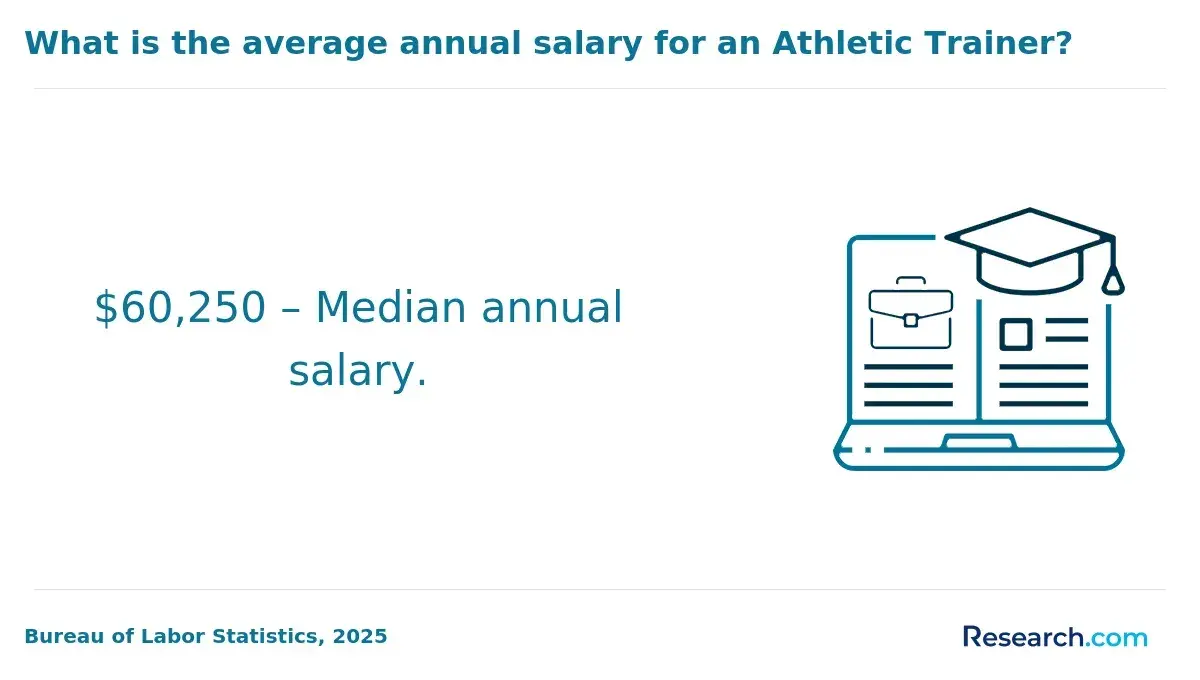
Athletic trainer pay varies widely by experience, setting, location, schedule demands, and leadership responsibility. The average athletic trainer salary in the United States hovers near $60,250 according to the U.S. Bureau of Labor Statistics, with some estimates slightly higher at $61,540. Entry-level athletic trainers might start closer to $43,000, while seasoned professionals and those in leadership roles can earn above $80,000.
At the elite tier, salaries can approach $99,000. Higher earnings are more likely when an athletic trainer has substantial experience, manages staff or programs, works in a higher-paying market, or develops specialized clinical skills. A master's degree is now commonly treated as the baseline qualification, so students should not assume that graduate education alone guarantees higher pay; the work setting and level of responsibility still matter.
| Salary point | Amount stated | How to interpret it |
| Average salary from the U.S. Bureau of Labor Statistics | $60,250 | A broad national benchmark, not a guarantee for a specific job offer |
| Alternative estimate | $61,540 | A slightly higher estimate that reflects differences in data sources |
| Possible entry-level starting point | $43,000 | More common for new professionals or lower-paying settings |
| Experienced or leadership-level earnings | Above $80,000 | More likely with seniority, management duties, or specialized roles |
| Elite-tier potential | $99,000 | Usually associated with top-end roles, markets, or organizations |
Location can also affect earnings. Salaries can peak at $82,366 in Oregon and about $58,837 in California, reflecting differences in demand, cost of living, employer type, and local labor markets. Before accepting an offer, compare salary with schedule expectations, travel, benefits, licensure costs, and opportunities for advancement.
If you are still planning your undergraduate path, reviewing the easiest bachelor's degree to get can help you think through pre-professional options, but make sure your coursework prepares you for admission to an accredited athletic training graduate program.
What internships can you apply for to gain experience as an athletic trainer?
Internships and clinical experiences help students turn classroom knowledge into practical judgment. For athletic training students, the most valuable opportunities provide supervised exposure to injury evaluation, emergency planning, rehabilitation, documentation, and interprofessional communication. Some experiences are built into accredited programs, while others may be supplemental and competitive.
- Professional sports organizations: Opportunities with teams in leagues such as the NFL and MLB, as well as performance organizations such as EXOS, can expose interns to high-performance environments, athlete recovery routines, equipment preparation, and collaboration with strength, conditioning, and medical staff.
- Healthcare providers: Clinics and systems such as UW Health may offer experience in patient intake, injury evaluation, manual therapy, therapeutic exercise, rehabilitation progression, and medical documentation. These settings are especially useful for students who want a stronger clinical foundation beyond the sideline.
- University and school teams: College and school-based placements often involve practice and game coverage, taping, emergency equipment checks, rehabilitation sessions, and communication with coaches. These settings teach time management because multiple athletes may need care at once.
- Corporations, nonprofits, and government agencies: These less traditional experiences may involve workplace wellness, injury prevention, community sports programs, tactical populations, or public health initiatives. They can broaden your understanding of where athletic training skills apply.
When evaluating an internship, ask who supervises you, what tasks you are permitted to perform, whether the experience aligns with your program requirements, and how feedback is provided. A prestigious setting is less useful if you only observe; a smaller site with strong mentoring may build better clinical competence.
Students considering long-term academic or leadership goals may also compare advanced education formats, including a doctorate degree no dissertation, but practical clinical experience remains essential for athletic training career readiness.
How can you advance your career as an athletic trainer?
Advancement in athletic training usually comes from a combination of clinical excellence, reliability, specialized expertise, leadership ability, and professional visibility. The strongest candidates do not simply collect credentials; they use training and experience to solve higher-level problems for athletes, patients, teams, and organizations.
- Continuing Education: Go beyond minimum renewal requirements by choosing courses that match your career goal. For example, a trainer pursuing clinic work may prioritize rehabilitation and orthopedic assessment, while one in school athletics may focus on emergency care, heat illness, concussion management, and policy implementation.
- Professional Networks: Join athletic training communities, attend conferences, volunteer for committees, and build relationships with physicians, physical therapists, coaches, and administrators. Many better opportunities are discovered through trusted professional contacts before they appear in broad job searches.
- Mentorship: Seek more than one mentor. A clinical mentor can sharpen your evaluation and treatment skills, while an administrative mentor can help you understand budgeting, staffing, negotiation, and leadership. Peer mentors also help you compare workplaces and avoid avoidable mistakes.
- Specialized Certifications: Advanced credentials can help you stand out when they match a real practice need. Choose certifications that support your target setting rather than adding letters to your résumé without a clear purpose.
Career advancement also requires documentation of results. Track projects you led, policies you improved, injury prevention efforts, return-to-play processes, and staff training contributions. These examples make promotion conversations and job interviews more concrete.
Where can you work as an athletic trainer?
Athletic trainers work wherever physically active people need injury prevention, immediate care, rehabilitation guidance, and return-to-activity decisions. Traditional sports settings remain important, but the profession has expanded into healthcare, occupational, military, and performing arts environments.
- Colleges and universities: Athletic trainers support student-athletes in settings that may include NCAA Division I powerhouses and Big Ten programs. Work can involve practice coverage, travel, rehabilitation, medical coordination, and compliance with institutional policies.
- Secondary schools: Public and private schools hire athletic trainers to provide first response, injury evaluation, rehabilitation guidance, and health education for young athletes. These roles may involve broad responsibility because the trainer can be one of the few medical professionals on site.
- Professional sports: Organizations in the NFL, NBA, MLB, NHL, and Olympic teams rely on athletic trainers for injury care, performance support, recovery coordination, and communication across medical and coaching staff.
- Sports medicine clinics and healthcare systems: Facilities such as Mayo Clinic and Concentra may use athletic trainers in rehabilitation, physician practice support, patient education, outreach, and community sports medicine services.
- Industrial employers: Companies such as Amazon and Boeing, as well as construction environments including those managed by Turner Construction Company, may employ athletic trainers to reduce workplace injury risks, support ergonomics, and improve employee readiness.
- Military and government agencies: The U.S. Army and Air Force integrate athletic trainers into readiness and resilience efforts, where the patient population may face high physical demands.
- Performing arts: Dance companies and orchestras use athletic trainers to help performers prevent and recover from overuse injuries, acute injuries, and workload-related physical stress.
- Municipal police and fire departments: Athletic trainers may support occupational health, fitness, injury prevention, and return-to-duty processes for public safety professionals.
Each setting has trade-offs. Sports roles may offer team identity and high-energy environments but require nights, weekends, and travel. Clinic and industrial roles may provide more predictable schedules but less traditional game-day work. If speed of entry into related fields is part of your planning, fast online degrees that pay well can help you compare educational timelines, but athletic training itself requires the proper accredited pathway.
What challenges will you encounter as an athletic trainer?
Athletic training can be meaningful, but it is not an easy fallback career. The work combines healthcare responsibility, unpredictable schedules, emotional pressure, and frequent communication with people who may have competing priorities.
- Heavy workload and long hours: Athletic trainers may cover practices, games, rehabilitation sessions, documentation, meetings, and travel. Schedules can shift quickly when weather, injuries, tournaments, or staffing shortages occur.
- Psychological demands: Athletes may be anxious, frustrated, or fearful after an injury. Trainers often support both physical recovery and emotional adjustment while staying within professional boundaries.
- Competitive job market: Desirable positions in college athletics, professional sports, and elite performance settings can attract many qualified applicants. Experience, networking, and specialized skills can make a difference.
- Regulatory complexity: Athletic trainers must understand licensure rules, documentation requirements, privacy expectations, referral protocols, and employer policies. Mistakes can create clinical and legal risk.
- Role ambiguity and decision-making challenges: In some settings, especially where an athletic trainer works alone, expectations may be unclear. New professionals may need to educate administrators and coaches about scope of practice and safe decision-making.
- Mentorship scarcity: Some early-career trainers have limited access to experienced colleagues. Without mentorship, it can be harder to refine clinical judgment or navigate workplace politics.
- Compensation concerns: Pay may not always match the level of education, responsibility, and schedule demands. Candidates should evaluate total compensation, benefits, workload, and advancement potential before accepting a role.
The best way to prepare is to ask direct questions before enrolling in a program or accepting a job: Who supervises new trainers? How many athletes or patients are assigned? What emergency policies are in place? How is overtime or travel handled? What resources are available for continuing education?
What tips do you need to know to excel as an athletic trainer?
Excelling as an athletic trainer requires more than knowing injury protocols. The strongest professionals combine clinical accuracy with trust-building, consistency, and the ability to explain decisions clearly under pressure.
- Develop unshakable communication skills so athletes, coaches, parents, and healthcare providers understand what is happening, what the next step is, and why a decision was made.
- Sharpen critical thinking by treating each injury as a specific clinical problem rather than relying only on routine assumptions. Similar symptoms can have different causes and different risks.
- Adopt meticulous organizational habits for documentation, equipment checks, rehabilitation plans, physician notes, and follow-up timelines. Small administrative errors can become major care gaps.
- Embrace lifelong learning through continuing education in areas such as strength conditioning, sports nutrition, emergency response, rehabilitation, and evidence-based practice.
- Cultivate authentic relationships with mentors, peers, physicians, coaches, and administrators. Trust makes it easier to advocate for athlete safety when pressure is high.
- Integrate holistic health approaches by considering sleep, nutrition, mental wellness, workload, and recovery strategies instead of focusing only on the injured body part.
Also learn to set professional boundaries. Being dedicated does not mean being available without limits or allowing unsafe return-to-play decisions. Clear policies, strong documentation, and consistent communication protect both the athlete and the trainer.
How do you know if becoming an athletic trainer is the right career choice for you?
Athletic training may be a strong fit if you want a healthcare role that is active, team-oriented, and decision-heavy. It may be a poor fit if you want predictable office hours, minimal emotional stress, or work that rarely involves urgent situations.
- Adaptability and Empathy: Successful athletic trainers stay calm in fast-moving environments while still treating injured athletes and patients with patience and respect.
- Personality Traits: Research on qualities needed to be an athletic trainer shows many succeed with a practical, organized "sensing-feeling-judging" mindset, while others bring a more sociable and energetic style. There is no single personality type, but reliability and sound judgment are essential.
- Work Schedule and Environment: Expect irregular hours, including nights and weekends, especially in sport settings. Travel may also be part of the job. If you prefer a stable 9-to-5 routine, compare clinic, industrial, or occupational roles before committing to a sports-heavy path.
- Emotional and Physical Demands: The role can involve emergency response, difficult conversations, frustrated athletes, and long periods on your feet. Physical stamina and emotional resilience both matter.
- Career Satisfaction Indicators: Athletic trainer career satisfaction in the US correlates strongly with a passion for sports medicine, clear communication skills, and comfort in high-stress moments.
A practical way to test your fit is to shadow athletic trainers in more than one setting. Compare a secondary school, a clinic, and a college or professional environment if possible. You may discover that the profession is right for you but that one setting fits your life better than another. If you are still exploring education options broadly, trade colleges online can help you compare flexible career-training routes, though athletic training requires its specific accredited education and certification pathway.
What Professionals Who Work as an Athletic Trainer Say About Their Careers
- : "Pursuing a career as an athletic trainer has given me incredible job stability and competitive salary potential, especially as demand grows in both healthcare and sports sectors. I appreciate how my expertise is valued across diverse settings, from hospitals to professional teams. This career truly offers a secure and rewarding path. — Manuel"
- : "The unique challenges of working in athletic training keep every day exciting—from injury prevention on the field to emergency response during competitions. It's a fast-paced environment that requires quick thinking and adaptability, which I love. I feel fortunate to have a career that constantly pushes me to grow. — Brent"
- : "What stands out to me in athletic training is the continual professional development and clear opportunities for advancement through certifications and specialized training. The career growth potential is significant, and I am motivated knowing I can evolve my practice in tandem with new research and techniques. It's a truly dynamic field. — Jasmine"
Other Things You Should Know About Becoming an Athletic Trainer
To become an athletic trainer in 2027, a candidate must hold at least a master's degree in Athletic Training. Accredited programs combine classroom and clinical experience. Completion of coursework in areas like anatomy, physiology, and nutrition is essential, followed by certification exams such as the Board of Certification (BOC).
Yes, CPR (Cardiopulmonary Resuscitation) certification is typically required for athletic trainers. Because they often work in environments where sudden injuries or emergencies occur, being trained in CPR allows them to respond quickly and effectively to life-threatening situations until further medical help arrives.
Continuing education is mandatory to maintain certification with the Board of Certification for athletic trainers. They must complete a specified number of continuing education units (CEUs) every few years to stay current with medical advancements and best practices, ensuring high-quality care for their patients and clients.
References
- How to Market Yourself as an Athletic Trainer - Athletic Trainer Insurance Plus https://athletictrainerinsuranceplus.com/how-to-market-yourself-as-an-athletic-trainer/
- Why I Became An Athletic Trainer - Hulst Jepsen PT https://www.hjphysicaltherapy.com/why-i-became-an-athletic-trainer/
- Breaking Barriers: Overcoming Common Challenges in Sports Performance Training - Alkeme Sports Rx https://alkemesportsrx.com/breaking-barriers-overcoming-common-challenges-in-sports-performance-training/
- Athletic Trainers : Occupational Outlook Handbook: : U.S. Bureau of Labor Statistics https://www.bls.gov/ooh/healthcare/athletic-trainers.htm
- Challenges for Newly Credentialed Athletic Trainers During Their Transition to Practice - PMC https://pmc.ncbi.nlm.nih.gov/articles/PMC6863686/
- 101 Tips For Starting Athletic Development Training https://kingsportstraining.com/14929481-101-tips-for-starting-athletic-development-training
- Average Athletic Trainer Salary in the US https://www.carerev.com/blog/average-athletic-trainer-salary-in-the-us
- Here are Some Facts About Athletic Trainers You Should Know https://atp.uidaho.edu/blog/thinking-about-an-athletic-training-profession-here-are-some-facts-about-athletic-trainers-you-should-know/
- What is athletic training? Part 4: Benefits of the career — ATvantage Athletic Training https://www.theatvantage.com/blog/what-is-athletic-training-part-4-benefits-of-the-career
- Athletic training: Salary, career path and how to get started https://www.cmich.edu/blog/all-things-higher-ed/athletic-training-salary-career-path-and-how-to-get-started


