
2027 Informatics Nursing Careers: Skills, Education, Salary & Job Outlook

Co-Founder and Chief Data Scientist
Choosing an informatics nursing career means deciding whether you want to move beyond bedside care into the systems, data, and technology that shape how care is delivered. The field is not simply “nursing plus computers.” It requires clinical judgment, workflow analysis, communication across teams, and enough technical fluency to improve electronic health records, reporting tools, decision support, and patient safety processes.
The path can feel demanding because it usually takes 4 to 6 years of education and practice to become fully qualified. That investment matters: informatics nurses often influence care at a wider scale than they could in a single unit, helping entire organizations use data and technology more safely and efficiently.
This guide explains what informatics nurses do, the skills and credentials employers look for, how to enter the field, what salaries and work environments look like, and where the career can lead. Reported salaries range from $61,000 to over $300,000, but actual earnings depend heavily on experience, location, role level, certifications, employer type, and leadership responsibility.
Key Things You Should Know About Informatics Nursing Career
- The typical earning potential for an informatics nurse ranges from $85,000 to $100,000 annually, with over 60% earning more than $100,000 according to recent surveys.
- This is a rapidly growing specialty driven by healthcare digitization, indicating strong demand and stable career prospects.
- Starting as a registered nurse, typically with a BSN, is required, and many employers prefer additional certification or a master's degree in nursing informatics for advancement.
- Success requires strong clinical nursing knowledge, proficiency in health information technology, data analysis skills, project management, communication, and problem-solving abilities.
- Career advancement can lead to roles such as nursing informatics specialist, informatics manager, director of nursing informatics, or chief nursing informatics officer through experience, education, and certifications.
What do Informatics Nurses do?
Informatics nurses help healthcare organizations use technology in ways that support safer, faster, and more reliable care. They sit between clinical teams and technical teams, translating nursing workflows into system requirements and turning digital tools into processes clinicians can actually use.
The work often centers on electronic health records, clinical documentation, data quality, reporting, decision support, staff training, system testing, and workflow redesign. Instead of providing direct patient care throughout a shift, informatics nurses improve the tools and processes that many clinicians rely on every day.
A day in the life of Informatics Nurses
A typical day may include meeting with nurses or physicians about a documentation problem, reviewing data to identify workflow bottlenecks, testing an EHR update, writing training materials, troubleshooting a system issue, or coordinating with IT analysts and vendors. The role is usually office-based, but it still depends on strong clinical credibility because system changes can affect patient care, staff workload, compliance, and safety.
The pace varies. Some weeks are steady and analytical; others are intense, especially during system launches, upgrades, audits, or urgent workflow fixes. The best informatics nurses are comfortable moving between details and big-picture thinking: they can spot a technical issue, understand the clinical risk, and explain the solution in plain language.
What are the key responsibilities of Informatics Nurses?
Informatics nurses are responsible for making healthcare technology useful, safe, and aligned with clinical practice. Their responsibilities vary by employer, but most roles combine workflow improvement, system support, data analysis, training, and cross-functional communication.
- Assess clinical workflows and identify where technology creates delays, errors, duplicate work, or documentation burden.
- Gather and analyze clinical data to find quality, safety, compliance, and operational improvement opportunities.
- Support the development, implementation, and optimization of electronic medical record (EMR) systems and related healthcare technologies.
- Participate in system testing, validation, upgrade planning, and go-live support to reduce disruption for clinical users.
- Train nurses, physicians, and other staff on new features, documentation standards, troubleshooting steps, and system protocols.
- Collaborate with clinical leaders, IT teams, administrators, compliance teams, and vendors to align technical changes with care delivery needs.
- Monitor system performance, data integrity, documentation quality, and workflow efficiency after implementation.
- Help departments resolve technology-related problems while protecting patient privacy, data accuracy, and regulatory compliance.
The most challenging vs. the most rewarding tasks
The hardest work often comes during large system transitions, such as EMR implementations, migrations, or major upgrades. These projects require coordination across many stakeholders, careful communication, rapid problem-solving, and patience with staff who may be frustrated by change. A poor rollout can slow care, increase documentation errors, or damage trust in the system.
The most rewarding part is seeing a change produce measurable improvement. A redesigned workflow may reduce duplicate documentation. A better alert may help clinicians act sooner. A cleaner report may give leaders the data they need to improve staffing, quality, or safety. For nurses who want to expand their impact beyond one patient assignment, that scale can be a major reason to enter the field.
Nurses who need a faster route to graduate-level preparation sometimes compare flexible options such as a 1 year masters program, but the right choice depends on accreditation, clinical requirements, cost, schedule, and whether the curriculum supports informatics goals.
What are the key skills for Informatics Nurses?
Employers look for informatics nurses who can understand clinical practice, evaluate data, improve systems, and earn trust from both frontline staff and technical teams. Technical knowledge matters, but the role is not purely technical. Communication, change management, and clinical judgment are just as important.
Key technical skills
- Electronic Health Records (EHR) Systems: Understand how clinicians document care, retrieve information, place orders, follow protocols, and use clinical decision support within digital systems.
- Data Analytics and Interpretation: Turn patient care data, workflow data, and quality metrics into practical recommendations for improvement.
- Health Information Systems Implementation: Help plan, test, launch, and optimize clinical systems without disrupting patient care more than necessary.
- Database Management: Understand how data is stored, queried, validated, and reported so clinical and operational decisions are based on reliable information.
Essential soft skills
- Critical Thinking: Evaluate whether a technology change truly solves the clinical problem or simply moves the burden elsewhere.
- Complex Problem Solving: Resolve issues that involve people, process, policy, software limitations, and patient safety risks.
- Active Listening: Understand what nurses, physicians, administrators, and IT staff actually need before proposing a solution.
- Coordination and Collaboration: Keep projects moving across departments that may have different priorities, timelines, and vocabulary.
The one overlooked skill that separates the good from the great
Project management is one of the most valuable but often underestimated skills in nursing informatics. A system upgrade is not successful just because the software works. It also needs a realistic timeline, clear ownership, user testing, training, communication, risk management, and follow-up after launch.
For example, an informatics nurse supporting a clinical system upgrade may need to coordinate IT analysts, nurse leaders, super users, compliance reviewers, and vendor staff. Without project management, missed details can create delays or workflow problems. With strong project management, the same rollout can be safer, calmer, and easier for staff to adopt.
If you are comparing online education options to build technical or healthcare-administration skills, resources such as easiest degrees to get online can be a starting point. Still, choose programs based on accreditation, curriculum quality, transferability, cost, and career relevance rather than convenience alone.
Informatics Nursing Careers: A Step-by-Step Guide to Getting Started
The path to informatics nursing is easier to plan when you treat it as a sequence: become a licensed nurse, build clinical credibility, develop informatics exposure, then pursue roles and credentials that match your goals. Many employers prefer candidates who understand real clinical workflows before moving into system design or optimization.
- Complete nursing education. Start with an approved nursing program that prepares you for registered nurse licensure. A BSN is often the stronger long-term option for informatics roles, though some nurses begin with an ADN and continue their education later.
- Earn RN licensure. Meet your state’s requirements and pass the required licensing exam before practicing as a registered nurse.
- Build clinical experience. Work in patient care long enough to understand documentation demands, communication patterns, staffing realities, safety risks, and how technology affects daily practice.
- Seek informatics exposure. Volunteer for EHR committees, become a super user, assist with training, participate in quality improvement projects, or help test workflow changes.
- Develop technical and analytical skills. Learn the basics of EHR configuration, reporting, data quality, project management, workflow mapping, privacy, and healthcare regulations.
- Move into an informatics role. Look for titles such as informatics nurse, clinical informatics specialist, EHR analyst, clinical analyst, or nursing informatics specialist.
- Pursue certification when eligible. Professional credentialing can strengthen credibility once you meet education, licensure, experience, and practice-hour requirements.
A common mistake is trying to skip the clinical foundation. Informatics work is most effective when the nurse understands what happens at the bedside, where documentation burden comes from, and how a small system change can affect patient care.
What education, training, or certifications are required?
The core qualification for informatics nursing is registered nurse licensure. From there, employers often prefer or require a Bachelor of Science in Nursing (BSN), especially for roles that involve system implementation, leadership, quality improvement, or certification eligibility. An Associate Degree in Nursing (ADN) may qualify a nurse for RN licensure, but most informatics roles are more competitive with a BSN at minimum.
Advanced roles may require or strongly prefer a Master of Science in Nursing (MSN) with an informatics focus, a related graduate degree, or a Doctor of Nursing Practice (DNP) with an informatics specialty. These credentials can be especially useful for leadership, consulting, education, research, and enterprise-level informatics work.
The main nursing informatics credential is the Informatics Nursing Certification (NI-BC™) from the American Nurses Credentialing Center (ANCC). It requires a BSN or higher, an active RN license, two years of full-time RN experience, and documented informatics practice hours. The RN license itself is mandatory and is obtained by passing the NCLEX exam. On-the-job preparation commonly includes at least two years of clinical RN experience and up to 2,000 hours of informatics nursing practice to maintain certification eligibility.
Education and credential options
| Credential or training | How it helps | Best fit |
| ADN plus RN licensure | Can start a nursing career and build clinical experience | Nurses who plan to continue toward a BSN while working |
| BSN plus RN licensure | Common baseline for informatics roles and certification pathways | Nurses who want stronger access to informatics opportunities |
| MSN in Informatics | Builds advanced knowledge in systems, data, leadership, and healthcare technology | Nurses pursuing specialist, manager, educator, or leadership roles |
| DNP with informatics specialty | Supports advanced practice leadership, systems improvement, and organizational strategy | Nurses aiming for senior leadership or high-level transformation work |
| NI-BC™ certification | Provides professional validation of nursing informatics knowledge and experience | Experienced RNs who meet eligibility requirements |
Are advanced degrees or niche certifications worth the investment?
Advanced degrees can be worth the investment if your goal is leadership, consulting, research, education, or high-level systems strategy. They may also help with career stability and credibility in organizations that require graduate preparation for senior roles. However, they can be expensive and time-intensive, often taking two to four years plus significant clinical and informatics practice.
Certifications can also be valuable, but they are not a shortcut into the field. They require experience, eligibility documentation, exam preparation, and continuing education. For many nurses, the best sequence is to gain clinical experience, participate in informatics-related projects, move into an informatics role, and then pursue certification when it supports a clear career objective.
If you are considering doctoral study but want alternatives to traditional research-heavy formats, options such as a doctoral degree no dissertation may be worth comparing. Review accreditation, curriculum, residency or project requirements, cost, and employer recognition before enrolling.
What is the earning potential for Informatics Nurses?
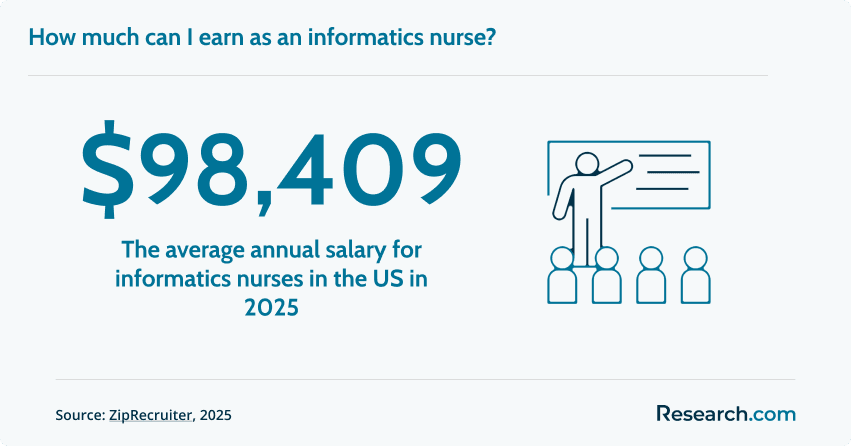
Nursing informatics can offer strong earning potential because the role combines licensed clinical expertise with technology, data, workflow, and organizational improvement skills. The median annual salary for an Informatics Nurse is approximately $98,409, making it a financially attractive option for nurses who want to move into a more systems-focused career.
The informatics nurse starting salary 2025 typically begins around $70,000 for entry-level positions. Senior-level nurses with advanced skills, certifications, and leadership responsibility can earn up to $150,500. Reported compensation can be higher in some executive, consulting, or specialized leadership roles, which is why broad salary discussions sometimes include salaries ranging from $61,000 to over $300,000.
| Career stage | Salary figure stated | What can influence earnings |
| Entry level | Around $70,000 | Clinical background, location, employer type, EHR exposure, and first informatics role title |
| Median | Approximately $98,409 | Experience, certifications, project scope, and technical responsibility |
| Senior level | Up to $150,500 | Leadership duties, advanced education, enterprise projects, consulting, and specialized expertise |
| Broad reported range | $61,000 to over $300,000 | Role level, geography, employer, executive responsibility, and consulting or technical leadership work |
Location can make a major difference, especially in areas such as Washington, DC, New York, and Massachusetts. Earnings may also rise with experience in EHR implementations, analytics, quality improvement, regulatory reporting, project management, and leadership. When comparing opportunities, look beyond base salary and consider remote-work flexibility, benefits, tuition support, certification reimbursement, call expectations, and promotion pathways.
What is the job outlook for Informatics Nurses?
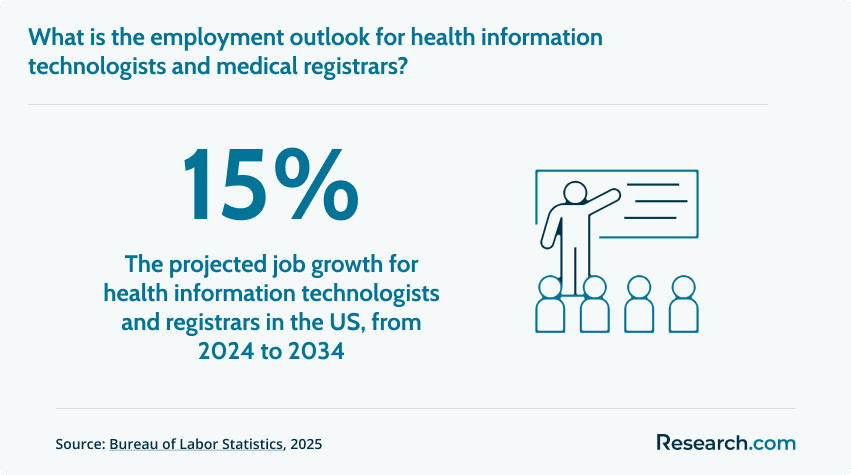
Jobs in informatics nursing are projected to grow at a rate of 11% from 2023 to 2033. That is faster than the average growth for all occupations and nearly double the general registered nurse growth rate. Demand is tied to the continued expansion of electronic health records, data-driven quality improvement, telehealth, regulatory reporting, and digital patient-care tools.
This outlook does not mean every applicant will quickly find a high-paying informatics job. Employers often want nurses who can prove both clinical competence and informatics readiness. Experience as an EHR super user, participation in implementation projects, quality improvement work, analytics exposure, or formal informatics education can make a candidate more competitive.
The key factors shaping the future outlook
The biggest driver is healthcare’s dependence on digital systems. Electronic health records, artificial intelligence, predictive analytics, remote monitoring, and clinical decision support all require professionals who understand patient care and can evaluate how technology affects safety, workflow, documentation, and outcomes.
Telehealth and remote monitoring are also expanding the need for nurses who can support digital care models, virtual communication, patient-generated data, and remote workflows. This may create more hybrid or remote roles, although many implementation and training responsibilities still require on-site collaboration.
Cost-conscious nurses often compare education options before building new skills, including resources on the cheapest online universities. Affordability matters, but it should be weighed with accreditation, program quality, faculty expertise, clinical relevance, and whether the program supports informatics career goals.
What is the typical work environment for Informatics Nurses?
The nursing informatics work environment is usually less physically demanding than bedside nursing, but it is still high-responsibility work. Informatics nurses often work in offices within hospitals or large healthcare organizations, where about 33% of informatics nurses are employed. Others work in ambulatory healthcare services (19%) or professional, scientific, and technical services (11%).
The setting is collaborative. Informatics nurses regularly interact with bedside clinicians, nurse leaders, physicians, IT analysts, administrators, compliance teams, quality departments, and external vendors. Their job is to make sure technology decisions reflect real clinical practice, not just technical requirements.
Most informatics nurses work a standard Monday through Friday schedule of around 40 hours per week. However, evenings or weekends may be required during major system implementations, upgrades, downtime planning, emergency fixes, or go-live support. Remote and hybrid work options are increasingly common in technology-focused positions, but on-site work may still be necessary for training, workflow observation, stakeholder meetings, and critical project phases.
What are the pros and cons of Informatics Nurse careers?
Informatics nursing can be a strong fit for nurses who enjoy systems thinking, technology, teaching, analysis, and organizational improvement. It may be a poor fit for nurses who want frequent direct patient care or who dislike long-term projects, meetings, documentation, and change management.
Pros
- Broader impact: A successful system improvement can affect hundreds of clinicians and many patients, not just one assignment or unit.
- Reduced bedside physical demands: Many roles are office-based and may offer more predictable hours than shift-based clinical nursing.
- Strong problem-solving work: The role involves analyzing workflows, improving data quality, reducing errors, and making technology easier to use.
- Career flexibility: Informatics experience can lead to roles in hospitals, ambulatory care, consulting, vendor organizations, education, analytics, and leadership.
- Bridge role: Nurses who communicate well can become trusted translators between clinical staff and technical teams.
Cons
- Less direct patient contact: Some nurses miss the immediate patient relationships and hands-on care of bedside practice.
- Resistance to change: Staff may be skeptical of new systems, especially if past implementations increased workload.
- Competing priorities: Clinical, IT, administrative, compliance, and vendor teams may disagree about what matters most.
- High-stakes projects: Poor system design or rollout problems can affect documentation, communication, safety, and clinician trust.
- Continuous learning: Technology changes quickly, so informatics nurses must keep building technical, regulatory, and project skills.
If you need an affordable route to finish prerequisites or advance your degree while working, you can compare cheap online universities for working adults. Make sure any program you consider is appropriately accredited and aligned with nursing licensure, graduate admission, or informatics career requirements.
What are the opportunities for advancement for Informatics Nurses?
Advancement in nursing informatics can happen in two main ways: moving into leadership or becoming a deeper specialist. Leadership roles focus on strategy, teams, budgets, governance, and organizational change. Specialist roles focus on areas such as EHR optimization, analytics, quality improvement, clinical decision support, training, or research.
Informatics nurse leadership roles
- Clinical Informatics Manager: Oversees informatics projects, coordinates teams, and helps align clinical needs with IT priorities.
- Director of Clinical Informatics: Leads informatics programs and helps set strategy for clinical technology, workflow improvement, and data use.
- Senior Nursing Informatics Officer: Guides nursing informatics strategy and supports larger departmental or enterprise transformation.
- Chief Nursing Informatics Officer: Works at the executive level to shape how nursing practice, technology, data, and organizational goals connect.
Specialization and advancement paths
- Systems Implementation & Optimization: Lead EHR rollouts, upgrades, workflow redesign, and post-launch improvements.
- Data Analytics & Quality Improvement: Use clinical data to support patient safety, outcomes improvement, regulatory reporting, and operational decisions.
- Education & Training: Design staff education, super-user programs, adoption plans, and competency support for clinical technologies.
- Clinical Decision Support: Help develop alerts, order sets, documentation prompts, and evidence-based tools that support clinicians at the point of care.
- Policy Development & Research: Contribute to standards, governance, compliance, and innovation in healthcare informatics.
- Consulting, academia, or entrepreneurship: Apply informatics expertise outside a single employer through teaching, advisory work, product development, or independent consulting.
To move up, document your results. Track projects you supported, workflows improved, training delivered, data-quality issues resolved, adoption rates improved, or safety and efficiency outcomes influenced. Advancement is easier when you can show measurable value, not just technical familiarity.
What other careers should you consider?
If you like parts of informatics nursing but are unsure whether the role fits, several related careers may be worth comparing. These paths use clinical knowledge, data, technology, or healthcare operations in different ways.
- Health Information Management Specialist: Focuses on healthcare data management, privacy, coding, compliance, and the accuracy of patient information.
- Clinical Analyst: Uses clinical knowledge and data analysis to improve workflows, reporting, technology use, and care delivery processes.
- Healthcare Information Technology Project Manager: Leads healthcare IT projects, manages timelines and stakeholders, and coordinates implementations or upgrades.
- Director of Clinical Informatics: Provides leadership for informatics strategy, quality improvement, technology adoption, and data-driven care initiatives.
- Clinical Decision Support Developer: Builds and maintains tools that support evidence-based decisions, such as alerts, order sets, care pathways, and documentation prompts.
Use your preferred work style to narrow the choice. If you want leadership and strategy, look at director or manager roles. If you enjoy data, consider clinical analysis or quality improvement. If you like implementation and coordination, project management may fit. If you want to stay closest to nursing practice while influencing systems, informatics nursing remains one of the most direct paths.
Here's What Professionals Say About Their Informatics Nursing Careers
- Amina: "In my role as a nurse informaticist, I truly feel like I'm building bridges between the clinical side and technology. Designing electronic health record systems that actually complement a nurse's workflow has allowed me to see the direct impact on patient safety and efficiency. It's fulfilling to know that my contribution helps clinicians make better decisions in real time while improving the overall system. This work gives me a sense of purpose that extends well beyond bedside care."
- Malik: "Transitioning from bedside nursing to informatics wasn't easy-I had to learn SQL, Python, and how to map complex workflows to ensure successful EHR implementations. The technical skills were just part of it; I also had to develop the confidence to communicate effectively between doctors, IT teams, and administrators. What keeps me motivated is realizing that these skills allow me to be a translator who helps everyone speak a common language for better patient care."
- Linh: "What I find most rewarding about working in nursing informatics is the scale of impact. Unlike bedside care where I affected one patient at a time, now I help shape tools used by hundreds of clinicians, which can positively influence outcomes on a much larger level. It feels powerful to support my colleagues through technology and improve workflows that reduce burnout. The diversity of projects also keeps me engaged and growing professionally."
Other Things You Should Know About Informatics Nursing
In 2027, the demand for informatics nurses has increased significantly. This growth is driven by the rise in digital health records, a need for improved healthcare data management, and an emphasis on patient-centered care using technology. As healthcare systems continue to adopt electronic health records, informatics nurses play a critical role in bridging the gap between clinical practice and technology.
In 2027, informatics nurses require strong analytical skills, proficiency in electronic health records, knowledge of data management, and effective communication. These skills improve healthcare delivery and data-driven decisions, enhancing job prospects as the demand grows for technologically adept healthcare professionals.
References
- Alternative Nursing Careers: 10 Exciting Options - Averett https://absn.averett.edu/blog/alternative-nursing-careers/
- 6 Top Careers in Healthcare Informatics https://bouve.northeastern.edu/news/6-top-careers-in-healthcare-informatics/
- Calling Nursing Informatics Leaders: Opportunities for Personal and Professional Growth https://ojin.nursingworld.org/table-of-contents/volume-26-2021/number-3-september-2021/calling-nursing-informatics-leaders/
- 10 Alternative Careers for Nurses (That Don’t Require Another Degree) — Shine On RN https://www.shineonrn.com/blog/10-alternative-careers-for-nurses-that-dont-require-another-degree
- 8 Reasons to Choose a Career in Nursing Informatics | Walden University https://www.waldenu.edu/online-masters-programs/master-of-science-in-nursing/msn-nursing-informatics/resource/eight-reasons-to-choose-a-career-in-nursing-informatics
- 30+ Non-Clinical and Non-Bedside Nursing Jobs https://nightingale.edu/blog/alternative-nursing-careers.html
- Nursing CEUs - 100% Online - Nursing Continuing Education - RN CEUs https://nursingcecentral.com/nurse-informatics/
- Alternative Careers for Nurses | Jobs That Require Nursing Degrees | Prolink https://prolinkworks.com/perspectives/time-for-change-here-are-best-alternative-careers-for-nurses
- Exploring Nursing Informatics Jobs https://www.wgu.edu/blog/exploring-nursing-informatics-jobs1912.html
- Nursing Informatics | Ultimate Guide to Career Paths & Salaries | Maryville Nursing https://nursing.maryville.edu/blog/nursing-informatics


