
2027 Manufacturing Engineer Careers: Skills, Education, Salary & Job Outlook

Co-Founder and Chief Data Scientist
Becoming a manufacturing engineer is a strong fit if you want a career that connects engineering design, production systems, quality, cost control, and hands-on problem solving. The role is not limited to one industry: manufacturing engineers work wherever companies need to make physical products efficiently, consistently, and at scale.
The decision point is whether you are ready for a technical career that combines math, engineering judgment, shop-floor communication, and continuous improvement. Manufacturing engineer careers can be demanding because production problems are often urgent, equipment is expensive, and quality failures can affect customers, safety, and profitability. At the same time, the career offers visible impact, stable demand, and strong earning potential, with median salaries between $79,000 and $93,000 and continued need driven by automation, reshoring, quality systems, and sustainable manufacturing practices.
This guide explains what manufacturing engineers do, the skills and education employers typically expect, salary and job outlook, work conditions, advancement options, and related careers to compare before committing to this path.
Key Things You Should Know About a Manufacturing Engineer Career
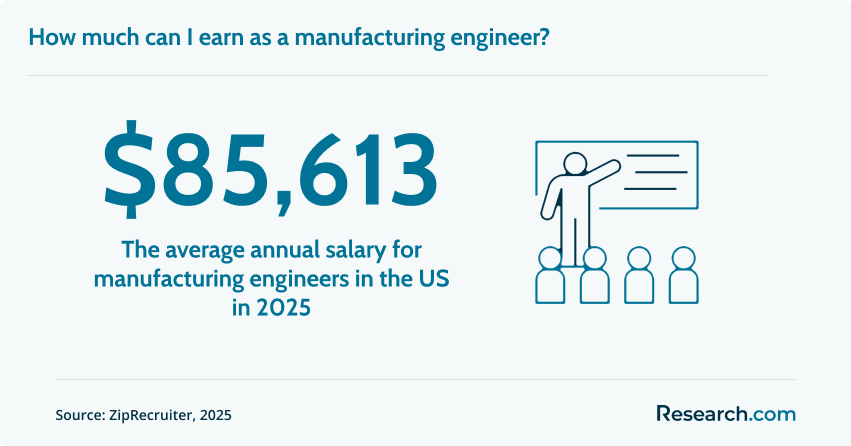
- The typical earning potential for a manufacturing engineer in the U.S. ranges from about $85,600 to $86,000 annually, with some experienced professionals earning as much as $108,000.
- This field is stable and growing quickly, with a projected 12% increase in jobs over the next decade, outpacing average occupational growth rates.
- A bachelor's degree in manufacturing engineering, industrial engineering, mechanical engineering, or a related field is generally required to enter this career.
- Success depends on strong skills in process improvement, problem-solving, proficiency with CAD and manufacturing software, and knowledge of lean manufacturing and Six Sigma, along with excellent communication and teamwork abilities.
- Career advancement often leads to roles such as senior manufacturing engineer, manufacturing engineering manager, and eventually plant manager or director of manufacturing, especially with added certifications or graduate education.
What do manufacturing engineers do?
Manufacturing engineers design, improve, and manage the systems that turn raw materials and components into finished products. Their job is to make production faster, safer, more reliable, and more cost-effective without sacrificing quality.
In practice, they act as the link between product design and real-world production. A design may look good on paper, but a manufacturing engineer determines how it can be built repeatedly, at the required quality level, within budget, and on schedule. That may involve selecting equipment, improving a workstation layout, testing a new process, analyzing defects, reducing scrap, or helping operators solve recurring production problems.
A day in the life of manufacturing engineers
A typical day often includes both desk-based analysis and time on the production floor. Manufacturing engineers may review production data, investigate equipment downtime, meet with operators, coordinate with quality teams, update process documentation, work with suppliers, or test a process change before it is rolled out.
The work is practical and measurable. Improvements may show up as fewer defects, shorter cycle times, reduced waste, safer workflows, lower costs, or higher throughput. For people who like seeing the results of their engineering decisions in a physical product or production line, manufacturing engineering can be especially rewarding.
What are the key responsibilities of manufacturing engineers?
Manufacturing engineers are responsible for improving how products are made. Their work usually sits at the intersection of engineering, operations, quality, safety, maintenance, and supply chain management.
- Analyze manufacturing processes: Study production steps, cycle times, defect rates, equipment performance, and labor flow to identify inefficiencies.
- Improve quality and consistency: Work with quality teams to reduce variation, prevent defects, and ensure processes meet required standards.
- Design and test production systems: Develop tooling, equipment layouts, process documentation, and manufacturing methods that support reliable output.
- Troubleshoot production issues: Respond to equipment failures, process disruptions, bottlenecks, and quality problems that affect output.
- Create and maintain procedures: Write standard operating procedures, work instructions, process controls, and training materials for production teams.
- Support operators and technicians: Train staff on new tools, process changes, safety requirements, and quality expectations.
- Lead continuous improvement projects: Apply Lean techniques, 5S workplace organization, and waste reduction initiatives to improve performance.
- Coordinate with vendors and internal teams: Help evaluate materials, machinery, tooling, budgets, inventory needs, and supplier performance.
The most challenging vs. the most rewarding tasks
The hardest part of the job is often balancing speed, cost, quality, and safety at the same time. A process change that reduces cost may create quality risk. A faster production line may increase equipment wear. A customer deadline may require overtime or rapid troubleshooting. Manufacturing engineers must make practical trade-offs while protecting compliance and product reliability.
The most rewarding part is the visible impact. When a redesigned process reduces waste, improves throughput, or prevents recurring defects, the result is easy to see. The job is well suited to people who enjoy solving problems that affect real workers, real equipment, and real products.
For students who want an early, flexible entry point before pursuing more advanced engineering education, a fast-track online associates degree can help build foundational technical knowledge for manufacturing-related roles.
What are the key skills for manufacturing engineers?
Manufacturing engineers need both technical depth and the ability to work across departments. The strongest candidates can analyze data, understand machines and materials, communicate with operators, and explain engineering decisions to managers who care about cost, schedule, and risk.
Core hard skills
- Process improvement: Used to reduce waste, shorten cycle times, improve throughput, and make production more predictable.
- Computer-aided design (CAD): Useful for creating or modifying product designs, tooling, fixtures, layouts, and equipment components with tools such as AutoCAD or SolidWorks.
- Statistical analysis: Important for interpreting production data, identifying trends, finding root causes, and validating whether a process change actually worked.
- Mathematics: Algebra, geometry, calculus, and statistics support measurement, tolerances, process capability, cost analysis, and data-driven decisions.
- Quality control: Needed to understand inspection methods, defect prevention, process variation, and compliance requirements.
- Manufacturing systems knowledge: Includes familiarity with production equipment, materials, workflow, safety practices, and plant operations.
Key soft skills
- Critical thinking: Helps engineers evaluate competing explanations before changing a process or blaming a machine, material, or operator.
- Complex problem solving: Essential when production issues involve equipment, people, materials, software, and timing all at once.
- Attention to detail: Protects product quality, documentation accuracy, safety compliance, and repeatability.
- Analytical thinking: Supports better decisions when reviewing production data, costs, downtime, and quality metrics.
- Communication: Helps translate technical findings into clear instructions, business recommendations, and shop-floor actions.
The one overlooked skill that separates the good from the great
Cross-functional communication is one of the most valuable skills in manufacturing engineering. The best engineers can speak with operators, technicians, maintenance teams, quality specialists, suppliers, managers, and design engineers without losing clarity or credibility.
This matters because production problems rarely belong to one department. For example, a defect may appear to be an operator issue, but the actual cause could involve fixture design, material variation, machine calibration, unclear instructions, or unrealistic design tolerances. A manufacturing engineer who can bring the right people together and frame the problem accurately is more likely to prevent expensive mistakes.
Strong communication also supports career growth. Engineers who can connect technical improvements to cost savings, quality gains, customer requirements, and business goals are better positioned for leadership roles and high-impact projects. Students comparing flexible education options may find the best open enrollment online colleges useful when looking for programs that support technical and professional skill development.
Manufacturing Engineer Careers: A Step-by-Step Guide to Getting Started
Starting a manufacturing engineering career is easier to manage when you treat it as a sequence of decisions: education, experience, credentials, specialization, and advancement. The path can vary by employer and industry, but most successful candidates build the same core foundation.
- Build foundational education: Study engineering fundamentals such as materials, mechanics, manufacturing processes, statistics, quality systems, and process design.
- Gain practical experience: Use internships, co-op programs, lab projects, technician roles, or entry-level production experience to learn how manufacturing works outside the classroom.
- Develop software and data skills: Become comfortable with CAD, spreadsheets, production data, statistical tools, and any manufacturing software commonly used in your target industry.
- Obtain professional credentials: Consider certifications that align with your goals, especially if you want to demonstrate knowledge in manufacturing methods, quality, Lean, or Six Sigma.
- Choose a focus area: Build expertise in automation, quality, process engineering, additive manufacturing, sustainable production, or another specialty that matches employer demand.
- Advance into senior or leadership roles: Take ownership of larger projects, mentor junior staff, lead process improvements, and learn how engineering decisions affect budgets and operations.
A common mistake is waiting until graduation to get hands-on experience. Manufacturing employers value practical judgment, so internships, shop experience, capstone projects, and exposure to real production environments can make a candidate more competitive.
What education, training, or certifications are required?
Manufacturing engineers typically hold a bachelor of science degree in manufacturing engineering, mechanical engineering, or industrial engineering. Other suitable fields include electrical or process engineering. An ABET-accredited or similarly recognized degree program is important because many employers use accreditation as a signal that the program meets accepted engineering education standards.
Coursework often includes materials science, manufacturing processes, computer-aided design, statistics, quality control, automation, engineering economics, and systems analysis. Students should prioritize programs that include labs, design projects, internships, cooperative education, or direct exposure to manufacturing equipment and production environments.
Certifications that can strengthen your profile
Key certifications include the Certified Manufacturing Technologist (CMfgT) and Certified Manufacturing Engineer (CMfgE), both issued by the Society of Manufacturing Engineers (SME). Six Sigma certifications, including Yellow, Green, and Black Belt, are valuable for roles focused on process improvement, quality, and waste reduction.
Some positions may require a Professional Engineer (PE) license, which involves state-specific exams and experience requirements. A PE license is not required for every manufacturing engineering role, but it may matter more in regulated environments, consulting, public-facing engineering work, or roles where formal engineering signoff is expected.
Training and early career experience
On-the-job training often begins with internships or cooperative education during college and continues after hiring through employer-specific systems, safety procedures, equipment training, and mentorship. Entry-level engineers usually learn under supervision before taking ownership of larger process changes or production systems.
Are advanced degrees or niche certifications worth the investment?
Advanced degrees such as a Master of Science in manufacturing engineering or an MBA can be useful for specialized technical roles, management tracks, or leadership positions. They can support higher-level opportunities in areas such as automation and additive manufacturing, but they require a significant time and financial commitment.
Specialized certifications such as Certified Additive Manufacturing-Fundamentals (CAM-F) or Six Sigma may be a more targeted and affordable way to strengthen your qualifications. In many manufacturing settings, practical experience, measurable project results, and employer-sponsored training can be just as important as graduate education.
The best choice depends on your target role. If you want to become a technical specialist, niche certifications and project experience may offer a direct return. If you want to move into plant leadership, operations management, or executive roles, a graduate degree or MBA may be more relevant. Students looking for a lower-cost starting point can compare options such as the best affordable online associate degrees before committing to a longer engineering pathway.
What is the earning potential for manufacturing engineers?
Manufacturing engineering can offer a solid salary path, especially for professionals who gain experience in process improvement, automation, quality systems, and production leadership. The median annual salary for a Manufacturing Engineer in the US is $79,633 as of 2025.
The manufacturing engineer starting salary 2025 is about $63,000. At the senior level, salaries can increase to around $105,000 annually. These figures show a clear earnings progression as engineers build technical judgment, lead larger projects, and become responsible for higher-value production outcomes.
Actual pay depends on several factors, including location, industry, employer size, overtime expectations, education, certifications, and specialization. Metropolitan areas and regions with a strong manufacturing base may offer higher compensation, while roles in advanced manufacturing, automation, aerospace, medical devices, electronics, or other technically demanding sectors may reward specialized skills.
| Career stage | Salary information stated | What usually affects movement to the next level |
| Entry level | About $63,000 | Internships, technical fundamentals, CAD ability, production exposure, and willingness to learn plant systems |
| Mid-career | Median annual salary of $79,633 as of 2025 | Independent project ownership, process improvement results, quality knowledge, and cross-functional communication |
| Senior level | Around $105,000 annually | Leadership of complex projects, automation or quality expertise, mentoring, and measurable operational impact |
To improve earning potential, focus on skills that employers can connect to measurable business value: reduced scrap, fewer defects, lower downtime, safer processes, faster throughput, and better use of labor and equipment.
What is the job outlook for manufacturing engineers?
The job outlook is favorable. The employment of manufacturing engineers, combined with industrial engineers, is projected to grow 12% from 2023 to 2033, a rate much faster than the average 3-5% growth for all occupations.
This growth reflects the continuing need for engineers who can improve production systems, reduce costs, integrate new technologies, and help manufacturers compete in changing markets. Rather than eliminating the role, automation often increases demand for engineers who can select, implement, troubleshoot, and optimize automated systems.
The key factors shaping the future outlook
- Automation and robotics: Manufacturers need engineers who can integrate machines, sensors, controls, and data systems into reliable production workflows.
- Digital manufacturing and Industry 4.0: Connected equipment and production data create demand for engineers who can interpret information and turn it into process improvements.
- Reshoring and domestic production expansion: More U.S. production activity can create openings tied to facility modernization, line design, and operational efficiency.
- Replacement needs: Retiring engineers and aging infrastructure contribute to ongoing demand for skilled professionals.
- Sustainability and waste reduction: Companies increasingly need engineers who can reduce material waste, energy use, and process inefficiencies while maintaining quality.
For students preparing for this market, choosing reputable education matters. Programs from accredited online colleges non profit may provide flexible ways to build credentials while maintaining confidence in institutional quality.
The strongest long-term prospects are likely to go to manufacturing engineers who combine traditional engineering fundamentals with data analysis, automation literacy, quality improvement, and strong communication across production teams.
What is the typical work environment for manufacturing engineers?
The typical manufacturing engineer work environment is a mix of office work and time in industrial production areas. Engineers may spend part of the day analyzing data, updating documentation, attending meetings, or designing process changes, then move to the plant floor to observe equipment, talk with operators, test changes, or troubleshoot problems.
Production floors can be noisy, fast-moving, and physically demanding compared with a traditional office. Protective gear may be required, and temperature control can vary depending on the facility. Most professionals in this field find employment in transportation equipment manufacturing (20%), fabricated metal product manufacturing (12%), and computer and electronic product manufacturing (11%).
Do manufacturing engineers work weekends? Yes, they often do. Many roles are full time, and overtime can be common during equipment failures, production emergencies, customer deadlines, new product launches, plant shutdowns, or major project rollouts. Some employers may require evenings, weekends, or rotating shifts depending on the production schedule.
Remote or hybrid work is usually limited because the role depends heavily on equipment, physical processes, and direct collaboration with production staff. Some analysis, documentation, or design tasks may be done away from the floor, but manufacturing engineers generally need regular on-site presence to be effective.
What are the pros and cons of manufacturing engineer careers?
Manufacturing engineering can be a rewarding career for people who like practical problem solving, measurable results, and a blend of technical and operational work. It is less ideal for those who want a fully remote job, a predictable desk-only schedule, or work that is mostly theoretical.
Pros
- Visible impact: You can often see the results of your work in better production flow, fewer defects, safer processes, or lower waste.
- Strong problem-solving focus: The job offers continuous technical challenges tied to real equipment, materials, people, and products.
- Cross-industry flexibility: Manufacturing engineers can work in transportation equipment, fabricated metal products, computer and electronic products, and many other production environments.
- Continuous learning: Automation, robotics, digital manufacturing, and process improvement methods create ongoing opportunities to build new expertise.
- Career mobility: Experience can lead to senior engineering, quality, automation, operations, project management, or plant leadership roles.
Cons
- High-pressure problems: Production issues can be urgent because downtime, defects, or missed deadlines may be expensive.
- Schedule demands: Overtime, weekends, evenings, or rotating shifts may be required during emergencies or major rollouts.
- Limited remote work: The hands-on nature of the job usually requires on-site presence.
- Competing priorities: Engineers often have to balance cost, speed, safety, quality, and production targets at the same time.
- Routine documentation: Standard operating procedures, reports, and compliance records are necessary but may feel repetitive.
If you are comparing credentials that could improve your career options, reviewing what certifications pay the most can help you think more strategically about skill-building and return on investment.
What are the opportunities for advancement for manufacturing engineers?
Manufacturing engineers can advance by moving into larger technical responsibilities, managing people and projects, or specializing in high-demand areas such as automation, quality, process engineering, or sustainable production. The best path depends on whether you prefer leadership, technical depth, or operations management.
Clear advancement paths
- Junior Manufacturing Engineer (0-2 years): Learn production systems, support process improvements, assist with Lean and Six Sigma work, and build confidence on the plant floor.
- Manufacturing Engineer (2-5 years): Own core engineering tasks, troubleshoot recurring issues, manage smaller projects, and contribute directly to process optimization.
- Senior Manufacturing Engineer (5-8 years): Lead complex projects, mentor junior engineers, influence quality and productivity metrics, and make higher-impact technical decisions.
- Lead/Principal Manufacturing Engineer (8-12 years): Set technical direction, guide major improvements, represent the engineering function, and influence broader manufacturing strategy.
Manufacturing engineer career specialization options
- Automation Engineering: Focuses on robotics, controls, sensors, and automated production systems that improve efficiency and consistency.
- Quality Assurance: Emphasizes defect prevention, inspection systems, compliance, root cause analysis, and continuous quality improvement.
- Process Engineering: Concentrates on designing, measuring, and optimizing workflows for better output, cost control, and reliability.
- Sustainable Production: Applies engineering methods to reduce waste, improve resource use, and support more environmentally responsible manufacturing.
Advancement is usually tied to results. Engineers who can document measurable improvements, communicate across departments, and lead change without disrupting production are more likely to move into senior, lead, or management roles.
What other careers should you consider?
If manufacturing engineering sounds close but not quite right, several related careers use overlapping skills. Comparing them can help you decide whether you prefer process improvement, product design, quality, systems optimization, machinery, or direct supervision of production teams.
| Career | How it relates to manufacturing engineering | Best fit if you prefer |
| Process Engineer | Optimizes manufacturing processes to improve efficiency, quality, and cost-effectiveness. | Deep work on process design, measurement, and improvement |
| Quality Engineer | Focuses on product and process quality, defect reduction, testing, and standards compliance. | Root cause analysis, data, inspection systems, and quality control |
| Industrial Engineer | Uses systems thinking to improve productivity, workflow, labor use, and operational efficiency. | Large-scale systems, operations research, and productivity improvement |
| Mechanical Engineer | Applies knowledge of machinery, materials, mechanics, and design to equipment and products. | Design, mechanics, equipment, and technical analysis |
| Production Supervisor | Oversees manufacturing teams, schedules, output targets, and day-to-day production performance. | People management, shift operations, and direct production leadership |
Choose manufacturing engineering if you want a role that combines engineering analysis with hands-on production improvement. Consider quality engineering if you are most interested in defects and standards, industrial engineering if you prefer system-level efficiency, mechanical engineering if you want more design focus, and production supervision if you want to manage people and daily output more directly.
Here's What Professionals Say About Their Manufacturing Engineer Careers
- : "I chose manufacturing engineering because I was drawn to the sheer variety of industries it touches. From electronics to automotive parts, knowing that I help turn raw materials into actual products gives me a real sense of accomplishment. Designing processes that can efficiently produce thousands of units takes creativity and precision, and I love being part of that. It's rewarding to see a product I've helped develop out in the world, knowing I had a hand in every step. Lisa"
- : "One of the toughest lessons I learned as a Manufacturing Engineer was the necessity of clear communication with customers early on. It's tempting to say a design is impossible, but often it's just about finding smarter solutions without driving up costs. I've had to get comfortable saying no or suggesting alternatives, because rushing into manufacturing without thorough feedback only creates delays and waste. Balancing time pressure with quality means constant negotiation and patience, but it's worth it when the end result is cost-effective and reliable. Maya"
- : "Every day as a Manufacturing Engineer throws something new at me, and that unpredictability keeps me sharp. I thrive in a fast-paced setting where I'm pushed to troubleshoot on the fly and learn new techniques constantly. Whether it's optimizing a production line or problem-solving unexpected bottlenecks, the challenge motivates me to be better. The excitement of jump-starting every morning ready to tackle whatever comes my way is what keeps me passionate about this role. Myrna"
Key Findings
- Manufacturing engineers improve how products are made by connecting engineering design, production systems, quality control, cost reduction, and process improvement.
- The career is best suited to people who enjoy hands-on technical problem solving, data analysis, teamwork, and visible operational impact.
- Typical education includes a bachelor of science degree in manufacturing engineering, mechanical engineering, industrial engineering, or a related field, preferably from an ABET-accredited or similarly recognized program.
- Useful credentials include Certified Manufacturing Technologist (CMfgT), Certified Manufacturing Engineer (CMfgE), Six Sigma certifications, and in some cases a Professional Engineer (PE) license.
- The median annual salary for a Manufacturing Engineer in the US is $79,633 as of 2025, with a manufacturing engineer starting salary 2025 of about $63,000 and senior-level salaries around $105,000 annually.
- The employment of manufacturing engineers, combined with industrial engineers, is projected to grow 12% from 2023 to 2033, faster than the average 3-5% growth for all occupations.
- The work environment usually combines office analysis with regular time on production floors, where overtime, weekends, evenings, or rotating shifts may be required.
- Advancement can lead to senior engineering, lead or principal roles, automation engineering, quality assurance, process engineering, sustainable production, operations leadership, or management.
Other Things You Should Know About Manufacturing Engineer
Manufacturing engineers in 2027 must continuously develop their skills to stay relevant with evolving technologies like AI and automation. This includes learning data analysis, machine learning principles, and understanding advanced robotics. The challenge lies in integrating these technologies while maintaining production efficiency and quality standards.
In 2027, Lean Manufacturing remains essential for manufacturing engineers. This methodology focuses on minimizing waste and optimizing efficiency. By continuously improving processes, it ensures sustainable production and competitive advantage in today's technology-driven environment.
References
- Career Profiles https://www.brightnetwork.co.uk/career-profiles/manufacturing-engineer/
- Understanding the Manufacturing Engineer Career Path - Techneeds https://www.techneeds.com/2025/07/15/understanding-the-manufacturing-engineer-career-path/
- Manufacturing engineer: job description https://targetjobs.co.uk/careers-advice/job-descriptions/manufacturing-engineer-job-description
- Certified Manufacturing Engineer (CMfgE) Certification https://www.sme.org/training/technical-certification/certified-manufacturing-engineer-cmfge-certification/
- Career Development Guide: Advancing as a Manufacturing Engineer https://www.expertia.ai/career-tips/career-development-guide-advancing-as-a-manufacturing-engineer-91136s
- 2025 Career Goals for Manufacturing Engineers - 12+ Goal Examples (Full Guide) https://www.tealhq.com/professional-goals/manufacturing-engineer
- Manufacturing Engineering Careers Here Is What You Should Consider https://www.nextgeneration.ie/blog/2024/04/advancing-your-career-in-manufacturing-engineering-jobs-opportunities-and-growth
- Manufacturing Engineer Job Descriptions for Hiring Managers and HR https://www.4cornerresources.com/job-descriptions/manufacturing-engineer/
- Manufacturing engineer https://www.prospects.ac.uk/job-profiles/manufacturing-engineer
- 8 Manufacturing Skills To Master and How To Own the Skills Gap https://www.amper.co/post/8-manufacturing-skills-to-master-and-how-to-own-the-skills-gap


