
2027 Medical Librarian Careers: Skills, Education, Salary & Job Outlook

Co-Founder and Chief Data Scientist
Medical librarian careers sit at the intersection of healthcare, research, technology, and education. If you are drawn to medicine but prefer evidence work, information systems, teaching, and research support over direct patient care, this field can offer a practical and meaningful career path.
The main decision is whether the education and specialization required for medical librarianship match your goals. Most roles require graduate preparation in library and information science, plus the ability to work confidently with biomedical databases, medical terminology, copyright rules, privacy expectations, and evidence-based research methods.
This guide explains what medical librarians do, the skills and credentials employers value, where they work, how much they can earn, and what advancement can look like. It also puts key trade-offs in context: the work can be intellectually rewarding and stable, but it requires precision, continuous learning, and comfort supporting high-stakes healthcare decisions. Salary estimates in this guide include a 2025 median annual salary of $63,195, with a range from approximately $49,000 to up to $87,000 depending on experience, setting, location, and responsibilities. You may also see broader projections such as 9% growth tied to retirements, while the role-specific outlook discussed below cites about 2% growth from 2024 to 2034.
Key Things You Should Know About Medical Librarian Career
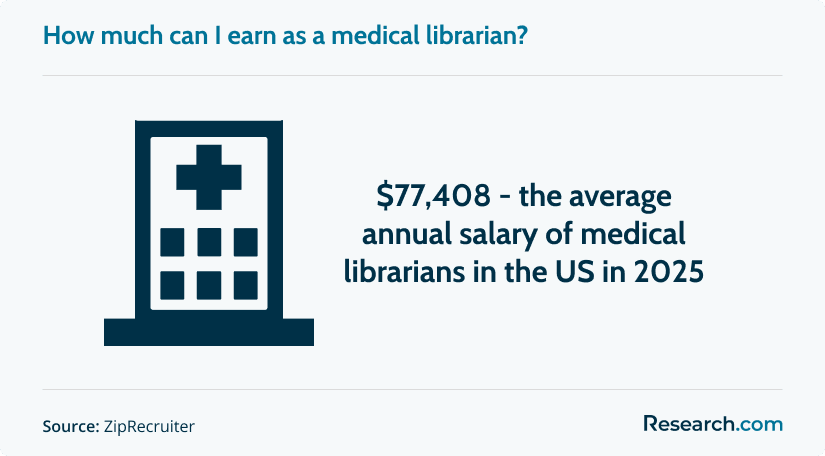
- The typical earning potential for a medical librarian in the United States is around $77,408 annually, with most professionals making between $64,500 and $90,000 per year.
- This field offers stable demand with an expected growth rate of about 3% from 2022 to 2032, matching the average pace for all occupations.
- A master's degree in library science (MLS or MLIS), often with a focus on medical or health sciences librarianship, is generally required to start in this career.
- Success depends on strong skills in database searching, information management, research support, digital literacy, effective communication, and the ability to clearly present complex medical information.
- Career advancement can lead to roles in library management, specialized clinical informationist positions, or leadership in academic and research settings, often supported by further certifications or advanced degrees.
What do medical librarians do?
Medical librarians help clinicians, researchers, students, administrators, and sometimes patients find, evaluate, organize, and use health information. Their work supports evidence-based care, biomedical research, medical education, and patient understanding. Instead of simply pointing users to articles, they translate information needs into effective search strategies, identify reliable sources, and make complex medical literature easier to use.
In a hospital, a medical librarian may help a care team locate the best available evidence for a clinical question. In an academic medical center, they may teach students how to search PubMed, support systematic reviews, or manage digital collections. In government or research settings, they may help organize health data, maintain specialized databases, or improve access to scientific information.
A day in the life of medical librarians
A typical day can combine urgent requests and long-term projects. A librarian might begin by responding to a clinician’s question, then train residents on database searching, review citations for a research team, update online resource guides, and coordinate access to materials not held by the library.
The role rewards people who enjoy precise research, service-oriented communication, and constant learning. The work is not usually clinical, but it can affect clinical decision-making by helping healthcare professionals locate accurate, current, and relevant evidence.
What are the key responsibilities of medical librarians?
Medical librarians are responsible for connecting users with trustworthy biomedical information. Their duties vary by employer, but most roles involve a mix of reference support, literature searching, instruction, collection management, technology use, and collaboration with healthcare or research teams.
- Conduct advanced literature searches: Search biomedical databases to answer clinical, research, education, and policy questions.
- Support evidence-based practice: Help clinicians, students, and researchers identify high-quality evidence and understand source reliability.
- Maintain medical information collections: Organize, evaluate, and update print and digital resources so users can access current materials efficiently.
- Provide reference services: Respond to questions in person, by phone, through chat, and by email for clinicians, patients, administrators, faculty, and students.
- Teach search and information skills: Train healthcare staff and learners to use databases, citation tools, clinical resources, and research workflows.
- Create educational materials: Develop guides, handouts, tutorials, and patient-facing information resources when appropriate.
- Manage interlibrary loan and document delivery: Help users obtain articles, books, reports, and other materials not available in-house.
- Support research projects: Assist with citation management, systematic reviews, data organization, and publication support, depending on the position.
The most challenging vs. the most rewarding tasks
| Aspect of the role | What it looks like in practice | Why it matters |
| Most challenging | Handling urgent requests while maintaining accuracy and documenting search methods clearly. | In healthcare settings, incomplete or poorly sourced information can affect decisions. |
| Most rewarding | Seeing research support, training, or patient education improve someone’s ability to make an informed decision. | The librarian’s impact often happens behind the scenes, but it can be meaningful and practical. |
| Most skill-intensive | Translating a vague question into a searchable, answerable information need. | Strong reference interviews and search strategy design separate basic searching from professional-level evidence work. |
Students who are still building an academic foundation may compare flexible early-degree options, including the top online associate degree in 6 months accredited, before moving toward the graduate preparation typically expected for professional librarian roles.
What are the key skills for medical librarians?
Medical librarians need more than general library skills. The strongest candidates combine information science, health literacy, technology fluency, research methods, and careful communication. Employers often look for people who can work independently, explain complex information clearly, and collaborate with clinicians, faculty, researchers, students, and patients.
Core technical skills
- Health information resource management: Select, organize, maintain, and evaluate medical databases, journals, e-books, clinical tools, and research guides.
- Medical cataloging and indexing: Classify and describe medical materials so users can retrieve them efficiently.
- Information retrieval and evidence-based searching: Build effective searches in databases such as PubMed and MEDLINE to support clinical and research questions.
- Medical terminology: Understand enough biomedical language to interpret requests, identify synonyms, and search accurately.
- Legal and ethical awareness: Respect copyright, licensing terms, patient privacy expectations, and responsible handling of sensitive health information.
- Technology and database fluency: Use discovery systems, citation tools, link resolvers, digital repositories, and online learning platforms.
Professional skills employers value
- Critical thinking: Evaluate sources, clarify ambiguous requests, and choose appropriate evidence for the user’s need.
- Active listening: Ask the right follow-up questions before beginning a search, especially when the request is clinical or time-sensitive.
- Communication: Explain search results, database limits, and evidence quality in language the user can act on.
- Collaboration: Work with healthcare teams, faculty, researchers, administrators, and community partners.
- Adaptability: Keep up with changing databases, publishing models, healthcare technology, and research practices.
- Instructional ability: Teach individuals and groups how to search, evaluate, and apply health information.
The one overlooked skill that separates the good from the great
One high-value skill is health informatics integration: understanding how information tools, clinical workflows, and digital systems connect. A medical librarian who can align evidence resources with the way clinicians, researchers, or students actually work becomes more than a search expert; they become a partner in improving information flow.
For example, a librarian may help design alerts for new research, organize resources inside a learning management system, or support access to evidence tools used by a hospital team. This skill can be especially useful in settings that value advanced information systems, including Scientific Research and Development Services.
Professionals returning to school or changing careers may also explore flexible education options such as degrees for older adults online to strengthen research, technology, or health-related competencies.
Medical Librarian Careers: A Step-by-Step Guide to Getting Started
The path to becoming a medical librarian is usually straightforward, but it requires planning. The most common route includes undergraduate study, a graduate library science degree, practical health information experience, and ongoing professional development.
- Complete undergraduate education. A bachelor’s degree is typically the first step. No single major is required for every role, but coursework in biology, health sciences, psychology, public health, communication, data, or social sciences can be useful.
- Research graduate program requirements early. Most professional librarian positions require an MLIS or MLS. Look for programs that offer health sciences librarianship, medical informatics, evidence-based practice, or research support coursework.
- Pursue graduate education in library and information science. Choose a program that fits your schedule, budget, and career goals. If possible, select electives and projects related to medical libraries, biomedical databases, systematic reviews, or consumer health.
- Gain hands-on experience. Internships, practicums, student jobs, volunteer roles, or assistant positions in academic, hospital, research, or health sciences libraries can help you build employer-ready skills.
- Build database and evidence-searching proficiency. Practice advanced searching in tools such as PubMed and MEDLINE, and learn how to document search strategies clearly.
- Join professional networks. Professional associations, conferences, webinars, and mentorship can help you understand hiring expectations and specialization options.
- Consider credentials after you have a direction. Certifications can support advancement, but they are most valuable when matched to your target setting and role.
- Keep learning after entry-level employment. Medical knowledge, publishing tools, artificial intelligence, data practices, and health information systems change quickly. Continuing education is part of the job.
A good strategy is to treat each step as evidence-building for employers. By graduation, you should be able to show not only that you completed a degree, but that you can search medical literature, teach users, manage resources, and communicate with healthcare or research audiences.
What education, training, or certifications are required?
The standard professional credential for medical librarians is a Master of Library and Information Science (MLIS) or Master of Library Science (MLS), usually from an American Library Association (ALA)-accredited program. A bachelor’s degree is typically required before entering the master’s program, but the undergraduate major is often flexible.
Useful undergraduate backgrounds include biology, health sciences, public health, psychology, social sciences, English, communication, computer science, and related fields. A science major can help with medical terminology and research context, while humanities or social science majors may bring strong writing, instruction, and analysis skills.
Common education and credential requirements
| Requirement | How important it is | What to look for |
| Bachelor’s degree | Usually required before graduate study | Choose a major that builds research, writing, data, health, or communication skills. |
| MLIS or MLS | Key professional credential | Prioritize an American Library Association (ALA)-accredited program when possible. |
| Health sciences coursework | Highly useful for medical librarian roles | Look for electives in health sciences librarianship, medical informatics, evidence-based practice, or biomedical databases. |
| Internship or practicum | Often important for employability | Seek placements in medical, academic health, hospital, research, or consumer health information settings. |
| AHIP credential | Valued for professional recognition and advancement | The Academy of Health Information Professionals (AHIP) credential from the Medical Library Association may strengthen a career profile, though it is not always mandatory for entry-level roles. |
| State librarian licensure | Varies by location and role | Check state or local requirements, especially for positions connected to public institutions or regulated librarian roles. |
Employers may also provide training on local systems, licensing rules, electronic resource platforms, interlibrary loan procedures, and institutional policies. Because medical libraries often use specialized databases and subscription tools, on-the-job training is common even for well-prepared graduates.
Are advanced degrees or niche certifications worth the investment?
Advanced credentials can be worthwhile when they match a clear career goal. AHIP recognition, post-master’s certificates, informatics training, or specialized research credentials may help professionals move into leadership, systematic review support, academic health sciences roles, or technology-focused positions.
The trade-off is cost and time. Additional credentials do not guarantee an immediate salary increase, and some employers value direct experience as much as formal credentials. Before enrolling, compare job postings in your target region and setting. Look for repeated requirements, not one-off preferences.
For professionals targeting academic, research, or leadership roles, doctoral study may be relevant in some cases. Those comparing flexible options can review programs such as a doctorate without dissertation, while also confirming that the credential aligns with actual employer expectations.
What is the earning potential for medical librarians?
The median annual salary for a Medical Librarian in 2025 is $63,195. The medical librarian salary range 2025 extends from an entry-level salary of approximately $49,000 to a senior-level salary that can reach up to $87,000.
Those numbers are useful benchmarks, but salary can vary widely by employer type, geography, responsibilities, education, and experience. A medical librarian in a large academic medical center or research institution may have different compensation prospects from one working in a smaller hospital, nonprofit, or public health organization.
Factors that influence medical librarian pay
- Location: Urban areas and high-cost regions may offer higher salaries, though living costs can reduce the practical difference.
- Employer type: Hospitals, universities, government agencies, and research organizations may use different pay scales.
- Experience: Senior librarians with a record of teaching, research support, team leadership, or digital resource management may qualify for higher pay.
- Education and credentials: An MLIS or MLS is often central to professional roles. Additional credentials may help when they match the position.
- Specialization: Skills in systematic reviews, informatics, data management, clinical support, or digital systems can improve competitiveness.
- Supervisory responsibility: Managing staff, budgets, collections, or library services can increase earning potential.
How to evaluate a salary offer
Do not look only at the base salary. Review health benefits, retirement contributions, tuition support, professional development funding, remote-work flexibility, schedule expectations, union or civil service structures, and promotion pathways. In academic and government settings, benefits and stability may be a major part of total compensation.
What is the job outlook for medical librarians?
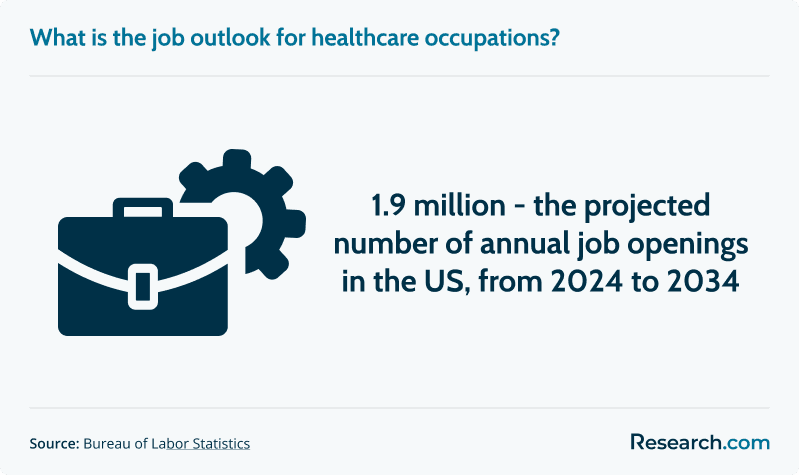
The job outlook for medical librarian roles reflects projected growth of about 2% from 2024 to 2034, which is slower than average compared with all occupations. That does not mean the field is disappearing. It means new job growth may be limited, while replacement openings, retirements, and specialized demand remain important.
The field is expected to retain moderate stability because healthcare, education, government, and research organizations still need reliable access to medical evidence. At the same time, candidates should be prepared for competition, especially for desirable academic medical center, research, or hospital roles.
The key factors shaping the future outlook
- Retirements: Around 50% of current medical librarians are likely to retire over the next decade, creating replacement opportunities.
- Digital transformation: Medical libraries increasingly manage electronic journals, databases, digital repositories, online instruction, and virtual consultations.
- Growth in biomedical research: Research teams continue to need help with literature searching, evidence synthesis, citation management, and information organization.
- Evidence-based healthcare: Clinicians and administrators need accurate, timely information to support care, policy, and quality improvement.
- Technology and AI: Search tools are changing, but expert evaluation, search strategy design, and source judgment remain valuable.
How to stay competitive
To improve job prospects, build a portfolio that shows practical skill. Include sample search strategies, instruction materials, research guides, systematic review support examples, data or informatics projects, and evidence of collaboration. Employers are more likely to notice candidates who can demonstrate how they solve real information problems.
Professionals considering advanced education for research or leadership roles may compare shorter doctoral options such as 2 year phd programs, while confirming that the degree is relevant to their intended career path.
What is the typical work environment for medical librarians?
Medical librarians usually work indoors in information-rich environments such as hospitals, academic medical centers, colleges and universities, government agencies, research organizations, and specialized health libraries. About 33% of medical librarians work in hospitals, 31% in colleges or universities, and 17% in government roles.
The work environment often blends quiet research time with frequent interaction. A librarian may spend part of the day searching databases or managing digital resources, then shift into teaching, reference consultations, meetings, or collaboration with clinical and academic teams.
Common work settings
| Setting | Typical focus | Best fit for people who enjoy |
| Hospitals | Clinical information support, staff training, patient education, and urgent evidence requests. | Fast-moving questions, healthcare teams, and applied information work. |
| Colleges or universities | Medical education, faculty research, student instruction, systematic reviews, and academic collections. | Teaching, research support, and scholarly communication. |
| Government roles | Public health information, policy support, records, data access, and specialized collections. | Public service, structured systems, and long-term information management. |
| Research organizations | Biomedical literature, data management, publication support, and specialized evidence services. | Deep research, technical tools, and scientific collaboration. |
Work schedules are commonly Monday through Friday during standard business hours. Weekend duties are rare in many roles, though expectations can vary by employer. Remote or hybrid work may be possible for tasks such as virtual consultations, online instruction, database work, research support, or digital collection management, but roles tied closely to hospital teams or physical collections may require more on-site time.
What are the pros and cons of medical librarian careers?
Medical librarianship can be a strong fit for people who want meaningful work in healthcare without becoming a clinician. It offers intellectual challenge, service impact, and a role in evidence-based decision-making. The trade-off is that the work can be demanding, highly detailed, and sometimes underrecognized.
Pros
- Meaningful contribution: Medical librarians provide information that can support patient care, research, education, and public health.
- Continuous learning: The role keeps professionals engaged with new medical research, technology, and information practices.
- Collaborative work: Librarians often work with clinicians, faculty, students, researchers, administrators, and community partners.
- Varied career settings: Opportunities exist in hospitals, universities, government agencies, research organizations, and health information programs.
- Specialization potential: Professionals can move toward informatics, systematic reviews, consumer health, data management, or leadership.
Cons
- Graduate education is usually needed: The MLIS or MLS requirement adds time and cost before entering many professional roles.
- Information overload is constant: Medical literature is large, complex, and always changing.
- Accuracy pressure can be high: Clinical and research questions may require careful, well-documented searches under tight timelines.
- Technology changes quickly: Librarians must keep learning new databases, platforms, discovery tools, and digital workflows.
- Impact may be indirect: The work matters, but librarians do not always see the final outcome of the information they provide.
The best way to decide is to compare the work against your strengths. If you like research, teaching, healthcare topics, systems thinking, and helping others use evidence well, the advantages may outweigh the challenges. If you prefer highly visible outcomes, direct patient care, or routine tasks, another health information career may fit better.
Students trying to reduce upfront education costs can compare options such as the cheapest online college bachelor degree programs before planning for graduate study.
What are the opportunities for advancement for medical librarians?
Medical librarian career advancement can happen in two main ways: moving into leadership or developing a high-demand specialization. Some professionals become department heads, managers, or directors. Others become experts in clinical informatics, systematic reviews, data management, research impact, consumer health, or digital resources.
Common advancement path
- Entry-level: Library Assistant, Library Technician, Graduate Assistant, or similar support role that builds experience with users, collections, and systems.
- Early professional: Medical Librarian or Health Sciences Librarian providing reference, instruction, database searching, and collection support.
- Mid-level: Specialist roles in systematic reviews, clinical support, instruction, digital resources, research services, or consumer health.
- Senior-level: Department Head, Manager, Director, or program lead responsible for staff, budgets, strategy, services, and institutional partnerships.
- Academic and research leadership: Teaching, publishing, grant support, scholarly communication, or research leadership within academic health centers.
Specialization areas
- Health informatics and data management: Work with electronic health information, clinical decision-support resources, research data, and workflow integration.
- Research support and systematic reviews: Assist with advanced search strategies, evidence synthesis, citation management, and review methodology.
- Consumer health and patient education: Develop clear, accessible resources that help patients and communities understand health information.
- Digital resources and technology management: Manage electronic collections, access systems, digital archives, discovery tools, and emerging platforms.
- Instruction and curriculum support: Teach students, residents, faculty, or healthcare staff how to find and evaluate medical evidence.
How to position yourself for promotion
Document your results. Track instruction sessions, research projects supported, search strategies created, user guides developed, resources improved, and collaborations completed. Advancement often depends on showing that your work improves access, saves time, supports research, strengthens education, or helps healthcare teams use evidence more effectively.
What other careers should you consider?
If medical librarianship appeals to you but you are unsure about the MLIS or MLS route, related careers may offer similar work with different education requirements, work settings, or advancement paths. These roles often use the same strengths: research, organization, communication, data handling, and the ability to make complex information usable.
- Informationist: Works closely with clinical or research teams to retrieve, organize, and apply biomedical information in decision-making contexts.
- Research Analyst: Collects, evaluates, and organizes information or data to support decisions in healthcare, education, policy, business, or research settings.
- Data Manager / Data Curator: Organizes, documents, preserves, and improves access to structured digital information, especially in research or healthcare environments.
- Records Manager / Archival Specialist: Manages records, retention schedules, classification systems, compliance, and long-term preservation.
- Content Strategist: Plans, structures, and improves information for specific audiences, often using digital platforms, user experience principles, and analytics.
How to choose among related paths
| If you enjoy... | Consider... | Why |
| Healthcare evidence and database searching | Medical Librarian or Informationist | These roles stay closest to clinical and biomedical information support. |
| Working with datasets and documentation | Data Manager / Data Curator | The focus shifts from library services to structured data quality, access, and preservation. |
| Policy, reports, and decision support | Research Analyst | This path emphasizes analysis and synthesis for organizational decisions. |
| Compliance and long-term information control | Records Manager / Archival Specialist | The work centers on retention, classification, preservation, and governance. |
| Audience-focused digital communication | Content Strategist | This role uses information organization to improve clarity, engagement, and usability. |
The right option depends on whether you want to work closest to healthcare teams, research data, institutional records, public-facing content, or organizational decision-making. Compare job descriptions before choosing a degree or credential path.
Here's What Professionals Say About Their Medical Librarian Careers
- Aisha: "When I was diagnosed with a chronic condition, it changed how I understood the value of clear health information. As a medical librarian, I help patients and care teams find trustworthy resources they can actually use. Supporting doctors and nurses with research that may shape more personalized care keeps the work meaningful."
- Tomas: "Balancing full-time medical library work while finishing my master's degree and completing a part-time internship was difficult. I was tired often, but the experience forced me to learn quickly. Supportive supervisors helped me build confidence with complex health information systems, and that early pressure made me more capable."
- Nia: "Medical librarians do not always get direct feedback, so the impact can feel invisible. Then I learned that community health workers used resources I provided to help patients ask better questions during appointments. That reminded me that the work can reach far beyond the library itself."
Key Findings
- Medical librarians help healthcare professionals, researchers, students, administrators, and patients find and use reliable biomedical information.
- The most common professional credential is an MLIS or MLS, often from an American Library Association (ALA)-accredited program.
- Core skills include evidence-based searching, medical database use, health information resource management, instruction, communication, and legal or ethical awareness.
- The median annual salary for a Medical Librarian in 2025 is $63,195, with a salary range from approximately $49,000 to up to $87,000.
- The job outlook cites about 2% growth from 2024 to 2034, while replacement openings may be supported by retirements, with around 50% of current medical librarians likely to retire over the next decade.
- Common work settings include hospitals, colleges or universities, and government roles; about 33% work in hospitals, 31% in colleges or universities, and 17% in government roles.
- Advancement is possible through leadership or specialization in areas such as health informatics, systematic reviews, research support, consumer health, and digital resources.
- This career is best suited to people who enjoy research, healthcare topics, teaching, technology, and helping others make evidence-informed decisions.
Other Things You Should Know About Medical Librarian
The average salary of a medical librarian in 2027 is expected to be around $60,000 to $75,000 annually. This range can vary based on factors including location, education level, and years of experience. Salaries may also be influenced by the size and type of employing institution, such as hospitals or academic research facilities.
To become a medical librarian in 2027, a master's degree in library science (MLS) from an ALA-accredited program is typically required. Additionally, coursework or experience in health sciences is highly beneficial for specialization in the medical field.
References
- Becoming a Librarian | Step by Step Guide https://www.lancashire.ac.uk/articles/advice/become-a-librarian
- Future of Medical Librarianship – Krafty Librarian https://kraftylibrarian.com/future-of-medical-librarianship/
- Career Resources https://www.mlanet.org/resources/career-development-resources/
- Bringing the best of medical librarianship to the patient team https://pmc.ncbi.nlm.nih.gov/articles/PMC64754/
- What does a Medical Librarian do? Career Overview, Roles, Jobs | KAPLAN https://jobs.community.kaplan.com/career/medical-librarian
- 16 Pros and Cons of Being a Librarian https://www.becomeopedia.com/pros-and-cons-of-being-a-librarian/
- Librarian Certification https://www.librariancertification.com/
- Alternative Careers https://newlibrarianrefshelf.omeka.net/alternative-job-descriptions
- Alternative LIS Careers - SJSU | School of Information https://ischool.sjsu.edu/alternative-lis-careers
- The Winding Career Path of One Medical Librarian https://news.nnlm.gov/region_5/the-winding-career-path-of-one-medical-librarian/


