
2027 Quality Improvement Nurse Careers: Skills, Education, Salary & Job Outlook

Co-Founder and Chief Data Scientist
Becoming a quality improvement nurse is a career decision for nurses who want to move beyond individual patient assignments and improve the systems that shape care for entire units, facilities, or health networks. The role blends clinical judgment with data analysis, patient safety, regulatory compliance, staff education, and process improvement.
The path is structured but not instant. Most candidates first earn a nursing degree, become licensed as an RN, build clinical experience, and then add quality-focused training or certification. For nurses who enjoy problem-solving, evidence-based practice, and cross-functional teamwork, the payoff can be strong: the national median salary is $90,275 annually, with experienced roles reaching up to $135,500 or more.
This guide explains what quality improvement nurses do, the skills and credentials employers value, the typical work environment, earning potential, job outlook, advancement options, and related careers. It draws on more than a decade of career advising perspective to help you decide whether this path fits your goals and how to move toward it with fewer missteps.
Key Things You Should Know About Quality Improvement Nurse Career
- The typical earning potential for a quality improvement nurse ranges between $90,275 and $94,480 annually, with an average hourly wage of about $43.40.
- This field is stable and growing, with a projected 5% increase in demand for registered nursing roles, including quality improvement nurses, from 2024 to 2034.
- To start as a quality improvement nurse, one must be a registered nurse, usually requiring a Bachelor of Science in Nursing (BSN) or graduation from an accredited nursing program.
- Success in this role depends on strong skills in data analysis, clinical expertise, communication, leadership, problem-solving, and a thorough understanding of healthcare regulations and patient safety.
- Career advancement can lead to positions like quality improvement coordinator, nurse manager, director of quality improvement, or senior healthcare administration roles, often supported by advanced degrees or certifications.
What do Quality Improvement Nurses do?
Quality improvement nurses help healthcare organizations deliver safer, more consistent, and more effective care. Instead of focusing only on one patient at a time, they examine patterns across patient records, workflows, incident reports, staff practices, and outcome data to find where care can be improved.
Their work often connects clinical teams, administrators, compliance staff, and leadership. A quality improvement nurse may review a rise in patient falls, investigate medication errors, evaluate infection-prevention practices, or help implement a new protocol after an audit. The goal is not to assign blame; it is to identify system weaknesses and create practical, measurable improvements.
A Day in the Life of Quality Improvement Nurses
A typical day may include reviewing quality dashboards, auditing charts, attending committee meetings, preparing reports, training staff, and following up on active improvement projects. Some work is analytical and office-based, while some requires time on clinical units to observe workflows and speak with frontline staff.
For example, a quality improvement nurse might compare documentation trends across units, interview staff about barriers to a safety protocol, and present findings to a patient safety committee. The role requires comfort with both numbers and people: data identifies the problem, but collaboration makes the solution work.
This career can be a strong fit for nurses who like clinical problem-solving, want a broader impact than bedside care alone, and are comfortable influencing change across departments.
What are the key responsibilities of Quality Improvement Nurses?
Quality improvement nurses are responsible for finding gaps in care, helping organizations meet quality and safety standards, and turning improvement plans into daily practice. Their responsibilities vary by employer, but most roles combine auditing, data review, project management, staff education, and compliance support.
- Review patient records, case documentation, and care processes to identify quality issues, safety risks, and compliance gaps.
- Analyze information from audits, incident reports, quality dashboards, regulatory reviews, and patient feedback to detect trends.
- Design, coordinate, and evaluate quality improvement projects that address measurable problems in patient care or workflow.
- Participate in or lead root cause analyses after serious incidents, adverse events, or sentinel events.
- Prepare reports for managers, committees, regulatory bodies, or executive leadership using clear, evidence-based findings.
- Educate nurses, physicians, and support staff on updated protocols, regulatory expectations, documentation practices, and best practices.
- Monitor adherence to organizational policies and external standards, then recommend changes when goals are not being met.
- Support committees focused on patient safety, infection prevention, risk management, accreditation, or performance improvement.
The Most Challenging vs. The Most Rewarding Tasks
One of the hardest parts of the job is investigating serious safety events. Root cause analysis can involve sensitive records, emotional conversations, interdepartmental tension, and findings that require uncomfortable process changes. The nurse must remain objective, protect confidentiality, and keep the discussion focused on prevention rather than blame.
The most rewarding part is seeing a quality initiative improve patient outcomes. When a new process reduces infections, lowers fall rates, improves documentation accuracy, or strengthens discharge planning, the impact reaches many patients and staff members. That broader influence is one reason many experienced nurses move into quality improvement.
Nurses who want to strengthen their qualifications may also explore career-focused healthcare certifications that support advancement in quality, safety, compliance, or leadership roles.
What are the key skills for Quality Improvement Nurses?
Quality improvement nurses need a mix of clinical credibility, analytical ability, communication skills, and change leadership. Employers look for nurses who can understand bedside realities, interpret data accurately, and guide teams toward better processes without alienating the people expected to use them.
Core Hard Skills
- Quality Improvement (QI) Process Analysis: Ability to evaluate workflows, identify failure points, and recommend safer, more efficient processes.
- Evidence-Based Practice (EBP): Skill in using current research, clinical guidelines, and professional standards to support care changes.
- Healthcare Informatics: Comfort working with electronic health records, quality dashboards, patient outcome data, and reporting systems.
- Documentation and Reporting: Ability to write clear findings, track quality metrics, prepare audit summaries, and communicate results to different audiences.
- Regulatory Awareness: Understanding how policies, accreditation requirements, and compliance standards affect care delivery.
- Project Coordination: Ability to manage timelines, stakeholders, action plans, follow-up tasks, and measurable outcomes.
Key Soft Skills
- Critical Thinking: Evaluating complex clinical and operational problems without jumping to conclusions.
- Teamwork and Collaboration: Working effectively with nurses, physicians, administrators, compliance staff, and support teams.
- Active Listening: Understanding why staff may struggle with a process before recommending changes.
- Judgment and Decision Making: Balancing patient safety, workflow realities, regulations, and organizational priorities.
- Communication: Translating data into practical recommendations that frontline staff and leaders can act on.
The One Overlooked Skill That Separates the Good from the Great
Change management leadership is often the difference between a good idea and a sustained improvement. A nurse may identify the right solution, but if staff do not understand it, trust it, or have time to apply it correctly, the initiative can fail.
Strong quality improvement nurses know how to build buy-in. They involve frontline staff early, explain the reason for the change, pilot new workflows when possible, share results, and adjust the plan based on feedback. This is especially important when a new safety protocol changes long-standing habits on a busy unit.
Advanced education can also support leadership growth. Nurses considering long-term academic or executive roles may want to compare options such as accessible PhD degree programs, especially if research, teaching, or system-level leadership is part of their career plan.
Quality Improvement Nurse Careers: A Step-by-Step Guide to Getting Started
The route into quality improvement nursing usually begins with clinical nursing practice. Employers typically want candidates who understand real patient care environments before they move into roles focused on improving systems, documentation, safety, and outcomes.
- Complete a nursing degree. Start with an Associate Degree in Nursing (ADN) or Bachelor of Science in Nursing (BSN) to build the clinical foundation required for RN practice.
- Earn RN licensure. Pass the NCLEX-RN exam and meet your state’s licensing requirements before practicing as a registered nurse.
- Build clinical experience. Gain hands-on experience in settings such as acute care, long-term care, or medical-surgical units. This helps you understand workflows, patient safety risks, documentation demands, and team dynamics.
- Get involved in quality work early. Volunteer for unit-based councils, quality committees, audit projects, safety huddles, policy reviews, or infection prevention initiatives.
- Pursue relevant training or certification. Add education in quality improvement, patient safety, healthcare informatics, compliance, or leadership when you are ready to move toward specialized roles.
- Apply for quality-focused roles. Look for titles such as Quality Improvement Nurse, Quality Nurse, Clinical Quality Coordinator, Patient Safety Nurse, or Quality Improvement Coordinator.
- Advance into leadership or specialization. With experience, certifications, and possibly graduate education, move toward senior quality, manager, director, or system-level roles.
A common mistake is trying to move into quality improvement without enough clinical context. The strongest candidates can connect data to real workflows because they have seen how care is delivered under pressure.
What education, training, or certifications are required?
Quality improvement nurses typically begin with RN preparation. The most common entry degrees are an Associate Degree in Nursing (ADN) or a Bachelor of Science in Nursing (BSN). An ADN can qualify graduates for RN licensure, while a BSN is often preferred because it includes more preparation in leadership, research, population health, and evidence-based practice.
RN licensure is essential. Candidates must pass the NCLEX-RN exam and meet all state licensing requirements. From there, most nurses build two to five years of clinical experience before moving into a quality improvement role. Acute care, long-term care, and medical-surgical units can all provide relevant experience, especially when nurses participate in audits, safety projects, documentation reviews, or quality committees.
The Certified Professional in Healthcare Quality (CPHQ), offered by the National Association for Healthcare Quality (NAHQ), is one of the most recognized credentials for this field. It can help demonstrate knowledge of healthcare quality concepts, performance improvement, patient safety, and data use.
Common Qualification Path
- Minimum foundation: ADN or BSN, RN licensure, and clinical nursing experience.
- Preferred preparation: BSN plus direct involvement in quality improvement, safety, compliance, or committee work.
- Specialized credential: CPHQ for nurses ready to document healthcare quality expertise.
- Advanced preparation: MSN with a focus on Quality or Safety, graduate certificate, or specialized credentials for leadership and system-level roles.
Are advanced degrees or niche certifications worth the investment?
Advanced credentials can be worthwhile, but the value depends on your career goal. If you want an entry-level quality improvement role, clinical experience, RN licensure, committee work, and a targeted certification may be enough to compete. If you want to become a Quality Improvement Manager, Director of Quality, or system-level leader, an MSN with a focus on Quality or Safety may carry more weight.
Niche credentials, such as the QAPI Certified Professional (QCP), can be useful when they align with your setting or specialty. Graduate certificates may also be a practical middle ground because they offer focused education in less time than a full graduate degree and may prepare nurses for national certifications such as the CPHQ.
Before investing, compare the credential with job postings in your target market. If employers repeatedly list a BSN, CPHQ, MSN, or specific quality background, that is a stronger signal than choosing a program based only on general prestige. Nurses considering doctoral-level options may also want to review a PhD program without dissertation if their long-term goals include leadership, scholarship, or advanced academic work.
What is the earning potential for Quality Improvement Nurses?
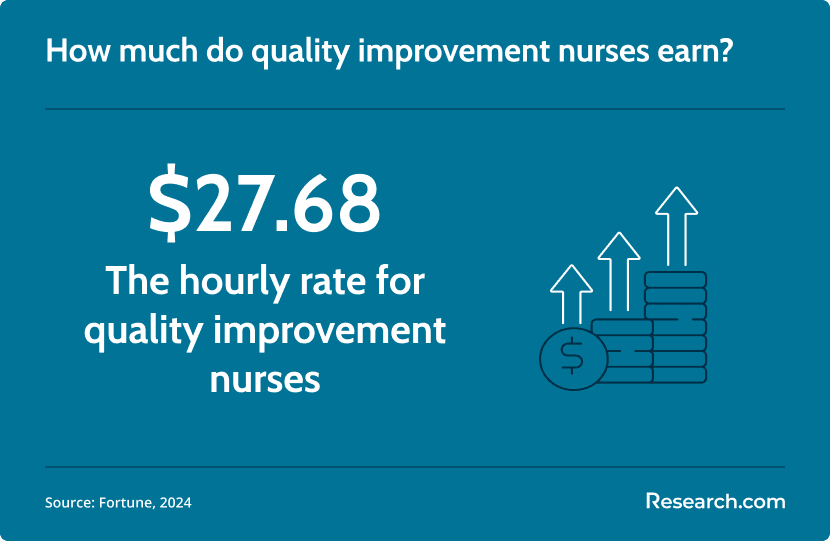
The national median salary for quality improvement nurses is $90,275 annually. This makes the role financially attractive for experienced nurses who want to apply clinical expertise in quality, safety, compliance, and healthcare operations.
Earnings vary widely by experience, setting, location, education, and scope of responsibility. Entry-level quality improvement nurses typically start around $66,500, while senior-level positions can reach up to $135,500 or more. Nurses in leadership roles, large health systems, specialized facilities, or high-cost regions may have stronger earning potential than those in smaller organizations or lower-paying markets.
What Can Affect Pay?
- Experience: Nurses with several years of clinical practice and documented quality project experience are often more competitive.
- Education: A BSN is commonly preferred, while graduate education may support advancement into management or director roles.
- Certification: Credentials such as CPHQ can strengthen a candidate’s profile, especially for dedicated quality roles.
- Work setting: Hospitals, ambulatory healthcare services, nursing and residential care facilities, and healthcare systems may structure pay differently.
- Leadership scope: Roles overseeing multiple units, departments, sites, or regulatory programs usually carry more responsibility and may offer higher compensation.
When evaluating salary, look beyond the headline number. Compare benefits, schedule expectations, remote-work flexibility, professional development support, tuition assistance, and whether the role is staff-level, coordinator-level, manager-level, or director-level.
What is the job outlook for Quality Improvement Nurses?
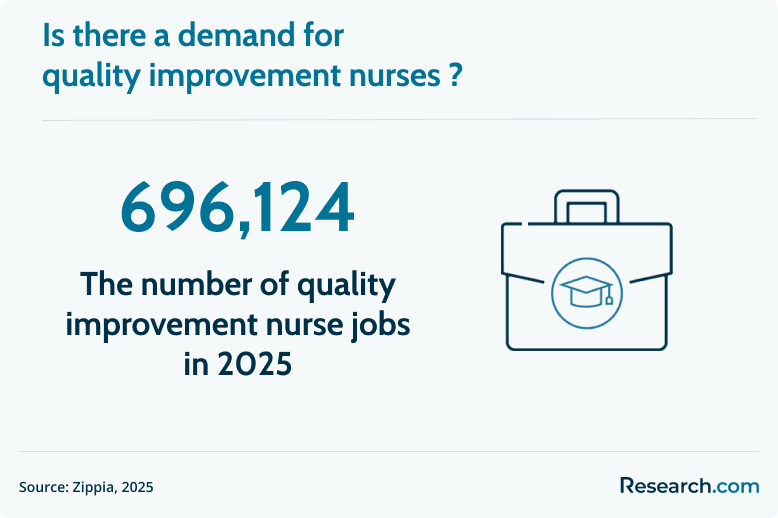
The job outlook for quality improvement nurses is strong, with a projected growth rate of 6% from 2023 to 2033. That is slightly above the average growth for all occupations, which is 4%. Demand is supported by patient safety priorities, regulatory expectations, healthcare complexity, and the need to improve outcomes while controlling risk.
The Key Factors Shaping the Future Outlook
An aging population is increasing demand for chronic care management and coordinated healthcare services. As patient needs become more complex, healthcare organizations need professionals who can identify gaps, reduce preventable harm, and standardize effective care processes.
Technology is also changing the role. Electronic health records, dashboards, analytics tools, and digital reporting systems give organizations more data than ever, but data alone does not improve care. Quality improvement nurses help interpret that information and turn it into practical changes that clinicians can implement.
Workforce attrition, retirements, burnout, and staffing shortages create challenges, but they also reinforce the importance of quality and safety roles. Organizations under staffing pressure need better systems, clearer workflows, and stronger prevention strategies to protect patients and staff.
For nurses planning an affordable route into or beyond nursing education, online schools accepting financial aid may be worth comparing as part of a broader education plan.
What is the typical work environment for Quality Improvement Nurses?
The quality improvement nurse work environment is usually more administrative than bedside nursing, but it still depends heavily on clinical knowledge. Many quality improvement nurses work in offices within hospitals, healthcare systems, clinics, or long-term care organizations. They also spend time on patient care units, in meetings, and in departments where process changes are being reviewed or implemented.
About 59% of these nurses are employed in hospitals-state, local, and private-while another 18% work in ambulatory healthcare services and 6% serve in nursing and residential care facilities. That means hospitals remain the most common setting, but opportunities also exist in outpatient care, residential care, and system-level quality departments.
The typical schedule is often Monday through Friday during standard business hours. Night and weekend shifts are rare compared with bedside nursing, although urgent safety events, survey preparation, or major reporting deadlines can require flexibility. Some organizations may allow certain documentation, reporting, or meeting tasks to be completed remotely, but many roles still require on-site collaboration.
Who They Work With
- Nurses and nurse managers
- Physicians and advanced practice providers
- Risk management and compliance teams
- Infection prevention and patient safety staff
- Quality committees and executive leaders
- Data analysts, informatics teams, and administrative staff
This environment suits nurses who want a steadier schedule than many bedside roles but still want to stay connected to patient care outcomes and clinical operations.
What are the pros and cons of Quality Improvement Nurse careers?
Quality improvement nursing can be highly rewarding, but it is not a low-pressure administrative role. It requires accountability, diplomacy, patience, and the ability to work through resistance when changes affect busy clinical teams.
Pros
- Broad patient impact: Improvements can affect entire units, departments, or facilities rather than one assignment at a time.
- Meaningful work: Projects often focus on reducing harm, improving outcomes, strengthening documentation, and supporting safer care.
- More predictable schedule: Many roles follow standard business hours with rare night or weekend shifts.
- Career mobility: Experience in quality can lead to roles in patient safety, compliance, informatics, accreditation, leadership, or education.
- Strong use of clinical expertise: Nurses can apply bedside experience to solve system-level problems.
Cons
- Resistance to change: Staff or leaders may push back against new protocols, especially when workloads are already heavy.
- High accountability: Serious event investigations, compliance gaps, and regulatory expectations can create pressure.
- Heavy documentation: The role often involves extensive reports, audits, data tracking, and follow-up.
- Less direct patient contact: Nurses who value continuous bedside interaction may miss that part of practice.
- Organizational barriers: Limited resources, slow approvals, and competing priorities can delay improvements.
This career is a good fit for nurses who like data-informed problem-solving, can communicate with different professional groups, and are willing to influence change over time. Nurses building toward the role may also compare practical certificate options that can support career growth.
What are the opportunities for advancement for Quality Improvement Nurses?
Quality improvement nursing offers several advancement routes. Some nurses move into senior quality roles, while others specialize in patient safety, regulatory compliance, informatics, or clinical education. Advancement usually depends on clinical experience, project results, leadership ability, education, and certification.
Quality Improvement Nurse Promotion Pathways
- Quality Improvement Nurse: Entry or staff-level role for nurses with clinical RN experience, often strengthened by a BSN and involvement in QI projects.
- Senior Quality Improvement Nurse or Quality Improvement Coordinator: More responsibility for project planning, reporting, staff coaching, committee participation, and cross-department initiatives. Employers may prefer an MSN or specialized certification like CPHQ or CPPS.
- Quality Improvement Manager: Supervises quality programs, staff, metrics, and organizational improvement priorities.
- Director of Quality: Oversees broader quality strategy, regulatory readiness, patient safety goals, performance improvement programs, and leadership reporting.
- System-level or executive roles: Focus on quality, safety, compliance, and outcomes across multiple facilities or service lines, often supported by graduate education and extensive leadership experience.
Areas to Specialize and Excel
- Patient Safety: Lead initiatives that reduce preventable harm, strengthen reporting culture, and improve safety practices.
- Data Analytics & Informatics: Use healthcare data, dashboards, and electronic health record trends to guide evidence-based improvements.
- Regulatory Compliance & Accreditation: Help organizations prepare for audits, meet standards, and correct compliance gaps.
- Clinical Education & Staff Training: Teach teams how to apply new protocols, documentation standards, and quality improvement practices.
- Risk Management: Support event review, prevention strategies, and communication around high-risk processes.
To advance, document measurable results. Employers value candidates who can show that a project improved compliance, reduced variation, strengthened documentation, or improved patient safety metrics.
What other careers should you consider?
If quality improvement nursing appeals to you, several related careers may also fit your skills. These roles use clinical knowledge, communication, education, coordination, or safety expertise, but they differ in daily focus and level of patient contact.
- Nurse Educator: Teaches nurses, students, or clinical staff. This path may fit nurses who enjoy training, mentoring, curriculum design, and translating standards into practice.
- Infection Preventionist: Focuses on preventing healthcare-associated infections through surveillance, data analysis, staff education, and compliance monitoring.
- Nurse Health Coach: Works with individuals to support wellness goals, behavior change, chronic disease management, and preventive care.
- Case Manager (Workers' Compensation Case Manager): Coordinates care, monitors progress, communicates with stakeholders, and helps patients move through treatment plans efficiently.
- Patient Advocate: Helps patients understand options, navigate healthcare systems, communicate concerns, and access appropriate support.
When comparing alternatives, ask three questions: Do you want direct patient contact or system-level impact? Do you prefer teaching, data, coordination, compliance, or advocacy? And do you want a role closer to bedside care or closer to administration?
Here's What Professionals Say About Their Quality Improvement Nurse Careers
- : "Taking on the role of a Quality Improvement Nurse allowed me to move beyond the bedside and see the bigger picture of care delivery. I focus on analyzing workflows, identifying where mistakes could occur, and developing changes that reduce those risks. It is rewarding to know that my work benefits entire departments and helps make care safer and more effective for every patient who comes through our doors. Every project challenges me to think creatively and collaborate with different teams, and that meaningful impact keeps me motivated every day. — Julian"
- : "Moving from direct patient care into system improvement was a steep learning curve. I had to get used to relying on data and reports instead of immediate patient feedback, which felt distant at first. Convincing busy clinicians to try new processes was not easy, and there was resistance. What helped was starting with small pilot programs, showing measurable outcomes, and keeping communication open with staff. The work tests your patience, but it pays off when care quality improves. — Latasha"
- : "One of my proudest moments was leading a project that reduced patient falls in a challenging unit. At first, many staff members were doubtful about the new protocols. By tracking the data closely and sharing progress, attitudes gradually changed. Seeing the numbers drop and the team’s confidence grow showed me how behind-the-scenes quality work can create safer environments and better patient experiences. That makes the long hours and detailed work worth it. — Isaac"
Key Findings
- Quality improvement nurses use clinical experience, data analysis, staff education, and process improvement to make healthcare safer and more consistent.
- The national median salary is $90,275 annually, with entry-level nurses typically starting around $66,500 and senior-level positions reaching up to $135,500 or more.
- The projected growth rate is 6% from 2023 to 2033, slightly above the 4% average growth for all occupations.
- Most candidates need an ADN or BSN, RN licensure through the NCLEX-RN exam, and two to five years of clinical experience before moving into quality improvement.
- A BSN is often preferred, and the CPHQ from the National Association for Healthcare Quality (NAHQ) can strengthen a candidate’s qualifications.
- About 59% of these nurses work in hospitals-state, local, and private-while 18% work in ambulatory healthcare services and 6% work in nursing and residential care facilities.
- The role often offers a more predictable Monday-through-Friday schedule than bedside nursing, though urgent safety or compliance matters may require flexibility.
- Advancement opportunities include Senior Quality Improvement Nurse, Quality Improvement Coordinator, Quality Improvement Manager, Director of Quality, and system-level leadership roles.
Other Things You Should Know About Quality Improvement Nurse
To become a quality improvement nurse in 2027, you'll need an RN license, typically achieved with an Associate's or Bachelor's degree in Nursing. Many employers prefer candidates with a Bachelor's degree coupled with further specialization in quality improvement or healthcare administration.
Certifications such as the Certified Professional in Healthcare Quality (CPHQ) can enhance a quality improvement nurse's career in 2027. This credential, recognized by the National Association for Healthcare Quality, demonstrates expertise in quality management and improvement principles, vital for career advancement.
References
- Most Common Career Changes for Nurses https://nurse.org/education/career-change-nurse/
- 30+ Non-Clinical and Non-Bedside Nursing Jobs https://nightingale.edu/blog/alternative-nursing-careers.html
- 11 Alternative Nursing Careers Using Your Clinical Skills https://steppingstonenurseacademy.com/2025/04/01/alternative-nursing-careers/
- Top 10 Soft Skills Needed In Health Care https://carrington.edu/blog/top-10-soft-skills-needed-health-care/
- 5 Quality Improvement Specialist Interview Questions and Answers for 2025 | Himalayas https://himalayas.app/interview-questions/quality-improvement-specialist
- Experiences of Newly Qualified Nurses’ Engagement with Quality Improvement in Practice: A Qualitative Follow-Up Study https://pmc.ncbi.nlm.nih.gov/articles/PMC11503377/
- The Nursing Workforce https://www.ncbi.nlm.nih.gov/books/NBK573922/
- RN Clinical Consultant V, Professional Practice and Magnet at Kaiser Permanente https://www.kaiserpermanentejobs.org/job/pasadena/rn-clinical-consultant-v-professional-practice-and-magnet/641/87494679984
- Top 10 Quality Improvement Nurse Interview Questions and Answers (Updated 2025) https://www.cvowl.com/blog/quality-improvement-nurse-interview-questions-answers
- Quality Improvement Nurse https://nursing.jnj.com/specialty/quality-improvement-nurse


