
2027 Web Design Careers: Skills, Education, Salary & Job Outlook

Co-Founder and Chief Data Scientist
Choosing a web design career means deciding whether you want work that blends visual design, user experience, and front-end technology. The field can be attractive because it rewards creativity and practical problem-solving, but it is not a shortcut career. Web designers must keep learning as tools, accessibility standards, device expectations, and client needs change.
The opportunity is still meaningful for people who enjoy building digital experiences. Web design careers grow 16% faster than average, and salaries can be competitive, with earnings nearing $85,000 annually in the US. Strong candidates usually combine design judgment, HTML and CSS knowledge, basic JavaScript awareness, communication skills, and a portfolio that proves they can turn business goals into usable websites.
This guide explains what web designers do, the skills and credentials that matter, typical salary and job outlook data, work environments, advancement options, and related careers to consider. Use it to decide whether web design fits your strengths—and what steps to take if you want to enter the field in 2026.
Key Things You Should Know About Web Design Career
- The typical earning potential for web designers in the United States is around $98,090 annually, with some variation depending on experience and location.
- This field is growing steadily, with an 8% job growth rate projected from 2023 to 2033, which is faster than the average for most occupations.
- A bachelor's degree in web design, graphic design, computer science, or a related field is usually required, though strong portfolios and certifications can sometimes compensate for formal education.
- Success depends on strong skills in HTML, CSS, JavaScript, and design tools like Adobe Creative Suite, combined with a solid understanding of UX/UI principles and effective communication.
- Career advancement can lead from entry-level roles to senior designer positions, UX/UI specialization, or broader creative leadership roles like art director or design manager, including opportunities in freelance or consulting work.
What do Web Designers do?
Web designers plan and create the visual structure, layout, and interactive experience of websites. Their work shapes how visitors understand a brand, find information, complete tasks, and decide whether a site feels credible. A strong web designer does more than make pages attractive; they organize content, guide attention, reduce friction, and help users move through a digital experience with confidence.
The role sits between graphic design, user experience, marketing, and front-end development. Some web designers focus mainly on visual concepts and prototypes, while others also build responsive pages with HTML, CSS, and light JavaScript. In smaller companies or freelance work, one person may handle research, design, basic development, testing, and updates. In larger teams, responsibilities are often divided among UX designers, UI designers, developers, content strategists, and product managers.
A Day in the Life of Web Designers
A typical day may include reviewing a client brief, sketching a layout, building wireframes, refining typography and color choices, preparing design files, checking mobile responsiveness, or discussing implementation details with developers. Web designers also spend time responding to feedback, explaining design decisions, and revising work to meet business goals without sacrificing usability.
The pace can vary. Early project stages often involve research, planning, and creative exploration. Later stages may become more deadline-driven as designs move into development, testing, and launch. The final output is usually a live website, landing page, digital product interface, or set of design assets that supports a brand’s online presence.
What are the key responsibilities of Web Designers?
Web designers are responsible for turning goals, content, and user needs into clear digital interfaces. Their exact duties depend on the employer, project size, and team structure, but most roles include a mix of planning, design production, collaboration, testing, and maintenance.
- Clarify project goals: Meet with clients, managers, or stakeholders to define the audience, purpose, brand requirements, content needs, budget, and timeline.
- Create wireframes and prototypes: Use tools such as Photoshop or Adobe XD to map page structure, test design concepts, and identify usability problems before development begins.
- Design website layouts: Select typography, color schemes, imagery, spacing, graphics, navigation patterns, and interactive elements that support the site’s purpose.
- Design for multiple devices: Make sure pages work across desktops, tablets, and mobile screens, with attention to readability, touch targets, and responsive behavior.
- Test usability and functionality: Review site behavior across browsers and devices, gather feedback, and identify issues that affect navigation, accessibility, or performance.
- Collaborate with developers and other teams: Work with software engineers, marketers, content creators, product managers, and business stakeholders to ensure the final site matches the approved design and supports technical requirements.
- Maintain and improve sites after launch: Update content, fix design issues, improve pages based on analytics or feedback, and keep visual elements consistent as the site grows.
The Most Challenging vs. The Most Rewarding Tasks
One of the hardest parts of web design is balancing what clients want with what users need. A client may prefer a trend, animation, or layout that looks impressive but slows the site, confuses visitors, or makes important content harder to find. Good web designers learn how to explain trade-offs clearly and recommend solutions that protect both brand goals and usability.
The most rewarding part is seeing a finished site go live and perform its purpose. A successful design can help a business attract customers, help a nonprofit reach supporters, make an online service easier to use, or give a creative professional a stronger public presence. For many designers, that visible impact is what makes the work satisfying.
If you want structured preparation, an online accelerated bachelor's can help you build design, technology, and communication skills more quickly than a traditional timeline, depending on the program and your prior credits.
What are the key skills for Web Designers?
Employers typically look for web designers who can combine visual judgment with technical awareness and strong communication. A polished portfolio matters, but hiring managers also want evidence that you can solve real problems, accept feedback, work with constraints, and deliver designs that users can understand.
Key Hard Skills
- HTML and CSS: Web designers should understand how pages are structured and styled, even when developers handle production code.
- JavaScript fundamentals: Basic JavaScript knowledge helps designers plan interactive elements such as forms, sliders, menus, pop-ups, and dynamic page behavior.
- User Experience (UX) Design: Research, user flows, wireframing, navigation planning, and usability testing help designers create sites that are easy to use.
- Visual and interface design: Typography, color, spacing, hierarchy, imagery, and layout choices determine whether a site feels professional and readable.
- Design software proficiency: Tools such as Adobe Creative Suite, Figma, or Sketch are commonly used to create mockups, prototypes, design systems, and handoff files.
- Responsive design: Designers need to understand how layouts adapt across screen sizes and how mobile behavior affects navigation, content, and interaction.
Essential Soft Skills
- Active listening: Designers must understand what clients and users are actually trying to accomplish, not just what they initially request.
- Critical thinking: Strong designers can evaluate whether a design choice supports the goal or simply follows a trend.
- Complex problem solving: Websites often involve competing needs, including branding, usability, performance, accessibility, content, and technical limits.
- Collaboration: Web design is rarely isolated work. Designers coordinate with developers, marketers, writers, product teams, and executives.
- Feedback management: Designers need to receive critique professionally, defend important decisions with evidence, and revise work without losing sight of the objective.
The Overlooked Skill That Separates Good From Great Web Designers
Client and stakeholder management is often the difference between a smooth project and a frustrating one. Great web designers can translate broad business goals into design priorities, explain why certain choices matter, and keep feedback focused on outcomes rather than personal preferences.
For example, a designer may need to persuade a stakeholder that a simpler homepage will convert better than a crowded one, or that accessibility improvements are not optional polish but part of building a usable site. This skill prevents unnecessary revisions, protects project timelines, and helps the final product serve users more effectively.
For professionals seeking stronger credentials, online certs that pay well may offer targeted ways to build job-relevant skills. These are the most important web design skills 2025 professionals must possess to thrive.
Web Design Careers: A Step-by-Step Guide to Getting Started
Getting started in web design is easier when you treat the process as a sequence: learn the foundations, build proof of skill, get feedback, and then specialize. Employers and clients rarely hire based on coursework alone. They want to see work that demonstrates taste, usability, technical understanding, and follow-through.
- Build foundational knowledge: Learn HTML, CSS, basic JavaScript, layout principles, typography, color theory, responsive design, accessibility basics, and UX fundamentals. You can do this through self-study, college programs, bootcamps, certificates, or online tutorials.
- Study strong websites critically: Analyze how professional sites use navigation, spacing, calls to action, hierarchy, and mobile layouts. Do not copy designs; learn how successful sites guide user behavior.
- Create practice projects: Build landing pages, portfolio sites, redesign concepts, nonprofit mockups, small business websites, or e-commerce page samples. Each project should solve a clear problem.
- Develop a focused portfolio: Include your best work, not every project you have completed. Explain the goal, your design choices, tools used, constraints, and final outcome.
- Gain practical experience: Look for internships, freelance projects, volunteer work, entry-level roles, or collaborations with developers and content creators. Real client constraints teach skills that tutorials cannot.
- Seek professional validation: Certifications can help, especially when they align with tools or skills employers request. They are most useful when paired with a portfolio that proves practical ability.
- Specialize and advance: As you gain experience, focus on UX design, UI design, front-end development, accessibility, design systems, e-commerce, or another niche that matches your strengths.
- Consider leadership or freelance paths: Experienced designers may move into lead roles, design management, product design, consulting, or independent client work.
A step-by-step guide to web design career planning should reduce uncertainty, not create a rigid formula. Your path may be faster if you already have design, coding, marketing, or writing experience. It may take longer if you are building both technical and visual skills from the ground up.
What education, training, or certifications are required?
Web design does not always have one mandatory education path, but many professional roles prefer candidates with formal training, a strong portfolio, or both. A relevant bachelor's degree is commonly used to enter the field, especially for candidates targeting structured corporate roles or competitive design teams.
Common degree options include a Bachelor's in Interactive Media Studies, Graphic Design, or Computer Engineering. Each has a different emphasis. Interactive media programs often blend design and digital production. Graphic design programs focus more heavily on visual communication. Computer engineering programs provide stronger technical depth, which can be useful for designers who want to move toward front-end development or product work.
Certifications can also strengthen a resume when they validate current, practical skills. Essential certifications include the Wix Studio Web Designer Certification and the Google UX Design Certificate. Advanced credentials include a Master's in Web Design or Development and the Adobe Certified Professional in Web Design.
No formal on-the-job training hours are mandated, but internships, supervised projects, and practical portfolio work are important. In web design, evidence of what you can create often carries as much weight as the name of the credential.
Are advanced degrees or niche certifications worth the investment?
Advanced degrees can be worthwhile for people who want leadership roles, academic depth, a career change with structured support, or access to a stronger professional network. They may also help candidates who want to move into UX strategy, digital product leadership, or specialized design research. The trade-off is cost, time, and the risk of studying theory without building enough current portfolio work.
Niche certifications are usually faster and more targeted. A tool-specific credential, such as one connected to Adobe, can help you demonstrate proficiency, but it should not replace broad design ability. Employers still want to see whether you can solve layout, usability, branding, and responsive design problems in real projects.
If you are already working and want a flexible route, a fast online master's degree may help you continue building credentials without fully stepping away from your career. Before enrolling, compare curriculum, accreditation, portfolio support, faculty experience, cost, and whether the program teaches current design tools and workflows.
What is the earning potential for Web Designers?
The average web designer salary 2025 is $98,090 annually, serving as a useful benchmark for web and digital interface designers. This median figure means half of workers earn more and half earn less. Actual pay can differ widely depending on experience, location, industry, technical depth, portfolio quality, and whether a designer works full-time, freelance, or in a hybrid role.
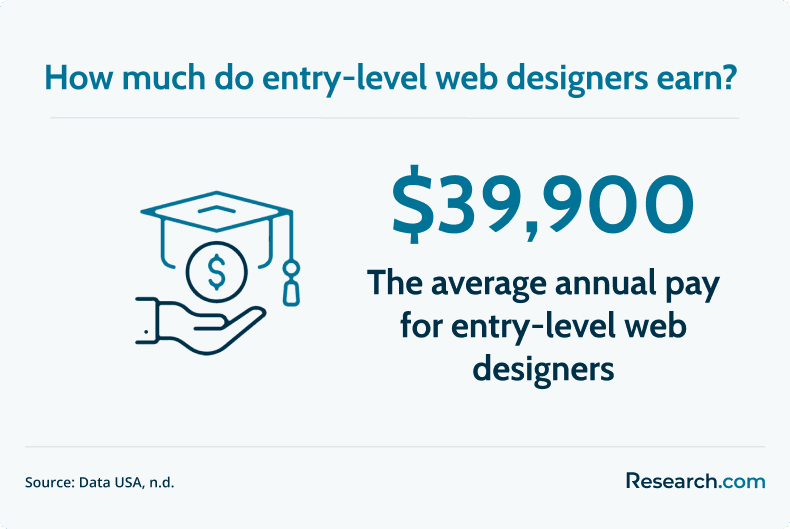
Web designer salary by experience level varies significantly. Entry-level positions may start around $49,349 to $71,000, while senior designers can earn up to $129,000 to $135,000 annually. Alternative data from salary aggregators suggest entry-level salaries near $53,500 and senior-level salaries around $80,000. These ranges show why it is important to compare sources carefully and evaluate salaries in relation to job duties, cost of living, benefits, and required skills.
What affects web designer pay?
- Experience level: Senior designers typically earn more because they can lead projects, solve ambiguous problems, mentor others, and manage stakeholder expectations.
- Technical skill depth: Designers who understand front-end development, accessibility, UX research, or design systems may qualify for broader and higher-paying roles.
- Industry: Pay can vary between agencies, software companies, e-commerce businesses, media organizations, nonprofits, and corporate design teams.
- Location: Metropolitan areas often pay more, though higher salaries may come with higher living costs. Remote work can also affect compensation policies.
- Employment type: Freelancers may set higher project rates but must account for taxes, unpaid admin time, inconsistent income, and benefits they provide for themselves.
- Additional compensation: Bonuses, profit-sharing, equity, and benefits can change the total value of an offer beyond base salary.
For career planning, treat salary figures as directional rather than guaranteed. The strongest candidates usually increase earning potential by building a clear specialty, documenting measurable project results, and learning how to communicate the business value of their design work.
What is the job outlook for Web Designers?
The employment outlook for web designers is strong, with a projected growth rate of 8% from 2023 to 2033, nearly twice the average growth rate of all occupations. This suggests continued demand for professionals who can create, improve, and maintain digital experiences across websites, applications, and online services.
Demand is not only about building new websites. Many organizations already have sites but need redesigns, accessibility improvements, mobile optimization, conversion-focused landing pages, better content structure, and more consistent brand experiences. Designers who can connect visual design to measurable user and business outcomes should be better positioned than those who rely only on aesthetics.
The Key Factors Shaping the Future Outlook
Several forces support continued opportunities in the field. Businesses still need a professional digital presence, e-commerce continues to shape customer expectations, and new digital products require interfaces that are clear and trustworthy. Mobile apps, streaming services, online marketplaces, and other digital platforms also create demand for design skills tied to user behavior and interaction.
Technology will also change the work. AI tools and website builders can automate basic layouts, generate design variations, and speed up production. However, these tools do not remove the need for designers who can define strategy, understand users, create original brand experiences, evaluate quality, and solve complex design problems. The value of the designer increasingly comes from judgment, not simply tool operation.
Professionals seeking faster entry routes may explore quick schooling for good paying jobs, especially when programs include practical projects, portfolio development, and current web design workflows.
What is the typical work environment for Web Designers?
Web designers commonly work in office-based, remote, or hybrid environments. Because most design tools, collaboration platforms, and project management systems are digital, many designers can work from home or split time between home and an employer’s office. Client-facing freelancers may also work from coworking spaces, home offices, or client locations.
Most web designers are employed in industries like computer systems design and related services (23%), advertising and public relations (14%), and the information sector (13%). These settings can differ significantly. Agencies may involve fast project turnover and multiple clients. In-house design teams may focus more deeply on one company’s brand, products, and long-term site performance. Technology companies may expect closer collaboration with product managers and software engineers.
The web designer typical work schedule is usually a standard full-time workload of about 40 hours per week. However, overtime or weekend work can happen near launches, campaign deadlines, redesign milestones, or urgent site fixes. Freelancers may have more control over schedules but also need to manage client communication, contracts, billing, marketing, and project scope.
Collaboration is a major part of the job. Web designers often work with software engineers, content creators, product managers, marketing teams, executives, and clients. Clear communication is essential because a design that looks good in isolation still needs to work within technical limits, content realities, brand standards, and business goals.
What are the pros and cons of Web Designer careers?
Web design can be a strong career fit for people who enjoy visual creativity, technology, and practical problem-solving. It can also be stressful for those who dislike feedback cycles, shifting requirements, or the need to keep learning new tools. Before entering the field, weigh both the rewards and the demands.
Intrinsic Rewards
- Creative expression: Web designers make visible work that combines layout, color, typography, imagery, and interaction.
- Practical impact: A well-designed site can help users find information, buy products, book services, donate, learn, or contact an organization.
- Tangible results: Designers can see their work published and often measure outcomes through engagement, conversions, feedback, or usability improvements.
- Varied skill use: The role blends artistic judgment, technical understanding, communication, and strategy.
- Continuous learning: New tools, platforms, and design practices can keep the work intellectually engaging.
Intrinsic Challenges
- Changing requirements: Clients and stakeholders may revise goals, content, priorities, or design direction during a project.
- Subjective feedback: Designers often need to separate personal taste from evidence-based decisions and business requirements.
- Usability constraints: The most visually interesting option is not always the clearest, fastest, or most accessible one.
- Deadline pressure: Launch dates, marketing campaigns, and development schedules can create intense periods of work.
- Rapid tool changes: Designers must keep skills current as software, design systems, AI tools, and user expectations evolve.
This career rewards people who can stay flexible while maintaining design standards. If you want a practical training route, the most popular accredited trade schools online may help you compare programs that offer career-focused preparation and hands-on experience.
What are the opportunities for advancement for Web Designers?
Web design career growth opportunities include promotion into senior design roles, movement into related specialties, and independent work. Advancement usually depends on portfolio quality, project outcomes, communication ability, leadership potential, and whether you can connect design decisions to user and business goals.
Clear Advancement Paths
- Junior Web Designer to Web Designer: Early-career designers build production skills, learn from feedback, and complete smaller design tasks or supervised projects.
- Web Designer to Senior Web Designer: Senior designers handle more complex projects, make strategic design decisions, guide visual systems, and mentor others.
- Senior Web Designer to Lead Web Designer: Lead designers coordinate design direction, review work, communicate with stakeholders, and help teams maintain quality.
- Lead Web Designer to Director of User Experience: Leadership roles focus more on strategy, team management, design standards, cross-functional planning, and business outcomes.
- Lateral moves: Experienced designers may move into roles such as Senior Product Designer or Design System Leadership.
Specialization Opportunities
- User Experience (UX) Design: Focus on research, user flows, wireframing, usability testing, and improving user satisfaction.
- User Interface (UI) Design / Visual Design: Specialize in typography, color, layout, visual hierarchy, components, and the overall look and feel of websites.
- Interaction Design: Design user flows, microinteractions, animations, and interactive elements that support engagement and clarity.
- Front-End Web Development: Combine design with HTML, CSS, and JavaScript to build interfaces, often leading toward specialized developer or full-stack roles.
- Information Architecture: Organize content and navigation so users can find information quickly and logically.
- SEO Optimization: Align design and site structure with search visibility, performance, content hierarchy, and user intent.
- Content Strategy: Shape messaging, page structure, and content priorities so the website communicates clearly and supports conversion goals.
The web design career advancement potential is strongest for professionals who keep their portfolios current, learn adjacent skills, and show that their work improves real outcomes—not just visual appearance.
What other careers should you consider?
If you are interested in web design but unsure whether it is the best fit, compare it with nearby careers. The right choice depends on whether you prefer visual design, coding, research, branding, animation, strategy, or direct user problem-solving.
- Front-end Developer: A strong option if you enjoy coding more than visual exploration. Front-end developers implement user interfaces and often work deeply with HTML, CSS, JavaScript, frameworks, performance, and accessibility.
- User Experience (UX) Designer: A good fit if you care most about usability, user journeys, research insights, wireframes, and product logic rather than final visual polish alone.
- Graphic Designer: A better match if you prefer branding, typography, layout, marketing materials, and visual identity across digital and print formats.
- UX Researcher: Ideal for people who enjoy studying user behavior, conducting interviews or tests, analyzing data, and turning findings into design recommendations.
- Motion Graphics Designer: A strong choice if you enjoy animation, storytelling, transitions, video assets, and dynamic visual content for digital platforms.
To decide, review job descriptions and portfolio examples for each path. If you are drawn to how websites look and function, web design may fit. If you want to build the code behind interfaces, front-end development may be stronger. If you prefer studying users and shaping product decisions, UX design or UX research may be the better direction.
Here's What Professionals Say About Their Web Design Careers
- Laila: "When I started working with a local nonprofit, I wasn't a pro by any means, but I could immediately see how redesigning their website would help them connect with more supporters. It felt incredible to know that my designs weren't just about visuals-they actually helped small organizations and creatives expand their reach and get their voices heard. Each project reminds me that good design can empower people in meaningful ways beyond aesthetics. That's what keeps me passionate about what I do."
- Andre: "I didn't have any formal training in web design when I took on my first freelance clients, and the imposter syndrome hit hard. Balancing a full-time job, graduate classes, and client work often left me doubting if I could manage it all. I focused on treating every project like a real challenge to improve my skills and relied heavily on the workflows I developed over time. Taking it step by step helped me push through those early doubts and build confidence in my craft."
- Sienna: "The best moments for me come when a client reaches out after a launch to say their new site has brought in clients they only dreamed of before. Hearing that they're proud to share their website makes all the long nights worth it. Learning to set my own rates and overcoming my early fears transformed how I approach projects, and watching clients succeed is the most rewarding part of my work. Those milestones remind me that the effort I put in genuinely changes lives."
Key Findings
- Web design is a practical creative career that combines visual design, user experience, communication, and front-end technical knowledge.
- The strongest candidates build portfolios that show real problem-solving, not just attractive screenshots.
- Important skills include HTML, CSS, basic JavaScript, UX design, responsive design, visual hierarchy, design software, collaboration, and stakeholder management.
- A relevant bachelor's degree can help, but certifications, internships, freelance projects, and portfolio work are also important ways to prove readiness.
- The average web designer salary 2025 is $98,090 annually, though actual earnings vary by experience, location, specialization, employment type, and industry.
- The job outlook is positive, with projected growth of 8% from 2023 to 2033, nearly twice the average growth rate of all occupations.
- AI tools and website builders may automate basic work, but designers who understand strategy, usability, accessibility, branding, and user behavior remain valuable.
- Advancement paths include senior web designer, lead web designer, Director of User Experience, Senior Product Designer, Design System Leadership, UX design, UI design, interaction design, and front-end development.
Other Things You Should Know About Web Design Careers
In 2027, web designers must master responsive design, understand UX/UI principles, and be proficient in HTML, CSS, and JavaScript. Familiarity with AI tools, accessibility standards, and frameworks like React or Vue.js is essential to remain competitive. Proficiency in these areas ensures the creation of user-friendly and accessible web experiences.
While not all web designers need to code deeply, understanding HTML, CSS, and JavaScript remains fundamental in 2027. These skills enhance collaboration with developers and empower designers to create interactive prototypes, allowing them to bring their ideas to life with greater precision.
References
- Is Web Design a Good Career? Explore This Career Guide https://online.champlain.edu/blog/is-web-design-good-career
- How to Become a Web Designer https://www.coursera.org/ca/articles/how-to-become-a-web-designer
- How to Become a Web Designer (2025 Guide) | BrainStation® https://brainstation.io/career-guides/how-to-become-a-web-designer
- Web designer https://www.prospects.ac.uk/job-profiles/web-designer
- Bureau of Labor Statistics (BLS) | https://www.bls.gov/ooh/computer-and-information-technology/web-developers.htm
- Testimonials - Web Design, SEO and PHP, Android, C/C++ Programming Training https://www.smartmentors.net/testimonials/
- Thinking of becoming a web designer? Read this first. https://80000hours.org/career-reviews/web-designer/
- Full-Time Web Design Career: 7 Things You Need to Know https://mavenmarketinggroup.com/blog/full-time-web-design-career/
- Things you should know about Web Designer’s position | Work in IT | NFJ Log https://nofluffjobs.com/log/work-in-it/things-you-should-know-about-web-designers-position/


