
2027 What Does a Chief Nursing Officer or Chief Nurse Executive Do: Responsibilities, Requirements, and Salary

Co-Founder and Chief Data Scientist
A chief nursing officer (CNO) or chief nurse executive (CNE) is the senior nursing leader responsible for how nursing care is organized, staffed, measured, and improved across a hospital or healthcare system. For nurses who want to move beyond unit-level leadership into executive decision-making, this role is one of the clearest paths to shaping patient care at scale.
The position matters because nursing leaders influence staffing models, patient safety priorities, quality outcomes, regulatory readiness, and the work environment for nurses. With over 41,000 chief nursing officers currently employed in the United States, the role is also a major leadership track within healthcare administration.
This guide explains what a chief nursing officer or chief nurse executive does, how the two titles compare, what education and leadership skills employers usually expect, how much the role pays, and what the career path can look like for experienced nurses preparing for executive leadership.
Key Things You Should Know About What a Chief Nursing Officer or Chief Nurse Executive Does
- A chief nursing officer or chief nurse executive oversees all nursing operations, ensuring high-quality patient care and regulatory compliance.
- The position requires advanced education, strong leadership skills, and years of nursing and administrative experience.
- Salaries for chief nursing officers and chief nurse executives reflect the role’s seniority and vary depending on the size and type of healthcare organization.
Is a chief nursing officer the same as a chief nurse executive?
In many healthcare organizations, “chief nursing officer” and “chief nurse executive” refer to the same senior nursing leadership role. Both titles usually describe the executive responsible for nursing strategy, nursing operations, patient care standards, workforce planning, and collaboration with the broader leadership team.
The difference is often organizational rather than functional. A hospital may use “chief nursing officer” for the top nurse executive at one facility, while a larger health system may use “chief nurse executive” for a leader overseeing nursing practice across multiple hospitals, service lines, or regions. In either case, the role carries executive authority and requires the ability to connect bedside realities with system-level decisions.
The titles may vary, but the core expectations are similar: lead nursing practice, protect patient safety, manage nursing resources, support nurse leaders, maintain compliance, and help the organization meet quality and financial goals. Nurses pursuing this path often build on advanced clinical and leadership preparation, including doctoral-level education. Some explore specialized advanced practice routes such as DNP AGACNP jobs, although executive nursing leadership generally requires broader management and systems experience beyond clinical specialization alone.
What are the key responsibilities of a chief nursing officer/nurse executive in 2027?
A chief nursing officer or chief nurse executive is accountable for the performance of nursing services across the organization. The role combines executive strategy, operational management, regulatory oversight, and direct support for nursing leaders. Instead of managing only one unit, the CNO or CNE makes decisions that affect staffing, quality, patient experience, nurse retention, and the organization’s ability to deliver safe care.
Key responsibilities typically include:
- Setting nursing standards and policies. The CNO or CNE develops, approves, and enforces nursing policies that support consistent, evidence-based, and legally compliant care.
- Leading nursing workforce strategy. This includes staffing models, recruitment, retention, scheduling practices, succession planning, and leadership development for nurse managers and directors.
- Improving patient safety and quality outcomes. Nursing executives monitor performance data, investigate care gaps, and lead initiatives tied to infection prevention, falls, medication safety, readmissions, and patient satisfaction.
- Managing budgets and resources. They oversee nursing department budgets, evaluate labor costs, allocate resources, and balance financial discipline with patient care needs.
- Representing nursing at the executive level. The CNO or CNE brings nursing priorities into board, executive, and medical leadership discussions so care delivery decisions reflect frontline realities.
- Maintaining compliance and accreditation readiness. They help ensure nursing operations meet healthcare laws, accreditation standards, ethical requirements, and internal policies.
- Supporting clinical and operational change. Nursing executives lead major changes such as new technology rollouts, care model redesign, emergency preparedness efforts, and quality improvement programs.
According to industry data, the largest employers of medical and health services managers—which include chief nursing officers and chief nurse executives—are hospitals (29%), physician offices (14%), nursing and residential care facilities (9%), government organizations (7%), and outpatient care centers (7%). This distribution shows why many CNO and CNE roles require experience in complex, highly regulated care environments.
Although nursing leadership is the foundation of the role, executive nurses also benefit from understanding the administrative and revenue cycle side of healthcare. Familiarity with coding, documentation, billing, and reimbursement can help leaders connect clinical decisions with operational sustainability. Professionals studying areas such as a fast track online medical billing and coding associate degree may gain useful perspective on how healthcare operations are measured and financed.
What degree do you need to become a chief nursing officer/nurse executive?
Most chief nursing officers and chief nurse executives begin as registered nurses and advance through years of clinical practice, supervisory roles, and formal leadership education. A nursing degree and active RN background are generally expected, but executive-level roles usually require more than clinical competence. Employers often look for graduate education, management training, and a record of leading teams, budgets, and quality initiatives.
A bachelor’s degree in nursing is the most common educational level—held by about 47% of current professionals in this role. Approximately 24% hold a master’s degree, and 20% have an associate degree. These figures show that career paths can vary, but they should not be read as a shortcut around graduate preparation. For competitive CNO and CNE roles, especially in hospitals and multi-facility systems, a Master of Science in Nursing (MSN), healthcare administration degree, business degree, or dual graduate degree is often preferred.
Common education path
- Associate degree or BSN and RN licensure: The entry point for clinical nursing practice. Many nurses later complete a BSN if they started with an associate degree.
- Bedside and specialty experience: Early clinical work builds credibility, judgment, and understanding of patient care systems.
- Graduate education: An MSN, MBA, MHA, DNP, or dual degree can strengthen preparation in finance, leadership, policy, informatics, quality improvement, and organizational strategy.
- Executive development: Certifications, fellowships, mentoring, committee leadership, and administrative assignments help nurses demonstrate readiness for senior roles.
Dual-degree preparation can be especially useful because CNOs and CNEs must speak both the language of nursing practice and the language of executive management. Programs discussed in resources such as what can you do with a dual MSN MBA degree can help nurses understand how nursing leadership connects to budgeting, strategy, operations, and organizational performance. Some nursing executives also pursue terminal degrees such as a DNP or Ph.D. in Nursing, particularly when they want to lead system-wide practice transformation, research initiatives, or academic-clinical partnerships.
What leadership skills are essential for a chief nursing officer/nurse executive?
A chief nursing officer or chief nurse executive needs more than seniority. The role requires the ability to lead through complexity, make high-stakes decisions with incomplete information, and earn trust from nurses, physicians, executives, patients, and regulators. Strong candidates combine clinical credibility with financial literacy, communication skill, and a systems view of healthcare delivery.
Essential leadership skills include:
- Patient-centered focus (18.2%) – Keeping patient safety, dignity, access, and outcomes at the center of nursing operations and executive decisions.
- Strategic leadership (6.6%) – Translating organizational goals into nursing priorities, staffing plans, quality programs, and measurable outcomes.
- Rehabilitation management (5.6%) – Overseeing specialized care units and recovery programs when the organization’s services include rehabilitation or post-acute care.
- Patient safety oversight (4.9%) – Building systems that reduce preventable harm, support transparent reporting, and strengthen continuous quality improvement.
- Performance improvement (4.8%) – Using data to identify gaps, redesign workflows, and evaluate whether changes improve care and efficiency.
- Commitment to quality care (4.2%) – Setting expectations for clinical excellence and holding teams accountable without creating a punitive culture.
- Customer service orientation (3.9%) – Understanding patient experience, family communication, service recovery, and trust as part of high-quality care.
Skills that often separate strong candidates
- Financial and operational judgment: CNOs and CNEs must understand labor costs, productivity, resource allocation, and the financial effects of care delivery decisions.
- Change management: Nursing executives often lead technology adoption, care model redesign, restructuring, and quality initiatives that affect thousands of staff and patients.
- Conflict resolution: The role requires managing disagreements among nursing teams, physicians, administrators, unions, patients, and families.
- Executive communication: Strong nursing executives can explain clinical risks, staffing needs, and quality priorities clearly to boards and senior leaders.
- Ethical decision-making: The CNO or CNE must balance patient needs, staff safety, compliance requirements, and organizational constraints.
Advanced clinical preparation can add credibility, but executive nursing leadership also demands broad systems thinking. Nurses comparing advanced practice and leadership options may review resources such as DNP midwifery salary information to understand how specialized doctoral training can support clinical impact, leadership development, and long-term career planning.
What is the average salary of a chief nursing officer/nurse executive in 2027?
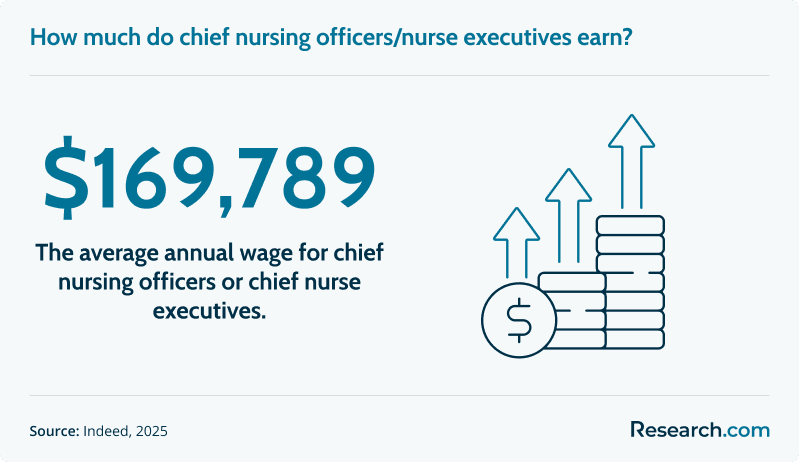
In 2027, the average annual salary for a chief nursing officer or chief nurse executive in the United States is approximately $169,789. This compensation reflects the scope of the role: executive accountability for nursing operations, patient care quality, workforce performance, compliance, and strategic planning.
Actual pay can vary widely. A CNO leading nursing services in a large metropolitan hospital or multi-facility health system may have a very different compensation package from a nursing executive in a smaller community facility, outpatient network, or long-term care organization. Location, organization size, financial performance, reporting structure, and years of executive experience can all affect salary.
What can influence compensation?
- Facility size and complexity: Larger hospitals and health systems usually require broader operational oversight.
- Geographic market: Executive compensation often reflects regional labor costs and competition for senior healthcare leaders.
- Scope of authority: A role overseeing multiple hospitals, departments, or service lines may pay more than a single-site leadership role.
- Experience and credentials: Graduate education, executive certifications, and a record of measurable quality or financial improvements can strengthen a candidate’s negotiating position.
- Compensation structure: Total compensation may include base salary, performance incentives, retirement benefits, healthcare benefits, and other executive-level benefits.
Additional credentials do not guarantee a specific salary, but they can expand a nurse’s qualifications for advanced clinical and leadership roles. Nurses reviewing options such as FNP graduate certificate salary pathways should evaluate how each credential fits their long-term goals, whether those goals are advanced practice, nursing administration, or executive leadership.
What is the typical career path to becoming a chief nursing officer/nurse executive?
The path to chief nursing officer or chief nurse executive is usually gradual. Employers rarely hire directly into this role without substantial clinical, managerial, and administrative experience. Most CNOs and CNEs build credibility first as registered nurses, then advance into progressively larger leadership roles where they manage people, budgets, quality outcomes, and organizational change.
Common career progression
- Registered nurse: Develops clinical judgment, patient care experience, and understanding of unit-level operations.
- Charge nurse or clinical leader: Begins coordinating shifts, supporting peers, handling immediate workflow issues, and communicating with providers.
- Nurse manager: Manages a unit or department, including staffing, scheduling, performance reviews, quality metrics, and budget responsibilities.
- Director of nursing or service line leader: Oversees multiple units or specialty areas and becomes more involved in policy, quality improvement, and cross-functional planning.
- Vice president of nursing or patient care services: Takes on broader operational and strategic responsibilities, often reporting to senior executives.
- Chief nursing officer or chief nurse executive: Leads nursing strategy and operations at the highest organizational level.
Graduate education and professional certifications often become more important as nurses move from department leadership into enterprise-level roles. Experience in strategic planning, budgeting, accreditation, risk management, informatics, workforce planning, and quality improvement is especially valuable because these responsibilities are central to executive nursing practice.
A DNP, Ph.D. in Nursing, MSN, MBA, MHA, or dual degree can support advancement, but degrees alone are not enough. Search committees generally look for a proven record: successful team leadership, measurable improvements in outcomes, sound financial decisions, and the ability to work effectively with physicians and executives. Nurses exploring doctoral leadership routes may find resources such as what can you do with a FNP DNP degree useful when comparing clinical doctorate pathways with administrative leadership goals.
What is the projected job growth for nursing executives over the next decade?
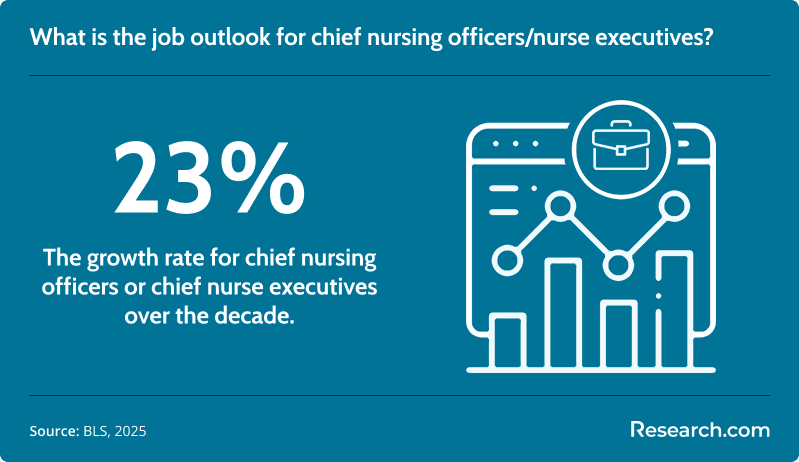
The outlook for nursing executives is strong because healthcare organizations need experienced leaders who can manage complex care delivery, workforce shortages, quality expectations, and regulatory pressure. According to labor data, employment of medical and health services managers—a category that includes nursing executives—is projected to increase by 23% from 2024 to 2034. This growth rate is much faster than the average for all occupations.
Several forces support demand for chief nursing officers and chief nurse executives: an aging population, technological advancements, expansion of healthcare services, and the need for leaders who can coordinate care across hospitals, outpatient settings, long-term care, and community-based services.
Each year, about 62,100 new openings for healthcare managers are expected. Not every opening will be a CNO or CNE role, since the category covers a broad range of healthcare management jobs. Still, the projection signals a favorable environment for nurses who are building the education, experience, and executive leadership record needed to compete for senior administrative positions.
What is a typical workday like for a chief nursing officer/nurse executive?
A chief nursing officer or chief nurse executive does not have a predictable bedside-style schedule. The workday is usually a mix of operational review, executive meetings, problem-solving, staff leadership, and long-range planning. The role is fast-moving because nursing operations affect every part of patient care.
A typical day may begin with reviewing staffing levels, patient census data, safety reports, quality dashboards, and urgent operational concerns. From there, the CNO or CNE may meet with nurse managers, directors, medical leaders, finance teams, human resources, compliance officers, and the executive team.
Common activities include:
- Reviewing nurse staffing, overtime, vacancies, and patient acuity trends.
- Discussing quality and safety performance with clinical leaders.
- Approving or revising nursing policies and care delivery procedures.
- Participating in budget, workforce, compliance, or strategic planning meetings.
- Representing nursing priorities in executive or board-level discussions.
- Mentoring nurse leaders and addressing leadership development needs.
- Responding to urgent clinical, staffing, patient experience, or regulatory issues.
- Evaluating progress on technology, care model, or performance improvement initiatives.
The role requires constant switching between details and strategy. A CNO may move from a staffing escalation to a board presentation, then to a patient safety review, then to a conversation with frontline nurses about workflow problems. The best nursing executives stay visible enough to understand staff concerns while maintaining the discipline to make system-level decisions.
What trends are shaping the future of chief nursing officers/nurse executives in 2027?
The CNO and CNE role is becoming more data-driven, technology-aware, and workforce-focused. Nursing executives are no longer expected only to oversee nursing departments; they are expected to help redesign care delivery, improve retention, support digital transformation, and prove the value of nursing in measurable terms.
- Increased focus on data-driven decision-making – Nursing executives use analytics to track quality outcomes, staffing patterns, patient experience, labor costs, and operational performance. The challenge is turning dashboards into practical changes that nurses can actually implement.
- Integration of digital health technologies – Telehealth, electronic medical records, remote monitoring, and AI-driven tools are changing nursing workflows. CNOs and CNEs must help evaluate whether technology improves care, reduces burden, or creates new risks.
- Emphasis on workforce well-being – Nurse shortages and burnout have made retention a strategic priority. Nursing executives are expected to address workload, professional development, safety, workplace culture, and leadership support.
- Cross-functional leadership – CNOs and CNEs increasingly work with chief medical officers, chief information officers, finance leaders, compliance teams, and human resources to align clinical quality, technology, staffing, and business strategy.
- Commitment to diversity and inclusion – Nursing executives are involved in equitable recruitment, inclusive leadership development, culturally responsive care, and efforts to reduce disparities in the workforce and patient outcomes.
These trends make the role more complex but also more influential. Future-ready nursing executives will need to combine clinical credibility with digital literacy, workforce strategy, quality improvement expertise, and the ability to lead change across professional boundaries.
How does a chief nursing officer differ from a chief medical officer?
A chief nursing officer and a chief medical officer are both senior healthcare executives, but they lead different professional domains. The CNO or CNE is responsible for nursing practice, nursing operations, nurse staffing, patient care delivery, nursing quality metrics, and the nursing workforce. The chief medical officer focuses on physician leadership, medical staff performance, clinical strategy, provider engagement, and organization-wide medical standards.
The two roles overlap in patient safety, quality improvement, clinical policy, and care coordination. The difference is perspective. The CNO or CNE evaluates how care is delivered by nursing teams across units and settings, while the CMO addresses the organization’s overall clinical strategy, medical practice standards, and physician-related performance.
In a well-run healthcare organization, the CNO and CMO work closely together. For example, the CMO may help define evidence-based treatment protocols, while the CNO ensures nursing workflows, staffing, education, and monitoring systems support those protocols at the bedside. Both roles are essential to safe, coordinated, high-quality care.
Here’s What Graduates Have to Say About What a Chief Nursing Officer or Chief Nurse Executive Does
-
: "After 15 years in bedside nursing, stepping into the role of chief nurse executive gave me a new perspective on how leadership shapes patient care. I learned how strategic planning and policy decisions can improve outcomes across entire departments. It’s challenging, but seeing the direct results of our efforts in patient satisfaction makes it worthwhile. The transition required advanced study and mentoring, but it was one of the most fulfilling career moves I’ve made.
Michelle"
-
: "My journey to becoming a chief nursing officer started when I decided to pursue a master’s degree and later a DNP. The academic foundation helped me manage both clinical and administrative responsibilities more effectively. Mentoring young nurses is now one of my favorite parts of the job because I see the same ambition I once had. Leading teams through challenges and celebrating success together keeps me motivated every day.
David"
-
: "Working as a chief nurse executive means you’re constantly balancing compassion with critical decision-making. I spend my days ensuring our nurses have the tools and support they need to provide excellent care while managing budgets and compliance standards. It’s a demanding role, but it reminds me daily that great leadership directly impacts patients’ lives. Every challenge is an opportunity to innovate and improve healthcare delivery.
Sandra"
Other Things You Should Know About What a Chief Nursing Officer or Chief Nurse Executive Does
On average, becoming a chief nursing officer or executive in 2027 can take over 15-20 years. This journey typically includes obtaining a BSN, gaining substantial nursing experience, earning a master's degree in nursing or healthcare administration, and developing leadership skills.
In 2027, chief nursing officers (CNOs) face challenges such as adapting to rapidly advancing healthcare technologies, addressing workforce shortages, managing budget constraints, and maintaining high-quality patient care amidst increased administrative demands. Balancing these issues requires strategic leadership and innovative problem-solving.
References
- BLS. (2025, August 28). Medical and health services managers. bls.gov.
- Indeed. (n.d.). Chief nursing officer salary in United States. indeed.com.
- Zippia. (2025, January 8). Best Colleges and Degrees for Chief Nursing Officers. zippia.com.
- Zippia. (2025, January 8). Chief Nursing Officer Demographics and Statistics [2025]: Number of chief nursing officers in the US. zippia.com.
- Zippia. (2025, January 8). Chief Nursing Officer skills for your resume and career. zippia.com.


