
2027 What Does a Creative Writer Do: Responsibilities, Requirements, and Salary

Co-Founder and Chief Data Scientist
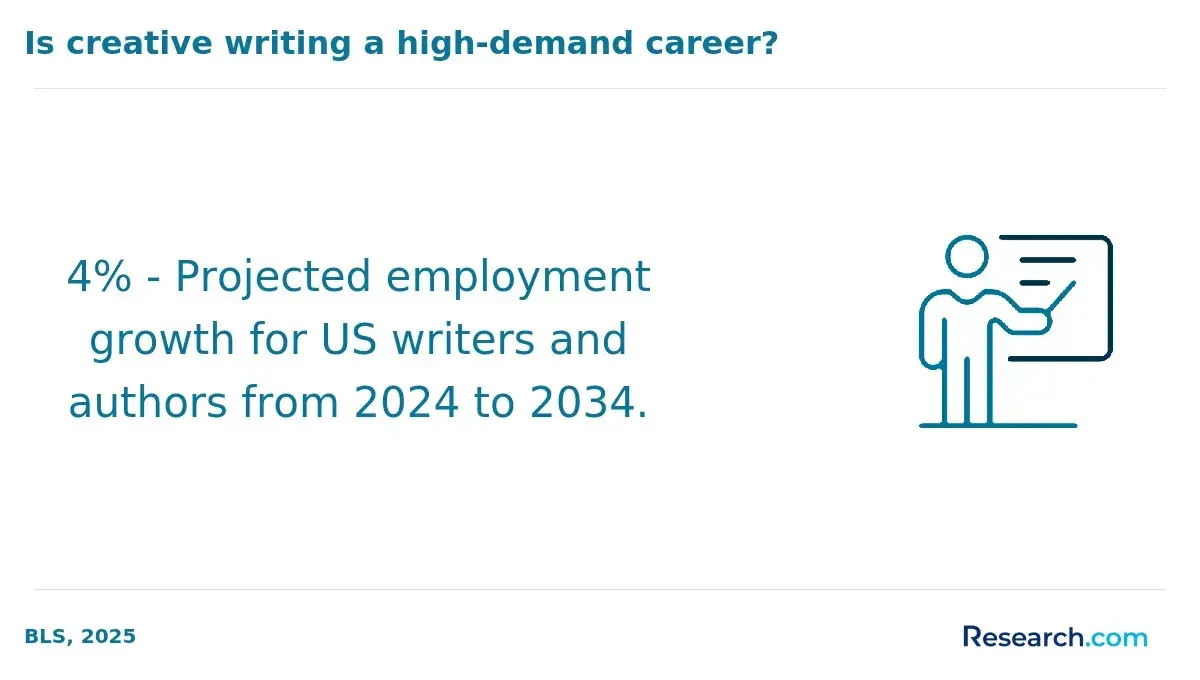
Many aspire to write professionally but are unsure what a creative writer actually does today, or how this role has expanded across publishing, streaming, digital media, and branded storytelling. Others hesitate, uncertain if writing can offer stability or a clear career path. According to the U.S. Bureau of Labor Statistics, the median annual wage for writers and authors was $72,270, with employment projected to grow 4% through 2034.
This steady outlook shows continued demand for strong storytellers, even as platforms and formats evolve. This article will help readers understand what creative writers do day to day, the skills and preparation required, and how creative writing intersects with emerging media, labor trends, and technology shaping the future of storytelling.
Key Things You Should Know About What a Creative Writer Does
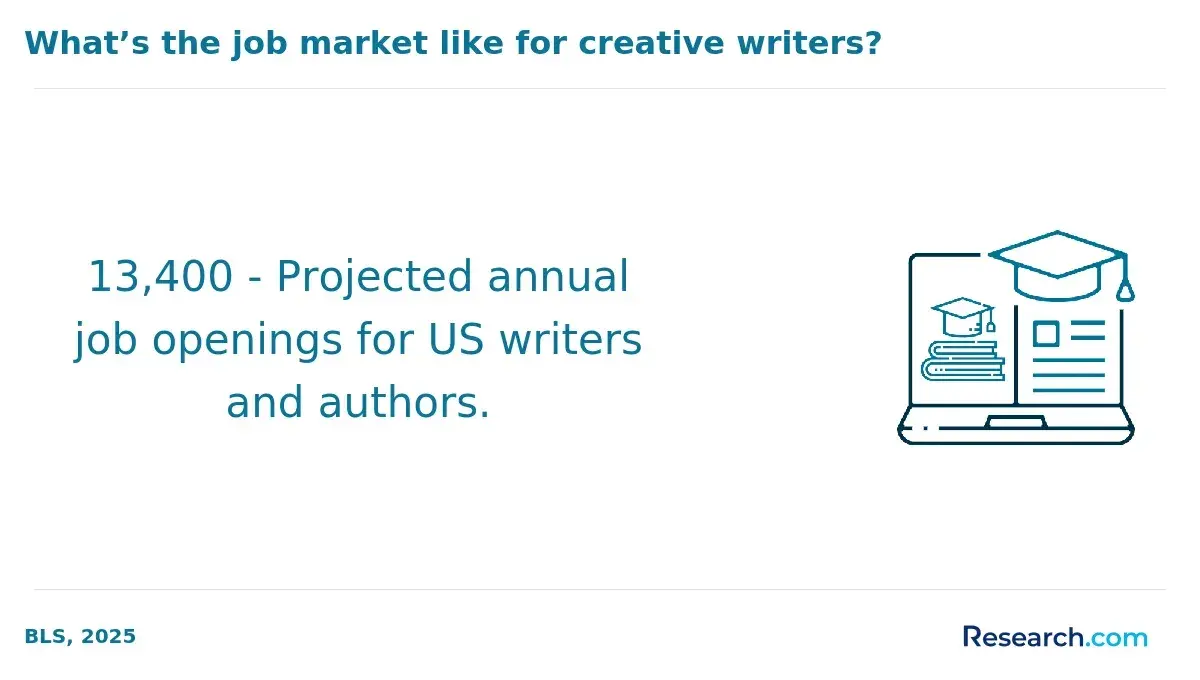
- Creative writers develop original content that becomes media value: novels, scripts, branded content, and story-based digital assets, and the labor market for writers is projected to add 13,400 annual openings through 2034.
- Creative writing is centered on communication craft and narrative problem-solving, and most full-time writers still hold a bachelor’s degree, with 73% earning that degree level as their highest credential.
- Typical median pay for writers and authors was around $62,185 to $72,270 per year, but income varies widely depending on format, rights retention, freelancing structure, and whether the writer develops intellectual property that scales into royalties.
What is a creative writer in 2027?
A creative writer is a professional who uses narrative strategy, literary craft, and audience psychology to produce original written material across multiple media ecosystems. The term no longer means only fiction authors. It now includes hybrid storytelling roles driven by streaming, branded entertainment, social video, gaming story arcs, and narrative IP that can be licensed or adapted.
Today, writers are not only producers of pages. They are producers of attention and intellectual property assets. Programs like accelerated online professional writing degrees now train writers to think as creative operators, not hobbyists.
Creative writers occupy a defined labor position. The BLS reported 135,400 writer jobs in the U.S., with a 4% growth projected through 2034, and a median wage of $72,270. That places creative writing in the cluster of as-fast-as-average growth jobs, but with higher-than-average median earnings for bachelor’s-level fields.
What does a creative writer actually do each day?
Most people imagine a creative writer simply “getting inspired and typing.” In reality, the daily workload is structured around research, framing, drafting, and revision cycles. A typical day includes gathering reference information, verifying claims, outlining narrative direction, and translating story structure into usable material. Writers also spend significant time aligning voice and tone with editorial constraints or brand guidelines. Daily task clusters typically include:
- Research and reference collection - Writers scan news, cultural trend analysis, competitor story worlds, and audience conversation to find angles that justify attention.
- Drafting and prototyping - Writers produce outlines, treatments, beat sheets, pages, and acts. They often produce multiple variants and pitch their rationale.
- Rewriting and notes integration - Revision is not optional. Industry-standard professional writers spend more hours rewriting than they spend drafting.
- Stakeholder orchestration - Writers answer to editors, producers, creative directors, or brand leads. They negotiate meaning, constraints, and deadlines.
A creative writer’s day is more similar to a project manager’s day than most people realize. The writing is the visible output; most of the time is spent thinking, aligning, validating, and orchestrating narrative assets. Full-time creative writing is extremely cognitive. It is an applied strategy discipline.
Where do creative writers create value for employers or clients?
A creative writer creates value in the same way a product designer or strategist does: by capturing attention, moving sentiment, and generating monetizable interpretation. A writer who understands brand value, funnel theory, loyalty mechanics, and audience identity can convert words into revenue. In entertainment, this shows up as box office, sub retention, licensing, adaptation rights, or repeat consumption.
In business strategy, this shows up as email lift, conversion lift, or brand affinity growth. Writers increasingly function like narrative economists. Graduate education, including a top online master's in strategic communication degree, often trains this economic framing. Value creation domains:
- Brand value: A brand voice becomes an asset.
- Audience equity: Stories create emotional switching costs.
- IP equity: One story can be monetized across multiple formats.
- Conversion effects: Words can change behavior at scale.
This is why creative writing roles have quietly shifted upward in strategic value ranking inside media companies, streaming companies, and creator economy platforms. The writer is not a typist. The writer is a value engineer.
How do creative writers find and shape ideas?
The primary job of a creative writer is idea formation. Writers track cultural signals, detect tension, find contradiction, and convert those into narrative engines. Professional ideation steps:
- Input mining: Writers scan culture, data, discourse, and archives.
- Pattern locking: Writers detect recurring tensions and thematic patterns.
- Angle formulation: Writers select which conflict or contradiction to dramatize.
- Narrative framing: Writers choose POV, world rules, argument, or aesthetic code.
- Prototyping: Writers develop loglines, synopses, outline variants, and scene scaffolds.
- Audience modeling: Writers decide who this story is for and what change is delivered.
Most professional creative writing is iterative. Writers generate 20 ideas and discard 17. They write pages to prove the idea. They test tone. They do micro research on lexicons, slang, registers, and socio-linguistic markers.
Which writing formats are most relevant in 2027?
Employers expect a creative writer to be versatile across multiple formats. Short-form is currently dominant, such as social posts, platform-native hooks, and short dialogue lines for reels. Long-form remains extremely valuable for brands that want topical authority, educational content, or serialized newsletter audience-building.
Multimedia scripts are also rising because video and audio continue to pull attention away from static text. Additionally, branded storytelling sits in the middle—it blends emotional narrative with usable information, such as a founder story that still leads a reader to a product. Some learners who compare creative writing to best audio and music online degrees notice how cross-media literacy now matters more than single-format specialization.
In practice, formats now mix. A long essay might be repurposed into a short TikTok hook, which becomes a script for a 60-second reel, then becomes an email CTA. Flexibility is the key format advantage.
What tools and tech platforms do creative writers use now?
Most working writers today do not write inside a single app. Workflows have become distributed across tools that help plan, track, revise, and prepare work for delivery. A realistic workflow now looks like a small ecosystem instead of a notebook.
Core categories that matter in practice:
- Docs + shared editors - Google Docs, Word, Notion, Dropbox Paper. These make commenting and version tracking stable and transparent.
- Screenwriting + formatting tools - Final Draft, Highland, WriterDuet. These are used when dialogue pacing, beats, or visual scene cues matter to producers or editors.
- Production-adjacent apps - Descript, Riverside, Premiere. Writers use these when writing short scripts that are directly tied to fast-turn platform edits.
- AI assistants - Used for friction tasks: option generation, line alternatives, condensing research notes.
The helpful lens is this: a creative writer does not need every tool, but they do need enough stack literacy to work inside the systems their clients or producers already use.
What skills matter most for becoming competitive in this field?
Employers are screening more for repeatable professional habits than raw originality. The differentiator is composure under constraints—not flashiness. Skill here is craft plus operational awareness.
Capabilities that impact hiring decisions:
- Language craft - Clear phrasing, pattern awareness, non-generic line choices.
- Deadline discipline - Showing that you can estimate work correctly, then deliver on the date you committed to.
- Narrative architecture - Being able to create escalation and shape information in digestible sequence.
- Voice control - Being able to tune warmth, formality, and tonal edges based on platform and audience.
- Client and stakeholder management - Knowing how to ask the right questions before draft one, so the draft is structurally aligned.
A creative writer is ultimately hired for reduction of risk. When you lower uncertainty for the buyer of writing, repeat business becomes statistically more likely. That is what ultimately makes the career durable.
Which academic degrees or credentials help someone advance?
Multiple academic routes feed into creative writing careers. English, writing, journalism, communication, media studies, and theatre are the most common majors. A growing number of learners also come from film and audio programs.
As a point of comparison, some prospective writers browse cinematography online degrees to see how visual grammar is taught in story-based programs. Graduate degrees (MA in Writing, MFA) help some writers specialize, especially those working in publishing, screenwriting, or literary fiction.
However, formal degrees are not the only credentialing path. Certificates, stackable micro-credentials, portfolio boot camps, and niche formats like dialogue labs or poetry-to-prose intensives now deliver focused competency. Credentials mainly help when they improve your portfolio. Employers hire based on real samples, not general transcripts.
What industry experience helps a writer reach professional-level status?
Professional-level creative writers usually stack multiple forms of experience before they’re viewed as established. Employers and agencies look less at degrees and more at visible proof of consistency and audience impact. Common milestones include:
- small paid assignments or spec writing projects
- internships in publishing, studios, agencies, or digital content shops
- formally published pieces (journalism, essays, short fiction)
- script or show bible samples for screen work
- contest shortlists or prize mentions
- ghostwriting or co-writing with mid-size clients
Writers typically hit a critical confidence shift once they’ve shipped 30–50 published pieces or scripts. At that threshold, they develop repeat clients and referral pathways, which is what marks the move into durable professional status.
How much do creative writers earn in 2027?
Most creative writers do not follow a single earnings model. Income tends to be multi-stream, and it varies by vertical. Full-time writers employed in media, marketing, or entertainment generally earn $52,000–$82,000 annually, based on U.S. workforce compensation trackers for creative occupations.
Freelancers usually fall into a broader range—$30,000 on the low end (if they only work a few retainer clients) to $120,000+ (if they combine high-ticket niches, ghostwriting, or whitepaper assignments).
Royalties and IP revenue introduce a different dynamic. Many writers earn very little from books or games in early years, and then experience spikes only when an audience forms or when an adaptation deal lands. The hallmark of a financially stable writing career is not a single win. It is a diversified set of revenue sources that can absorb market cycles.
Which future trends will influence creative writing careers?
AI is reshaping the baseline. In the current landscape, generative tools automate low-level drafting and outlining. This forces human writers to differentiate by voice, nuance, narrative tension, and deep insight. Writer value moves toward conceptual design, not just typing words.
Streaming platforms are expanding writer opportunities because more global series are ordered each year. The creator economy continues to absorb writers into serialized content (Substack, Patreon, long-form YouTube explainers). In addition, interactive storytelling—games, quests, nonlinear fiction—is slowly moving into mainstream hiring pipelines.
The most resilient writers will be the ones who stay format-fluid: they can write text that stands alone as literature, and text that functions as UX, narrative design, or entertainment asset.
What do working creative writers say about this career?
- Matthew: "I am a late-career professional who transitioned from traditional journalism to ghostwriting thought leadership for climate tech founders. I find the pace intense, but my research skills finally convert directly into client value. I also enjoy how writing pairs well with policy advocacy"
- Liz: "I grew up on video game fanfiction forums. Today I ghostwrite for streamers and mid-size gaming studios. The path is nontraditional, but the work feels like my childhood imagination finally has a budget."
- Andre: "I was once terrified of pitching. Now I help multiple agencies produce email copy, short scripts, and KS decks for product launches. I built my portfolio steadily, and I am proud that people now trust my creative voice."
Key Findings
- Creative writing is now a labor category with formal economic value, not just an artistic identity. The BLS reported 135,400 writer jobs in the U.S., with a 4% projected growth through 2034.
- Creative writers create multiple revenue streams (employment, freelance retainers, strategic content, IP licensing) instead of relying on one format.
- Employers value narrative strategy, not mere typing. Most of the job is research, development, prototyping, and alignment.
- Skill to convert stories into monetizable outcomes (brand value, conversion effects, audience equity) is the core economic differentiator.
- Writers who master cross-format fluency (short-form native video scripts + long-form narrative + branded storytelling) increase their leverage and pricing.
- Salaries vary widely because income depends on project type, revenue model, and IP rights, not only hourly rates or job titles.
Other Things You Should Know About Creative Writers
In 2027, aspiring creative writers can expect to earn an average salary between $51,000 and $84,000 annually, depending on their experience, location, and the nature of projects they undertake. Freelance opportunities can also affect earnings significantly.
In 2027, job stability for creative writers will depend heavily on industry demand and individual skill level. Writers with diverse portfolios and adaptability in emerging digital platforms may find more sustainable opportunities. However, fluctuations in entertainment and publishing industries can affect overall job security.
A creative writer primarily develops narrative stories, characters, scripts, or literary work. A content writer primarily develops informational or branded content that has a clear business or marketing objective. In practice, the job market is blending the two, and many modern roles expect you to be fluent in both voice control and SEO-adjacent structure.
References
- U.S. Bureau of Labor Statistics. (2025). Writers and authors. In Occupational Outlook Handbook. U.S. Department of Labor. Retrieved February 3, 2026, from https://www.bls.gov/ooh/media-and-communication/writers-and-authors.htm
- Indeed Editorial Team. (2025). 12 Jobs You Can Do With a Degree in Creative Writing. https://www.indeed.com/career-advice/finding-a-job/what-can-you-do-with-a-degree-in-creative-writing
- Zippia. (n.d.). Creative writer skills for your resume and career. Zippia. https://www.zippia.com/creative-writer-jobs/skills/
- CareerFittest. (n.d.). How to become a creative writer: What it is and career path. CareerFittest. https://www.careerfittest.com/how-to-become-a-creative-writer/
- The Chronicle of Higher Education. (n.d.). Creative writing jobs United States. ChronicleJobs. https://jobs.chronicle.com/jobs/creative-writing/united-states/
- ZipRecruiter. (2026). Creative writer salary in the United States. https://www.ziprecruiter.com/Salaries/Creative-Writer-Salary
- ONET Online. (n.d.). Summary report for: 27-3043.05 — Poets, lyricists, and creative writers. National Center for ONET Development. https://www.onetonline.org/link/summary/27-3043.05


