
2027 What Does a Genetic Counselor Do: Responsibilities, Requirements, and Salary

Co-Founder and Chief Data Scientist
Choosing a career in genetic counseling means deciding whether you want a profession that combines advanced genetics, patient counseling, medical ethics, and fast-changing genomic technology. It is a strong fit for people who enjoy science but also want direct responsibility for helping patients and families understand risk, testing options, diagnoses, and difficult health decisions.
This guide explains what genetic counselors do, how to prepare for an accredited MS in genetic counseling program, what graduate training usually costs, where financial aid may come from, and how the job market and salaries compare across clinical, laboratory, industry, and remote roles. It also covers specialization options, program selection criteria, and current ethical and technology trends shaping the profession.
Because genetic counseling is a regulated, graduate-level healthcare career, readers should pay close attention to accreditation, board certification eligibility, supervised clinical training, and state licensing requirements where they plan to work. The strongest applicants and future professionals are those who can show both scientific readiness and mature counseling judgment.
What are the benefits of getting an online graduate certificate in genetic counsling?
- Career Advancement: Specialized roles in clinical care, labs, biotech, and academia.
- Earning Potential: Median salary in 2025 is $98,910 annually; salaries range from $81,864 (10th percentile) to $120,700 (90th percentile) depending on experience and location (Salary.com). Entry-level roles start around $75,000–$85,000, while senior professionals can earn over $105,000.
- Flexible Learning: Master’s required; hybrid/online programs available. This flexibility allows students to complete clinical rotations locally while managing personal and professional responsibilities.
What can I expect from an accredited MS in genetic counseling program?
The Master of Science (MS) in genetic counseling is a two-year, accredited, post-bachelor’s program that fundamentally merges advanced genetics and clinical patient support.
- Integrated medical science: Expect intensive coursework covering medical genetics, molecular biology, biostatistics, and human dysmorphology.
- Core clinical rotations: Mandatory, supervised fieldwork is required across key specialties, specifically reproductive (prenatal), oncology (cancer), and pediatrics/general genetics.
- Psychosocial counseling skills: The curriculum features specialized training, including role-playing, focused on active listening, risk communication, and non-directive counseling methods.
- Research thesis requirement: All students must complete an original master's thesis or capstone project involving data collection, analysis, and formal presentation.
- Laboratory techniques: Training includes practical exposure to molecular and cytogenetics lab procedures for variant interpretation and clinical report writing.
- Minimum case requirement: Graduates must complete a minimum of 50 distinct supervised participatory cases to qualify for board certification.
- Professional ethics: Coursework addresses the ethical, legal, and social implications (ELSI) of genetic information, alongside skills for advocacy and collaborative teamwork.
Where can I work as certified genetic counselor (CGC)?
The Certified Genetic Counselor (CGC) credential provides professionals with highly specialized, transferable skills, opening doors to diverse settings beyond the traditional hospital clinic in the USA.
- Hospitals and Medical Centers: The largest sector for employment, consisting of clinical patient care within specialized units like oncology, pediatrics, and cardiology.
- Medical and Diagnostic Laboratories: Non-patient-facing roles focusing on interpreting complex raw genetic data, classifying variants, and writing final clinical reports for testing companies.
- Outpatient Care Centers: Specialized clinics and private practices that handle high-volume referrals, often paying higher average wages than general hospital systems.
- Telegenetics Providers: Remote roles delivering full counseling services via video conference, allowing for greater geographical flexibility and reaching underserved areas.
- Biotech and Industry: Non-clinical positions in pharmaceutical and biotechnology firms focused on medical affairs, product development, or educating healthcare providers on new genetic tests.
- Academia and Research: Roles involving teaching, mentoring graduate students, and coordinating clinical or psychosocial research protocols at universities.
- Public Health and Government: Positions within federal or state agencies, focusing on population-based screening programs (like newborn screening) and shaping health policy.
How much can I earn as a certified genetic counselor?
- National Median Salary: $98,910 annually (U.S. Bureau of Labor Statistics, 2025).
- Entry-Level Pay: Around $75,135; increases to $84,570 with 1–4 years of experience (PayScale, 2025).
- Senior Range: $115,419–$128,469 for experienced professionals (Salary.com, 2025).
- Top-Paying Industries: Outpatient Care Centers – $135,560; Management roles – $126,120
- Career Growth: Salaries average $105,565 for experts with 8+ years of experience (Salary.com, 2025).
What does a genetic counselor do?
A genetic counselor helps individuals and families understand how inherited conditions, genetic test results, and family health history may affect medical care, reproductive planning, and long-term risk management. The job is not simply explaining lab results. It requires combining genetics, risk assessment, counseling skills, ethics, and patient advocacy in a way that supports informed decision-making.
Most genetic counselors work with patients directly, although some move into laboratories, research, public health, insurance, biotechnology, or education. In clinical care, their work often includes the following responsibilities:
- Risk assessment and pedigree analysis: Genetic counselors collect detailed personal and family health histories, often across three generations, to identify inheritance patterns and estimate the likelihood of a genetic condition occurring or recurring.
- Patient education: They explain genetic concepts, inheritance patterns, testing limitations, and medical implications in language patients and non-genetics providers can understand.
- Testing coordination: They help determine whether testing is appropriate, select test types such as panel testing, exome sequencing, or NIPT, coordinate ordering, and often assist with insurance documentation.
- Variant interpretation: They review lab reports, explain whether results are pathogenic, likely pathogenic, uncertain, benign, or negative, and clarify what those classifications mean for care.
- Informed decision-making: Genetic counselors use a non-directive approach to help patients consider testing, screening, family planning, preventive surgery, surveillance, or treatment options without pressuring them toward a single choice.
- Psychosocial support: They help patients process anxiety, grief, uncertainty, guilt, stigma, or fear that may come with genetic risk or diagnosis.
- Care planning and referrals: They recommend follow-up with appropriate specialists, such as oncologists, cardiologists, maternal-fetal medicine physicians, pediatric geneticists, or support organizations.
- Patient advocacy: They help patients navigate insurance coverage, privacy concerns, family communication, testing access, and healthcare resources.
- Multidisciplinary collaboration: They work with physicians, nurses, laboratory scientists, social workers, researchers, and other healthcare professionals to coordinate care.
- Research and teaching: Some genetic counselors conduct clinical or psychosocial research, supervise students, teach healthcare teams, or contribute to policy and practice guidelines.
The profession is especially valuable because genetic information can affect not only one patient but also biological relatives. A genetic counselor must therefore help patients understand both personal and family implications while respecting privacy, autonomy, culture, and values. For readers comparing this path with broader counseling careers, it may help to review what you can do with a counseling degree, while noting that genetic counseling requires specialized graduate training in genomics.
What is the average cost of an MS in genetic counseling program?
The cost of an MS in genetic counseling depends heavily on whether the school is public or private, whether the student qualifies for in-state tuition, and how much aid the program offers. Tuition is only one part of the total cost. Students should also budget for fees, health insurance, housing, transportation, clinical rotation travel, application expenses, and board-related costs after graduation.
Typical cost categories include:
- Public, in-state tuition: $23,000 to $50,000 for the entire program, often the lowest-cost route for students who qualify for residency-based tuition.
- Public, out-of-state tuition: $58,000 to $87,500 for the two-year program, which can make residency rules and state options important parts of the decision.
- Private institution tuition: $88,000 to over $100,000, usually without a residency-based price difference.
- University fees: $2,000 to $5,000 for required technology, activity, health, or campus fees that may not be included in listed tuition.
- Fieldwork and travel: $3,000 to $6,000 for transportation, parking, lodging, or temporary relocation connected to clinical rotations, especially when away rotations are required.
- Health insurance: $6,000 to $8,000 per year if the student must purchase university coverage and cannot waive it with comparable insurance.
- Application costs: $1,000 to $1,500 for applying to multiple programs and completing the National Matching Service (NMS) registration process.
- Board certification fee: The American Board of Genetic Counseling (ABGC) exam fee, typically paid after graduation by candidates pursuing certification.
When comparing programs, students should not rely on tuition alone. A higher-tuition program with strong assistantship funding may be less expensive than a lower-tuition program with limited aid. Likewise, a school in a high-cost city can require substantially more borrowing for living expenses even if tuition is moderate.
A practical cost comparison should include the full cost of attendance, expected aid, rotation travel requirements, local rent, health insurance rules, and whether students can work part time during the program. Because genetic counseling programs are intensive and clinically demanding, many students have limited time for outside employment.
What financial aid and scholarship options are available for genetic counseling students?
Genetic counseling students typically use a mix of federal loans, institutional aid, scholarships, assistantships, and, when available, fellowship funding. The best financial aid strategy is to maximize grants, tuition waivers, stipends, and scholarships before borrowing. Students should ask each program for a written breakdown of typical funding, not just whether aid is “available.”
- Graduate assistantships (GA): These positions may provide a full tuition waiver, a monthly stipend, and health insurance benefits in exchange for teaching, research, program support, or clinical education duties. They are highly competitive and can significantly reduce debt.
- Federal direct unsubsidized loans: Graduate students may borrow up to $20,500 annually through this federal loan option to help cover educational costs.
- Public Service Loan Forgiveness (PSLF): Genetic counselors who work for qualifying non-profit hospitals, academic medical centers, or public health employers may be able to pursue loan forgiveness after 10 years of qualifying payments.
- Program-specific scholarships: Departments and universities may offer merit-based or need-based awards. Amounts vary, so students should ask whether scholarships are renewable for the second year.
- Alliance for Genetic Counseling Fellowship (AGCF): This selective fellowship provides full tuition and a living stipend to students from underrepresented backgrounds attending specific consortium programs.
- Leadership Education in Neurodevelopmental Disabilities (LEND): This federally funded interdisciplinary training fellowship includes a substantial stipend for students interested in pediatrics and developmental disabilities.
- National Society of Genetic Counselors (NSGC) awards: These grants and scholarships support student research, professional development, and conference participation.
- Work-study positions: Eligible students may obtain part-time university jobs that help with living expenses, although program schedules can limit availability.
Before accepting an offer, students should calculate expected debt at graduation and compare it with realistic entry-level earnings. They should also ask whether the program has paid assistantships, whether clinical rotations create extra travel costs, and whether graduates commonly work for PSLF-eligible employers.
The broader genetics and genomics economy is also expanding. The global predictive genetic testing and consumer genomics market is growing from $7.83 billion in 2024 to $9.07 billion in 2025, reflecting a 15.7% CAGR (The Business Research Company, 2025). By 2029, it is projected to reach $16.14 billion, sustaining a 15.5% CAGR, as shown in the graphic below.
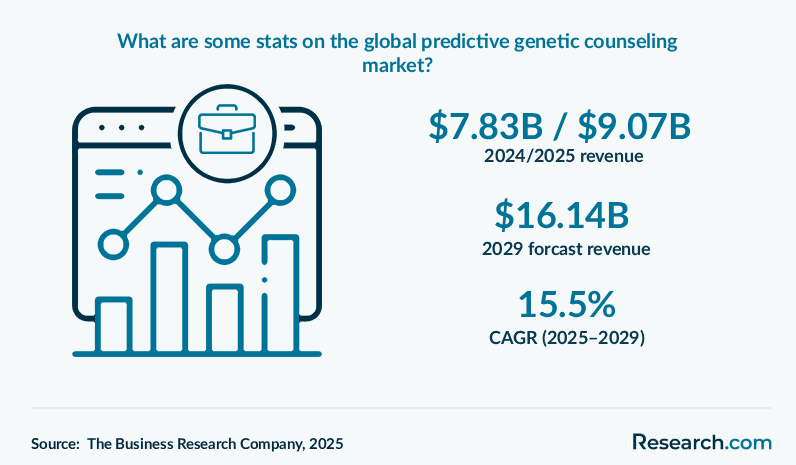
This growth is tied to consumer ancestry services, pharmacogenomics, AI integration, employer-sponsored programs, and biotech-healthcare partnerships. For genetic counseling students, the key takeaway is not that every job will be in consumer genomics, but that demand for professionals who can interpret and communicate genetic information is widening beyond traditional hospital settings.
What are the prerequisites for enrolling in an MS in genetic counseling program?
Admission to an MS in genetic counseling program is highly competitive because programs need applicants who can succeed in advanced genetics coursework and provide mature, ethical, patient-centered counseling. Applicants to genetics Masters programs should expect schools to review academic preparation, advocacy experience, exposure to the profession, communication skills, and readiness for clinical training.
- Bachelor's degree: Applicants must hold a baccalaureate degree from an accredited institution. A science major is common, but many programs consider applicants from other academic backgrounds if prerequisites are complete.
- Genetics coursework: Programs typically require at least one semester of upper-level general or human genetics, often with a grade of B- or better.
- Biochemistry coursework: At least one semester of biochemistry is usually required because students must understand the molecular basis of inherited disease.
- Statistics coursework: Statistics or biostatistics is important for risk assessment, research evaluation, and evidence-based practice.
- Psychology or social science coursework: Courses in psychology, sociology, or behavioral science help prepare applicants for counseling theory and psychosocial care.
- Crisis, advocacy, or counseling experience: Competitive applicants often document hundreds of hours in settings such as crisis hotlines, domestic violence shelters, peer counseling, patient advocacy programs, or similar service roles.
- Genetic counselor exposure: Shadowing, informational interviews, webinars, clinic observation, or other structured exposure helps applicants show that they understand the profession beyond the classroom.
- Grade Point Average (GPA): Many programs require a minimum cumulative undergraduate GPA of 3.0, although competitive applicants often present stronger overall and science GPAs.
- Research exposure: Laboratory, clinical, or psychosocial research experience can strengthen an application by showing critical thinking, data interpretation, and persistence.
- National Matching Service (NMS): Applicants must register for the matching process that coordinates interviews and final program acceptance offers.
The most common mistake is treating prerequisites as a checklist only. Strong applicants can explain why their coursework, advocacy work, and genetic counseling exposure have prepared them for both the scientific and emotional demands of the profession. Admissions committees often look closely at reflection, communication, empathy, resilience, and understanding of non-directive counseling.
What courses and clinical rotations are typically in an accredited MS in genetic counseling program?
An accredited MS in genetic counseling program usually combines classroom instruction, supervised clinical practice, laboratory exposure, research training, and professional development over two years. The curriculum is designed to prepare graduates for board certification eligibility and for entry-level practice across core specialty areas.
Common coursework
- Medical genetics: Students study human cytogenetics, molecular genetics, population genetics, inheritance, and mechanisms of genetic disease.
- Genetic counseling theory: Courses cover counseling models, risk communication, interviewing techniques, informed consent, patient autonomy, grief, crisis response, and ethical practice.
- Clinical applications of genomics: Students learn about genetic testing methods, variant interpretation, laboratory workflows, report writing, and clinical utility.
- Biopsychosocial issues: Programs address the emotional, family, cultural, disability-related, and social implications of genetic information, including equity and access concerns.
- Research methods and biostatistics: Students learn research design, data analysis, critical appraisal, and usually complete a master's thesis or capstone project.
Typical clinical rotations
- Prenatal and reproductive genetics: Students gain experience with carrier screening, fetal anomalies, NIPT, diagnostic testing, and preimplantation genetic diagnosis (PGD).
- Cancer genetics: Students assess hereditary cancer risk, discuss testing options, interpret results, and coordinate screening or prevention recommendations.
- Pediatric or general genetics: Rotations often include developmental delays, birth defects, rare disease evaluation, and family counseling in collaboration with medical geneticists.
- Laboratory or industry: Students learn how testing is performed, how variants are classified, how reports are developed, and how laboratories communicate results to clinicians.
- Adult or specialty genetics: Elective or advanced rotations may include cardiology, neurology, ophthalmology, pharmacogenomics, metabolic genetics, or other focused areas.
Clinical training is a major part of the degree. Students are expected to build case-management skills, practice counseling under supervision, receive feedback, and meet the minimum 50 participatory cases across the core specialty areas required for board certification eligibility. Prospective students should ask programs how early clinical exposure begins, how cases are supervised, and whether rotations require travel or relocation.
What types of specializations are available for genetic counselors (e.g., prenatal, oncology, cardiovascular)?
Genetic counselors can specialize in clinical areas, laboratory interpretation, research, public health, technology, or industry. Some professionals begin in general clinical roles and specialize later, while others enter graduate school with a clear interest in a field such as cancer, prenatal, or cardiovascular genetics.
- Prenatal and reproductive genetics: Focuses on preconception counseling, carrier screening, prenatal screening, diagnostic testing, fetal anomalies, pregnancy loss, and reproductive decision-making.
- Oncology or cancer genetics: Assesses hereditary cancer risk, including BRCA1/2 and Lynch syndrome, and helps patients consider screening, prevention, testing, and family communication.
- Pediatric genetics: Works with children and families affected by genetic syndromes, birth defects, developmental delays, metabolic conditions, and rare diseases.
- Cardiovascular genetics: Focuses on inherited heart conditions such as cardiomyopathies, aortic disorders, and sudden cardiac death syndromes.
- Neurogenetics: Addresses inherited neurological conditions such as Huntington’s disease, muscular dystrophy, and early-onset dementias.
- Laboratory and industry: Often involves variant classification, test development, clinical report writing, provider education, quality improvement, and product support.
- Pharmacogenomics (PGx): Examines how genetic variation may affect medication response and dosing recommendations.
- Public health and research: Includes population screening, newborn screening follow-up, policy work, program evaluation, and clinical or psychosocial research.
- Ophthalmology and auditory genetics: Focuses on inherited conditions associated with vision loss, blindness, deafness, or hearing impairment.
- General adult genetics: Covers adult-onset genetic conditions, connective tissue disorders, multisystem syndromes, and coordination of care across specialties.
Specialization affects daily work. A prenatal counselor may work with time-sensitive pregnancy decisions, while an oncology counselor may focus heavily on prevention and family cascade testing. A laboratory counselor may have little or no direct patient contact but may spend more time interpreting complex genetic data. Students should use rotations to test which setting best matches their strengths and preferred pace of work.
Three congenital anomalies show distinct annual prevalence rates among infants. Anencephaly occurs in approximately 1 in 5,246 births, affecting around 700 babies. Atrioventricular septal defect (AVSD) appears in about 1 in 1,712 births, impacting roughly 2,145 infants. Limb deficiencies occur in approximately 1 in 2,064 births, totaling around 1,779 cases.
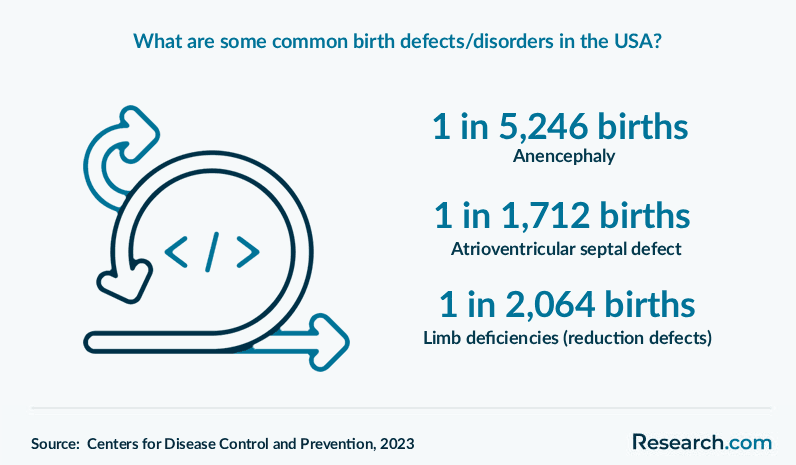
These figures (Centers for Disease Control and Prevention, 2023) show why prenatal screening, pediatric genetics, and family counseling remain important parts of the profession. Genetic counselors help families understand what screening can and cannot detect, what diagnostic testing may clarify, and how to make decisions under uncertainty.
How do you choose the best accredited MS in genetic counseling program?
The best MS in genetic counseling program is not always the most recognizable school. The right choice is the accredited program that gives you strong clinical training, reasonable cost, supportive mentorship, good board preparation, and access to the specialties you may want to pursue. Students comparing graduate options, including accredited online degrees, should remember that genetic counseling training depends heavily on supervised clinical experiences.
- Accreditation status: Confirm that the program is accredited by the Accreditation Council for Genetic Counseling (ACGC). Accreditation is essential for eligibility for the ABGC certification exam.
- Clinical rotation access and variety: Review affiliated hospitals, clinics, laboratories, and specialty sites. A strong program should provide core exposure to prenatal, cancer, pediatric, and other relevant settings.
- Program cost and funding: Compare total cost of attendance, not just tuition. Ask about assistantships, stipends, scholarships, fees, health insurance, and rotation travel costs.
- Curriculum balance: Some programs may emphasize clinical counseling, psychosocial training, laboratory science, public health, or research more strongly. Choose one that fits your goals.
- Faculty expertise and mentorship: Look for faculty whose clinical, laboratory, or research interests align with your potential specialty interests, such as cardiology, neurogenetics, cancer, or reproductive genetics.
- Board pass and job placement rates: Ask for official ABGC first-time pass rates, employment outcomes, and how the program supports students who need to retake the exam.
- Geographic location and job market: Consider cost of living, local clinical sites, licensing rules, and whether you would be willing to work in that region after graduation.
- Cohort size and culture: Small cohorts can provide close mentoring, but culture matters. Ask current students whether the environment is collaborative, inclusive, transparent, and responsive to feedback.
Before ranking programs, create a comparison sheet with accreditation, cost, funding, rotations, board outcomes, research expectations, faculty fit, location, and student support. Informational interviews with current students and recent graduates are often the best way to identify issues that are not visible on a program website.
What career paths and work settings are available for Certified Genetic Counselors?
Certified Genetic Counselors can work in direct patient care, laboratories, industry, public health, education, insurance, advocacy, and remote care. While there are different types of counselors, genetic counselors stand out because their work requires both counseling competence and specialized genetics expertise.
- Hospitals and university medical centers: These remain major employers for clinical genetic counselors and often combine patient care, research, student supervision, and multidisciplinary practice.
- Genetic testing laboratories: Counselors may interpret variants, review cases, write reports, communicate with ordering providers, support test development, or assist with quality assurance.
- Physicians' offices and private clinics: Genetic counselors may work in oncology, maternal-fetal medicine, cardiology, fertility, neurology, or other specialty practices.
- Biotech and pharmaceutical companies: Roles may include medical science liaison work, medical affairs, product education, clinical trial support, provider training, and precision medicine initiatives.
- Telegenetics and remote work: Remote counseling expands access for patients who live far from specialty clinics and can offer counselors more flexible work arrangements.
- Public health departments: Counselors may support newborn screening follow-up, population screening programs, prevention initiatives, and community education.
- Academia and education: Experienced professionals may become faculty members, clinical supervisors, program directors, researchers, or continuing education leaders.
- Health maintenance organizations (HMOs) and insurance companies: These roles may involve utilization review, genetic testing policy, coverage guidance, and medical necessity evaluation.
- Advocacy and non-profit organizations: Counselors may work with patient groups, disease-specific foundations, education campaigns, support services, and fundraising initiatives.
Career setting affects salary, schedule, patient contact, workload, and advancement options. Clinical roles offer direct patient impact and multidisciplinary care. Laboratory and industry roles may offer higher compensation or broader product and policy influence. Public health and advocacy roles may appeal to counselors who want to improve access and systems-level care.
As shown in the graph below, Genetic counselors are primarily employed in patient care, with 1,380 working in General Medical and Surgical Hospitals and 620 in Offices of Physicians. Non-traditional roles are growing: Outpatient Care Centers employ 290 counselors, Medical and Diagnostic Laboratories 220, and Colleges, Universities, and Professional Schools 200 (Bureau of Labor Statistics, 2025). While hospitals remain the core, the field is diversifying into biotech, testing, and academia, reflecting expanding demand and specialization.
How much can I earn as a genetic counselor?
Genetic counselor pay varies by experience, certification, geography, employer type, specialty, and whether the role is clinical, laboratory-based, industry-based, or managerial. The field offers strong compensation for a master’s-level healthcare profession, but applicants should compare salary expectations with graduate school debt and local cost of living.
- Average annual salary: Projected to be near $98,000 to $102,000 for all experience levels in the United States in 2025.
- Entry-level salary: New graduates with 0-2 years of experience can generally expect $81,000 to $95,000.
- Industry and laboratory salary: Non-patient-facing roles frequently report the highest compensation, often averaging $115,000 to over $135,000.
- Top percentile earners: Highly experienced professionals in senior, leadership, or management roles can earn $125,000 to over $137,000.
- High-paying locations: Salaries are often highest in major metropolitan areas with high cost of living and strong biotech presence, such as San Francisco, New York, and Boston.
- Hospital setting salary: Large hospital systems typically fall within the average to mid-range of the overall pay scale.
- Outpatient care centers: These settings may report higher salaries than hospitals because of specialized or high-volume practice models.
- Experience growth: Salary generally increases with experience, and mid-level GCs with 5-8 years typically exceed the $105,000 mark.
Compensation is strongest for professionals who combine certification, specialty expertise, strong communication skills, and experience with complex cases or genomic technologies. Industry and laboratory roles may pay more, but some counselors prefer clinical positions because of direct patient interaction, teaching, or hospital-based benefits. Readers comparing related fields can also review health psychologist salaries, while recognizing that training paths and licensure requirements differ.
What is the job market for Certified Genetic Counselors?
The job market for Certified Genetic Counselors is strong because genetic testing is becoming more common in oncology, reproductive medicine, pediatrics, cardiology, neurology, pharmacogenomics, and laboratory medicine. Demand is also supported by the need for professionals who can explain uncertain results, guide ethical decision-making, and help non-genetics clinicians use genomic information appropriately.
- Employment growth outlook: The profession is projected to grow between 9% and 16% over the next decade, which indicates faster-than-average demand and strong career stability.
- Demand drivers: Growth is tied to lower genetic testing costs, precision medicine applications, expanded panel testing, and increased ordering of complex tests by physicians.
- New openings: An estimated 300 to 400 new job openings are projected annually, on average, from new job creation and replacement needs.
- Market concentration: Jobs are often concentrated in metropolitan areas with academic medical centers, large hospital systems, and biotechnology hubs, especially in places such as California and the Northeast.
- Industry demand: Laboratories and industry employers continue to recruit genetic counselors, often from clinical practice, because they need professionals who understand both genomics and clinical communication.
- Graduate program bottleneck: Although job demand is favorable, admission to accredited MS programs remains highly competitive, and many qualified applicants may go unmatched each year.
- Geographic mobility: New graduates may improve their first-job options by considering multiple regions, rural or underserved areas, telehealth roles, or less saturated markets.
- Job security: The profession’s combination of scientific expertise and counseling skill supports long-term demand across healthcare and industry.
As shown in the graphic below, genetic counseling offers a strong career outlook, with a 2024 median annual salary of $98,910 and an hourly wage of $47.55 (U.S. Bureau of Labor Statistics, 2025). The field had about 4,000 jobs in 2024 and is projected to grow 9% by 2034—adding roughly 400 new positions, a rate much faster than average. Entry-level roles require a master’s degree, reflecting the specialized expertise needed. High pay and rapid growth make genetic counseling a top-tier healthcare profession for master’s-level practitioners.
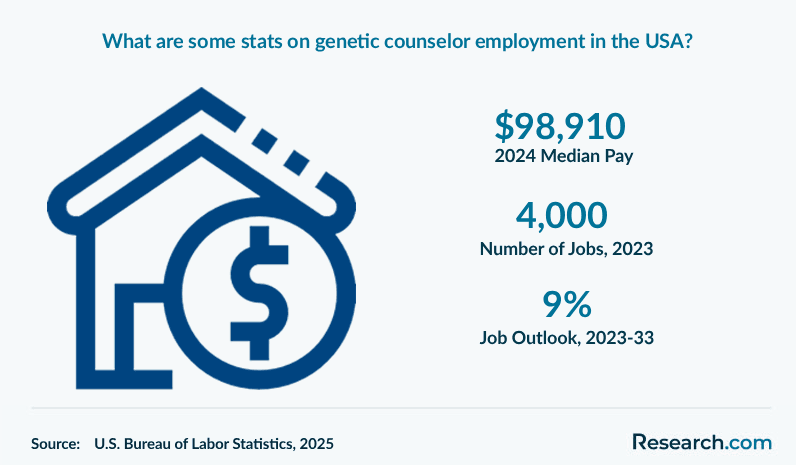
The market is favorable for certified professionals, but applicants should still be strategic. The strongest job candidates usually have solid clinical case experience, clear specialty interests, comfort with technology, and the ability to communicate uncertainty well. A career in health science can also lead to other healthcare paths for readers who want to compare options beyond genetics.
What are some current ethical, technological, and telegenetics trends impacting the field?
Genetic counseling is changing quickly as testing becomes cheaper, data sets become larger, and patients gain more access to genetic information outside traditional clinics. These changes create opportunity, but they also raise ethical questions about privacy, equity, consent, clinical utility, and how much guidance patients should receive when results are uncertain.
- Telegenetics expansion: Remote counseling by video or phone can improve access for patients far from specialty centers, but it also requires attention to state licensing, privacy, documentation, emergency planning, and equitable access to technology.
- Polygenic risk scores (PRS): PRS tools introduce probabilistic risk estimates for common diseases and require counselors to explain risk in context, including limitations related to ancestry, environment, lifestyle, and clinical usefulness.
- AI and automation: Artificial intelligence may support variant classification, literature review, or large-scale data interpretation, but counselors remain necessary for clinical synthesis, patient communication, ethics, and context-specific decision-making.
- Pressure on non-directive counseling: When a genetic result clearly points to a medically beneficial intervention, counselors must balance respect for autonomy with the responsibility to explain why follow-up may matter.
- Direct-to-consumer (DTC) testing: More patients bring consumer genetic results to medical visits. Counselors help distinguish entertainment, ancestry, raw data, and clinically validated testing.
- Gene editing ethics: Technologies such as CRISPR raise difficult questions about somatic treatment, germline editing, disability rights, consent, and the implications for future generations.
- Integration into primary care: As genetic testing moves into cardiology, oncology, obstetrics, and primary care, genetic counselors increasingly serve as educators, consultants, and system-level implementation experts.
- Equity and access: The field is focusing more on reducing disparities in access to genetic services, improving representation in genomic data, and designing care models for underserved communities.
- Data ownership and privacy: Genomic data can be valuable for research, biobanks, and commercial products, making informed consent, confidentiality, and patient control ongoing ethical priorities.
These trends do not make genetic counselors less relevant. They make the profession more important. As genetic information becomes easier to generate, patients and clinicians need trained professionals who can explain what results mean, what they do not mean, and how they should—or should not—shape medical decisions.
Here's What Graduates Say About Their Genetic Counseling Careers
- Michaela : "I love that my master’s degree ensures I am always at the forefront of genetic science, especially in cancer research. Being the one who translates a complex genomic report into actionable steps for a patient is incredibly rewarding, providing clarity during a family's most uncertain moments. I truly feel privileged to bridge the gap between the laboratory and compassionate care every day."
- Ben : "The professional flexibility is a huge benefit; I am a cardiovascular specialist, but I can still collaborate on research and mentor students without having to sacrifice a great work-life balance. My schedule allows me to dedicate time to complex case preparation while also preserving the energy needed to support families through their hardest decisions. The ability to grow professionally while staying engaged with patients makes the long hours worthwhile."
- Aman: "What I appreciate most is the unique blend of communication and scientific detective work; no two cases are ever the same, so the work is always engaging. The job security is fantastic, and knowing that my specialized skill set is in high demand across hospitals and industry makes me confident in my long-term career path. I’m proud to be a counselor and use my skills to empower people with vital health information."
Key Findings
- Genetic counseling is a master’s-level healthcare profession that combines genetics, risk assessment, psychosocial counseling, ethics, and patient education.
- An accredited MS in genetic counseling is essential for ABGC certification eligibility, and applicants should verify ACGC accreditation before applying.
- Program costs vary widely: public in-state tuition may range from $23,000 to $50,000, while private institution tuition can range from $88,000 to over $100,000.
- Competitive applicants usually need strong science prerequisites, a minimum cumulative undergraduate GPA of 3.0, counseling or advocacy experience, genetic counselor exposure, and NMS registration.
- Clinical training typically includes prenatal, cancer, pediatric or general genetics, laboratory or industry, and specialty rotations, with the minimum 50 participatory cases required for board certification eligibility.
- Common specializations include prenatal and reproductive genetics, oncology, pediatrics, cardiovascular genetics, neurogenetics, pharmacogenomics, laboratory genetics, public health, and research.
- Genetic counselor salaries are projected near $98,000 to $102,000 for all experience levels in the United States in 2025, with industry and laboratory roles often averaging $115,000 to over $135,000.
- The job outlook is strong, with projected growth between 9% and 16% over the next decade and an estimated 300 to 400 new job openings annually, on average.
- Technology is expanding the field, but AI, telegenetics, DTC testing, and genomic data growth increase the need for skilled professionals who can interpret results ethically and communicate them clearly.
Other Things You Should Know About Genetic Counseling Careers
In 2027, genetic counselors guide patients on genetic conditions, interpret genetic test results, and collaborate with healthcare providers. They also educate families on hereditary risks and support decision-making regarding genetic testing and management. This includes staying updated on advancements in genomic technologies to ensure informed patient care.
No, the Graduate Record Examination (GRE) is generally no longer required for admission to many Master of Science in Genetic Counseling (MSGC) programs, reflecting a nationwide trend towards holistic application review. The majority of programs have either permanently waived the requirement or made the submission of GRE scores optional, reducing financial and testing barriers for applicants.
While a few programs may still accept or list the GRE as optional, admissions committees now place greater weight on the applicant's science GPA, specialized prerequisite coursework, quality of the personal essay, and proven experience in advocacy or counseling. Prospective students should check the specific requirements of each program through the National Matching Service (NMS) platform.
In 2027, a genetic counselor primarily provides information and support to patients regarding genetic disorders. They interpret genetic test results, help patients understand their options, and guide decision-making about healthcare based on genetic information.
References
- Centers for Disease Control and Prevention. (2023, October 30). Facts and statistics on birth defects. Centers for Disease Control and Prevention.
- Salary.com. (2025). Genetics counselor salary. Salary.com.
- The Business Research Company. (2025). Predictive genetic testing and consumer genomics market insights 2025. The Business Research Company.
- U.S. Bureau of Labor Statistics. (2024, April). Occupational employment and wages: Genetic counselors. U.S. Bureau of Labor Statistics.
- U.S. Bureau of Labor Statistics. (2025). Genetic counselors. U.S. Bureau of Labor Statistics.


