
2027 What Does a Learning and Development Director Do: Responsibilities, Requirements, and Salary

Co-Founder and Chief Data Scientist
A learning and development director director plays a key role in shaping how employees grow, perform, and stay engaged within an organization. From designing training strategies to leading company-wide development initiatives, this position bridges people and performance.
In this guide, we’ll answer essential questions about what an L&D director does, the skills and qualifications required, and what salary to expect. Whether you’re exploring this career path or looking to hire for it, this guide will help you understand the responsibilities, requirements, and opportunities that define this impactful leadership role.
Key Things You Should Know About Being a Learning and Development Director
- A learning and development director designs and oversees company-wide training programs that align with business goals and employee growth.
- Success in this role requires strong leadership, communication, and data-driven decision-making to measure and improve learning outcomes.
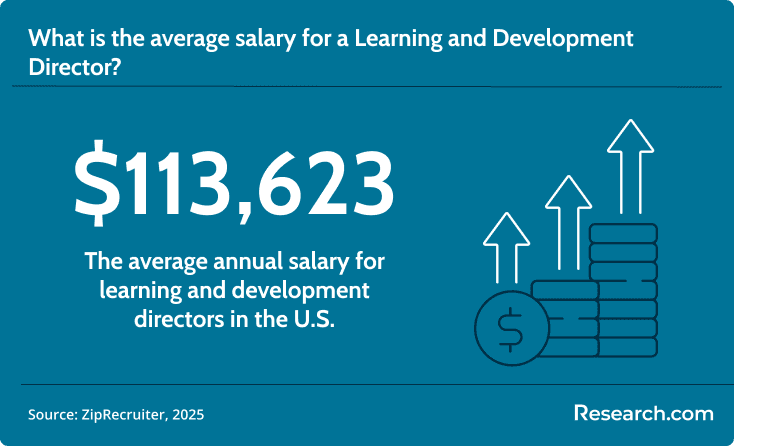
- The average salary for a learning and development director is $113,623, reflecting the strategic impact and expertise the position demands.
What is a learning and development (L&D) director?
A learning and development director is a senior professional responsible for shaping and executing an organization’s overall learning strategy. This role focuses on identifying skill gaps, designing effective training programs, and fostering a culture of continuous growth among employees.
L&D sirectors work closely with executives and department leaders to ensure that learning initiatives support both individual development and business objectives. By aligning talent development with company goals, they help drive performance, innovation, and employee engagement across all levels.
Beyond creating training frameworks, L&D directors often lead teams of learning specialists, manage budgets, and evaluate the effectiveness of programs through data and feedback. Much like professionals who pursue careers with a master’s in TESOL, they must understand how people learn and apply that knowledge to create effective educational strategies. The role combines strategic vision with hands-on leadership, making it both analytical and people-focused.
What are the main duties and day-to-day tasks of an L&D director?
The main duties of a L&D director revolve around leading initiatives that strengthen workforce capability and align employee growth with organizational success. Their daily tasks blend strategic planning, program management, and performance evaluation to ensure continuous improvement.
- Design and implement learning strategies: They create comprehensive learning frameworks that support company goals and drive professional development across all levels. These strategies often integrate leadership training, skill development, and succession planning.
- Assess organizational training needs: By analyzing performance data and conducting skill gap assessments, they identify where employees need support. This ensures training programs are relevant and results-driven.
- Oversee training programs and delivery: They manage the rollout of workshops, e-learning modules, and leadership initiatives across departments. Collaboration with internal teams and external vendors ensures consistency and quality.
- Measure learning effectiveness: They evaluate training outcomes using performance metrics, feedback, and ROI analysis. This helps refine programs and demonstrate their impact on business performance.
- Lead and develop L&D teams: They guide instructional designers, trainers, and coordinators to maintain a high-performing learning function. Coaching and mentorship are key parts of their leadership responsibilities.
Exploring the best online instructional design master’s programs can provide a strong benchmark for aspiring L&D professionals. These programs train students in mastering e‑learning tools, curriculum development, and training analytics—skills directly relevant to leading an L&D function.
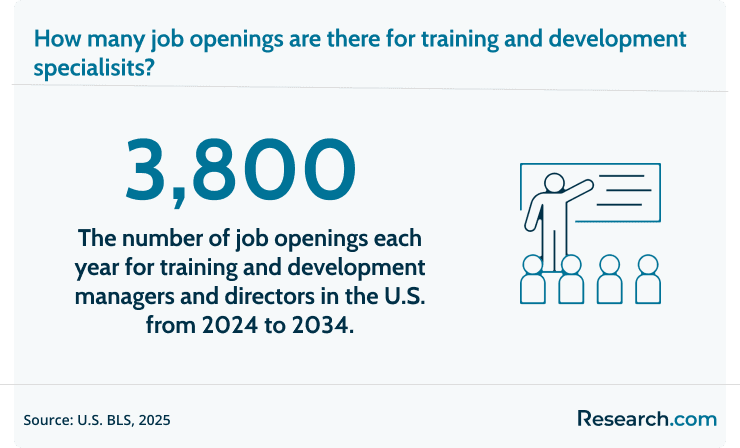
With approximately 3,800 job openings projected each year for training and development managers, the demand closely reflects the essential day-to-day responsibilities of Learning and Development Directors. These professionals are tasked with designing training strategies, assessing skill gaps, managing learning programs, and aligning development initiatives with organizational goals.
How does this role ensure alignment between learning initiatives and business goals?
A learning and development director ensures alignment between learning initiatives and business goals by deeply understanding the organization’s strategic priorities. They collaborate with senior leaders to identify the skills, knowledge, and behaviors needed to achieve those objectives.
By translating business strategies into targeted training programs, they make sure learning efforts directly contribute to performance improvement and organizational growth. This alignment transforms training from a cost center into a strategic investment that drives measurable results.
Additionally, the L&D director uses data and analytics to monitor progress and evaluate the impact of learning programs on business outcomes. Regular feedback from stakeholders helps them refine initiatives to remain relevant as priorities evolve. They also promote a culture of learning that supports innovation, adaptability, and long-term success. Through this strategic approach, L&D directors bridge the gap between employee development and the company’s competitive advantage.
Aspiring L&D directors can draw valuable insights from specialized education programs that focus on diverse learning needs. For example, careers with a master’s in multilingual learner education emphasize strategies for supporting learners from varied linguistic and cultural backgrounds, which parallels the L&D director’s role in creating inclusive training programs.
What educational background is typically required for an L&D director?
To become a successful learning and development director, having the right educational foundation is essential. This role requires both academic knowledge and practical expertise in managing people, programs, and organizational change. The following qualifications are typically expected:
- Bachelor’s degree in a related field: Most L&D directors hold a bachelor’s degree in human resources, business administration, education, psychology, or organizational development. This provides the groundwork for understanding leadership, training, and performance management.
- Master’s degree or advanced education (preferred): Many employers prefer candidates with a master’s degree in organizational leadership, HR management, or instructional design. This level of study helps develop the strategic thinking and data-driven decision-making skills needed for executive roles.
- Professional certifications: Credentials such as the Certified Professional in Learning and Performance (CPLP), SHRM Certified Professional (SHRM-CP), or Association for Talent Development (ATD) certifications add credibility and demonstrate a commitment to ongoing professional growth.
Which professional certifications or credentials can enhance career prospects?
Earning professional certifications can significantly enhance an L&D director’s credibility, expertise, and career advancement opportunities. These credentials demonstrate a commitment to continuous learning and validate specialized skills in leadership and talent development.
- SHRM Certified Professional (SHRM-CP) or Senior Certified Professional (SHRM-SCP): These credentials from the Society for Human Resource Management highlight expertise in HR strategy, workforce planning, and employee engagement.
- Certified Professional in Training Management (CPTM): Provided by Training Industry, Inc., this certification focuses on managing corporate training functions and aligning learning strategies with business goals.
- Project Management Professional (PMP): This globally recognized credential demonstrates strong project management skills, essential for overseeing complex learning initiatives and budgets.
- Certified Professional in Learning and Performance (CPLP / APTD): Offered by the Association for Talent Development (ATD), this certification validates advanced knowledge in instructional design, training delivery, and performance improvement.
- Chartered Institute of Personnel and Development (CIPD) Qualifications: Widely recognized in the UK and internationally, these certifications strengthen expertise in organizational development, leadership, and learning strategy.
What career path leads to becoming an L&D director?
Becoming a learning and development director typically requires a blend of experience, education, and leadership growth within HR and training functions. Professionals often progress through roles that build expertise in talent management, instructional design, and organizational strategy.
- Start in entry-level HR or training roles: Many begin as training coordinators, HR assistants, or learning specialists to gain hands-on experience in employee development and program management.
- Advance to mid-level positions: Roles such as Learning and Development Manager, Training Manager, or HR Business Partner help professionals develop leadership skills and strategic oversight.
- Gain cross-functional experience: Exposure to areas like organizational development, performance management, or change leadership broadens understanding of how learning supports business goals.
- Pursue leadership and strategic roles: Transitioning into senior positions such as Head of Talent Development or Learning Strategist prepares professionals for executive-level decision-making.
- Build a strong professional network: Engaging with industry associations like the Association for Talent Development (ATD) and attending conferences or workshops can enhance visibility and open leadership opportunities.
The top-paying industries for learning and development directors offer some of the most competitive salaries in the field. According to the U.S. Bureau of Labor Statistics, the professional, scientific, and technical services industry leads with an average annual salary of $145,610, which is similar to some high technical communication degree salary levels.
The chart below shows the top-paying industries for training and development managers in the U.S.
What is the average salary for a learning and development director?
The average salary for a learning and development director is approximately $113,623 per year. This figure reflects the strategic importance of the role, as L&D Directors are responsible for aligning employee growth initiatives with organizational performance goals. They oversee training budgets, lead development teams, and ensure that learning programs deliver measurable business results—all responsibilities that justify competitive compensation packages.
However, salaries can vary based on several factors, including location, industry, and company size. L&D Directors in large corporations or high-demand industries such as technology, healthcare, or finance often earn significantly more. Additionally, those with advanced degrees, certifications, or extensive leadership experience tend to command higher salaries.
Exploring specialized fields can provide insight into how education shapes career opportunities. For example, religious studies jobs emphasize research, teaching, and program development, which parallels aspects of a L&D director’s role. Both require strong analytical skills, the ability to design engaging educational experiences, and the capacity to guide learners or employees toward growth and understanding.
What types of roles or industries provide relevant experience?
Gaining relevant experience for an L&D director role often comes from positions and industries that emphasize people development, organizational growth, and performance improvement. Diverse exposure helps build the strategic and interpersonal skills essential for success in this leadership position.
- Human resources and talent management: Roles in HR, recruitment, or talent development provide foundational experience in employee engagement, performance reviews, and workforce planning.
- Corporate training and education: Working as a training specialist, instructional designer, or e-learning manager builds expertise in curriculum design and adult learning principles.
- Consulting and organizational development: Experience in HR or management consulting helps develop strategic thinking and the ability to align learning solutions with business outcomes.
- Technology and software industries: These fast-paced sectors offer opportunities to lead digital learning initiatives, implement learning management systems (LMS), and manage change.
- Healthcare, finance, or manufacturing: Highly regulated industries often require structured training programs, giving professionals valuable experience in compliance, leadership development, and continuous improvement.
Similar to programs like an online nurse administrator graduate certificate, which prepares healthcare leaders to manage staff development and organizational training, aspiring L&D directors can pursue advanced credentials focused on workforce learning, leadership, and performance improvement.
What is the job outlook and demand for L&D directors in the coming years?
The job outlook for learning and development directors is highly positive, reflecting the growing importance of employee development in today’s workforce. According to the U.S. Bureau of Labor Statistics, employment of training and development managers is projected to increase to 49,200 positions in 2034, representing a 6 percent growth rate, which is faster than the average for all occupations.
This steady rise highlights the increasing demand for leaders who can design and implement learning strategies that support organizational agility and innovation.
This growth is fueled by rapid technological advancements, evolving workplace structures, and the need for continuous upskilling. Organizations across all industries are prioritizing learning initiatives to enhance productivity, engagement, and retention.
As a result, L&D directors who can align learning programs with business goals and leverage emerging technologies will continue to be in strong demand throughout the next decade. The chart below shows the number of employment changes for training and development managers, which are closely similar to L&D directors:
What are the biggest challenges faced by L&D directors today?
L&D directors face a range of challenges as they navigate rapid changes in technology, workforce expectations, and business priorities. These obstacles require strategic thinking, adaptability, and innovation to ensure learning programs remain relevant and effective.
- Keeping up with technology: Rapid advancements in digital learning tools and artificial intelligence require L&D Directors to stay agile and continuously update their strategies. They must evaluate and implement the right technologies to enhance accessibility, engagement, and learning outcomes.
- Measuring ROI and impact: Proving the effectiveness of learning initiatives can be difficult since the results are often long-term and qualitative. L&D Directors must develop metrics and data-driven methods to demonstrate how training contributes to organizational success.
- Adapting to remote and hybrid work models: With teams spread across different locations, maintaining consistent training quality has become a major challenge. L&D leaders must design flexible, tech-enabled programs that foster collaboration and inclusivity.
- Managing limited budgets and resources: Balancing cost control with the need for impactful, innovative learning solutions is a constant struggle. Effective prioritization and creative use of existing tools are key to maximizing value.
- Meeting diverse learning needs: Workforces today are more diverse than ever, requiring programs that accommodate different backgrounds, learning preferences, and career stages. L&D Directors must ensure inclusivity while maintaining scalability and relevance.
Here's What L&D Directors Have to Say About Their Careers
- Jerome: "Pursuing a career in human resources has been incredibly rewarding because I get to shape company culture and help people reach their full potential. The variety of responsibilities, from recruiting to training and employee engagement, keeps every day interesting and meaningful. Seeing employees grow because of initiatives I’ve implemented is the best part of my job."
- Nora: "Working in HR has given me the perfect balance between strategy and empathy. I have had the opportunity to lead organizational change, improve workplace policies, and directly impact job satisfaction across teams. Knowing that my work contributes to both company success and individual happiness makes it deeply fulfilling. "
- Eugene: "After earning my HR certification, I was amazed at how quickly new career opportunities appeared. Human resources has allowed me to build strong relationships, solve complex problems, and continuously learn about people and business. It is a field that truly rewards compassion and leadership."
Key Findings:
- Employment of training and development managers is projected to grow 6 percent from 2024 to 2034, faster than the average for all occupations.
- The total number of jobs is expected to increase from 46,400 in 2024 to 49,200 in 2034, showing steady demand for L&D leadership roles.
- The average salary for Learning and Development Directors is $113,623, reflecting the strategic importance of this position.
- The professional, scientific, and technical services sector leads with an average salary of $145,610, followed by the management and finance industries.
Key Findings
- Directors are high-level leaders who manage the L&D budget, oversee the creation and implementation of all training modalities (e-learning, leadership programs, etc.), and lead and mentor the L&D professional team.
- The core responsibility is establishing the organization’s strategic learning and development plan, which involves identifying employee skill gaps and ensuring all training initiatives are closely aligned with overall business goals.
- A key duty involves evaluating program effectiveness by analyzing performance data and learning outcomes to measure the impact on the business and drive continuous improvement.
- The minimum educational requirement is typically a bachelor's degree in a field like HR, education, or organizational development, though a master's degree is often preferred for this senior-level position.
- The average annual salary for a director of learning and development in the U.S. is approximately $113,623 to $146,005, with top earners often making over $175,000 annually.
Other things you should know about being a learning and development director
In 2027, L&D directors use a combination of quantitative and qualitative metrics, such as learner feedback, performance improvement, and business impact assessments. They may also leverage advanced data analytics to track progress and demonstrate program value comprehensively.
In 2027, essential skills for a Learning and Development Director include strategic planning, proficiency in digital learning technologies, data analytics for measuring program effectiveness, and strong leadership abilities to manage teams and influence organizational culture and growth.
References
- Hawley, M. (2024). 9 Learning and Development Certifications for the Workplace. Reworked
- U.S. Bureau of Labor Statistics. (2025). Occupational Outlook Handbook: Training and Development Managers. U.S. BLS
- University of Arizona Global Campus. (2024). What is a Learning and Development Specialist? UAGC
- ZipRecruiter. (2025). Salary: Learning And Development Director. ZipRecruiter


