
2027 What Does a Project Controller Do: Responsibilities, Requirements, and Salary

Co-Founder and Chief Data Scientist
Choosing a project controller career means choosing the analytical side of project delivery: budgets, schedules, forecasts, risks, reports, and the early warning signs that keep a project from drifting off course. Organizations rely on these professionals when projects become too complex to manage by intuition alone, especially in construction, engineering, IT, manufacturing, energy, healthcare, and corporate transformation work.
The role matters because missed deadlines and cost overruns can affect cash flow, client trust, compliance, and profitability. Recent data suggests that 71% of executives identified improved project management as a key driver for business success in 2027, which helps explain why project control skills remain valuable across industries.
This guide explains what project controllers do, how the role differs from project management, what education and experience employers commonly expect, which tools and certifications can strengthen your profile, and what salary range you can reasonably evaluate when comparing opportunities in the U.S.
Key Things You Should Know About What a Project Controller Does
- The project controller's core function is to monitor, control, and report on project cost and schedule performance, acting as a specialized financial custodian who advises the project manager rather than leading the overall project team.
- Entry into this field typically requires a bachelor's degree in finance, accounting, or a related field, with experience ranging from one (1) to seven (7) years.
- The project controller profession is frequently hiring in the construction/engineering and IT sectors, and a PMP certification potentially boosts a Project Controller's salary by 10% to 20%
What is the role of a project controller in a project management life cycle?
A project controller supports the project management life cycle by tracking whether a project is staying aligned with its approved budget, schedule, scope, and performance baseline. While the project manager leads delivery, the project controller supplies the financial, schedule, and performance intelligence needed to make timely decisions.
In practical terms, the role is most visible during planning, execution, monitoring, controlling, and closeout. A project controller helps build cost baselines, establish reporting procedures, track actual spending, compare progress against the schedule, identify variances, and forecast the likely impact of delays or cost changes.
Core responsibilities in the project life cycle
- Planning: Help define budgets, cost codes, reporting templates, schedule baselines, resource plans, and control procedures.
- Execution: Monitor spending, commitments, invoices, labor hours, procurement activity, and schedule progress.
- Monitoring and controlling: Analyze cost and schedule variances, prepare forecasts, flag risks, and support corrective action planning.
- Change control: Track approved and pending changes, assess budget and timeline effects, and maintain documentation.
- Reporting: Produce status reports, dashboards, earned value summaries, cash flow updates, and management briefings.
- Closeout: Reconcile final costs, support lessons learned, confirm documentation is complete, and compare final results with the original baseline.
A strong project controller does more than collect numbers. The job requires asking whether the numbers make sense, identifying what changed, explaining why it changed, and helping the team understand what may happen next if no corrective action is taken.
What is the key difference between a project controller and a project manager?
The key difference is accountability. A project manager is responsible for leading the project to completion, while a project controller is responsible for monitoring, analyzing, and reporting the project’s cost and schedule performance. The project manager makes delivery decisions; the project controller provides the evidence that supports those decisions.
| Area | Project Manager | Project Controller |
| Primary focus | Overall project delivery, stakeholder management, scope, team coordination, and outcomes | Cost control, schedule tracking, forecasting, reporting, documentation, and variance analysis |
| Decision authority | Typically owns or escalates major project decisions | Usually advises through data, analysis, and recommendations |
| Daily work | Coordinates teams, resolves delivery issues, manages stakeholder expectations, and drives execution | Updates budgets and schedules, reviews actuals, prepares reports, analyzes risks, and tracks changes |
| Success measure | Project delivered according to agreed scope, quality, timeline, and business expectations | Reliable project visibility, accurate forecasts, timely warnings, and disciplined cost and schedule control |
The two roles work closely together. A project manager may ask, “Can we still meet the deadline?” A project controller answers with schedule data, cost implications, risk assumptions, and forecast scenarios. In highly technical sectors such as IT, that analysis may include the cost of implementing a new platform after completing a cloud engineering course online or bringing in specialized cloud talent.
The distinction matters when evaluating job postings. Some employers use titles loosely, so read the responsibilities carefully. If the job emphasizes team leadership, client ownership, and delivery accountability, it is closer to project management. If it emphasizes budgets, forecasting, earned value, reporting, and cost/schedule controls, it is closer to project control.
How many years of relevant finance or accounting experience do project controller jobs require?
Project controller jobs commonly require a bachelor’s degree in finance, accounting, business, or a related field, plus relevant experience in finance, accounting, project coordination, cost control, or project reporting. The typical experience range is approximately one to seven years, depending on the level of the role, the size of the projects, and the industry.
Junior project controller roles may accept around one to two years of finance or accounting experience, especially if the candidate has strong Excel, reporting, budgeting, or scheduling exposure. Mid-level roles often expect several years of hands-on work with project budgets, cost tracking, purchase orders, invoices, forecasts, or schedule updates. Senior roles often ask for five or more years of experience, and some listings prefer seven or more years in project financial management or related areas.
What experience counts most
- Budget tracking: Monitoring planned versus actual spending and explaining variances.
- Financial reporting: Preparing recurring reports for managers, clients, finance teams, or executives.
- Forecasting: Estimating future costs, remaining work, cash flow, or schedule effects.
- Project cost control: Working with cost codes, commitments, invoices, change orders, accruals, and earned value concepts.
- Cross-functional coordination: Communicating with project managers, finance, procurement, operations, and stakeholders.
For career changers, the most useful background is not always a job title with “controller” in it. Accounting analyst, financial analyst, project coordinator, cost analyst, scheduler, project accountant, and operations analyst roles can all provide relevant preparation if they involve budgets, reports, timelines, and variance analysis.
This practical work-history emphasis is different from fields where a specific graduate credential is often central to entry, such as pursuing an ALA-accredited online master's in library science.
What bachelor's degree is best for a project controller career path?
The best bachelor’s degrees for a project controller career are usually finance, accounting, business administration, project management, or a closely related field. The strongest option depends on the type of projects you want to support and whether you prefer the financial, operational, or scheduling side of the role.
Finance
A finance degree is a strong fit for project controllers who want to focus on budgeting, forecasting, cash flow, financial modeling, and investment-related decisions. It builds comfort with numbers, assumptions, risk, and performance analysis, all of which are central to project controls.
Accounting
An accounting degree is especially useful in roles tied closely to cost tracking, invoices, accruals, revenue recognition, compliance, and financial reporting. Project controllers in construction, engineering, government contracting, and large corporate environments often benefit from this foundation because project costs must be coded, documented, reconciled, and explained accurately.
Business Administration
A business administration degree offers a broader foundation across finance, operations, management, strategy, and organizational behavior. It can be a good choice for students who want flexibility and may later move from project control into operations, program management, business analysis, or management roles.
The value of combining specialized knowledge with management preparation is not unique to project control. Similar career movement appears in fields where technical experience and business leadership intersect, such as various RN MBA jobs in healthcare administration.
Project Management
A bachelor’s degree in project management is directly aligned with scheduling, risk management, scope control, quality control, cost estimation, and stakeholder coordination. It can be especially useful if you want to work closely with project managers or eventually move into project leadership.
How to choose the best degree
- Choose finance if you want stronger preparation in forecasting, financial analysis, and business decision support.
- Choose accounting if you want stronger preparation in cost documentation, reporting accuracy, compliance, and audit-ready records.
- Choose business administration if you want a broad pathway into project controls, operations, or management.
- Choose project management if you want direct exposure to schedules, risk, scope, and project delivery methods.
Whichever major you choose, build evidence of practical ability through internships, Excel-heavy coursework, budgeting projects, scheduling tools, data analysis, and case studies. Employers often care as much about whether you can interpret project data as they do about the degree title.
Is a master’s degree or an MBA necessary to advance as a senior project controller?
A master’s degree or MBA is not strictly necessary to become a senior project controller. Many professionals advance through experience, strong reporting skills, industry knowledge, software proficiency, and a track record of helping teams control cost and schedule risk on increasingly complex projects.
That said, a master’s degree—especially an MBA with a focus on finance, project management, operations, or business administration—can be useful when you want to move into broader leadership roles. It may help you build strategic thinking, executive communication, financial planning, and organizational management skills that become more important at senior levels.
When an advanced degree may be worth it
- You want to move from project controller to project controls manager, program manager, operations manager, or finance leadership.
- Your employer values graduate education for promotion into management roles.
- You work on large, complex, regulated, or capital-intensive projects where financial strategy and risk governance matter.
- You need stronger business, leadership, or executive communication skills.
When experience may matter more
- You already work in project controls and need deeper software, earned value, scheduling, or forecasting expertise.
- Your target employers emphasize hands-on experience over academic credentials.
- You can gain leadership by managing reports, mentoring junior staff, or owning controls for larger projects.
- The cost and time commitment of graduate school would slow your career progress more than it helps.
The best decision is to compare the degree against your target job postings. If senior roles in your industry repeatedly list an MBA or master’s as preferred, it may strengthen your candidacy. If postings emphasize Primavera P6, cost control, forecasting, and industry experience, targeted certifications and project experience may produce a better return.
This pattern is common in specialized leadership paths. In healthcare, for example, professionals may ask What can you do with an MSN degree in nurse executive leadership? The same question applies here: will the degree unlock the leadership role you actually want?
Meanwhile, the chart below shows the most common project controller degrees.
Where can I find online training or courses to master project controls software tools?
You can find online training for project controls through specialized project controls providers, software-focused academies, certification-aligned institutes, and general professional learning platforms. The best choice depends on whether you need broad project controls knowledge, a specific tool such as Primavera P6 or Microsoft Project, or preparation for a professional certification.
Project Control Academy
Project Control Academy offers online training focused specifically on project controls. Its courses cover areas such as scope management, scheduling, cost control, earned value management, and forecasting. This type of training is useful if you want to understand the full controls process rather than learn only one software interface.
Plan Academy
Plan Academy is a strong option for learners who need practical training in project controls software and scheduling methods, including Primavera P6, Construction CPM Scheduling, and Forensic Delay Analysis. It is particularly relevant for construction, engineering, and infrastructure environments where detailed schedules and delay analysis matter.
Project Controls Institute
Project Controls Institute offers online courses that align with industry certifications, including courses for AACE certification exams. Its training spans estimating, planning, scheduling, and cost control, making it useful for professionals who want a structured project controls curriculum with certification relevance.
LinkedIn Learning
LinkedIn Learning provides shorter courses on common project management and collaboration tools such as Microsoft Project, Asana, Trello, and Jira. These courses are helpful for building tool familiarity, especially for entry-level professionals or those moving into IT, operations, or corporate project environments.
ECITB Training Courses
The Engineering Construction Industry Training Board (ECITB) offers project controls courses focused on fundamentals such as estimating, planning, scheduling, risk management, and document management. These courses are well suited for learners who want applied technical competence in engineering construction contexts.
How to choose the right training
- Choose a software-specific course if job postings in your target industry name a tool such as Primavera P6, Microsoft Project, or Jira.
- Choose a project controls fundamentals course if you need to understand cost, schedule, forecasting, and reporting as a system.
- Choose a certification-aligned course if you plan to pursue AACE, PMI, or another professional credential.
- Choose a hands-on course with exercises, templates, and sample project data if you need portfolio-ready skills.
Before paying for a course, check whether it includes current software versions, downloadable practice files, instructor support, and examples from your target industry. A course that teaches real project scenarios is usually more useful than one that only demonstrates menu navigation.
How can a project controller develop stronger analytical and problem-solving skills?
A project controller develops stronger analytical and problem-solving skills by working with real project data, learning structured analysis methods, and practicing how to turn findings into clear recommendations. The goal is not just to identify that a project is over budget or behind schedule, but to explain why, estimate the impact, and help the team decide what to do next.
Build technical analysis skills
- Strengthen Excel and spreadsheet modeling: Practice pivot tables, lookups, formulas, scenario tables, charts, and data validation so you can analyze large project datasets efficiently.
- Learn project controls software: Use tools such as Primavera P6, Microsoft Project, and business intelligence platforms to connect schedules, costs, and progress data.
- Study earned value management: Understand planned value, earned value, actual cost, schedule variance, cost variance, and performance indexes.
- Improve forecasting: Practice estimating cost at completion, schedule impact, remaining work, and risk-adjusted outcomes.
Use structured problem-solving methods
- Root cause analysis: Separate symptoms from causes when costs rise or milestones slip.
- Variance analysis: Compare baseline, actuals, commitments, and forecasts to identify where performance changed.
- Scenario planning: Model best-case, expected-case, and worst-case outcomes before recommending action.
- Risk analysis: Connect risks to cost and schedule impacts rather than treating them as abstract concerns.
Develop business judgment
- Ask better questions: Instead of only reporting a variance, ask whether it is timing-related, scope-related, productivity-related, supplier-related, or caused by an estimating error.
- Learn from closeouts: Compare final results with the original baseline to understand which assumptions were wrong and which controls worked.
- Seek feedback: Ask project managers, finance leaders, and schedulers whether your reports are clear, timely, and actionable.
- Work cross-functionally: Spend time with procurement, operations, engineering, finance, and field teams to understand how project data is created.
These skills go beyond general administration. The strongest project controllers combine technical discipline with judgment: they know when a number is wrong, when a forecast is too optimistic, and when a small variance may signal a larger delivery risk. The following chart highlights the technical skills most frequently cited for this role, showing the market value of financial analysis and structured project control techniques.
What is the typical project controller career path progression?
A typical project controller career path begins in support or analyst roles, moves into independent project control responsibility, and can progress into senior specialist, management, or executive-level positions. Advancement usually depends on project complexity, industry knowledge, software proficiency, communication skills, and the ability to influence decisions with reliable analysis.
Trainee or Junior Project Controller
At the entry level, professionals learn the basics of project cost tracking, schedule updates, reporting cycles, document control, and variance identification. They usually work under supervision and focus on accuracy, process discipline, and familiarity with project controls terminology.
Project Controller
At the mid-level stage, project controllers manage recurring cost and schedule reporting more independently. They review actuals, monitor commitments, track change orders, update forecasts, assess risks, and explain performance trends to project managers or finance teams.
Senior Project Controller/Discipline Lead
Senior project controllers typically handle larger or more complex projects, mentor junior staff, improve reporting methods, and present analysis to clients or senior leaders. They are expected to understand not only what the data says, but what actions the project team should consider.
Project Controls Manager/Head of Project Controls
At the management level, professionals oversee teams, standardize controls procedures, improve systems, review portfolio-level performance, and ensure reporting consistency across multiple projects. This role requires leadership, governance, stakeholder management, and process improvement skills.
Director or Executive Roles
Some project controllers move into director or executive roles such as Director of Project Controls, Program Manager, VP of Operations, or related leadership positions. At this stage, the work expands from project-level control to portfolio strategy, enterprise risk, capital planning, and organizational performance.
How to move up faster
- Own increasingly complex projects rather than only producing routine reports.
- Build credibility by improving forecast accuracy and identifying risks early.
- Learn the commercial model of your industry, including contracts, change orders, margins, and compliance requirements.
- Develop executive-ready communication: concise summaries, clear assumptions, and practical recommendations.
- Mentor others or lead process improvements to show management potential.
Having outlined the stages of professional growth from Trainee to Executive, it is useful to view career progression alongside earning potential. The following chart lists the top five highest-paying states for Project Controllers.
What is the average project controller salary in the U.S.?
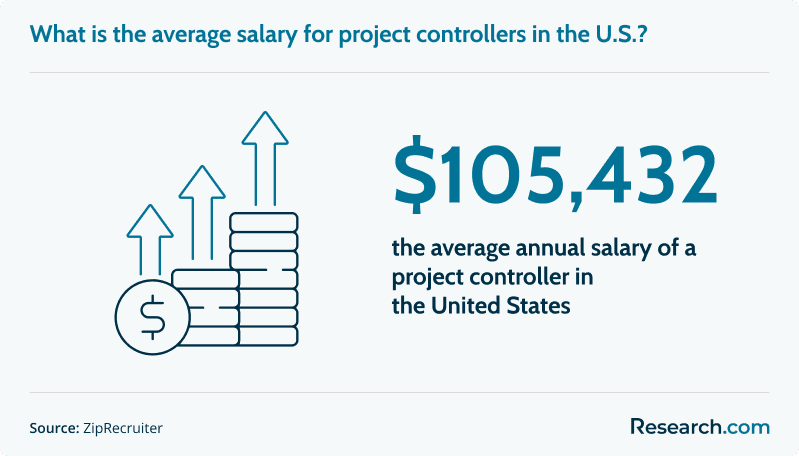
The average project controller in the United States earns approximately $105,432 per year, or about $51 per hour. Salaries for this role typically range from around $89,000 at the 25th percentile to $124,000 at the 75th percentile, with top earners reaching up to $140,000 annually.
Use these figures as a benchmark, not a guarantee. Compensation can vary widely by industry, project size, location, employer type, and the level of responsibility attached to the title. A project controller managing reporting for a small internal project may be paid differently from one controlling costs for a large capital project, engineering program, or enterprise technology rollout.
Factors that influence project controller pay
- Experience level: Senior and expert-level controllers generally earn more because they can manage complex budgets, interpret risk, and advise leadership.
- Geographic location: High cost-of-living metropolitan areas such as San Francisco, CA, and New York, NY, often offer higher compensation to offset local expenses.
- Industry: Technology, finance, consulting, engineering, construction, manufacturing, and energy may pay differently based on project scale, margins, and risk.
- Company size: Large organizations with complex portfolios and high-budget projects often offer higher pay and broader benefits than smaller employers.
- Education and certifications: A master’s degree and relevant professional certifications in finance or project management, such as CPA or PMP, can improve competitiveness and may support higher compensation.
- Tool proficiency: Experience with systems such as Primavera P6, Microsoft Project, ERP platforms, advanced Excel, and reporting dashboards can make a candidate more valuable.
How to evaluate a salary offer
- Compare the offer with the project size, reporting complexity, and number of stakeholders you will support.
- Ask whether overtime, bonuses, travel, hybrid work, and benefits are included in total compensation.
- Review whether the role is truly project control or a broader finance, scheduling, or project management position under a different title.
- Consider career value, not only starting pay. A role with complex projects and strong mentorship may accelerate advancement.
Does holding a project management certification significantly increase a project controller’s salary?
Holding a project management certification such as PMP (Project Management Professional) can strengthen a project controller’s salary potential, especially when the role requires close coordination with project managers, risk planning, stakeholder communication, or broader delivery oversight. Certification does not guarantee a raise, but it can help distinguish candidates in competitive senior roles.
Impact on Salary
Certified project controllers typically have a stronger case for higher compensation than otherwise similar candidates without certification, particularly when employers value formal project management knowledge. According to industry surveys and salary reports, certification can lead to a salary increase of approximately 10% to 20%, depending on experience, location, industry, and the responsibilities of the role.
The salary effect is usually strongest when certification is paired with practical experience. A credential alone is less persuasive than a credential plus evidence that you can manage forecasts, explain variances, support change control, and help project teams avoid cost and schedule surprises.
Additional Benefits
- Recognition of expertise: Certification signals that you understand established project management principles and terminology.
- Better promotion potential: Employers may prefer certified professionals for senior, client-facing, or leadership-track roles.
- Broader credibility: A project controller with project management knowledge can communicate more effectively with project managers and stakeholders.
- Continuing education: Many certification programs encourage ongoing learning, which helps professionals stay current.
- Professional network: Certification communities can expose you to job leads, best practices, and industry trends.
When certification is most useful
- You want to move into senior project controller, project controls manager, or program-facing roles.
- Your target employers list PMP or similar credentials as preferred qualifications.
- You already have hands-on project controls experience and want a formal credential to validate broader project knowledge.
- You work in an industry where formal project management methods are widely used.
Which industries hire project controllers most frequently?
Project controllers are most frequently hired in industries where projects are large, expensive, schedule-sensitive, highly regulated, or technically complex. The role is especially common when organizations need disciplined tracking of budgets, schedules, contracts, risks, resources, and performance milestones.
Construction and Engineering
Construction and engineering are major employers of project controllers because projects often involve large budgets, subcontractors, long timelines, procurement constraints, safety requirements, and strict client deliverables. Controllers help track cost codes, change orders, schedules, earned value, invoices, and progress against baseline plans.
Information Technology (IT)
IT organizations hire project controllers for software development, infrastructure upgrades, cloud migrations, cybersecurity initiatives, ERP implementations, and digital transformation programs. In these environments, controllers monitor budgets, timelines, staffing, vendor costs, and shifting scope in fast-moving projects.
Finance and Banking
Finance and banking employers use project controllers for regulatory initiatives, systems upgrades, process improvements, reporting projects, and operational transformation. These projects often require careful budget oversight, documentation, governance, and compliance awareness.
Healthcare
Healthcare organizations need project controllers for facility construction, system implementations, clinical operations improvements, service expansions, and technology upgrades. The role is valuable because healthcare projects often involve regulatory requirements, budget limits, multiple stakeholders, and patient-service implications.
Manufacturing and Energy
Manufacturing employers use project controllers for product development, plant improvements, process optimization, supply chain projects, and equipment investments. Energy companies hire them for infrastructure, maintenance, capital projects, sustainability initiatives, and complex engineering programs.
How industry choice affects the role
- Construction and engineering often emphasize scheduling, cost codes, change orders, and earned value.
- IT often emphasizes resource planning, vendor costs, agile or hybrid delivery, and scope changes.
- Finance and healthcare often emphasize governance, compliance, documentation, and stakeholder reporting.
- Manufacturing and energy often emphasize capital spending, procurement, operational downtime, and long-range planning.
Regardless of industry, the role is defined by detailed tracking and adherence to measurable requirements. That precision is mirrored in other high-consequence fields, such as the need to document concentrated fieldwork hours BCBA candidates require for certification.
Here’s What Professionals Have to Say About What a Project Controller Does
- : "Transitioning into project control gave my career the structure and analytical depth I wanted. I enjoy turning complex financial data and schedules into practical insights the project team can use. The work makes me feel like the project’s financial compass because my analysis helps keep decisions grounded in reality. — Elias"
- : "The demand for skilled project controllers gives the role strong career value across industries, from construction to technology. Budget oversight can be intense, but mastering resource forecasting and variance analysis has made me a more confident partner to project managers and senior stakeholders. — Sarah"
- : "What I appreciate most is the mix of accounting discipline and direct involvement in project delivery. You are not just working with numbers after the fact. Your cost tracking, forecasting, and reporting can prevent financial surprises before they damage the project. — Omar"
Key Findings
- A project controller monitors and analyzes project cost, schedule, forecasts, risks, reports, and documentation so leaders can make informed decisions.
- The project manager owns overall delivery, while the project controller provides the financial and schedule visibility that supports delivery decisions.
- Project controller roles commonly require a bachelor’s degree and approximately one to seven years of relevant finance, accounting, cost control, or project reporting experience.
- Finance, accounting, business administration, and project management are the most directly relevant bachelor’s degrees for this career path.
- A master’s degree or MBA is not mandatory for senior advancement, but it can help professionals move toward management, program leadership, or broader operational roles.
- Online training is most valuable when it teaches practical tools such as Primavera P6, Microsoft Project, earned value management, forecasting, and project controls reporting.
- The average project controller salary in the United States is approximately $105,432 per year, or about $51 per hour, with typical salaries ranging from around $89,000 to $124,000 and top earners reaching up to $140,000 annually.
- Certifications such as PMP can improve salary potential and promotion prospects, particularly when combined with hands-on project controls experience.
- Construction, engineering, IT, finance, banking, healthcare, manufacturing, and energy are among the industries that most frequently hire project controllers.
Other Things You Should Know About What a Project Controller Does
In 2027, the typical salary range for a project controller is expected to be between $75,000 and $110,000 annually, depending on experience level, industry sector, and geographic location. Highly experienced project controllers in thriving sectors such as technology or pharmaceuticals might earn towards the higher end of this range.
To become a project controller in 2027, a bachelor's degree is typically required, often in finance, business administration, or engineering. Additional certifications like Certified Cost Professional (CCP) or Project Management Professional (PMP) can enhance career prospects and are highly regarded in the industry.
References
- 10 Best States for Projects Controllers in 2025 - Zippia. (2025, January 8). https://www.zippia.com/projects-controller-jobs/best-states
- How to become a Projects controller: what it is and career path - Zippia. (2025, January 8). https://www.zippia.com/projects-controller-jobs
- Project Controller salary. (2025). ZipRecruiter. Retrieved November 4, 2025, from https://www.ziprecruiter.com/Salaries/Project-Controller-Salary
- What is a project controller? (Plus skills for them to develop). (2025, July 27). Indeed. Retrieved November 4, 2025, from https://www.indeed.com/career-advice/finding-a-job/what-is-project-controller


