
2027 What Does a Project Director Do: Responsibilities, Requirements, and Salary

Co-Founder and Chief Data Scientist
Becoming a project director is a career move from managing individual deliverables to leading the full project portfolio behind an organization’s strategy. The role is for experienced professionals who can turn executive priorities into coordinated budgets, timelines, staffing plans, risk controls, and measurable results.
Demand for project leadership is strong because organizations are running more complex technology, construction, healthcare, operations, and transformation initiatives at the same time. With an estimated project management talent demand of 64% from 2025 to 2035, professionals who can manage scale, uncertainty, and cross-functional execution are positioned for significant responsibility.
This guide explains what project directors do, how the role differs from project management, what education and certifications can help, how salaries vary, which specializations exist, and what steps can move you toward this senior leadership track.
Key Things You Should Know About Becoming a Project Director
- A project director can work in different industries, including construction, business and finance, IT, education, and nonprofit management.
- Project directors handle several teams, so they must have strong soft skills in addition to their technical knowledge.
- While the career pathway is straightforward, many project directors hold eight or more years of experience in their fields before attaining this position.
What does a project director do on a typical workday?
A project director’s workday usually centers on portfolio oversight: making sure multiple projects are moving in the right direction, using resources responsibly, and supporting the organization’s larger goals. Unlike a project manager, who may spend much of the day coordinating one project team, a project director looks across several teams, risks, budgets, and stakeholder priorities.
A typical day may begin with reviewing dashboards, progress reports, budget updates, resource needs, and risk logs. The director looks for early warning signs: missed milestones, vendor delays, scope creep, cost overruns, quality issues, or conflicts between departments. The goal is not to micromanage every task but to identify where intervention is needed before problems become expensive.
Much of the day is spent in decision meetings. Project directors meet with project managers to approve changes, remove roadblocks, compare timelines, and clarify priorities. They may also work with finance teams on budget controls, HR or operations leaders on staffing, procurement teams on vendor performance, and legal or compliance teams on requirements that affect delivery.
Project directors also serve as the communication bridge between execution teams and senior leadership. They translate technical project updates into business terms executives can act on, such as cost exposure, schedule impact, customer risk, operational value, or strategic alignment. In stakeholder meetings, they may explain performance metrics, recommend adjustments, or make the case for pausing, scaling, or canceling an initiative.
The end of the day often involves documenting decisions, reviewing compliance items, preparing executive summaries, prioritizing follow-ups, and coaching project managers. In office-based industries, this work may happen through meetings and project management platforms. In construction, engineering, healthcare, or client-facing work, project directors may also visit sites, attend inspections, or meet directly with clients and vendors.
The role requires comfort with both detail and strategy. A strong project director can understand the operational reality of a project while still asking whether the work supports the organization’s long-term direction.
What is the difference between a project manager and a project director?
The main difference between a project manager and a project director is scope. A project manager is usually accountable for delivering one or a small number of projects on time, within budget, and to the required standard. A project director is accountable for the performance of multiple projects or a portfolio and for making sure those projects support business priorities.
In practical terms, project managers focus on execution. Project directors focus on governance, prioritization, escalation, strategic alignment, and leadership across teams.
| Area | Project Manager | Project Director |
| Primary focus | Daily delivery of assigned projects | Oversight of multiple projects, programs, or portfolios |
| Decision level | Task, schedule, team, and project-level decisions | Budget, priority, resource, risk, and strategic decisions |
| Typical reporting line | Reports to a project director, program leader, or department head | Reports to executive leadership and stakeholders |
| Main success measure | Whether the project meets scope, schedule, cost, and quality expectations | Whether the overall project portfolio delivers business value and stays aligned with company goals |
Project Manager’s Responsibilities
- Delegates tasks to individual team members
- Executes projects by managing daily progress
- Assists team members during project implementation
- Collaborates with project directors during project planning
- Reports to project directors
Project Director’s Responsibilities
- Handles overall project developments across a broader portfolio
- Mentors project managers on project implementation and escalation
- Provides recommendations to keep projects aligned with company goals
- Creates budgets, plots timelines, and approves or denies proposals
- Reports to executive leadership and stakeholders
There can be overlap, especially in smaller organizations. Both roles may work with contractors, negotiate timelines, communicate with stakeholders, and manage risk. The difference is that project managers usually escalate major risks upward, while project directors decide how those risks affect resources, priorities, and business commitments.
Risk management is one of the clearest areas of shared responsibility. According to the Project Management Institute (PMI), 82% of project professionals proactively identify and assess risks to mitigate them before escalating issues to senior leadership (75%). Strong organizations make this process deliberate: project managers surface project-level risks early, and project directors evaluate whether those risks require portfolio-level action.
For professionals planning their careers, the move from project manager to project director is not simply a promotion in title. It requires a shift from managing tasks to leading systems, from tracking deliverables to making trade-offs, and from reporting progress to influencing executive decisions.
This chart displays the techniques used to mitigate project obstacles.
What degree and certifications do you need to be a project director?
Most project directors need at least a bachelor’s degree plus substantial professional experience. A graduate degree is not always required, but advanced education and recognized certifications can strengthen a candidate’s credibility, especially for competitive roles in large organizations or specialized industries.
According to Zippia, 66% of professionals in this role hold a bachelor’s degree (Zippia, 2025). Common majors include business administration, management, project management, finance, engineering, information technology, communications, marketing, and human resource management. The best degree depends on the industry you want to enter: engineering or construction roles may value technical training, while operations or corporate roles may prefer business and management backgrounds.
A business degree with a concentration in project management is one of the most direct academic pathways because it covers planning, budgeting, operations, risk, and organizational leadership. However, project directors are often promoted from within technical fields, so a non-business degree can still be useful when paired with leadership experience and project delivery results.
Certifications that can strengthen your qualifications
Employers do not always require certifications, but credentials can help demonstrate that you understand formal project management methods, governance, risk control, and stakeholder communication. They may also support advancement into higher-paying or more specialized roles.
- Project Management Professional: PMI’s globally recognized PMP credential validates advanced project management experience and leadership skills.
- Certified Project Director: Offered by the Global Association for Quality Management, this certification verifies comprehensive knowledge of project portfolio management and recognizes advanced skills in directing multiple large-scale or high-risk projects.
- PRINCE2 Project Management: This certification from PeopleCert emphasizes a structured, process-oriented approach to standardizing project delivery and ensuring consistency, risk control, and clear communication throughout the project lifecycle.
- PMO Certified Professional: This PMI credential showcases expertise in optimizing project management offices (PMOs), equipping professionals with the ability to align organizational strategy with project governance.
- Agile Certified Practitioner: A PMI-ACP certification highlights a professional’s ability to apply agile principles and methods in diverse project environments with fast-changing priorities.
Specialized industries may require or strongly prefer niche credentials. For example, professionals managing cybersecurity projects may benefit from online CISM training. In construction, the Certified Construction Manager (CCM) credential from the Construction Management Association of America is widely respected for validating leadership in large-scale project delivery.
The strongest preparation is usually a combination of three things: a relevant degree, a record of successful project delivery, and certifications that match the project environment you want to lead. Credentials alone rarely make someone ready for a director role, but they can help verify your methods and distinguish you from candidates with similar experience.
This chart displays the distribution of project directors, by education level.
What is the average salary for a project director?
Project directors typically earn high salaries because they are accountable for complex initiatives, large budgets, multiple teams, and decisions that affect business performance. Reported pay varies by source, industry, location, experience, certification, and the size of the portfolio being managed.
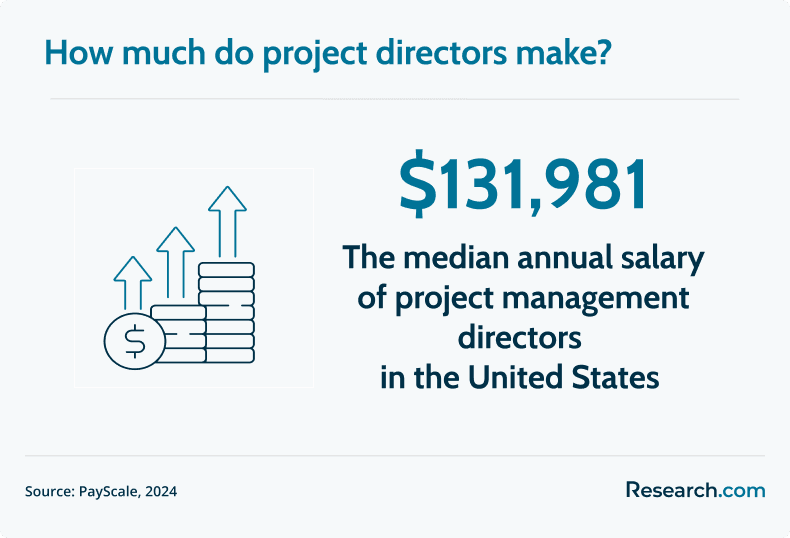
Project directors make around $131,981 annually, with incomes ranging between $106,000 and $193,000 (PayScale, 2025; Glassdoor, 2025). The U.S. Bureau of Labor Statistics (BLS) does not publish a specific wage category for project directors, but the annual wage for general and operations managers is a close comparison at $133,120.
Experience has a major effect on compensation. According to the 13th edition of PMI’s Project Management Salary Survey, project professionals in the early stages of their career earn around $80,000, while professionals with 10 to 15 years of experience earn $140,000 annually. This gap reflects the value employers place on judgment, risk management, stakeholder leadership, and a track record of delivering complex work.
Credentials can also affect pay. PMI-certified professionals earn 44% more than their non-certified peers. Even Project Management Professionals (PMPs) with less than five years of experience take home $112,000. Team size matters as well: project professionals who manage more than 10 members earn higher than $125,000.
| Factor | How it can affect salary |
| Experience level | More years of progressive responsibility can lead to higher pay, especially after managing larger budgets or higher-risk projects. |
| Certification | Credentials such as PMI certifications may strengthen marketability and are associated with higher earnings. |
| Industry | IT, finance, and construction roles often offer higher salaries because projects may involve complex systems, regulations, capital investments, or business risk. |
| Team and portfolio size | Directors responsible for larger teams or multiple initiatives are often compensated for broader accountability. |
| Location | Major metropolitan areas typically pay above the national average, though cost of living should be considered. |
Education can also influence compensation, particularly when a graduate degree supports management, finance, analytics, or technical leadership. Professionals from related management-focused backgrounds, such as a social media marketing degree online, may be able to leverage analytical, planning, and campaign leadership skills toward project leadership roles with competitive pay.
When evaluating salary offers, look beyond the base number. Project director compensation may also reflect bonuses, profit-sharing, travel expectations, project risk, team size, reporting level, and whether the role is accountable for one department or enterprise-wide initiatives.
What specializations exist within project management?
Project management specialization usually develops in two ways: by industry and by method. Industry specialization helps directors understand the regulations, timelines, technical language, and stakeholders of a field. Method specialization helps them choose the right delivery approach for the type of work being managed.
Common industry specializations
- Business Analysis: Directors in this area use data-informed strategies, stakeholder analysis, and process evaluation to make sure projects support business objectives.
- Construction and Urban Planning: Directors supervise infrastructure, housing, transportation, or development projects that require technical coordination, sustainability considerations, public input, and regulatory awareness. This can be a relevant pathway for professionals exploring urban planning careers.
- Healthcare: Healthcare project directors coordinate initiatives related to patient care delivery, hospital workflows, digital health technologies, compliance requirements, and operational improvement.
- IT and AI: Directors in this field manage technology infrastructure, software delivery, artificial intelligence initiatives, cybersecurity considerations, scalability, and digital transformation projects.
- Government and Public Administration: Project directors in public-sector environments manage policy implementation, urban development, community initiatives, grant-funded programs, and cross-agency coordination.
Common functional and methodology specializations
Some project directors specialize in risk management, where they identify threats, evaluate exposure, and create mitigation plans before problems affect budgets or deadlines. Others focus on agile project management, leading cross-functional teams through iterative planning, faster feedback cycles, and changing priorities.
Methodology also shapes specialization. Directors using Scrum may oversee short development cycles, regular team check-ins, and incremental delivery. Directors using lean processes focus on eliminating waste, improving flow, and increasing value. In more regulated or construction-heavy environments, structured and sequential approaches may be more appropriate.
The best specialization depends on your background and career target. A director leading AI implementation needs a different mix of technical fluency and risk judgment than one leading hospital workflow redesign or transportation infrastructure. Choosing a specialization can help you build deeper credibility and compete for roles where general project management experience is not enough.
What skills do you need to have as a project director?
Project directors need a balanced skill set: strategic thinking to guide priorities, technical understanding to evaluate plans, financial discipline to control resources, and interpersonal strength to lead people through uncertainty. PMI notes that project professionals value industry-specific knowledge and business acumen skills equally, along with mentorship and leadership.
The most important skills are not isolated traits. They work together. A director may need to interpret budget data, explain a delay to executives, help a project manager reset priorities, and negotiate with a vendor in the same afternoon.
- Communication: 84% of senior leaders value this skill when hiring project professionals. Directors must explain goals, trade-offs, risks, and decisions clearly to teams, executives, clients, and stakeholders.
- Technical Know-How and Business Acumen: Directors need enough technical understanding to evaluate project realities and enough business judgment to connect those realities to strategy, market conditions, and organizational goals.
- Interpersonal Skills: Because project directors work across functions, they must build trust, manage conflict, listen carefully, and keep teams aligned even when priorities compete.
- Organization: Directors must prioritize work, allocate resources, maintain project governance, manage time, and keep decision-making processes clear.
- Financial and HR Skills: Many directors are responsible for budgeting, forecasting, staffing, workload planning, and performance expectations.
- Mentorship and Leadership: Directors develop project managers, model accountability, set standards, and help teams grow through coaching rather than constant correction.
- Critical Thinking and Problem-Solving Skills: Directors must analyze complex information, anticipate risks, compare options, and make decisions when the available information is incomplete.
Digital fluency is increasingly important. Construction and engineering directors may use Building Information Modeling (BIM) software to coordinate work visually. IT-focused directors may work with Agile, DevOps, workflow automation, and collaboration platforms. These tools do not replace leadership, but they improve visibility, accountability, and speed when used well.
These capabilities are especially useful for professionals exploring careers with a technology management degree, where managing systems, digital processes, and technology teams is central to the work.
A common mistake is assuming that strong project tracking alone is enough. At the director level, employers look for judgment: knowing when to escalate, when to say no, when to reallocate resources, and when a project no longer supports the intended value.
This chart displays the skills rating of project professionals.
What is the typical career path for a project director?
The career path to project director usually takes years of progressive responsibility. Most professionals begin by learning how projects work at the task and team level, then move into management roles where they lead full project cycles, and eventually advance into director positions where they oversee multiple teams or initiatives.
Many start as junior or associate project management specialists. These roles often involve tracking deliverables, updating schedules, coordinating resources, documenting meeting outcomes, and reporting progress to managers. This stage is important because it teaches the mechanics of project work: scope, timelines, dependencies, communication, and accountability.
After three to five years of experience, professionals may move into project manager, team lead, or supervisory roles. At this level, they are responsible for guiding entire project cycles, assigning work, managing stakeholders, controlling risks, and handling administrative responsibilities. This is where many future directors begin developing the judgment and leadership habits needed for senior roles.
Project director roles typically become attainable after eight to 10 years of progressively responsible experience. By then, candidates are expected to show a record of successful delivery, cross-functional leadership, budget responsibility, and the ability to manage competing priorities. They must also be able to coach project managers rather than simply complete project work themselves.
From there, some professionals move into roles such as regional managing director or vice president of a department. These positions involve shaping policy, allocating resources, setting priorities, and leading broader organizational change. Professionals with 18 or more years of experience may advance into executive positions, such as chief project officer or chief operations officer. These roles involve setting company-wide project strategies and ensuring alignment between projects and the corporate vision.
This path is not fixed. Advancement depends on education, certifications, industry expertise, leadership performance, organizational size, and timing. Professionals who want to accelerate their progress should seek complex assignments, document measurable results, pursue relevant credentials, build mentoring relationships, and learn how senior leaders evaluate project value.
What is the job outlook for project directors?
The job outlook for project directors is strong because organizations in nearly every sector need experienced leaders who can coordinate complex work, manage risk, and turn strategy into execution. While employment projections are often reported for broader project management and operations categories, the demand signals are favorable for professionals with director-level project leadership skills.
According to the BLS, project management specialists are projected to see a 5.6% employment growth from 2024 to 2034, creating about 78,200 job openings per year. Employment of general and operations managers is expected to rise by 4.4%, or roughly 22,200 annual openings. These categories do not represent project directors exactly, but they are relevant indicators because director roles often sit at the intersection of project leadership and operations management.
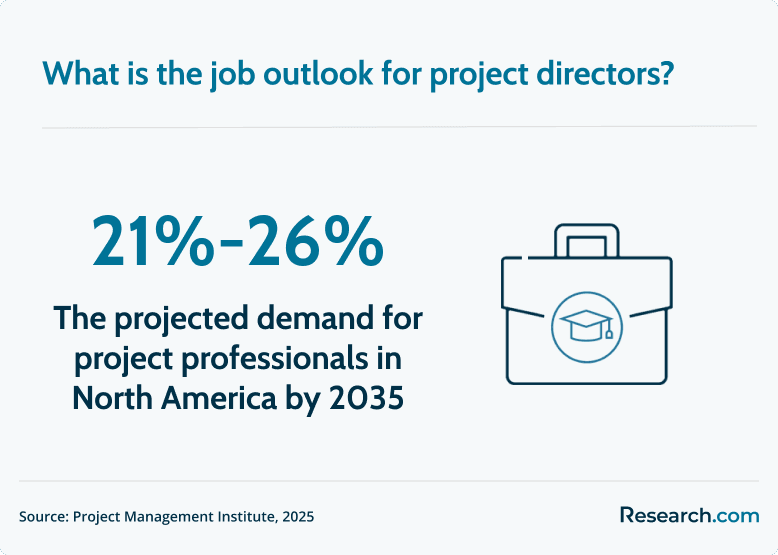
The PMI also reports that global demand for project professionals will reach 65.4 million by 2035, up 64% from 2025’s 40 million, based on a high-growth scenario. In North America alone, demand is expected to increase between 21% and 26%, or about 4.9 to 5.1 million professionals by 2035, leading to a potential talent gap of 1.3 to 1.6 million workers.
The World Economic Forum further identifies project management as one of the fastest-growing professional fields through 2030. Growth comes from new business initiatives, technology implementation, infrastructure needs, organizational transformation, and replacement demand as senior professionals retire or move into executive roles (BLS, 2025).
Technology is also reshaping the role. Companies adopting IT modernization, artificial intelligence, automation, and digital transformation need directors who can manage cross-departmental change without losing control of cost, security, timelines, or stakeholder expectations. This does not mean every project director must be a technologist, but it does mean digital literacy and change leadership are becoming more valuable.
For job seekers, the best outlook is likely for candidates who combine project governance, industry expertise, financial judgment, and the ability to lead through ambiguity. Employers are not only looking for people who can keep projects on schedule; they want leaders who can decide which projects matter most.
What are the biggest challenges project directors face?
Project directors face pressure from several directions at once: executives want results, teams need clarity, clients expect delivery, and budgets are rarely unlimited. The hardest part of the role is often not knowing what should happen in theory, but making the best decision when priorities conflict.
- Resource Allocation and Budget Constraints: Directors must distribute funding, staff, time, and tools across competing initiatives. Poor allocation can delay priority projects or overload high-performing teams.
- Project Prioritization: Managing multiple initiatives makes it difficult to decide what should come first. In fact, 61% of PMOs identify prioritization as their top challenge (Project Management Solutions, 2025).
- Stakeholder Communication: Project directors must align executives, managers, clients, vendors, and technical teams that may define success differently. Miscommunication can create rework, frustration, and loss of trust.
- Change Management and Team Dynamics: New systems, workflows, and organizational changes often create resistance. Directors must explain the purpose of change, support managers, and keep teams productive during transitions.
- Risk and Uncertainty in Emerging Fields: AI, automation, global operations, and new regulations can change project assumptions quickly. Directors need processes that detect risk early and allow timely adjustment.
Effective project directors address these challenges with clear governance. They define how decisions are made, who owns each risk, when issues must be escalated, and what data leaders need to compare priorities. Without that structure, directors can spend too much time reacting to emergencies instead of leading the portfolio.
Communication is especially important because many project failures begin as alignment failures. Skills associated with what can you do with an organizational communication degree can support a project director’s ability to manage information, clarify expectations, and resolve issues before they grow.
How do you become a project director?
To become a project director, you need to build a track record that proves you can deliver projects, lead people, manage resources, and make decisions that support business goals. The path is usually gradual, but it can be planned deliberately.
- Earn a Relevant Degree: Most project directors begin with a bachelor’s degree in business administration, management, project management, engineering, information technology, communications, or another field connected to their target industry.
- Gain Foundational Experience: Start in entry-level project, operations, analyst, coordinator, or technical roles where you can learn project workflows, documentation, scheduling, collaboration, and reporting.
- Move Into Project Management Roles: Seek responsibility for full project cycles, budgets, stakeholder updates, vendor coordination, risk tracking, and team leadership.
- Pursue Professional Certification or Advanced Education: Consider recognized project management certifications or a graduate degree if they align with your industry, employer expectations, and career goals.
- Build Industry Expertise: Develop deep familiarity with the sector you want to lead, whether that is IT, healthcare, construction, finance, public administration, or another field.
- Document Results: Track measurable achievements such as completed projects, budget performance, improved delivery times, risk reductions, stakeholder outcomes, and team growth.
- Develop Executive-Level Communication: Practice presenting project information in terms of value, risk, cost, trade-offs, and strategy rather than only tasks and timelines.
The strongest candidates are not only experienced project managers. They are professionals who can show that they understand governance, people leadership, financial responsibility, and organizational strategy. If you want to move into directorship, look for assignments that expose you to senior stakeholders, larger budgets, cross-functional teams, and higher-stakes decisions.
Becoming a project director requires consistent professional growth, adaptability, and a proven record of delivery. Technical mastery helps you understand the work, but people-centered leadership is what allows you to scale your impact through teams.
What Professionals Who Work as Project Directors Say About Their Careers
- Jamil: "I started as a junior project coordinator right after college and never expected to become a project director. The biggest change was learning to stop thinking only about execution and start thinking about leadership, risk, and strategy. I had to become more analytical, but I also had to become a better listener. Today, I’m proud that my work helps shape where the organization is going."
- Monica: "Becoming a project director taught me that leadership is never finished. The field changes constantly, and feedback has helped me make better decisions under pressure. I’ve had setbacks, but they forced me to think more strategically and communicate more clearly. Over time, I learned that strong leadership requires humility as much as confidence."
- Devin: "Leading international projects has been one of the most demanding and rewarding parts of my career. Time zones, cultural expectations, regulations, and communication styles all affect delivery. The responsibility can feel heavy, but seeing the impact of a well-run project across communities makes it worthwhile. Global project management depends on respect, preparation, and clear communication."
Key Findings
- Project directors lead multiple projects or portfolios, while project managers usually focus on delivering individual projects.
- Most project directors need at least a bachelor’s degree, and 66% of professionals in this role hold one (Zippia, 2025).
- Certifications such as PMP, Certified Project Director, PRINCE2, PMO Certified Professional, and PMI-ACP can improve credibility and career mobility.
- Project directors make around $131,981 annually, with incomes ranging between $106,000 and $193,000 (PayScale, 2025; Glassdoor, 2025).
- Experience, certification, industry, location, team size, and portfolio complexity all influence salary potential.
- Common specializations include business analysis, construction and urban planning, healthcare, IT and AI, and government or public administration.
- The career path usually moves from coordinator or specialist roles to project manager, then to project director after eight to 10 years of progressively responsible experience.
- Demand is supported by projected growth for project management specialists, general and operations managers, and PMI’s estimate that global demand for project professionals will reach 65.4 million by 2035.
- The biggest challenges include resource constraints, prioritization, stakeholder communication, change management, and risk in fast-changing fields.
Other Things You Should Know About Becoming a Project Director
In 2027, a project director has overarching responsibility, focusing on strategy and alignment with organizational goals. They oversee multiple projects, while project managers handle day-to-day management of specific projects. Project directors ensure resources and objectives align company-wide.
On average, it takes around 10 to 15 years to become a project director, depending on the industry and the individual's career progression. This typically includes gaining experience in project management and obtaining relevant education and certifications.
Yes. Many project directors begin their careers as project managers and move up after demonstrating strong leadership, strategic planning, and cross-functional management skills. Transitioning to a director role requires broader oversight of multiple projects and greater responsibility for organizational strategy. Additional experience and professional certifications often support this advancement.
References
- Glassdoor. (2025, April 10). How much does a Project Director make? Retrieved October 29, 2025, from https://www.glassdoor.com/Salaries/project-director-salary-SRCH_KO0,16.htm
- PayScale. (2025, September 18). Average Project Management Director Salary. Retrieved October 29, 2025, from http://payscale.com/research/US/Job=Project_Management_Director/Salary
- Project Management Institute. (2025a). Pulse of the Profession 2025: Boosting Business Acumen. https://www.pmi.org/learning/thought-leadership/boosting-business-acumen
- Project Management Institute. (2025b). Earning Power: Project Management Salary Survey—Thirteenth Edition. https://www.pmi.org/learning/careers/project-management-salary-survey
- Project Management Institute. (2025c). Global Project Management Talent Gap. https://www.pmi.org/learning/thought-leadership/global-project-management-talent-gap
- U.S. Bureau of Labor Statistics. (2025, August 28). Occupational projections, 2024–2034, and worker characteristics, 2024 (Employment in thousands). Employment Projections. https://www.bls.gov/emp/tables/occupational-projections-and-characteristics.htm
- Zippia. (2025, January 8). Project director education requirements. Retrieved October 29, 2025, from https://www.zippia.com/project-director-jobs/education


