
2027 What Does a Web Developer Do: Responsibilities, Requirements, and Salary

Co-Founder and Chief Data Scientist
Choosing a web development career means deciding whether you want to build the digital products people use every day: websites, online stores, dashboards, portals, apps, and the systems behind them. The field rewards people who like solving practical problems with code, learning new tools, and turning business or design requirements into reliable user experiences.
The demand is tied to how much of the economy now runs online. Global e-commerce sales were projected to surpass $7.4 trillion by 2025, and organizations still need developers who can create, secure, improve, and maintain the platforms that support those transactions. Web development can also be entered through several routes, including degrees, bootcamps, self-study, certifications, internships, freelance work, and portfolio projects.
This guide explains what web developers do, how front-end, back-end, and full-stack roles differ, what skills and languages matter most, how education and certifications fit into hiring, and what salary and job outlook data suggest about the career. Use it to decide whether web development matches your strengths and what steps to take next.
Key Things You Should Know About What a Web Developer Does
- Nearly every company needs an online presence, creating a consistent and growing demand for skilled developers in sectors ranging from tech and finance to healthcare and entertainment.
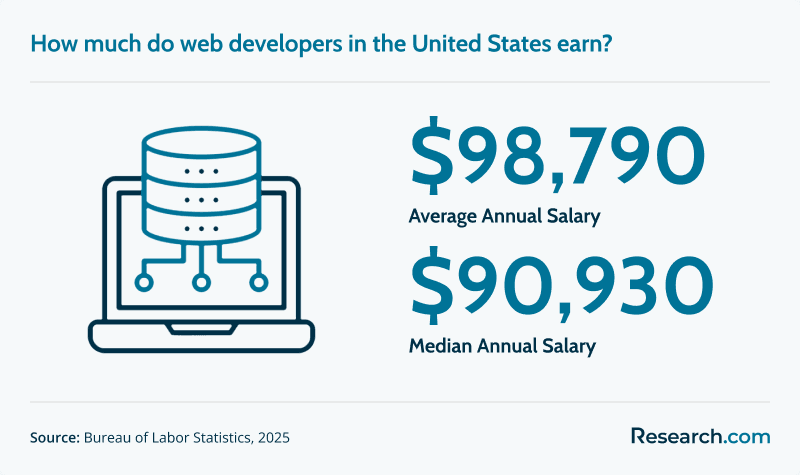
- Web development commands a competitive salary, with an average yearly pay of $98,790, and offers significant opportunities for advancement into senior developer, project manager, or software architect positions.
- Web development is one of the most remote-friendly careers, offering a high degree of flexibility in where and how you work, which is a major draw for work-life balance.
What is the core mission of a web developer?
The core mission of a web developer is to build, improve, and maintain websites and web applications that work reliably for users and meet the goals of the organization behind them. Developers write the code that controls how a site looks, how users interact with it, how data moves through it, and how securely it operates.
In practice, this means web developers are responsible for more than “making websites.” They turn business needs, product ideas, design files, and user requirements into working digital tools. A good developer considers usability, performance, accessibility, security, browser compatibility, mobile responsiveness, maintainability, and long-term scalability.
The role also continues after launch. Developers fix bugs, add features, update dependencies, improve speed, respond to security concerns, and adapt a site as user needs or business priorities change. In many organizations, the web developer is one of the main people protecting the quality and usefulness of the company’s digital presence.
What are the different types of web developers?
Web developers usually specialize in one of three areas: front-end, back-end, or full-stack development. The right path depends on whether you prefer visual user-facing work, systems and data work, or a broader role that combines both.
| Type of web developer | Main focus | Best fit for people who enjoy |
| Front-end developer | Builds the parts of a website or application that users see and interact with in the browser, including layouts, navigation, forms, buttons, animations, and responsive behavior. | Design implementation, user experience, visual detail, accessibility, and interactive interfaces. |
| Back-end developer | Builds the server-side logic, databases, APIs, authentication systems, and infrastructure that allow the front end to function. | Data, system architecture, security, performance, business logic, and problem-solving behind the scenes. |
| Full-stack developer | Works across both the front end and back end, often building complete features or smaller applications from interface to database. | Variety, end-to-end product thinking, flexible roles, and understanding how all parts of an application connect. |
Front-end development can be a strong fit if you like immediate visual feedback and care about how people experience a product. Back-end development may be better if you are drawn to logic, data modeling, and secure systems. Full-stack development works well for people who want range, especially in startups, small teams, freelance work, or roles where one developer may own an entire feature.
What are the key responsibilities of a web developer?
Web developers are responsible for turning requirements into working software and keeping that software stable after release. Their duties vary by specialization, employer size, and project type, but most involve planning, coding, testing, debugging, documenting, collaborating, and maintaining web products over time.
Core Front-End Developer Responsibilities
- Translating designs into code: Front-end developers convert wireframes, prototypes, and visual designs into functioning pages using HTML, CSS, JavaScript, and related frameworks.
- Building responsive interfaces: They make sure websites work across desktops, tablets, and smartphones without broken layouts or confusing interactions.
- Improving user experience: They implement navigation, forms, menus, buttons, page flows, and interface behaviors that help users complete tasks efficiently.
- Optimizing front-end performance: They reduce slow load times by improving image handling, code structure, asset loading, and browser rendering.
- Supporting accessibility: They help ensure that pages can be used by people who rely on keyboard navigation, screen readers, captions, contrast, and other accessibility features.
- Maintaining visual consistency: They work with designers and product teams so the final product reflects the intended brand, layout, and design system.
Core Back-End Developer Responsibilities
- Developing server-side logic: Back-end developers use languages such as Python, Java, Ruby, or PHP to process requests, execute business rules, and connect application components.
- Managing databases: They design, integrate, and maintain databases such as MySQL or PostgreSQL so information can be stored, retrieved, updated, and protected.
- Building and maintaining APIs: They create Application Programming Interfaces that allow the front end, mobile apps, third-party tools, and internal systems to exchange data.
- Handling security and authentication: They implement logins, permissions, encryption practices, validation, and other protections that reduce risk. Developers focused on security may benefit from advanced preparation such as CISSP online training.
- Monitoring reliability: They investigate errors, improve uptime, review logs, and adjust systems so applications continue to perform under real user demand.
The chart below shows the educational attainment of web developers in the United States.
How do web developers work with other tech professionals?
Web development is highly collaborative. Developers rarely work from vague instructions and disappear until launch; they coordinate with product, design, marketing, testing, security, data, and management teams to make sure the final product works for users and supports business goals.
- UI/UX designers: Designers define the structure, flow, and look of an interface. Developers translate those mockups and prototypes into interactive code, while also flagging technical constraints or accessibility concerns.
- Project managers: Project managers help define timelines, scope, priorities, and deliverables. Developers provide estimates, explain blockers, report progress, and help teams decide what can be built within a given schedule.
- Product managers: Product managers clarify user needs and business priorities. Developers help assess technical feasibility, break features into tasks, and identify trade-offs between speed, quality, and complexity.
- Digital marketers: Marketing teams may need landing pages, campaign tracking, analytics setup, SEO-friendly site structures, and conversion improvements. Developers who understand marketing workflows can work more effectively with colleagues who have training similar to what is covered in the best online social media marketing degree programs.
- Quality assurance testers: QA testers identify bugs, test user flows, verify fixes, and check edge cases. Developers use those findings to reproduce problems, correct code, and prevent similar issues in future releases.
- Security and IT teams: Developers coordinate with security and infrastructure professionals to reduce vulnerabilities, protect data, manage permissions, and deploy applications safely.
The best developers communicate clearly with both technical and nontechnical colleagues. Being able to explain why a feature is difficult, what risk a bug creates, or which option is more maintainable can be just as important as writing clean code.
What essential skills do successful web developers possess?
Successful web developers combine technical fluency with the professional habits needed to work on real products. Employers look for people who can write code, understand trade-offs, solve problems independently, and collaborate without creating confusion or unnecessary technical debt.
Key Technical Skills
- HTML, CSS, and JavaScript: These are the foundation of front-end development. Even back-end and full-stack developers benefit from understanding how pages are structured, styled, and made interactive.
- Server-side programming: Developers should know at least one back-end environment, such as Python, Node.js, Java, Ruby, or PHP, depending on the roles they are targeting.
- Frameworks and libraries: Tools such as React on the front end or Django on the back end help developers build faster, follow common patterns, and work within team codebases.
- Version control: Git is a standard tool for tracking code changes, reviewing work, collaborating with other developers, and safely managing releases.
- Databases and APIs: Web developers need to understand how applications store data, retrieve it, update it, and exchange it through APIs.
- Testing and debugging: Developers must be able to identify why something fails, reproduce errors, isolate the cause, and verify that a fix works without breaking other features.
- Performance and security awareness: Fast, stable, secure sites require careful attention to code quality, dependencies, validation, authentication, and data handling.
Key Soft Skills
- Systematic problem-solving: Strong developers break complex issues into smaller parts, test assumptions, and avoid guessing when diagnosing bugs.
- Clear communication: Developers must explain technical limits, ask precise questions, document decisions, and translate technical concepts for nontechnical teammates.
- User-centered thinking: A technically correct feature can still fail if users cannot understand it. Many developers strengthen this area through UX design online training or hands-on collaboration with designers.
- Adaptability: Web technologies change quickly. Developers need to learn new frameworks, update old code, and adjust to evolving security, performance, and accessibility expectations.
- Attention to detail: Small mistakes can create broken layouts, security gaps, data errors, or poor user experiences. Careful review and clean documentation reduce those risks.
- Professional reliability: Meeting deadlines, communicating blockers early, and writing maintainable code make a developer easier to trust on production projects.
What are the top programming languages a web developer should learn?
The best languages to learn depend on whether you want to focus on front-end, back-end, or full-stack development. Still, most web developers should start with the core browser technologies before choosing a deeper specialization.
Web development also overlaps with design, content, marketing, and digital media careers. If you are comparing technical and creative paths, it may help to explore questions such as, What jobs can you get with a graphic design degree?
| Technology or language | Why it matters | Most relevant path |
| HTML | Defines the structure and content of web pages. | Front-end and full-stack |
| CSS | Controls layout, styling, spacing, responsiveness, and visual presentation. | Front-end and full-stack |
| JavaScript | Adds interactivity and is widely used across front-end frameworks and some back-end environments. | Front-end, back-end, and full-stack |
| React, Angular, or Vue.js | Modern JavaScript frameworks and libraries help teams build complex user interfaces more efficiently. | Front-end and full-stack |
| Python, Java, PHP, Ruby, or Node.js | These are common choices for server-side development, application logic, and back-end services. | Back-end and full-stack |
| SQL | Used to query and manage relational databases such as MySQL and PostgreSQL. | Back-end and full-stack |
A practical learning sequence is to begin with HTML, CSS, and JavaScript; then build several small projects; then add a front-end framework or a back-end language depending on your target role. Avoid trying to learn every language at once. Employers usually prefer evidence that you can build and explain working projects over a long list of tools you have only sampled.
The chart below shows the industries in which web developers are mostly employed.
What is the educational background needed to become a web developer?
You do not need one single educational path to become a web developer. Some developers earn computer science or web development degrees, some complete bootcamps, some are self-taught, and many combine several forms of training. What matters most in hiring is whether you can demonstrate job-ready skills through projects, code samples, technical interviews, and practical experience.
A bachelor’s degree can be useful because it provides structured training in programming, data structures, algorithms, databases, software engineering, and systems thinking. Many employers still value a bachelor’s degree in computer science or a related field, especially for roles that involve complex systems, larger engineering teams, or long-term advancement. It is important to note that a bachelor's degree in web development costs around $35,000 to $65,000, excluding room & board, books, fees, and living expenses.
Bootcamps and certificate programs can be faster and more career-focused, but quality varies. Before enrolling, review the curriculum, instructor background, project expectations, career support, completion requirements, student outcomes, and refund policies. Self-study can be affordable and flexible, but it requires discipline, a structured roadmap, and enough project work to prove your skills.
If you do not have the resources to comfortably afford a degree or certificate, review financial aid options such as grants, scholarships, and loans. A common starting point is the Free Application for Federal Student Aid (FAFSA), which is used to determine eligibility for federal aid.
For readers considering a formal program, it can be helpful to compare the career paths connected to a degree by reviewing What can you do with a web development degree? Regardless of the route, build a portfolio that shows real ability: responsive pages, database-backed applications, API integrations, authentication flows, testing, documentation, and clear explanations of your technical decisions.
Which certifications can boost your hiring potential?
Certifications can strengthen a web developer’s resume when they validate a specific skill an employer needs. They are most useful when paired with a portfolio, GitHub activity, internships, freelance work, or professional experience. A certificate alone rarely proves job readiness, but it can help you pass resume screens and show commitment to structured learning.
Certifications from major technology providers can be especially relevant for back-end and full-stack roles. Examples include Amazon credentials such as AWS Certified Developer and Microsoft credentials such as Azure Developer Associate. These can signal that you understand cloud-based development, deployment, and services used in modern web applications.
Beginner-friendly credentials can also help new developers organize their learning. If you are just starting, researching What are the easiest IT certifications to get? can help you identify foundational options in areas such as HTML/CSS, JavaScript, general IT, or specific development tools.
Choose certifications carefully. Prioritize credentials that match the jobs you want, use technologies employers mention in postings, require hands-on practice, and help you build portfolio-ready projects. Avoid spending heavily on certificates before you can demonstrate the basics through working code.
What is the average web developer salary?
Web developer pay is competitive, but salary varies by specialization, experience, employer, industry, location, and the complexity of the systems a developer can handle. According to the latest data from the U.S. Bureau of Labor Statistics (BLS), the average annual wage for web developers is $98,790, with a median annual salary of $90,930. The latter is considerably higher than the collective median yearly pay of all jobs in the United States, which is $49,500.
Developers with stronger back-end, full-stack, cloud, security, architecture, or leadership skills may have access to higher-paying roles. Entry-level pay is typically lower than senior-level pay, while experienced developers who lead projects, mentor teams, or own complex production systems may earn substantially more. It is common for senior developers or those in management roles to earn well over $130,000 per year.
Industry also matters. The industries that offer the highest average annual salaries are building material and supplies dealers ($148,160); securities, commodity contracts, and other financial investments ($140,970); and motor vehicle manufacturing ($133,360).
When comparing salary offers, look beyond the base number. Remote work flexibility, benefits, bonuses, equity, learning budgets, workload, on-call expectations, and advancement opportunities can significantly affect the real value of a position.
The chart below displays the US states that offer the highest average salaries.
What is the job outlook for web developers?
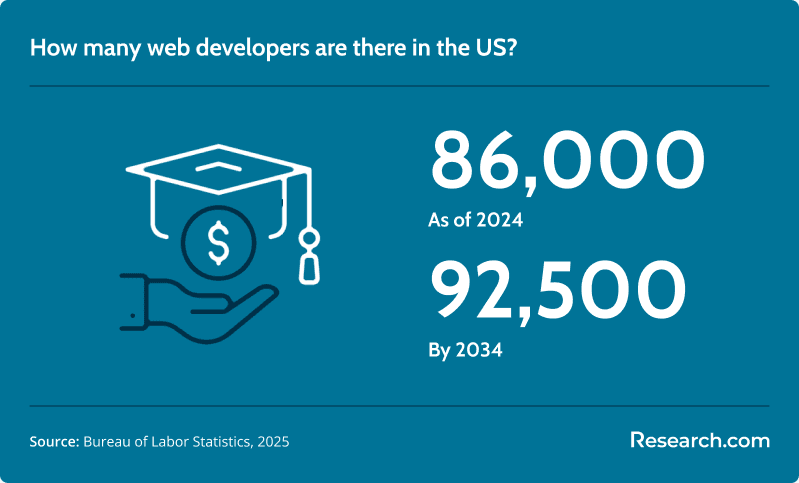
The job outlook for web developers remains positive because organizations continue to need websites, applications, e-commerce systems, internal tools, customer portals, and secure digital services. The U.S. Bureau of Labor Statistics projects that employment for web developers will grow by 7 percent from 2024 to 2034, which is faster than the average for all occupations.
This growth is projected to result in about 14,500 job openings for developers each year over the next decade. According to the job portal Indeed, there are currently over 3,000 job openings for web developers, as of October 2025.
The US state that employs the most web developers is California, with 10,590, while the largest employing industry is computer systems design and related services, providing jobs to 22,250 developers.
Job seekers should still expect competition, especially for entry-level roles. The strongest candidates usually have a focused portfolio, clean code samples, evidence of collaboration, and enough practical knowledge to discuss trade-offs during interviews. Developers who continue learning modern frameworks, accessibility, security basics, performance optimization, and cloud-connected workflows are better positioned for long-term employability.
How can you start your web development career?
You can start a web development career by following a practical sequence: learn the foundations, build proof of skill, get feedback, gain experience, and apply strategically. The goal is not just to finish tutorials; it is to become capable of building, explaining, fixing, and improving real projects.
- Learn HTML, CSS, and JavaScript first. These are the base technologies for the web. Do not rush past them just to use a framework.
- Build small projects before large ones. Start with landing pages, forms, calculators, dashboards, and API-based projects. Then combine those skills into larger applications.
- Create a portfolio of 3-5 strong projects. Each project should have a clear purpose, readable code, responsive design, and a short explanation of what you built and why.
- Use Git and publish your code. Employers often want to see how you organize code, write commits, document projects, and improve work over time.
- Practice debugging and explaining your decisions. Interviews often test how you think, not just whether you remember syntax.
- Gain practical experience. Look for internships, freelance work, volunteer projects, open-source contributions, or internal projects at your current workplace.
- Apply with a targeted resume. Match your skills and projects to the job description. A front-end role should emphasize interfaces and user experience; a back-end role should emphasize APIs, databases, and server-side logic.
Common mistakes include collecting too many tutorials without building independently, copying portfolio projects without understanding them, ignoring accessibility and responsiveness, and applying before you can explain your own code. A smaller portfolio of well-built projects is usually stronger than a large collection of unfinished or generic work.
Here's What Web Developers Say About Their Careers
- : "The creative problem-solving aspect of front-end development is incredibly rewarding; there’s a real satisfaction in writing code that transforms a design into a beautiful, functional interface for thousands of users. This daily challenge, where I get to both be analytical and artistic, is what makes the job exciting and prevents any two days from feeling the same. — June"
- : "My career as a full-stack developer has offered the financial stability I desperately wanted, with my salary increasing 25% in just two years, which is a fantastic factual benefit. Even more impactful, however, is the genuine sense of being a valuable expert whose skills are constantly in demand across every business sector. — Noah"
- : "The flexibility of remote work is the absolute highlight, allowing me to maintain a great work-life balance and travel while still holding a competitive, full-time position. Knowing I can meet critical deadlines from anywhere gives me a profound feeling of control and autonomy over my professional and personal life. — David"
Key Findings
- Web developers build and maintain the websites and applications that organizations use to serve customers, process information, sell products, and operate online.
- The field is commonly divided into front-end, back-end, and full-stack development. Front-end work focuses on the user interface, back-end work focuses on systems and data, and full-stack work combines both.
- Core technical skills include HTML, CSS, JavaScript, a server-side language, databases, APIs, Git, testing, debugging, performance awareness, and security basics.
- A degree is helpful but not always required. A bachelor’s degree in web development costs around $35,000 to $65,000, excluding room & board, books, fees, and living expenses, while bootcamps, certifications, and self-study can also support entry into the field.
- According to the latest BLS data cited here, web developers earn an average annual wage of $98,790 and a median annual salary of $90,930, compared with $49,500 for the collective median yearly pay of all jobs in the United States.
- The BLS projects employment for web developers to grow by 7 percent from 2024 to 2034, with about 14,500 job openings for developers each year over the next decade.
- The most effective way to start is to learn the foundations, build a focused portfolio of 3-5 projects, gain practical experience, and apply for roles that match your demonstrated skills.
Other Things You Should Know About What Web Developers Do
In 2027, web developers need proficiency in programming languages such as HTML, CSS, and JavaScript. Familiarity with frameworks like React.js or Angular is crucial. Knowledge of responsive design, version control systems like Git, and strong problem-solving abilities are also essential for success.
The timeline can vary, but you can learn the fundamental skills for an entry-level position in about 6 to 12 months through dedicated self-study or a coding bootcamp. Achieving mastery and moving into senior roles takes several years of continuous learning and professional experience.
References
- MDN Web Docs. (n.d.). Learn web development. Retrieved October 30, 2025, from https://developer.mozilla.org/en-US/docs/Learn
- Q-Success. (2025). Usage statistics of server-side programming languages for websites. W3Techs. Retrieved October 30, 2025, from https://w3techs.com/technologies/overview/programming_language
- Statista. (2024). Global retail e-commerce sales from 2021 to 2027. Retrieved October 30, 2025, from https://www.statista.com/statistics/379046/worldwide-retail-e-commerce-sales/
- Stack Overflow. (2024). 2024 Developer Survey. Retrieved October 30, 2025, from https://survey.stackoverflow.co/2024/
- U.S. Bureau of Labor Statistics. (2025, September 4). Web developers and digital designers. Occupational Outlook Handbook. Retrieved October 30, 2025, from https://www.bls.gov/ooh/computer-and-information-technology/web-developers.htm


