
2027 What Does an Acute Care Nurse Practitioner Do: Responsibilities, Requirements, and Salary

Co-Founder and Chief Data Scientist
As an experienced nurse, you've likely seen the numbers. With a projected 40% job growth for nurse practitioners by 2034, the opportunity for career advancement is undeniable. This often leads to a critical question: Is making the leap to become an acute care nurse practitioner the right next step for you? While the potential is exciting, the path forward can seem overwhelming, filled with questions about requirements, specializations, and the true nature of the role.
That's why our team of career planning experts, with over a decade of experience, developed this guide. We are here to provide the clear, trusted roadmap you need to navigate these complexities and make a confident, well-informed decision about your future in 2027.
Key Things You Should Know About What Does an Acute Care Nurse Practitioner Do
- The 2024 median annual salary for nurse practitioners is approximately $129,210.
- The job market for nurse practitioners is projected to grow by 40% between 2024 and 2034.
- The core function of an ACNP is managing acutely and critically ill patients in high-stakes environments.
- Becoming an ACNP typically requires 2 to 3 years of graduate study after gaining RN experience.
- ACNPs work in diverse settings, including intensive care units, emergency departments, and specialized hospital services.
What is an acute care nurse practitioner?
An acute care nurse practitioner is an advanced practice registered nurse who specializes in caring for patients with acute, critical, and complex chronic illnesses.
Because both roles can be found within a hospital, it's easy to confuse the ACNP with a Family Nurse Practitioner (FNP). However, the key difference isn’t the building they work in—it’s the condition of their patients. ACNPs are specifically trained to manage unstable patients in fast-paced environments. They also have a population focus, such as adult-gerontology or pediatrics, which we’ll explore in more detail later.
Focusing on High-Acuity Patients
So, what does "high-acuity" actually mean? It refers to patients who are physiologically unstable, often dependent on technology like ventilators or complex medications, and are highly vulnerable to life-threatening complications.
For example, an ACNP is prepared to manage a patient in septic shock in the ICU. In contrast, an FNP working as a hospitalist is better prepared to manage a patient with a stable chronic condition, like diabetes, who has been admitted for a less severe illness.
This focus on managing the most complex and critically ill patients is what defines the ACNP's specialty and shapes all of their day-to-day responsibilities.
What are the key responsibilities of an acute care nurse practitioner?
While the core of the role is rooted in nursing, the day-to-day responsibilities of an ACNP represent a significant expansion in scope and authority. Their work centers on exercising a high degree of autonomy to manage patient care.
Here are the key responsibilities you would take on:
- Perform comprehensive patient assessments. This involves synthesizing complex data from physical exams, patient histories, and diagnostic tests to form a complete clinical picture.
- Diagnose complex acute and critical conditions. You will be responsible for identifying the underlying cause of a patient's instability, from septic shock to acute respiratory failure.
- Develop and implement treatment plans. This means you are the one creating the plan of care, not just carrying out orders from another provider.
- Order and interpret diagnostic tests. You will decide which labs, imaging, and other tests are needed and then interpret the results to guide your clinical decisions.
- Prescribe medications and other therapies. This includes managing complex medication regimens, such as titrating vasopressors or adjusting ventilator settings.
- Perform invasive procedures. Depending on the setting, this can include inserting central lines, performing intubations, or other advanced procedures.
A Fundamental Shift in Accountability
If you are an experienced RN, many of these tasks may seem familiar. The crucial difference, however, is the shift from contributing to the plan to having the ultimate accountability for it. This is the essence of practicing at the "top of your license."
For example, where an RN might recognize a dangerous heart rhythm and notify the provider, the ACNP is the provider who diagnoses the rhythm, decides on the correct medication, and writes the order to administer it. This move from participation to leadership is the most significant and rewarding part of the transition.
Where does an acute care nurse practitioner typically work?
While the intensive care unit is a common home for ACNPs, their expertise in managing complex patients is in demand across many high-acuity hospital settings. You will most often find them working in ICUs, emergency departments, and a wide range of inpatient specialty services.
In fact, data shows that general medical and surgical hospitals are a top employer for nurse practitioners, with over 70,900 employed in these settings, second only to physicians' offices. This highlights the central role ACNPs play in inpatient care.
But the job title doesn't tell the whole story. The day-to-day reality of the role can change dramatically depending on which of these doors you walk through each day.
How the Work Changes by Setting
Think of it as the difference between a marathon and a series of sprints. In the Intensive Care Unit (ICU), the focus is on sustained vigilance. You are managing a small number of critically ill patients over hours or days, making meticulous adjustments to ventilators, medications, and life support to guide them toward stability.
In contrast, the Emergency Department (ED) is about rapid assessment and disposition. The rhythm is one of controlled chaos, as you quickly triage, diagnose, and stabilize a wide variety of patients to determine the next step in their care. Other ACNPs work on specialty teams like cardiology or trauma surgery, providing expert consultation for specific patient populations.
The chart below shows the top industries for nurse practitioner employment, highlighting the central role of hospital-based care.
What skills does an acute care nurse practitioner need?
Success as an ACNP requires more than just advanced clinical knowledge. It demands a specific blend of technical abilities and professional skills to navigate high-stakes environments where decisions have immediate consequences.
Many aspiring ACNPs focus heavily on procedural skills, but the most effective practitioners balance those with a strong set of cognitive and interpersonal abilities.
Hard Skills
These are the teachable, technical competencies you will master in your program and early career.
- Advanced health assessment: Going beyond a standard physical exam to detect subtle changes in critically ill patients.
- Complex pharmacology: Understanding and managing intricate medication regimens, including titratable drips and sedatives.
- Procedural competence: Proficiency in procedures relevant to your specialty, such as intubation or central line placement.
- Diagnostic reasoning: The ability to synthesize data, develop a list of potential diagnoses, and determine the most likely cause of a patient's condition.
Soft Skills
These are the professional attributes that enable you to apply your hard skills effectively.
- Critical thinking and problem-solving: The ability to analyze complex situations, anticipate potential problems, and adapt the plan of care.
- Calm under pressure: Maintaining composure and clear judgment in chaotic or life-threatening situations.
- Clear communication: Effectively explaining complex information to patients, families, and other members of the healthcare team.
- Leadership and collaboration: The ability to lead a team during a crisis and work collaboratively with nurses, physicians, and other specialists.
The Cornerstone: Advanced Diagnostic Reasoning
While all these skills are important, the true foundation of the acute care nurse practitioner role is advanced diagnostic reasoning. This is the cognitive skill that allows you to connect all the dots—the lab values, the monitor readings, the physical exam findings—to arrive at an accurate diagnosis.
It is this ability that truly separates the advanced practice role from the RN role. Poor communication can make you less effective, but a failure in diagnostic reasoning can lead to the wrong treatment plan entirely. Mastering this skill is the key to becoming a trusted and autonomous provider.
What are the requirements to become an acute care nurse practitioner?
The path to becoming an ACNP is a structured progression that builds upon your foundation as a registered nurse. It requires a specific combination of education and, most importantly, the right kind of hands-on clinical experience.
Here are the core requirements you will need to meet:
- A current, unencumbered Registered Nurse (RN) license is the first step.
- Next is a Bachelor of Science in Nursing (BSN) degree, which serves as your educational foundation.
- Gaining 1 to 3 years of relevant high-acuity clinical experience is a critical requirement.
- Finally, you must graduate from an accredited master's (MSN) or doctoral (DNP) program with an ACNP focus.
It is crucial to understand that most competitive programs are looking for experience in settings like an ICU or emergency department. This background ensures you have the foundational skills to manage the complex patient cases you will encounter in your graduate training.
Educational Pathways for Aspiring ACNPs
While a BSN is the most common starting point, it’s not the only one. Universities have created bridge programs to make the career accessible to a wider range of qualified candidates. RN-to-MSN programs are designed for experienced nurses with an Associate Degree in Nursing (ADN), while Direct Entry MSN programs are for those who hold a bachelor's degree in a non-nursing field.
Choosing Your Graduate Degree: MSN vs. DNP
The Master of Science in Nursing (MSN) is the fastest path to clinical practice. The Doctor of Nursing Practice (DNP) is a terminal degree focused more on systems leadership, research application, and improving healthcare outcomes. For nurses aiming for the highest level of clinical practice and leadership, many excellent online DNP with an adult-gerontology acute care NP specialization options are available.
Geographic demand is another key factor in career planning. The chart below shows the states with the highest employment levels for nurse practitioners, including hubs like Florida and Texas.
What are the specializations for an acute care nurse practitioner?
One of the most common points of confusion for aspiring ACNPs is the idea of specialization. Many nurses assume you go to school to become a "Cardiology NP" or a "Trauma NP," but the process is more structured than that.
The best way to think about it is as a two-tiered system. First, you earn your foundational license to practice, and then you develop your specific clinical expertise.
Tier 1: Foundational Population Certifications
This is the mandatory, entry-level board certification that defines the patient population you are legally qualified to treat. It is determined by the graduate program you choose. The two primary tracks are:
- Adult-Gerontology Acute Care Nurse Practitioner (AG-ACNP): This is the most common path, preparing you to care for acutely ill patients from young adulthood through old age.
- Pediatric Acute Care Nurse Practitioner (CPNP-AC): This is a separate track focused entirely on managing acutely and critically ill infants, children, and adolescents.
Think of this as earning your driver's license. It gives you the legal authority to be on the road, but it doesn't make you an expert in off-road driving or race car driving.
Tier 2: Developing a Clinical Focus
This is where you become a true specialist in an area like cardiology, critical care, neurology, or trauma. This expertise is developed after you are certified, primarily through your job experience and additional training.
Many experienced ACNPs choose to deepen their expertise in a specific area by completing online AGACNP graduate certificate programs. Another increasingly popular route is to complete a post-graduate NP fellowship, which is a year-long, paid training program offered by a hospital to turn a new graduate into an expert in a highly specialized field.
How long does it take to become an acute care nurse practitioner?
After gaining one to three years of RN experience with a BSN, the graduate portion of your education will typically take about two to three years of full-time study for an MSN program. If you choose to pursue a DNP, that usually takes three to four years of full-time study.
It's helpful to look at the total timeline. From the day you start your BSN to your first day practicing as an ACNP, the entire journey is often between six and eight years.
Navigating Program Pace and Potential Delays
The timeline can change based on your personal circumstances. Many nurses choose part-time programs to continue working, which can extend the length of a program to four or five years. For those looking to enter practice sooner, many institutions now offer accelerated online MSN AGACNP programs designed to condense the curriculum.
One of the biggest potential delays in the current educational landscape is the challenge of securing clinical preceptors. Many programs require students to find their own training sites, and a nationwide shortage of qualified preceptors can sometimes delay a student's graduation. It is a critical factor to consider and ask about when you are evaluating potential programs.
How much can an acute care nurse practitioner earn?
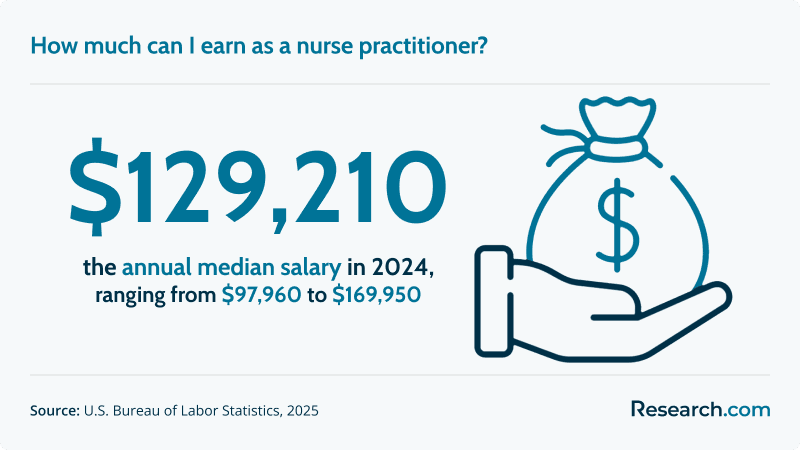
In 2024, the median annual salary for nurse practitioners was approximately $129,210, with most earning between $97,960 and $169,950.
This figure provides a strong financial benchmark for the profession. However, it's important to remember that this is a median for all NPs, and several factors will influence your specific salary as an acute care nurse practitioner. This number represents the midpoint, not necessarily a universal starting salary, but it clearly shows the significant earning potential of the role.
Factors That Influence Your Earning Potential
So what are those factors? Your geographic location, years of experience, clinical specialty, and the type of facility you work for all play a significant role in your compensation.
For example, while hospitals are a primary employer, some of the highest median wages for NPs are found in specialized areas like residential mental health facilities ($160,330) and scientific research and development services ($143,430). Thinking about these variables early on can help you strategically guide your career toward its maximum earning potential.
What is the job outlook for an acute care nurse practitioner?
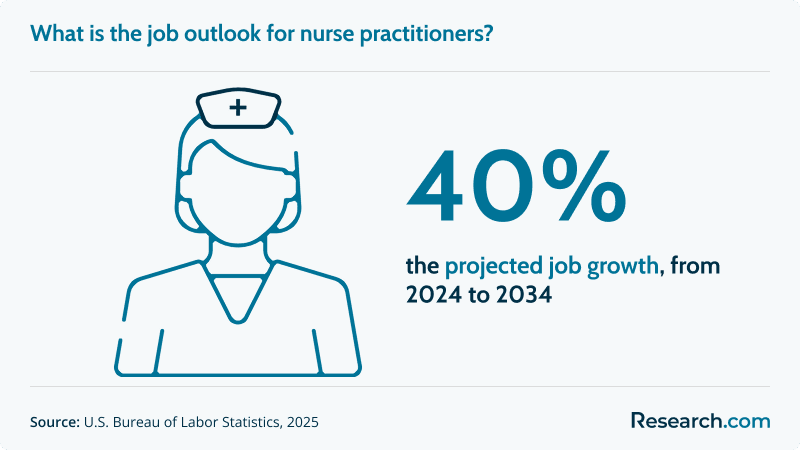
The job outlook for nurse practitioners is excellent. The U.S. Bureau of Labor Statistics projects a 40% growth for the profession between 2024 and 2034, a rate that is much faster than the average for all occupations.
This powerful growth projection provides a strong sense of job security for anyone investing the time and resources to enter the field. While the overall market is robust, it is important to remember that the most desirable jobs in competitive specialties and locations will still attract a large number of qualified applicants.
The Driving Forces Behind Strong Job Growth
This high demand isn't a temporary trend; it's a response to fundamental shifts in the U.S. healthcare system. The nation's aging population requires more complex care, and a persistent shortage of physicians in certain specialties has created a critical need for highly skilled advanced practice providers.
To put the demand in perspective, it's estimated that approximately 29,200 new advanced practice nurses will be needed each year through 2032 to meet the country's rising need for both primary and specialty care. This systemic demand is what makes the ACNP role a secure and future-proof career choice.
What are the advancement opportunities for an acute care nurse practitioner?
The career path for an ACNP doesn't end after you land your first job. The experience and expertise you gain in a clinical role open up numerous avenues for advancement, allowing you to scale your impact and take on new challenges.
Here are the primary advancement paths available to an experienced ACNP:
- Move into clinical leadership. This path involves taking on roles like a lead NP, a team manager, or even a system-wide Director of Advanced Practice, where you would oversee and support all the APPs in a hospital.
- Transition to academia. Many seasoned ACNPs find great satisfaction in educating the next generation by becoming a professor or clinical instructor at a university.
- Pursue a career in administration. Your clinical expertise is a valuable asset in hospital administration or healthcare policy, where you can help shape the systems that impact patient care.
- Engage in scientific research. For those passionate about advancing the science of nursing, a career as a nurse scientist offers the chance to contribute to evidence-based practice.
Advancing into Academia and Research
The paths into academia and research are particularly rewarding for those who wish to become thought leaders in the field. For those who want to educate future generations of nurses, exploring BSN to PhD nursing programs online is a logical next step after gaining significant clinical experience.
Furthermore, certain industries offer higher compensation that often reflects these specialized advancement tracks. The chart below shows that some of the highest wages for NPs are found in fields like scientific research and grantmaking services.
What are the challenges and rewards of being an acute care nurse practitioner?
Beyond the salary and job outlook, it's essential to consider the day-to-day realities of the role. Like any high-stakes profession, a career as an ACNP comes with a unique set of challenges and deeply meaningful rewards.
A clear-eyed view of both sides is crucial for making a decision that aligns with your personal and professional goals.
Key Challenges
- High-stress environment: The nature of caring for critically ill patients involves constant pressure and a significant risk of professional burnout.
- Scope-of-practice hurdles: Depending on the state, you may have to navigate complex regulations or advocate for your role within the healthcare team.
- Psychological weight: The shift to being the provider with ultimate responsibility for patient outcomes can be a profound psychological adjustment.
Key Rewards
- Deep professional satisfaction: There is immense fulfillment in using your advanced skills to make a direct, life-altering impact on patients and their families.
- Clinical autonomy: You have the authority to diagnose, create treatment plans, and make critical decisions, which is a primary motivator for many RNs.
- Constant intellectual stimulation: The complexity of acute and critical care ensures that you are always learning, problem-solving, and growing as a clinician.
Navigating the Professional Landscape
One of the most significant challenges new graduates face is establishing their professional identity. The role of the acute care nurse practitioner is still evolving in some institutions, and you may encounter situations where you need to clarify your capabilities.
The most effective way to navigate this is not through defensiveness, but through excellence. By focusing on providing exceptional patient care, collaborating effectively with nurses and physicians, and clearly communicating your clinical reasoning, you demonstrate the immense value of your role. Over time, this builds the trust and respect that are essential for a satisfying career.
Is becoming an acute care nurse practitioner worth it?
After considering the responsibilities, the requirements, the financial return, and the daily realities, we arrive at the most important question: Is it worth it for you?
There is no simple "yes" or "no" answer. For the right person, becoming an ACNP is an exceptionally rewarding and worthwhile career. It is a path for those who are passionate about complex, high-stakes medicine, who are driven by a desire for greater autonomy, and who are prepared for the academic and emotional rigor the journey demands.
Choosing the right career path is a deeply personal decision, whether you are drawn to the high-stakes environment of an ICU or a creative field pursued through online audio and music degrees. To find your answer, consider the key trade-offs. You are investing significant time, money, and effort in exchange for a career that offers a high salary, strong job security, and the profound satisfaction of leading the care for patients during their most vulnerable moments.
If that exchange feels right for you, then you have your answer.
Here’s What Acute Care Nurse Practitioners Have To Say About What They Do
- Marie: "I worked for five years as an RN in the emergency department, and I knew I wanted more. Going back to school was tough, especially finding clinical placements, but it was the only way to get the autonomy I was looking for. Now I run traumas, make the call on admissions, and really drive patient care from the moment they come through the door. It was the right move."
- Chloe: "Honestly, I was worried about the student loans. It's a huge financial commitment, and I spent a lot of time running the numbers. But the salary increase after I graduated was significant, and it gave my family a level of financial stability we just didn't have before. It was an investment that started paying off from my very first paycheck."
- Tara: "People always ask if it’s like being a doctor, but the perspective is different. My nursing background is the foundation for everything I do—it’s how I talk to families, how I collaborate with the bedside nurses, and how I see the patient as a whole person, not just a disease process. I’m not a substitute for a physician; I’m a different, essential part of the same team."
Key Findings
- With a median annual salary of approximately $129,210 in 2024, the ACNP role offers substantial earning potential that provides strong financial validation for the required educational investment.
- The job market for nurse practitioners is projected to grow by an exceptional 40% by 2034, signaling immense job security and a stable long-term career path for graduates.
- Over 70,900 nurse practitioners are employed in general medical and surgical hospitals, confirming that the hospital is the primary environment where ACNPs apply their specialized skills in high-acuity patient care.
- An estimated 29,200 new advanced practice nurses are needed each year through 2032, highlighting the urgent and systemic demand that creates significant opportunities for aspiring ACNPs entering the field.
- States like Florida, with nearly 24,700 nurse practitioners, represent major employment hubs, offering a clear geographic focus for those planning their education and future careers.
Other Things You Should Know About What Acute Care Nurse Practitioners Do
In 2027, the average salary for an Acute Care Nurse Practitioner in the U.S. is approximately $117,000 annually. This figure can vary based on factors such as geographic location, years of experience, and specific healthcare settings.
To become an Acute Care Nurse Practitioner in 2027, candidates typically need a Bachelor of Science in Nursing (BSN), an active RN license, and a Master of Science in Nursing (MSN) with a specialization in acute care. Some programs may also require prior critical care experience.
In 2027, Acute Care Nurse Practitioners (ACNPs) are responsible for diagnosing and managing acute, critical, and complex health conditions. They perform assessments, prescribe medications, and collaborate with healthcare teams to provide high-quality patient care. Their role often involves working in hospitals, emergency rooms, or specialty clinics, handling tasks usually undertaken by physicians.
References
- American Association of Colleges of Nursing. (2024). Nursing shortage fact sheet. Retrieved November 12, 2025, from AACN.
- American Nurses Association. (2023, April). Types of nurse practitioner specialties. Retrieved November 12, 2025, from ANA.
- NPHub. (2025, March 15). 2025 challenges for nurse practitioners and how to overcome them. Retrieved November 12, 2025, from NPHub.
- U.S. Bureau of Labor Statistics. (2025). Occupational employment and wage statistics (OEWS) profiles. Retrieved November 12, 2025, from BLS.
- U.S. Bureau of Labor Statistics. (2025). Occupational outlook handbook: Nurse anesthetists, nurse midwives, and nurse practitioners. Retrieved November 12, 2025, from BLS.


