
2027 Acute Care vs. Critical Care vs. Trauma Nurse Practitioner: Explaining the Difference

Co-Founder and Chief Data Scientist
As the role of Nurse Practitioners (NPs) continues to expand, students planning an NP career face important decisions about specialization. Currently, there are 463,456 NPs practicing across the United States (Kaiser Family Foundation, 2025), each contributing to patient care in unique ways.
Among the high-acuity options are Acute Care Nurse Practitioners, Critical Care Nurse Practitioners, and Trauma Nurse Practitioners, each with distinct responsibilities, patient populations, and practice settings.
From my perspective as a career planning and education expert, my team and I have guided many students through these choices. In this guide, we will examine the key differences between these NP specialties, strategies for selecting the right path, and considerations for professional growth and opportunities.
Key Things to Know About Acute Care Nurse Practitioners, Critical Care Nurse Practitioners, and Trauma Nurse Practitioners
- Among the three specialties, Critical Care nurse practitioners earn the highest salaries, averaging $172,199 per year. Trauma nurse practitioners follow at approximately $130,295, while Acute Care nurse practitioners earn around $117,423 annually.
- The BLS (2024) projects very strong overall growth for nurse practitioners, with employment expected to increase 40% from 2024 to 2034.
- Acute Care nurse practitioners manage complex but generally stable patients, Critical Care nurse practitioners provide intensive, life-sustaining care in ICUs, and Trauma nurse practitioners focus on rapid stabilization and emergency interventions following injury or trauma.
- What education is required to become an Acute Care Nurse Practitioner, Critical Care Nurse Practitioner, and Trauma Nurse Practitioner? Education Requirements
- Are there specialized certifications or advanced training unique to each NP role? Board Certifications
- How does the scope of practice differ between acute care NPs, critical care NPs, and trauma NPs? Key Differences
- In what healthcare settings do acute care NPs, critical care NPs, and trauma NPs most often work? In what healthcare settings do acute care NPs, critical care NPs, and trauma NPs most often work?
- How do teamwork and collaboration differ among the three NP specialties? How do teamwork and collaboration differ among the three NP specialties?
- What skills are shared among acute care NPs, critical care NPs, and trauma NPs, and which are unique to each? What skills are shared among acute care NPs, critical care NPs, and trauma NPs, and which are unique to each?
- How do salaries compare across acute care NPs, critical care NPs, and trauma NPs? Salary Comparison
- What does the job outlook look like for each NP specialty? Job Outlook Comparison
- Which type of NP might be the best fit for different personality types and career goals? Which type of NP might be the best fit for different personality types and career goals?
- Can NPs transition between acute, critical care, and trauma specialties easily, or do they require additional training? Can NPs transition between acute, critical care, and trauma specialties easily, or do they require additional training?
What education is required to become an Acute Care Nurse Practitioner, Critical Care Nurse Practitioner, and Trauma Nurse Practitioner?
To become an NP in any specialty, the foundation starts with a Bachelor of Science in Nursing (BSN) and licensure as a registered nurse (RN). From there, prospective NPs must pursue a graduate degree—either a Master of Science in Nursing (MSN) or a Doctor of Nursing Practice (DNP).
An acute care NP typically enrolls in a program that emphasizes adult-gerontology acute care or pediatric acute care, depending on their chosen population focus. This includes a post master's adult gerontology acute care NP certificate online.
A critical care NP usually follows the acute care track as well, but with clinical rotations heavily focused on intensive care units (ICUs) and complex patient management. A trauma NP often comes from acute care or emergency NP graduate programs, where the coursework and clinical placements prepare them for fast-paced environments involving trauma patients. In all cases, graduate-level education ensures they are prepared for advanced practice roles.
Are there specialized certifications or advanced training unique to each NP role?
Each NP specialty requires or benefits from targeted certifications and advanced training that build on the graduate degree. Here are some examples:
Acute Care NP
For acute care NPs, the most common exams include the Adult-Gerontology Acute Care Nurse Practitioner (AGACNP-BC) offered by the American Nurses Credentialing Center (ANCC) and the Acute Care Nurse Practitioner-Adult Gerontology (ACNPC-AG) offered by the American Association of Critical-Care Nurses (AACN). Those who have completed the best online MSN pediatric nurse practitioner programs may pursue the Pediatric Acute Care Nurse Practitioner Certification (CPNP-AC) through the Pediatric Nursing Certification Board (PNCB).
Trauma NP
Trauma and critical care don’t have unique NP board exams yet — they build on acute care NP credentials plus specialty certifications. They may also earn certifications such as the Trauma Certified Registered Nurse (TCRN) or Advanced Trauma Care for Nurses (ATCN). Many also complete trauma-focused residencies or fellowships that provide hands-on training in emergency resuscitation, surgical collaboration, and rapid patient stabilization.
Critical Care NP
Candidates typically follow the Adult-Gerontology Acute Care NP (AGACNP) or Acute Care Nurse Practitioner-Adult Gerontology (ACNPC-AG) certification pathway. some obtain supplemental certifications, such as the Critical Care Registered Nurse (CCRN) credential, which, while not required for NP practice, enhances credibility and demonstrates advanced competency in ICU-level care. These reflect proficiency in ventilator management, hemodynamic monitoring, and other ICU-based skills.
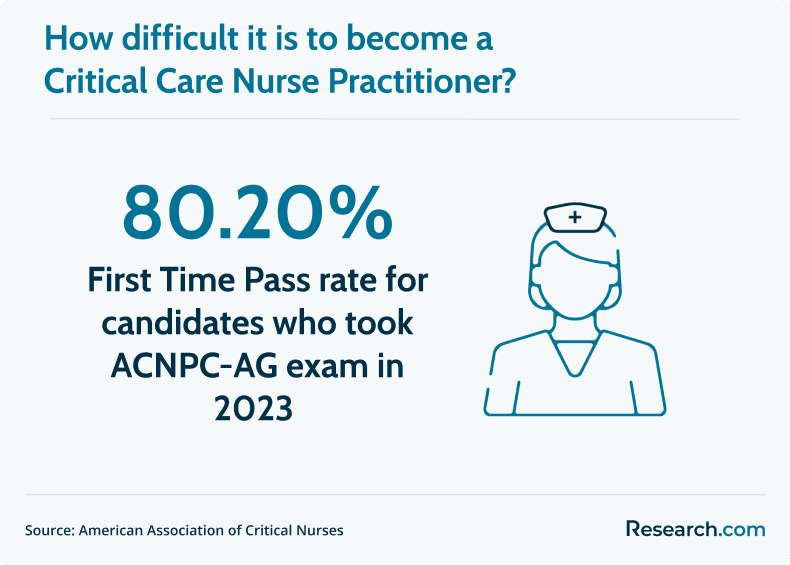
The 2023 ACNPC-AG examination data indicate that of 1,238 candidates tested, 901 achieved initial certification, resulting in a first-time pass rate of 80.2% (American Association of Critical Nurses, 2025). This is considered a relatively high passing rate, reflecting both the rigor of the exam and the strong preparation of candidates. With focused graduate education, substantial clinical experience, and dedicated study, aspiring Critical Care nurse practitioners are well-prepared to succeed in this challenging specialty.
How does the scope of practice differ between acute care NPs, critical care NPs, and trauma NPs?
Each NP specialty has a defined scope of practice that reflects the types of patients they serve and the level of intervention they provide. Here are their main differences:
- Disease and Condition Management. Acute care nurse practitioners are trained to manage patients with complex illnesses that may be severe but not always immediately life-threatening. Their scope emphasizes diagnostics, treatment planning, and coordination of specialty care.
- Life-Sustaining Interventions. Critical care nurse practitioners handle patients in unstable or critical condition, focusing on advanced monitoring, ventilator management, and rapid treatment modifications in intensive care settings.
- Emergency Stabilization. Trauma NPs are responsible for immediate interventions in life-or-death situations. Their scope centers on resuscitation, wound care, and urgent procedures to stabilize patients after accidents or injuries.
Understanding the difference between NP subspecialties is somewhat similar to comparing other health roles, such as the difference between COTA and OTA, where both work in rehabilitation but handle varying levels of patient assessment and care responsibility. Likewise, acute care, critical care, and trauma NPs share overlapping competencies but differ in clinical depth and urgency of care.
In what healthcare settings do acute care NPs, critical care NPs, and trauma NPs most often work?
While all three practice in hospital environments, each NP specialty is concentrated in different areas of care delivery:
- Hospital and Specialty Units. Acute care nurse practitioners often work in step-down units, medical-surgical wards, specialty hospital clinics, and rehabilitation centers where acutely ill patients need close but not continuous monitoring.
- Intensive Care Units (ICUs). Critical care nurse practitioners are embedded in ICUs, including medical, surgical, and cardiac units, where patients require round-the-clock, highly technical monitoring and intervention.
- Emergency and Trauma Centers. Trauma nurse practitioners are positioned in emergency departments and trauma centers, responding to urgent, high-acuity cases. They also participate in trauma response teams and collaborate directly with trauma surgeons.
The Bureau of Labor Statistics or BLS (2024) chart below shows that the NPs, including nurse anesthetists, nurse midwives, are predominantly employed in physicians’ offices, which account for 46% of the workforce.
Meanwhile, hospitals employ 25% of NPs, including those in acute care, critical care, and trauma specialties, where high-acuity and inpatient care require advanced clinical expertise. Outpatient care centers (9%) and offices of other health practitioners (5%) represent additional opportunities for NPs to practice in specialized or community-based settings.
For those planning to move into hospital-based or specialty leadership, comparing NP roles is not unlike analyzing job opportunities with a business certificate—it’s about aligning your specific skills and training with the most relevant work environments that offer career growth.
How do teamwork and collaboration differ among the three NP specialties?
Teamwork and collaboration play an essential role across NP specialties, but the structure and intensity of team dynamics vary depending on the patient population and care setting:
- Interdisciplinary Coordination. Acute care nurse practitioners collaborate with hospitalists, specialists, nurses, and therapists to create comprehensive treatment plans. Their teamwork emphasizes continuity of care, smooth transitions between hospital and outpatient services, and coordination with families.
- High-Intensity Teamwork. Critical care nurse practitioners work in fast-paced ICU environments where split-second decisions are made collaboratively with intensivists, respiratory therapists, pharmacists, and bedside nurses. Their teamwork focuses on managing unstable patients and adapting plans as conditions change minute by minute.
- Rapid Response Collaboration. Trauma nurse practitioners partner closely with trauma surgeons, emergency physicians, nurses, and surgical staff during crisis situations. Their collaboration is procedure-driven and often involves coordinated rapid response efforts to stabilize patients within the “golden hour” after traumatic injury.
Acute Care, Critical Care, and Trauma nurse practitioners may work together and collaborate in hospital and emergency settings. While each specialty has a distinct focus, they frequently coordinate care to ensure seamless patient transitions. Collaboration may involve joint rounds, shared care planning, and communication with physicians, nurses, and other healthcare professionals. This teamwork ensures that patients receive comprehensive, high-quality care across different stages of illness or injury.
Team structure and scope also echo patterns seen in other professions, such as the difference between a credential and a license in teaching—both validate capability, but one allows practice authority while the other affirms professional specialization within a system of collaboration and oversight.
What skills are shared among acute care NPs, critical care NPs, and trauma NPs, and which are unique to each?
The three NP specializations share a number of core competencies that are essential for providing high-quality patient care in complex healthcare environments. These are:
- Advanced clinical assessment skills. All three NPs conduct thorough evaluations to determine patient needs, monitor conditions, and guide treatment decisions.
- Critical thinking and clinical decision-making. They apply evidence-based reasoning to develop care plans, prioritize interventions, and respond to changes in patient status.
- Medication management. Each NP safely prescribes, adjusts, and monitors medications according to patient conditions and treatment protocols.
- Effective communication. They collaborate closely with patients, families, and interdisciplinary teams to ensure coordinated and comprehensive care.
- Documentation and EMR proficiency. Accurate record-keeping and use of electronic medical records are essential in all three specialties for continuity of care and compliance.
The data below shows that direct patient care remains central to NPs, with “patients” appearing on 28.7% of resumes. Other top skills—diagnosis, home health, diagnostic tests, acute care, EMR, and medical care—highlight NPs’ clinical judgment, technical ability, and adaptability across care settings. The large “Other Skills” category (44.2%) indicates that many NPs emphasize additional competencies, such as leadership, communication, and specialized procedures.
In many cases, NPs seeking to advance their expertise pursue academic pathways like an Eds online degree or other specialized graduate credentials that combine clinical knowledge with educational leadership—expanding both their teaching ability and practice influence.
How do salaries compare across acute care NPs, critical care NPs, and trauma NPs?
According to recent data from ZipRecruiter (2025), salaries vary significantly across the three NP specialties. ACNP salary is about $117,423 per year, reflecting their essential role in managing hospitalized patients with complex conditions. Trauma NPs make slightly more, with an average annual salary of $130,295, given their expertise in emergency stabilization and post-trauma management.
CCNPs, however, are the highest earners among the three, with average annual wages reaching $172,199, as their work in intensive care units demands advanced procedural skills and constant management of life-threatening conditions.
While these figures represent national averages, salaries can differ based on region, specific healthcare setting, years of experience, and degrees. Those with doctorate degrees tend to have higher compensation, which is among the reasons to earn your Doctorate In Nursing Practice degree.
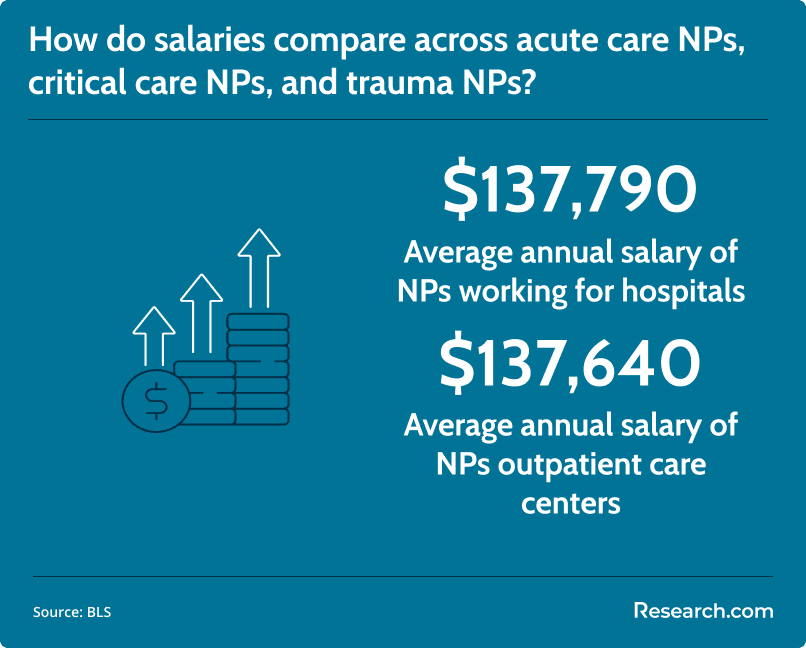
According to BLS (2024), nurse practitioners (NPs), alongside nurse anesthetists and nurse midwives, earned strong median salaries across the top healthcare industries. The highest wages for NPs were found in hospitals at $137,790 annually, closely followed by outpatient care centers at $137,640.
What does the job outlook look like for each NP specialty?
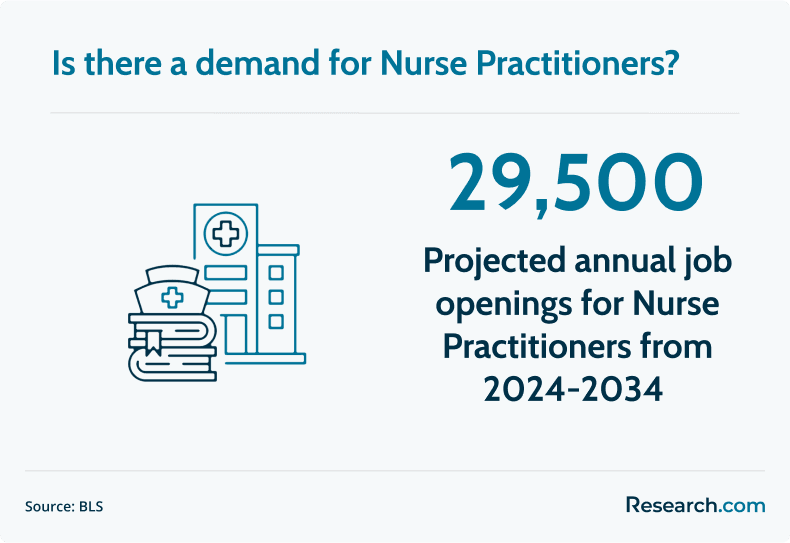
The BLS (2024) projects very strong overall growth for nurse practitioners are expected to see a 40% increase in employment from 2024 to 2034, with about 29,500 openings per year on average, driven largely by an aging population and rising prevalence of chronic disease.
Therefore, the demand for advanced-practice roles will be robust across settings. In practical terms, acute care NPs will likely see steady demand where hospitals and specialty clinics treat complex, often hospital-required conditions; critical care nurse practitioners should remain in high demand in ICUs and step-down units as more patients need intensive, technology-driven care; and trauma nurse practitioners will be sought after at trauma centers and busy emergency departments that require rapid stabilization and procedural support.
Regional and employer factors (for example, large shares of APRNs work in physicians’ offices and hospitals) will shape where growth is concentrated, so local hospital expansion, state scope-of-practice laws, and trauma-center capacity will materially affect opportunities for each specialty.
Which type of NP might be the best fit for different personality types and career goals?
Each NP specialty aligns with unique personality traits and long-term ambitions. Acute care nurse practitioners are often the best fit for detail-oriented planners who enjoy managing complex cases, coordinating with multiple specialists, and supporting patients through recovery and transitions. This role appeals to those who value structured care and the ability to influence long-term outcomes.
Critical care nurse practitioners are well-suited for high-stakes decision-makers who thrive in fast-paced environments and excel in handling advanced technology while making rapid adjustments for unstable patients. The intensity of ICU work tends to attract those who want to be deeply involved in life-or-death decisions.
Trauma nurse practitioners, on the other hand, are an ideal match for crisis-ready responders who perform best in unpredictable, high-pressure situations. They often enjoy procedural work and hands-on emergency care, making this specialty attractive to NPs who want to act quickly and directly in saving lives during urgent trauma events.
Can NPs transition between acute, critical care, and trauma specialties easily, or do they require additional training?
One of the benefits of a BSN degree is that it makes nurses eligible to pursue advanced roles, such as Nurse Practitioners (NPs). With this foundational education, nurses are well-positioned to advance into specialized areas of practice, though moving between NP specialties may require further training. Here’s how NPs can move from one specialization to another:
- From Acute Care to Critical Care. An acute care NP may transition to critical care by completing ICU-focused residencies, fellowships, or additional certifications such as CCRN, since ICU care requires advanced technical and monitoring skills.
- From Critical Care to Trauma. Critical Care NPs can move into Trauma NP roles by acquiring trauma-specific training, including emergency procedures, trauma protocols, and surgical collaboration, often supported through hospital-based orientation or certifications such as Trauma Certified Registered Nurse (TCRN) or Advanced Trauma Care for Nurses (ATCN).
- From Trauma to Acute Care. Trauma nurse practitioners may shift to acute care roles more easily, but they may need to expand skills in chronic condition management and long-term patient planning, areas less emphasized in trauma settings.
Key Findings
- In the 2023 ACNPC-AG examination, 1,238 candidates were tested, with 901 achieving initial certification.
- Nearly half of all NPs (46%) work in physicians’ offices, making this the largest employment setting for the profession.
- Hospitals employ 25% of NPs, while outpatient care centers account for 9%, reflecting the diversity of practice environments.
- Hospital-based NPs earn the highest median annual wages, averaging $137,790.
- On average, there are approximately 29,500 annual job openings for acute care, critical care, and trauma NPs, alongside other NP specialties.
References:
- American Association of Critical-Care Nurses. (2025). Certification exam statistics and cut scores. https://www.aacn.org/certification/preparation-tools-and-handbooks/exam-stats-and-score
- Kaiser Family Foundation. (2025). Total number of nurse practitioners. https://www.kff.org/other-health/state-indicator/total-number-of-nurse-practitioners/
- Indeed Editorial Team. (2025). 11 of the highest-paid types of nurse practitioners. Indeed. https://www.indeed.com/career-advice/finding-a-job/highest-paid-types-of-nurse-practitioners
- ZipRecruiter. (2025, August). Acute care nurse practitioner salary. https://www.ziprecruiter.com/Salaries/Acute-Care-Nurse-Practitioner-Salary
- ZipRecruiter. (2025, August). Critical care nurse practitioner salary. https://www.ziprecruiter.com/Salaries/Critical-Care-Nurse-Practitioner-Salary
- ZipRecruiter. (2025, August). Trauma nurse practitioner salary. https://www.ziprecruiter.com/Salaries/Trauma-Nurse-Practitioner-Salary
Other Things to Know About Key Acute Care NP, Critical Care NP, and Trauma NPs
In 2027, Acute Care NPs focus on managing and preventing acute illnesses. Critical Care NPs specialize in treating life-threatening conditions in intensive care settings. Trauma NPs are experts in assessing and managing severe injuries, typically in emergency and trauma centers.
In 2027, Trauma Nurse Practitioners often need certifications like Trauma Nursing Core Course (TNCC) and Advanced Trauma Care for Nurses (ATCN). These programs, offered by the Emergency Nurses Association, enhance skills for handling severe, urgent cases in trauma settings.


