
2027 How to Become an Ultrasound Technician in Louisiana

Co-Founder and Chief Data Scientist
In Louisiana, many aspiring healthcare professionals face uncertainty when pursuing a career as an ultrasound technician. With roughly 3,500 diagnostic medical sonographers employed and median wages above $60,000, the field offers both stability and growth driven by rising demand for non-invasive imaging.
This article, prepared by career planning experts, will outline education, certification, and job opportunities in Louisiana, guiding readers toward informed career choices.
Key Things to Know About Becoming an Ultrasound Technician in Louisiana
- Louisiana ultrasound technicians must complete a CAAHEP-accredited associate program with prerequisites, clinical hours, health clearances, and certification preparation.
- Professionals can pursue specialties like OB/GYN, vascular, cardiac, or abdominal sonography and earn ARDMS, ARRT, or CCI certifications employers require.
- The field is projected to grow 15% with advancement through higher education, specialization, and leadership, despite challenges like strain, stress, and staffing.
- What education is required to become an ultrasound technician in Louisiana?
- What specialties can ultrasound technicians choose from in Louisiana?
- Which certification exams are required to become an ultrasound technician in Louisiana?
- Is a license required to practice as an ultrasound technician in Louisiana?
- What to expect during ultrasound technician clinical training in Louisiana?
- How much does it cost to become an ultrasound technician in Louisiana?
- What is the average salary for ultrasound technicians in Louisiana?
- What is the job outlook and demand for ultrasound technicians in Louisiana?
- What are the career advancement steps for ultrasound technicians in Louisiana?
- What emerging technology trends are impacting ultrasound practice in Louisiana?
- What are the common challenges ultrasound technicians face in Louisiana?
- How Can Complementary Radiology Expertise Enhance Ultrasound Careers in Louisiana?
What education is required to become an ultrasound technician in Louisiana?
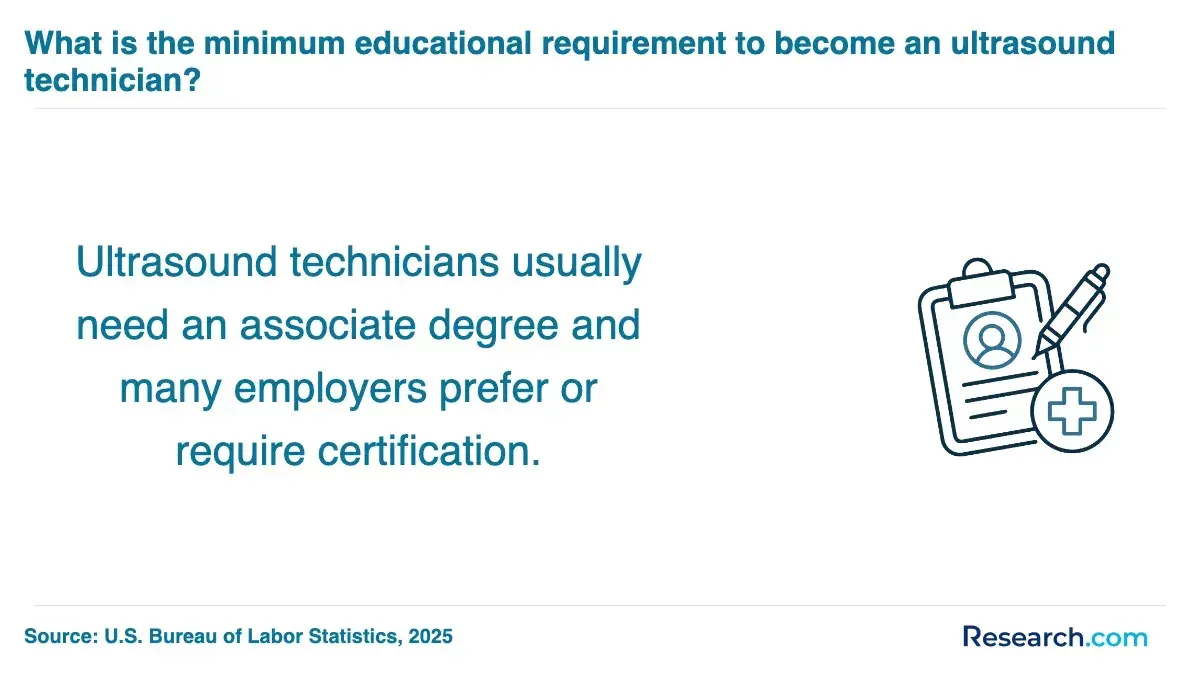
In Louisiana, ultrasound technicians must complete accredited education that blends classroom learning with clinical training. Programs focus on building technical knowledge, hands-on experience, and preparation for professional certification.
Below are the key educational requirements:
- Minimum Degree Requirement: An Associate Degree in Diagnostic Medical Sonography from a CAAHEP-accredited program is required, with bachelor’s degrees available though less common.
- Prerequisite Coursework: Students must complete courses such as English Composition, College Algebra, Anatomy and Physiology I and II with labs, Medical Terminology, Physics, Psychology, and a Humanities elective, earning at least a “C” in each.
- Credit Hours: Associate of Applied Science programs typically require about 62 credit hours, combining general education with specialized sonography courses.
- Clinical and Lab Experience: At least 36 credit hours are dedicated to supervised lab practice and clinical rotations, offering essential real-world training.
- Selective Admissions: Admission is competitive and often based on GPA (minimum 2.75), prerequisite completion, and sometimes an entrance exam.
- Background and Health Requirements: Students must pass a background check, drug test, physical exam, immunizations (including Covid-19), and hold CPR certification.
- Certification Preparation: While Louisiana does not require state licensure, most employers expect certification through ARDMS or CCI.
- Program Locations: Accredited programs are available at Baton Rouge Community College, Delgado Community College, LSU-Eunice, and Bossier Parish Community College.
Prospective students should carefully review sonography degree requirements in Louisiana to ensure eligibility. Graduates can expect a strong job outlook with competitive compensation, as detailed in the average radiology tech job salary by state.
What specialties can ultrasound technicians choose from in Louisiana?
Ultrasound technicians in Louisiana can select from several specialties that match both educational preparation and clinical demand. Below are the primary specialties available in the state.
- Abdominal Sonography: Focuses on imaging abdominal organs such as the liver, kidneys, and gallbladder, supporting diagnosis of tumors, stones, and organ disorders.
- Obstetrics and Gynecology Sonography: Involves monitoring fetal development and evaluating the female reproductive system, making it one of the most in-demand specialties statewide.
- Vascular Sonography: Examines veins and arteries to detect clots, blockages, or circulation issues, often included as part of broader sonography programs.
- Cardiac Sonography (Echocardiography): Specializes in heart imaging to evaluate structure, rhythm, and blood flow, essential in detecting cardiovascular conditions.
- General Sonography: Provides multi-area training across abdominal, OB/GYN, and vascular imaging, preparing graduates for diverse entry-level diagnostic roles.
Graduates from Louisiana programs are well-positioned for certification in these specialties, which are recognized by employers statewide. The expanding healthcare landscape in urban centers like New Orleans offers promising opportunities for those pursuing an ultrasound technician career, especially when combined with strategic knowledge of radiology career salary trends.
Which certification exams are required to become an ultrasound technician in Louisiana?
Certification exams are an essential step for ultrasound technicians in Louisiana. Although the state does not issue its own license, most healthcare employers require national certification. Below are the primary certification options available to sonographers in Louisiana.
- ARDMS Certification Exams: The American Registry for Diagnostic Medical Sonography is the leading credentialing body. Candidates must pass the Sonography Principles and Instrumentation (SPI) exam plus a specialty exam, such as Abdomen, OB/GYN, or Vascular. Eligibility usually requires a CAAHEP-accredited program or verified clinical experience.
- CCI Certification Exams: Cardiovascular Credentialing International offers credentials like the Registered Cardiac Sonographer (RCS) and Registered Vascular Specialist (RVS). These exams measure knowledge in cardiovascular anatomy, ultrasound physics, and clinical techniques. They are especially valuable for technicians focusing on cardiac and vascular imaging.
- ARRT Sonography Certification: The American Registry of Radiologic Technologists provides the Sonography (S) credential. Candidates must complete an accredited program and meet ethics standards. Some Louisiana facilities accept ARRT as an alternative to ARDMS, particularly in radiology and multi-modality practices.
Is a license required to practice as an ultrasound technician in Louisiana?
Louisiana does not require a state license to practice as an ultrasound technician. This approach places responsibility on national certification as the standard for professional credibility, patient safety, and clinical competency.
Below are the main requirements for ultrasound technicians in Louisiana:
- National Certification Requirement: Credentials must be obtained through ARDMS, ARRT, or CCI to practice legally and effectively.
- No State-Specific License: The Louisiana State Radiologic Technology Board of Examiners regulates radiologic technologists, but sonographers fall outside its scope.
- Accredited Education: Candidates must complete a CAAHEP-accredited sonography program, such as those offered by Baton Rouge Community College or Louisiana State University.
- Required Examinations: The Sonography Principles and Instrumentation (SPI) exam plus a specialty exam in Abdomen, OB/GYN, or another area are necessary for certification.
- No Provisional Practice: Louisiana does not allow practice under supervision without certification, reinforcing reliance on national standards.
- Professional Advancement: Compliance with these requirements strengthens employability, builds trust, and opens career growth opportunities in the state.
To better understand who is entering the profession, the chart below highlights the age range of ultrasound technicians in Louisiana.
What to expect during ultrasound technician clinical training in Louisiana?
Clinical training in Louisiana is a vital stage that equips students with the applied skills and professional readiness needed for certification and employment. It integrates direct patient care, advanced imaging practice, and mentorship to ensure competence. Below are the key aspects of this training:
- Extensive Hands-On Patient Care: Students learn positioning, safety, and communication by working directly with patients under supervision.
- Supervised Use of Imaging Equipment: Trainees gain experience with ultrasound machines, Doppler, and 3D imaging guided by credentialed sonographers.
- Specialty Rotations: Exposure to OB/GYN, abdominal, vascular, and cardiac sonography provides diverse skills required for ARDMS certification.
- Mentorship from Licensed Professionals: Clinical instructors and sonographers offer feedback that strengthens technical ability and professionalism.
- Program-Specific Clinical Hours: Accredited programs require at least 1,000 supervised hours across varied patient populations.
- Competency Evaluations: Ongoing assessments measure accuracy in imaging, anatomy recognition, and patient care standards.
- Adherence to Policies: Students must complete health clearances, background checks, and screenings before clinical placement.
- Integration with Coursework: Clinical practice connects directly to classroom instruction, reinforcing theoretical learning in real scenarios.
- Selective Admission Requirements: Completion of prerequisites with competitive grades is necessary for placement into clinical rotations.
- Full-Time Commitment: Training requires consistent attendance and flexibility across multiple healthcare facilities statewide.
How much does it cost to become an ultrasound technician in Louisiana?
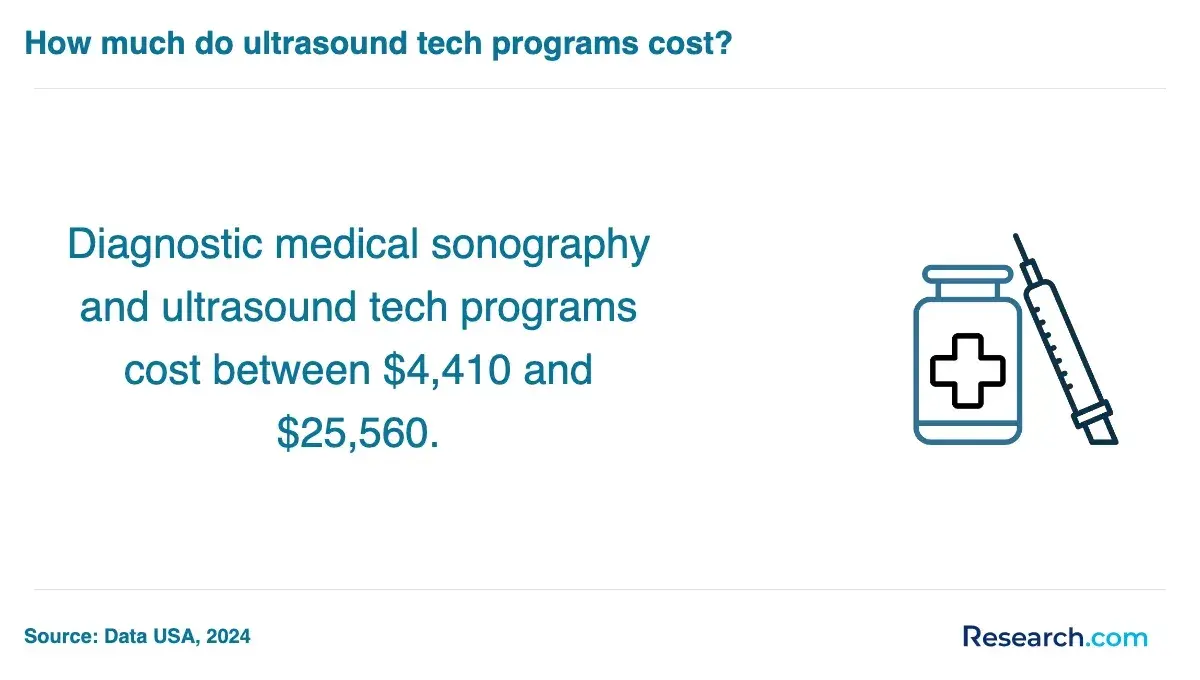
Becoming an ultrasound technician in Louisiana requires both financial planning and academic commitment. While tuition forms the bulk of expenses, students must also account for clinical fees, study materials, certification, and personal living costs. Below are the key expenses to expect.
- Tuition and Fees: Associate and certificate programs at public schools average $16,576, while bachelor’s programs can range from $24,156 to $29,470 or higher for out-of-state students.
- Clinical Training Expenses: Costs for labs, uniforms, liability insurance, and travel to externships vary by program structure and clinical site distance.
- Certification and Exam Fees: Most candidates pay $225–$250 for ARDMS exams, with possible added fees for specialty tests or retakes.
- Licensing or State Fees: Louisiana does not currently require state licensure, so there are no additional state licensing charges.
- Books and Materials: Textbooks, imaging software, and medical supplies generally cost $500 to $1,200 for the entire program.
- Living Expenses: Housing, food, transportation, and personal needs typically range from $10,000 to $15,000 annually depending on lifestyle and location.
The cost of ultrasound technician programs in Louisiana varies widely based on program type, in-state or out-of-state enrollment, and personal living situations. Prospective students may find opportunities for financial aid, scholarships, and employer tuition assistance to help reduce the overall financial commitment. Those interested in flexible learning options may also consider a diagnostic medical sonography online associate's degree.
What is the average salary for ultrasound technicians in Louisiana?
The average annual salary for ultrasound technicians in Louisiana is about $67,280, lower than the national average of $84,410. Still, the state offers competitive wages that reflect its healthcare market conditions. Below are the key factors that influence pay in Louisiana.
- Experience Level: Entry-level sonographers earn around $55,000, while highly experienced professionals can exceed $80,000 annually.
- Education and Certifications: Holding ARDMS or other advanced certifications typically boosts earning potential compared to technicians with basic qualifications.
- Work Setting: Large hospitals provide average salaries near $70,000, while outpatient clinics and private practices often pay closer to $62,000.
- Geographic Location: Urban centers such as New Orleans and Baton Rouge usually offer salaries above $72,000, while rural areas tend to fall at or below the state average.
- Specialization: Specializing in OB/GYN, cardiovascular, or abdominal sonography leads to higher wages, with cardiovascular sonographers earning up to $85,000.
What is the job outlook and demand for ultrasound technicians in Louisiana?
The employment outlook for ultrasound technicians in Louisiana is stable and promising. Jobs in this field are expected to grow by 15% from 2023 to 2033, closely mirroring the national average. This growth is driven by healthcare expansion, advancing technology, and evolving patient needs. Below are the main factors shaping demand in the state.
- Population Growth and Aging: Louisiana’s expanding and aging population increases the need for diagnostic imaging, particularly as older adults require frequent ultrasound procedures.
- Healthcare Expansion: The rise of hospitals, outpatient centers, and clinics across the state contributes to steady job creation for ultrasound technicians.
- Technological Advancements: Innovations in sonography, such as enhanced cardiac and vascular imaging, open specialized career paths for trained technicians.
- Preventive Care Trends: The growing emphasis on preventive healthcare raises reliance on ultrasound as a safe and non-invasive screening method.
- Regional Demand Variations: Urban areas typically offer more opportunities, while rural communities may present fewer openings due to limited medical infrastructure.
What are the career advancement steps for ultrasound technicians in Louisiana?
Ultrasound technicians in Louisiana can advance their careers through focused specialization, obtaining advanced certifications, and assuming leadership roles. These steps allow professionals to enhance their expertise within the healthcare sector, improving both job prospects and earning potential. Emphasizing career advancement for ultrasound technicians in Louisiana opens doors to more complex and rewarding positions statewide.
- Specialization: Concentrating on advanced sonography specialties in Louisiana such as OB/GYN, vascular, or cardiac sonography increases technical skills and marketability. Technicians focusing on echocardiography, for example, can command salaries exceeding $100,000 annually.
- Advanced Certifications: Earning credentials from recognized bodies like the American Registry for Diagnostic Medical Sonography (ARDMS), Cardiovascular Credentialing International (CCI), or the American Registry of Radiologic Technologists (ARRT) is crucial for unlocking access to specialized clinical roles and higher pay.
- Higher Education: Pursuing bachelor’s or master’s degrees in sonography or related health sciences expands opportunities in research, leadership, or education. Louisiana offers pathways that support progression from associate to advanced degrees, complementing the pursuit of easiest medical degree programs for working professionals.
- Leadership Roles: Experienced sonographers may transition into supervisory or administrative positions, including roles such as Diagnostic Imaging Director, which typically involve managing personnel and departmental operations with salaries that can reach over $200,000 per year.
- Education and Training: Becoming an instructor or clinical trainer in local sonography programs allows seasoned technicians to mentor new professionals and shape quality standards within the field.
- Research or Technology Development: Advanced education enables contribution to medical imaging research and development, fostering innovation in ultrasound technology and improving diagnostic capabilities.
To show the foundation that supports these advancement opportunities, the chart below highlights the most common skills among ultrasound technicians in Louisiana.
What emerging technology trends are impacting ultrasound practice in Louisiana?
Recent advancements in digital imaging—including artificial intelligence integration, tele-sonography, and machine learning—are reshaping diagnostic approaches in Louisiana. These technologies drive improved diagnostic accuracy, streamlined workflows, and enhanced patient safety. Ultrasound professionals are advised to pursue ongoing technical training and certify in emerging modalities to remain competitive. For insights into diversifying your healthcare career, consider how to become a nurse midwife in Louisiana.
What are the common challenges ultrasound technicians face in Louisiana?
Ultrasound technicians in Louisiana face a variety of challenges that influence their daily practice, career advancement, and overall well-being. Understanding these difficulties helps professionals prepare for the realities of the job while finding strategies to maintain resilience and job satisfaction. Below are some of the most common challenges in the state.
- Physical Strain and Ergonomics: Repetitive scanning motions and prolonged standing often cause musculoskeletal issues in the back, shoulders, and neck, making ergonomic awareness essential.
- Emotional Stress: Working with patients during sensitive or difficult medical circumstances can lead to compassion fatigue and emotional strain despite efforts to remain professional.
- Workload and Staffing Shortages: Many facilities require technicians to manage heavy caseloads with limited support staff, resulting in longer hours and higher stress levels.
- Certification and Continuing Education Requirements: Meeting ongoing credential requirements, including continuing education and compliance checks, can be challenging when combined with full-time work.
- Technology Adaptation: Rapid advancements in ultrasound systems demand continuous training, which may not always be readily available in smaller or rural healthcare settings.
- Job Market Competition: Regional variations in demand mean that some areas have more qualified candidates than positions, creating competition despite Louisiana’s average salary of about $61,790.
Recognizing these challenges helps ultrasound technicians prepare strategically to overcome the physical demands of sonography jobs in Louisiana. For those seeking pathways in this field, exploring what is the most affordable online associates degree in radiology can provide educational options aligned with career goals.
How Can Complementary Radiology Expertise Enhance Ultrasound Careers in Louisiana?
Ultrasound technicians looking to broaden their scope can benefit from integrating radiology competencies to drive interdisciplinary career growth. Expanding one's expertise through targeted training enhances diagnostic capabilities, facilitates collaborative treatment planning, and may lead to diversified role opportunities in evolving healthcare environments. Evaluate advanced certification programs and additional coursework that bridge the gap between sonography and radiologic technology; for further guidance, explore how to become a radiology technician in Louisiana to understand complementary career pathways.
What do ultrasound technicians in Louisiana say about their career?
Working as an ultrasound technician in Louisiana has given me steady employment and a chance to grow in a respected healthcare field. The variety of cases keeps my work exciting, and seeing patients feel reassured through accurate imaging makes every effort worthwhile. Simone
This career has brought me stability, advancement opportunities, and daily challenges that keep me motivated in Louisiana’s healthcare system. I value the strong demand for sonographers here, along with the trust patients place in my skills, which makes the work incredibly meaningful. Daniel
Becoming an ultrasound technician in Louisiana has allowed me to use both technical expertise and compassion to support patients. The role offers competitive pay, job security, and chances to specialize, while meaningful patient interactions remind me why I chose this profession. Maris
Related Articles for Nearby States
- 2027 How to Become an Ultrasound Technician in Mississippi
- 2027 How to Become an Ultrasound Technician in Arkansas
- 2027 How To Become an Ultrasound Technician in Texas
- 2027 How to Become an Ultrasound Technician in Alabama
- 2027 How to Become an Ultrasound Technician in Tennessee
- 2027 How to Become an Ultrasound Technician in Missouri
- 2027 How to Become an Ultrasound Technician in Oklahoma
- 2027 How to Become an Ultrasound Technician in Florida
- 2027 How to Become an Ultrasound Technician in Kentucky
- 2027 How to Become an Ultrasound Technician in Georgia
References:
- Travel Ultrasound Tech Jobs in Louisiana Released Hourly. Retrieved from Advantis Medical
- How to Become an Ultrasound Technician in Louisiana. Retrieved from HealthJob
- Academics - Diagnostic Medical Sonography. Retrieved from Louisiana State University Eunice
- Find Accredited Ultrasound Technician Schools in Louisiana. Retrieved from UltrasoundSchoolsInfo
- Diagnostic Medical Sonography FAQs. Retrieved from Delgado Community College
- How Ultrasound Technologies are Changing the Medical World. Retrieved from AMN Healthcare
- Allied Health Programs. Retrieved from Northwestern State University
- Here Are The Steps To Becoming An Ultrasound Technician. Retrieved from NurseJournal
- How to Become a Medical Sonographer in Louisiana. Retrieved from Dreambound
- Advance Your Ultrasound Technology Career. Retrieved from Accredited Schools Online
Other Things You Should Know About Becoming an Ultrasound Technicians in Louisiana
In 2027, you can pursue an online program to become an ultrasound technician, but it's essential to complete hands-on clinical training. Louisiana typically requires accredited education programs, which combine online coursework with in-person clinical experience to ensure competency in sonography practice.
To become an ultrasound technician in Louisiana in 2027, you need to complete an accredited program in diagnostic medical sonography, which typically offers an associate degree or certificate. Additionally, obtaining certification from the American Registry for Diagnostic Medical Sonography (ARDMS) is highly recommended and widely recognized in the field.
In 2027, ultrasound technicians in Louisiana do not require state licensure to practice. However, obtaining certification from the American Registry for Diagnostic Medical Sonography (ARDMS) is highly recommended as it enhances job prospects and demonstrates proficiency in the field.


