
2027 Is Forensic Science a Good Career: Benefits, Job Market & Career Growth

Co-Founder and Chief Data Scientist
The world of forensic science is one of meticulous scientific inquiry, a reality that stands in sharp contrast to its fast-paced television counterpart. Success in this field belongs to patient, detail-oriented individuals who are passionate about the scientific method. Understanding this distinction is key to aligning your career expectations with reality.
Notably, employment of forensic science technicians is projected to grow 13% between 2024 and 2034, much faster than the average for all occupations. To help you build a clear and accurate picture, this guide will directly address the central question on your mind: "Is forensic science a good career?" Using official data on job growth, salary, and the required qualifications, we will provide the straightforward insights you need to determine if this is the right professional path for you.
Key Things You Should Know About Forensic Science Careers
- A career as a forensic science technician offers strong job security, with a projected growth rate of 13%, much faster than the average for all occupations.
- You can expect a solid income, as the median annual salary for forensic science technicians is $67,440.
- Success as a forensic science technician requires a strong foundation in the natural sciences; a bachelor's degree in chemistry or biology is the hiring standard.
- The work environment for forensic science technicians is highly stable, with 87% of all positions located within state and local government agencies.
- The role of a forensic science technician is fundamentally lab-based, focused on the methodical and precise analysis of evidence, not active crime scene investigation.
- How much do forensic science technicians make? Average Pay
- What is the job outlook for forensic science technicians? Job Outlook
- What are the main benefits of choosing a career in forensic science? Advantages
- What education do you need to become a forensic science technician? Education Requirements
- What should you major in for a forensic science career? What should you major in for a forensic science career?
- Are there specializations you can pursue in a forensic science program? Specializations
- Where do most forensic science technicians work? Relevant Industries
- What does a typical day look like for a forensic scientist? What does a typical day look like for a forensic scientist?
- What does career growth and advancement look like in this field? Career Growth
- What skills are essential to succeed as a forensic scientist? Top Skills
- Is forensic science different from what's shown on TV? Is forensic science different from what's shown on TV?
- Who is a career in forensic science best suited for? Who is a career in forensic science best suited for?
How much do forensic science technicians make?
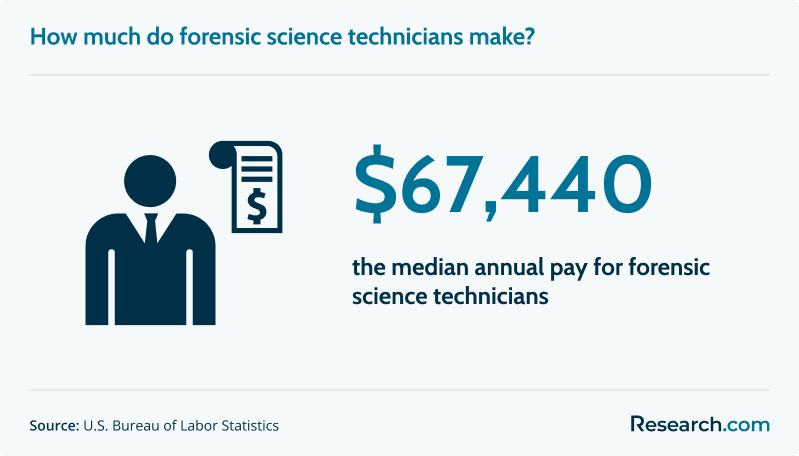
The median annual pay for forensic science technicians was $67,440 as of 2024. This competitive salary reflects the high level of scientific expertise the role demands, ensuring that your investment in a rigorous science degree translates into a stable and rewarding income.
While your starting salary may be in a different range, this median figure is a crucial indicator of your earning potential after gaining a few years of valuable experience. It’s a clear signal of the financial growth you can expect as you build your skills.
Furthermore, it's essential to look beyond the base salary. Government roles are known for their comprehensive benefits packages—including robust health insurance, retirement plans, and often a pension—that can significantly increase your total compensation.
This level of security is a key advantage of a public sector career and a critical factor when evaluating the true financial value of the job.
Comparing Salaries to Federal and Other Government Roles
An insider tip for maximizing your earning potential is to look at which government sectors pay the most. The top-paying employers for forensic science technicians are State governments, with a median pay of $71,180, followed by local governments at $65,890. While this career is primarily in state and local justice systems, it's helpful to see how it compares to other mission-driven federal roles.
How much does a CIA agent make? While the work is very different, comparing their salaries can offer helpful context for understanding pay ranges across the public sector. This comparison shows that a career in forensic science provides competitive compensation for a highly specialized scientific role.
What is the job outlook for forensic science technicians?
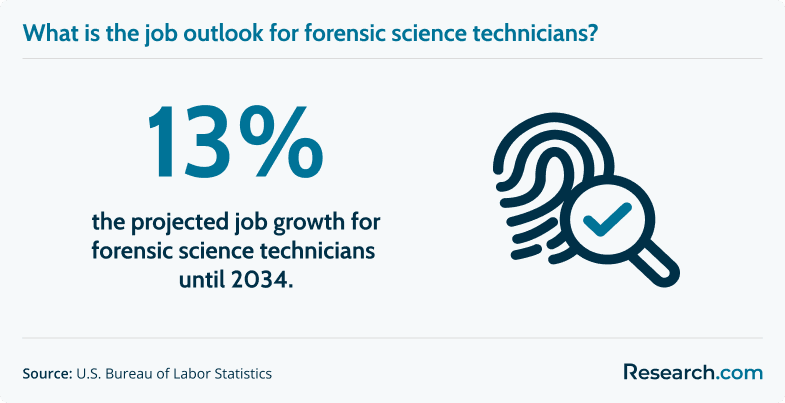
The job outlook for forensic science technicians is exceptionally strong, with a projected growth of 13% between 2023 and 2034. This rate is much faster than the average for all occupations, providing a clear, data-backed answer to any concerns about long-term career stability. In addition, there are currently over 1,000 job openings for forensic science roles in the United States.
The demand for skilled technicians is consistently fueled by advancements in scientific technology and a growing reliance on forensic evidence within the legal system.
For anyone asking, why forensic science is a good career in terms of job security, the robust growth forecast is one of the most powerful positive indicators. It signals that investing in the right scientific education positions you to enter a field with expanding opportunities. This allows you to build a long-term professional path with confidence.
Interestingly, this kind of data-driven career outlook is often compared to other fast-growing applied sciences, such as cybersecurity—prompting many students to ask, what is the difference between cyber defense and cyber security when choosing their specialization.
What are the main benefits of choosing a career in forensic science?
Beyond the strong salary and job growth, the core benefits of a career in forensic science center on a unique combination of purpose, stability, and intellectual engagement. These are the key advantages that make the profession a deeply rewarding long-term path.
- Meaningful, Mission-Driven Work: Your analysis of evidence provides objective, scientific facts that directly support the justice system. This gives the role a powerful sense of purpose and real-world impact.
- Exceptional Job Stability: Because most roles are in government, the career is well-insulated from the volatility of the private sector. This provides a secure and predictable professional track with strong benefits.
- Constant Intellectual Challenge: The work requires you to be a meticulous scientific problem-solver. You will constantly apply rigorous principles to analyze complex puzzles, making the role intellectually stimulating.
- Structured Advancement Path: Government agencies typically have clearly defined career ladders. This provides a transparent and predictable pathway for professional growth from a technician to senior and supervisory roles.
- Continuous Learning: The field is constantly evolving with new technologies and analytical techniques. This creates a dynamic environment where you are always developing new skills and staying at the forefront of scientific practice.
This unique blend of benefits provides a clear answer to the question, "Is forensic science a good career for those who are meticulous and mission-oriented?" — much like asking is construction management a good major for those who want structured career growth in a technical field.
What education do you need to become a forensic science technician?
The non-negotiable minimum educational standard for a forensic science career is a bachelor's degree in a natural science, such as chemistry or biology.
Hiring managers prioritize candidates with this background because the job is, first and foremost, a scientific one. Your degree is proof that you have the rigorous scientific knowledge and extensive lab experience required to perform the job's core analytical duties
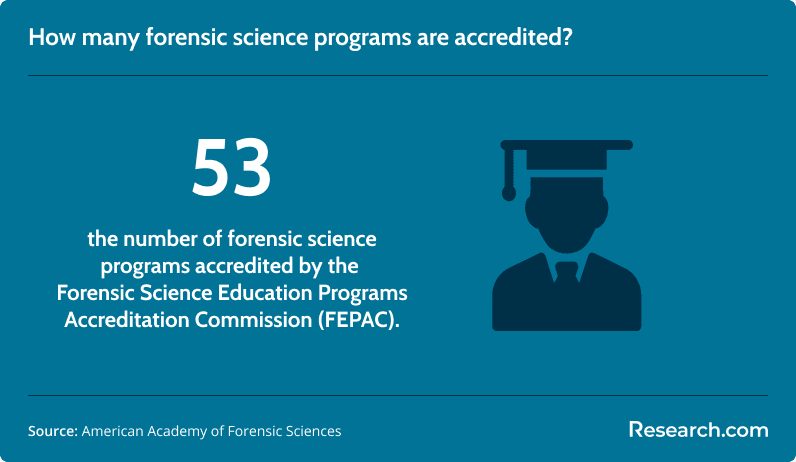
. While some institutions offer forensic science majors, a foundational degree in a hard science is often considered more valuable. For an added advantage, look for programs accredited by the Forensic Science Education Programs Accreditation Commission (FEPAC), as this is a significant quality signal that employers recognize.
Students comparing pathways in related applied sciences may also come across programs in health and laboratory sciences. In those cases, it’s worth understanding why get a bachelor's degree in health sciences—since both fields demand a solid grounding in biology, chemistry, and evidence-based methods.
The Role of a Master's Degree in Career Advancement
While a bachelor's degree is the key to getting your first job, a master's degree is a strategic tool for long-term career growth. It is not typically required for entry-level positions but becomes essential for specializing in a high-demand area or moving into a management or leadership track.
An advanced degree can qualify you for roles like a DNA analyst or toxicologist, or prepare you to become a lab supervisor. For those aiming for senior leadership, supplementing your scientific expertise with administrative knowledge can be a powerful move.
For example, earning one of the shortest master's degree in homeland security online can provide the policy and management skills needed to lead a public safety division.
The visual below presents the top-paying sectors for forensic science technicians.
What should you major in for a forensic science career?
The most strategic choice you can make is to major in a foundational natural science, as hiring managers prioritize deep scientific expertise. While a forensic science degree might seem like the obvious answer, a strong background in chemistry or biology is often seen as equally valuable by employers.
Here is a breakdown of the best academic paths to consider.
- Chemistry: Often viewed as the gold standard for the field, a chemistry degree provides the strongest foundation for many specializations, including toxicology, trace evidence analysis, and controlled substance identification.
- Biology: This major is essential for anyone interested in the rapidly growing fields of DNA analysis and biological evidence screening. A strong background in genetics and molecular biology will make you a highly competitive candidate.
- Forensic Science: A dedicated forensic science major can be an excellent choice, but with a critical caveat: it must have a rigorous science curriculum. Look for FEPAC-accredited programs that require the same core chemistry, biology, and physics courses as a traditional science degree.
Ultimately, the title of your major is less important than the scientific rigor of your coursework. When evaluating programs, focus on the depth of the lab experience and the strength of the core science classes. If you pursue an associate’s degree abbreviation in a related discipline before transferring to a bachelor’s program, make sure it aligns with the prerequisites required for upper-level forensic or laboratory coursework.
Are there specializations you can pursue in a forensic science program?
Yes, the field of forensic science is highly specialized, and you are typically hired to fill a specific analytical role rather than a generalist position. While your undergraduate program provides a broad scientific foundation, your career path will be defined by the specific discipline you pursue.
Here are some of the key specializations available:
- DNA Analysis: This specialization focuses on processing biological evidence to develop DNA profiles used for identification. It is ideal for professionals with a strong background in molecular biology and genetics.
- Toxicology: Toxicologists are responsible for identifying the presence of drugs, alcohol, and poisons in biological samples. This career path is deeply rooted in advanced chemistry and pharmacology.
- Trace Evidence Analysis: This discipline involves the meticulous examination of microscopic materials, such as fibers, paint chips, glass fragments, and gunshot residue, to link suspects to crime scenes.
- Firearms and Toolmark Examination: In this role, you analyze firearms, ammunition, and toolmarks to determine if a specific weapon or tool was used in a crime. This requires a deep understanding of mechanics and physics.
- Digital Forensics: As one of the fastest-growing specializations, this area focuses on recovering and analyzing data from computers, mobile phones, and other digital devices. For those looking to lead in this high-tech space, pursuing one of the shortest management information systems master's degree online can provide a direct route to management.
Choosing one of these paths allows you to develop deep expertise and build a long-term career at the forefront of scientific investigation.
Where do most forensic science technicians work?
The single most important factor defining this career is where you work. The vast majority of forensic science technicians are employed in the public sector, which creates a uniquely stable and structured work environment. The breakdown is as follows:
- Local Government: The largest group of technicians works for city or county agencies. These roles are typically within the crime laboratories of local police departments and sheriff's offices.
- State Government: A significant number of professionals are employed by statewide organizations. This includes positions in state bureaus of investigation or state police crime labs.
- Other Sectors: A smaller number of technicians find roles in other areas, such as federal government agencies, private laboratories that handle contract work, or universities.
This public-sector focus is a key reason why forensic science is a good career for individuals seeking security and a structured professional path. Understanding that the work is centered on public service within a government framework is crucial for setting realistic career expectations.
The chart below displays the industry distribution of forensic science technicians in the United States.
What does a typical day look like for a forensic scientist?
Contrary to popular media portrayals, a typical day for a forensic scientist is not spent at active crime scenes or in interrogation rooms. The role is fundamentally a laboratory-based scientific position, centered on methodical analysis and meticulous documentation.
Your day is a structured rhythm of careful scientific procedures: preparing and analyzing evidence samples, calibrating and maintaining highly sensitive instruments, and documenting every step of your process with unwavering accuracy for legal purposes.
A significant portion of your time is also dedicated to writing detailed reports and having your work peer-reviewed to ensure quality and objectivity.
The work is purely analytical and non-clinical; you are a scientist working with inanimate evidence, not a healthcare professional interacting with patients. While other technical roles might focus on direct service, such as knowing in what states can medical assistants legally draw blood, a forensic scientist’s focus is entirely on the integrity of the sample and the accuracy of the analysis.
Success in this career comes from a passion for the scientific method and a deep respect for precision and procedure.
What does career growth and advancement look like in this field?
Career growth in forensic science follows a structured and predictable path, typical of a government employment framework. Advancement is steady and based on a combination of experience, performance, and often, further education or specialized certifications.
The typical career ladder begins with an entry-level role as a Forensic Science Technician or Analyst. After several years of gaining proficiency, you can advance to a senior analyst position, which may involve more complex casework or training junior staff.
From there, the path leads to supervisory roles, such as a section supervisor for a specific discipline like DNA or toxicology, and ultimately to a top-level position as a laboratory director or manager.
Adjacent Roles and Career Transitions
One important thing to remember is to recognize that the skills you develop as a forensic scientist are also valuable in related fields within the justice system. While the core of your work is lab-based analysis, your expertise in evidence handling, documentation, and courtroom testimony can open doors to other roles.
For example, some professionals transition into quality assurance management within a lab system or become technical consultants. It’s also helpful to understand how your role differs from related positions.
Learning how to become an evidence technician, a role focused on collecting and cataloging evidence at the scene, can clarify your own lab-focused career path and show you the broader ecosystem of professions you'll be working alongside.
What skills are essential to succeed as a forensic scientist?
Success in this field requires a unique blend of deep technical knowledge and specific personal attributes. While your science degree provides the foundation, these are the core skills that hiring managers look for and that will define your effectiveness in the role.
- Meticulous Attention to Detail. You must be able to spot minute inconsistencies and follow complex procedures without deviation. In a field where the smallest error can have significant consequences, precision is non-negotiable.
- Objectivity and Integrity. Your job is to be an impartial analyst of the facts. You must be able to separate your work from any personal biases and report your findings accurately, regardless of the potential outcome.
- Strong Written and Verbal Communication. You will spend a significant amount of time writing highly detailed technical reports. You must also be able to clearly and confidently explain your scientific findings to non-scientists, including lawyers, judges, and juries.
- Problem-Solving and Critical Thinking. The work is more than just running tests; it's about interpreting complex data, troubleshooting instruments, and using logic to draw sound conclusions from your analysis.
- Patience and Self-Discipline. Forensic analysis is not instantaneous. It involves methodical, often repetitive, processes that can take days or weeks. The ability to stay focused and maintain high standards throughout a lengthy analytical process is essential.
Assessing your own aptitude for these skills is a critical step in deciding if this career is the right personal and professional fit for you.
Is forensic science different from what's shown on TV?
Yes, the reality of forensic science is profoundly different from what is portrayed on television. The "CSI effect" has created many misconceptions, and understanding the truth is essential for anyone seriously considering this career.
The biggest difference is that forensic scientists are specialist scientists, not law enforcement officers. They do not interview suspects, make arrests, or carry weapons. Their role is confined to the laboratory.
Another major myth is the speed of the work. On TV, DNA results and complex analyses are often completed in minutes. In reality, these processes are meticulous and time-consuming, requiring days or even weeks of careful work and peer review.
The daily job is not a series of action-packed moments but a steady, methodical application of the scientific method. Grasping this distinction—between a support-role scientist and a front-line investigator—is the most important step in aligning your expectations with the reality of this rewarding scientific career.
Who is a career in forensic science best suited for?
A career in forensic science is best suited for patient, detail-oriented individuals who have a deep passion for the scientific method and value stability over high-risk, high-reward work. It is not a career for thrill-seekers, but for methodical thinkers who find satisfaction in careful, precise analysis.
The ideal candidate is an objective, impartial professional who understands their role is to provide scientific facts, not to solve the crime itself. They are comfortable in a structured, lab-based environment and are motivated by a sense of public service and a desire to contribute to the justice system.
Ultimately, the final verdict on the question, "Is forensic science a good career?" depends on you. If you are a dedicated scientist at heart who thrives on process and precision, this stable, meaningful, and intellectually stimulating path offers a truly rewarding professional future.
Here’s What Graduates Have to Say about Their Forensic Science Career
- Adam: "Every day presents a new, intricate puzzle; the satisfaction of applying rigorous scientific method to uncover crucial truths is immense. While the caseload can be emotionally heavy, knowing my precise analysis provides closure for families and brings justice to the legal system is profoundly rewarding. My work as a DNA analyst truly matters. "
- Daisy: "The transition from theory to practice was intense, requiring incredible attention to detail and long, unpredictable hours at crime scenes. However, the opportunity to use cutting-edge technology and collaborate with law enforcement to directly impact public safety is an unparalleled professional high. It's a challenging, yet absolutely vital, career path."
- John: "Forensic science demands constant learning and exposes you to the darkest aspects of humanity, which can be draining, but the camaraderie within the lab makes a huge difference. The most surprising benefit has been the steady intellectual stimulation—interpreting complex chemical and physical evidence gives me a sense of purpose that a typical lab job couldn't offer. I feel I am making a direct contribution to accuracy in court."
Key Findings
- The forensic science field offers exceptional job security for new graduates, with a projected growth rate of 13%, which is significantly faster than the average for all occupations.
- With a median annual salary of $67,440, the profession provides a competitive and stable income, ensuring a strong financial return on a specialized science degree.
- The career is defined by its public-sector environment, as a commanding 87% of all technicians work for state and local government agencies, a reality that shapes the job's culture and stability.
- Your choice of major is a critical signal to employers; a foundational degree in chemistry or biology is prioritized because it directly proves you have the rigorous lab skills required for the role.
- For those looking to maximize their earning potential, the highest salaries are found in state government roles, which offer a median pay of $71,180.
- Ultimately, this career represents a trade-off: you exchange the potential volatility of the private sector for the stability, mission, and structured environment of a scientific support role within the justice system.
References:
- Cochran, D. (2024, May 13). CSI: Myth vs. reality – What they don’t show you about forensics on television. Drew Cochran, Attorney at Law. Retrieved October 13, 2025, from https://www.drewcochranlaw.com/2024/05/13/csi-myth-vs-reality-what-they-dont-show-you-about-forensics-on-television/
- College Board. (n.d.). Forensic science technicians. BigFuture. Retrieved October 13, 2025, from https://bigfuture.collegeboard.org/careers/forensic-science-technician
- U.S. Bureau of Labor Statistics. (2025). 19-4092 Forensic Science Technicians. Occupational Employment and Wage Statistics. Retrieved October 13, 2025, from https://www.bls.gov/oes/2023/may/oes194092.htm
- U.S. Bureau of Labor Statistics. (2025). Forensic science technicians. Occupational Outlook Handbook. Retrieved October 13, 2025, from https://www.bls.gov/ooh/life-physical-and-social-science/forensic-science-technicians.htm
- Zippia. (2025, January 8). Forensic scientist education requirements. Retrieved October 13, 2025, from https://www.zippia.com/forensic-scientist-jobs/education/
Other Things You Should Know About Forensic Science Careers
In 2027, a career in forensic science offers diverse work environments, from labs to crime scenes, and plays a crucial role in solving criminal cases. The field combines science and law, providing job satisfaction through impactful work. Additionally, the demand for skilled professionals continues to grow, promising career stability and growth opportunities.
In 2027, forensic science professionals may face challenges such as high competition for positions, the need for continuous education to keep up with advancing technology, and emotionally demanding work environments. Additionally, budget limitations in public sectors might affect job opportunities and resources.
To start a career in forensic science in 2027, a bachelor's degree in forensic science or a related field like biology or chemistry is typically required. Specific courses might include crime scene investigation, forensic biology, and advanced chemistry, aligning with industry standards.


