
2027 Steps to Become a Registered Dietitian in California

Co-Founder and Chief Data Scientist
California projects 12,500 employed dietitians and nutritionists by 2032, reflecting steady growth in healthcare careers tied to nutrition science. This trend highlights rising demand for professionals who can guide evidence-based dietary practices, preventive care, and public health initiatives across the state.
In this article, I will list the steps to become a registered dietitian in California, from completing accredited education and supervised practice to licensure and certification. I will also help you better understand these requirements so you can navigate opportunities in one of the nation’s largest nutrition job markets.
Key Things to Know About Becoming a Registered Dietitian in California
- In California, you must complete a bachelor’s degree in dietetics or a related field, along with a supervised practice program of at least 1,200 hours through an approved dietetic internship.
- Aspiring dietitians in California must also pass the Commission on Dietetic Registration (CDR) national exam to earn the registered dietitian nutritionist (RDN) credential, which is required for state licensure.
- Dietitians in California benefit from strong employment opportunities and earn an average annual salary of $75,005, with higher earnings possible depending on setting and experience.
- What degree is required to become a registered dietitian in California?
- How many supervised practice hours are needed to become a registered dietitian in California?
- What are the eligibility requirements for the dietetic registration exam in California?
- How can you get a license after passing the dietetic registration exam in California?
- What types of dietitian specializations can you pursue in California?
- What is the average salary of a registered dietitian in California?
- How can professional organizations support career advancement for registered dietitians in California?
- What do you need to keep your dietitian registration active in California?
- How long does it take to become a registered dietitian in California?
- Can international students qualify to become registered dietitians in California?
- What career paths can registered dietitians pursue in California?
- Is pursuing allied health certifications beneficial for registered dietitians in California?
What degree is required to become a registered dietitian in California?
The pathway to becoming a registered dietitian in California involves completing specific academic qualifications designed to meet state and national standards. The following degrees represent the core educational milestones necessary for entry into the profession.
- Bachelor’s Degree: A bachelor’s degree is required as foundational education, typically emphasizing nutrition or a related science field, and often obtained through nutrition programs in California that are accredited by the Accreditation Council for Education in Nutrition and Dietetics (ACEND).
- Master’s Degree: A master’s degree requirement for a registered dietitian in California involves advanced coursework and supervised practice, meeting the standards set by accrediting bodies to prepare candidates for professional practice.
- Supervised Practice Program: Completion of an accredited supervised practice or internship program is mandated to gain hands-on experience essential for credentialing and licensure.
- Credentialing Examination Preparation: Educational programs must adequately prepare candidates for the national registration examination, ensuring competency in dietetic knowledge and skills.
Prospective dietitians should also consider the required skills for highest paying medical jobs as part of their professional development to enhance career prospects in healthcare settings.
How many supervised practice hours are needed to become a registered dietitian in California?
To become a registered dietitian in California, a minimum of 1,000 supervised practice hours must be completed through an ACEND-accredited program. This requirement aligns with national standards established by ACEND. Additional state-specific factors and educational prerequisites also influence the pathway to eligibility.
The following points outline the key elements related to supervised practice hour requirements in California:
- ACEND Accreditation: Supervised practice must be completed within an ACEND-accredited program, ensuring adherence to nationally recognized educational and training standards essential for exam eligibility.
- Typical Program Structure: Most internships in California span 6 to 12 months full-time, with some offering part-time schedules, providing flexibility while meeting hour requirements.
- Practice Settings: Training occurs in diverse environments such as hospitals, community agencies, foodservice management, and public health organizations, offering comprehensive professional exposure.
- Graduate Degree Requirement: Since January 1, 2024, candidates must possess at least a master’s degree in addition to completing supervised practice hours to qualify for the Registered Dietitian Nutritionist exam.
- State-Specific Requirements: California does not impose additional supervised practice hours beyond the national standard nor require state licensure for dietitians, although continuing education is necessary to maintain registration.
- Verification Statement: Completion of academic and supervised practice criteria results in a verification statement, enabling candidates to sit for the Commission on Dietetic Registration exam.
What are the eligibility requirements for the dietetic registration exam in California?
Eligibility for the dietetic registration exam in California requires meeting several specific criteria that align with national standards and state regulations. These requirements emphasize academic achievement and verified credentials through accredited programs. The following outlines the essential eligibility requirements for the registered dietitian exam in California.
- Minimum Educational Qualifications: Candidates must hold at least a graduate degree (master’s or higher) from a U.S. Department of Education (USDE)-recognized accredited institution or an equivalent foreign degree. This applies across fields, though nutrition-related majors are common.
- California ACEND-accredited dietetics program requirements: Completion of ACEND-accredited coursework is mandatory, typically through a Didactic Program in Dietetics (DPD), Coordinated Program in Dietetics (CP), or Graduate Program in Nutrition and Dietetics (GP). These programs ensure comprehensive coverage of nutrition science and related disciplines.
- Verification Statement Submission: Following coursework completion, program directors must submit a verification of eligibility to the Commission on Dietetic Registration (CDR), confirming all educational standards have been met. This verification is required before exam registration.
- Registration for the National Exam: Candidates must register and pay for the national dietetic registration exam through the CDR. Exam scheduling is arranged via Pearson VUE testing centers, which are accessible within California.
- Passing the National Registration Exam: Successful completion of the national exam is required to obtain the RD credential, which is recognized nationwide and essential for professional practice.
- State-Specific Credentialing: California does not require a state license for dietitians but prohibits use of the titles “dietitian,” “registered dietitian,” or “registered dietitian nutritionist” without passing the CDR exam. This title protection is enforced by state law.
While supervised practice hours through an ACEND-accredited internship are a national requirement, this section focuses on coursework and credential verification. For those interested in career prospects and nutrition salary information, understanding these eligibility requirements is a critical first step.
The chart below illustrates the typical majors of registered dietitians, offering a clearer picture of the most common educational backgrounds in the field.
How can you get a license after passing the dietetic registration exam in California?
After passing the dietetic registration exam in California, the process to legally practice as a registered dietitian involves several critical steps focused on maintaining national credentials rather than obtaining a state license.
- Receive Your CDR Registration Card: Obtain your official credential from CDR, which authorizes practice as an RDN or RD in California.
- Maintain CDR Registration: Renew your registration every five years and complete at least 75 continuing professional education units (CPEUs) within each cycle to retain your credential.
- Optional Specialty Certification: Pursue additional certifications in specialized fields such as sports or pediatric nutrition to enhance your qualifications and career prospects.
- Retain Professional Documentation: Keep all registration, exam results, and continuing education records updated and accessible for employer verification.
- Comply With Employer Requirements: Meet any additional credentialing or background checks required by healthcare facilities or employers despite the absence of state licensure.
- Stay Informed on Regulatory Changes: Monitor updates from professional organizations to adapt to any future legislative changes affecting dietetic practice in California.
When I spoke with a registered dietitian from California who graduated from a local university, she reflected on the unique licensing landscape in the state. She noted, “Not having a state license initially felt like a relief because I could start practicing immediately after receiving my CDR credential.” However, she also mentioned challenges when considering work outside California, explaining, “Since other states require licensure, I had to research their specific requirements carefully before applying elsewhere.”
She appreciated California’s system for allowing flexibility and emphasized the importance of keeping her national registration current. “The lack of state licensure means my focus is on maintaining my professional development continuously, which ultimately benefits my practice.” Her experience highlights that while California’s approach differs from other states, it offers both advantages and responsibilities for dietitians committed to lifelong learning and compliance.
What types of dietitian specializations can you pursue in California?
Dietitians in California have access to a broad spectrum of specializations that allow them to apply their expertise in diverse healthcare and community settings. Many pursue advanced training through masters in nutrition and dietetics online or traditional programs, which prepare them to address specific patient needs and population health concerns while enhancing the overall effectiveness of nutrition care across the state.
Below is an overview of key dietitian specializations available in California.
- Clinical Dietitian: Provides medical nutrition therapy in healthcare environments, managing conditions such as diabetes and cancer through tailored nutrition plans.
- Community Dietitian: Develops and implements nutrition education programs aimed at improving public health and addressing food insecurity within diverse populations.
- Pediatric Dietitian: Focuses on the nutritional needs of children and adolescents, managing growth issues, allergies, and feeding disorders.
- Geriatric Dietitian: Specializes in nutrition care for older adults, addressing chronic disease management and age-related metabolic changes.
- Sports Dietitian: Offers nutrition strategies to athletes and physically active individuals to optimize performance and recovery.
- Food Service Dietitian: Oversees nutrition standards, menu planning, and food safety in institutional and organizational settings.
- Research Dietitian: Engages in scientific studies to advance knowledge in nutrition and dietetics, often within academic or government institutions.
- Renal (Nephrology) Dietitian: Provides specialized nutrition care for patients with kidney disease, commonly working in dialysis centers and nephrology clinics.
- Oncology Dietitian: Supports cancer patients through nutrition interventions that address treatment side effects and improve quality of life.
What is the average salary of a registered dietitian in California?
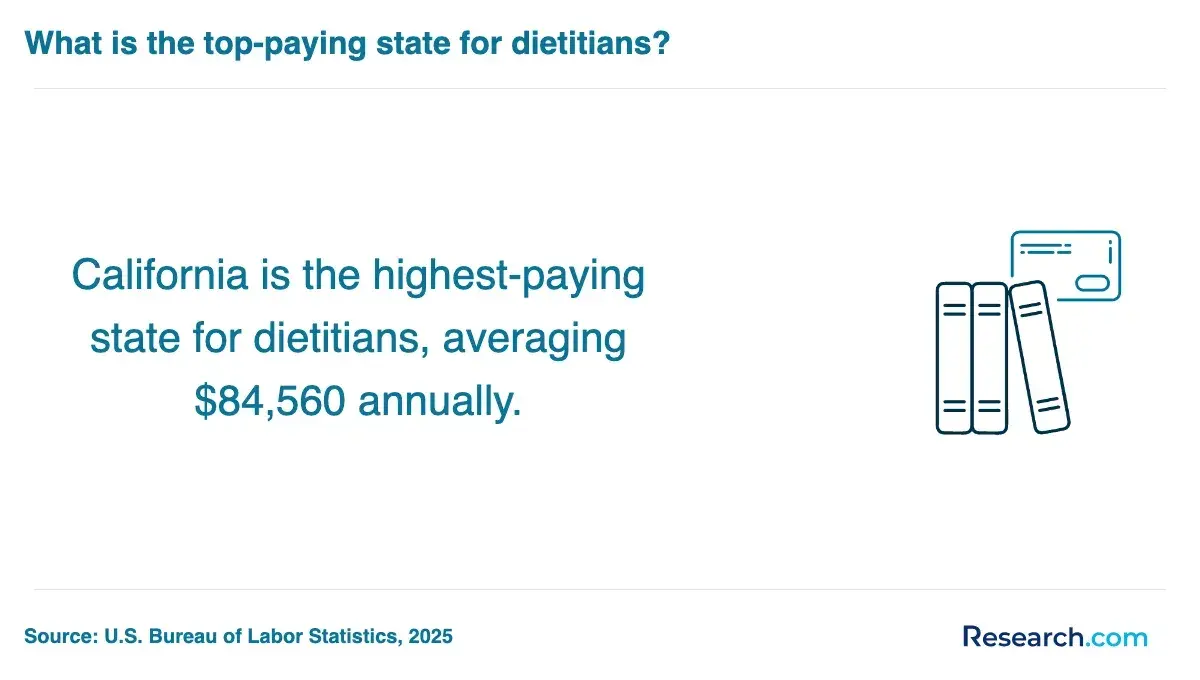
The average salary for a registered dietitian in California is more than $80,000 annually. This pay is higher than the national average for dietitians and nutritionists, reflecting California’s higher cost of living and strong healthcare demand.
- Location: Salaries vary across the state, with cities like Cupertino ($93,765), Berkeley ($93,058), and South San Francisco ($91,328) offering some of the highest average pay.
- Experience: Entry-level dietitians generally earn around the 25th percentile of $59,700, while top earners in the 90th percentile make up to $98,690 annually.
- Work Setting: Hospital and research-based roles often pay more than positions in schools or community programs.
- Demand and Specialization: Dietitians with advanced certifications, such as clinical nutrition or diabetes education, can command higher salaries.
- Salary Range: Salaries for dietitians in California range from $36,515 to $109,546, with most falling between $59,700 and $87,300.
- Growth Outlook: With a projected national job growth rate of 6% from 2024 to 2034, opportunities for California dietitians are expected to expand, alongside potential salary increases.
How can professional organizations support career advancement for registered dietitians in California?
Registered dietitians can leverage professional organizations and industry networks to access advanced training, mentorship programs, and specialized conferences that are not covered in standard continuing education. These groups often offer targeted workshops, networking events, and up-to-date industry insights that assist in refining clinical skills and broadening career horizons. Additionally, many associations collaborate with academic institutions to provide resources and guidance on pathways such as how to become a nutritionist in California, reinforcing real-world application of emerging nutrition practices and research trends.
What do you need to keep your dietitian registration active in California?
Maintaining active dietitian registration in California is vital to legally practice and uphold professional standards. The registration confirms ongoing competence and adherence to ethical requirements, ensuring public trust and legal compliance. Failure to maintain registration may result in loss of credential and legal consequences.
- Annual Fee: Pay $80 yearly to the Commission on Dietetic Registration by August 31; the fee rises to $90 in 2027.
- Recertification Cycle: Renew registration every five years by completing required fees and professional development.
- Continuing Education: Earn 75 CPEUs per five-year cycle, including at least 1 CPEU in ethics or health equity.
- Professional Development Portfolio: Submit a PDP every five years demonstrating alignment of CPE activities with goals.
- Late Fees and Reinstatement: Pay $200 per year for late fees and fulfill all requirements for reinstatement.
When I spoke with a registered dietitian from California who graduated locally, he emphasized the importance of staying organized with deadlines and continuing education. “Since California doesn’t offer license reciprocity, I had to complete all requirements here, which was challenging but ensured I fully understood state-specific regulations,” he explained.
He found that maintaining the portfolio was particularly helpful to track progress and reflect on professional growth. “It’s a continuous commitment, but knowing that I’m meeting high standards keeps me motivated and confident in my practice,” he reflected. This experience highlights the dedication needed to keep registration active and the benefits of California’s rigorous process.
How long does it take to become a registered dietitian in California?
The process of becoming a registered dietitian in California generally spans five to seven years, depending on the educational path and program format. Most students begin with a bachelor’s degree, followed by graduate studies and supervised practice before obtaining the credential. This timeline reflects recent changes requiring a master’s degree for eligibility, which adds complexity to the registered dietitian education timeline California.
Undergraduate programs typically take around four years, with many students pursuing a master’s degree afterward, extending the total duration by one to two years. Coordinated or accelerated programs may combine coursework and supervised experiential hours, potentially reducing the timeline to about five years for full-time, motivated students. Preparation for the Commission on Dietetic Registration exam also factors into the overall timeframe.
Individual circumstances, such as part-time attendance, prerequisite completion, or program availability, can influence how long it takes to become a registered dietitian in California. Prospective students might find it helpful to review a ranking of the most popular online bachelors degrees in nutritional science to select programs that fit their schedule and goals. Flexibility and planning are key in managing the time investment required for this profession.
Can international students qualify to become registered dietitians in California?
International students can pursue the registered dietitian credential in California by fulfilling specific educational and credentialing criteria. These requirements ensure that international graduates meet the standards set by U.S. accrediting bodies and are prepared for professional practice.
- Foreign Degree Validation: Academic degrees must be evaluated as equivalent to a U.S. bachelor’s or master’s degree by an agency recognized by the Commission on Dietetic Registration (CDR).
- Completion of ACEND-Accredited Coursework: Required coursework and supervised practice must be completed in a program accredited by the Accreditation Council for Education in Nutrition and Dietetics (ACEND), which may include U.S.-based internships or specialized programs.
- Supervised Practice Requirement: A minimum of 1,000 hours of supervised practice in an ACEND-accredited program is mandatory, achievable through approved U.S. internships or recognized international programs issuing ACEND verification.
- Master’s Degree Requirement: Candidates must have completed at least a master’s degree, either in the U.S. or through a recognized foreign equivalent, to be eligible for the CDR Registration Examination for Dietitians.
- CDR Registration Examination: Passing the CDR Registration Examination is essential to earn the Registered Dietitian Nutritionist (RDN) credential.
- Visa and Work Authorization: Appropriate visa status and work authorization are required for internship participation and employment within California, with specifics varying by program and employer.
The chart below from the Journal of the Academy of Nutrition and Dietetics details the employment status of registered dietitians and nutritionists.
What career paths can registered dietitians pursue in California?
Registered dietitians in California have access to diverse career opportunities reflecting the state’s varied healthcare and community needs. These roles offer competitive salaries and a positive job outlook, especially in clinical nutrition jobs in California.
- Clinical Dietitian: Working in hospitals and clinics, clinical dietitians provide medical nutrition therapy with an average salary of around $83,000 and strong demand driven by California’s aging population.
- Community/Public Health Dietitian: These professionals develop nutrition programs targeting public health concerns such as diabetes, earning between $65,000 and $80,000, particularly in underserved areas.
- Foodservice Management Dietitian: Overseeing nutrition standards in institutions like schools and healthcare facilities, these dietitians earn $70,000 to $85,000 with stable employment prospects.
- Private Practice/Consulting Dietitian: Providing individualized nutrition counseling, experienced practitioners can earn $90,000 or more, though success depends on business skills.
- Corporate/Industry Dietitian: Working with food companies and wellness startups, these dietitians earn $80,000 to $100,000, often advancing to leadership or research roles.
- Research Dietitian: Conducting studies in academic or government settings, salaries range from $80,000 to $95,000, with roles requiring advanced expertise.
- Educator/Academic Dietitian: Teaching and supervising in higher education, these dietitians earn $75,000 to $100,000 depending on experience and credentials.
- Specialty Dietitian Roles: Specializing in fields like sports or pediatric nutrition, salaries often exceed $85,000 with certification and experience.
Those interested in exploring nutritional science jobs can find comprehensive educational pathways and career resources at nutritional science jobs.
Is pursuing allied health certifications beneficial for registered dietitians in California?
Expanding professional credentials through targeted certifications can enhance a registered dietitian’s role in interdisciplinary healthcare settings. In California’s competitive job market, additional certifications—such as those in allied health—provide opportunities to diversify practice and improve patient care outcomes. Evaluating complementary credentialing options supports collaboration within multidisciplinary teams and can lead to a more adaptable career path. For professionals interested in broadening their scope, exploring training on how to become a medical assistant in California is one strategic pathway.
What Registered Dietitians Say About Their Careers in California
- Completing my dietetics program at San Diego State University was a transformative experience that prepared me well for the dynamic environment of California's academic institutions. Starting my career as a registered dietitian in a local school allowed me to integrate nutrition education with cultural diversity, which is so rich here. I find great joy in helping students develop lifelong healthy habits while navigating the unique challenges of food access in our communities. The support from colleagues and the opportunity for professional growth make this path incredibly rewarding. - Nikita
- My journey began at California State University, Long Beach, where the comprehensive curriculum and hands-on experiences equipped me for a fulfilling career. Working in a school setting has deepened my passion for community impact, especially in underserved neighborhoods where nutrition education can change lives. California's abundant resources and focus on wellness have given me unique opportunities to design programs that resonate culturally and promote equity. Reflecting on my growth, I’m proud to contribute positively to children's health and well-being. - Andrea
- Graduating from the University of California, Davis, opened doors to a career full of professional development and diverse challenges unique to California’s environment. Starting work in a local school gave me insight into how agricultural abundance can be leveraged to improve student nutrition and education. The balance between state-of-the-art research and practical application keeps me motivated and continually advancing in my field. I appreciate the stability and career advancement potential that being a registered dietitian in California offers, alongside the chance to inspire young minds daily. - Linda
Related Articles for Nearby States
- 2027 Steps to Become a Registered Dietitian in Nevada
- 2027 Steps to Become a Registered Dietitian in Oregon
- 2027 Steps to Become a Registered Dietitian in Arizona
- 2027 Steps to Become a Registered Dietitian in Idaho
- 2027 Steps to Become a Registered Dietitian in Utah
- 2027 Steps to Become a Registered Dietitian in Washington
- 2027 Steps to Become a Registered Dietitian in New Mexico
- 2027 Steps to Become a Registered Dietitian in Colorado
- 2027 Steps to Become a Registered Dietitian in Montana
- 2027 Steps to Become a Registered Dietitian in Wyoming
References:
- BLS (2025). Dietitians and Nutritionists. Retrieved from https://www.bls.gov/ooh/Healthcare/Dietitians-and-nutritionists.htm
- Commission on Dietetic Registration (2024). 2024 Needs Satisfaction Survey of the Academy of Nutrition and Dietetics and Commission on Dietetic Registration: Executive Summary. Retrieved from https://www.eatrightpro.org/news-center/press-releases/2024-press-releases https://www.jandonline.org/action/showPdf?pii=S2212-2672%2825%2900043-7
- O*NET OnLine (n.d.). California Employment Trends 29-1031.00 - Dietitians and Nutritionists. Retrieved from https://www.onetonline.org/link/localtrends/29-1031.00?st=CA
- Zippia (2025). Registered dietitian demographics and statistics in the US. Retrieved from https://www.zippia.com/registered-dietitian-jobs/demographics/
- ZipRecruiter (2025). Dietitian Salary in California. Retrieved from https://www.ziprecruiter.com/Salaries/Dietitian-Salary--in-California
Other Things You Should Know About Being a Registered Dietitian in California
To become a registered dietitian in California by 2026, you must earn a bachelor's degree accredited by the Accreditation Council for Education in Nutrition and Dietetics (ACEND). This typically involves completing coursework in nutrition, food science, and biology.
In California, you do not need to major specifically in dietetics or nutrition to qualify for the prerequisites to become a registered dietitian. Many programs accept students from diverse academic backgrounds as long as they complete the required coursework in nutrition and related sciences. This flexibility allows students from other majors to fulfill the necessary prerequisites through additional classes, making it possible to enter dietetics without a dedicated nutrition degree.
However, majoring outside of dietetics may require more careful planning to ensure all required courses are completed, which is why some students prefer a focused nutrition major to streamline the path to registration.
In 2027, aspiring registered dietitians in California must complete at least 1,200 hours of supervised practice in a program accredited by ACEND. This experience can be part of a Dietetic Internship or a Coordinated Program in Dietetics.


