
World Online Ranking of Best Chemistry Scientists – 2025 Report

Co-Founder and Chief Data Scientist
On May 13, 2025, Research.com released the 4th edition of its annual report on the best chemists. This report was created to enhance the visibility of leading experts in chemistry, guide the academic community in research, and recognize the work of outstanding chemical specialists. It also aims to help researchers navigate the field more easily by highlighting those making significant contributions worldwide.
We share these rankings to inspire academics, students, and decision-makers to explore the vital research areas chemistry leaders focus on. This event provides a unique opportunity to learn about the top scientists from different universities, countries, and research institutions. By doing so, the report also supports stronger global networking, helping researchers connect with experts who share their interests.
For the 2025 edition, the team reviewed more than 18,000 scientist profiles. These profiles were collected from a range of trusted bibliometric data sources. Different indicators and metrics were used to assess who should be included carefully. The report gives an updated and detailed view of where the top minds in chemistry are contributing today.
A scientist needed a D-index of at least 20 to qualify for this ranking, especially if most of their work was in chemistry. Researchers were evaluated based on their D-index in chemistry, the share of their research dedicated to the field, and their awards and career achievements. This way, only the most active and impactful specialists made it into the final list.
Latest discoveries in chemistry research
One of the most significant breakthroughs in chemistry this year is the development of a machine-learning model called React-OT. Created by researchers at MIT, React-OT can predict the structures of transition states in chemical reactions in less than a second. Transition states are crucial for understanding reactions and designing better catalysts, but they are hard to study through experiments. The new model uses optimal transport to generate highly accurate structures quickly and cheaply. This could help chemists design new reactions to create valuable products like medicines and fuels much faster, speeding up innovation in many industries.
Another exciting discovery focuses on a human protein called TSPO1, which plays a vital role in how cells manage certain compounds. Scientists have now identified TSPO1 as a cholesterol-dependent enzyme involved in breaking down molecules linked to oxygen and inflammation. This research offers a fresh view of TSPO1’s true function in the body. It could lead to better treatments for inflammation-related diseases, like Alzheimer’s or certain cancers. This finding also helps unify decades of research on TSPO proteins. It strengthens the connection between cell chemistry and disease control.
The key findings for the 4th edition of the best chemistry scientists ranking
- The United States leads with 415 top chemistry scientists despite dropping from 443 the previous year.
- China shows strong growth, rising to 157 scientists from 130 in the previous report.
- The Chinese Academy of Sciences has the most top-ranked chemists at 32, an increase from 31 last year.
- The average D-index for the top 1% of chemists is 223.3, significantly higher than the overall average of 123.07 for the top 1,000 chemists.
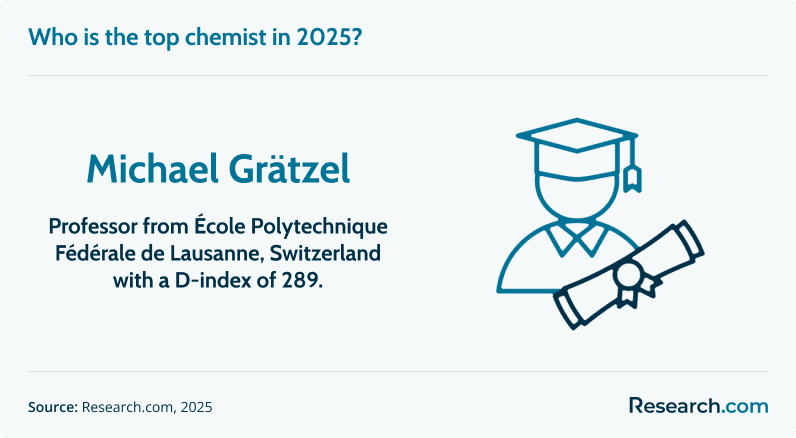
- Michael Grätzel from Switzerland holds the highest D-index worldwide at 289, ranking first among all chemists.
The full ranking for the 2025 list of the best chemistry scientists can be found here:
BEST CHEMISTRY SCIENTISTS RANKING
Countries with the highest number of leading chemistry scientists
The United States continues to lead the world with the highest number of top chemistry scientists. In the 2025 report, 415 American scientists made it into the top 1,000. While the U.S. remains in first place, the number has slightly dropped from 443 in last year’s report. China is firmly in second place, showing strong growth with 157 scientists this year, compared to 130 the year before. This increase shows China’s rising influence in global chemistry research.
Germany holds the third position with 76 scientists, slightly increasing from 74 last year. Japan comes next with 50 scientists, dropping slightly from 52. The United Kingdom stays steady with 49 scientists, the same number as in the last report. Australia and the Netherlands both have 26 scientists each. While Australia saw a slight decrease from 27, the Netherlands moved up from 23 scientists. Canada, Italy, and Switzerland complete the top ten, with 20, 19, and 16 scientists, respectively. Compared to last year, Canada lost one scientist, Italy stayed the same, and Switzerland replaced South Korea, which had 17 scientists before.
These shifts show that minor changes continue to reshape the chemistry research landscape while the leading countries remain strong.
Please note that the country associated with a scientist is based on their affiliated research institution according to MAG, not on their actual nationality.
Institutions with the highest number of leading scientists
The Chinese Academy of Sciences ranks first again, now with 32 scientists among the top 1,000. This is a slight increase from 31 scientists in last year's report. It represents about 3.2% of all leading scientists listed. The University of California, Berkeley remains strong in second place, although it dropped from 27 to 22 scientists. Stanford University follows with 21 scientists, up from 20 in the previous edition.
Max Planck Society and Northwestern University both have 16 scientists each. Northwestern saw a slight drop from 18 last year, while Max Planck stayed steady. Tsinghua University improved its standing with 15 scientists, reinforcing China's growing influence in chemical research. Institutions like Harvard University (12 scientists), MIT (11 scientists), and California Institute of Technology (11 scientists) continue to show strong global research presence. However, some saw slight drops compared to the last report.
The top institutions represent about 19% of all leading scientists. This highlights that while many universities contribute to chemistry research, a few major centers consistently drive a large share of global innovation.
Strengthening chemistry research through online universities
Online universities are becoming a key part of chemistry education and research. They make it easier for students everywhere to access high-quality programs, including those focused on chemistry. As the demand for flexible learning rises, online universities are helping to build a new generation of scientists ready to contribute to future discoveries.
According to recent data from the NCES, nearly 14,000 undergraduate chemistry degrees were awarded last year. Many students are turning to online universities for advanced studies or specialized certifications. By offering flexible schedules, lower costs, and broader access to research resources, online universities support young researchers who may not have easy access to traditional programs. This trend is making the field of chemistry more diverse, innovative, and globally connected.
D-index ranking — leaders, averages, and distribution
In Europe, Professor Michael Grätzel from École Polytechnique Fédérale de Lausanne, Switzerland, leads the region and ranks 1st globally with a D-index of 289.
In North America, Professor George M. Whitesides at Harvard University, United States, is the top scientist, ranked 2nd in the world with a D-index of 266.
In Asia, Professor Yadong Li of Tsinghua University, China, is the leading figure, ranking 5th worldwide with a D-index of 213.
Professor Shi-Zhang Qiao from the University of Adelaide, Australia, represents Oceania as the top scientist, standing 21st globally with a D-index of 190.
In Africa, Professor Mika Sillanpää from the University of Johannesburg, South Africa, is the top chemist with a D-index of 127 and ranks 311th worldwide.
In South America, Professor Elson Longo at the Federal University of São Carlos, Brazil, leads with a D-index of 112, placing 610th globally.
The average D-index for the top 1% of scientists in the top 1,000 rankings is 223.3, while the overall average for all scientists is 116.
The scholar with the lowest D-index value who made it into the 2025 ranking has a D-index of 2.
The average number of discipline publications for the top 1% of scientists is 1432.7, compared to an overall average of 701.1 for all ranked scientists.
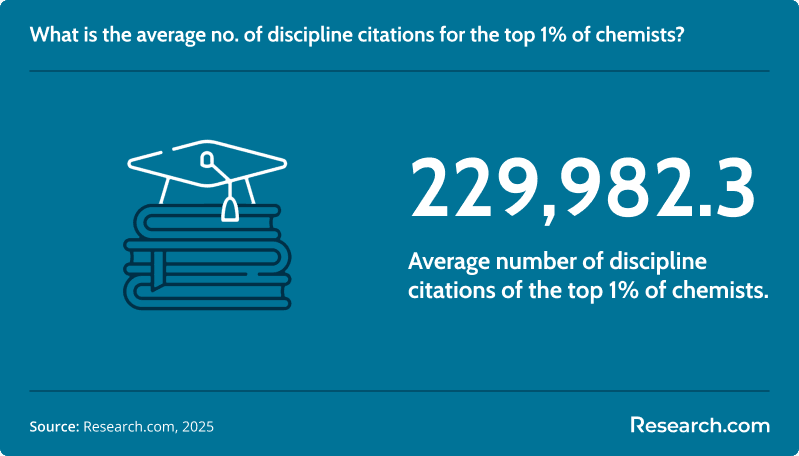
The average number of discipline citations for the top 1% is 229,982.3, while the overall average across the top 1,000 scientists is 64,152.54.
You can learn more about the methodology used to create this report here.
About Research.com
All research was coordinated by Imed Bouchrika, Ph.D., a computer scientist with a well-established record of collaboration on a number of international research projects with different partners from the academic community. His role was to make sure all data remained unbiased, accurate, and up-to-date.
Research.com is the number one research portal for science and educational rankings. Our mission is to make it easier for professors, research fellows, and students to progress with their research and find the top experts in a wide range of scientific disciplines. Research.com is also a leading educational platform that helps students find the best colleges, academic opportunities, and career paths.


