
World Online Ranking of Best Animal & Veterinary Scientists – 2025 Report

Co-Founder and Chief Data Scientist
On April 22, 2025, Research.com released the fourth edition of its yearly ranking of the world’s best scientists in the field of animal and veterinary science. The report highlights the top researchers working to improve animal health and welfare. Its main goal is to raise awareness of key contributors and guide students, teachers, institutions, and research leaders as they navigate important academic and scientific topics.
We believe that by sharing this ranking, educators, students, and industry leaders will better understand where top animal and veterinary science experts are focusing their efforts. This ranking allows readers to learn from the achievements of leading researchers worldwide. It also offers insight into universities and research centers shaping the discipline’s future.
The 2025 edition of the report is based on an in-depth analysis of more than 2,500 scientist profiles. Research.com used data from multiple trusted bibliometric sources. Several performance indicators were considered to evaluate each expert’s contributions and determine who should be featured in this year’s list.
To be included in the ranking, researchers had to meet specific requirements. The starting point was a minimum D-index of 20 in the animal and veterinary sciences field. Researchers were also evaluated based on how much of their work falls within the field, their overall impact, and their awards or achievements. This careful selection process helps ensure that the report features those who have made a lasting mark on animal and veterinary science.
Latest discoveries in animal science & veterinary research
In a significant discovery, researchers studied the skulls and teeth of 99 extinct crocodylomorph species and 20 living crocodylian species to explore how these animals survived two mass extinction events. The study, published in April 2025, found that the secret to their long-term survival may lie in their flexible diets and adaptable lifestyles. Using morphometric tools to analyze cranial shapes, the team showed that extinct crocodylomorphs had more varied skull shapes than today's crocodiles. This suggests that many had diverse diets and lived in different habitats. The finding is important because it supports the idea that animals with generalist diets—those that can eat various foods—may be more likely to survive environmental crises, a trend also seen in mammals.
Another recent breakthrough focuses on soft-coated wheaten terriers (SCWTs), a dog breed known to be at risk for protein-losing enteropathy (PLE). A February 2025 study found early warning signs of intestinal disease in these dogs, years before symptoms show up. Researchers discovered changes in fecal fatty acids and gut permeability in healthy SCWTs similar to those in dogs already diagnosed with PLE. These early markers, also used in identifying preclinical IBD in humans, could lead to better early detection and treatment. This research is a step forward in understanding inherited gut diseases in dogs. It may even help improve human IBD diagnosis by drawing valid comparisons across species.
Key findings for the 2025 edition of the best animal & veterinary scientists ranking
- The United States leads globally with 302 scientists in the top 1000, making up over 30% of the list.
- The University of Guelph and Wageningen University & Research tie for first among institutions, each with 24 top-ranked scientists.
- The average D-index for the top 1% of scientists is 116.2, significantly higher than the overall average of 52.8.
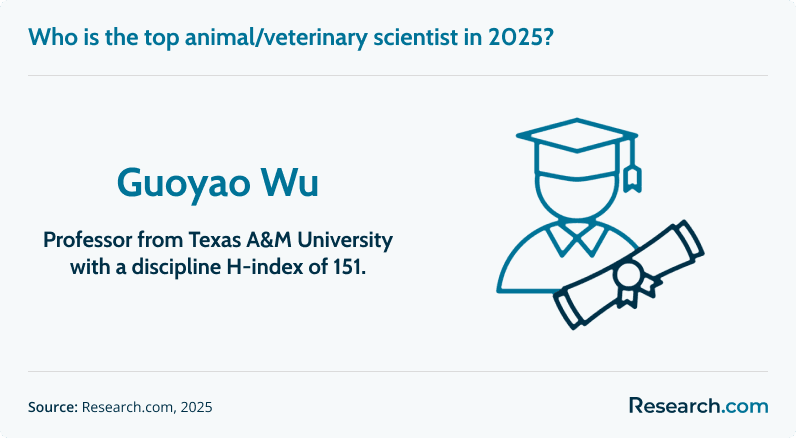
- Professor Guoyao Wu from Texas A&M University ranks 1st globally with a D-index of 151.
- The top 1% of scientists have an average of 611.8 publications, more than double the average of 248.03.
- The average number of citations among the top 1% is 48,610.8, compared to 11,272.22 for all ranked scientists.
The full ranking for the 2025 list of best animal and veterinary science scientists can be found here:
BEST ANIMAL & VETERINARY SCIENTISTS RANKING
Countries with the highest number of leading animal & veterinary scientists
The 2025 report shows some notable shifts in where the top animal and veterinary scientists are based. The United States remains the clear leader, with 302 scientists in the top 1,000. Although the country still dominates, this number is down from 319 in the 2024 edition. The U.K. holds second with 93 scientists, showing a strong rebound from last year’s 83. Canada stays third with 79 researchers, just one fewer than the previous year. Australia follows with 63 experts, showing a slight increase. Italy saw the most noticeable jump among the top ten, rising from 42 to 52 scientists—an impressive gain of ten places.
Other countries in the top ten also saw minor changes. Spain dropped slightly to 47 from last year’s 52. The Netherlands now ranks seventh with 37 scientists, just ahead of France with 36. Belgium secured the ninth spot with 30 scientists. At the same time, Germany re-entered the top ten, replacing Brazil and Denmark with 29 leading researchers. This change shows Germany’s growing influence in the field, while Brazil and Denmark are no longer in the top group.
While the U.S. still leads, the 2025 report reveals growing global diversity in animal and veterinary science. More countries are contributing to top research, and Europe, in particular, is gaining ground.
Please note that the country associated with a scientist is based on their affiliated research institution, according to MAG, not on their actual nationality.
Institutions with the highest number of leading scientists
The 2025 report reveals new shifts among the institutions with the highest number of top-ranked animal and veterinary scientists. Wageningen University & Research and the University of Guelph now share the top spot, each with 24 scientists in the global top 1,000. This marks a small but essential rise for Wageningen, which had 22 in 2024. The University of California, Davis, follows in third with 21 scholars, highlighting its continued leadership in agricultural and veterinary research.
The United States Department of Agriculture ranks fourth with 19 scientists, while the Agricultural Research Service drops slightly from last year’s third place, now tied with Ghent University at 18 experts. INRAE, Cornell University, and the Swedish University of Agricultural Sciences each have 17 scientists listed. The University of Melbourne rounds out the top ten with 16. U.S.-based institutions make up half of the top ten, showing strong but slightly reduced dominance compared to previous years.
This year’s data also reflects more international balance. European institutions now represent 45% of the top ten, up from 40% last year. The increase from places like INRAE (France) and the University of Copenhagen (Denmark) signals growing European research output. Meanwhile, the University of Florida dropped out of the top ten after previously holding a higher spot, now with 14 scientists. Institutions in Canada, the Netherlands, and Australia also show strong performances, with Canada contributing 10% of the top 20 institutions.
Online universities encouraging animal science and veterinary research
Online universities are more significant in supporting animal science and veterinary research. With flexible programs and access to digital tools, more students choose online education to start careers in this field. As technology improves, online learning environments can now offer virtual labs, interactive simulations, and real-time collaborations to help students build the same skills as traditional classrooms.
According to data from the NCES in 2023, U.S. institutions awarded over 6,500 bachelor's degrees in animal science. Many of these students are turning to online universities for more affordable, flexible ways to earn their degrees. Many online programs now include research components, allowing students to join faculty-led projects or complete internships remotely. These programs are helping expand the research pipeline by making the field more accessible, especially for students in rural areas or working professionals.
Online universities are opening the door to a broader and more diverse group of future scientists by supporting research-focused animal science and veterinary care education. Their impact can already be seen as more graduates from online programs go on to contribute to academic research, industry innovation, and global conservation efforts. As demand for skilled professionals continues to rise, online learning is helping meet that need while promoting continued research in the field.
D-index ranking — leaders, averages, and distribution
For North America, Professor Guoyao Wu from Texas A&M University in the United States tops the global list with a D-index of 151 and holds the number one world ranking.
For Europe, Professor Ynte H. Schukken from Wageningen University & Research in the Netherlands leads the region with a D-index of 103 and ranks 9th globally.
For Oceania, Professor R.C.A. Thompson from Murdoch University in Australia also holds a D-index of 103, placing him 10th in the world ranking.
In Asia, Professor Yulong Yin from the Chinese Academy of Sciences in China leads with a D-index of 100, ranking 13th worldwide.
For South America, Professor Marcelo B. Labruna of the Universidade de São Paulo in Brazil is the top regional scientist with a D-index of 87 and ranks 31st globally.
Africa’s leading scientist is Professor Frans Jongejan from the University of Pretoria in South Africa, who holds a D-index of 74 and ranks 92nd globally.
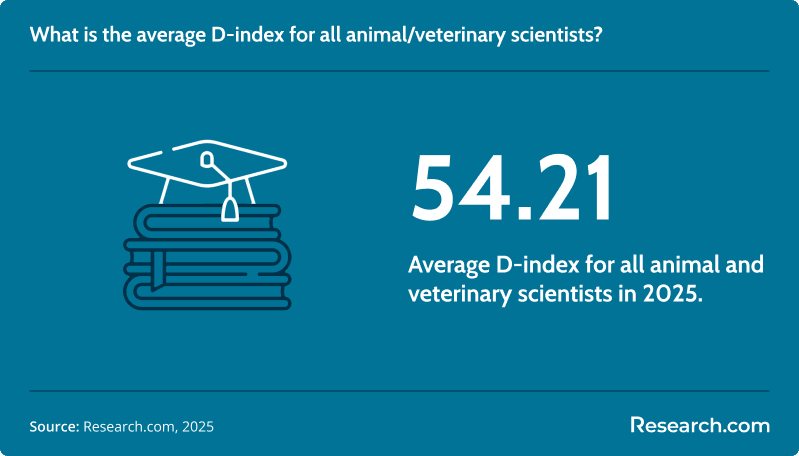
The average D-index among the top 1% of scientists is 116.2, while the overall average for all ranked scientists is 52.8.
The scholar with the lowest D-index to make the 2025 list holds a value of 20.
The top 1% of scientists have published an average of 611.8 papers, compared to 248.03 for all listed researchers.
The top 1% average 48,610.8 citations, while the overall average for all scientists is 11,272.22.
You can learn more about the methodology used to create the ranking here.
About Research.com
All research was coordinated by Imed Bouchrika, Ph.D., a computer scientist with a well-established record of collaboration on a number of international research projects with different partners from the academic community. His role was to make sure all data remained unbiased, accurate, and up-to-date.
Research.com is the number one research portal for science and educational rankings. Our mission is to make it easier for professors, research fellows, and students to progress with their research and find the top experts in a wide range of scientific disciplines. Research.com is also a leading educational platform that helps students find the best colleges, academic opportunities, and career paths.


