
2027 Best Online Graduate Certificate Nursing Informatics Programs

Co-Founder and Chief Data Scientist
For registered nurses (RNs) seeking to advance their careers without a full master's degree, an online graduate certificate in nursing informatics is an excellent choice. These programs are specifically designed to equip nurses with the skills needed to merge their clinical expertise with the power of information technology.
By focusing on areas like data analytics, electronic health records (EHRs), and clinical systems, a graduate certificate prepares you for high-demand, specialized roles that improve patient care and organizational efficiency. The flexibility of online learning makes it possible to earn this valuable credential while continuing to work, providing a clear path to career growth.
This article will help you find the best online graduate certificate nursing informatics programs, providing a comprehensive overview of what to look for, from accreditation and curriculum to cost and career outcomes.
What are the benefits of getting an online graduate certificate nursing informatics program?
- Graduates can pursue specialized, in-demand roles like Clinical Analyst, Nursing Informatics Specialist, or Healthcare IT Project Manager. While an RN's median salary is around $93,600, many nurse informaticists earn six-figure salaries, with some experienced professionals making over $150,000.
- The demand for nursing informatics professionals is strong and is expected to grow faster than average. The widespread use of Electronic Health Records (EHRs) and other digital health technologies in hospitals and other healthcare settings has created a consistent need for experts who can manage and optimize these systems.
- An online format allows working nurses to earn a specialized credential without having to put their careers on hold. The flexibility of studying at your own pace and from any location makes it possible to balance work, life, and academic commitments, making it an ideal option for busy professionals.
What can I expect from an online graduate certificate nursing informatics program?
An online graduate certificate in nursing informatics is a specialized, post-baccalaureate credential for Registered Nurses (RNs) who wish to blend their clinical knowledge with expertise in information technology. This program is designed to create a bridge between bedside care and the digital systems that support it, such as Electronic Health Records (EHRs) and data analytics platforms.
By focusing on the implementation, optimization, and management of these technologies, the certificate equips nurses with the skills to improve patient outcomes, enhance workflow efficiency, and contribute to data-driven decision-making in healthcare. The curriculum typically covers topics like clinical systems analysis, data management, project management, and quality improvement, preparing graduates for a range of leadership and specialty roles within the evolving digital healthcare landscape.
Where can I work with an online graduate certificate nursing informatics program?
Graduates of online graduate certificate nursing informatics programs are highly sought after in a wide range of industries and settings, reflecting the growing reliance on technology in healthcare. The most common employer is a hospital or multi-facility health system, where these professionals are essential for managing and optimizing Electronic Health Records (EHRs) and other clinical IT systems. They often work in IT departments or serve as a critical bridge to nursing and other clinical departments, ensuring technology enhances patient care and staff efficiency.
Beyond traditional hospitals, graduates also find rewarding careers in other healthcare facilities such as outpatient clinics, long-term care facilities, and rehabilitation centers, where they help implement and maintain smaller-scale but equally vital digital health solutions. Their unique blend of clinical knowledge and technical skills makes them invaluable in any environment where health data is created and managed.
In addition to direct healthcare providers, nursing informatics graduates can find opportunities with a variety of other organizations. This includes healthcare technology and software companies where they use their clinical perspective to help design and improve products. They are also employed by consulting firms that advise healthcare organizations on IT strategy and system implementation.
Furthermore, roles exist in government agencies that focus on public health, as well as in academic institutions where they may contribute to research or education. The flexibility of many informatics roles means a significant portion of professionals in this field can also work remotely, offering a better work-life balance compared to traditional bedside nursing.
How much can I make with an online graduate certificate nursing informatics program?
Graduates with a nursing informatics graduate certificate can expect a significant increase in their earning potential compared to a general Registered Nurse (RN). While the median salary for RNs is around $93,600 per year, professionals in nursing informatics typically earn more.
According to a HIMSS survey, a large percentage of nurse informaticists earn a base salary of over $100,000 annually, with many earning even more depending on their experience, location, and specific role. For instance, a Clinical Analyst may earn an average of about $98,500 per year, while more senior positions like Clinical Informatics Manager or Director can see salaries ranging from $120,000 to over $150,000.
The specific salary figures can vary widely based on several factors. Experience is a major determinant; nurses who transition into informatics after several years of clinical practice often command higher salaries. Geographical location also plays a significant role, with salaries in major metropolitan areas and states like California, New York, or Massachusetts generally being higher than in other regions.
Furthermore, earning professional certifications, such as the ANCC's Informatics Nursing Certification (NI-BC), and working for larger healthcare systems or technology companies can also lead to higher compensation. The certificate itself is a powerful credential that signals specialized expertise, making graduates highly valuable in a competitive job market.
- Best Online Graduate Certificate Nursing Informatics Programs for 2027 List of Programs
- How long does it take to complete an online graduate certificate nursing informatics program? Completion Time
- How does an online graduate certificate nursing informatics program compare to an on-campus program? How does an online graduate certificate nursing informatics program compare to an on-campus program?
- What is the average cost of an online graduate certificate nursing informatics program? Program Cost
- What are the financial aid options for students enrolling in an online graduate certificate nursing informatics program? Financial Aid
- What are the prerequisites for enrolling in an online graduate certificate nursing informatics program? Requirements
- What courses are typically in an online graduate certificate nursing informatics program? What courses are typically in an online graduate certificate nursing informatics program?
- What types of specializations are available in online graduate certificate nursing informatics programs? What types of specializations are available in online graduate certificate nursing informatics programs?
- How to choose the best online graduate certificate nursing informatics program? How to choose the best online graduate certificate nursing informatics program?
- What career paths are available for graduates of online graduate certificate nursing informatics programs? Career Paths
- What is the job market for graduates with an online graduate certificate nursing informatics program? Job Outlook
- Can non-nursing professionals transition into nursing informatics? Can non-nursing professionals transition into nursing informatics?
- What challenges should I expect in an online graduate certificate nursing informatics program? What challenges should I expect in an online graduate certificate nursing informatics program?
Best Online Graduate Certificate Nursing Informatics Programs for 2027
Nurses who enjoy clinical problem-solving but want to move closer to data, electronic health records, workflow design, and healthcare technology often consider a graduate certificate in nursing informatics. This credential can be a practical option if you already have a nursing degree and want focused graduate-level training without committing immediately to a full master’s or doctoral program.
This guide explains how online graduate certificate nursing informatics programs work, how long they take, what they cost, what admissions requirements to expect, and how to compare programs. It also highlights several programs, common career paths, financial aid options, and questions to ask before enrolling.
Quick answer: Is an online graduate certificate in nursing informatics worth considering?
An online graduate certificate in nursing informatics can be a strong fit for licensed nurses who want to work with electronic health records, clinical data, health IT implementation, workflow improvement, quality initiatives, or informatics leadership. Most programs are built for working nurses, often take about 12 to 16 months, and usually require prior nursing education and an active RN license. The best choice depends on accreditation, cost, curriculum, practicum requirements, certification alignment, and whether the program supports your target role.
How do we rank schools?
This ranking uses a transparent methodology that evaluates programs with data from established education sources, including the Integrated Postsecondary Education Data System (IPEDS), Peterson's databases and its Distance Learning Licensed Data Set, and the College Scorecard from the National Center for Education Statistics.
Because nursing informatics certificates vary widely in credits, format, practicum expectations, and eligibility rules, students should use rankings as a starting point rather than the only decision tool. Always confirm current tuition, admission policies, accreditation, and certificate requirements directly with the school before applying.
Featured online graduate certificate nursing informatics programs
| School | Certificate | Program length | Credits | Listed cost | Accreditation noted |
| Duke University School of Nursing | Health Informatics Post-Graduate Certificate | 12 months | 15-18credit hours | $705 | Commission on Collegiate Nursing Education (CCNE) |
| Johns Hopkins University | Post-Baccalaureate Certificate in Clinical Informatics | 12-24 months | 21 quarter credits or 10.5 semester credits | $1,275 | American Medical Informatics Association |
| University of Maryland School of Nursing | Nursing Informatics Certificate | 3 semesters | 19 credit hours | $926 | Commission on Collegiate Nursing Education (CCNE) |
| South University | Post-Graduate Certificate in Nursing Informatics | 12-18 months | 28 credit hours | $700 per credit hour | Commission on Collegiate Nursing Education (CCNE) |
| Ohio University | Clinical Informatics Certificate | 1.5 semesters (full-time) | 9 credit hours | $829 for in-state | Commission on Accreditation of Health Informatics and Information Management Education (CAHIIM) |
1. Duke University School of Nursing
Duke University provides a Health Informatics Certificate for registered nurses who hold either a bachelor’s or master’s degree. Applicants are expected to have at least one year of work experience in a health-related setting. The certificate blends online coursework, campus-based sessions, and a customized practicum experience.
- Program Length: 12 months.
- Tracks/Concentrations: Health Informatics Post-Graduate Certificate
- Program Cost: $705
- Required Credits to Graduate: 15-18credit hours
- Accreditation: Commission on Collegiate Nursing Education (CCNE).
2. Johns Hopkins University
The Johns Hopkins University School of Medicine offers a Post-Baccalaureate Certificate in Clinical Informatics for health professionals who already hold a master’s or health-professional degree, as well as bachelor’s-prepared applicants with relevant experience. Students study areas such as applied clinical informatics, precision medicine, and public health, with completion possible in as little as 12 months.
- Program Length: 12-24 months
- Tracks/Concentrations: Post-Baccalaureate Certificate in Clinical Informatics
- Program Cost: $1,275
- Required Credits to Graduate: 21 quarter credits or 10.5 semester credits
- Accreditation: American Medical Informatics Association
3. University of Maryland School of Nursing
The University of Maryland School of Nursing offers a 19-credit Nursing Informatics Certificate focused on core competencies in nursing informatics and healthcare informatics. Coursework is available online, while the practicum must be completed in an approved setting.
- Program Length: 3 semesters
- Tracks/Concentrations: Nursing Informatics Certificate
- Program Cost: $926
- Required Credits to Graduate: 19 credit hours
- Accreditation: Commission on Collegiate Nursing Education (CCNE)
4. South University
South University has an online Post-Graduate Certificate in Nursing Informatics for nurses who already hold a master’s or doctoral nursing degree. The program emphasizes information management, communication systems, and technology-supported decision-making across nursing practice settings.
- Program Length: 12-18 months
- Tracks/Concentrations: Post-Graduate Certificate in Nursing Informatics
- Program Cost: $700 per credit hour
- Required Credits to Graduate: 28 credit hours
- Accreditation: Commission on Collegiate Nursing Education (CCNE)
5. Ohio University
Ohio University offers a fully online graduate-level Clinical Informatics Certificate through its College of Health Sciences and Professions. The curriculum examines how clinicians store, access, retrieve, and analyze health information, and the certificate may connect to the Master of Integrated Health Studies.
- Program Length: 1.5 semesters (full-time)
- Tracks/Concentrations: Clinical Informatics Certificate
- Program Cost: $829 for in-state
- Required Credits to Graduate: 9 credit hours
- Accreditation: Commission on Accreditation of Health Informatics and Information Management Education (CAHIIM)
How long does it take to complete an online graduate certificate nursing informatics program?
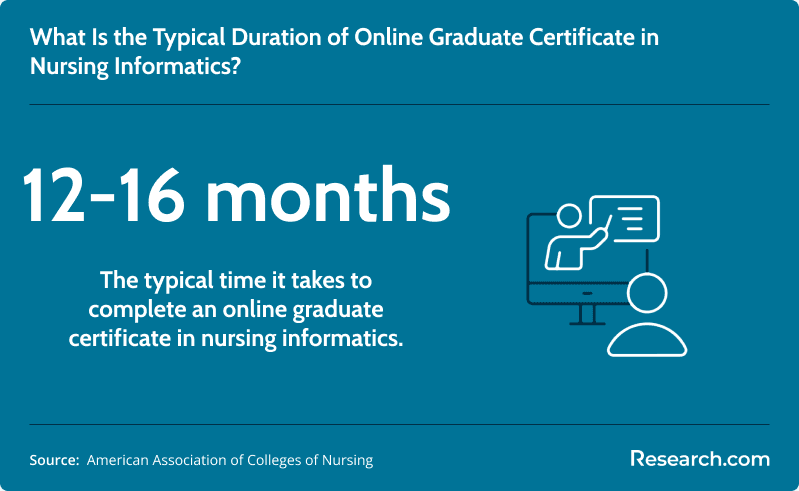
Most online graduate certificate nursing informatics programs take 12 to 16 months to finish. Some accelerated options can be completed more quickly, while part-time formats, practicum scheduling, and prerequisite requirements can extend the timeline.
| Factor | How it affects completion time |
| Course format | Many online certificates use 7- to 10-week courses, which can help working nurses progress steadily without taking a full semester course load. |
| Total credits | Certificate requirements often range from 12 to 19 credit hours, and programs with more credits generally require more time. |
| Enrollment pace | Some schools use a fixed sequence, while others allow students to move more slowly or take additional courses when their schedule allows. |
| Eligibility rules | Programs may require a BSN, MSN, active RN license, or specific clinical experience before admission. |
| Practicum placement | If the program includes a practicum, securing an approved site and preceptor can affect when you finish. |
The shorter timeline is one reason certificates appeal to working nurses. Compared with a full graduate degree, a certificate can help you add informatics training more quickly while continuing in your current role. If admission flexibility is a priority, compare requirements among the easiest online nursing informatics programs.
How does an online graduate certificate nursing informatics program compare to an on-campus program?
Online and campus-based nursing informatics certificates can cover similar academic content, but the learning experience is different. The right format depends on your work schedule, learning preferences, access to local programs, and need for in-person interaction.
| Comparison point | Online graduate certificate | On-campus graduate certificate |
| Best for | Working nurses who need schedule flexibility or live far from a preferred school | Students who want a structured classroom setting and regular face-to-face contact |
| Schedule | Often asynchronous or partially synchronous, depending on the program | Usually tied to set class meeting times and campus attendance |
| Location | Allows students to consider schools outside their immediate area | Requires commuting or relocation unless the school is nearby |
| Networking | Depends on virtual discussions, group projects, faculty access, and practicum connections | Can make in-person networking with classmates and faculty easier |
| Costs beyond tuition | May reduce commuting, parking, gas, and relocation expenses | May involve transportation, campus fees, housing, or other location-based costs |
| Support services | Requires strong online advising, technical support, library access, and career services | May provide easier physical access to campus offices, labs, libraries, and events |
Online study can be especially useful for nurses who cannot pause full-time work. It also expands the range of available schools, so you are not limited only to programs near your home. To compare broader nursing education options by cost and format, review available online nursing programs.
Campus programs may be a better match if you prefer live classroom discussion, immediate instructor feedback, and a predictable weekly schedule. The trade-off is reduced flexibility, which can be difficult for nurses working rotating shifts, nights, weekends, or family-heavy schedules.
What is the average cost of an online graduate certificate nursing informatics program?
The total cost of an online graduate certificate in nursing informatics commonly falls between $10,000 and $15,000, although the actual amount depends on the school, credit load, student residency, and fees. Like some online AGPCNP graduate certificate programs, many nursing informatics certificates charge by the credit, with rates ranging from around $500 to over $800 per credit hour.
| Cost factor | What to check before enrolling |
| Public or private institution | Private universities often list higher tuition than public institutions, though financial aid can affect net cost. |
| Residency status | Public schools may charge lower rates for in-state students, including in some online programs. |
| Credit requirement | Most certificate programs require between 12 and 19 credit hours, so a lower per-credit price may still lead to a higher total if the program requires more credits. |
| Fees and materials | Ask about application fees, technology fees, clinical placement fees, books, software, and course materials. |
| Travel or campus sessions | Hybrid programs may require campus visits, which can add transportation, lodging, and time-off-work costs. |
| Employer support | Tuition reimbursement can substantially reduce out-of-pocket cost if your employer covers informatics-related education. |
Cost should be evaluated against your career goal, not just the sticker price. A lower-cost program may be the better choice if it is accredited, respected by employers, and aligned with your target role. A higher-cost program may make sense if it offers stronger practicum support, specialized faculty, or a curriculum that directly prepares you for the work you want to do.
Education level can influence earning potential in nursing informatics. Among highly educated professionals in the field, including those with a doctorate or nurse practitioner degree, 25% report earning $176,000 or more annually. To understand how informatics training can connect to broader roles and compensation patterns, explore health informatics careers.
The chart below shows how formal education level relates to nurse informaticist salary patterns.
What are the financial aid options for students enrolling in an online graduate certificate nursing informatics program?
Financial aid for graduate certificates can be more limited than aid for full degree programs, so students should verify eligibility early. The first step is completing the Free Application for Federal Student Aid (FAFSA), then asking the school’s financial aid office whether the certificate qualifies for federal or state funding.
Some students in eligible graduate certificate programs may use Direct Unsubsidized Loans, but not every certificate is approved for federal aid. Before you commit, ask for a written explanation of what aid applies to your exact program and enrollment status. If you are still weighing the larger career pathway, read more about how to get into nursing informatics.
| Funding option | How it may help | Question to ask |
| FAFSA-based aid | May identify eligibility for federal or state aid, depending on program approval. | Is this certificate program approved for federal financial aid? |
| Direct Unsubsidized Loans | May be available for some eligible graduate certificate students. | Can certificate students borrow under this program at my enrollment level? |
| Employer tuition reimbursement | Healthcare employers may help pay for education related to informatics, systems, quality, or leadership. | Does my employer cover certificates, and do I need manager approval before enrolling? |
| Scholarships and grants | Professional organizations and nursing associations may offer awards that do not require repayment. | Are certificate students eligible, or are awards limited to degree-seeking students? |
| University payment plans | Can spread tuition payments across a term rather than requiring one full payment upfront. | Are there payment plan fees or deadlines? |
| Veterans benefits | Eligible veterans may be able to use Department of Veterans Affairs education benefits. | Does the school certify this program for VA benefits? |
| Private student loans | Can fill remaining funding gaps but may carry different rates and repayment terms. | What is the total repayment cost, and are there better lower-cost options first? |
Many healthcare organizations support nurses who pursue skills that improve system implementation, documentation accuracy, workflow efficiency, or patient safety. Before taking out loans, check whether your employer will cover part of the certificate in exchange for continued employment or service requirements.
What are the prerequisites for enrolling in an online graduate certificate nursing informatics program?
Admission requirements vary, but most online nursing informatics certificates expect applicants to show nursing preparation, professional licensure, academic readiness, and clinical experience. Programs connected to advanced nursing roles, including those leading toward MSN care coordination jobs, may use similar standards.
| Common prerequisite | Why it matters |
| Bachelor of Science in Nursing (BSN) | A BSN from an accredited institution is the typical baseline for graduate nursing certificate admission. Some schools may consider ADN-prepared applicants who already hold a graduate degree in a related field, but the BSN is the standard path. |
| Active, unencumbered RN license | Applicants usually need a current RN license with no restrictions or disciplinary conditions in the state where they will study or complete any required practicum. |
| Minimum GPA | A 3.0 GPA on a 4.0 scale is commonly expected, though some schools may consider conditional admission for applicants who are strong in other areas. |
| Professional nursing experience | Many programs prefer or require at least one year of clinical nursing experience so students can connect informatics concepts to real practice problems. |
| Technology readiness | Because coursework is online and informatics-focused, students need reliable internet access, comfort with learning platforms, and willingness to work with data and digital systems. |
Most applicants should also prepare a complete application file. This often includes official transcripts, a resume or CV, two or three recommendation letters, and a statement of purpose explaining why nursing informatics fits their professional goals. Some programs may request an interview or prior coursework such as undergraduate statistics.
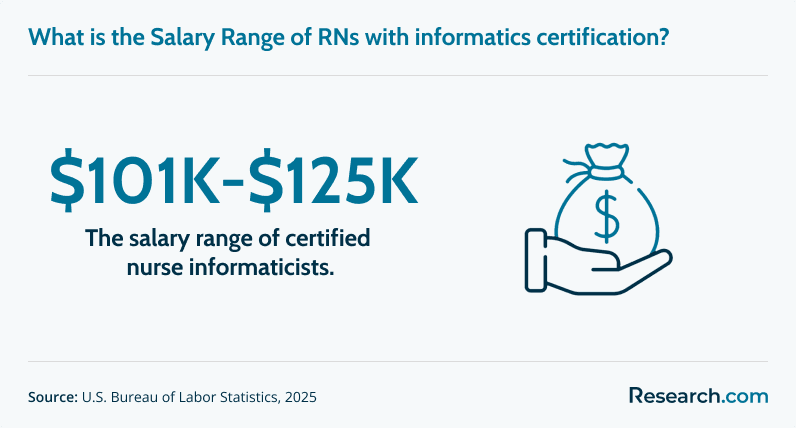
Certification can also influence career mobility. An informatics-related certification is associated with higher salaries among nursing informatics professionals, regardless of experience level, and certified nurse informaticists typically report salaries between $101,000 and $125,000. Nurses who want to strengthen their credentials may also explore other healthcare certifications in informatics, data systems, and health IT.
Recognized organizations connected to informatics and health information credentials include the American Nurses Association (ANA), the Healthcare Information and Management Systems Society (HIMSS), the American Medical Informatics Association (AMIA), and the American Health Information Management Association (AHIMA).
What courses are typically in an online graduate certificate nursing informatics program?
An online graduate certificate in nursing informatics usually combines nursing science, health information systems, data management, project leadership, and practical application. Like online masters higher education programs, the coursework is designed to move students beyond theory and into applied decision-making.
| Course area | What students usually learn | How it applies at work |
| Foundations of nursing informatics | Core concepts, field history, informatics theory, and the nurse informaticist’s role | Helps nurses understand how technology, communication, and information systems support care delivery |
| Clinical information systems | Selection, design, implementation, optimization, and evaluation of systems such as EHRs, patient portals, and telehealth tools | Prepares students to support technology adoption and improve clinical workflows |
| Healthcare data analysis | Data collection, management, analysis, visualization, and interpretation | Supports quality improvement, evidence-based practice, patient safety work, and operational decision-making |
| Healthcare project management | Planning, budgeting, implementation, stakeholder communication, and evaluation for health IT projects | Builds skills for EHR rollouts, system upgrades, workflow redesign, and informatics initiatives |
| Practicum or capstone | Applied experience in a healthcare or informatics setting under faculty or preceptor guidance | Allows students to demonstrate workplace-ready skills and build professional connections |
When comparing curricula, look beyond course titles. A strong program should show how students practice system evaluation, workflow analysis, change management, data-informed decision-making, and communication with both clinical and IT teams.
What types of specializations are available in online graduate certificate nursing informatics programs?
Nursing informatics is already a focused graduate specialty, but many programs allow students to emphasize a particular area through electives, practicum projects, or capstone topics. Similar to online masters in engineering management programs, the best fit depends on the professional problem you want to solve.
Common specialization areas
| Focus area | What it emphasizes | Possible roles |
| Clinical informatics | Use of technology to support direct care, EHR workflows, clinical decision support, and documentation improvement | Clinical analyst, informatics nurse specialist, EHR optimization specialist |
| Data analytics and quality improvement | Use of healthcare data to identify trends, measure outcomes, improve patient safety, and support performance improvement | Quality analyst, data-focused informatics specialist, clinical performance improvement role |
| Consumer health informatics | Patient-facing technologies such as portals, telehealth platforms, mobile health tools, and digital education resources | Patient engagement specialist, telehealth informatics role, digital health support role |
| Informatics leadership and management | Project management, strategic planning, budgeting, implementation leadership, and governance for health technology | Clinical informatics manager, director-level informatics role, Chief Nursing Informatics Officer pathway |
Clinical informatics is one of the most common directions because it sits directly between frontline nursing and health IT. Nurses in this area often translate clinical needs for technical teams and help staff use systems more effectively.
Data analytics and quality improvement may appeal to nurses who enjoy measurement, outcomes, and process change. As of 2025, 72% of nurse informaticists are employed in hospitals, making hospital-based data and workflow improvement an important employment area.
Nurse informaticists work in a variety of settings and take on roles that reflect how deeply technology is embedded in healthcare delivery. The following chart breaks down major practice settings.
How do you choose the best online graduate certificate nursing informatics program?
The best online nursing informatics certificate is not automatically the most famous, fastest, or cheapest option. It is the program that matches your admission profile, budget, schedule, practicum needs, and career target.
Step-by-step checklist for comparing programs
- Confirm accreditation first. Look for nursing accreditation through recognized organizations such as the Commission on Collegiate Nursing Education (CCNE) or the Accreditation Commission for Education in Nursing (ACEN), and verify the status directly with the accreditor or school.
- Check whether the curriculum supports certification goals. If you plan to pursue the Informatics Nursing Certification (NI-BC) through the American Nurses Credentialing Center (ANCC), ask how the program’s courses and practicum support that preparation. You can also compare broader nursing certifications.
- Review the course sequence. Make sure the program covers the informatics topics you need, such as EHR optimization, data analytics, project management, clinical decision support, privacy, or workflow redesign.
- Ask how practicum placement works. Some schools help identify sites and preceptors; others expect students to secure placements independently.
- Understand the online format. Ask whether classes are asynchronous, synchronous, hybrid, or self-paced, and whether any campus visits are required.
- Compare total cost, not just tuition. Include fees, books, software, travel, exam preparation, and any lost work hours.
- Evaluate faculty experience. Faculty with informatics practice, health IT leadership, analytics, or implementation experience can add practical value.
- Look at student support. Online students need accessible advising, technical help, library services, career guidance, and faculty communication.
Questions to ask before applying
- Is the certificate open to BSN-prepared nurses, MSN-prepared nurses, or both?
- Does the program require an active RN license in a specific state?
- Are there synchronous class meetings, and are they recorded?
- How many practicum hours are required, if any?
- Will the school help me find a practicum site near my location?
- Does the curriculum include EHR implementation, data analysis, workflow mapping, and project management?
- Can certificate credits transfer into a master’s program later?
- What is the total program cost after fees?
- Are certificate students eligible for financial aid, scholarships, or payment plans?
- What career services are available to online certificate students?
Common mistakes to avoid
| Mistake | Better approach |
| Choosing a program only because it is inexpensive | Compare accreditation, curriculum quality, practicum support, and employer recognition along with price. |
| Assuming every online program is fully flexible | Verify live class times, assignment deadlines, group work expectations, and campus visit requirements. |
| Ignoring practicum logistics | Ask early who finds the site, what settings qualify, and whether your workplace can be used. |
| Not checking certification alignment | Confirm whether coursework supports your long-term credentialing plan. |
| Looking only at rankings | Use rankings as one input, then evaluate fit, cost, outcomes, and requirements for your situation. |
| Assuming salary outcomes are guaranteed | Review salary data carefully and remember that pay depends on role, location, employer, experience, education, and certification. |
What career paths are available for graduates of online graduate certificate nursing informatics programs?
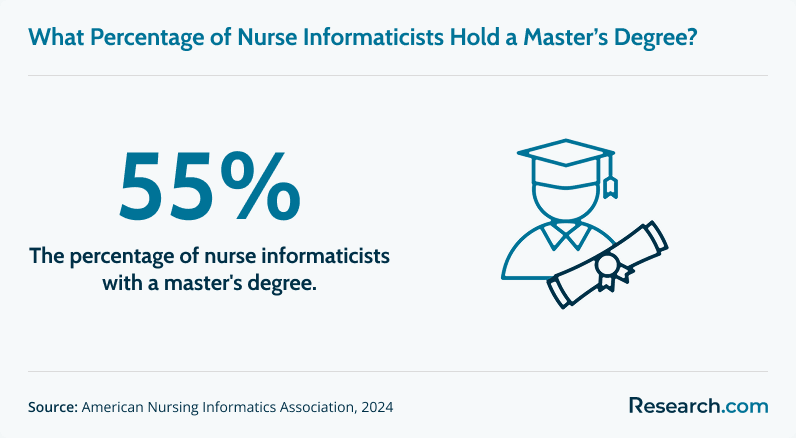
About 55% of nurse informaticists hold a master’s degree. Graduates of online nursing informatics certificates may pursue career paths in healthcare that connect nursing practice with technology, data, process improvement, and system implementation.
These roles typically use a nurse’s clinical background alongside newer skills in data management, workflow analysis, stakeholder communication, and health IT project support.
| Career path | Typical responsibilities | Good fit for nurses who enjoy |
| Clinical Analyst/Informatics Specialist | Serve as a bridge between clinical staff and IT teams, support EHR improvements, train users, and help systems fit nursing workflows. | Problem-solving, teaching, documentation improvement, and staff support |
| Informatics Nurse Specialist | Participate in system design, implementation, data collection, analysis, and technology-supported patient safety work. | Combining bedside knowledge with systems thinking |
| Clinical Informatics Manager | Lead informatics teams or initiatives, oversee technology projects, manage planning and budgets, and coordinate stakeholders. | Leadership, strategy, project oversight, and change management |
| Healthcare IT Project Manager | Manage technology projects such as EHR rollouts, upgrades, integration efforts, and workflow redesign initiatives. | Timelines, budgets, cross-functional teams, and implementation planning |
| Informatics Consultant | Advise healthcare organizations on informatics strategy, system selection, process improvement, and implementation challenges. | Autonomy, varied client work, analysis, and expert guidance |
With experience, nursing informatics professionals may move into leadership titles such as Director of Clinical Informatics or Chief Nursing Information Officer (CNIO). A certificate alone may not guarantee advancement, but it can help demonstrate focused preparation for technology-driven nursing roles.
What is the job market like for graduates of an online graduate certificate nursing informatics program?
The job market for nursing informatics is supported by healthcare’s continued reliance on technology to manage patient data, improve care coordination, support clinical decision-making, and track quality outcomes. Hospitals, health systems, vendors, consulting firms, public health organizations, and digital health companies all need professionals who understand both clinical practice and information systems.
The U.S. Bureau of Labor Statistics projects faster-than-average growth for health information technologists and medical records professionals. While that category is broader than nursing informatics, it reflects the same larger shift toward digital healthcare infrastructure, data management, and technology-enabled operations.
Earning potential is another reason nurses explore this field. HIMSS survey data indicates that a significant share of nurse informaticists earn base salaries above $100,000, which can compare favorably with general registered nurse pay. Actual earnings vary by employer, location, education level, certification, leadership responsibility, and years of experience.
The field may also offer more schedule variety than bedside nursing. Some informatics roles include remote or hybrid work, especially in analytics, EHR support, vendor relations, consulting, and project management. However, implementation periods, system go-lives, and training events may still require evening, weekend, or on-site work.
What do professionals say about online graduate certificate nursing informatics programs?
- : "The online certificate gave me a way to keep my full-time RN position while learning how to support EHR workflows and communicate more effectively with our IT team. I could apply what I was learning almost immediately in my hospital role. — Maria"
- : "As a parent with a packed schedule, the online format made graduate study possible. I completed coursework after family responsibilities were handled, and the virtual discussions still helped me connect with instructors and classmates. — David"
- : "I wanted a path out of routine bedside work without leaving nursing completely. The certificate strengthened my understanding of data analytics and EHR optimization, and it helped me qualify for a promotion and a significant salary increase. — Jessica"
Can non-nursing professionals transition into nursing informatics?
Professionals without a nursing background generally cannot move directly into nursing informatics roles that require RN licensure and clinical nursing judgment. They first need a nursing pathway that builds the clinical foundation employers expect. One option is to research accelerated BSN programs for non nurses online, which are designed for students who already have a non-nursing bachelor’s degree and want to qualify for nursing practice.
After earning the appropriate nursing degree, passing licensure requirements, and gaining clinical experience, a nurse can then pursue graduate-level informatics training. This sequence matters because nursing informatics depends on understanding real clinical workflows, documentation challenges, patient care priorities, and how technology affects frontline staff.
What challenges should I expect in an online graduate certificate nursing informatics program?
Online nursing informatics certificates are flexible, but they are not effortless. Students often balance graduate coursework with shift work, family responsibilities, and professional obligations. Because informatics coursework may include data, systems analysis, and project-based assignments, students should be ready for both independent study and applied technical learning.
| Challenge | How to prepare |
| Self-directed learning | Create a weekly study schedule before courses begin and protect time for readings, discussions, and projects. |
| Technology barriers | Test your internet connection, learning platform access, video tools, and required software early. |
| Limited in-person interaction | Use office hours, discussion boards, group projects, professional associations, and practicum contacts to build relationships. |
| Work-life-school balance | Talk with your manager and family about high-demand weeks, especially during practicum or capstone work. |
| Informatics terminology | Expect a learning curve around health IT, data standards, system implementation, and analytics concepts. |
| Academic readiness | If you are still completing undergraduate nursing preparation, comparing the easiest online RN to BSN degree programs may help you plan the next step before graduate certificate study. |
Key Insights
- An online graduate certificate in nursing informatics is best suited for licensed nurses who want focused training in health IT, EHR systems, data, workflow improvement, and clinical technology leadership.
- Most programs take about 12 to 16 months, though credit requirements, practicum placement, and part-time enrollment can change the timeline.
- Total program cost often falls between $10,000 and $15,000, but students should compare full cost after fees, books, technology expenses, and possible campus visits.
- Accreditation, practicum support, curriculum relevance, and certification alignment matter more than choosing solely by price or ranking.
- Common career paths include clinical analyst, informatics nurse specialist, healthcare IT project manager, clinical informatics manager, and informatics consultant.
- Certification and advanced education can strengthen career prospects, but salaries are not guaranteed and depend on role, employer, location, experience, and credentials.
- Non-nurses usually need to complete nursing education and RN licensure first because nursing informatics roles rely on clinical judgment and real-world care experience.
References:
- American Nurses Association. (2025). ANIA 2025 fact sheet. ANIA.
- Healthcare Information and Management Systems Society. (n.d.). HIMSS nursing informatics workforce survey. HIMSS.
- Healthcare Information and Management Systems Society. (n.d.). Nursing informatics workforce salary and benefits report. HIMSS.
- Healthcare Information and Management Systems Society. (2023). 2022 nursing informatics workforce survey. HIMSS.
- U.S. Bureau of Labor Statistics. (2024, May 8). Health information technologists and medical registrars. Occupational Outlook Handbook.
- Zippia. (n.d.). Informatics nurse jobs demographics. See also ANIA nursing informatics data.
Other Things You Should Know About the Best Online Graduate Certificate Nursing Informatics Programs
When selecting an online graduate certificate nursing informatics program, ensure it is accredited by organizations like the Commission on Collegiate Nursing Education (CCNE) or the Accreditation Commission for Education in Nursing (ACEN). These accreditations ensure quality education, adherence to academic standards, and can enhance career prospects in 2027.
Admission requirements for 2026 online graduate certificate nursing informatics programs typically include a bachelor's degree, an active RN license, and relevant work experience. Some programs may also require prerequisite courses in nursing or informatics, personal statements, and letters of recommendation.


