
2027 Cheapest and Fastest Online Wind Turbine Technician Certificate Programs

Co-Founder and Chief Data Scientist
Choosing an online wind turbine technician certificate program is a practical decision for people who want to enter renewable energy without committing to a long degree. Wind turbines already account for nearly 8% of electricity generation globally, and maintaining these systems requires technicians who can work safely at height, troubleshoot electrical and mechanical systems, and keep turbines operating reliably.
This guide is for career changers, recent high school graduates, trade school students, and working adults comparing fast and affordable wind turbine technician training options. It explains what online programs cover, how long they take, what they cost, which programs may fit different budgets and timelines, and what career outcomes to expect after completion.
Quick Answer: Is an Online Wind Turbine Technician Certificate Worth It?
An online wind turbine technician certificate can be worth it for students who want a short, career-focused path into wind energy and can meet the physical demands of the job. These programs commonly prepare learners for entry-level roles in turbine maintenance, field service, blade repair, installation support, and wind farm operations. The strongest programs combine online technical coursework with hands-on training, safety preparation, or simulation-based labs.
What are the benefits of getting an online wind turbine technician certificate program?
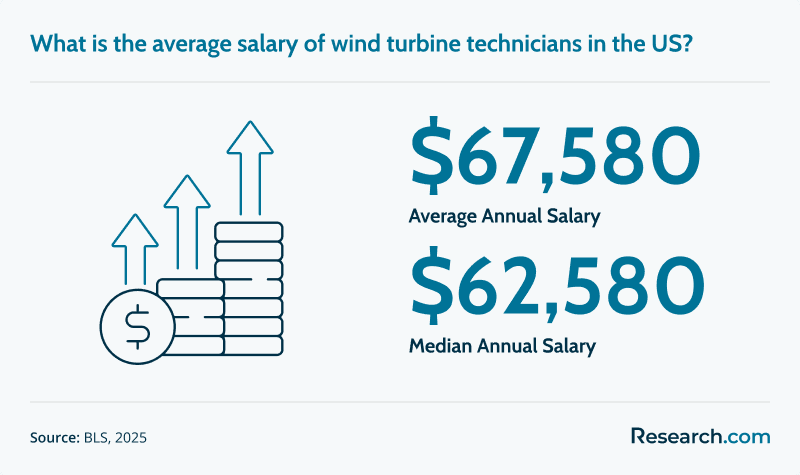
- Wind turbine technicians earn an average annual salary of $67,580 and a median annual salary of $62,580.
- Graduates may qualify for roles such as wind turbine technician, blade repair technician, field service technician, wind turbine installation technician, and wind farm operations and maintenance team member.
- Online programs can be easier to fit around work or family responsibilities than campus-based programs, and some offer lower tuition, modular payment options, or self-paced schedules.
What can I expect from an online wind turbine technician certificate program?
An online wind turbine technician certificate program usually focuses on the technical and safety knowledge needed to inspect, maintain, troubleshoot, and repair wind turbine systems. Students learn how turbines produce electricity, how mechanical and hydraulic systems function, how electrical circuits and controls are used in turbines, and how technicians document and respond to faults.
Most online programs are not purely lecture-based. Many use videos, interactive modules, 2D and 3D animations, virtual electrical labs, circuit simulations, and turbine system software to help students practice diagnostic thinking. Some programs also include required or optional in-person training, such as a short boot camp, lab session, climbing practice, OSHA training, First Aid/CPR, or other safety preparation.
The right program should help you build three kinds of readiness: technical readiness for turbine systems, safety readiness for field work, and job readiness for entry-level technician roles. Because wind turbine work is hands-on and physically demanding, students should look carefully at how each online program handles practical training before enrolling.
Where can I work with an online wind turbine technician certificate program?
Wind turbine technician certificate graduates typically work wherever turbines are built, installed, monitored, or maintained. Some positions are located at a single wind farm, while others require travel between sites. Work settings can also differ depending on whether the employer is a utility, manufacturer, contractor, maintenance provider, or training organization.
| Work Setting | What Technicians Usually Do There | Best Fit For |
| Onshore wind farms | Inspect turbines, complete scheduled maintenance, diagnose faults, replace parts, and support daily wind farm operations. | Students who want the most common wind technician work environment and are comfortable working in rural or remote areas. |
| Offshore wind farms | Maintain turbines located in oceans or seas, often with additional safety requirements such as GWO sea survival training. | Technicians willing to work in a marine environment and spend extended periods on vessels or platforms. |
| Manufacturing facilities | Assist with turbine component assembly, quality control, equipment maintenance, and production support. | Learners who prefer factory-based technical work instead of frequent tower climbing. |
| Service and maintenance companies | Provide operations and maintenance services for wind farm owners, often traveling to different turbine sites. | Technicians who like varied assignments and do not mind travel. |
| Utilities and energy companies | Maintain wind assets owned by power producers or utility companies. | Graduates seeking employer-based wind farm operations roles. |
| Training centers | Teach turbine safety, electrical systems, mechanical systems, or field procedures after gaining industry experience. | Experienced technicians who want to move into instruction or workforce training. |
How much can I make with an online wind turbine technician certificate program?
According to the United States Bureau of Labor Statistics (BLS), wind turbine technicians earn an average annual salary of $67,580 and a median annual salary of $62,580. The median is higher than the collective median annual pay of all occupations in the country ($49,500).
Reported earnings for wind turbine technicians range from $49,110 to $88,090, with higher pay possible for technicians who gain experience, earn additional safety or technical credentials, move into high-demand regions, or advance into lead, supervisory, or managerial roles. New graduates should not assume they will start near the top of the range; entry-level pay usually depends on location, employer type, travel expectations, safety credentials, and prior mechanical or electrical experience.
| Career Stage | Typical Positioning | Pay Consideration |
| New graduate or entry-level technician | Completes preventive maintenance, assists senior technicians, documents repairs, and builds field experience. | More likely to start near the lower end of the salary range. |
| Experienced wind technician | Troubleshoots electrical, hydraulic, mechanical, and control system problems with less supervision. | Pay may rise with tenure, certifications, and employer demand. |
| Lead technician or site-level specialist | Coordinates maintenance work, supports safety procedures, mentors junior technicians, or specializes in advanced repairs. | Higher earnings may be possible, especially in hard-to-staff locations. |
| Managerial or operations role | Oversees crews, maintenance schedules, safety compliance, or wind farm performance. | May exceed standard technician pay ranges depending on role and employer. |
- Cheapest and Fastest Online Wind Turbine Technician Certificate Programs for 2027
- How long does it take to complete an online wind turbine technician certificate program?
- How does an online wind turbine technician certificate program compare to an on-campus program?
- What is the average cost of an online wind turbine technician certificate program?
- What are the financial aid options for students enrolling in an online wind turbine technician certificate program?
- What are the prerequisites for enrolling in online wind turbine technician certificate programs?
- What courses are typically in an online wind turbine technician certificate program?
- What are the skills needed to become a successful wind turbine technician?
- How to choose the best online wind turbine technician certificate program?
- What career paths are available for graduates of online wind turbine technician certificate programs?
- What is the job market for graduates of online wind turbine technician certificate programs?
Cheapest and Fastest Online Wind Turbine Technician Certificate Programs for 2027
How do we rank programs?
Certificate training can be shorter than a degree, but it still requires careful comparison. Tuition, hands-on requirements, accreditation, employer recognition, and time to completion can vary widely. To identify programs for this guide, we reviewed information from credible education data sources, including the IPEDS database, College Scorecard, Peterson's database, and the National Center for Education Statistics.
Readers who want a fuller explanation of Research.com’s ranking process can review our methodology page.
| Program | Length | Cost | Best For |
| George Brown College Wind Turbine Technician Program | 32 weeks | $1,750; $580 pay-as-you-learn | Students seeking a low-cost, fully online, self-paced option. |
| Pinnacle Career Institute Online Wind Turbine Technician Certificate | 40 weeks | $23,464 | Learners who want online coursework plus a hands-on boot camp. |
| Texas State Technical College Wind Energy Technician Certificate of Completion | 1 year | $9,720 | Students who want a hybrid public college pathway with 36 credits. |
| High Plains Technology Center Advanced Wind Energy Technician | 20 weeks | $7,057 annual cost | Students seeking intensive hands-on training and included certifications. |
| Universal Technical Institute Wind Turbine Technician Training Program | 7 months | $31,598 in-state; $38,251 out-of-state | Learners who want employer-informed hybrid training. |
| University of Houston-Downtown Wind Turbine Technician | 32 weeks | $1,750; $580 pay-as-you-learn | Students looking for asynchronous, simulation-supported online training. |
| Colby Community College Wind Technology Technical Certificate | 1 year | $145 in-district; $150 in-state; $204 out-of-state; $230 international per credit | Students wanting an online community college certificate with optional boot camps. |
| Renewable Energy Institute Wind Power | 3 months | $627 | Beginners or professionals seeking a short wind power course. |
| Danish Wind Power Academy Online Wind Turbine Training | 15 days | $4,395 for Advanced Component Theory | Working professionals needing focused turbine model or component training. |
| Farmingdale State College Sustainable Energy Certificate | 1 semester | $353 per credit | Students interested in broader sustainable energy systems, not only wind. |
1. George Brown College Wind Turbine Technician Program
The George Brown College Wind Turbine Technician Certificate Program is a fully online and self-paced option built for students preparing for entry-level wind energy work. The program costs $1,750 and is typically completed in 32 weeks. Its 14 modules use multimedia instruction and simulation software to teach turbine servicing, diagnosis, repair, and installation concepts. Graduates may pursue positions in wind farm construction, operation, maintenance, blade repair, and turbine service.
- Program Length: 32 weeks
- Required Credits to Graduate: 14 modules
- Total Cost: $1,750; $580 (pay-as-you-learn)
- Accreditation: Canadian Government
2. Pinnacle Career Institute Online Wind Turbine Technician Certificate
The Pinnacle Career Institute Online Wind Turbine Technician Certificate Program combines flexible online study with a required practical component. Over 40 weeks, students study electricity, hydraulics, wind physics, safety, and related technical topics before attending a 10-day hands-on boot camp in Kansas City, Missouri, at no additional cost. This format may appeal to students who want distance learning but also need structured in-person practice for job readiness.
- Program Length: 40 weeks
- Required Credits to Graduate: N/A
- Total Cost: $23,464
- Accreditation: Accrediting Commission of Career Schools and Colleges
3. Texas State Technical College Wind Energy Technician Certificate of Completion
The Texas State Technical College Wind Energy Technician Certificate of Completion is a 12-month hybrid program offered at the Harlingen and Sweetwater campuses. The program costs approximately $9,720 and requires 36 credits. Coursework includes digital fundamentals, SCADA systems, wind turbine materials, electromechanical equipment, and programmable logic controllers. Graduates are prepared for technical work in wind turbine construction, manufacturing, utilities, and power generation environments.
- Program Length: 1 year
- Required Credits to Graduate: 36
- Total Cost: $9,720
- Accreditation: Southern Association of Colleges and Schools Commission on Colleges
4. High Plains Technology Center Advanced Wind Energy Technician
The High Plains Technology Center Advanced Wind Energy Technician program is an intensive option located in a major U.S. wind region. Students train in safety, AC/DC electricity, mechanical drive systems, hydraulics, preventive maintenance, and wind-specific field skills. Facilities include a working 100kW turbine, 2.3 MW nacelle, and indoor climbing tower. The program also includes preparation for credentials such as GWO, OSHA, CPR/First Aid, and confined space rescue. It is offered twice a year, is PELL-eligible, and includes scholarship opportunities through partners such as Duke Energy and AT&T.
- Program Length: 20 weeks
- Required Credits to Graduate: N/A
- Annual Cost: $7,057
- Accreditation: Oklahoma Board of Career and Technology Education
5. Universal Technical Institute Wind Turbine Technician Training Program
The Universal Technical Institute Wind Turbine Technician Training Program is a hybrid training pathway developed with employer input. Students study energy industry fundamentals, DC and AC electrical theory, industrial controls, renewable energy systems, and wind turbine operations. The curriculum emphasizes compliance and safety, including ANSI and GWO standards, climbing and rescue procedures, and hands-on turbine component work. Applicants must meet education requirements such as a high school diploma, GED, or equivalent.
- Program Length: 7 months
- Required Credits to Graduate: N/A
- Total Cost: $31,598 (in-state); $38,251 (out-of-state)
- Accreditation: Accrediting Commission of Career Schools and Colleges
6. University of Houston-Downtown Wind Turbine Technician
The University of Houston-Downtown Wind Turbine Technician online certificate is an asynchronous program designed for students preparing for entry-level turbine service work. The program averages 32 weeks to complete and includes 14 interactive modules covering wind energy theory, electricity, electronics, safety, PLCs, SCADA, and other technical topics. Students use learning tools such as 3DLab, CircuitLogix Pro, and PLCLogix 500. The full program costs $1,750, while the pay-as-you-learn option starts at $580. Students may take up to two years to complete the program.
- Program Length: 32 weeks
- Required Credits to Graduate: 14 modules
- Total Cost: $1,750; $580 (pay-as-you-learn)
- Accreditation: Southern Association of Colleges and Schools Commission on Colleges
7. Colby Community College Wind Technology Technical Certificate
The Colby Community College Wind Technology Technical Certificate is a one-year, fully online program requiring 37 credit hours. The curriculum covers wind and solar energy, electronics, energy technologies, power storage and transmission, hybrid systems, and a final internship. Students may also attend optional Saturday boot camps every eight weeks for hands-on experience. This option may suit learners who want an online renewable energy certificate from a community college with an applied component.
- Program Length: 1 year
- Required Credits to Graduate: 37
- Cost per Credit: $145 (in-district); $150 (in-state); $204 (out-of-state); $230 (international)
- Accreditation: Higher Learning Commission
8. Renewable Energy Institute Wind Power
The Renewable Energy Institute Wind Power course is a short online course covering wind power theory, turbine technology, design, maintenance, environmental impact, and policy incentives. The program includes 20 hours of CPD-accredited instruction, expert-led video lessons, and access to resources through the REI Resource Centre. Participants receive a certificate of participation and may take the internationally recognized Galileo Master Certificate (GMC). At $627, it may be useful for beginners exploring wind energy or professionals who want targeted knowledge rather than a full technician program.
- Program Length: 3 months
- Required Credits to Graduate: N/A
- Total Cost: $627
- Accreditation: Scottish Qualifications Authority
9. Danish Wind Power Academy Online Wind Turbine Training
Danish Wind Power Academy provides online wind turbine training designed for working professionals and organizations that need focused instruction without stopping operations. Offerings include advanced component theory, advanced platform theory, and shorter technical sessions on areas such as hydraulics, controls, and gearboxes. Live instruction is delivered by TUV-certified trainers and may include breakout rooms and applied exercises. Courses can be tailored to turbine models, job roles, language needs, and time zones.
- Program Length: 15 days
- Required Credits to Graduate: N/A
- Cost per Course: $4,395 (Advanced Component Theory);
- Accreditation: N/A
10. Farmingdale State College Sustainable Energy Certificate
The Farmingdale State College Sustainable Energy Certificate is a fully online, one-semester program covering solar PV, wind energy, energy storage, and geothermal systems. It is broader than a wind turbine technician certificate because it also addresses sustainable energy integration, policy awareness, environmental impact, and public communication. Graduates may pursue entry-level opportunities with utility companies, alternative energy firms, government agencies, or advocacy organizations.
- Program Length: 1 semester
- Required Credits to Graduate: 18
- Cost per Credit: $353
- Accreditation: Middle States Commission on Higher Education
How long does it take to complete an online wind turbine technician certificate program?
Most online wind turbine technician certificate programs can be completed in 6 months to a year, although individual timelines vary by school, schedule, course load, and whether hands-on sessions are required. Many of these credentials are offered through trade schools, community colleges, technical colleges, and continuing education providers.
| Program Pace | Typical Length | Who It Fits Best | Trade-Off |
| Accelerated | 4 to 6 months | Full-time students, career changers with technical experience, or learners who can commit more weekly study time. | Faster completion, but less room to absorb difficult electrical and mechanical content. |
| Standard-paced | 9 to 12 months | Working adults, part-time students, and learners balancing school with family responsibilities. | More manageable schedule, but a longer wait before entering the workforce. |
| Short professional course | 15 days to 3 months | Professionals seeking targeted wind energy knowledge or component-specific training. | May not provide the same entry-level technician preparation as a longer certificate. |
According to College Board, 34.42% of wind turbine service technicians in the country completed a certificate program, 28.74% earned a high school diploma or less, 21.78% finished some college, and 15.07% have an associate degree. This shows that a certificate is a common pathway, but it is not the only route into the occupation.
How does an online wind turbine technician certificate program compare to an on-campus program?
Online and on-campus wind turbine technician programs can both lead to career preparation, but they serve different students. Wind technician training is often considered one of the good trades to learn because it can be completed faster than many degrees and is tied to a growing energy field. However, students should choose the format based on how much structure, hands-on access, and schedule flexibility they need.
| Factor | Online Certificate Program | On-Campus or Hybrid Program |
| Schedule | Often self-paced or asynchronous, making it easier to study around work. | Usually follows a fixed class and lab schedule. |
| Location | Accessible from any location with reliable internet, unless a boot camp or lab visit is required. | Requires regular travel to campus or relocation near the training site. |
| Hands-on practice | May rely on simulations, virtual labs, local arrangements, or short in-person boot camps. | Typically provides repeated access to tools, equipment, climbing towers, nacelles, or lab systems. |
| Cost | May reduce commuting, housing, and campus-related expenses. | May involve higher living, travel, or campus service costs. |
| Instructor interaction | Usually through email, discussion boards, learning platforms, and video sessions. | More immediate in-person feedback and peer collaboration. |
| Best fit | Self-directed learners who need flexibility and can arrange any required practical training. | Students who learn best through structured labs and face-to-face instruction. |
When an online program makes sense
- You need to keep working while training for a new career.
- You live far from a wind energy training campus.
- You are comfortable using simulations and online learning systems.
- The program includes a credible plan for hands-on practice, safety training, or field readiness.
When an on-campus or hybrid program may be better
- You want repeated practice with physical equipment before applying for jobs.
- You prefer a fixed schedule and direct supervision.
- You need help building confidence with climbing, tools, electrical systems, and safety procedures.
- The campus has strong local employer relationships for internships, apprenticeships, or hiring pipelines.
What is the average cost of an online wind turbine technician certificate program?
Many online wind turbine technician certificate programs cost between $1,500 and $2,000, with an average cost of approximately $1,750. Some online trade schools and continuing education providers use this pricing model for fully online programs that include tuition, learning materials, simulation software, exams, and technical support.
For example, the University of Houston-Downtown and George Brown College both list a full program cost of $1,750. They also provide a pay-as-you-learn option that starts at $580, covering the first module and learning package, with additional modules available at $90 each. This structure can help students start with a lower upfront cost while progressing at their own pace. These programs are often completed in about 32 weeks, with up to two years allowed for completion.
Costs can rise sharply when a program includes extensive hands-on labs, in-person boot camps, campus facilities, or longer credit-bearing coursework. Before enrolling, students should compare total cost, not just advertised tuition.
| Cost Item | Why It Matters | Question to Ask |
| Tuition | The main program charge, but not always the full cost. | Is tuition charged per program, module, course, or credit? |
| Technology and software | Some programs require simulation tools or Windows-compatible software. | Are lab software, simulations, and exams included? |
| Hands-on training | Boot camps may require travel even if instruction is mostly online. | Is the boot camp required, and who pays for travel and lodging? |
| Safety certifications | Credentials such as OSHA, CPR/First Aid, or GWO-related training may improve job readiness. | Which certifications are included in the listed price? |
| Equipment and supplies | Some programs may require tools, safety gear, or computer upgrades. | What must I buy separately before starting? |
| Completion timeline | Longer enrollment may affect access to materials or additional fees. | How long do I have to finish without paying extra? |
What are the financial aid options for students enrolling in an online wind turbine technician certificate program?
Students considering wind turbine technician training should check financial aid eligibility before enrolling, especially because some non-degree certificate programs do not qualify for traditional federal aid. As with electrician trade schools, funding depends on the institution, accreditation, program structure, student status, and state or local workforce rules.
- Federal and State Financial Aid: Some accredited programs at public colleges or eligible institutions may qualify for grants or loans. Students should complete the FAFSA (Free Application for Federal Student Aid) to confirm eligibility.
- Scholarships and Grants: Renewable energy organizations, schools, workforce agencies, and regional partners may offer funding for technical education or clean energy training.
- Payment Plans and Modular Pricing: Some programs reduce upfront cost through pay-as-you-learn models or module-based payments.
- Employer Tuition Assistance: Students already employed in energy, manufacturing, maintenance, or industrial settings may be able to use employer reimbursement or training sponsorships.
- Veterans Benefits: Eligible veterans and military-affiliated students may be able to use GI Bill benefits or other military education funding for qualifying programs.
- Workforce Development and Apprenticeship Programs: Local workforce boards, technical colleges, and wind energy employers may support subsidized training or paid work-and-learn options.
What are the prerequisites for enrolling in online wind turbine technician certificate programs?
Admission requirements vary by school, but most online wind turbine technician certificate programs expect students to have basic academic readiness, reliable technology access, and the physical ability to prepare for field-based work. Applicants should read program requirements carefully because online coursework does not remove the physical realities of wind technician jobs.
- High School Diploma or Equivalent: Most programs require a high school diploma, GED, or equivalent. Some may admit students aged 19 or older as mature students even without a diploma.
- Technical Aptitude: Prior exposure to electronics, mechanical systems, tools, troubleshooting, or industrial maintenance can help, even when it is not required for admission.
- Computer and Internet Access: Students usually need a reliable computer and internet connection. Some programs specify a Windows-based system with a modern processor such as Intel Core i3 or AMD Ryzen 3 and above, at least 4 GB RAM, adequate storage, and software compatibility. Certain tools may not run on Mac, Chromebook, or Linux devices.
- Physical Requirements: Hybrid programs or employers may expect students to climb ladders, work at heights, lift equipment, and operate safely in confined or elevated spaces.
- Age and Residency Requirements: Some schools may set minimum age rules, residency requirements, or location-based tuition policies.
The industries that employ the most technicians are wind electric power generation (28%), commercial and industrial machinery and equipment repair and maintenance (21%), power and communication line construction (13%), self-employed professionals (12%), and machinery and equipment merchant wholesalers (9%).
Students comparing technical careers can also review related training for the highest paying trade jobs in their area, especially if they already have mechanical, electrical, or maintenance skills that could transfer to another field.
What courses are typically in an online wind turbine technician certificate program?
Online wind turbine technician programs usually combine renewable energy fundamentals with electrical, mechanical, hydraulic, safety, and control system coursework. The goal is to help students understand both how a turbine works and how technicians respond when performance drops, components fail, or safety risks appear.
| Course Area | What Students Learn | Why It Matters on the Job |
| Introduction to Wind Turbines | Wind industry basics, turbine types, major components, and the role of technicians. | Gives students the vocabulary and system-level understanding needed for later courses. |
| Safety, Maintenance & Repairs | Worksite safety, preventive maintenance, troubleshooting procedures, and repair practices. | Safety and maintenance discipline are central to field work. |
| Wind Energy Theory | Aerodynamics, wind-to-electricity conversion, and energy production concepts. | Helps technicians understand performance issues and turbine behavior. |
| Basic Electricity | AC/DC concepts, circuits, measurements, and electrical components. | Electrical troubleshooting is a core part of turbine maintenance. |
| Direct Current (DC) Circuits | DC circuit behavior, wiring, measurements, and simulation-based practice. | Supports safe and accurate work with turbine electrical systems. |
| Alternating Current (AC) Circuits | AC power systems, loads, and electrical principles used in generation systems. | Prepares students for real turbine electrical environments. |
| Power Electronics | Power conversion, control devices, and turbine efficiency systems. | Modern turbines depend on electronic controls and energy conversion equipment. |
| Transformers, Motors & Generators | Operation and maintenance of electromechanical equipment. | These components are central to turbine power generation and system reliability. |
| Electrical Code & Blueprint Reading | Codes, safety standards, schematics, and technical drawings. | Technicians must read documentation accurately and follow safety rules. |
| Mechanical & Hydraulic Systems | Gears, bearings, lubrication, brakes, hydraulics, and mechanical assemblies. | Many turbine failures involve mechanical or hydraulic systems. |
| Monitoring & Communication Systems | SCADA systems, turbine monitoring, alerts, and communications. | Technicians use data to diagnose problems and prioritize repairs. |
| Programmable Logic Controllers (PLCs) | PLC basics and automated control functions. | PLCs help control turbine operations and automated responses. |
Students who enjoy mechanical and diagnostic work may also compare related programs at automotive technician trade schools, particularly if they want a broader set of repair and maintenance career options.
What are the skills needed to become a successful wind turbine technician?
Wind turbine technicians need more than classroom knowledge. The role requires technical accuracy, physical stamina, safety discipline, and the ability to solve problems in challenging field conditions. Employers often look for candidates who can learn quickly, document work clearly, follow procedures, and stay calm while working at height.
- Mechanical and Electrical Knowledge: Technicians must understand gears, brakes, bearings, hydraulics, rotating equipment, AC/DC circuits, transformers, motors, generators, and power electronics.
- Troubleshooting and Problem-Solving: A major part of the job involves diagnosing mechanical, hydraulic, electrical, and control system faults using tools, software, and logical testing methods.
- Safety Awareness: Fall protection, electrical safety, confined space procedures, rescue protocols, and emergency response are essential because the work can be hazardous.
- Technical Communication and Documentation: Technicians must record maintenance activity, complete reports, log repairs, and communicate clearly with supervisors and crew members.
- Familiarity with Technology: SCADA systems, computer diagnostics, PLCs, and digital monitoring tools are increasingly important in turbine operations.
- Physical Fitness and Stamina: The job may involve climbing turbine towers, carrying tools, working in tight spaces, and spending long periods outdoors.
- Attention to Detail: Small errors in inspection, wiring, lubrication, or documentation can affect turbine reliability and safety.
- Teamwork and Collaboration: Wind technicians often work in crews where coordination and communication are necessary for safe maintenance.
- Adaptability and Continuous Learning: Turbine technology, safety procedures, and employer expectations change over time, so technicians need to keep skills current.
The industries that offer the highest average annual salaries to wind turbine technicians, as shown by the chart below, are machinery, equipment, and supplies merchant wholesalers ($75,550); company management ($73,560); and engine, turbine, and power transmission equipment manufacturing ($68,870).
How to choose the best online wind turbine technician certificate program?
The best online wind turbine technician certificate program is not always the cheapest or fastest one. The right choice depends on your budget, schedule, physical readiness, location, career goals, and need for hands-on training. Use the following criteria before committing to a program.
| Selection Factor | Why It Matters | What to Verify Before Enrolling |
| Accreditation and reputation | Accreditation can affect financial aid, transfer options, and employer confidence. | Confirm the accreditor, institutional status, and whether employers recognize the credential. |
| Hands-on training | Wind turbine work is physical and equipment-based. | Ask whether labs, boot camps, climbing practice, or field experiences are required or optional. |
| Safety credentials | Employers value applicants who understand workplace safety from day one. | Check whether OSHA, First Aid/CPR, GWO-related training, or rescue practice is included. |
| Curriculum depth | Programs should cover electrical, mechanical, hydraulic, PLC, SCADA, and maintenance topics. | Review the course list and compare it with entry-level job postings. |
| Schedule flexibility | Self-paced programs can help working adults, but they require discipline. | Find out whether courses are asynchronous, synchronous, full-time, or part-time. |
| Total cost | Fees, software, travel, and equipment can change the real price. | Request a full cost breakdown, including boot camp travel if applicable. |
| Career support | Job search help can be valuable in a specialized field. | Ask about employer partnerships, resume support, interview preparation, and placement assistance. |
| Technology requirements | Some programs require specific operating systems or simulation tools. | Confirm computer specifications before paying tuition. |
Common mistakes to avoid
- Choosing only by price: A low-cost program may be a good value, but not if it lacks practical training or employer relevance.
- Ignoring accreditation: Accreditation can influence aid eligibility, credibility, and future education options.
- Assuming online means no in-person requirement: Some programs include mandatory boot camps or labs.
- Overlooking physical demands: Turbine work often involves heights, climbing, lifting, and outdoor conditions.
- Forgetting travel costs: A “free” boot camp may still require airfare, lodging, meals, or time away from work.
- Expecting guaranteed salary outcomes: Pay varies by region, employer, experience, certifications, and demand.
What career paths are available for graduates of online wind turbine technician certificate programs?
Graduates usually start in field-oriented roles that involve turbine inspection, repair, installation support, monitoring, or maintenance planning. Some roles require additional experience, safety credentials, travel, or specialized training.
| Career Path | Main Responsibilities | Good Fit For |
| Wind Turbine Technician | Inspect turbines, perform preventive maintenance, troubleshoot faults, and repair electrical, mechanical, and hydraulic systems. | Graduates who want the most direct wind technician role. |
| Wind Turbine Installation Technician | Support turbine assembly, installation, construction, retrofits, and commissioning work. | Students open to project-based work and travel. |
| Blade Technician | Inspect, repair, and maintain turbine blades, often while working at height or using rope-access methods. | Technicians interested in a specialized repair niche. |
| Field Service Technician | Travel between sites to diagnose problems, complete repairs, and support customers or wind farm operators. | Graduates who want variety and can handle frequent travel. |
| Control and Monitoring Technician | Use SCADA and monitoring tools to track performance, respond to alerts, and support outage response. | Learners with strong technology, data, and systems interests. |
| Preventive Maintenance Technician | Focus on scheduled inspections, lubrication, component checks, and maintenance routines. | Entry-level graduates building field experience. |
| Health and Safety Technician | Support safety compliance, training, documentation, and worksite procedures in wind energy settings. | Technicians interested in safety management and training. |
| Wind Energy Support Specialist | Coordinate tools, parts, maintenance schedules, logistics, and service planning. | Students who want a technical-administrative role rather than full-time tower work. |
The US states that offer the highest average annual salaries to wind turbine technicians are California ($94,320), Kentucky ($82,470), and Pennsylvania ($77,090).
What is the job market for graduates of online wind turbine technician certificate programs?
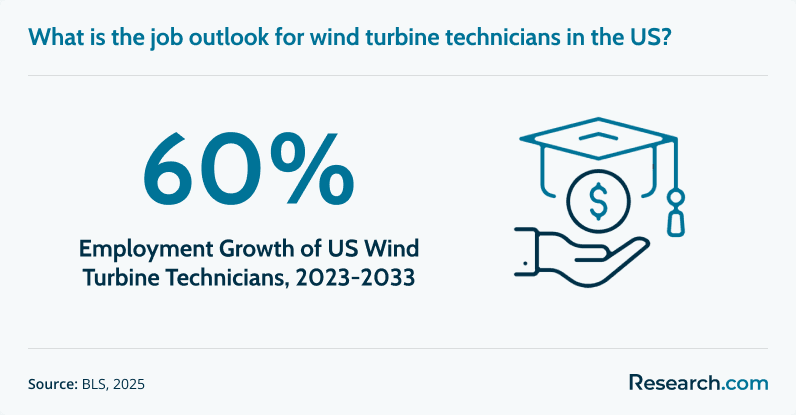
According to the BLS, employment of wind turbine technicians in the United States is projected to grow by 60% from 2023 to 2033, much faster than the average growth rate for all occupations in the country (4%). The occupation is expected to increase from 11,400 workers in 2023 to about 18,200 by 2033, adding 6,800 professionals to the workforce.
During that period, the BLS expects around 2,100 job openings for wind turbine technicians each year. Indeed currently reports over 500 openings for the role in the country. Graduates can improve their chances by targeting high-demand regions, employers with active wind assets, and roles that match their technical strengths.
The industries that employ the most wind turbine technicians are electric power generation and distribution (3,450), commercial and industrial machinery and equipment (2,290), and utility system construction (1,460). The US states employing the most technicians are Texas (3,570), Iowa (710), and Oklahoma (550).
Current trends affecting wind turbine technician training
- Growing reliance on monitoring systems: Technicians increasingly work with SCADA systems, digital diagnostics, sensors, and performance data. Programs that include controls and monitoring can better prepare students for modern turbine operations.
- Greater emphasis on safety credentials: Because technicians work at height, around electrical systems, and sometimes in remote environments, employers value formal safety preparation and documented training.
- Expansion of offshore wind work: Offshore roles can require additional safety preparation, marine survival training, and different scheduling expectations than onshore work.
- Employer preference for practical experience: Online coursework is useful, but hands-on practice with tools, climbing systems, and turbine components can make graduates more competitive.
- Stackable technical skills: Electrical, mechanical, hydraulic, PLC, and troubleshooting skills can also support advancement into maintenance leadership, field service, operations, or related industrial roles.
Questions to ask before enrolling
- Is the institution accredited, and by which agency?
- Does the program include hands-on training, a boot camp, lab work, or field experience?
- Are safety credentials such as OSHA, First Aid/CPR, or GWO-related training included?
- What is the total cost after software, exams, travel, equipment, and fees?
- Can I complete the program while working full-time?
- What computer system and software do I need?
- How long do I have to complete the program?
- Does the school provide career support or employer connections?
- What roles have recent graduates pursued?
- Will the program prepare me for the physical demands of climbing, heights, and outdoor work?
Here's What Graduates Have to Say About Their Online Wind Turbine Technician Certificate Programs
-
: "
"Online study gave me the time to work through the mechanical and electrical concepts behind wind power without rushing. The practical modules helped me connect troubleshooting lessons to real turbine maintenance. Today, I feel like I am part of the clean energy workforce." - Ray
"
-
: "
"The best part of the program was being able to replay lessons and review digital resources whenever a topic felt difficult. That made the technical material less overwhelming, and instructor support was easy to access online. The certificate helped me make a confident move into a new field." - Dave
"
-
: "
"I was unsure about changing careers into wind energy, but the online format made the transition possible. The lessons, simulations, and safety content helped me understand turbine operations before stepping into the field. The flexibility made a real difference." - Mark
"
Key Insights
- An online wind turbine technician certificate is best for students who want a shorter pathway into renewable energy and can handle a self-directed learning format.
- Employment of wind turbine technicians in the United States is projected to grow by 60% from 2023 to 2033, compared with 4% for all occupations.
- Wind turbine technicians earn an average annual salary of $67,580 and a median annual salary of $62,580, but entry-level wages vary by location, employer, experience, and credentials.
- Many online wind turbine technician certificate programs cost between $1,500 and $2,000, but programs with extensive hands-on training can cost much more.
- Most online certificate programs take 6 months to a year, while some short professional courses can be completed faster but may not offer full entry-level technician preparation.
- Hands-on readiness matters. Before enrolling, confirm whether the program includes labs, boot camps, climbing practice, safety credentials, or simulation-based technical training.
- Certificate training is a common pathway: 34.42% of wind turbine service technicians in the country completed a certificate program, while others entered with a high school diploma or less, some college, or an associate degree.
- The strongest program choice is the one that balances cost, accreditation, schedule, safety preparation, technical depth, and realistic career support.
References:
- BLS (2024, April 3). 49-9081 Wind Turbine Service Technicians. BLS
- BLS (2025, June 4). Industry: Cross-industry, Private, Federal, State, and Local Government Period: May 2024. BLS
- BLS (2025, April 18). Wind Turbine Technicians. BLS
- College Board. What education level do Wind Turbine Service Technicians have? College Board
- Fernandez, L. (2024, June 24). Share of electricity generation from wind energy sources worldwide from 2010 to 2023. Statista
Other Things You Should Know About Online Wind Turbine Technician Certificate Programs
To find the most economical and rapid online wind turbine technician certificate programs for 2027, research accredited institutions and compare tuition costs, program duration, and available resources. Ensure that the program aligns with industry standards and offers hands-on training opportunities, as these factors significantly influence cost-effectiveness and speed.
In 2027, the quickest and most affordable online programs for wind turbine technician certificates emphasize rapid skill development. These programs offer flexible schedules with a focus on core technical skills. They typically use a mix of online modules and practical components, ensuring graduates are job-ready and meet industry standards.
In 2027, the cheapest and fastest online wind turbine technician programs offer self-paced learning, comprehensive curriculum, and hands-on virtual labs. Tuition costs typically range from $1,500 to $3,500, and programs can be completed in 3 to 6 months depending on dedication and prior experience.


