
2027 Is a Graphic Design Degree Worth It?

Co-Founder and Chief Data Scientist
You have a passion for design, but a nagging voice asks if it's a "real" career that can provide a stable future. This uncertainty, pitting your creative drive against the need for financial security, is a common hurdle. The fact that 68% of professional graphic designers hold a bachelor's degree suggests that formal education is a critical step, but is a graphic design degree worth it for you?
Our career planning experts, with more than 10 years of experience, have created this guide to replace that uncertainty with data-driven clarity. We will break down the costs, benefits, and long-term career outcomes to help you make a confident, strategic decision about your future.
Key Things You Should Know About Graphic Design Degree Programs
- The annual median wage for graphic designers was a solid $61,300, providing a stable financial foundation for a professional career.
- The field has a steady demand, with an average of 20,000 job openings for graphic designers projected each year for the next decade.
- A bachelor’s degree in graphic design or a related field is the typical requirement for entry into the profession.
- Programs focus on teaching timeless principles of design, strategic thinking, and visual communication, not just how to use specific software.
- The career offers a defined trajectory for growth, with opportunities to advance into senior roles, such as Art Director.
- How much do graphic designers make? Salary
- What is the current demand for graphic designers? Job Outlook
- What education is required to become a graphic designer? Education Requirements
- How much does a graphic design degree typically cost? Degree Cost
- What key skills do you learn in a graphic design program? Skills
- How does a degree help you build a professional portfolio? How does a degree help you build a professional portfolio?
- What is the long-term career path for a graphic designer? What is the long-term career path for a graphic designer?
- Which industries pay the most for graphic designers? Top Industries
- Can you succeed as a graphic designer without a degree? Can you succeed as a graphic designer without a degree?
- How is AI changing the future of graphic design? How is AI changing the future of graphic design?
- What are the major pros and cons of getting a graphic design degree? What are the major pros and cons of getting a graphic design degree?
- How can you make a graphic design degree worth it? How can you make a graphic design degree worth it?
How much do graphic designers make?
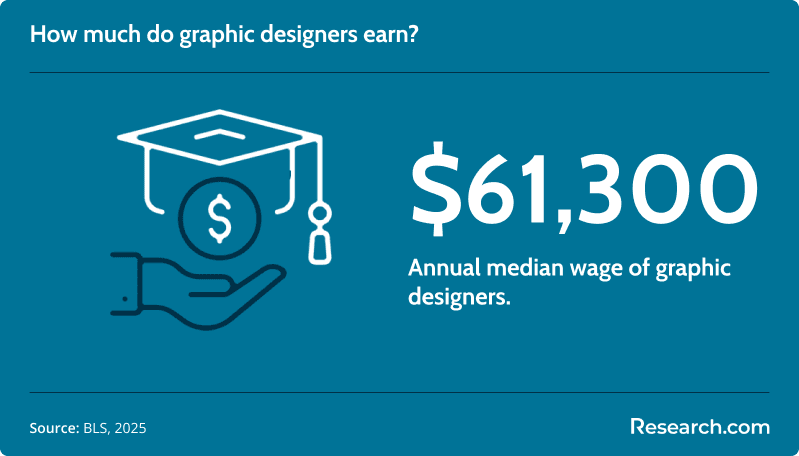
Graphic designers earn a stable, professional wage, with the annual median pay standing at $61,300. This figure is one of the most critical pieces of evidence when considering is a graphic design degree worth it or even broader questions like is a general studies degree worth it, as it directly counters the outdated myth of the "starving artist" and establishes a baseline for a secure, middle-class income.
This median salary represents the midpoint for the profession—meaning half of all designers earned more than this amount and half earned less. It reflects the earnings of designers across various industries and experience levels. For those just starting, this number provides a reassuring benchmark. At the same time, for those with ambition, it serves as a solid foundation from which to grow.
Salary Growth Through Education and Experience
While experience is a significant factor in salary growth, education plays a key role in unlocking higher earning potential from the start. An insider tip to remember is that credentials can set your initial salary baseline. For example, while the average salary for a designer with a bachelor's degree is around $53,661, those who pursue a master's degree can see that average jump to $58,581.
This demonstrates that employers often reward the advanced strategic skills and specialized knowledge gained in a graduate program. Over time, combining this higher educational credential with a strong portfolio and years of professional experience is the most reliable path to securing senior-level roles and a six-figure income.
What is the current demand for graphic designers?
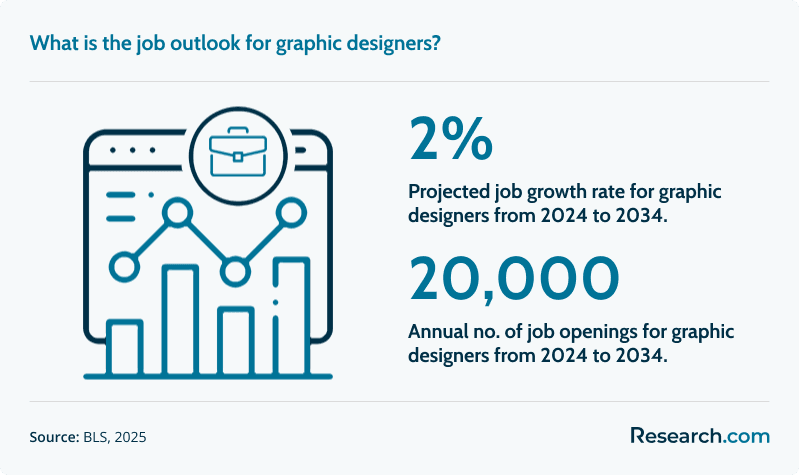
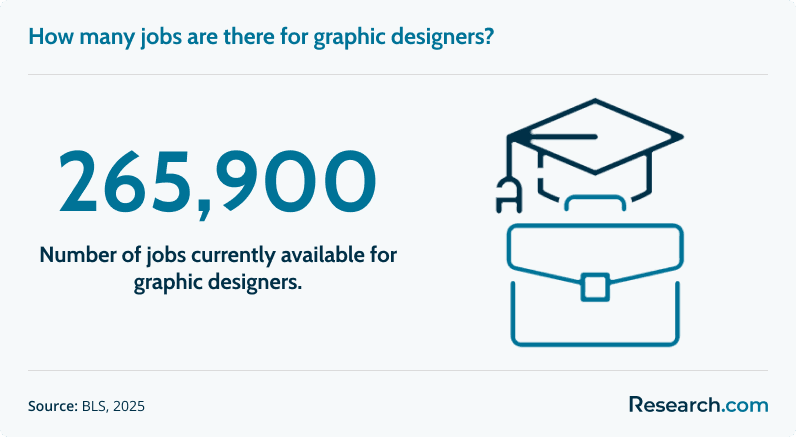
The demand for graphic designers remains steady despite slower-than-average growth, providing a sizable job market for qualified professionals. In 2024, there were 265,900 jobs for graphic designers, with employment projected to grow 2 percent from 2024 to 2034 and about 20,000 openings each year, on average, over the decade.
Just as students today ask “what is media literacy” to understand the skills needed to navigate modern information landscapes, understanding trends in graphic design helps aspiring professionals align their education with market demand. This data shows a healthy and active employment landscape.
While the overall projected job growth rate is 2%, it's crucial to see the story behind that number. This figure reflects a significant shift in the industry: demand is moving away from traditional print publications and expanding rapidly in digital areas. This means that designers with skills in web design, user experience (UX), and digital media are more in demand than ever. For a new generation of designers, this isn't a shrinking field—it's a field that is evolving to be more central to the modern economy.
What education is required to become a graphic designer?
A bachelor's degree in graphic design or a related fine arts field is the standard education required to become a professional graphic designer. While some in the industry are self-taught, data shows that the most reliable and common path into the profession is through formal education. In fact, 68% of working graphic designers have a bachelor's degree, establishing it as the benchmark credential that employers expect to see.
Many prospective students also ask “is a creative writing MFA degree worth it” to evaluate the value of specialized graduate programs, highlighting the importance of understanding the ROI of any advanced degree.
This degree signals to employers that you have undergone a rigorous, structured program covering not just technical skills but also the history, theory, and strategic thinking that underpin professional design work. It is the clearest way to differentiate yourself from a hobbyist and position yourself as a serious candidate for a long-term career.
Unique Advantages of the Degree
While a strong portfolio is essential, a degree program provides distinct advantages that are difficult to replicate on your own. Think of the degree as the structured environment that helps you build that portfolio to a professional standard while also giving you a competitive edge.
- Structured Feedback Loops. In a degree program, you receive constant, expert critiques from professors and peers, which accelerates your skill development far more quickly than working in isolation.
- Professional Networking. You are immediately immersed in a community of fellow designers and connected to faculty with industry experience, building a professional network before you even graduate.
- Access to Resources. Universities provide access to high-end software, printing labs, and other expensive resources that are often out of reach for an individual.
- Collaborative Project Experience. Many courses are built around team-based projects, teaching you the vital communication and collaboration skills needed to succeed in a professional creative environment.
How much does a graphic design degree typically cost?
The cost of a graphic design degree varies widely depending on the type of institution you choose to attend. Based on recent data, the average annual tuition and fees for a full-time program can range from around $11,827 at a public university to $20,515 or more at a private institution.
Students often wonder “is a double major worth it” when weighing tuition costs against potential career benefits, making it important to consider both financial and academic outcomes.
It's important to view these figures as a starting point. A key detail to remember is that the "sticker price" is rarely what most students actually pay. Financial aid, including scholarships, grants, and loans, can significantly reduce the total cost of attendance. This means you have the flexibility to find a high-quality program that aligns with your career goals and your budget.
Accelerated Programs as a Cost-Saving Strategy
One of the best ways to manage the investment in your education is to consider a more condensed path. For students who are focused on entering the workforce quickly, exploring the shortest graphic design programs online can be a powerful cost-saving strategy. These programs often allow you to complete your bachelor's degree in less than the traditional four years.
By finishing your degree sooner, you not only save on tuition and fees for the semesters you skip but also reduce your living expenses. More importantly, this allows you to start your professional career earlier, meaning you can begin earning a salary and gaining valuable experience while your peers may still be in school. This approach provides an actionable solution for managing both the time and money invested in your degree.
What key skills do you learn in a graphic design program?
In a graphic design program, you learn a strategic framework for visual problem-solving that goes far beyond simply mastering software. While technical proficiency with tools like Adobe Creative Cloud is a component, the core of a degree program is to teach you the timeless, tool-agnostic principles that separate a technician from a true design strategist.
- Master the principles of design theory. You will gain a deep understanding of composition, color theory, typography, and visual hierarchy, which are the foundational building blocks of all effective visual communication.
- Develop strategic thinking. Coursework challenges you to move beyond aesthetics and focus on solving business problems, ensuring your design choices are always tied to a clear purpose and objective.
- Learn to communicate visually. A degree teaches you the language of visual storytelling, enabling you to create designs that effectively inform, persuade, and connect with a target audience.
- Cultivate critical thinking and active listening. You will learn how to analyze a creative brief, understand client needs, and incorporate feedback, which are essential skills for professional success.
These skills are what employers are truly looking for, as they form the basis for high-value specializations. For instance, many of the best online user experience design degrees are built upon these core principles of strategic, human-centered design.
How does a degree help you build a professional portfolio?
A graphic design degree helps you build a professional portfolio by providing the ideal structure, guidance, and opportunities to create competitive, job-ready work before you graduate. This process is designed to solve a common problem for aspiring designers: how to create professional-quality pieces without having professional clients.
Think of your degree curriculum as a series of strategic portfolio-building projects. Each assignment challenges you with a different real-world scenario, from creating a brand identity for a fictional company to designing a user interface for a mobile app. This allows you to demonstrate a wide range of skills and creative solutions.
Furthermore, you are building this portfolio under the direct guidance of experienced professors who can provide expert feedback to elevate your work. Many programs also integrate internships, giving you the chance to add work for actual clients to your portfolio. This means you don't just graduate with a diploma; you graduate with a curated collection of your best work, ready to impress potential employers.
What is the long-term career path for a graphic designer?
The long-term career path for a graphic designer offers a clear, structured progression from entry-level execution to senior-level strategy and leadership. A typical trajectory begins with a role as a Junior Designer, focused on production and learning. With experience, you can advance to a Senior Designer, taking on more complex projects and client-facing responsibilities, before ultimately reaching a common senior-level role like Art Director.
As an Art Director, you become responsible for the overall visual style and direction for major projects, managing teams and making high-level strategic decisions. This path shows a clear ladder for growth within a corporate or agency structure.
Alternatively, many designers build a long-term career through entrepreneurship. With 18% of graphic designers being self-employed, building a freelance business or starting a design studio is a well-established and viable path for those who seek more autonomy. This means you have the power to choose a career trajectory that aligns with your personal and professional goals.
Specialization Pathways: Motion Graphics and Digital Media
Another powerful way to advance your career is by developing a deep expertise in a high-demand specialty. As the design world becomes increasingly digital, skills in motion graphics and animation have become particularly valuable. This specialization opens up opportunities in industries like advertising, film, television, and tech.
For those looking to fast-track their entry into this exciting field, accelerated online animation degree programs provide a focused curriculum to build these specific skills. By specializing, you not only increase your earning potential but also position yourself as an expert in a growing segment of the industry, creating a distinct and valuable long-term career path.
Which industries pay the most for graphic designers?
The highest-paying industries for graphic designers are in the technology and government sectors. For example, designers working for software publishers earn an annual mean wage of $98,330, while those employed by the Federal Executive Branch earn an average of $101,080. These figures demonstrate that design skills are highly valued and well-compensated in some of the most stable and respected sectors of the economy.
While many people associate graphic design primarily with advertising agencies and specialized design firms, the reality is that designers are integrated into nearly every industry. The fact that top salaries are found in tech and government proves that design is not a peripheral service but a core function of major organizations. This means a design degree can be a gateway to a secure and lucrative career in a wide variety of professional environments.
Emerging Opportunities in Entertainment and Tech
Beyond established corporate roles, some of the most exciting and high-paying opportunities are emerging at the intersection of entertainment and technology. The video game industry, in particular, has a growing demand for skilled designers who can create immersive visual experiences, from user interfaces to in-game assets.
This niche requires a unique blend of artistic talent and technical skill, and it is a field where specialization is highly rewarded. For those interested in this dynamic career path, exploring the shortest online game art and design programs can provide a focused and efficient way to gain the specific skills needed to enter this lucrative sector of the entertainment tech industry.
Can you succeed as a graphic designer without a degree?
While it is possible to succeed as a graphic designer without a degree, it is a harder and less certain path, with the degree representing the most reliable route to senior roles and long-term career stability. Many talented self-taught designers build successful careers, particularly as freelancers. However, for those seeking to climb the ladder in a corporate environment, the lack of a formal credential can become a significant barrier.
The key difference comes down to institutional validation. A degree provides a clear, universally understood signal to employers that you have a comprehensive foundation in design principles. This is often the key that unlocks the door to interviews for competitive corporate jobs.
For a self-taught professional asking is a graphic design degree worth it, the answer often lies in the structure of the industry itself. For instance, while 63% of writers are self-employed, only 18% of designers are. This suggests that the pathway to success for many designers runs through companies where a bachelor's degree is the standard entry requirement, making the credential a powerful tool for advancement.
How is AI changing the future of graphic design?
Artificial intelligence is changing the future of graphic design by becoming a powerful co-pilot, automating routine tasks and freeing up human designers to focus on high-level strategy and creative problem-solving. While there is a valid concern that automated design tools may reduce the need for designers for more basic tasks, AI is not a replacement for a professional designer.
Instead of making designers obsolete, AI is evolving the role. It can rapidly generate iterations, handle tedious production work, and analyze data to suggest design directions. This allows the human designer to shift their focus from being a "pixel-pusher" to a true creative director, guiding the technology and making the critical strategic decisions that AI cannot. The future of design belongs to those who can leverage AI as a tool to enhance their own creativity and efficiency.
What Skills Keep a Designer Irreplaceable?
The skills that make a human designer irreplaceable are precisely the ones that AI cannot replicate: strategy, empathy, and critical thinking. These are the core competencies that are developed and refined in a formal degree program. Data supports this, showing that 88.5% of jobs in the arts and design fields require more than just basic people skills.
AI can generate an image, but it cannot conduct a client discovery meeting to understand a business's core challenges. It can suggest color palettes, but it cannot empathize with a target audience to create a design that truly resonates with them. It can create layouts, but it cannot build a comprehensive brand strategy that aligns with long-term corporate goals. These human-centric skills are, and will remain, the most valuable assets a professional designer brings to the table.
What are the major pros and cons of getting a graphic design degree?
Answering the question, "Is a graphic design degree worth it?", involves weighing a clear set of advantages against the significant investment of time and money. Based on the evidence, here is a summary of the significant pros and cons to help you make your final determination.
- Pro: It provides the most reliable career path. A degree is the standard credential in the industry, opening doors to more job opportunities and providing a structured route to advancement.
- Pro: It accelerates your skill and portfolio development. You gain a deep understanding of design theory and build a professional portfolio under expert guidance in a condensed timeframe.
- Pro: It unlocks higher long-term earning potential. A formal credential is a key factor in securing higher-paying senior and specialized roles within top industries.
- Con: It requires a significant financial investment. Tuition and fees represent a substantial upfront cost that must be carefully considered and planned for.
- Con: It demands a major time commitment. A traditional bachelor's degree takes several years to complete, which represents a significant period of dedication to your studies.
The decision rests on your personal career goals. For those seeking a stable, long-term professional career, the advantages of a degree are clear and compelling.
How can you make a graphic design degree worth it?
The most powerful way to answer "Is a graphic design degree worth it for me?" is to actively make it so. The ultimate return on your investment is determined by the proactive choices you make during your program, treating it not as a passive credential but as an active opportunity to build your skills, network, and professional reputation.
To maximize the degree's value, focus on these key actions:
- Choose the right program. Select a school with strong industry connections, experienced faculty, and a curriculum that aligns with your specific career interests.
- Seek out internships. Real-world experience is invaluable. Actively pursue internships to apply your skills, learn from professionals, and add compelling work to your portfolio.
- Develop a specialization. Identify a high-demand niche that excites you, such as UX/UI design or motion graphics, and take elective courses to build a specialized skill set.
- Network relentlessly. Connect with your professors, peers, and guest speakers. These relationships are the foundation of your professional network and can lead to future opportunities.
By taking these steps, you transform your degree from a simple qualification into a strategic launchpad for a successful and fulfilling career. This proactive mindset is key, especially in a field with such a significant economic impact; the value added by arts and culture to the U.S. economy has more than doubled over the last 25 years, underscoring the growing importance of creative professions.
Planning for a Long-Term Career: The Role of Graduate Education
As you advance in your career, you may eventually seek to move into senior leadership or strategic roles that require a different level of expertise. For many designers, planning for this next step involves considering graduate education.
A master's degree can provide the advanced knowledge needed to pivot into high-level positions. For instance, a top online master's in strategic communication degree can equip a seasoned designer with the skills to lead a corporate communications department or a creative agency. Viewing education as a lifelong tool for advancement is the ultimate way to ensure your career continues to grow and evolve over the long term.
Here’s What Graduates Have to Say About Their Graphic Design Degree Program
- Lina: "I always had the creative talent, but my parents were worried about me making a living from it. The degree program gave me a structured path and a professional vocabulary that completely changed their perspective. Seeing my final portfolio, filled with projects for real-world scenarios, proved to them and to me that this was a serious and respectable career choice. My confidence grew immensely because I finally had the credentials to back up my passion."
- Darius: "I was a self-taught designer hitting a clear income ceiling. I could handle the software, but I couldn't command the rates of a formally trained professional. Going back to school online to get my degree was a strategic business decision. The program taught me the principles of UX/UI design, a specialization that allowed me to confidently take on much more complex and lucrative projects. It was the best investment I ever made in my career."
- Conrad: "The biggest fear I had was that graphic design was a dead-end job with no room for growth. My professors, who were all industry veterans, completely dismantled that myth for me. They mapped out the entire career ladder, from my first job to becoming an art director. The networking opportunities were incredible; I met professionals who showed me exactly how they built their long-term careers, which gave me a clear vision for my own future."
Key Findings
- The annual median wage of $61,300 serves as a definitive counter-narrative to the "starving artist" myth, providing the financial validation that a stable, middle-class income is the professional standard.
- With 68% of working designers holding a bachelor's degree, the credential is not merely an advantage but the established industry benchmark, offering the market credibility needed to be competitive.
- The career offers clear dual paths for long-term growth, with a structured ladder to senior roles, such as Art Director, and a robust entrepreneurial option, as evidenced by the 18% of self-employed designers.
- Graphic design is a critical function in high-status sectors, with top salaries in the Federal Government ($101,080 average) and software publishing, proving the profession is both respected and financially rewarding.
- The job market is consistently active and can support new talent, with an average of 20,000 openings projected each year, countering fears of oversaturation.
- Human skills remain the most valuable asset in the field, as 88.5% of arts and design jobs require high-level people skills like strategy and empathy, which are irreplaceable by AI.
References:
- National Center for Education Statistics. (2025). Integrated Postsecondary Education Data System (IPEDS), Trend Generator. U.S. Department of Education. Retrieved September 22, 2025, from NCES.
- National Endowment for the Arts. (2025). Arts and Cultural Industries Grew at Twice the Rate of U.S. Economy, Adding $1.2 Trillion. Retrieved September 22, 2025, from NEA.
- O*Net Online. (2025). 27-1024.00 - Graphic Designers. Retrieved September 22, 2025, from O*Net Online.
- U.S. Bureau of Labor Statistics. (2025a). Occupational Employment and Wages, 27-1024 Graphic Designers. Occupational Employment and Wage Statistics. Retrieved September 22, 2025, from BLS.
- U.S. Bureau of Labor Statistics. (2025b). Graphic Designers. Occupational Outlook Handbook. Retrieved September 22, 2025, from BLS.
- U.S. Bureau of Labor Statistics. (2025c). Writers and Authors. Occupational Outlook Handbook. Retrieved September 22, 2025, from BLS.
- U.S. Bureau of Labor Statistics. (2025d). Share of Cognitive and Mental Requirements for Arts and Media Occupations. Occupational Requirements Survey. Retrieved September 22, 2025, from BLS.
- Zippia. (2025). Graphic Designer Jobs: Education Requirements and Average Salary. Retrieved September 22, 2025, from Zippia.
Other Things You Should Know About Graphic Design Degree Programs
Graphic design students should focus on developing skills in UX/UI design, motion graphics, and proficiency in software like Adobe Creative Suite. Staying current with digital trends and mastering data visualization techniques will also enhance career prospects in 2027.
In 2027, graphic design graduates can explore emerging roles in virtual reality design, user experience for AI applications, and sustainable design consultancy. As technology and design fields evolve, interdisciplinary skills in these areas expand job prospects beyond traditional roles.


