
2027 Is Double Majoring Worth It?

Co-Founder and Chief Data Scientist
Deciding on a double major is a financial calculation as much as an academic one. The core question—"Is double majoring worth it?"—comes down to a clear trade-off. While it can offer a salary bump and a competitive edge, it also comes with significant costs in time, tuition, and lost opportunities for real-world experience.
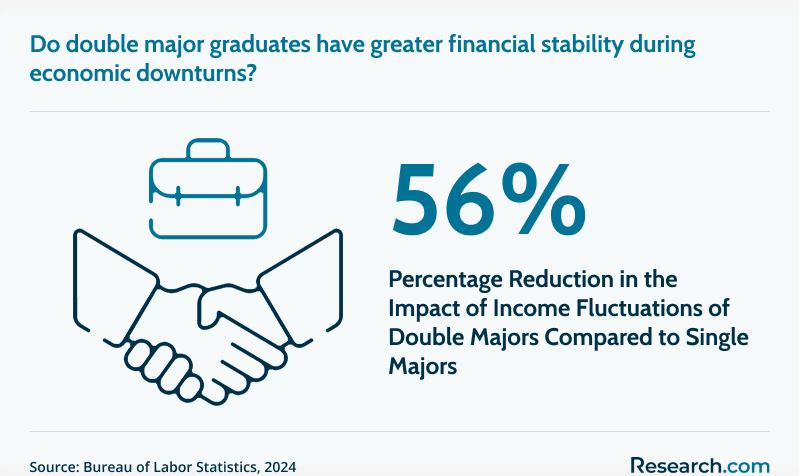
A recent national study found that students who double major experienced 56% less income volatility during economic downturns compared with those holding a single major. This guide is designed to cut through that noise. We will provide a clear, data-driven framework to weigh the costs against the benefits, helping you make a strategic choice that secures your financial and professional future.
Key Things You Should Know About Double Major Programs
- The real benefit of a double major isn't having two credentials; it's creating a unique skill set where the two fields amplify each other. A strategic, synergistic combination is far more valuable than two unrelated degrees.
- Pursuing a second major often adds an extra year of study. This means you must account for another year of tuition, fees, and—most importantly—a year of lost income you could have been earning.
- For many employers, a candidate with a single major, a high GPA, and relevant internship experience is a stronger applicant than one with a double major and no practical experience.
- A double major is most effective when you have a clear career goal and use the second major to build the specific skills needed for that niche. It is not an effective way to figure out what you want to do.
- The demanding workload can stretch your focus, potentially damaging your GPA. For many competitive career paths and graduate schools, a high GPA is a critical requirement that outweighs the benefit of a second major.
- How much more money can you make with a double major? Effect on Salary
- Does a double major take longer to complete Completion Time
- How much more does a double major cost? Average Cost
- What are the main benefits of double majoring? Benefits
- How do employers view a double major on a resume? Employer Views
- What are the best double major combinations for today's job market? Best Double Majors
- What are the biggest disadvantages of a double major? Disadvantages
- Can a double major hurt your academic performance? Can a double major hurt your academic performance?
- Who should not consider a double major? Who should not consider a double major?
- How do you strategically choose a second major? Selection
- Are there alternative academic strategies to achieve similar career outcomes? Are there alternative academic strategies to achieve similar career outcomes?
- Is a double major more important than internships or a high GPA? Is a double major more important than internships or a high GPA?
- Is a double major ultimately worth it? Is a double major ultimately worth it?
How much more money can you make with a double major?
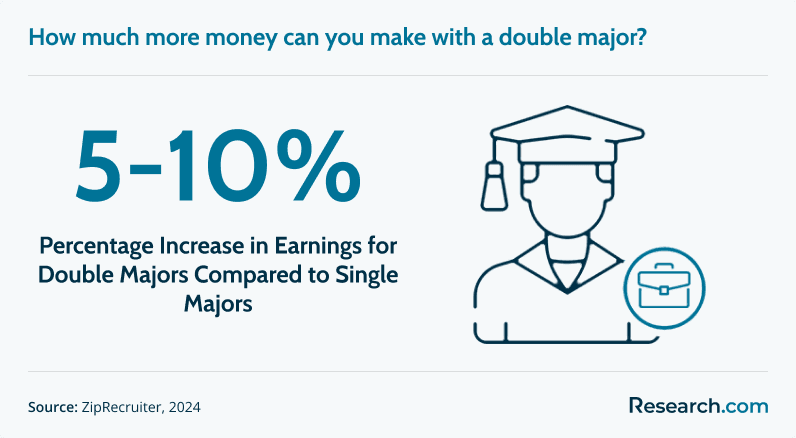
Graduates with a double major can expect to earn 5-10% more than those with a single major, but this financial benefit is highly dependent on the chosen fields. The real value isn't a universal pay bump; it comes from creating a powerful, synergistic skill set that unlocks specific, high-demand roles, such as those preparing for a career in media literacy.
For example, combining a technical major with a business or communications field can make you a uniquely qualified candidate for leadership positions in tech.
Ultimately, the answer to “Is double majoring worth it?” from a purely financial perspective hinges on that strategic combination. The goal is to build a professional profile that is more valuable than the sum of its parts.
A potential salary increase is an appealing benefit, but it doesn't come for free. To accurately weigh this upside, you first need to calculate the cost, starting with your time.
Does a double major take longer to complete?
Yes, in most cases, a double major will take longer to complete than a single degree. This path often extends the standard four-year bachelor's timeline to five years, as a double major may add approximately one year to the time-to-graduation. For students asking, "is a master degree worth it," understanding the time commitment of a double major can provide perspective on managing extended academic timelines.
The key factor that determines the extra time is the amount of curriculum overlap between the two programs. If the majors are in completely different departments, you will have to satisfy two distinct sets of core requirements.
It is possible to complete a double major in four years, but this requires meticulous planning from your very first semester. You would need to choose majors with significant course overlap, take a heavier course load each semester, and potentially enroll in summer or winter classes.
This accelerated path leaves little room for error or for exploring elective courses that might interest you. That extra time spent in school leads directly to the final part of our cost equation: the financial price tag.
How much more does a double major cost?
Adding a second major can be a significant financial decision, often costing well over $90,000 when you account for all the factors. The true cost includes more than just an extra year of tuition; you must also factor in the lost income from a delayed start to your career. For students weighing long-term educational investments, asking “is getting a PsyD worth it” can provide perspective on how additional schooling impacts both cost and career trajectory.
If your second major adds a year to your studies, it may increase overall student debt by around $15,000, but that is only part of the story.
The larger, often overlooked, part of the equation is opportunity cost. According to the U.S. Bureau of Labor Statistics, the median annual salary for a bachelor's degree holder is $77,948. By spending an additional year in school, you are giving up the potential to earn a full year's salary.
It's essential to frame this total cost as an investment. For that investment to pay off, the specialized career path it enables must provide a return that clearly outweighs both the added debt and the lost wages.
Now that we have a clear and sober understanding of the costs in time and money, let's explore the other side of the ledger: the strategic advantages that might make this investment worthwhile.
What are the main benefits of double majoring?
Beyond a potential salary bump, the strategic benefits of a double major are what truly build a compelling professional profile. Just as many students ask “is an MFA in creative writing worth it” to evaluate long-term career advantages, considering a double major helps you assess how combining fields can maximize both skills and opportunities.
Develop a versatile and rare skill set.
By combining two disciplines, you learn to analyze problems and devise solutions from multiple perspectives. This ability to connect disparate ideas is highly valued by employers and is essential for success in emerging, interdisciplinary fields.
For instance, many high-demand careers, such as those found in UX design degrees online, are built on a blend of technical and creative skills.
Gain a competitive edge for specialized roles.
Many of the most interesting and lucrative jobs exist at the intersection of two fields. A double major in economics and computer science, for example, makes you a prime candidate for FinTech roles that a single-major graduate from either field might not be qualified for.
Expand your future career pathways.
Having a solid foundation in two distinct areas gives you more flexibility and options after graduation. If your primary industry faces a downturn, your second major can serve as a powerful alternative, effectively future-proofing your career.
Signal ambition and a strong work ethic.
Successfully completing the rigorous demands of a double major sends a clear message to employers. It demonstrates your capacity for hard work, your advanced time-management skills, and your commitment to going above and beyond minimum requirements.
Cultivate greater intellectual agility.
Consistently working across two different academic frameworks forces you to become a more flexible and adaptable thinker. This mental cross-training enhances your critical thinking and problem-solving abilities, making you a more effective and resilient professional.
Building a unique skill set is great in theory, but how does it actually play out in the real world? Let's look at it from an employer's point of view.
How do employers view a double major on a resume?
Employers view a double major positively if it tells a logical and strategic story, but they are skeptical if it seems unfocused or comes at the expense of your GPA. When it's done right, a synergistic combination is often seen as a significant CV boost that signals a strong work ethic and advanced analytical skills.
The question of "Is double majoring worth it?" from their perspective is answered when your academic choices clearly align with the needs of the job you're applying for. Hiring managers are looking for a coherent narrative, not just a longer list of credentials.
Why Skills and Synergy Matter More Than Credentials
It's crucial to remember that companies hire people to solve specific problems. A double major becomes impressive when it demonstrates you have a unique combination of skills to do just that.
For example, a Biology and Data Science double major tells a compelling story for a role in the growing bioinformatics industry. However, employers are increasingly focused on a candidate's entire profile.
A recent survey found that 92% of hiring professionals state that soft skills are as important as hard skills. If the demanding schedule of a double major prevents you from gaining practical internship experience or developing core communication and teamwork skills, it can lose its strategic value.
The key takeaway is that a double major is a powerful signal when it forms part of a logical package, supported by a strong academic record and practical experience. A positive impression depends on telling that logical story.
To better understand how education level impacts long-term career security, consider the chart below, which illustrates unemployment rates by education level.
What are the best double major combinations for today's job market?
The most valuable double major combinations pair a quantitative or technical field with a specific domain or communication field, creating a skill set that is both deep and broadly applicable.
The guiding principle is to choose a second major that either adds a crucial technical skill to a non-technical field or provides essential business context to a technical one.
Some of the most synergistic double major combinations include Computer Science and Economics for FinTech, Engineering and Business for product management, or Biology and Data Science for bioinformatics.
While there is no single best combination, the most successful ones are always aligned with a specific career goal. Think of your second major as the key that unlocks a particular industry.
Here are some popular majors to consider:
Computer Science
A major in computer science provides a foundation in programming languages, software engineering, and systems design. Students learn how to build applications, develop algorithms, and work with emerging technologies like artificial intelligence and machine learning. The major prepares graduates for roles in software development, data engineering, cybersecurity, and beyond.
Economics
Economics majors study how societies allocate scarce resources and how markets function under different conditions. Coursework often covers microeconomics, macroeconomics, and econometrics, giving students the tools to analyze real-world problems. Graduates can pursue careers in banking, consulting, public policy, or international organizations. The major also serves as strong preparation for advanced studies such as law, business, or public administration.
Business Administration
This major offers broad exposure to core business areas, including management, marketing, finance, and operations. Students gain practical skills in leadership, strategy, and problem-solving, making them versatile hires across industries. A business administration background can lead to roles in corporate management, entrepreneurship, or nonprofit leadership.
Compared to highly specialized majors like the shortest physics programs online, this degree emphasizes adaptable knowledge that can pivot to multiple fields.
Data Science
Data science combines mathematics, statistics, and computer programming to extract meaningful insights from large datasets. Students learn to use tools like Python, R, and SQL alongside data visualization techniques to guide real-world decision-making. Career opportunities span across industries, including finance, healthcare, technology, and marketing. As more organizations rely on data to drive growth, demand for data science graduates continues to rise.
Biology
A biology major explores the study of living organisms, from cellular structures to complex ecosystems. Coursework includes genetics, physiology, ecology, and laboratory research, giving students both theoretical and practical experience. Graduates often pursue careers in healthcare, research, biotechnology, or conservation. The major also provides strong preparation for advanced studies in medicine, dentistry, or environmental sciences.
Social Work
Social work majors are trained to help individuals, families, and communities address personal and systemic challenges. Students study topics such as human behavior, social policy, and counseling techniques, often completing fieldwork or internships. Career paths include child welfare, healthcare social work, and community advocacy. The major emphasizes empathy, resilience, and leadership, making graduates essential contributors to social support systems.
What are the biggest disadvantages of a double major?
While a double major can offer unique advantages, it's critical to weigh them against the significant potential downsides. The increased workload and time commitment come with very real risks that can impact both your academic success and your career readiness.
- Significant Opportunity Cost. The time you spend fulfilling requirements for a second major is time you cannot spend on internships, co-op programs, or networking.
- Risk of a Lower GPA. The intense workload increases the risk of your grades slipping, which can be a major red flag for competitive graduate programs and employers who use GPA as a screening tool.
- Danger of Surface-Level Knowledge. By dividing your attention and advanced coursework between two areas, you may graduate with a broad understanding but lack the deep, specialized knowledge in your primary field that employers seek.
- Academic and Personal Burnout. The pressure to manage a heavy course load, meet deadlines for two different departments, and excel in all your classes can be immense. This can lead to chronic stress and exhaustion, diminishing your overall college experience.
- Less Flexibility for Exploration. Committing to a double major leaves little room for electives that might spark a new passion, such as exploring creative programs like the best online degree in cinematography, studying abroad, or participating in campus clubs and activities that build soft skills.
Of all these risks, the most immediate is the potential damage to your academic record. Let's take a closer look.
Can a double major hurt your academic performance?
Yes, a double major can hurt your academic performance if the workload is not managed with exceptional care. This typically happens when the sheer volume of work across two demanding subjects makes it difficult to give either one the deep focus it requires.
The rigor of college coursework is a significant step up from high school, and spreading your attention too thin is a common reason why even the best students see their GPA drop.
A key point to remember is that for many competitive career paths and graduate school admissions, a high GPA is a non-negotiable asset. A transcript with a 3.8 GPA in a single, relevant major is often far more valuable to an admissions committee or a recruiter than a 3.2 GPA across two majors.
Who should not consider a double major?
A double major is not the right path for students who are still undecided about their career goals, those who want to fully engage in campus life, or anyone motivated more by the idea of prestige than a specific strategic outcome. If you find yourself in one of these groups, choosing a single major is often the smarter strategic decision.
The double-major path is particularly ill-suited for the student who hopes a second major will help them figure out what they want to do; it is an expensive and inefficient tool for exploration.
It's also a poor fit for students who place a high value on experiences outside the classroom, like studying abroad, participating in clubs, or having a rich social life. The intense time commitment required for a double major often forces you to sacrifice these valuable aspects of personal and professional development.
Students Driven by Passion Over a Specific Career Path
A double major is a tool for specialization, not exploration. If your interest in a second subject is driven by genuine intellectual curiosity rather than a clear career objective, there are better and more flexible ways to pursue that passion.
A single, focused major that you love, supplemented by a minor or carefully chosen electives, can be a much more rewarding path. This approach allows you to gain deep expertise in your primary field while still having the freedom to explore other interests.
For instance, a business major with a love for asking big questions can satisfy that curiosity through a minor or flexible online courses. Options like the fastest online philosophy degree programs show there are many low-commitment ways to gain knowledge without the immense pressure of a second major. This strategy gives you the best of both worlds.
Now that we've covered the costs, benefits, and risks, let's transition to a practical framework for those who have weighed the evidence and are still considering moving forward.
How do you strategically choose a second major?
The most effective way to choose a second major is to start with a specific career goal and work backward to identify the skill gaps in your primary major. This is a practical, industry-focused approach that treats your second major as a targeted tool for professional development.
The process begins not with your interests, but with the job market. Start by researching job descriptions for the roles you want five years after graduation. Make a list of the required skills and qualifications that appear most frequently.
Once you have this list, compare it against the curriculum of your primary major. Where are the gaps? If your goal is to lead marketing teams at a tech company, your marketing major might not provide the technical literacy you need. That gap is what your second major should be designed to fill.
This process ensures your choice is driven by strategy, not just passion, and maximizes your return on investment.
Working Backwards: Choosing a Major to Fill a Skill Gap
This work backward method turns your decision into a logical equation. For example, a student majoring in business who wants to work in a technology-driven company will quickly see that job descriptions call for skills in data analysis, network management, or cybersecurity. Their business curriculum provides a strong foundation in management and finance, but a clear technical skill gap exists.
In this scenario, strategically adding a second major makes perfect sense. Looking into the best online information technology bachelor degree programs would be a direct way to find a curriculum that fills that identified gap, making them a much more competitive candidate for management roles in the tech sector. This ensures that the significant investment of time and money is directly tied to a specific, valuable career outcome.
You now have a process for choosing, but there's one final, critical trade-off you must consider before making the final call.
Are there alternative academic strategies to achieve similar career outcomes?
In addition to a double major, consider alternative academic pathways that can deliver specialized skills with less time and financial investment. Focused certificate programs, targeted minors, and selective online credentials often enable you to develop industry-specific expertise while preserving flexibility and reducing opportunity costs. For instance, enrolling in best online degrees programs can provide efficient, industry-relevant qualifications that augment your primary degree without the extended commitment of a full double major. Assess these alternatives against your career objectives and resource constraints to determine which route maximizes both your professional prospects and academic investment.
Is a double major more important than internships or a high GPA?
No, for the vast majority of employers, a double major is not more important than a high GPA and relevant internship experience. This is the most critical trade-off to understand. When a hiring manager reviews a stack of resumes, they are looking for proven ability and practical skills.
A high GPA is a clear indicator of your work ethic and mastery of a subject, while internships provide direct evidence that you can apply your knowledge in a professional environment.
A double major is only a valuable asset if it is achieved without compromising these two foundational pillars. If pursuing a second major causes your GPA to drop or leaves you with no time for hands-on experience, it becomes a liability, not a benefit.
The strategic priority for a successful job search should be a high GPA first, followed by relevant internships. A second major is a distant third.
When a Double Major Becomes the Deciding Factor
While the rule above holds true for most general career paths, a double major becomes critically important for highly specialized, interdisciplinary roles. In fields like FinTech (Finance + Computer Science) or Bioinformatics (Biology + Data Science), expertise in two distinct domains is a non-negotiable job requirement.
For these niche positions, the double major isn't just a "bonus"—it's the core qualification that gets you the interview. In these cases, the combination of degrees is direct proof of the technical skills and problem-solving skills that employers rank as top attributes. This is the exception where the double major moves from a distant third priority to a primary requirement for entry.
The chart below shows the most popular double major fields based on the University of Wisconsin-Madison students.
So, is a double major ultimately worth it?
A double major is worth it only if you can give a confident "yes" to three critical questions. This final decision is not about a simple pro-con list; it's a personal cost-benefit analysis that depends entirely on your specific goals, circumstances, and motivation. Instead of giving you a universal answer, this framework will empower you to find your own.
Before you commit to the significant investment of time, money, and energy, make sure your plan satisfies these three conditions:
- Is there clear synergy? Does the combination of majors create a unique skill set that directly qualifies you for a specific, high-value career path you are passionate about?
- Can you maintain excellence? Are you confident you can complete the second major without sacrificing your GPA or giving up essential hands-on experience from internships, research, or co-op programs?
- Is your motivation strategic? Is this decision driven by a clear career objective, or is it influenced by a vague sense of prestige or the fear of a single major not being "enough"?
Ultimately, the answer to "Is double majoring worth it?" is a strategic one that only you can make. If you can answer yes to all three questions, you have a strong, logical case for proceeding. If not, you can confidently choose a single major, knowing that focusing on a high GPA and practical experience is the most proven path to success. You now have the framework to make a smart, intentional choice for your future.
Here’s What Graduates Have to Say About Their Double Major Programs
- Simon: "Pursuing a double major in Economics and Computer Science immediately tripled my job prospects, proving the value of having both analytical depth and technical skills. I felt incredibly confident entering the workforce knowing I could speak the language of both business strategy and coding. That versatility has been my greatest career asset. "
- Janet: "My double major in English Literature and Political Science taught me to think critically and communicate persuasively on complex social issues. I loved bridging the creative, narrative side of my brain with the structural analysis required for policy—it made me a far more effective advocate. It was academically challenging, but totally worth the intellectual freedom. "
- Paula: "The unique blend of my Biology and Public Health degrees gave me a comprehensive view of disease, from the cellular level to the community level. This dual perspective allows me to design health interventions that are both scientifically sound and socially practical, giving my work a purpose I truly believe in. It felt like I earned two distinct skillsets for the price of one education. "
Key Findings
- While a double major can increase earnings by 5-10%, its primary financial value comes from unlocking specialized, high-paying roles, not from a general salary increase.
- The true cost of a double major includes not just the ~$15,000 in potential added debt but also the significant opportunity cost of a lost year of income, which can be over $77,000 for a bachelor's degree holder.
- Employers are not automatically impressed by a double major; 92% of hiring professionals state that soft skills are just as important as hard skills, which are often developed through internships and practical experiences.
- Pursuing a double major requires a careful trade-off analysis, as the intense workload can jeopardize your GPA and limit time for internships—experiences that develop the problem-solving skills that 88.6% of employers rank as their top priority.
- A double major is most effective when used as a tool for strategic specialization, such as combining a technical field with a domain-specific one, rather than as a tool for academic exploration.
- For the vast majority of career paths, a high GPA and relevant internship experience are more valuable assets on a resume than a second major.
References:
- Academia Stack Exchange. (2024). Double major in physics and engineering for career safety? Retrieved September 26, 2025, from https://academia.stackexchange.com/questions/32338/double-major-in-physics-and-engineering-for-career-safety
- Bankrate. (2025). The financial ROI of your college major. Retrieved September 26, 2025, from https://www.bankrate.com/loans/student-loans/roi-by-college-major/
- National Association of Colleges and Employers. (2024). What are employers looking for when reviewing college students’ resumes?. Retrieved September 26, 2025, from https://www.naceweb.org/job-market/trends-and-predictions/what-are-employers-looking-for-when-reviewing-college-students-resumes/
- Northeastern University. (2024). Combined majors. Khoury College of Computer Sciences. Retrieved September 26, 2025, from https://www.khoury.northeastern.edu/combined-majors/
- U.S. Bureau of Labor Statistics. (2024). Education pays. Retrieved September 26, 2025, from https://www.bls.gov/careeroutlook/2024/data-on-display/education-pays.htm
- ZipRecruiter. (2024). What is the average double major salary by state. Retrieved September 26, 2025, from https://www.ziprecruiter.com/Salaries/What-Is-the-Average-Double-Major-Salary-by-State
Other Things You Need To Know About Double Major Programs
In 2027, a double major generally provides more comprehensive expertise and can enhance employability in specific fields. While a minor allows specialization in a secondary interest, a double major demonstrates broader academic rigor, often leading to increased job prospects and higher starting salaries.
In 2027, choosing between a minor and a double major depends on career goals. A double major can provide deeper expertise, potentially leading to better job prospects, while a minor allows exploration of another field with less coursework, offering a balanced college experience.
To pursue a double major in 2027, you typically need to maintain at least a 3.0 GPA, though requirements vary by university. Some institutions may demand even higher GPAs, especially for competitive or specialized programs.
In 2027, universities may increase the credit requirements for a double major to ensure students gain comprehensive knowledge in both fields. This could mean balancing a heavier course load and longer study duration to meet graduation criteria efficiently.


