
2027 MBA Degree vs. Certificate: Explaining the Difference

Co-Founder and Chief Data Scientist
With an estimated 1.1 million management jobs opening annually, the path to leadership is clear. Yet, for many ambitious professionals, the crucial next step is clouded by the choice between a comprehensive MBA degree and a targeted certificate degree.
Prepared by career planning experts with over a decade of experience, this guide explains the difference, helping you navigate the pros, cons, costs, and career outcomes of each path to find the right fit for your professional goals.
Key Things You Should Know About MBA Degree vs. Certificate Programs
- An MBA is designed for a career transformation, while a certificate is built for skill augmentation.
- The median annual salary for management occupations, a common target for MBA graduates, is $122,090.
- A top-tier MBA represents a significant investment, with median out-of-state private tuition around $32,282 per year.
- Certificates offer a more accessible entry point, with costs closer to the median in-state public tuition of $7,070.
- The job market for leadership is strong, with an estimated 1.1 million management positions opening each year.
- A full-time MBA is a multi-year commitment, whereas a focused certificate can often be completed in under a year.
- MBA Degree vs. Certificate: Explaining the Difference MBA vs. Certificate
- What are the pros and cons of choosing an MBA degree? What are the pros and cons of choosing an MBA degree?
- What are the pros and cons of choosing a business certificate? What are the pros and cons of choosing a business certificate?
- What skills will I learn in an MBA degree vs. a certificate program? What skills will I learn in an MBA degree vs. a certificate program?
- Can a business certificate be applied toward an MBA degree later? Can a business certificate be applied toward an MBA degree later?
- What are the admission requirements for each program? Requirements
- How do the costs of an MBA degree vs. a certificate compare? Costs
- What jobs can I get with an MBA degree vs. a business certificate? What jobs can I get with an MBA degree vs. a business certificate?
- How much can you earn with an MBA degree vs. a certificate? Salary
- What is the job market outlook for graduates? Job Outlook
- How can I effectively finance my graduate business education? How can I effectively finance my graduate business education?
- What are the long-term career advancement opportunities? What are the long-term career advancement opportunities?
- MBA Degree vs. Certificate: Which one is right for you? MBA Degree vs. Certificate: Which one is right for you?
MBA Degree vs. Certificate: Explaining the Difference
The fundamental difference comes down to your career goal. An MBA is a transformative degree designed to turn a functional expert into a broad, strategic business leader. A targeted certificate degree is an augmenting credential, meant to add a specific, tactical skill to your existing toolkit.
While a 2024 survey shows that 52% of global candidates prefer an MBA, a significant 39% are seeking specialized business master's degrees, with another 8% looking at other credentials. This shows there isn't one "best" path, only the one that's right for you.
Professionals deciding between these two often face the same kind of dilemma seen in PsyD vs masters in clinical psychology—one option offers a broad, transformative foundation for leadership, while the other delivers focused expertise and faster entry into specific roles.
This table breaks down the core distinctions.
| Feature | MBA Degree | Business Certificate |
| Core Purpose | Transformation: To develop a functional expert into a holistic business leader. | Augmentation: To add a specific, in-demand skill to an existing professional's toolkit. |
| Scope of Learning | Broad & Strategic: Covers all core business functions (finance, marketing, operations, strategy). | Narrow & Tactical: Focuses deeply on a single subject or skill (e.g., digital marketing, project management). |
| Key Skills Gained | Leadership, strategic thinking, cross-functional decision-making, and networking. | Specialized hard skills, proficiency in specific tools, and tactical knowledge for immediate application. |
| Typical Duration | 1-2 years (full-time) or 2-3+ years (part-time) | A few weeks to 12 months, depending on the program. |
| Primary Career Outcome | Career switching (changing industry or function) and acceleration into senior leadership. | Career acceleration (promotion in current field) and upskilling to fill a specific knowledge gap. |
| Ideal For | The professional seeking a fundamental career change and long-term leadership trajectory. | The professional needing a specific skill quickly to advance in their current career path or take on new projects. |
Understanding the Types of Business Certificates
It's also important to know that not all certificates are created equal. Their value depends heavily on the provider, and they generally fall into three categories.
- University-Based Certificates: These are often graduate-level programs from accredited institutions and may sometimes offer credits that can be applied to a future master's degree.
- Professional/Industry Certificates: These are credentials offered by professional organizations (like the PMP for project management) that are highly recognized and valued within a specific field.
- Platform-Based Certificates: These are typically offered by online learning platforms and are best for acquiring a specific, technical skill with a tool or software.
As you can see, the educational landscape offers a variety of options for professionals. Whether you’re interested in business analytics, marketing, or niche creative fields such as best online photography programs, there’s a certificate designed to suit nearly every professional interest and level of commitment.
What are the pros and cons of choosing an MBA degree?
Choosing an MBA degree is a major strategic decision, not just an academic one. It's an investment designed to fundamentally reshape your long-term career path. The value goes far beyond the classroom, which is why recent data shows a renewed preference for in-person programs. Professionals understand that the immersive experience and the powerful network you build are core components of the return.
Here’s how to weigh that investment.
Pros of an MBA Degree
- Build a powerful, lifelong network. You gain access to an elite group of peers, faculty, and alumni who can open doors for decades to come.
- Achieve a significant long-term ROI. While the upfront cost is high, top MBA programs consistently lead to substantial salary increases and a steeper career growth trajectory.
- Execute a complete career transformation. This is the most effective credential for switching industries or job functions, with specialized options like an MBA in engineering management online available
Cons of an MBA Degree
- Face a substantial financial cost. Tuition for top programs is high, and that doesn’t include fees, living expenses, or books.
- Commit to an intensive schedule. A full-time program requires you to step out of the workforce for one to two years, while part-time options demand a multi-year commitment.
- Calculate the opportunity cost. The most significant and often overlooked expense is the salary you give up while you are not working during a full-time program.
What are the pros and cons of choosing a business certificate?
A business certificate degree is a targeted investment. Think of it as a strategic tool to solve an immediate problem by filling a specific skill gap on your resume. The growing corporate investment in employee upskilling confirms the value of this approach; employers recognize and reward professionals who proactively acquire in-demand competencies.
Here’s the trade-off you’re making.
Pros of a Business Certificate
- Keep costs low and manageable. Certificates are a fraction of the cost of a full degree, making them a financially accessible way to invest in your skills.
- Learn on a flexible schedule. Most programs are designed for working professionals, with part-time, online, and self-paced options that fit around your job.
- Make an immediate impact at work. The tactical skills you learn can be applied to your current role right away, leading to quick wins and demonstrating your value.
Cons of a Business Certificate
- Gain a narrow scope of knowledge. A certificate provides depth in one area but won’t give you the broad, cross-functional business understanding that an MBA does.
- Face variable quality and recognition. The market is crowded, and the value of your credential depends entirely on the reputation and accreditation of the provider.
- Have limited networking opportunities. While you’ll connect with classmates, certificate programs don’t offer the same deep, lifelong professional network as a top-tier MBA.
This trade-off mirrors choices in healthcare education, such as masters in nursing without BSN, where professionals balance flexibility, cost, and career acceleration when selecting shorter or more advanced study paths.
What skills will I learn in an MBA degree vs. a certificate program?
An MBA degree teaches you how to think, while a certificate program teaches you how to do. The MBA curriculum focuses on developing broad, strategic "soft" skills—the kind that help you lead teams, make complex decisions, and see the entire business landscape. A certificate is designed to give you a specific, tactical "hard" skill, like proficiency in a particular software or analytical method.
While it’s easy to focus on tangible hard skills, employers consistently report that strategic thinking (55%), problem-solving (59%), and communication skills (57%) are what they value most in business school graduates.
The Growing Demand for AI Skills
The rise of artificial intelligence is the perfect example of this dynamic. According to a recent GMAC survey, 63% of prospective students want to learn how AI can be used to develop business strategy. An MBA will teach you how to lead that strategic integration.
At the same time, companies have an urgent need for professionals with the tactical ability to work with AI tools. This is where a credential like an online data analytics bootcamp becomes incredibly valuable, providing the specific, hands-on skills needed for immediate application. The ideal modern professional often has both: a broad strategic understanding and deep tactical capabilities.
Can a business certificate be applied toward an MBA degree later?
It’s a common misconception that any business certificate can be used as a stepping stone to a master's degree. The reality is more specific, but the answer is yes, this is sometimes possible.
Many universities now offer "stackable" graduate certificate programs. This means the credits you earn completing a specific, university-based certificate degree can be directly applied toward a future master's or MBA program at that same institution. You must verify this policy with the school's admissions department beforehand, as it is not a universal practice.
A Flexible Path to a Master's Degree
This stackable approach is a strategic way to "try before you buy." It allows you to gain a valuable, standalone credential quickly while keeping your options open for a full degree later. This pathway significantly reduces the financial risk of graduate education and provides a flexible entry point for busy professionals.
This trend reflects a broader shift toward more accessible and modular education in programs like the best online master's in engineering management programs. It empowers you to build your education in stages, responding to your career needs as they evolve.
What are the admission requirements for each program?
The admission standards for these two paths are quite different. For a competitive MBA program, the most important, non-negotiable requirement is the quality and quantity of your work experience—typically a minimum of three to five years. For certificate programs, the requirements are highly variable, ranging from a simple online application to more formal degree and experience prerequisites.
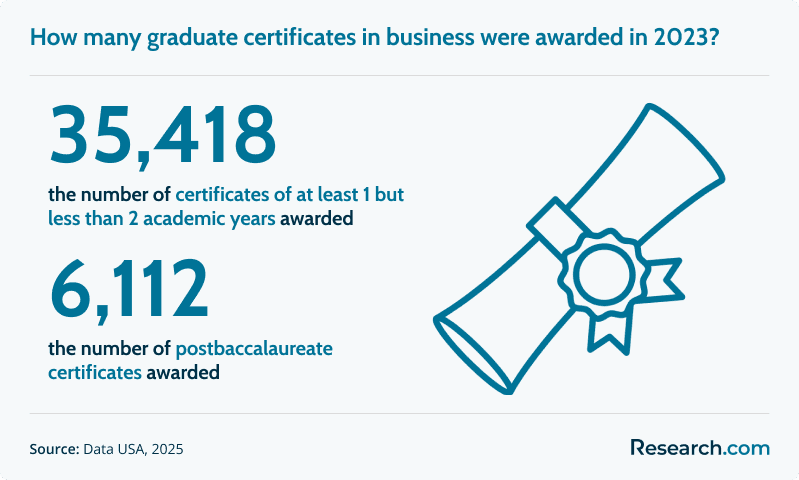
The popularity of certificates is clear, with U.S. institutions awarding over 35,000 certificates of at least one year and another 6,000 postbaccalaureate certificates in business annually.
Common MBA Admission Requirements
- A four-year bachelor's degree from an accredited institution is required.
- Most programs look for a minimum of 3-5 years of professional work experience.
- Applicants typically submit GMAT or GRE scores, though many schools now offer test waivers.
- You will need to provide essays, letters of recommendation, and a professional resume.
- A formal interview is almost always part of the final selection process.
Typical Certificate Admission Requirements
- Requirements vary widely, from a bachelor's degree to specific work experience.
- Many programs, especially those offered on online platforms, have open enrollment.
- University-based graduate certificates will require official transcripts.
- The application process is generally much shorter and less intensive than for an MBA.
For adult learners considering either route, it’s important to remember that it’s never too late to pursue education or career advancement—many professionals research how to go back to school as an adult before deciding which path best fits their lifestyle and long-term goals.
How do the costs of an MBA degree vs. a certificate compare?
It's no surprise that cost is the single biggest concern for professionals considering graduate education. For 48% of global candidates, the price tag is the top barrier. The key is to stop thinking of it as an expense and start analyzing it as an investment.
An MBA degree is a high-cost, high-potential-return investment in your entire career trajectory. A certificate is a low-cost, targeted investment in an immediate skill. To accurately compare them, you have to look beyond the tuition sticker price and consider the full financial picture.
Calculating the Full Investment
To get a true sense of the cost, you need to factor in three key areas.
- Tuition & Fees: This is the most obvious cost. A certificate can be very affordable, with prices sometimes aligning with the median in-state public tuition of $7,070. A top-tier MBA is a much larger figure, with median out-of-state private tuition running around $32,282 per year.
- Opportunity Cost: For a full-time MBA, this is the most significant and often overlooked factor. It's the one to two years of salary you will not earn while you are in school. This cost does not typically apply to certificate programs, which are usually completed while working.
- Funding Your Education: It's important to know that few people pay the full sticker price. Many MBA programs offer significant financial aid packages, including scholarships and grants. Private and federal loans are common, and employer tuition reimbursement is a key benefit to explore, especially for part-time programs and certificates.
What jobs can I get with an MBA degree vs. a business certificate?
The career outcomes for these two paths directly reflect their core purpose. An MBA degree is your tool for career transformation, enabling a significant pivot to a new industry or job function. A business certificate is your tool for career acceleration, helping you secure a promotion or specialize within your current field.
For example, a marketing manager might earn a certificate in digital analytics to become a senior marketing manager specializing in data-driven campaigns. An IT professional could get a Project Management Professional (PMP) certificate to move into a formal project manager role. These are targeted moves designed to add a specific, high-value competency to your existing experience.
While some see an MBA as a direct path to the C-suite, it's more accurate to view it as an entry point into high-growth industries. The top destinations for graduates remain consulting (30%), finance (25%), and technology (20%).
Entrepreneurial Pathways
It's also important to remember that not every career path involves climbing a corporate ladder. Both credentials can be powerful assets for starting your own business.
An MBA provides the comprehensive business foundation—from finance to marketing to operations—needed to build a company from the ground up. A certificate can provide a specific, critical skill needed to launch a venture, which is why there is a growing interest in finding the best entrepreneur and business ideas for nurses and other specialized professionals who want to leverage their unique expertise.
How much can you earn with an MBA degree vs. a certificate?
Here is the bottom line on earning potential. The median annual wage for management occupations—the typical target for MBA graduates—is currently $122,090. This figure provides a strong baseline for what you can expect in the roles an MBA prepares you for.
In contrast, earning a certificate typically yields a more immediate but modest salary increase, often in the range of 5-15% over your current earnings. It's a direct reward for a specific, newly acquired skill.
Beyond the Starting Salary: The Long-Term Trajectory
The most critical financial benefit of an MBA is not the starting salary, but the steeper long-term earnings curve. The degree is designed to accelerate your path to leadership, which is where compensation rises most significantly over a full career.
Thanks to a growing trend of salary transparency, you can research this yourself. Many business schools publish detailed employment reports that show not just starting salaries, but also career progression and earnings data for alumni three to five years after graduation, giving you a clearer picture of the long-term return.
What is the job market outlook for graduates?
The job market outlook is strong for graduates of both paths. The demand for skilled leadership is robust and projected to remain so, with an estimated 1.1 million management job openings expected on average each year for the next decade. This creates a stable, long-term environment of opportunity for those with the right qualifications.
At the same time, the urgent need for specialized, tactical skills in areas like data analytics, AI, and sustainability continues to grow. This dual demand means that whether you are seeking a broad leadership role or a specific technical competency, you are investing in a credential that the market values.
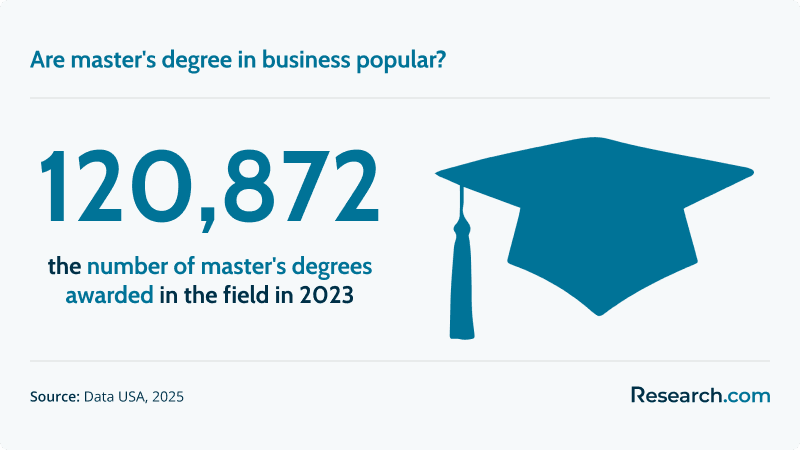
While economic cycles will always fluctuate, professionals with graduate-level credentials have historically shown more resilience during downturns. The popularity of these programs is a clear indicator of their perceived value, with over 120,000 master's degrees in business and management awarded in the U.S. each year.
How can I effectively finance my graduate business education?
When evaluating your education investment, consider the range of financing options available that can help offset tuition costs and improve overall ROI. Explore employer reimbursement programs, federal and institutional financial aid, and targeted scholarships designed exclusively for business education candidates. Additionally, many learners achieve significant savings through cost-efficient alternatives such as low cost MBA programs online, which blend quality instruction with affordability. Evaluating these financing strategies and comparing available options helps you align your educational investment with your long-term career and financial goals.
What are the long-term career advancement opportunities?
This is where the strategic difference between the two credentials becomes most clear. An MBA is specifically designed to accelerate your path to senior leadership roles like Vice President or C-suite executive. A certificate is a powerful tool for fueling your next one to two promotions within a specific functional track.
It’s a common misconception that an MBA is an automatic ticket to the corner office. The degree opens the doors to leadership tracks and provides the foundational skills, but your long-term advancement will always depend on your performance and impact.
Navigating a Modern Career Path
Today’s career trajectories are often less like a straight ladder and more like a "braided river," with professionals moving between roles, industries, and even sectors. This is where the MBA's broad, generalist toolkit becomes exceptionally valuable.
The strategic thinking, financial acumen, and leadership skills it provides are highly transferable, allowing you to navigate complex career shifts with confidence. This adaptability is why you see leaders in unconventional fields, who might combine business training with something like an online urban planning degree, creating unique, high-impact career paths.
MBA Degree vs. Certificate: Which one is right for you?
The right choice comes down to a single question: Are you seeking to transform your career or augment it? If your goal is a fundamental change—a new industry, a new function, or a long-term path to executive leadership—the MBA is the right tool. If you need to add a specific, valuable skill to accelerate in your current field, the certificate is the more efficient choice.
For those who find themselves between these two goals, the stackable certificate degree offers a flexible, lower-risk starting point. It allows you to gain an immediate skill while keeping the door open to a full master's degree down the road.
The Final Verdict for the Aspiring Leader
If you see yourself leading a large team, managing a P&L, or switching to a new industry like consulting or finance in the next five years, the MBA is your path. Ask yourself: Is the time and financial commitment worth a complete career reinvention?
The Final Verdict for the Focused Specialist
If you have a specific skill gap on your resume that is holding you back from the next promotion, a certificate is your solution. Ask yourself: Which specific competency will provide the most immediate and significant return on investment in my current role?
Here’s What Graduates Have to Say about Their MBA Degree vs. Certificate Choice
- Oliver: "As a mid-level manager, I understood my department perfectly but had blind spots when it came to the rest of the business. The MBA curriculum gave me the 30,000-foot view I needed to be seen as a credible leader for cross-functional initiatives. I could finally speak the language of every department. That comprehensive understanding is what positioned me for my next big promotion."
- Emily: "I work in marketing, and it was obvious that data analytics was the future. I found an online certificate program that focused on the exact software and techniques my company was adopting. The best part was being able to take what I learned in a module on Tuesday night and use it in a team meeting on Wednesday morning. My boss noticed, and I’m now leading our new analytics-focused projects."
- Daniel: "The biggest surprise of my online MBA was the network. I was in virtual breakout rooms with a CFO from the healthcare sector, a logistics expert from Europe, and a marketing lead from a startup. Hearing how they solved problems completely changed how I approached my own work. Within a year of graduating, I was promoted to a director-level position, and I know those conversations played a huge part."
Key Findings
- The strong demand for leadership is clear, with an estimated 1.1 million management job openings projected annually, reinforcing the long-term value of an MBA for professionals seeking career transformation.
- With a median annual wage of $122,090 for management roles, the potential return on investment for an MBA is substantial, directly addressing the primary concern of professionals needing clarity on their future earnings.
- Cost is the most significant barrier for 48% of prospective students, which highlights the critical role that lower-cost certificates play in providing accessible pathways for targeted upskilling.
- While 52% of global graduate management candidates prefer an MBA, the significant interest in other credentials shows a growing need for diverse educational solutions that fit different career goals and life stages.
- Employers prioritize strategic thinking (55%) and problem-solving (59%) in business graduates, validating the MBA's focus on developing the high-level leadership skills required for long-term career advancement.
- The viability of the certificate path is confirmed by its popularity, with over 35,000 graduate certificates in business and management awarded annually to professionals seeking a specific, immediate competency.
References:
- Data USA. (2025). Business administration, management, & operations. Retrieved October 7, 2025, from Data USA.
- Graduate Management Admission Council. (2025). GMAC Prospective Students Survey – 2025 Report. Retrieved October 7, 2025, from GMAC.
- U.S. Bureau of Labor Statistics. (2025). Management occupations. Occupational Outlook Handbook. Retrieved October 7, 2025, from BLS.
- Wood, J. D. M., de Paeztron, O., Li, N., Raasch, J., Peller‐Semmens, C., Purdy, L., ... & Symonds, G. (2025). Enhancing online MBA programmes: Student perceptions and key factors in programme design and delivery. British Educational Research Journal.
Other Things You Should Know About MBA Degree vs. Certificate Programs
An MBA in 2027 provides a comprehensive curriculum over 1-2 years, focusing on leadership and management. A certificate is shorter, typically within months, concentrating on specific skills. Certificates are cost-effective and suited for immediate career advancement, whereas MBAs offer a broader scope and long-term benefits.
Yes, an MBA program in 2027 typically offers various specialization options such as finance, marketing, and entrepreneurship, allowing students to tailor their education to specific career goals. Certificates, however, generally focus on one area and do not offer the same breadth or depth.
A 2027 MBA degree typically requires one to two years of full-time study, with around 60 credit hours. In contrast, certificate programs can be completed in a few months, often requiring only 12 to 18 credit hours. This difference affects the overall time commitment.


