
2027 Most Affordable Online Master's Degree in Supply Chain Management

Co-Founder and Chief Data Scientist
Choosing an online master’s degree in supply chain management is usually a career decision, not just an academic one. You may already work in logistics, procurement, operations, analytics, manufacturing, retail, healthcare, technology, or transportation and want a credential that can help you move into higher-responsibility roles. You may also be trying to decide whether a specialized supply chain master’s, an MBA concentration, or a shorter certificate is the better investment.
This guide explains what an online master’s in supply chain management covers, how it compares with campus-based study, what it can cost, how long it may take, which affordable programs are worth reviewing, and what career outcomes to evaluate before enrolling. It is designed for working adults, career changers, and business professionals who want a practical way to compare programs without overlooking accreditation, curriculum quality, total cost, financial aid, and return on investment.
Quick answer: Is an online master’s in supply chain management worth it?
An online master’s degree in supply chain management can be worth it if you want to qualify for management, analytics, procurement, logistics, or operations leadership roles and need the flexibility to keep working while studying. The strongest programs combine business strategy, supply chain analytics, logistics, sourcing, technology, and risk management. The degree is most valuable when it is offered by an accredited institution, fits your budget, supports your target career path, and gives you access to career services, employer connections, or applied projects.
What are the benefits of getting an online master's degree in supply chain management?
- Better access to advancement-oriented roles. A graduate credential in supply chain management can support progression into positions such as supply chain manager, logistics director, operations manager, procurement specialist, demand planning leader, or supply chain analyst across sectors including manufacturing, healthcare, retail, e-commerce, transportation, and technology.
- Strong compensation potential. According to industry reports, supply chain professionals can earn a median total compensation of $98,570, with graduate degree holders reporting higher incomes of $113,000 or more. Actual earnings depend on role, experience, industry, location, employer size, and performance-based compensation.
- Flexible study for working professionals. Online delivery can reduce relocation and commuting costs, expand access to programs outside your region, and help you build digital collaboration habits that matter in remote and hybrid supply chain teams.
- Practical exposure to disruption planning. Modern supply chains are affected by global sourcing risks, tariffs, pandemics, natural disasters, armed conflicts, cyber threats, sustainability expectations, and rapid changes in customer demand. Graduate-level coursework can help students understand how to build more resilient systems.
What can I expect from an online master's degree in supply chain management?
An online master’s in supply chain management teaches students how goods, services, data, suppliers, facilities, transportation networks, and customers connect across a business. Rather than studying logistics in isolation, students learn how procurement, forecasting, inventory, operations, analytics, risk, finance, and technology decisions affect the entire value chain.
- Programs typically cover the full supply chain lifecycle, including sourcing, procurement, production planning, inventory control, warehousing, transportation, distribution, reverse logistics, and supplier relationship management.
- Students learn to evaluate operational trade-offs, such as cost versus speed, inventory availability versus carrying cost, supplier concentration versus resilience, and automation versus workforce readiness.
- Common graduate topics include supply chain analytics, strategic sourcing, global logistics, sustainability, operations management, enterprise systems, digitalization, and supply chain risk.
- Online formats often combine asynchronous assignments with live sessions, team projects, case analyses, discussion boards, recorded lectures, simulations, and capstone projects.
- Many programs are built for employed adults, so coursework may use workplace-based projects that let students apply concepts to current business problems.
| What you study | Why it matters in supply chain roles |
| Supply chain analytics | Helps professionals interpret demand, cost, supplier, inventory, and transportation data for better decisions. |
| Procurement and sourcing | Builds skills in supplier selection, negotiation, contracting, and cost control. |
| Logistics and transportation | Supports decisions about routing, warehousing, carriers, delivery speed, and distribution networks. |
| Risk and resilience | Prepares students to plan for disruptions, supplier failures, regulatory issues, and global uncertainty. |
| Technology and systems | Develops familiarity with ERP tools, automation, analytics platforms, and digital supply chain processes. |
Who should consider an online master's degree in supply chain management?
This degree is usually a strong fit for professionals who already work near operations, logistics, procurement, manufacturing, retail, data analytics, transportation, or business management and want to move into higher-level planning or leadership work. It can also make sense for military logistics professionals, engineers, analysts, project managers, and career changers who want a structured path into supply chain roles.
Who may want a different path?
- Students who want broad executive training. If your main goal is general management across finance, marketing, leadership, and strategy, compare this degree with MBA online programs or MBA online programs before choosing a specialized master’s.
- Professionals aiming for doctoral-level business research or senior academic roles. Those planning to pursue advanced business scholarship may want to review online DBA programs.
- Students who are actually exploring healthcare or education careers. If your interests are outside business operations, compare alternatives such as affordable FNP graduate certificate programs online, cheapest online dental assistant to dental hygienist programs, cheapest online graduate certificate in nursing education, or cheapest online educational policy degree programs.
- Students primarily interested in finance specialization. If you want to move into finance rather than supply chain operations, an accelerated finance degree online may align better with your goals.
Where can I work with an online master's degree in supply chain management?
Graduates may work anywhere organizations need to buy, move, store, produce, distribute, or analyze goods and services. Common employers include manufacturers, retailers, healthcare systems, logistics providers, technology companies, e-commerce firms, consulting organizations, government agencies, and nonprofit organizations with complex procurement or distribution needs.
Large companies such as Amazon, FedEx, Apple, and Johnson & Johnson frequently employ supply chain professionals, but the field is not limited to multinational employers. Mid-sized businesses, startups, third-party logistics providers, and public agencies also need people who can reduce waste, improve delivery performance, manage vendors, forecast demand, and respond to disruption.
According to 2025 data from Zippia, the top industries employing supply chain managers and their corresponding share of the supply chain management workforce are:
- Fortune 500 - 25%
- Manufacturing - 21%
- Technology - 12%
- Retail 7%
- Transportation - 5%
How much can I make with an online master's degree in supply chain management?
Salary outcomes vary widely by role, experience, industry, geography, employer, and whether compensation includes bonuses or profit-sharing. Still, supply chain management is often attractive because it combines operational responsibility with measurable business impact.
According to salary data from the Association for Supply Chain Management (ASCM), entry-level positions might see starting salaries in the range of $65,000 to $70,000 annually. Professionals with 10 to 19 years under the belt reported incomes of $100,000, while those with 20 years of experience earned about $125,000.
Senior and specialized roles, including director of operations, global supply chain strategist, logistics executive, and technology-enabled supply chain leadership roles, may reach six-figure compensation. Industries such as tech, aerospace, pharmaceuticals, and consulting often offer higher pay, though competition and expectations may also be stronger.
Graduates often qualify for mid-level roles more quickly, where the average salary for such positions goes from $90,000 to $130,000. The ASCM salary report also notes that the median annual cash bonus for supply chain specialists ranges from $8,000 to $40,000.
| Career stage or compensation category | Reported figure from cited sources |
| Entry-level supply chain roles | $65,000 to $70,000 annually |
| Supply chain professionals with 10 to 19 years of experience | $100,000 |
| Supply chain professionals with 20 years of experience | About $125,000 |
| Mid-level roles | $90,000 to $130,000 |
| Median annual cash bonus for supply chain specialists | $8,000 to $40,000 |
- Most Affordable Online Master's Degree in Supply Chain Management Programs for 2027
- How long does it take to complete an online master's degree in supply chain management?
- How does an online master's degree in supply chain management compare to an on-campus program?
- What is the average cost of an online master's degree in supply chain management?
- What are the financial aid options for students enrolling in an online master's degree in supply chain management?
- What are the prerequisites for enrolling in an online master's degree in supply chain management?
- What courses are typically in an online master's degree in supply chain management program?
- What types of specializations are available in online master's degree in supply chain management programs?
- How to choose the best online master's degree in supply chain management program?
- What career paths are available for graduates of online master's degree in supply chain management programs?
- How can I verify the accreditation and quality of an online master's in supply chain management?
- How do online master's programs foster professional networking and mentorship?
- What challenges could impact my success in an online master's program in supply chain management?
- What is the job market for graduates with an online master's degree in supply chain management?
- What is the return on investment (ROI) for an online master's in supply chain management?
Most Affordable Online Master's Degree in Supply Chain Management Programs for 2027
How do we rank schools?
Affordability matters because a graduate degree should improve your career options without creating unnecessary financial strain. For supply chain professionals, the right low-cost program can provide advanced training in logistics, procurement, analytics, and operations while helping students preserve more of the long-term salary benefit.
To identify budget-conscious options, our team reviewed online master’s programs in supply chain management and related MBA concentrations with attention to tuition, credits, delivery format, accreditation, and program structure.
Our research process uses credible education data sources, including the College Scorecard database, the IPEDS database, the National Center for Education Statistics (NCES), and Peterson’s database, including its Distance Learning Licensed Data Set. You can also review the Research.com ranking methodology for more detail on how rankings are developed.
| School | Program | Cost per credit | Credits | Accreditation |
| University of North Carolina at Pembroke | Online MBA with a Concentration in Supply Chain Management | $268.11 for in-state students, $615 for out-of-state or international residents | 36 credits | AACSB |
| Athens State University | Online MS in Global Logistics and Supply Chain Management | $369 | 30 credits | ACBSP |
| Fitchburg State University | Online MBA in Supply Chain Management | $436 | 30 credits | IACBE |
| American Public University | Online MA in Supply Chain Management | $455 | 36 credits | ACBSP |
| University of West Florida | Online MBA with an emphasis in Supply Chain Logistics Management | $456.50 | 36 credits | AACSB |
1. University of North Carolina at Pembroke
The University of North Carolina at Pembroke offers a fully online MBA with a Concentration in Supply Chain Management for students who want business leadership training with focused study in logistics and operations. The program uses accelerated 7-week courses and provides several start dates each year. Coursework addresses topics such as strategic sourcing, logistics, and information systems, and online students learn from the same faculty who teach in the campus-based program.
- Program Length: Approximately 12 months
- Tracks/concentrations:
- Management Information Systems
- Operations Management
- Supply Chain Management
- Cost per Credit: $268.11 for in-state students, $615 for out-of-state or international residents
- Required Credits to Graduate: 36 credits
- Accreditation: Association to Advance Collegiate Schools of Business (AACSB)
2. Athens State University
Athens State University’s online Master of Science in Global Logistics and Supply Chain Management is designed for students who want an applied graduate program with multiple focus areas. The curriculum emphasizes project-based work, analytical models, and software-based learning. Students in the Logistics Information Systems track may earn the Systems Applications and Products (SAP) Student Recognition Award certificate by completing courses with SAP content, and Athens State is a full member of the SAP University Alliances program. The program prepares students for leadership-oriented supply chain work in federal agencies, manufacturing, wholesale trade, and corporate retail.
- Program Length: 12 months or five semesters
- Tracks/concentrations:
- Management
- Logistics Information Systems
- Artificial Intelligence
- Cost per Credit: $369
- Required Credits to Graduate: 30 credits
- Accreditation: Accreditation Council for Business Schools & Programs (ACBSP)
3. Fitchburg State University
Fitchburg State University’s online MBA in Supply Chain Management combines core business study with applied coursework in logistics, transportation, and Geographic Information Systems (GIS) using ArcGIS software. The 7-week course format and multiple start dates make the program a practical option for working adults. Graduates may apply their training to roles such as Supply Chain Manager, Procurement Director, and Logistics Analyst, especially in areas involving project management, enterprise resource planning (ERP), analytics, and operational improvement.
- Program Length: 12 months
- Tracks/concentrations:
- GIS and Decision-Making
- Transportation and Logistics Management
- Supply Chain Management
- Cost per Credit: $436
- Required Credits to Graduate: 30 credits
- Accreditation: International Accreditation Council for Business Education (IACBE)
4. American Public University
American Public University offers an online Master of Arts in Supply Chain Management that examines purchasing, logistics, distribution, warehousing, reverse logistics, and global supply chain operations. Courses are asynchronous and delivered in 8-week sessions, which may appeal to students who need schedule control. The program emphasizes applied problem-solving, analytics, and critical thinking, and it offers transfer credit options for eligible students.
- Program Length: Approximately 18 months
- Tracks/concentrations: MA in Supply Chain Management
- Cost per Credit: $455
- Required Credits to Graduate: 36 credits (up to 15 transfer credits accepted)
- Accreditation: Accreditation Council for Business Schools & Programs (ACBSP)
5. University of West Florida
The University of West Florida offers a fully online MBA with an emphasis in Supply Chain Logistics Management. The program uses accelerated 7-week courses and provides multiple start dates. Students study logistics, operations, strategic sourcing, information systems, analytics, leadership, and interpersonal skills. The online program is taught by the same faculty as the on-campus version.
- Program Length: As few as 16 months
- Tracks/concentrations:
- Global Logistics Management
- Seminar in Supply Chain Logistics Management
- Logistics Systems and Analytics
- Cost per Credit: $456.50
- Required Credits to Graduate: 36 credits
- Accreditation: Association to Advance Collegiate Schools of Business (AACSB)
How long does it take to complete an online master's degree in supply chain management?
Most online master’s programs in supply chain management take one to two years for full-time students. Part-time students often take two to four years, depending on course load, term structure, employer demands, family responsibilities, and whether the school allows students to pause or slow their pace.
The total credit requirement typically ranges from 30 to 36 credits. Accelerated options may be completed in as little as 10–16 months, but these formats can be demanding because students take compressed courses or heavier course loads. A thesis, practicum, internship, or capstone can also affect the timeline.
Flexible pacing is common in other online graduate and professional programs as well. Students comparing schedule models across fields may find it useful to review best online degree programs for working adults when thinking through how work, study, and personal responsibilities fit together.
| Enrollment format | Typical completion time | Best for |
| Accelerated full-time | 10–16 months | Students who can handle intensive coursework and want the fastest completion option. |
| Standard full-time | One to two years | Students who want steady progress without the heaviest accelerated workload. |
| Part-time | Two to four years | Working adults who need to balance study with employment or caregiving. |
How does an online master's degree in supply chain management compare to an on-campus program?
An online master’s in supply chain management can be academically comparable to an on-campus program when the institution is accredited, the curriculum is rigorous, and online students receive meaningful access to faculty, technology, career support, and peer interaction. The better choice depends on how you learn, where you live, how much schedule flexibility you need, and whether you want campus-based networking or remote convenience.
| Factor | Online master's program | On-campus master's program |
| Schedule | Often offers asynchronous or hybrid online coursework, which can be easier for employed students. | Usually requires attendance at set times and physical presence on campus. |
| Networking | May include virtual events, online groups, alumni platforms, and geographically diverse classmates. | Offers face-to-face interaction, campus events, and easier access to local employer visits. |
| Learning environment | Requires strong self-management, digital communication, and independent planning. | Provides more immediate in-person structure and access to campus facilities. |
| Degree value | Can carry the same academic value when the school is accredited and the program is well designed. | May appeal to students who prefer traditional classroom engagement. |
| Best fit | Working professionals, remote students, military-connected learners, and students who cannot relocate. | Students who want campus immersion, local networking, or in-person support. |
Online programs may include live class meetings, recorded lectures, discussion boards, virtual office hours, collaborative tools, and group projects. Many schools provide online students with the same transcripted degree and access to university resources as campus students, although specific services vary by institution.
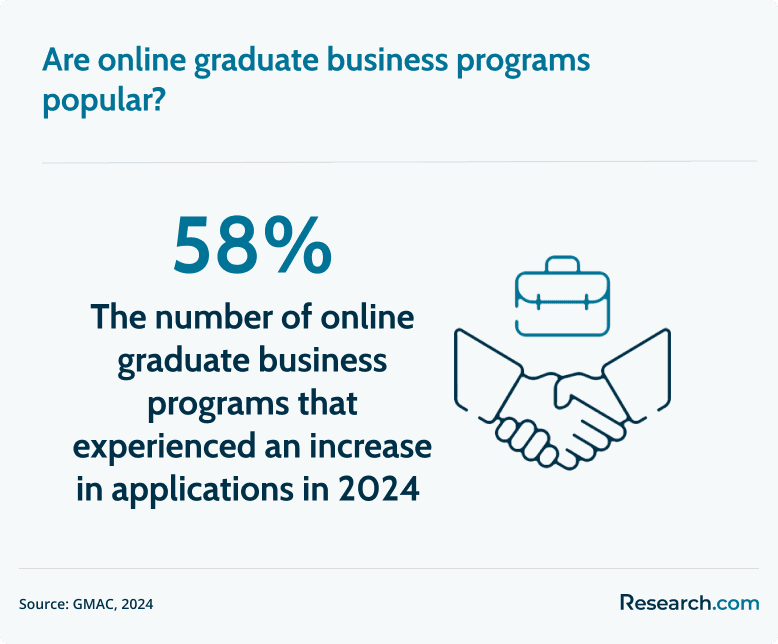
Application demand suggests that both formats remain relevant. The Graduate Management Admission Council (GMAC) reports that 59% of full-time graduate business programs saw more applications in 2024 compared to 2023, while 54% of online graduate business programs noticed growth in the same period.
What is the average cost of an online master's degree in supply chain management?
The cost of an online master’s in supply chain management depends on tuition per credit, total credits, residency rules, fees, textbooks, technology charges, transfer credits, and whether the degree is offered as a specialized master’s or an MBA concentration.
Based on our research for affordable programs in this guide, the total cost for an online master's degree in supply chain management can range from approximately $10,000 to $63,000. Some lower-cost options fall in the $10,000 to $20,000 range for the full program, while specialized programs at well-known universities can cost upwards of $35,000 to $60,000 or more.
When comparing programs, do not look only at the tuition rate. Ask whether the school charges online learning fees, application fees, graduation fees, exam proctoring fees, textbook costs, residency costs, or separate technology fees. Also check whether transfer credits can reduce the total number of credits you must pay for.
| Cost factor | Question to ask before enrolling |
| Tuition per credit | Is the published rate the same for online, in-state, out-of-state, and international students? |
| Total credits | How many credits are required, and can prior graduate credits transfer? |
| Fees | Are technology, proctoring, graduation, or student service fees added to tuition? |
| Books and software | Will students need paid analytics tools, simulation software, textbooks, or subscriptions? |
| Pacing | Does accelerated enrollment reduce cost, or does it only shorten the timeline? |
| Employer support | Does your employer offer tuition reimbursement, and does the program qualify? |
What are the financial aid options for students enrolling in an online master's degree in supply chain management?
Online graduate students may be eligible for several forms of financial support, but eligibility depends on the school, enrollment status, citizenship status, program accreditation, employer benefits, and military or veteran status. Start by asking the school for a full cost of attendance estimate and a written explanation of aid options.
- Federal student aid. Many schools advise graduate applicants to submit the Free Application for Federal Student Aid (FAFSA) to determine eligibility for federal loans and other aid programs. Students comparing institutions can also review cheap online colleges that accept FAFSA.
- Institutional scholarships and fellowships. Some universities offer merit-based scholarships based on academic performance, professional background, leadership experience, or program fit.
- Employer tuition assistance. Supply chain, logistics, manufacturing, retail, and technology employers may support graduate education if the program aligns with current or future job responsibilities.
- Military and veteran education benefits. Military-connected students may use benefits such as the GI Bill, military tuition assistance, and Veterans Affairs resources when the school and program meet eligibility requirements.
- Payment plans. Some institutions allow students to spread tuition payments over a term rather than paying the full amount upfront.
- Low-friction application options. If application costs are a concern, compare policies among online colleges with open enrollment and no application fee, while still checking accreditation and program fit.
According to the Graduate Management Admission Council, 47% of incoming graduate management education students to U.S. programs received merit-based scholarships or fellowships in 2024. The chart below provides additional context.
What are the prerequisites for enrolling in an online master's degree in supply chain management?
Admissions requirements vary, but most online supply chain master’s programs look for evidence that applicants can handle graduate-level business, analytics, and operations coursework. Some programs welcome career changers, while others prefer applicants with work experience in business, logistics, analytics, engineering, or operations.
- Bachelor’s degree. Applicants usually need a bachelor’s degree from an accredited institution. Business, engineering, logistics, economics, analytics, or operations backgrounds may help, but many programs consider applicants from other fields.
- Minimum GPA. Schools often set a minimum undergraduate GPA around 2.5 to 3.0. Some programs offer conditional admission when an applicant has professional experience or other strengths.
- Professional experience. Work experience may be preferred or required, especially for MBA-based programs. Even when it is not required, relevant experience can strengthen your application.
- GRE or GMAT scores. Some schools request standardized test scores, but many online programs waive the GRE or GMAT for applicants with strong academic records or professional experience.
- Prerequisite coursework. Programs may expect prior exposure to statistics, calculus, economics, accounting, or foundational business concepts. Others provide bridge modules for students who need preparation.
- Application materials. Common requirements include official transcripts, a resume, letters of recommendation, and a statement of purpose explaining your career goals and reason for pursuing the degree.
Always confirm requirements directly with each school before applying. Program deadlines, test waiver policies, transcript rules, and conditional admission options can change. The median acceptance rate for graduate management education programs in the U.S. was 71% in 2024.
What courses are typically in an online master's degree in supply chain management program?
Most online supply chain management master’s programs combine core business knowledge with technical and operational coursework. The strongest curricula emphasize applied decision-making, not just definitions and theory.
- Supply Chain Strategy and Design. Explores how organizations structure supply networks to support cost, service, speed, resilience, and growth goals.
- Logistics and Transportation Management. Covers distribution networks, carrier selection, routing, warehousing, fulfillment, and transportation performance.
- Procurement and Sourcing. Examines supplier evaluation, contracting, negotiation, vendor risk, global sourcing, and purchasing strategy.
- Operations and Production Management. Focuses on process design, capacity planning, inventory, production scheduling, quality, Lean methods, and Six Sigma concepts.
- Supply Chain Analytics. Teaches students to use data, forecasting, models, dashboards, and decision-support tools to improve performance.
- Global Supply Chain Management. Reviews international trade, customs, cross-border logistics, tariffs, regulation, and geopolitical complexity.
- Information Systems for Supply Chains. Introduces enterprise systems, automation, blockchain, digital platforms, and technology-enabled supply chain management.
- Risk Management and Sustainability. Addresses disruption planning, supplier resilience, ethical sourcing, emissions, waste reduction, and responsible operations.
Many programs end with a capstone, practicum, consulting project, or simulation in which students analyze a real or realistic supply chain problem and recommend measurable improvements.
What types of specializations are available in online master's degree in supply chain management programs?
Specializations help students align the degree with a target role or industry. The right concentration depends on whether you want to work closer to transportation, sourcing, analytics, manufacturing, sustainability, technology, or global trade.
| Specialization | Best for students interested in |
| Logistics and Transportation Management | Freight, distribution networks, shipping, carrier management, fulfillment, and delivery performance. |
| Global Supply Chain Management | International sourcing, trade regulation, tariffs, customs, global operations, and cross-border risk. |
| Procurement and Sourcing | Supplier management, negotiation, contract strategy, category management, and purchasing leadership. |
| Supply Chain Analytics | Forecasting, modeling, dashboards, optimization, performance measurement, and data-driven planning. |
| Sustainability and Green Supply Chains | Responsible sourcing, emissions reduction, circular supply chains, waste reduction, and compliance expectations. |
| Operations and Manufacturing Management | Production systems, quality control, Lean operations, process improvement, and plant-level efficiency. |
Data from ASCM reveals that supply chain is the most popular focus of graduate study for professionals aged 39 or younger who work in the supply chain industry. The figures show that 32% to 33% of these supply chain professionals chose supply chain as the focus of their graduate studies. The chart below shows other graduate study areas common among industry professionals.
How to choose the best online master's degree in supply chain management program?
The best program is not automatically the cheapest, fastest, or highest ranked. It is the program that gives you the right credential, curriculum, flexibility, support, and career value at a price you can justify.
- Verify institutional and business accreditation. Confirm that the school is properly accredited and look for relevant business accreditation such as AACSB, ACBSP, IACBE, or other recognized quality indicators.
- Match the curriculum to your career goal. If you want analytics roles, prioritize forecasting, modeling, ERP, and data courses. If you want procurement leadership, look for strategic sourcing and contract coursework. If you want logistics management, examine transportation, warehousing, and distribution content.
- Review course delivery carefully. Ask whether classes are asynchronous, synchronous, or mixed. Confirm whether live attendance is required and whether courses are 7-week, 8-week, semester-based, or self-paced.
- Calculate total cost, not just tuition. Include fees, books, software, travel, lost work hours, and the number of credits you must complete after transfer review.
- Check student support. Strong online programs provide advising, library access, technical help, tutoring, career services, faculty availability, and networking opportunities.
- Ask about employer connections. Look for industry projects, capstones, alumni networks, internship options, corporate partnerships, and career coaching.
- Compare curriculum currency. A recent AACSB report on what students want from business programs points to demand for robust, rigorous, practical, and up-to-date curricula. Supply chain students should look for programs that address analytics, AI, risk, sustainability, and digital systems.
Questions to ask admissions advisors before applying
- Is the degree title a specialized master’s or an MBA concentration?
- Will my transcript or diploma indicate the online format?
- How many credits can I transfer?
- Are there required live sessions, residencies, internships, or campus visits?
- What software, analytics tools, or enterprise systems will students use?
- What career services are available specifically to online graduate students?
- What percentage of students complete the program, and how long do they typically take?
- Are scholarships or employer partnership discounts available?
- Does the program have alumni working in my target industry?
What career paths are available for graduates of online master's degree in supply chain management programs?
Graduates can pursue roles across planning, sourcing, logistics, operations, analytics, technology, sustainability, and consulting. Some positions require prior experience, so students should review job postings in their target market before assuming that a degree alone will qualify them for senior roles.
| Role | What the role typically focuses on |
| Supply Chain Manager | Coordinates planning, sourcing, production, inventory, logistics, and delivery performance. |
| Logistics Manager | Manages transportation, warehousing, distribution, carriers, and logistics service providers. |
| Procurement Manager | Leads purchasing strategy, supplier negotiations, contract management, and vendor performance. |
| Operations Manager | Improves production processes, quality, capacity, efficiency, and cost-effectiveness. |
| Supply Chain Analyst | Uses data to identify bottlenecks, forecast demand, model scenarios, and recommend improvements. |
| Inventory Manager | Balances raw materials, work-in-progress, and finished goods against demand and cost constraints. |
| Demand Planner | Forecasts customer demand to support production, inventory, and distribution decisions. |
| Global Supply Chain Manager | Manages international sourcing, customs, tariffs, trade rules, and cross-border movement of goods. |
| Sustainability Manager | Develops environmentally and socially responsible sourcing, logistics, and operational practices. |
| Supply Chain Consultant | Advises organizations on process redesign, technology implementation, cost reduction, and resilience. |
| Supply Chain Technology Manager | Oversees ERP systems, analytics platforms, automation tools, and supply chain software adoption. |
| Project Manager | Leads supply chain improvement projects, system implementations, facility changes, or network redesigns. |
| Transportation Manager | Plans modes, routes, carriers, freight costs, and transportation performance. |
| Warehouse Manager | Supervises warehouse operations, storage, picking, shipping, safety, and inventory control. |
| Strategic Sourcing Manager | Creates long-term sourcing plans to secure reliable, cost-effective goods and services. |
Career advancement can also lead toward broader leadership positions. Supply chain experience can support pathways into operations, strategy, sustainability, and executive leadership. Professionals interested in sustainability leadership can compare requirements in this guide on how to become a CSO. Those comparing entrepreneurship outcomes may also review information on entrepreneurship average salary.
To help you compare career outcomes, the following chart presents median wages for selected roles in the profession.
How can I verify the accreditation and quality of an online master's in supply chain management?
Accreditation protects students by signaling that a school has gone through an external quality review. Before enrolling, confirm the institution’s accreditation status through official accreditation databases and the school’s own accreditation page. For business programs, also check whether the program or business school holds specialized accreditation such as AACSB, ACBSP, IACBE, or another relevant recognized credential.
- Confirm the institution is accredited before submitting a deposit.
- Check whether the business school has specialized accreditation.
- Review faculty credentials and supply chain industry experience.
- Ask whether the curriculum is reviewed with employer or advisory board input.
- Look for applied projects, analytics tools, case studies, and capstone experiences.
- Ask for student outcome information, career support details, and alumni examples.
- Be cautious with programs that promise guaranteed salaries or job placement.
If you are comparing advanced management degrees beyond supply chain, reviewing best value executive MBA options may help you understand differences in cost, audience, and leadership focus.
How do online master's programs foster professional networking and mentorship?
Strong online programs do not leave networking to chance. They create structured opportunities for students to meet faculty, classmates, alumni, employers, guest speakers, and industry mentors, even when students are geographically dispersed.
- Virtual live sessions. Real-time classes and seminars can help students discuss cases, ask questions, and build relationships.
- Team-based projects. Group assignments mirror the cross-functional collaboration common in supply chain work.
- Alumni platforms. Online communities can connect students with graduates working in logistics, operations, procurement, analytics, and consulting.
- Guest lectures and employer events. Industry speakers can help students understand current hiring expectations and technology trends.
- Mentorship programs. Some schools pair students with faculty, alumni, or working professionals for career guidance.
What challenges could impact my success in an online master's program in supply chain management?
Online learning can be convenient, but it is not automatically easier. Students who succeed usually have a realistic study schedule, reliable technology, clear career goals, and a willingness to participate actively in virtual discussions and group work.
| Common challenge | Better approach |
| Underestimating weekly workload | Ask current students or advisors how many hours courses typically require and block study time before classes begin. |
| Choosing based only on tuition | Compare accreditation, curriculum, total fees, transfer policy, faculty access, and career support. |
| Ignoring technology expectations | Confirm software requirements, internet needs, proctoring rules, and analytics tools before enrolling. |
| Staying passive in online courses | Attend live sessions when possible, join discussions, contact faculty, and build relationships with classmates. |
| Assuming the degree alone guarantees promotion | Pair the degree with measurable workplace achievements, certifications, internships, projects, or leadership experience. |
| Overlooking curriculum fit | Choose courses and electives that support your target role, such as analytics, procurement, logistics, or sustainability. |
What is the job market for graduates with an online master's degree in supply chain management?
The job market for supply chain management graduates is supported by the complexity of modern commerce. Organizations need professionals who can manage suppliers, reduce disruption risk, analyze demand, control costs, improve logistics, and implement technology across global and domestic networks.
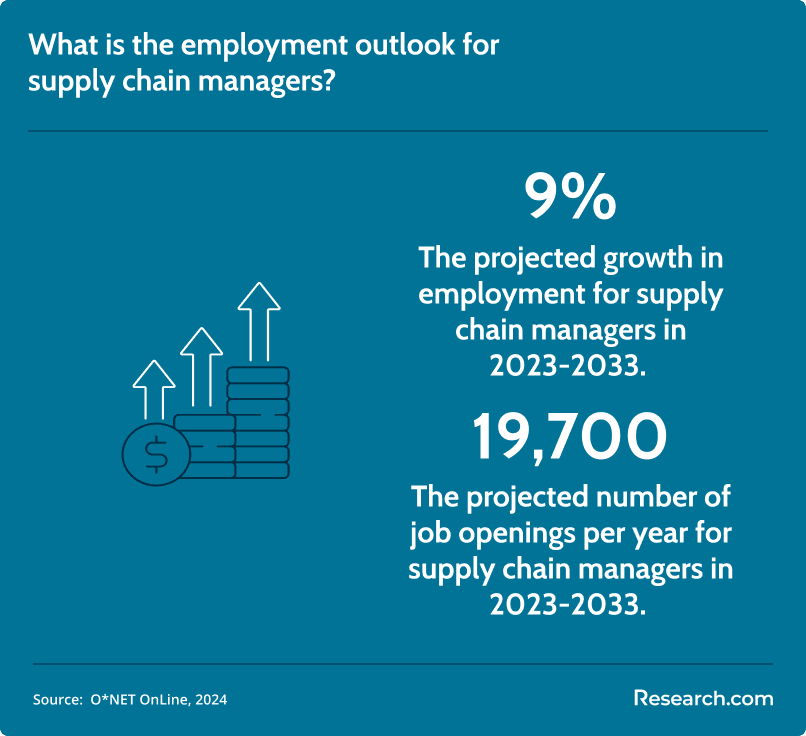
- Projected growth. O*NET OnLine projects a 9% job growth for supply chain managers between 2023 and 2033. This is considerably faster than the average growth rate for all occupations.
- Broad employer demand. Supply chain skills apply across manufacturing, retail, e-commerce, logistics, healthcare, technology, government, and consulting.
- Disruption-driven hiring needs. The pandemic, tariff wars, armed conflicts, and global logistics shocks have made resilience and risk planning more visible to executives.
- Technology change. AI, analytics, automation, and blockchain are changing how supply chains are planned and managed. A 2025 report from McKinsey highlights how managers play a crucial role in unlocking the full potential of AI for their organizations.
Current trends affecting supply chain careers
- AI-assisted planning. Employers increasingly value professionals who can use analytics tools responsibly while understanding the business assumptions behind forecasts and recommendations.
- Resilience over lowest cost. Many organizations now evaluate supplier diversity, inventory buffers, nearshoring options, and contingency planning rather than optimizing only for short-term cost.
- Sustainability pressure. Companies face growing expectations around emissions, ethical sourcing, waste reduction, and transparency.
- Cross-functional leadership. Supply chain managers often work with finance, sales, IT, compliance, legal, engineering, and customer experience teams.
- Credential-based competition. A master’s degree may help, but employers still weigh experience, technical skills, leadership ability, and measurable results.
Here’s what graduates have to say about their online master's degree in supply chain management
- “Studying online made it possible for me to stay employed while preparing for a leadership move. I could complete coursework outside regular work hours and still protect time for my family.” — Shirley
- “The program connected classroom concepts to global case studies and supply chain tools I could use immediately at work. The virtual discussions were more active than I expected, and I built real connections with classmates.” — Carlos
- “I entered the program as a career changer, so I needed both fundamentals and practical exposure. The mix of logistics, analytics, and project work helped me build confidence, and the faculty understood the realities of working adults.” — Mei
What is the return on investment (ROI) for an online master's in supply chain management?
The ROI of an online master’s in supply chain management depends on how much you pay, how quickly you complete the program, whether you keep earning income while enrolled, and whether the degree helps you move into higher-paying or higher-responsibility roles. A lower-cost accredited program can improve ROI, but only if the curriculum, employer recognition, and career support match your goals.
To evaluate ROI, compare your expected total program cost with realistic career outcomes in your industry and region. Do not rely only on national salary figures. Review job postings, talk with managers, examine alumni outcomes, and ask your employer whether the degree could support promotion, salary growth, or tuition reimbursement.
ROI checklist before you enroll
- What is the full program cost after fees, books, software, and transfer credits?
- Can you continue working while enrolled?
- Will your employer reimburse part of the tuition?
- Does the program teach skills listed in your target job postings?
- Does the school offer career coaching, employer events, or alumni networking?
- How soon could you reasonably qualify for a promotion or new role?
- Would a certificate, MBA, executive MBA, or specialized master’s produce a better outcome for your goals?
Common mistakes to avoid when choosing an online supply chain master's program
- Choosing without checking accreditation. Always verify institutional accreditation and, when relevant, business school accreditation before applying.
- Focusing only on sticker tuition. Calculate total cost, including fees, books, software, travel, and required credits.
- Assuming all online programs are equally flexible. Some require live attendance, group meetings, proctored exams, or fixed assignment schedules.
- Ignoring transfer credit rules. A program that accepts prior graduate credits may reduce both cost and completion time.
- Overlooking career services. Online students should have access to advising, networking, employer events, and job search support.
- Choosing a specialization too early. Review your target roles first, then select analytics, logistics, procurement, sustainability, or operations coursework accordingly.
- Assuming salary outcomes are guaranteed. A master’s degree can improve competitiveness, but compensation still depends on experience, performance, industry, location, and employer demand.
Key Insights
- An online master’s in supply chain management is best for professionals who want advancement in logistics, procurement, operations, analytics, global supply chain, or related leadership roles while maintaining work flexibility.
- Most online master's programs in supply chain management can be completed in one to two years of full-time study, while some accelerated programs are designed for 10–16 months.
- Program cost varies significantly. Based on the programs reviewed for this guide, total costs can range from approximately $10,000 to $63,000, so students should compare total cost rather than tuition alone.
- Accreditation, curriculum relevance, technology exposure, applied projects, and career support are more important than rankings by themselves.
- According to the Graduate Management Admission Council, 47% of incoming graduate management education students to U.S. programs received merit-based scholarships or fellowships in 2024.
- O*NET OnLine projects a 9% job growth for supply chain managers between 2023 and 2033, reflecting continued demand for professionals who can manage complex and resilient supply networks.
- AI, analytics, automation, and blockchain are changing supply chain work. The strongest candidates will combine technology fluency with business judgment, risk awareness, and communication skills.
References:
- Association for Supply Chain Management (January 2023). The Supply Chain Profession in 2023: Salaries and Careers Across the Globe. https://www.ascm.org/globalassets/ascm_website_assets/docs/salary/2023-ascm-supply-chain-salary-and-career-report.pdf
- Graduate Management Admission Council (October 2024). Application Trends Survey 2024 Report. https://www.gmac.com/-/media/files/gmac/research/admissions-and-application-trends/2024_ats.pdf
- O*NET OnLine (2024). Supply Chain Managers. https://www.onetonline.org/link/summary/11-3071.04
- U.S. Bureau of Labor Statistics (n.d.). Occupational Employment and Wage Statistics, Industry: Cross-industry, Private, Federal, State, and Local Government, Period: May 2024. https://data.bls.gov/oes/#/industry/000000 Data retrieved May 2025
- Zippia (January 2025). Supply Chain Manager demographics and statistics in the US. https://www.zippia.com/supply-chain-manager-jobs/demographics
Other Things You Should Know About Online Master's in Supply Chain Management Degrees
The most affordable online master's programs in supply chain management typically require a bachelor's degree, a minimum GPA, and professional experience. Some may require GRE/GMAT scores, but waivers are often available. These programs emphasize both affordability and accessibility for a diverse student body.
Financial aid options in 2027 include federal student loans, scholarships specific to supply chain fields, and employer tuition assistance. Check the FAFSA deadline for federal aid and explore scholarship deadlines to ensure eligibility for financial assistance.
The length of an online master’s program in supply chain management can influence the overall cost for 2027. Longer programs may accrue more tuition fees and indirect costs, such as textbooks and supplies, whereas shorter programs can be more affordable by limiting these expenses and allowing quicker entry into the workforce.


