
2027 Pre-Nursing vs. Nursing Majors: Explaining the Difference

Co-Founder and Chief Data Scientist
Deciding between a pre-nursing and a nursing major in 2027 is an important step for anyone planning a healthcare career. Pre-nursing programs attract thousands of students each year, with over 3,000 pre-nursing degrees awarded in 2023 alone. Meanwhile, nursing graduates continue to see strong demand, with 84% of BSN graduates receiving job offers by graduation.
Choosing the right path early can impact your readiness for nursing school and future career opportunities. This article explores program length, cost, admission requirements, and job prospects for pre-nursing and nursing majors to guide your decision.
Key Things to Know About Pre-Nursing and Nursing Majors
- Pre-nursing programs provide a clear roadmap for completing prerequisite courses. It helps students build a strong foundation before entering a nursing major.
- BSN-prepared nurses earn higher salaries than non-BSN nurses, with median annual wages around $92,560.
- Graduates can work in hospitals, clinics, schools, and community health.
- What is the difference between pre-nursing and nursing majors? Pre-Nursing vs. Nursing
- Should I apply directly to a nursing program or start with pre-nursing? Should I apply directly to a nursing program or start with pre-nursing?
- What pre-nursing programs are available in 2027? Pre-nursing Programs
- How do requirements vary between pre-nursing and nursing degrees? Requirements
- What is the cost difference between pre-nursing and nursing programs? Cost
- How does the Nursing major curriculum differ from pre-nursing? Curriculum
- How long do pre-nursing programs take compared to nursing degrees? How long do pre-nursing programs take compared to nursing degrees?
- What are the career outcomes for pre-nursing vs. nursing graduates? Career Outlook
- What is the pathway from pre-nursing to becoming a licensed registered nurse (RN)? What is the pathway from pre-nursing to becoming a licensed registered nurse (RN)?
What is the difference between pre-nursing and nursing majors?
Many students think pre-nursing is just an early stage of a Nursing degree. In reality, the two have very different goals.
Pre-nursing is a preparatory track. It includes the prerequisite science and general education courses needed before entering a nursing major. It does not qualify students to take the NCLEX exam or work as a nurse.
Pre-nursing programs usually take about two years. The focus is on general education and science courses such as anatomy, chemistry, and microbiology. Pre-nursing majors also provide foundational knowledge for advanced pathways, including direct entry MSN programs for non-nurses online.
In contrast, a nursing major, such as a Bachelor of Science in Nursing (BSN) or Associate Degree in Nursing (ADN), includes both prerequisites and clinical coursework. It leads directly to Registered Nurse (RN) licensure after graduation.
In contrast to a pre-nursing program, a full nursing major takes four years for a BSN or two to three years for an ADN. It includes clinical rotations, nursing leadership, and patient care courses.
Should I apply directly to a nursing program or start with pre-nursing?
Choosing between a pre-nursing track and a direct-entry nursing program depends on the student’s qualifications, readiness, and long-term career goals. Applicants who already meet admission requirements and are confident about pursuing nursing should apply directly to a nursing program. This path leads to faster licensure and stronger job prospects.
For students who still need to complete prerequisites or strengthen their GPA, starting with a pre-nursing track can be an excellent choice. This option provides time to build a solid academic foundation in biology, chemistry, anatomy, and other core sciences before applying to a nursing program.
Pre-nursing also helps students explore whether nursing is the right fit while fulfilling admission requirements for future BSN or ADN programs. It also gives clarity on career pathways, including questions like "what degree does a CNA need?" Many universities use the pre-nursing stage as a preparatory gateway to transition smoothly once they meet all criteria.
What pre-nursing programs are available in 2027?
In 2027, around 133 colleges in the United States offer pre-nursing programs that prepare students for RN or BSN programs. Most pre-nursing options are available at public, two-year community colleges. Associate degrees are the most common format, though some schools also provide shorter certificate tracks or four-year pre-nursing pathways that lead to BSN admission.
Here are some of the top U.S. pre-nursing programs in 2027:
Ohio State University – Pre-Major in Nursing
Ohio State is well-known for a pre-nursing track that covers all prerequisite courses needed for admission into its BSN program. Students in this track receive dedicated academic advising to guide them through the prerequisites and application process. Tuition is about $12,485.
Thomas Edison State University – Associate in Applied Science in Applied Health Studies
The school offers a pre-nursing track that leads into its accelerated BSN program. Students complete both the general education and science prerequisites needed for nursing, with the added bonus of being able to earn an Associate of Applied Science in Applied Health Sciences. The program runs for about two years, and tuition is $3,686 per term.
Central Washington University – Bachelor of Science in Pre-Nursing
Central Washington University ranks #1 in the “Best Value Pre-Nursing Studies Bachelor’s Degree Schools” category for students from families making $75,000-110,000. It offers a bachelor's pre-nursing program with relatively low net cost and strong academic support.
University of Michigan–Ann Arbor – Pre-Nursing Curriculum
A top rank among many pre-nursing studies, Michigan offers a very strong preparatory track with excellent resources, reputation, and opportunities. Its overall academic strength, clinical access, and research infrastructure make it a highly competitive option for students.
University of Pennsylvania – BSN Preparation Track
Penn is also highly rated. Students in its pre-nursing path benefit from a prestigious university setting, strong faculty, and access to clinical and interdisciplinary health resources. Like Michigan, tuition is higher, but the reputation, support, and networking opportunities are significant draws.
How do requirements vary between pre-nursing and nursing degrees?
Students can begin their nursing journey by enrolling in either a pre-nursing track or a full nursing degree. The two paths vary in admission standards, academic depth, and practical training requirements.
Coursework
Pre-nursing students take general education and science subjects such as biology, chemistry, anatomy, and microbiology before applying to a nursing major. Meanwhile, nursing programs expand on these prerequisites with advanced courses in pharmacology, health assessment, and nursing ethics. Nursing majors also include hands-on lab work, simulations, and clinical training.
GPA and Grade Requirements
Pre-nursing programs typically require students to maintain a minimum GPA between 2.5 and 3.0, which provides some flexibility as they complete introductory coursework in science and general education. These programs focus on building a strong academic foundation while allowing students time to adjust to the rigor of healthcare-related studies.
In contrast, nursing majors usually set higher academic standards, often requiring a minimum GPA of 3.0 or above for admission and continued enrollment. Students are expected to earn mostly A’s and B’s, particularly in prerequisite subjects such as anatomy, physiology, microbiology, and chemistry.
For students exploring healthcare-related pathways, understanding how academic performance influences opportunities can be compared to differences seen in can you be a nurse with a health science degree, where foundational courses and GPA directly affect eligibility for advanced nursing or healthcare programs.
Admission Tests
Many BSN programs require applicants to take standardized entrance exams such as the TEAS (Test of Essential Academic Skills) or the HESI A2 (Health Education Systems, Inc. Admission Assessment). These exams are designed to measure a student’s readiness for nursing education by assessing key skills in areas such as reading comprehension, math, science, and English language usage.
Pre-nursing students generally do not need to take these exams at the start of their studies. Instead, they complete foundational coursework first—such as anatomy, physiology, and general education requirements—and then take the TEAS or HESI A2 when they are ready to apply to a full nursing program.
Clinical Hours
Pre-nursing programs focus on academic coursework rather than direct patient care, emphasizing subjects like anatomy, physiology, microbiology, and psychology to prepare students for the demands of nursing education. These programs are designed to build the scientific and theoretical foundation necessary before students enter clinical training.
In contrast, BSN programs include extensive hands-on experience through clinical rotations in hospitals, community clinics, and other healthcare settings. Students typically complete 600 to 1,000 clinical hours, depending on state and school policies, gaining exposure to specialties such as pediatrics, obstetrics, medical-surgical nursing, and mental health.
The integration of clinical hours resembles the balance found in programs like difference between TEFL and TESOL, where theory and practice complement each other—classroom learning provides conceptual understanding, while practical application develops real-world skills.
What is the cost difference between pre-nursing and nursing programs?
Pre-nursing programs are generally much more affordable than full nursing degrees. The average tuition for pre-nursing studies in 2024-2025 is about $12,504 per year for in-state students and $32,291 for out-of-state students. In comparison, ADN programs at public colleges cost around $4,000 to $7,000 per year, or about $8,000 to $14,000 total for a two-year program.
In contrast, BSN programs are significantly more expensive. Tuition and fees for a four-year BSN typically range from $35,000 to over $100,000, depending on whether the school is public, private, in-state, or out-of-state. The national average cost for BSN programs, including tuition, fees, and housing, is around $30,880 per year.
Nursing programs also come with added expenses such as lab and clinical fees, uniforms, background checks, and licensing exam costs. These make them considerably more costly than pre-nursing tracks. For cost-conscious students, comparing educational paths can feel similar to evaluating is online school cheaper than in person, as affordability and flexibility are major factors when deciding which route offers the best return on investment.
How does the nursing major curriculum differ from pre-nursing?
The nursing major is both longer and more demanding than a pre-nursing track. While pre-nursing focuses on foundational sciences and general education, the nursing curriculum intensifies with advanced clinical training, patient care simulations, and specialized coursework.
The shift represents a move from classroom learning to real-world healthcare practice.
- Prerequisites vs. Specialty Courses: Pre-nursing focuses on general science courses like biology, chemistry, and anatomy. Nursing majors move into specialized areas such as pharmacology, health assessment, and nursing ethics.
- Clinical Hours: Pre-nursing has no clinical component. Nursing majors spend 600-1,000 hours in clinical placements to develop patient-care skills.
- Lab and Simulation Training: Pre-nursing labs focus on science fundamentals. Nursing programs include simulation labs that mimic hospital settings and teach real-time decision-making.
- Admission Standards: Pre-nursing programs often accept students with moderate GPAs. Nursing majors require completed prerequisites and a minimum 3.0 GPA for admission.
- General Education and Electives: Pre-nursing leans on general education subjects like humanities and psychology. Nursing majors apply those concepts in professional contexts such as leadership and community health.
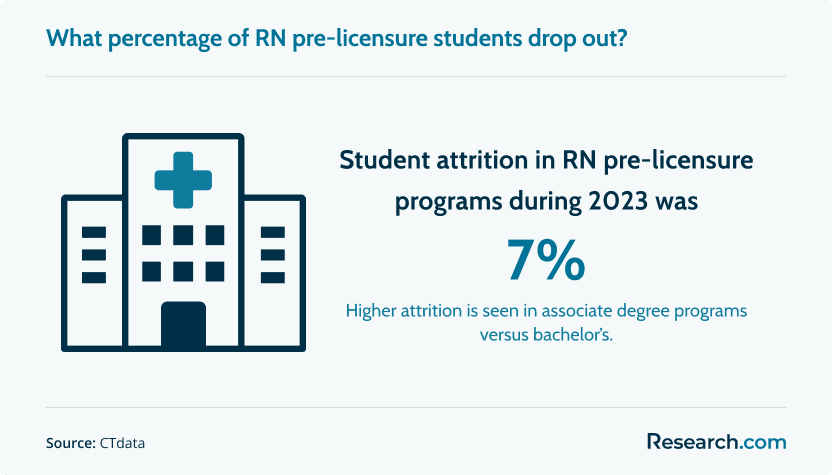
Anatomy and physiology are often the toughest courses in pre-nursing. A dissertation from the University of Southern Mississippi found attrition rates of 30-40% in anatomy and physiology courses across U.S. colleges. These courses require mastering complex body systems that serve as the foundation for later clinical work.
In nursing programs, pharmacology is consistently cited among the hardest courses. Students must memorize hundreds of medications and apply that knowledge safely in patient care. Even for those pursuing an online graduate certificate in nursing informatics, the critical thinking and application skills required in pharmacology remain challenging.
How long do pre-nursing programs take compared to nursing degrees?
Pre-nursing programs typically take 1 to 2 years to complete, depending on the student’s course load and prior credits. Once admitted into a nursing major, timelines vary depending on the degree type and school structure.
ADN programs typically take 2 to 3 years to complete and focus on essential nursing skills and clinical training for entry-level roles. BSN programs usually span 4 years total, with about 2 years dedicated to upper-division nursing coursework.
Students who want more flexibility or a faster path to nursing can choose part-time or accelerated programs. Part-time options let learners take fewer courses per semester, extending completion from about 2 years to 4 years.
Schools like CUNY and Purdue Global even offer evening or weekend classes. Accelerated BSN programs target those with prior bachelor’s degrees and compress coursework into 12-18 months of full-time study. Similarly, accelerated academic paths resemble options like can you get your MSN without a BSN, where learners with prior education can fast-track their progression toward advanced nursing qualifications.
What are the career outcomes for pre-nursing vs. nursing graduates?
Pre-nursing graduates have limited but not entirely absent career options. Many wonder, "What are entry-level nursing jobs?" available to them before completing a nursing major. Common positions include medical assistants, nursing aides, or patient care technicians, which usually require short certifications and passing competency exams. However, these roles typically offer lower pay and limited advancement.
In contrast, BSN graduates have stronger outcomes. The American Association of Colleges of Nursing (AACN) reports that 84% of BSN graduates receive job offers by graduation and 96% within six months. Around 71.7% of employers also show a strong preference for BSN-trained nurses, and 27.7% now require it for new hires.
BSN nurses also earn about $92,560 annually, roughly 15% more than those with an associate degree. While pre-nursing offers a foundation in healthcare, completing a nursing degree is crucial for licensure and higher-paying roles.
What is the pathway from pre-nursing to becoming a licensed registered nurse (RN)?
For many students, the pre-nursing stage lays the groundwork. It turns general science knowledge into the foundation needed for advanced nursing study, clinical training, and eventually, RN licensure.
Here is the typical pathway from pre-nursing to becoming a licensed RN:
1. Complete a pre-nursing program.
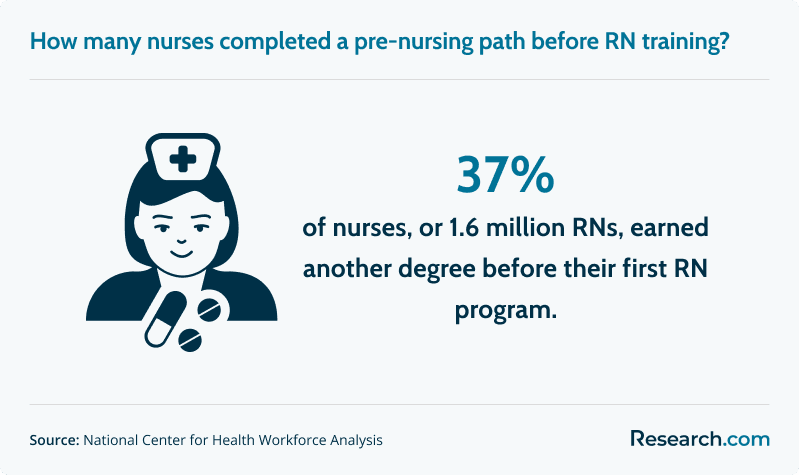
Students first take prerequisite courses such as anatomy, physiology, microbiology, and chemistry. These courses prepare them for the rigors of nursing school. According to the National Center for Education Statistics (NCES), most pre-nursing programs last one to two years, depending on whether the student studies full-time or part-time.
2. Apply to an accredited nursing program.
After completing prerequisites, students apply to an ADN or BSN program. BSN programs are becoming the preferred route, as the AACN reports that 71.7% of employers now show a strong preference for BSN-prepared nurses.
3. Complete nursing coursework and clinical training.
Once admitted, students engage in both classroom and hands-on training. Programs typically include 600-800 hours of clinical practice in hospitals or community settings.
4. Pass the NCLEX-RN exam.
To earn RN licensure, graduates must pass the NCLEX-RN, and pass rates vary by program type. The National Council of State Boards of Nursing (NCSBN) reports that BSN graduates had a first-time NCLEX pass rate of 90.3% in 2024, compared to 79.9% for ADN graduates.
5. Obtain state licensure.
After passing the NCLEX, candidates apply for RN licensure through their state board of nursing. States may have additional requirements, such as background checks or continuing education.
Where can pre-nursing and nursing graduates work, and how do their job opportunities differ?
Pre-nursing graduates may pursue entry-level healthcare jobs that use their basic clinical knowledge. These include certified nursing assistants (CNAs), patient care technicians (PCTs), or medical assistants.
To qualify, they must complete short certification programs approved by state nursing boards and pass the related competency exam. These roles commonly work in hospitals, long-term care facilities, or home health agencies.
In contrast, nursing graduates who complete an associate or bachelor’s degree and pass the NCLEX-RN exam qualify as RNs. They have wider employment options, from hospitals and outpatient centers to community clinics, public health programs, and non-bedside RN jobs.
Many nursing graduates also advance into specialized fields like pediatrics, intensive care, or surgical nursing. RNs earn a median annual salary of $93,600, with employment projected to grow 5% from 2022 to 2032.
Here’s What Graduates Say About Their Pre-Nursing and Nursing Majors
- Kate: "My pre-nursing experience at Ohio State gave me the structure I needed before entering the BSN program. The anatomy and microbiology labs were intense, but they helped me transition smoothly into clinicals later on. It felt like I was already halfway to becoming a nurse before my first hospital rotation."
- Sheryll: "Completing my BSN was demanding, but the simulation labs and 900+ hours of clinical work made me feel confident on my first day as an RN. It wasn’t just about passing exams. It was about learning how to stay calm and make decisions that actually save lives."
- Madison: "My pre-nursing program really emphasized critical thinking and teamwork. The advisors kept me on track for every nursing school deadline, and I ended up getting into my first-choice BSN program right after graduation. That guidance made all the difference."
Key Findings
- In 2023, about 15,549 students were enrolled in Pre-Nursing Studies programs in the U.S.
- The median in-state public tuition for Pre-Nursing Studies majors was around US$6,000, while out-of-state private tuition averaged about US$28,276.
- Roughly 70% of hiring organizations favor BSN-prepared nurses.
- Nursing programs with BSN degrees tend to have higher NCLEX-RN first-time pass rates compared to ADN or ASN programs.
- BSN RNs have an average salary of about $95,000 a year vs ADNs' $77,000 a year.
References:
- American Association of Colleges of Nursing. (2025, June 17). Schools of nursing enrollment increases across most program levels, signaling strong interest in nursing careers. https://www.aacnnursing.org/news-data/all-news/schools-of-nursing-enrollment-increases-across-most-program-levels-signaling-strong-interest-in-nursing-careers
- American Association of Colleges of Nursing. (2025, June 17). New graduate employment data. https://www.aacnnursing.org/news-data/research-data-center/new-graduate-employment-data
- American Association of Colleges of Nursing. (2025, June 17). Employment 2022. https://www.aacnnursing.org/news-data/all-news/article/employment-22
- Bureau of Labor Statistics. (2025, August 28). Registered nurses: Occupational outlook handbook. https://www.bls.gov/ooh/healthcare/registered-nurses.htm
- Bureau of Health Workforce. (2022). Nursing education and training: Data from the 2022 National Sample Survey of Registered Nurses. https://bhw.hrsa.gov/sites/default/files/bureau-health-workforce/data-research/nssrn-education-training-report.pdf
- CTData Collaborative. (2023). Nursing education in Connecticut in 2023. https://www.ctdata.org/nursing-education-2023
- Forbes. (2025, September 29). Best affordable online MSN programs of 2025. https://www.forbes.com/advisor/education/healthcare/best-affordable-online-msn-programs/
- Forbes. (2025, September 29). Best online RN-to-B.S.N. programs of 2025. https://www.forbes.com/advisor/education/healthcare/best-online-rn-to-bsn-programs/
- Kaihlanen, A. M. (2023). Nursing informatics competence profiles and perceptions. Journal of Advanced Nursing, 79(2), 123-134. https://onlinelibrary.wiley.com/doi/abs/10.1111/jan.15718
- U.S. Bureau of Labor Statistics. (2025, August 28). Registered nurses: Occupational outlook handbook. https://www.bls.gov/ooh/healthcare/registered-nurses.htm
- Wiley Online Library. (2023). Nursing informatics competence profiles and perceptions. https://onlinelibrary.wiley.com/doi/abs/10.1111/jan.15718
Other Things You Should Know About Pre-Nursing Vs. Nursing Majors in CURRENT_YEAR
In 2027, pre-nursing students generally have an advantage due to exposure to relevant coursework and healthcare field experience. However, admission is not guaranteed since it heavily depends on the competitiveness of the program and individual academic performance.
A pre-nursing program equips students with foundational knowledge in biology, chemistry, and anatomy that is crucial for nursing majors. It also develops essential skills such as critical thinking and time management, providing a strong academic basis to succeed in a nursing program in 2027.
The core courses in a pre-nursing curriculum for 2027 typically include anatomy, physiology, microbiology, and chemistry. These classes provide foundational knowledge essential for advanced nursing studies and prepare students for the rigorous academic demands of a nursing major.


