
2027 TESOL vs. ESL vs. TEFL Degree: Explaining the Difference

Co-Founder and Chief Data Scientist
English teaching isn’t one-size-fits-all. As of 2027, over 1.5 billion people are learning English worldwide, and the demand for qualified instructors keeps rising. But choosing between a TESOL, ESL, or TEFL degree can be confusing for anyone aiming to teach English locally or abroad.
This guide breaks down what each credential actually means, where it leads, and how much teachers can expect to earn. By the end, you’ll know which path aligns with your career goals—whether that’s teaching international students in the U.S. or building a teaching career overseas.
Key Things You Should Know About TESOL, ESL, and TEFL Degrees
- TESOL (Teaching English to Speakers of Other Languages) covers both domestic and international teaching. It’s ideal if you want flexibility—TESOL degrees prepare you to teach English to non-native speakers anywhere, whether in the U.S., online, or overseas.
- ESL (English as a Second Language) focuses on teaching English within English-speaking countries. This path suits those who want to work in schools, community programs, or adult education, helping immigrants and refugees integrate through language learning.
- TEFL (Teaching English as a Foreign Language) targets teaching opportunities abroad. It’s often certificate-based rather than a full degree and is designed for instructors planning to teach English in non-English-speaking countries.
- What is TESOL vs. ESL vs. TEFL Degree? TESOL vs. ESL vs. TEFL
- Which program (TESOL, ESL, TEFL) matches my career goals and location? Best Program for You
- What are the typical entry requirements for a TESOL / ESL / TEFL degree or certificate? Entry Requirements
- How long does each program take, and what formats are offered? Program Length
- What will I actually learn in a TESOL/ESL/TEFL program? Courses & Key Skills
- How much does each program cost, and what kinds of financial aid or scholarships exist? Program Costs & Aid
- What job opportunities are available after completing TESOL, ESL, or TEFL training? Career Paths & Jobs
- How much can I expect to earn, and what factors influence salary? Salary & Earning Factors
- What is the demand / job outlook for TESOL/ESL/TEFL professionals right now? What is the demand / job outlook for TESOL/ESL/TEFL professionals right now?
- How do I choose a quality program or provider? How do I choose a quality program or provider?
- Is pursuing an advanced leadership degree worthwhile for career progression? Is pursuing an advanced leadership degree worthwhile for career progression?
What is TESOL vs. ESL vs. TEFL Degree?
A TESOL, ESL, and TEFL degree all prepare individuals to teach English to non-native speakers, but each serves a different audience and career goal.
TESOL (Teaching English to Speakers of Other Languages) is the broadest, combining domestic and international teaching contexts. It’s ideal for educators who want to teach English either abroad or to immigrants and international students in English-speaking countries.
ESL (English as a Second Language) degrees focus specifically on teaching within English-speaking nations like the U.S., Canada, or the U.K. ESL teachers often work in K–12 schools, adult literacy programs, and community centers. In the U.S., the Bureau of Labor Statistics (2025) reports an average pay of $59,950 per year for adult ESL instructors.
Meanwhile, TEFL (Teaching English as a Foreign Language) degrees or certificates are geared toward those who plan to teach English in non-English-speaking countries such as Japan, Spain, or South Korea. TEFL credentials are often shorter, career-entry routes rather than full academic degrees, making them more flexible for travel-oriented professionals.
Those seeking faster study options can also look into accelerated ESL programs online for a quicker transition into teaching roles.
Which program (TESOL, ESL, TEFL) matches my career goals and location?
The right program depends on where you want to teach and the type of students you aim to work with.
- TESOL is the most versatile option—it qualifies you to teach English both in the U.S. and abroad. It’s well-suited for those seeking long-term careers in academia, international education, or curriculum development. TESOL graduates often hold advanced degrees and earn between $45,000 and $70,000 annually in the U.S.
- ESL degrees are best for teaching English within English-speaking countries. They prepare educators for public school systems, adult literacy centers, and community programs. The BLS (2025) notes that adult ESL teachers earn about $59,950 per year, with employment spread across education and nonprofit sectors.
- TEFL is ideal for those who want to teach English in non-English-speaking nations. It’s typically a certificate rather than a degree, allowing teachers to work in language institutes or private schools worldwide. Global salaries vary widely—from $600 to $4,000 per month, depending on region and experience.
The chart below highlights the most common majors among ESL teachers, showing that English-related fields dominate the profession and reinforce how academic background often aligns with one’s teaching pathway. Professionals comparing global teaching and academic credentials might also look into what is the difference between BA and MBA, since many TESOL graduates later pursue management or administrative roles in education institutions abroad.
What are the typical entry requirements for a TESOL / ESL / TEFL degree or certificate?
Entry requirements for TESOL, ESL, and TEFL programs differ by academic level and country, but all emphasize English proficiency and foundational education.
TESOL degree requirements:
- A bachelor’s degree in English, linguistics, or education (minimum GPA 2.5–3.0).
- English proficiency proof (TOEFL or IELTS) for non-native speakers.
- Some graduate programs—like those at New York University and University of Pennsylvania—require prior teaching experience or coursework in linguistics.
- Application materials often include a statement of purpose, recommendation letters, and transcripts.
ESL degree requirements:
- High school completion for undergraduate entry; a bachelor’s degree for graduate or certification tracks. According to Zippia (2025), 70% of ESL teachers have a bachelor’s degree, while 19% hold a master’s.
- Education-focused coursework, including pedagogy and applied linguistics.
TEFL certification requirements:
- Minimum of a high school diploma or bachelor’s degree (varies by provider).
- No teaching experience needed; programs usually last 120 hours.
- Applicants must demonstrate native or near-native fluency in English.
Applicants deciding between shorter certificates and advanced degrees may also compare outcomes similar to those in is it better to have a paralegal certificate or degree, since that same cost-versus-depth consideration applies here—certificate programs offer speed, while degrees deliver long-term career flexibility.
How long does each program take, and what formats are offered?
Program length and format vary significantly between TESOL, ESL, and TEFL degrees depending on level and delivery mode.
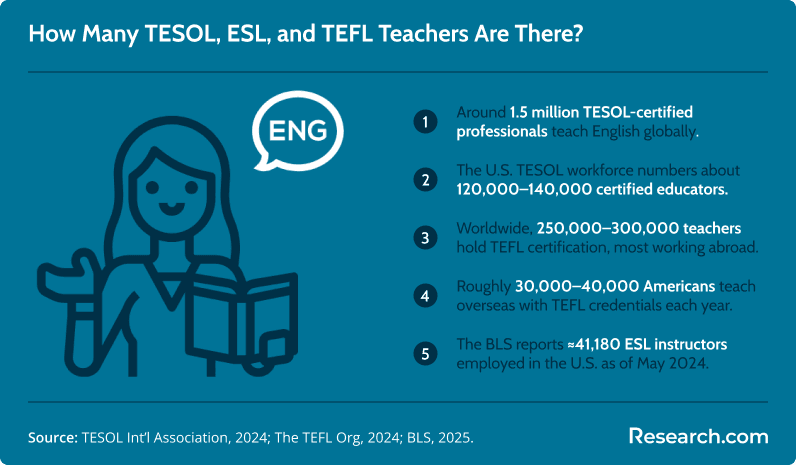
A TESOL degree typically takes two to four years to complete: four years for a bachelor’s and one to two years for a master’s. Many U.S. universities now offer hybrid or fully online TESOL programs, making them accessible for working educators. TESOL International Association (2024) estimates that 120,000–140,000 certified TESOL educators currently teach in the U.S., reflecting strong institutional demand for degree-qualified teachers.
ESL programs follow traditional academic timelines: four years for a bachelor’s and two years for a master’s. Flexible learning options are also growing. Some universities provide accelerated or distance-based tracks through online ESL teaching certification programs to allow teachers to qualify faster without leaving their jobs.
TEFL certifications are shorter—usually 120-hour courses completed in 4 to 12 weeks, available both online and in-person. These are ideal for those seeking immediate overseas teaching placements, especially in Asia, Europe, and Latin America.
The infographic below shows the scale of TESOL, ESL, and TEFL employment, illustrating how global demand and credential types correspond to different time commitments and training formats.
What will I actually learn in a TESOL/ESL/TEFL program?
Students enrolled in TESOL, ESL, and TEFL programs develop a blend of linguistic knowledge and teaching competence tailored to their target learners. These programs share several foundations but differ in depth, academic focus, and delivery format.
TESOL programs typically include:
- Second Language Acquisition and Linguistics
- English Grammar and Phonology for Teachers
- Curriculum Design and Language Assessment
- Cross-Cultural Communication and Pedagogy
- Teaching Practicum or Classroom Observation
ESL degrees often cover:
- Educational Psychology and Bilingual Education
- Literacy Development and Reading Instruction
- Classroom Management and Inclusive Teaching
- Lesson Planning and Technology Integration
- Student Assessment and Feedback Strategies
TEFL certifications emphasize:
- Lesson Planning and Classroom Control
- Speaking, Listening, and Pronunciation Techniques
- Adapting to International Classroom Settings
- Grammar Review and Error Correction
- Engaging Learners with Interactive Activities
Together, these subjects build strong communication, planning, and instructional skills. The chart below illustrates the top employer-valued skills for ESL teachers, confirming how academic coursework translates into practical classroom competencies. If you’re pursuing graduate-level teaching or leadership roles, you might also explore the difference between MA and MFA, since TESOL’s theoretical focus differs from an MFA’s creative or literary orientation.
How much does each program cost, and what kinds of financial aid or scholarships exist?
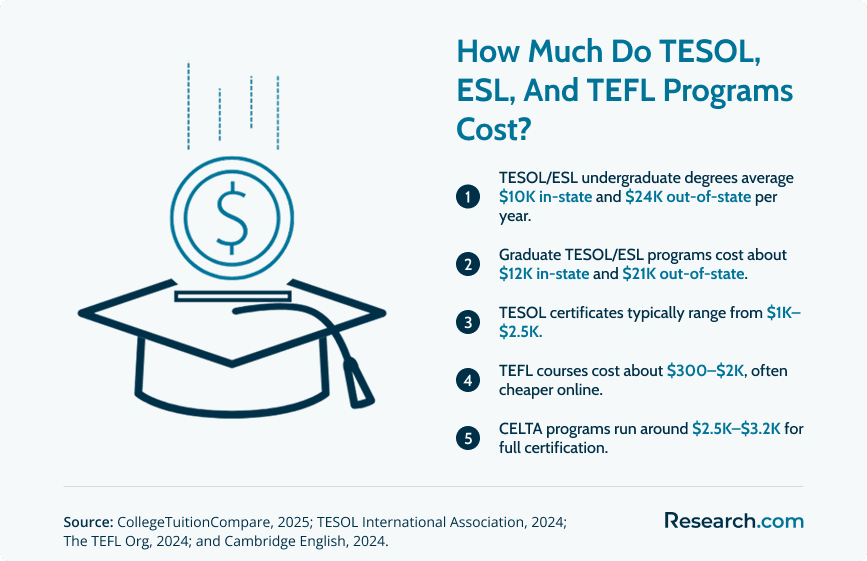
The cost of TESOL, ESL, and TEFL programs depends on the level, format, and country where you study. According to CollegeTuitionCompare (2025), undergraduate TESOL or ESL degrees average $10,000 per year for in-state students and $24,000 for out-of-state students. Graduate programs are slightly lower, averaging $12,000 in-state and $21,000 out-of-state. These totals exclude additional costs such as books, certification exams, or practicum fees.
TESOL certificates are the mid-range option, typically costing $1,000–$2,500, while TEFL courses are far cheaper—usually $300–$2,000, depending on the provider and location. CELTA, a highly regarded Cambridge credential, costs about $2,500–$3,200 for full certification. Many institutions now offer flexible financing, employer tuition reimbursement, and scholarships for international educators. Those seeking affordable graduate routes can check most affordable online TESOL master’s degree programs for updated tuition listings.
The infographic below breaks down the average cost range for each English-teaching pathway, showing how program length and credential level directly affect affordability and study options.
What job opportunities are available after completing TESOL, ESL, or TEFL training?
Graduates of TESOL, ESL, and TEFL programs can pursue a wide range of teaching and language-related careers both in the U.S. and abroad. Each credential opens doors to different sectors depending on specialization and location.
TESOL graduates often work as:
- University or community college instructors teaching advanced English courses.
- ESL/EFL curriculum developers for schools and educational publishers.
- Academic coordinators or teacher trainers, especially for international language institutions.
TESOL-certified educators in the U.S. earn between $45,000 and $70,000 annually, according to TESOL International Association (2024).
ESL degree holders typically find positions as:
- K–12 ESL teachers in public or private schools.
- Adult education or literacy instructors supporting immigrant learners.
- Language specialists or education consultants in government or nonprofit programs. The BLS (2025) reports an average ESL teacher salary of $59,950 per year.
TEFL-certified professionals usually work abroad as:
- Private language school teachers or corporate English trainers.
- Online ESL tutors for global students.
- Cultural exchange or volunteer educators through programs in Asia, Latin America, and Europe.
For those planning to teach professionally in the U.S., ESL master’s programs online can qualify educators for higher-level roles or state licensure pathways.
How much can I expect to earn, and what factors influence salary?
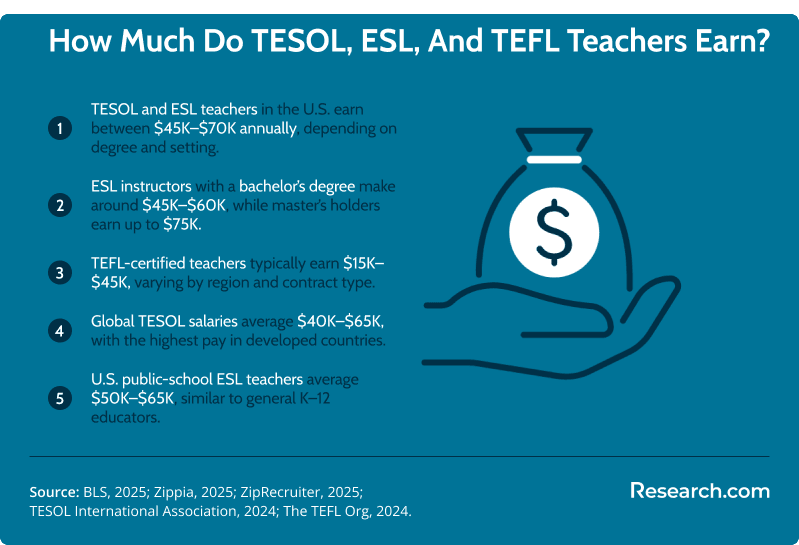
TESOL, ESL, and TEFL teachers earn widely varying salaries depending on education level, experience, and where they teach. In the United States, TESOL and ESL educators typically earn between $45,000 and $70,000 per year, aligning closely with national K–12 teacher averages.
According to BLS (2025), U.S. ESL instructors make about $59,950 annually, while those with master’s degrees can earn up to $75,000 in universities or specialized programs.
Internationally, salaries shift significantly. Global TESOL professionals earn around $40,000–$65,000, with higher pay in developed regions like the Middle East, Japan, or South Korea.
Meanwhile, TEFL-certified teachers, who often teach abroad, generally make $15,000–$45,000 depending on the host country’s cost of living, school funding, and benefits such as housing or airfare.
Other key factors include institutional type (public vs. private), teaching load, and advanced credentials. Educators can find more detailed breakdowns through ESL teacher salary data for local and international positions.
The infographic below summarizes the salary ranges across TESOL, ESL, and TEFL roles, showing how location, credentials, and experience drive income differences across English teaching pathways.
What is the demand / job outlook for TESOL/ESL/TEFL professionals right now?
The demand for TESOL, ESL, and TEFL professionals remains strong worldwide in 2025, fueled by globalization, migration, and the growing need for English proficiency in education and business. In the United States alone, the BLS reports around 41,180 ESL instructors currently employed, with steady growth projected as schools expand multilingual education programs. The outlook for adult and secondary ESL instruction is also positive, with continued federal and state support for English language learning among immigrants and refugees.
Globally, demand is even higher. The TESOL International Association estimates that 1.5 billion learners are studying English as a second or foreign language, creating sustained need for trained teachers. The TEFL Org reports 250,000–300,000 certified TEFL educators worldwide, many teaching across Asia, Europe, and Latin America. Countries like Japan, South Korea, and the UAE continue to offer competitive salaries and relocation benefits to attract qualified instructors.
Overall, the field offers stable employment, cultural mobility, and opportunities for both in-person and online teaching worldwide—making TESOL, ESL, and TEFL among the most portable education careers available today. For educators interested in advancing into leadership or program-management roles, comparing is an MBA better than a masters can help determine whether business-focused training provides an edge for running international schools or managing global language initiatives.
How do I choose a quality program or provider?
Choosing a quality TESOL, ESL, or TEFL program starts with verifying accreditation, credibility, and post-graduation outcomes. Accredited programs meet recognized teaching and linguistic education standards—such as those from TESOL International Association, Cambridge English (CELTA), or regional university accreditors in the U.S. Prospective teachers should confirm that their certificate or degree is accepted for employment both locally and abroad.
Key considerations include:
- Accreditation status – Look for programs recognized by official bodies (e.g., U.S. Department of Education, Ofqual, or CELTA).
- Program length and intensity – Shorter certificates (100–120 hours) may be enough for entry-level jobs, while graduate programs suit long-term careers.
- Instructor qualifications – Instructors should hold advanced TESOL degrees and international classroom experience.
- Career outcomes and alumni feedback – Check placement rates, teaching abroad partnerships, and verified student reviews.
- Delivery format and flexibility – Programs like the shortest online TESOL master’s programs allow learners to complete accredited coursework in accelerated online settings.
Ultimately, a credible provider combines strong academic grounding, supervised practicum experience, and transparent graduate results—ensuring your credential remains valid across borders.
Here's What Graduates Have to Say About Their TESOL, ESL, or TEFL Degree Program
- Marisela: "Studying TESOL online gave me the freedom to teach while earning my degree. The courses were practical, with modules on real classroom management and phonetics that I could apply immediately to my adult ESL students. Balancing work and study wasn’t easy, but the flexibility made it possible—and worth it. "
- Dev: "My TEFL certification opened doors to teaching in three countries within two years. The online format was interactive and engaging, especially the practicum sessions that paired me with real learners over video calls. I didn’t just learn grammar theory—I learned how to inspire confidence in new English speakers. "
- Hilda: "Completing my ESL master’s online gave me credentials recognized across states and abroad. The program’s focus on multicultural communication and assessment design prepared me for public-school teaching. I now manage a team of language educators, and the coursework still shapes my leadership approach daily. "
Is pursuing an advanced leadership degree worthwhile for career progression?
Advanced degrees extend career opportunities beyond traditional classroom roles by equipping educators with the skills required for leadership, curriculum design, and policy development. Such credentials often serve as a bridge to managerial and administrative positions, enabling teachers to contribute to institutional innovation and strategic planning. For professionals aiming to accelerate growth while continuing to teach, flexible options like EdD online programs offer an effective pathway to integrate advanced coursework with real-world practice. Evaluating these programs in terms of cost, duration, and long-term return on investment is essential for making an informed decision.
Key Findings
- The BLS (2025) reports around 41,180 ESL instructors currently employed in the U.S.
- TESOL International Association (2024) estimates 1.5 million professionals teaching English globally.
- TESOL and ESL teachers in the U.S. earn $45K–$70K annually, while TEFL teachers abroad earn $15K–$45K.
- TESOL/ESL undergraduate programs average $10K in-state and $24K out-of-state per year.
- 70% of ESL teachers hold a bachelor’s degree, and 19% hold a master’s, according to Zippia (2025).
- The TEFL Org (2024) reports 250,000–300,000 certified TEFL teachers worldwide, with strong demand in Asia and Europe.
References:
- Bureau of Labor Statistics (BLS). Adult Basic Education, Adult Secondary Education, and English as a Second Language Instructors.
- Bureau of Labor Statistics (BLS). Adult Basic and Secondary Education and ESL Teachers: Occupational Outlook Handbook.
- CollegeTuitionCompare. Teaching English as a Second or Foreign Language/ESL Language Instructor Program 2025 Tuition.
- Data USA. Teacher Education.
- EC English. 70 Statistics About the English Language.
- LSPM. Qualifi TEFL Certificate with Practice.
- TESOL International Association. TESOL Core Certificate Program.
- TEFL Org. TESOL Certification | Teach English Abroad & Online.
- TEFL Hero. How Much Does A TEFL Certification Cost? [2025 GUIDE].
- ZipRecruiter. ESL Teacher Resume Keywords and Skills.
- ZipRecruiter. What Are the Key Skills and Qualifications Needed to Thrive in the ESL Teacher Work From Home Position and Why Are They Important?
- ZipRecruiter. What Are the Key Skills and Qualifications Needed to Thrive in the Full-Time ESL Teacher Position and Why Are They Important?
- Zippia. ESL Teacher Jobs.
Other Things You Should Know About TESOL, ESL, and TEFL Degrees
TESOL, ESL, and TEFL programs in 2027 often require non-native English speakers to demonstrate proficiency through exams like IELTS or TOEFL. Minimum scores can vary, but typically a TOEFL score of 80 or an IELTS band of 6.5 is expected for enrollment.
TESOL is versatile, often favored for careers in diverse environments, including English-speaking countries, while TEFL focuses on teaching abroad. For long-term careers, TESOL provides broader opportunities, but both can be effective depending on regional demand in 2027.
Teaching experience is not a strict requirement for enrolling in TESOL, ESL, or TEFL programs in 2027. These programs are designed for individuals at various stages of their teaching journey, including those who are new to teaching. Experience may enhance understanding but is not mandatory.


