
2027 What Degree Do You Need To Be a Social Worker: Education Requirements in Alaska

Co-Founder and Chief Data Scientist
Many aspiring social workers in Alaska struggle to understand the exact educational path required to enter the profession. With Alaska's growing demand for qualified social workers—projected to rise by 12% over the next decade—obtaining the right degree is crucial. A Bachelor of Social Work (BSW) is the minimum requirement for entry-level positions, but most roles necessitate a Master of Social Work (MSW) for licensure and specialized practice.
This article, prepared by experts in career planning, clarifies Alaska’s education requirements and licensing steps, offering clear, actionable advice to guide prospective social workers toward a successful career.
Key Things to Know About Social Work Education Requirements in Alaska
- A minimum of a Bachelor of Social Work (BSW) from a program accredited by the Council on Social Work Education (CSWE) is required for entry-level social work positions in Alaska.
- Licensed Clinical Social Workers (LCSWs) must hold a Master of Social Work (MSW) degree and complete at least two years of supervised clinical experience as mandated by Alaska’s licensing board.
- Continuing education is necessary to maintain licensure, with Alaska requiring 30 hours of relevant training every two years to stay current on best practices and legal standards.
- What is the minimum degree required to become a licensed social worker in Alaska?
- What courses are covered in a social work degree program in Alaska?
- How long does it take to complete a social work degree program in Alaska?
- How much does a social work degree cost in Alaska?
- What degrees are required for different social work specializations in Alaska?
- What financial aid options are available to social work students in Alaska?
- What are the alternative pathways to become a social worker in Alaska?
- Are online social work degrees recognized in Alaska?
- What are the career prospects for social workers in Alaska?
- What organizations accredit social work degree programs in Alaska?
- What are the top institutions offering social work degree programs in Alaska?
- What are the licensing steps to practice social work in Alaska?
What is the minimum degree required to become a licensed social worker in Alaska?
To qualify for social work licensure in Alaska, candidates must meet specific education requirements that align with their desired level of practice. Meeting the minimum degree requirements for a social worker license in Alaska ensures access to various professional roles within the state.
- Licensed Baccalaureate Social Worker (LBSW): Requires a Bachelor’s degree in Social Work (BSW) from a Council on Social Work Education (CSWE)-accredited program or the University of Alaska, qualifying individuals for entry-level social work positions.
- Licensed Master Social Worker (LMSW): Necessitates a Master’s degree in Social Work (MSW) or a Doctorate of Social Work, allowing for a broader scope of practice and serving as a step toward clinical licensure.
- Licensed Clinical Social Worker (LCSW): Demands a Master’s or Doctorate degree combined with post-degree supervised experience, enabling independent clinical practice and advanced mental health roles.
Alaska social work education requirements are supported by accredited programs within the University of Alaska system, offering accessible pathways for residents. Those seeking to advance their expertise can explore careers with a masters in social work to understand how graduate studies align with licensure and professional development.
What courses are covered in a social work degree program in Alaska?
The right coursework equips social work students in Alaska with essential knowledge and skills tailored to the state's unique social and cultural landscape. Focusing on practical, culturally responsive education prepares graduates to effectively address local community needs. Below is a summary of core courses typically included in Alaska social work degree programs:
- Introduction to Social Work: Covers the profession's history, values, ethics, and roles with an emphasis on Alaska's social challenges and culturally responsive practice.
- Human Behavior in the Social Environment: Examines development across the lifespan, focusing on Alaska's behavioral health context.
- Social Welfare Policy and Services: Focuses on U.S. and Alaska-specific policies, advocacy, and service systems to prepare students for policy practice.
- Social Work Practice Methods: Teaches intervention strategies for individuals, families, groups, and communities, addressing rural and indigenous needs.
- Research Methods in Social Work: Provides training in research design and program evaluation relevant to Alaska’s communities.
- Field Education/Practicum: Requires supervised hands-on experience, with hours ranging from 400 (bachelor’s) to 960 (master’s), often focused on rural and Alaska Native populations.
- Diversity, Equity, and Inclusion in Practice: Addresses anti-racism, cultural humility, and Alaska-specific diversity issues for ethical, inclusive practice.
Alaska social work programs specifically integrate rural practice and Alaska Native issues, reflecting the state’s workforce and social realities. For example, specialized tracks in School Social Work and Children’s Mental Health may also be available, further tailoring education to community needs.
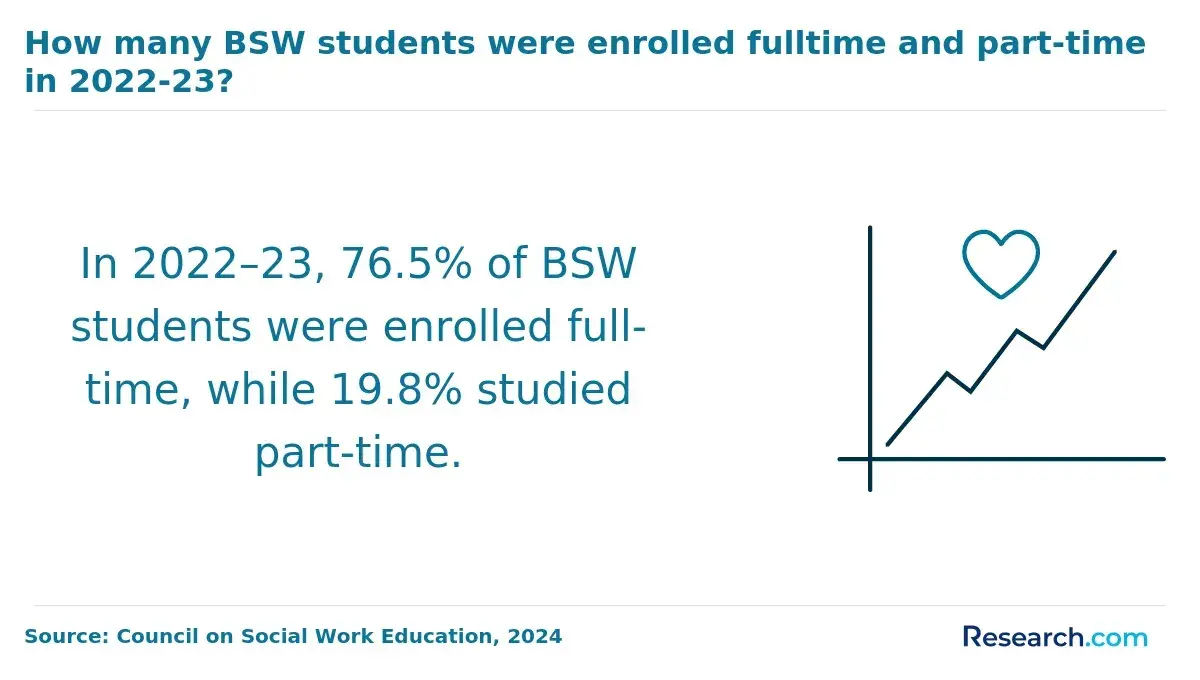
This image highlights that the majority of BSW students in 2022–23 were enrolled full-time, with a smaller portion studying part-time. These enrollment patterns help explain why Arkansas programs structure coursework and fieldwork to accommodate both traditional students and those balancing other commitments.
How long does it take to complete a social work degree program in Alaska?
Timing is a critical factor when planning social work education in Alaska, as it determines how quickly you can enter the workforce and respond to community needs. Knowing the typical duration of degree programs helps set realistic goals and manage expectations, especially given Alaska's unique geographical and educational context.
Below are key points outlining the usual timeframes for social work degrees and factors influencing these timelines.
- Bachelor of Social Work (BSW): Full-time students generally finish in four years, including a 400-hour senior practicum; part-time study or working while attending may extend this timeframe.
- Master of Social Work (MSW): The University of Alaska Anchorage offers a full-time path lasting about two years; part-time students typically take up to four years; advanced standing students with a recent BSW can complete it between 12 and 24 months.
- Doctor of Social Work (DSW) & PhD: These doctoral degrees aren't offered in Alaska and usually require three to five years nationally, with part-time study potentially extending beyond five years.
- Advanced Standing: Holding a BSW from a CSWE-accredited program can shorten MSW completion by up to a year, accelerating entry into professional practice.
- Fieldwork Requirements: Practicum hours, including the BSW senior practicum and MSW field placements, can lengthen program duration, especially for students in rural Alaska facing placement challenges.
- Study Format: Cohort models, online delivery, and distance education offer flexibility but may lead to longer program timelines due to scheduling and practicum availability.
A social worker from Alaska, who graduated from a local university, shared that her MSW journey took just under three years as she balanced part-time coursework with fieldwork in a remote community. She reflected, “The practicum was both rewarding and challenging, especially securing placements close to home.”
She also explained that while the program’s flexibility was vital for managing family commitments, “it extended the process slightly beyond the typical two years.” Despite the longer timeline, she emphasized that every extra month spent deepening her hands-on experience was worth it, preparing her thoroughly to serve diverse populations across Alaska.
How much does a social work degree cost in Alaska?
Knowing tuition and fees can shape your choices when pursuing a social work degree in Alaska, especially given the state’s high living costs. Accurate information helps students plan financially and explore the most affordable routes to licensure and career readiness.
- Bachelor of Social Work (BSW): In-state tuition at the University of Alaska Anchorage (UAA) is about $8,700 per year, while out-of-state tuition can exceed $26,000, with total costs reaching over $150,000 for nonresidents, including living expenses.
- Master of Social Work (MSW): Tuition ranges from $11,000 to $12,000 annually for residents and $24,000 to $26,000 for nonresidents, with a typical two-year program totaling up to $52,000 plus living costs; part-time and online options may vary slightly.
- Doctor of Social Work (DSW) and PhD: Alaska does not offer in-state programs; out-of-state and online costs vary widely, typically between $15,000 and $60,000, with funding opportunities available but competitive.
- Public vs. Private Institutions: Public universities provide the bulk of Alaska’s social work education with lower tuition, while private schools usually cost more and do not offer in-state discounts.
- In-State vs. Out-of-State Tuition: Residents benefit from significantly reduced tuition, often paying less than half compared to nonresidents, particularly for BSW and MSW programs.
- Online vs. On-Campus Programs: Online degrees offer flexible scheduling and may have uniform tuition regardless of residency, but students should budget for technology fees and necessary in-person field placements.
Additional expenses like textbooks, health insurance, and field education can increase the overall cost. To fully understand the cost of a social work degree in Alaska and optimize financial planning, consider all these factors and explore options carefully. For insight into career income differences, you can check LPC vs LCSW salary comparisons.
What degrees are required for different social work specializations in Alaska?
Different social work roles in Alaska require varying levels of education due to the specific skills and responsibilities involved. Meeting the degree requirements for social work specializations in Alaska ensures you are qualified to provide effective services and meet state licensing standards.
- Clinical Social Work: A Master’s Degree in Social Work (MSW) from a CSWE-accredited school is required, along with 3,000 hours of supervised clinical experience and passing the ASWB Clinical exam to diagnose and treat mental health issues.
- School Social Work: Typically requires a Bachelor of Social Work (BSW) for entry-level roles, though many districts prefer or require an MSW for advanced or specialized positions in educational settings.
- Healthcare Social Work: At minimum, a BSW is needed, but an MSW is preferred by most employers for complex clinical or case management roles in hospitals and care facilities.
- Child and Family Services: Entry-level positions require a BSW, while higher-level or supervisory roles demand an MSW and relevant licensure to manage complex cases and lead programs.
For licensure, both the Licensed Baccalaureate Social Worker (LBSW) and Licensed Master Social Worker (LMSW) credentials require corresponding degrees paired with successful ASWB exam completion. Alaska’s social work education pipeline includes accredited BSW and MSW programs to support these career pathways, making it essential to choose a program aligned with your specialization goals.
This chart highlights the top career paths for PhD graduates in social work, with most pursuing tenure-track positions in CSWE-accredited programs. It reinforces how advanced degrees in Alaska open doors primarily in academia and research, while also supporting opportunities in clinical practice and administrative leadership.
What financial aid options are available to social work students in Alaska?
Financial aid is crucial for students pursuing social work degrees in Alaska, as it helps alleviate the financial burdens associated with tuition and related educational costs. By accessing diverse funding sources, students can dedicate more focus to their studies and career development. Key options for financial aid for social work students in Alaska include:
- Federal Grants: The Federal Pell Grant offers need-based funding for eligible undergraduate social work students and does not require repayment, with awards ranging from $602 to $7,200 annually.
- State Scholarships and Grants: The Alaska Education Grant (AEG) and Alaska Performance Scholarship (APS) support Alaska residents enrolled in social work programs with need-based and merit-based awards between $500 and $4,000 per year.
- University and Departmental Scholarships: Institutions like the University of Alaska Fairbanks provide scholarships such as the Social Work Department Scholarship and the Dr. Berman Scholarship, specifically for social work majors, with awards starting at $500 annually.
- Work-Study Programs: Federal and institutional work-study opportunities allow eligible students to work part-time while gaining relevant professional experience, helping to offset educational expenses.
- Student Loans: Federal Direct Loans and private loans, both subsidized and unsubsidized, are available, but students should carefully consider borrowing limits and repayment plans.
- Funding from Professional Organizations: Scholarships from groups like Pilot International and social work associations offer additional financial support for BSW and MSW programs, with awards up to $1,500 based on merit and need.
- Loan Forgiveness Programs: Graduates working in public service or nonprofit social work positions in Alaska may qualify for federal loan forgiveness, reducing long-term student debt.
Students interested in exploring career paths with a social work degree and understanding financial aid further can review what do social work majors do to align their funding strategies with career goals.
What are the alternative pathways to become a social worker in Alaska?
Individuals with degrees or professional experience outside traditional social work can enter the field in Alaska through several alternative pathways that leverage their backgrounds without starting over. These options make the transition smoother and recognize relevant education and skills.
- Traditional MSW Track for Non-BSW Holders: Applicants with bachelor’s degrees in psychology, sociology, or related fields can pursue a comprehensive two-year MSW program covering foundational and advanced coursework.
- Degrees in Behavioral Sciences: Psychology or sociology degrees provide strong preparation for MSW admission and success in social work practice and fieldwork.
- Post-Bachelor’s Certificates or Bridge Programs: Though not common in Alaska, bridge programs or prerequisite courses in social sciences can strengthen graduate school applications and prepare for MSW studies.
- State-Specific Temporary Licensure: Alaska offers one-year temporary licenses at the BSW or MSW level, allowing supervised work while completing full licensure requirements.
A social worker from Alaska shared that shifting careers from a health background to social work felt challenging but rewarding. Graduating from a local program, he recalled navigating the MSW traditional track, often balancing coursework with family responsibilities. “It wasn’t easy adjusting to the social work mindset, but my previous experience helped me connect with clients differently,” he said.
He appreciated the practical support and flexibility offered by online courses and temporary licensure, which eased his transition. His story reflects how these pathways open opportunities for professionals committed to serving Alaska’s diverse communities without losing valuable prior skills.
This image illustrates how healthcare remains a major employment setting for social workers, with about 35% working in hospitals, clinics, and related environments. For those entering through alternative pathways in Alaska, it underscores the strong demand for professionals who can integrate social and medical support services.

Are online social work degrees recognized in Alaska?
Online Bachelor of Social Work (BSW) and Master of Social Work (MSW) programs have become increasingly popular in Alaska due to the state’s large geographic area and remote communities. Recognition of these online degrees is essential for students who want professional licensure and employment, as both require confirmation that their education meets state and national standards. The University of Alaska Anchorage and University of Alaska Fairbanks offer fully online, accredited programs designed to help residents meet these criteria.
Recognition depends mainly on program accreditation. The Alaska Board of Social Work Examiners requires degrees from programs accredited by the Council on Social Work Education (CSWE) for licensure at all levels (LBSW, LMSW, LCSW). Online programs from UAA and UAF hold this accreditation and deliver curricula equal to campus classes.
A 2023 survey found that over 80% of employers nationally recognize CSWE-accredited online social work degrees as equivalent to traditional ones, and UAA’s online MSW graduates had a 96% first-time pass rate on the LCSW exam in 2022.
Students should also consider required supervised fieldwork, which remains mandatory for both BSW and MSW degrees. UAA requires 480 to 960 hours of field experience, while UAF requires 400 hours. Many programs blend online courses with local field placements or occasional campus visits to ensure practical experience. Selecting a CSWE-accredited program approved by Alaska’s licensing board is vital for licensure eligibility and strong employment prospects in the state.
This chart highlights the different delivery formats available for BSW programs, ranging from fully in-person to blended, hybrid, and fully online models. It demonstrates how accredited online options are becoming increasingly common in Alaska, ensuring students across remote areas can still access recognized pathways to licensure.
What are the career prospects for social workers in Alaska?
Social work career prospects in Alaska are shaped by the state’s distinctive demographic, economic, and cultural factors. Opportunities exist across public agencies, healthcare settings, tribal organizations, and non-profit sectors, with growing demand for mental health services and community support. Data indicate that positions in these areas offer competitive salaries that tend to improve as professionals gain specialized skills and advanced licensure. Emerging trends, such as increasing use of telehealth and interdisciplinary collaboration, are broadening the scope of practice for social workers. For those considering complementary career pathways, review the fastest way to become a counselor in Alaska to further expand your professional opportunities.
What organizations accredit social work degree programs in Alaska?
Accreditation is vital for social work degree programs because it guarantees high academic standards, ensures eligibility for licensure, and enhances recognition by employers. Obtaining a degree from an accredited institution also solidifies your professional standing in Alaska’s social work field.
- Council on Social Work Education (CSWE): This is the main accrediting body for social work programs across the United States. Only graduates from CSWE-accredited Bachelor of Social Work (BSW) and Master of Social Work (MSW) programs qualify for social work licensure in Alaska, as confirmed by the Alaska Board of Social Work Examiners.
- Regional Higher Education Accrediting Bodies: Institutions in Alaska must hold accreditation from recognized regional agencies such as the Northwest Commission on Colleges and Universities (NWCCU). This ensures overall institutional quality and credit transferability, with the University of Alaska Anchorage being regionally accredited and offering CSWE-accredited programs.
- Alaska Board of Social Work Examiners: While not a direct accreditor, this state agency sets licensure standards and approves programs that meet the educational requirements. Only degrees from CSWE-accredited and regionally accredited institutions are accepted for professional licensure.
For those exploring options for advanced preparation, the range of MSW programs ensures pathways aligned with Alaska’s accreditation framework, providing a clear route to licensure and career advancement in social work.
What are the top institutions offering social work degree programs in Alaska?
Choosing the right social work degree program in Alaska is essential to ensure proper accreditation, career preparation, and a wise financial investment. Accredited programs provide the credentials necessary for licensure while equipping students with practical skills through field placements and flexible learning options.
- University of Alaska Anchorage (UAA): Offers Alaska’s only CSWE-accredited Master of Social Work program with advanced generalist training and specialized tracks including School Social Work and Children’s Mental Health.
- University of Alaska Fairbanks (UAF): Provides a CSWE-accredited Bachelor of Arts in Social Work emphasizing liberal arts and Native Alaskan learning philosophies, featuring hybrid and distance education formats for statewide accessibility.
- UAA Graduate Certificate Programs: Popular for professionals seeking advanced credentials, these certificates offer focused study areas without the commitment of a full degree and benefit from established fieldwork networks.
- UAF Online and Hybrid Options: Supports working professionals with an online-hybrid social work program combining synchronous coursework and occasional in-person sessions in Fairbanks.
- UAA Field Placement and Specialization: Requires substantial supervised fieldwork hours ensuring rigorous professional preparation while addressing Alaska’s workforce needs through diverse curriculum components.
For those seeking flexible pathways, numerous options exist, including online social work degrees that enable students to balance education with current work commitments. Selecting from these best social work programs in Alaska helps guarantee an accredited social work degrees Alaska employers recognize and value.
What are the licensing steps to practice social work in Alaska?
To obtain licensure in Alaska, graduates must verify that their accredited degree satisfies state requirements and then complete a period of supervised fieldwork as specified by the Alaska Board of Social Work Examiners. Applicants are required to submit detailed documentation of their practicum experiences, pass the ASWB exam at the appropriate level, and comply with additional state-specific mandates such as background checks and continuing education requirements. For a comprehensive guide on the process, consult how to become a social worker in Alaska.
What Do Social Workers in Alaska Say About Their Degree
- Completing my social work degree at the University of Alaska Anchorage gave me an unparalleled understanding of the unique cultural dynamics and challenges faced by local communities. Starting my career in a local school allowed me to apply what I learned in a setting that truly needs compassionate and informed social workers. The experience has been profoundly rewarding, as I get to witness the direct impact of my work on the well-being of students every day. Alaska’s rich cultural heritage and remote environment shaped my professional approach in ways I couldn’t have imagined elsewhere. I feel proud to contribute to a better future for the younger generation. Gerald
- Pursuing my degree at Alaska Pacific University was transformative for both my personal growth and professional advancement. Facing the unique challenges posed by Alaska’s environment, including rural outreach, strengthened my resilience and adaptability. Beginning my career in a local school allowed me to engage with diverse populations and help students navigate difficult life circumstances, which deepened my passion for social work. This path opened doors for ongoing professional development, and now I’m positioned to take on leadership roles. The sense of purpose I have here is genuinely unmatched. Duke
- Studying social work at the University of Alaska Fairbanks connected me deeply with Alaska’s indigenous communities and inspired me to focus on culturally sensitive practices. Starting to work in a local school right after graduation gave me the opportunity to address systemic issues affecting youth in a holistic way. The balance of professional growth and meaningful community impact here has been fulfilling beyond words. Alaska’s natural beauty and close-knit communities challenge you to be a socially responsible and empathetic practitioner. This career choice has changed my life while helping shape a better society. Arni
Related Articles for Nearby States
- 2027 What Degree Do You Need To Be a Social Worker: Education Requirements in Washington
- 2027 What Degree Do You Need To Be a Social Worker: Education Requirements in Oregon
- 2027 What Degree Do You Need To Be a Social Worker: Education Requirements in California
- 2027 What Degree Do You Need To Be a Social Worker: Education Requirements in Hawaii
- 2027 What Degree Do You Need To Be a Social Worker: Education Requirements in Idaho
- 2027 What Degree Do You Need To Be a Social Worker: Education Requirements in Montana
- 2027 What Degree Do You Need To Be a Social Worker: Education Requirements in Nevada
- 2027 What Degree Do You Need To Be a Social Worker: Education Requirements in Utah
- 2027 What Degree Do You Need to Be a Social Worker: Education Requirements in Arizona
- 2027 What Degree Do You Need To Be a Social Worker: Education Requirements in Wyoming
References:
- Best MSW Programs. How to Become a Social Worker in Alaska.
- College Factual. Best Value Colleges for Social Work (Income $30-$48k) in Alaska.
- Careers in Psychology. Alaska Social Work Degrees, Schools, and Careers.
- Masters in Social Work Online. MSW Programs in Alaska for 2023 [Online Available].
- Social Work Degree Center. How to Become a Social Worker in Alaska.
- University of Alaska Anchorage. Bachelor of Social Work.
- University of Alaska Anchorage. MSW Application and Admission Information.
- University of Alaska Anchorage. Online Master of Social Work.
- University of Alaska Fairbanks. Social Work Bachelor’s Degree Programs.
- University of Alaska Fairbanks eCampus. Social Work Online Degree Programs.
Other Things You Need to Know About Education Requirements in Alaska
In Alaska, to practice as a social worker in 2027, you must hold at least a Bachelor's in Social Work (BSW) from a Council on Social Work Education (CSWE) accredited program. Some positions may require a Master of Social Work (MSW) for advanced practice.
In Alaska, a doctorate is not required to become a clinical social worker. The state mandates a minimum of a master's degree in social work from an accredited program, along with the completion of supervised clinical experience, before licensure.
While a doctorate in social work (DSW or PhD) can enhance expertise and open doors to advanced research or academic roles, it is not necessary for clinical practice. Therefore, obtaining a master's degree and fulfilling licensing requirements is sufficient for most clinical social work careers in Alaska.
To practice as a social worker in Alaska, you typically need a Bachelor's degree in Social Work (BSW) from an accredited program at a university. While community colleges may offer related introductory courses, they do not provide BSW degrees necessary for social work licensure in the state.


