
2027 What Degree Do You Need To Be a Social Worker: Education Requirements in Arkansas

Co-Founder and Chief Data Scientist
Wondering what degree you need to become a social worker in Arkansas? With over 15,000 licensed social workers statewide, demand is growing fast thanks to rising community needs. Getting the right education is key to breaking into this rewarding field and making a real difference. Arkansas requires a minimum of a bachelor's degree in social work or a related field for entry-level positions, while clinical roles often need a master's and licensure.
This article, crafted by experts in career planning, breaks down Arkansas’s education rules step-by-step, guiding future social workers on how to meet requirements and kickstart their careers successfully.
Key Things to Know About Social Work Education Requirements in Arkansas
- You need at least a bachelor’s degree in social work (BSW) to start working as a social worker in Arkansas, but most positions prefer a master’s (MSW).
- The Arkansas State Board of Social Work requires a relevant degree for licensure, which is essential if you want to advance or specialize.
- Fieldwork or internships during your degree are super important for hands-on experience, and Arkansas programs usually require around 900 hours for MSW students.
- What is the minimum degree required to become a licensed social worker in Arkansas?
- What courses are covered in a social work degree program in Arkansas?
- How long does it take to complete a social work degree program in Arkansas?
- How much does a social work degree cost in Arkansas?
- What degrees are required for different social work specializations in Arkansas?
- What financial aid options are available to social work students in Arkansas?
- What are the alternative pathways to become a social worker in Arkansas?
- What are the career prospects and salary trends for social work graduates in Arkansas?
- How do Arkansas social work programs promote cultural competency?
- Are online social work degrees recognized in Arkansas?
- What organizations accredit social work degree programs in Arkansas?
- What are the top institutions offering social work degree programs in Arkansas?
What is the minimum degree required to become a licensed social worker in Arkansas?
Getting licensed as a social worker in Arkansas means meeting certain degree requirements that align with your career goals. Here's a quick look at the educational paths you'll need based on the license level.
- Licensed Social Worker (LSW): Requires a Bachelor’s Degree in Social Work (BSW) from a program accredited by the Council on Social Work Education, which is the minimum degree for social worker in Arkansas.
- Licensed Master Social Worker (LMSW): Requires a Master’s Degree in Social Work (MSW) from a CSWE-accredited university, allowing for advanced practice and eligibility for clinical or supervisory roles.
- Licensed Certified Social Worker (LCSW): Requires a Master’s Degree in Social Work (MSW) plus at least 4,000 hours of post-master’s supervised social work experience, enabling independent clinical practice and supervision of others.
Arkansas social worker education requirements are clear that all degrees must come from CSWE-accredited programs to ensure the right training and professional standards. If you’re interested in specialized areas, such as becoming a geriatric social worker, these basic degree paths serve as your starting point.
What courses are covered in a social work degree program in Arkansas?
Having the right coursework is key for any social work student to succeed, especially in a state like Arkansas where communities face a variety of unique challenges. The curriculum is designed not only to prepare students for licensure but also to equip them with practical skills to support diverse populations statewide. Here's a breakdown of the core courses you'll typically find in Arkansas social work degree programs:
- Introduction to Social Work: Offers a broad overview of the profession, including core values and social worker roles across different settings.
- Human Behavior and the Social Environment: Focuses on theories about human development and behavior in family, group, and community contexts.
- Social Welfare Policy and Services: Covers the history and current landscape of social welfare policies with a focus on advocacy.
- Research Methods in Social Work: Introduces both qualitative and quantitative research essential for evidence-based practice.
- Social Work Practice (Micro, Mezzo, and Macro): Teaches practical skills for working directly with individuals, groups, and communities.
- Diversity, Equity, and Inclusion in Practice: Emphasizes cultural competence and anti-racism to effectively serve diverse populations.
- Ethics and Professional Behavior: Explores ethical challenges and professional standards guided by the NASW Code of Ethics.
- Field Education/Internship: Provides real-world experience through placements in community or clinical settings.
- Rural Social Work Practice (State-Specific): Some Arkansas programs include this course to prepare students for the specific demands of rural communities.
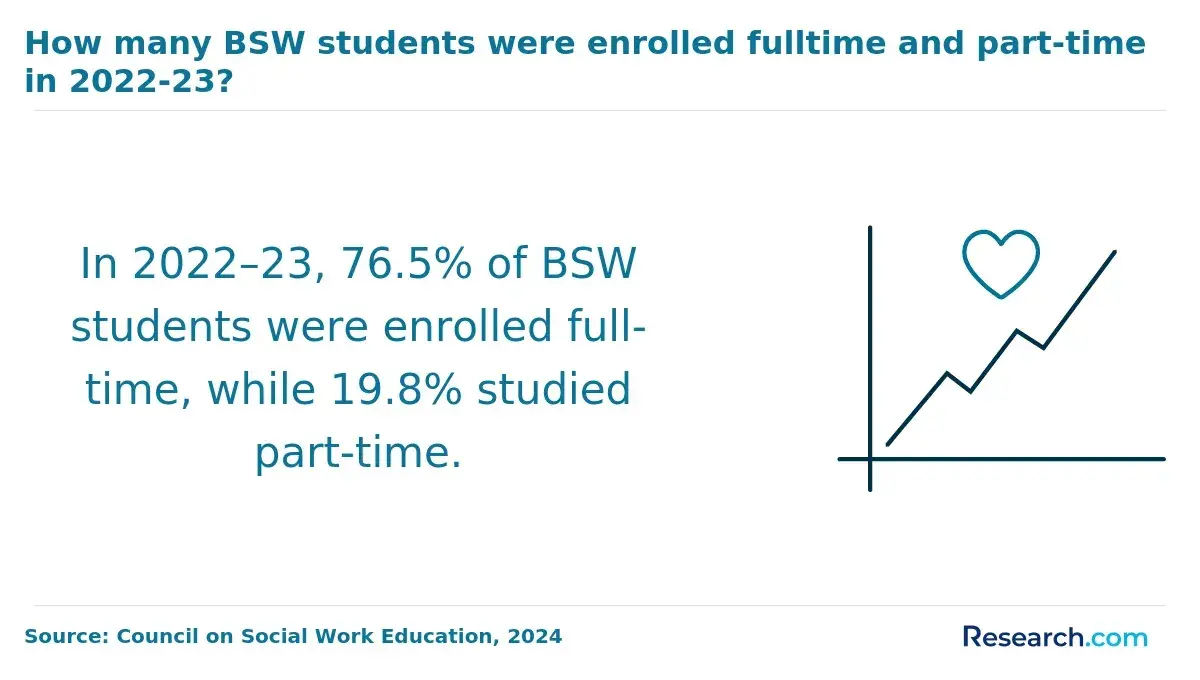
This image underscores how most BSW students in Arkansas, like nationally, pursue full-time study, with a smaller share enrolled part-time. Understanding these enrollment trends provides useful context for why programs balance coursework, fieldwork, and flexibility to meet the needs of diverse student populations.
How long does it take to complete a social work degree program in Arkansas?
When deciding on a social work degree in Arkansas, knowing how long it takes to finish is key. This helps you map out your career timeline and plan personal matters like work and family. Let’s break down the typical time frames and what can speed up or slow down your progress.
- Bachelor of Social Work (BSW): Usually takes full-time students about four years with 120 credit hours, either online or on campus; part-timers may take five to six years depending on their schedule.
- Master of Social Work (MSW): The standard full-time program lasts two years, but part-time students might need up to three; Advanced Standing options can cut it to just one year if you have a recent CSWE-accredited BSW.
- Doctoral Programs (DSW/PhD): These aren’t offered by major Arkansas schools but are available regionally, generally taking three to five years after your MSW with a lot of research and dissertation work.
- Full-time vs. Part-time Study: Full-timers usually finish faster—4 years for BSW and 2 years for MSW—while part-timers add one or two years, depending on coursework and internships.
- Advanced Standing: If you recently earned your BSW from an accredited program, you might finish your MSW in just one year full-time, which is a major time-saver.
- Fieldwork Requirements: Hands-on internships are essential and can affect how long your program takes, especially if placements get rescheduled or interrupted.
I talked with a social worker from Arkansas who graduated from a local program, and she shared how time flew by but wasn’t without its twists. “I planned for four years to finish my BSW, but juggling part-time classes and fieldwork stretched it nearer to five,” she said. She recalled moments when internship scheduling felt like puzzle pieces that just wouldn’t fit, and the patience required was real.
Still, she spoke warmly about how those experiences shaped her skills and confidence. “Looking back, even with the delays, it was worth every extra hour. The flexible pace helped me balance family and work, and staying in Arkansas for my field placements made the learning feel personal and connected.” Her story highlights how program length can vary, but the journey is rewarding and practical for those committed to social work here.
How much does a social work degree cost in Arkansas?
Knowing the cost of a social work degree in Arkansas helps you plan your education without surprises and find the best fit for your budget. Tuition for BSW/MSW programs and other degrees varies by school type, residency, and whether you study online or on campus.
- Bachelor of Social Work (BSW): Public universities charge in-state students about $7,500 to $10,000 per year, while out-of-state students pay between $15,000 and $20,000; private schools generally exceed $20,000 annually.
- Master of Social Work (MSW): In-state tuition at public Arkansas schools ranges from $8,000 to $12,000 yearly, with out-of-state costs between $16,000 and $24,000; private universities often charge over $22,000.
- Doctor of Social Work (DSW): Public programs, though rare, usually cost $10,000 to $15,000 per year, while private DSW studies can go beyond $25,000 annually.
- PhD in Social Work: Public institutions charge in-state students $10,000 to $15,000 yearly and out-of-state $18,000 to $22,000; private options may exceed $28,000.
- Online vs. On-Campus Tuition: Online tuition often matches or slightly undercuts on-campus rates, with some public schools offering in-state pricing to all online learners, though additional fees may apply.
Keep in mind, these figures don't include mandatory fees and extra costs like books and background checks. For insight into earning potential, check out the social workers salary data by state.
What degrees are required for different social work specializations in Arkansas?
Different social work roles in Arkansas require varying education levels because each specialty demands unique skills, expertise, and licensure to match specific client and community needs. Knowing the degree requirements for social work specializations in Arkansas helps you plan your education path effectively and focus on your career goals.
- Clinical Social Work: An MSW from a CSWE-accredited program is needed, plus two years of supervised full-time experience and passing the ASWB Clinical Exam for LCSW licensure.
- School Social Work: Generally requires a BSW for entry-level roles, though most workers pursue an MSW for better opportunities; licensure at LSW or LMSW level and sometimes educational endorsements are necessary.
- Healthcare Social Work: A BSW is the minimum for general roles, but an MSW is preferred for advanced case management, counseling, and leadership jobs, with LMSW or LCSW licenses often required.
- Child and Family Services: Entry-level positions call for a BSW, while supervisory or therapeutic roles usually require an MSW to provide clinical interventions.
- Generalist Social Work: BSW holders qualify for the LSW credential and can fill a wide range of entry-level positions in communities, schools, and healthcare.
This chart shows the most common career outcomes for PhD graduates in social work, with tenure-track positions in CSWE-accredited programs leading the way. It demonstrates how advanced degrees in Arkansas expand opportunities, particularly in academia and research, while also supporting roles in clinical practice and administration.
What financial aid options are available to social work students in Arkansas?
Financial aid is a game-changer for students pursuing social work degrees in Arkansas, helping to lower tuition costs and make higher education more doable. Since social work careers often start with moderate salaries, finding the right financial aid options is key to easing the burden along the way.
- Federal Grants (Pell Grant): Offers up to $6,895 annually for undergrads with financial need; no repayment required and based on FAFSA eligibility.
- State Scholarships and Grants: The Arkansas Department of Higher Education provides scholarships like the Arkansas Academic Challenge Scholarship to residents enrolled in social work programs who complete the FAFSA.
- Departmental Scholarships (BSW & MSW): Universities such as the University of Arkansas award scholarships for social work students meeting GPA and financial need criteria, with deadlines varying by school.
- Graduate Assistantships (MSW): MSW students can earn tuition waivers and stipends by assisting with teaching, research, or admin work in social work departments.
- Federal Work-Study Programs: Part-time jobs on campus or at nonprofit agencies let students earn while gaining social work-related experience.
- Student Loans: Both undergraduate and graduate students can access federal loans to fill funding gaps, though these must be repaid over time.
- Professional Organization Scholarships: Groups like the National Association of Social Workers-Arkansas Chapter offer competitive scholarships and grants to both BSW and MSW students.
- Loan Repayment and Forgiveness Programs: Licensed social workers in public or high-need roles may qualify for programs like Public Service Loan Forgiveness after 10 years of payments.
- Veterans’ Benefits: Veterans or dependents can use VA education benefits for tuition and housing assistance.
For students considering advanced degrees, exploring MSW online programs can also open doors to additional financial aid and flexible learning paths. Overall, these financial aid options offer strong support for social work students in Arkansas, making scholarships for BSW and MSW programs more accessible and helping future social workers focus on their important career goals.
What are the alternative pathways to become a social worker in Arkansas?
If you’re coming from another field or already hold a related degree, Arkansas offers several flexible ways to become a social worker without starting fresh. These options recognize your past education and experience, making the path smoother and quicker.
- Traditional MSW Pathway for Non-BSW Holders: A two-year Master of Social Work program designed for those with bachelor’s degrees in psychology, sociology, or similar areas, with foundational social work courses included.
- Advanced Standing MSW Programs: Available if you have a Bachelor of Social Work from an accredited school, letting you finish your MSW in about one year.
- Using Related Degrees as a Foundation: Degrees in fields like psychology or allied health can boost your MSW application and make learning easier.
- Post-Bachelor’s Certificate or Bridge Programs: These help fill gaps for students whose bachelor’s degrees aren’t related, prepping them for MSW admission.
- State-Specific Certification Routes: Though limited for school social workers, some alternative teaching certifications may apply if your master’s is recognized by the state.
When I asked a social worker from Arkansas who took one of these alternative routes about his experience, he reflected on how challenging it was to shift careers. Graduating from a local school, he shared, “I wasn’t starting over exactly, but it felt like I was learning a whole new language. Balancing work, family, and classes wasn’t easy, but having prior knowledge in psychology definitely helped me keep up.”
He appreciated that the programs respected his background, saying, “They didn’t just throw me in at the deep end; it was a bridge, not a jump.” His story shows that with determination and the right pathway, transitioning into social work in Arkansas is achievable and rewarding.
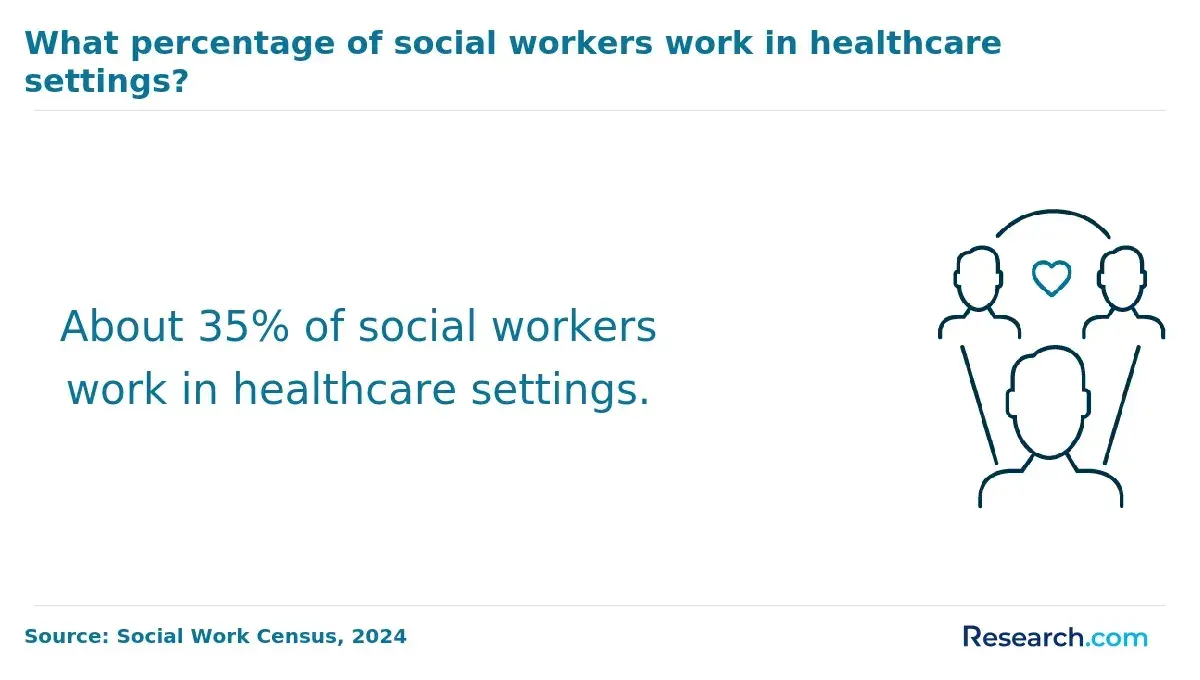
This image highlights that about 35% of social workers are employed in healthcare settings, showing how alternative pathways into the profession can lead to meaningful roles in hospitals, clinics, and care facilities. It emphasizes the strong demand for social workers across healthcare in Arkansas.
What are the career prospects and salary trends for social work graduates in Arkansas?
Arkansas continues to show steady demand for social work professionals due to evolving community needs and an increasing focus on integrated healthcare services. Recent data indicates that early-career social workers can expect competitive starting salaries with growth opportunities as they obtain advanced credentials and certifications. Moreover, local public agencies, healthcare facilities, and nonprofit organizations often offer structured career development programs that support specialized training and enhanced licensure. For a detailed roadmap to entering this field and maximizing career potential, consult the how to become a social worker in Arkansas guide.
How do Arkansas social work programs promote cultural competency?
Arkansas social work programs integrate cultural competency training directly into their curricula by offering specialized coursework, community engagement projects, and field placements in diverse settings. Faculty emphasize understanding local socio-economic and historical contexts, preparing students to work effectively with underrepresented populations. Some programs further include modules on multilingual communication techniques and trauma-informed care. For those seeking to enhance their counseling abilities within these frameworks, consider the fastest way to become a counselor in Arkansas.
Are online social work degrees recognized in Arkansas?
Online social work degrees like BSW and MSW are becoming super popular because they give folks flexibility to study around their busy lives. But it’s really important to know that not all online programs are treated the same when it comes to getting licensed or landing a social work job in Arkansas. If your degree isn’t recognized, you might hit some roadblocks with credentials or employers.
Recognition mostly depends on whether the program is accredited by the Council on Social Work Education (CSWE). Arkansas requires licensure candidates to have a degree from a CSWE-accredited school, whether online or in-person. These days, about 37% of MSW students choose online programs, up from 28% in 2020. Employers aren’t too picky about online versus campus degrees as long as the accreditation is solid and fieldwork is done properly—75% of social service hiring managers in the South say they don’t prefer one over the other.
Keep in mind, though, that online programs still require supervised field placements, often 900+ hours, which can’t be skipped. Some schools offer hybrid models with occasional in-person sessions, which might help with networking. The key is to pick an accredited online program, so you’re eligible for Arkansas licensure and ready for the job market.
This chart shows the different delivery methods for BSW programs, from entirely in-person to blended, hybrid, and fully online options. It highlights the growing flexibility in social work education, reinforcing that accredited online programs are increasingly common and fully recognized for licensure in Arkansas.
What organizations accredit social work degree programs in Arkansas?
Accreditation plays a huge role in making sure social work degree programs meet high standards, which helps graduates get licensed and recognized by employers. In Arkansas, attending an accredited program is key to sitting for the social work licensing exam and advancing your career.
- Council on Social Work Education (CSWE): This is the main body that accredits social work programs across the U.S. Only CSWE-accredited Bachelor of Social Work (BSW) and Master of Social Work (MSW) degrees qualify you to pursue licensure in Arkansas, and as of 2025, all Arkansas schools offering these degrees are CSWE-accredited, ensuring statewide and national recognition.
- Regional Accreditation (Higher Learning Commission): Social work programs in Arkansas must be part of colleges or universities accredited by the Higher Learning Commission (HLC). This shows the whole institution meets standards of quality, which employers trust and credits are transferable.
- Arkansas Department of Higher Education: Though it doesn’t accredit programs directly, this state agency reviews and approves degree offerings to make sure they follow regulations and workforce needs in Arkansas, helping keep educational quality consistent.
If you’re thinking about where to pursue your degree, exploring MSW online degree programs can be a great start while keeping accreditation in mind, especially for international students seeking flexible options that meet Arkansas social work licensing board standards.
What are the top institutions offering social work degree programs in Arkansas?
Picking the right program is key when you’re aiming for an accredited social work degree program Arkansas students trust because it directly impacts your licensure eligibility and future career opportunities. Plus, it’s a big financial move, so finding a school known for solid education and strong field experience is a smart play.
- University of Arkansas (Fayetteville): Offers both BSW and MSW programs accredited by CSWE, including an online Advanced Standing MSW that’s perfect if you already have a CSWE-accredited BSW. It’s known for excellent field placements and alumni earning average early career wages of over $45,000.
- University of Arkansas at Little Rock (UA Little Rock): Features a CSWE-accredited MSW with clinical and community impact concentrations, available fully online or in person, plus unique concurrent degrees with law and public service.
- Arkansas State University (Jonesboro): Provides both BSW and online MSW programs with a focus on rural social work specialization and practical training tailored to Arkansas communities.
- Harding University: A private school with a CSWE-accredited BSW that emphasizes ethical practice, Christian values, and offers a very personalized learning environment with strong mentorship.
- University of Arkansas at Pine Bluff: Has a CSWE-accredited BSW focused on serving historically underserved populations, blending classroom learning with extensive fieldwork.
With demand growing in healthcare and rural areas, these top social work schools in Arkansas offer flexible options and specialized tracks to get you ready for the field. If you want to explore more about social work careers, check out this resource on social worker jobs.
What Do Social Workers in Arkansas Say About Their Degree
- Pursuing my social work degree at the University of Arkansas gave me the strong foundation I needed to thrive in a local school setting. The program’s emphasis on practical skills and community engagement helped me feel confident in addressing the diverse needs of students. Starting my career here has been deeply rewarding because I get to witness firsthand the positive changes in children’s lives every day. The stability and support in this state’s educational system have made long-term career growth feel attainable and fulfilling. Kairi
- Choosing to study social work at Arkansas State University was a transformative experience that went beyond academics. The program’s focus on Arkansas’s unique cultural and social environment enriched my understanding of how to serve communities effectively. I’ve grown not just professionally, but personally, learning how to empower families and youth through tailored interventions. Working as a social worker in a local school allows me to contribute to the well-being of our future generations, which is a source of daily motivation and pride. Leila
- The journey through my social work program at Hendrix College introduced me to invaluable professional networks and development opportunities. Arkansas presents distinct challenges that have tested and shaped my approach, especially working with rural populations. Starting my career in a local school setting enabled me to apply theoretical knowledge in a meaningful way, addressing real issues affecting children and their families. This path has been deeply enriching and has opened doors for advancement within the field, all while helping me foster a genuine passion for educational support services. Lenon
Related Articles for Nearby States
- 2027 What Degree Do You Need to Be a Social Worker: Education Requirements in Missouri
- 2027 What Degree Do You Need To Be a Social Worker: Education Requirements in Oklahoma
- 2027 What Degree Do You Need To Be a Social Worker: Education Requirements in Tennessee
- 2027 What Degree Do You Need To Be a Social Worker: Education Requirements in Mississippi
- 2027 What Degree Do You Need to Be a Social Worker: Education Requirements in Louisiana
- 2027 What Degree Do You Need To Be a Social Worker: Education Requirements in Texas
- 2027 What Degree Do You Need to Be a Social Worker: Education Requirements in Kentucky
- 2027 What Degree Do You Need To Be a Social Worker: Education Requirements in Kansas
- 2027 What Degree Do You Need To Be a Social Worker: Education Requirements in Alabama
- 2027 What Degree Do You Need To Be a Social Worker: Education Requirements in Illinois
References:
- Arkansas State University. Master of Social Work – Standard Online.
- Arkansas State University. Social Work.
- Social Work License Map. How to Become a Social Worker in Arkansas.
- Southern Arkansas University. Social Work Degree Program.
- University of Arkansas. Regular (2-Year) Program.
- University of Arkansas. Social Work (SCWK).
- University of Arkansas at Little Rock. Master of Social Work.
- University of Arkansas at Little Rock. Social Work, M.S.W. Program.
- University of Arkansas – Fort Smith. Bachelor of Social Work.
- University of Arkansas at Monticello. Social Work.
Other Things You Need to Know About Education Requirements in Arkansas
The job outlook for social workers in Arkansas with the requisite degree is positive, expected to grow by around 13 percent by 2027. This growth is driven by increased demands for healthcare and social services in the state.
In Arkansas, a doctorate is not required to become a clinical social worker. The state mandates a master’s degree in social work (MSW) from an accredited program, along with supervised clinical experience and successful licensure exams. While a doctorate can enhance expertise and career opportunities, it is not necessary for licensure or practice as a clinical social worker. Most practitioners rely on their MSW and licensed clinical social work (LCSW) credentials to provide clinical services within the state.
In 2027, licensed social workers in Arkansas must complete 48 hours of continuing education every two years. This includes three hours in ethics and two hours in suicide prevention education, ensuring professionals remain current with industry standards and practices.


