
2027 What Degree Do You Need To Be a Social Worker: Education Requirements in Mississippi

Co-Founder and Chief Data Scientist
Mississippi faces a critical need for qualified social workers as nearly 17% of its population lives below the poverty line, emphasizing the demand for professional support services. To address this gap, obtaining the appropriate degree is essential. The state requires at least a Bachelor of Social Work (BSW) for entry-level positions, while a Master of Social Work (MSW) is necessary for clinical licensure.
Pursuing these degrees opens opportunities in healthcare, child welfare, and community services within Mississippi's growing social sector. This article, prepared by career planning experts, clarifies degree requirements and guides prospective social workers through Mississippi’s education and licensing pathways.
Key Things to Know About Social Work Education Requirements in Mississippi
- A Bachelor of Social Work (BSW) degree is the minimum requirement for entry-level social work positions in Mississippi, with over 60% of practitioners holding this degree.
- To provide clinical services independently, a Master of Social Work (MSW) degree is mandatory, as per Mississippi Board of Social Work licensure guidelines.
- Continuing education is required for licensed social workers; Mississippi mandates 30 hours every two years to maintain active status and ensure updated practice knowledge.
- What is the minimum degree required to become a licensed social worker in Mississippi?
- What courses are covered in a social work degree program in Mississippi?
- How long does it take to complete a social work degree program in Mississippi?
- How much does a social work degree cost in Mississippi?
- What degrees are required for different social work specializations in Mississippi?
- What financial aid options are available to social work students in Mississippi?
- What are the alternative pathways to become a social worker in Mississippi?
- What is the job market outlook for social work professionals in Mississippi?
- How can a social work degree enhance my counseling career in Mississippi?
- Are online social work degrees recognized in Mississippi?
- What organizations accredit social work degree programs in Mississippi?
- What are the top institutions offering social work degree programs in Mississippi?
What is the minimum degree required to become a licensed social worker in Mississippi?
The minimum education requirements for social worker in Mississippi are defined by clear degree standards accredited by the Council on Social Work Education (CSWE). Each level of licensure corresponds to a specific accredited social work degree Mississippi graduates must obtain.
- Licensed Social Worker (LSW): A Bachelor’s Degree in Social Work (BSW) from a CSWE-accredited program is mandatory for entry-level licensure, enabling holders to work under supervision in generalist social work roles.
- Licensed Master Social Worker (LMSW): Requires a Master’s or Doctorate Degree in Social Work (MSW/DSW/PhD) from a CSWE-accredited institution, permitting advanced practice and supervisory responsibilities.
- Licensed Certified Social Worker (LCSW): The highest licensure level, necessitating a Master’s or Doctorate Degree in Social Work with additional clinical experience, also from a CSWE-accredited program.
Mississippi offers 11 CSWE-accredited BSW degrees along with multiple accredited MSW programs, assuring a standardized qualification pipeline. As of 2023, around 4,400 licensed social workers are practicing in the state, a workforce expected to expand, especially in health care, child welfare, and rural service sectors. Prospective social workers focusing on roles such as social workers for the elderly should be aware that only CSWE-accredited degrees meet state licensure requirements, emphasizing the importance of pursuing an accredited social work degree that Mississippi institutions provide.
What courses are covered in a social work degree program in Mississippi?
Mississippi’s social work degree programs are carefully structured to align with both national accreditation standards and the state’s unique social challenges, ensuring graduates are well-prepared to serve diverse and vulnerable populations. The curriculum incorporates essential theoretical knowledge and practical skills required for licensure and effective practice. Below is an overview of the core courses typically included in these programs, highlighting state-specific focuses.
- Introduction to Social Work: Provides an overview of the profession’s history, values, and ethical frameworks that guide practice across varied settings.
- Human Behavior in the Social Environment I and II: Examines developmental and community influences on behavior with particular attention to Mississippi’s rural and diverse populations.
- Social Welfare Policy and Services I and II: Focuses on policy design and impacts, emphasizing implications for at-risk groups within the state.
- Populations at Risk: Addresses the needs of marginalized communities such as children, minorities, and the elderly, reflecting local demographic and health disparities.
- Research Methods in Social Work: Equips students to conduct and interpret research critical for evidence-based social work practice and program assessment.
- Social Work Practice I-IV (Generalist Practice): Develops diversified intervention skills for individuals, families, groups, and communities, including case management and organizing.
- Field Practicum/Seminar: Requires hands-on supervised experience totaling 12–15 credit hours over two semesters, a state licensure prerequisite without credit for prior experience.
- Child Welfare Services: Concentrates on child protection and foster care, addressing Mississippi’s elevated child poverty and foster care involvement rates.
- Human Diversity and Social Justice: Focuses on cultural competence and anti-oppressive practices tailored to Mississippi’s racial and economic diversity.
- Senior Seminar/Exit Examination: Integrates academic and field learning to prepare for state licensure examinations.
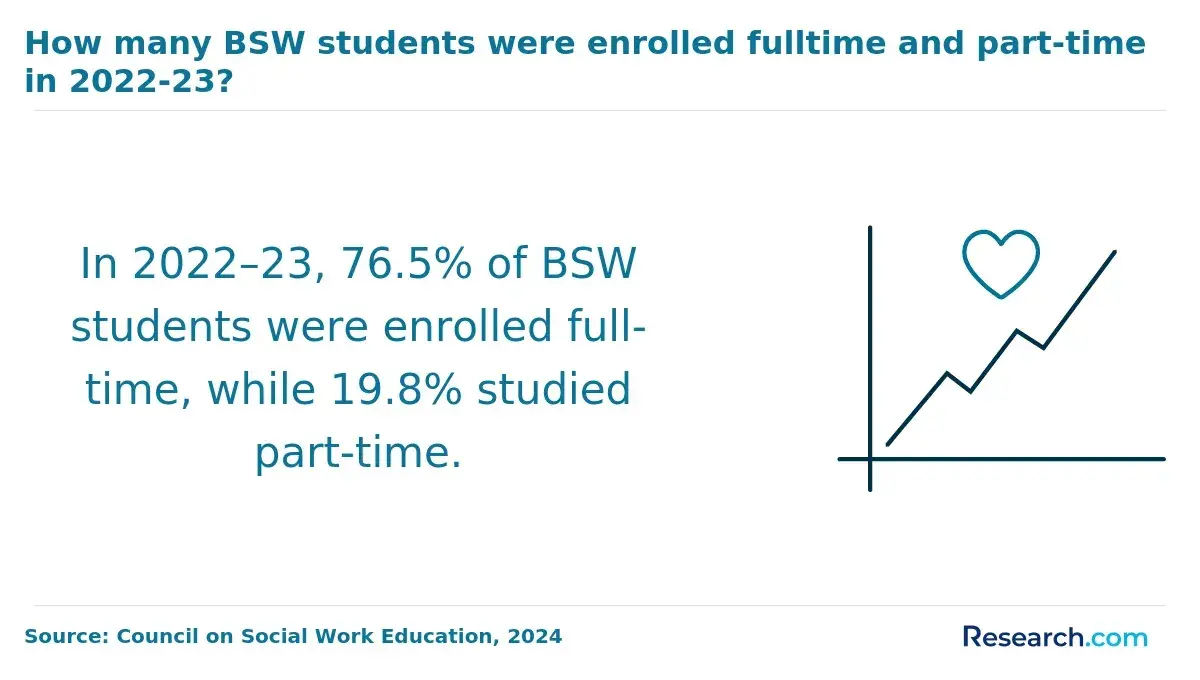
The image reinforces enrollment trends in Mississippi’s BSW programs, showing that most students study full-time while a smaller share pursue part-time paths. This balance highlights how program design accommodates varied student needs while maintaining rigorous academic and field requirements.
How long does it take to complete a social work degree program in Mississippi?
Planning the timeline for a social work degree in Mississippi is essential for aligning educational goals with career and licensure requirements. The duration varies widely depending on the degree level, enrollment status, and program structure. These factors directly impact how quickly graduates can enter the workforce or advance in their careers.
- Bachelor of Social Work (BSW): Typically completed in 4 years of full-time study, though part-time students may take up to 6 years; includes integrated fieldwork and practicum hours.
- Master of Social Work (MSW): Traditional full-time programs require about 2 years (60 credit hours) with 900 field instruction hours; part-time options can extend to 4–5 years, while advanced standing can reduce completion to 1 year with fewer credits and field hours.
- Doctor of Social Work (DSW): Generally demands 3–5 years of full-time study post-MSW, focusing on advanced clinical practice, leadership, and policy development.
- PhD in Social Work: Usually spans 4–6 years full-time after an MSW, emphasizing research and academic preparation with possible extensions for part-time study or employment commitments.
- Advanced Standing: Qualifies recent BSW graduates for reduced MSW coursework and practicum hours, significantly shortening program length.
- Fieldwork Requirements: Extensive field instruction is mandatory and delays in securing placements can extend overall program duration.
- Enrollment Status: Full-time study typically allows the shortest completion time; part-time students often take twice as long depending on course load.
- Institutional Variations: Universities offer different curricula and models, influencing program length and start times.
A social worker from Mississippi, who graduated from a local university, shared her experience about completing her MSW. She recalled the balancing act of full-time coursework alongside field placements, noting that while the program was designed to take two years, unexpected delays in securing fieldwork hours extended her study time closer to three years. “It was challenging to juggle the intense practicum requirements with personal responsibilities,” she said, emphasizing how part-time options helped her continue working while studying.
Reflecting on the journey, she expressed gratitude for the flexibility within her program but acknowledged that planning for potential extensions is essential. Her story highlights how factors beyond just credit hours and classes can influence how long it truly takes to complete social work education in Mississippi.
How much does a social work degree cost in Mississippi?
Knowing the tuition and fees associated with social work programs is essential for planning financial resources and making informed decisions about your education path. The cost of a social work degree in Mississippi varies widely by degree level, residency status, and institution type, affecting the overall affordability and return on investment.
- Bachelor of Social Work (BSW): Tuition for BSW programs at public universities ranges from $8,000 to $10,000 annually for in-state students and up to $15,000 for out-of-state; private colleges charge $15,000 to $25,000 per year, with additional fees and living expenses adding $3,000–$5,000.
- Master of Social Work (MSW): In-state tuition for MSW programs at public institutions typically costs $8,500 to $12,500 yearly; out-of-state tuition exceeds $15,000, while private universities may charge $20,000 or more; online programs have similar tuition but may reduce other costs.
- Doctorate of Social Work (DSW): Public university DSW tuition ranges from $10,000 to $15,000 per year; private programs are $20,000 to $30,000; part-time and online options are common and can influence total cost.
- PhD in Social Work: Public institutions charge $9,000 to $13,000 for residents and up to $20,000 for non-residents; private university tuition ranges from $22,000 to $35,000, often offset by assistantships or fellowships.
Mississippi social work tuition and fees at public schools typically offer significant savings for residents compared to private institutions, where rates are less variable. Many prospective students also consider the opportunities and costs of online versus on-campus programs when calculating the total MSW salary and career prospects in the field.
What degrees are required for different social work specializations in Mississippi?
Different social work roles in Mississippi necessitate varying education levels due to the distinct skills and licensure requirements involved. The degree requirements for social work specializations in Mississippi align with the complexity and responsibilities of each field.
- Clinical Social Work: Requires a Master of Social Work (MSW) from a CSWE-accredited program, plus state licensure as an LMSW or LCSW. Candidates must complete at least 900 hours of supervised fieldwork during their MSW and additional post-graduate supervised experience for clinical licensure.
- School Social Work: A Bachelor of Social Work (BSW) is the minimum, though most positions prefer or require an MSW with relevant educational field experience. Licensure as an LMSW is typically necessary, and some roles may require certification or endorsement by the Mississippi Department of Education.
- Healthcare Social Work: An MSW is strongly preferred for clinical and advanced practice roles in hospital and medical settings, focusing on health systems. A BSW may qualify for entry-level case management, but advancement and independent practice require an MSW and licensure.
- Child and Family Services: Entry-level roles accept a BSW after completing a 420-hour field internship and passing the state licensure exam. Leadership and clinical positions generally require an MSW for greater supervisory responsibilities within state and nonprofit agencies.
The chart highlights where PhD-level social work graduates most often find employment, with tenure-track and research positions dominating. This illustrates how advanced degrees in Mississippi and beyond open doors to academic leadership, research, and specialized practice opportunities across diverse professional settings.
What financial aid options are available to social work students in Mississippi?
Financial aid is essential for students pursuing social work degrees in Mississippi, as it significantly reduces the financial burden associated with tuition and related expenses. Access to various scholarships, grants, and work-study programs helps make education in social work more attainable for many aspiring professionals.
Key financial aid options for social work students in Mississippi include:
- Federal Grants: Need-based funding such as the Pell Grant provides non-repayable support determined by financial need and enrollment status.
- State Scholarships and Grants: Programs like the Higher Education Legislative Plan for Needy Students (HELP), Mississippi Tuition Assistance Grant (MTAG), and Mississippi Eminent Scholars Grant (MESG) offer awards ranging from partial tuition coverage to up to $2,500 annually for qualifying students.
- Institutional Scholarships: Many Mississippi colleges provide scholarships specifically for social work students, including both undergraduate and graduate awards; students should contact their financial aid offices for current opportunities.
- Graduate Assistantships: Graduate students can secure assistantships that offer stipends and practical experience through part-time work supporting their academic programs.
- Federal Work-Study Programs: This program offers part-time employment to students with financial need, with typical awards from $800 to $9,200 annually depending on level and institutional funding.
- Student Loans: Federal loans like Stafford Loans have annual limits varying from $5,500 to $20,500 depending on undergraduate or graduate status, requiring careful borrowing and planned repayment.
- Funding from Professional Organizations: Scholarships provided by organizations such as the National Association of Social Workers (NASW) Mississippi Chapter recognize academic achievement and commitment to social justice.
- Special Tuition Waivers and Institutional Aid: Certain populations may qualify for tuition waivers or emergency grants, which help alleviate unexpected financial challenges during their studies.
Students seeking financial aid for social work students in Mississippi are encouraged to apply early and leverage multiple sources to minimize debt and focus on their career goals, including exploring what jobs can you get with a social work degree through trusted resources such as what jobs can you get with a social work degree.
What are the alternative pathways to become a social worker in Mississippi?
Individuals holding degrees in fields such as psychology or sociology can transition into social work in Mississippi without restarting their education entirely. Several alternative pathways accommodate prior academic backgrounds while ensuring compliance with state licensure standards.
- Traditional MSW Track for Non-BSW Holders: A two-year Master of Social Work program designed for those with bachelor’s degrees in non-social work fields, providing foundational knowledge and field experience.
- Advanced Standing MSW Track: A shortened, typically 12-month MSW program for graduates with a Bachelor of Social Work from a CSWE-accredited school, allowing faster licensure preparation.
- Related Degrees as Foundations: Psychology, sociology, and human services degrees enhance MSW program applications and support smoother transitions into social work studies.
- Post-Bachelor’s Certificate or Bridge Programs: Targeted coursework options help fill prerequisite gaps before entering a full MSW program, varying by institution.
- State-Specific Alternative Certification: Reciprocity for out-of-state licensed social workers enables licensure transfer, subject to fees and active status.
A social worker from Mississippi, who earned his degree locally, reflected on his transition from psychology to social work through a traditional MSW program. He described the challenge of balancing prerequisite knowledge gaps with an accelerated learning curve, noting that “leveraging my psychology background gave me confidence, but the fieldwork demanded practical application that was new.” His experience underscores how alternative pathways require adaptability and persistence, yet offer rewarding career shifts without starting over.
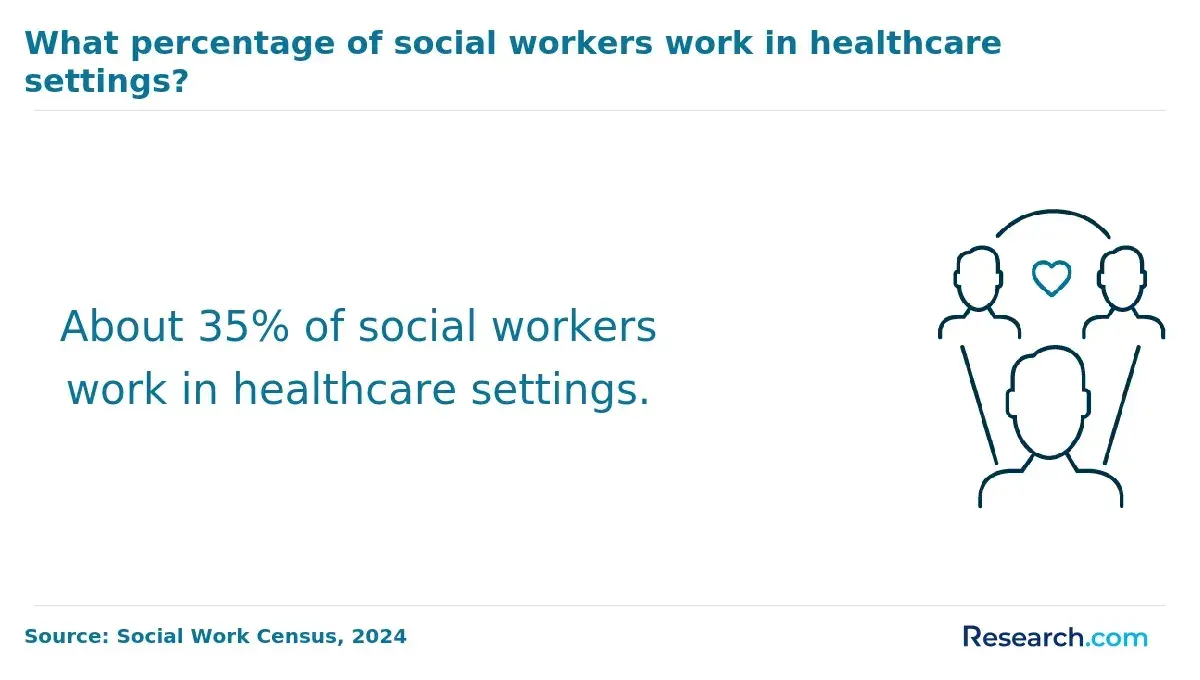
The image illustrates that about 35% of social workers practice in healthcare settings, reinforcing the value of alternative educational pathways. These routes allow career changers to enter high-demand fields like healthcare while meeting Mississippi’s licensure standards.
What is the job market outlook for social work professionals in Mississippi?
Mississippi’s social work sector is experiencing growth driven by increasing demands in healthcare, child welfare, and community services. Labor market data indicate a steady expansion in job opportunities, with competitive compensation and diverse roles emerging across clinical practice, policy advocacy, and community development. Professionals interested in tailored career strategies and advanced opportunities can explore how to become a social worker in Mississippi for detailed guidance.
How can a social work degree enhance my counseling career in Mississippi?
A social work degree develops critical skills—such as crisis intervention, empathetic communication, and ethical decision-making—that are directly transferable to counseling roles. Graduates can leverage their rigorous academic training and hands-on field experience to bridge into specialized counseling positions. Many professionals pursue additional certification or targeted training to qualify for counseling licensure, thereby expanding their career opportunities. For tailored guidance on streamlining this transition, consider the fastest way to become a counselor in Mississippi.
Are online social work degrees recognized in Mississippi?
Online Bachelor of Social Work (BSW) and Master of Social Work (MSW) programs have surged in popularity due to flexible, accessible learning options. For students in Mississippi, recognition of these online degrees directly affects eligibility for state licensure, which is mandatory for professional practice. Without official recognition, graduates may encounter significant obstacles in securing employment and advancing their careers.
Recognition in Mississippi depends heavily on accreditation, particularly by the Council on Social Work Education (CSWE), the national accrediting body. Mississippi mandates that social work degrees, whether earned online or on-campus, originate from CSWE-accredited institutions. National data indicates over 320 schools offer CSWE-accredited online MSW programs. Moreover, a 2023 survey revealed that 85% of U.S. human service organizations regard online social work degrees as equivalent to traditional degrees, assuming proper accreditation.
Additional considerations include supervised fieldwork requirements, which must be completed in-person at approved agencies to develop practical skills. Many online programs incorporate hybrid models combining remote coursework with local field placements to satisfy licensure prerequisites. Confirming a program’s CSWE accreditation and authorization to operate in Mississippi is essential, as only graduates from such schools qualify for licensure and meet employer expectations.
The chart shows that while entirely in-person BSW programs remain the most common nationwide, blended, hybrid, and online models are steadily expanding. For Mississippi students, this reflects growing recognition of flexible formats that still meet CSWE accreditation and state licensure requirements.
What organizations accredit social work degree programs in Mississippi?
Accreditation is a fundamental factor in maintaining high standards for social work degree programs in Mississippi, ensuring that they meet educational requirements needed for licensure and professional recognition. Graduates from accredited programs are eligible to take licensing exams and are preferred by employers, making accreditation a key consideration when selecting a program.
- Council on Social Work Education (CSWE): CSWE is the national accreditor for social work programs across the United States. Only students graduating from CSWE-accredited Bachelor of Social Work (BSW) and Master of Social Work (MSW) programs are eligible for social work licensure in Mississippi and most other states.
- Southern Association of Colleges and Schools Commission on Colleges (SACSCOC): This regional accrediting body guarantees that Mississippi colleges and universities maintain rigorous institutional quality standards, which are necessary for federal financial aid eligibility and professional licensure.
- Mississippi Commission on College Accreditation (MCCA): The MCCA monitors higher education program quality at the state level, certifying institutions authorized to operate and grant degrees in Mississippi. While it does not accredit individual social work programs, its oversight assures institutions meet state-specific regulations.
The demand for social workers in Mississippi is projected to grow by 12% through 2030, faster than the state average for all occupations, making it critical for prospective students to choose from accredited social work programs in Mississippi. For those seeking flexibility and affordability, exploring the cheapest online MSW programs can be a practical step toward meeting these accreditation and licensure requirements.
What are the top institutions offering social work degree programs in Mississippi?
Choosing the right institution for your social work education is essential for securing proper accreditation, comprehensive career preparation, and maximizing the value of your financial investment. Accredited MSW programs ensure that you meet licensure requirements and are well-equipped to serve diverse populations across Mississippi.
- University of Mississippi (Ole Miss): Offers fully accredited BSW and MSW degrees with strong field placements and diverse specialization options in clinical and community practice, addressing both rural and urban workforce needs.
- University of Southern Mississippi: The state's oldest graduate social work program providing BSW and MSW degrees, known for its international programs and extensive alumni network supporting employment opportunities.
- Jackson State University: Features a continuously accredited MSW program with an emphasis on Rural Nonurban Practice and Children, Youth, and Families, focusing on social justice and a diverse student body.
- Mississippi Valley State University: Provides an MSW program centered on rural social work and Child and Family Welfare, specifically tailored to serve underrepresented minority populations in the Mississippi Delta.
- Delta State University: Offers a CSWE-accredited BSW with flexible scheduling and strong community partnerships in the Mississippi Delta, ideal for working adults seeking hands-on experience.
For those seeking flexible options, exploring a social worker online degree can supplement traditional programs, supporting career advancement while meeting the state’s licensing prerequisites. Selecting from these top social work schools in Mississippi positions students for licensure success and aligns with regional workforce demands.
What Do Social Workers in Mississippi Say About Their Degree
- Pursuing my social work degree at the University of Southern Mississippi was a transformative experience that blended rigorous academics with meaningful community engagement. The faculty’s dedication to integrating Mississippi’s unique social challenges into the curriculum helped me develop a deep understanding of how to support local families effectively. Starting my career within a local school allowed me to apply my learning immediately, witnessing the positive impact on students’ mental health and well-being. The program’s emphasis on practical experience empowered me to grow both professionally and personally, fueling my passion for advocating for youth in our state. Kareem
- Completing my studies at Jackson State University provided a strong foundation for my work as a social worker. The program’s focus on cultural competency was crucial given Mississippi’s diverse communities and social dynamics. Beginning my career in a local school district gave me a front-row seat to the challenges faced by students, which reignited my commitment to addressing systemic inequalities. The exposure to these real-world issues and the chance to collaborate with dedicated educators made the transition from student to professional both smooth and fulfilling. Tiana
- The journey of earning my social work degree from Delta State University was marked by both professional development and personal growth. Mississippi’s rich cultural heritage and rural landscape posed unique challenges and opportunities that were thoroughly woven into my education. Working in a local school allowed me to directly contribute to enhancing student support programs, which was incredibly rewarding. Witnessing firsthand the critical role social workers play in nurturing young individuals inspired me to continue advancing my career while giving back to the community. Leon
Related Articles for Nearby States
- 2027 What Degree Do You Need to Be a Social Worker: Education Requirements in Louisiana
- 2027 What Degree Do You Need To Be a Social Worker: Education Requirements in Alabama
- 2027 What Degree Do You Need To Be a Social Worker: Education Requirements in Arkansas
- 2027 What Degree Do You Need To Be a Social Worker: Education Requirements in Tennessee
- 2027 What Degree Do You Need To Be a Social Worker: Education Requirements in Florida
- 2027 What Degree Do You Need to Be a Social Worker: Education Requirements in Missouri
- 2027 What Degree Do You Need to Be a Social Worker: Education Requirements in Georgia
- 2027 What Degree Do You Need to Be a Social Worker: Education Requirements in Kentucky
- 2027 What Degree Do You Need To Be a Social Worker: Education Requirements in Texas
- 2027 What Degree Do You Need to Be a Social Worker: Education Requirements in Indiana
References:
- CSWE. Accreditation Directory.
- Mississippi College. Social Work, BSW | Undergraduate.
- Mississippi State Online. Social Work.
- Northwest Mississippi Community College. Social Work.
- Public Health Online. Mississippi Social Work License | LSW, LMSW, LCSW Requirements in MS.
- Regis College. Bachelor of Social Work Licensure Requirements by State.
- Social Work Degree Center. Accredited MSW Programs in Mississippi.
- Social Work License Map. How to Become a Social Worker in Mississippi.
- University of Mississippi. Requirements | B.S.W. in Social Work | Applied Sciences | UM Catalog.
- University of Southern Mississippi. Social Work | Undergraduate Programs.
Other Things You Need to Know About Education Requirements in Mississippi
In Mississippi in 2027, to become a Licensed Social Worker (LSW), a Bachelor of Social Work (BSW) is required. For a Licensed Master Social Worker (LMSW) or Licensed Certified Social Worker (LCSW), a Master of Social Work (MSW) is necessary. Each level also requires passing a relevant licensure exam.
Social workers in Mississippi must complete 40 hours of continuing education every two years. This includes a minimum of two hours in professional ethics. The Mississippi State Board of Examiners for Social Workers and Marriage & Family Therapists oversees this requirement to ensure ongoing professional competency.
To meet the BSW admission requirements in Mississippi in 2027, focus on sociology, psychology, and social sciences. Completing prerequisite courses like human biology and statistics can also enhance your application.


