
Top 10 Qualities of Good Academic Research for 2027

Co-Founder and Chief Data Scientist
Academic research is judged by more than an interesting topic or a polished paper. A strong study must ask a focused question, use a defensible method, analyze evidence correctly, acknowledge prior scholarship, follow ethical standards, and explain its limits clearly. These standards matter even more now because research output continues to grow quickly: the National Science Foundation reported that global science and engineering research output increased at an annual rate of around 4% in the last decade.
This guide explains what makes academic research credible, useful, and publishable. It is designed for students preparing research papers, graduate researchers planning theses or dissertations, faculty members mentoring early-career scholars, and professionals who use research to make evidence-based decisions. You will learn how to choose a research topic, evaluate research quality, avoid common mistakes, use technology responsibly, and strengthen the impact of your work with better methods, transparency, and publication strategies.

Qualities of Good Academic Research Table of Contents
- How to choose a strong research topic
- Core qualities of good academic research
- How technology improves research quality
- Can advanced degree programs improve research skills?
- How mentorship and professional development strengthen research
- Why adaptability matters in modern research
- How structured academic training supports better research
- How open access and publication strategy increase research impact
- How interdisciplinary collaboration improves research outcomes
- How career incentives influence academic research quality
Quick Answer: What are the qualities of good research?
Good academic research is focused, systematic, evidence-based, ethical, transparent, and useful to its field. It begins with a clear research question, applies an appropriate methodology, builds on existing literature, uses empirical data, analyzes that data correctly, explains limitations, and reports enough detail for other researchers to evaluate, reproduce, or build on the study.
| Quality | What it means | Why it matters |
| Clear research question | The study investigates a specific, answerable problem. | It keeps the project focused and prevents unfocused data collection. |
| Appropriate methodology | The methods match the research question and evidence needed. | It improves validity, reliability, and credibility. |
| Grounding in prior literature | The study explains what is already known and what gap remains. | It shows how the work contributes to the field. |
| Empirical evidence | Claims are supported by observed, measured, or documented data. | It reduces unsupported speculation. |
| Ethical conduct | The research protects participants, reports honestly, and gives credit. | It safeguards trust in the research process. |
| Transparency | The paper explains data, methods, assumptions, and limitations. | It allows others to evaluate and verify the work. |
What is academic research?
Academic research, also called scholarly research, is a structured investigation intended to create, test, refine, or extend knowledge within a discipline. It differs from casual inquiry because it follows a deliberate process: researchers define a problem, review existing scholarship, choose a method, gather evidence, analyze results, and communicate findings in a form that can be examined by others.
In the United States, major research institutions such as Harvard University, Stanford University, and the Massachusetts Institute of Technology contribute heavily to scholarly output, but academic research is not limited to elite universities. It is also conducted in public colleges, teaching-focused institutions, laboratories, hospitals, archives, policy centers, and interdisciplinary research groups.
Academic research is often compared with professional or applied research. Both can be rigorous, but they usually serve different goals. Academic research tends to prioritize theory-building, scholarly debate, and peer-reviewed publication. Professional research is usually designed to solve a defined organizational, industry, or policy problem.
| Type of research | Main purpose | Typical audience |
| Academic research | Builds or challenges knowledge within a field. | Scholars, instructors, students, peer reviewers, and research institutions. |
| Professional or applied research | Develops practical answers to real-world problems. | Organizations, practitioners, clients, policymakers, and industry leaders. |
| Overlap between the two | Uses systematic inquiry and evidence to support conclusions. | Researchers and decision-makers who need reliable information. |
How to choose a strong research topic
A good research project usually starts before the first source is collected. The topic must be interesting enough to sustain your effort, narrow enough to be manageable, and significant enough to justify the work. Choosing too broad a topic often leads to vague conclusions; choosing a topic with no available data can stop the project before it develops.
Steps for selecting a research topic
- Start with a real intellectual problem. Look for a question, contradiction, gap, unexplained pattern, or unresolved debate in your field.
- Check whether the topic matters. Ask whether the answer would help scholars, practitioners, communities, institutions, or future researchers understand something more clearly.
- Review early literature before committing. Search scholarly databases, library catalogs, and credible repositories to learn what has already been studied.
- Narrow the topic into a research question. Replace a broad interest such as student motivation with a focused question about a population, setting, variable, time period, or phenomenon.
- Test feasibility. Consider your timeline, access to participants or sources, available tools, ethics review requirements, funding, and data quality.
- Ask for feedback early. Supervisors, instructors, librarians, and peers can identify problems you may not see, including scope creep or weak evidence.
- Align with assignment or program requirements. If the work is for a course, thesis, dissertation, grant, or publication, make sure the topic fits the expected format and standards.
Research topic decision checklist
| Question to ask | Good sign | Warning sign |
| Can I state the topic as a clear research question? | The question is specific and answerable. | The idea is still a broad subject area. |
| Is there enough credible literature? | Prior studies provide context and reveal a gap. | You find either almost nothing or only low-quality sources. |
| Can I collect or access the needed evidence? | Data, documents, participants, or observations are realistically available. | The project depends on unavailable records or unreachable participants. |
| Can I complete the study ethically? | Risks are manageable and review requirements are clear. | The study could harm participants or requires permissions you cannot obtain. |
| Does the topic contribute something? | The study clarifies, tests, extends, or challenges existing knowledge. | The work only repeats what is already well established. |
Core qualities of good academic research
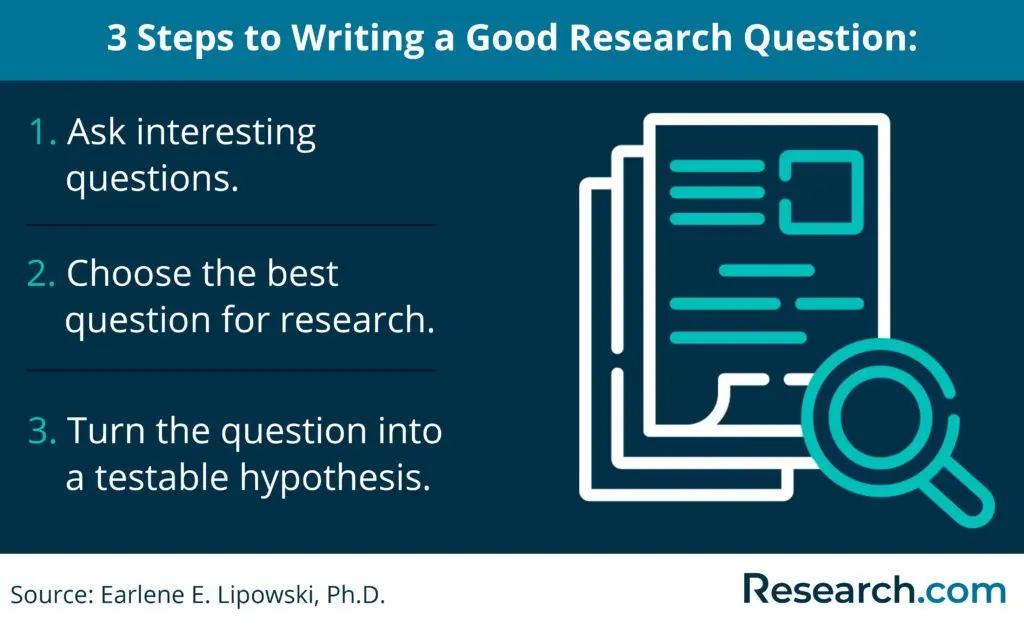
1. Good research begins with a focused research question.
A strong research question identifies exactly what the study is trying to discover, explain, compare, or test. It shapes the scope of the project, the type of evidence needed, the methodology, and the conclusions that can reasonably be drawn. This is why research-intensive fields, including engineering and physics degrees and careers, place significant emphasis on question formulation.
An effective question is not simply a topic in question form. It defines the population, phenomenon, relationship, setting, or time frame being examined. For example, a broad interest in exercise and mental health becomes more researchable when it specifies the population, intervention, outcome, and context. A clear question also helps researchers prepare a realistic project plan or scope of work sample because it clarifies what must be done and what falls outside the study.
Researchers often use frameworks such as FINER and PICO to test whether a question is workable. The FINER criteria are especially useful for evaluating whether a study idea is ready to become a formal research project.
- Feasible: The study can be completed with the available time, data, skills, funding, and permissions.
- Interesting: The question is meaningful to the researcher and relevant readers.
- Novel: The project adds something new, even if the contribution is a small refinement.
- Ethical: The design respects participants, communities, data rights, and scholarly integrity.
- Relevant: The findings matter to the field, practice, policy, or future research.
2. Good research uses a methodology that fits the question.
Research methodology is the planned approach used to collect, analyze, and interpret evidence. Choosing the wrong method can weaken an otherwise promising study. A survey may be inappropriate for a question that requires deep interpretation of lived experiences, while interviews alone may not be enough to test a statistical relationship. For this reason, learning how to write research methodology is a central part of research training.
The best methodology depends on the research question, the type of evidence available, the field’s standards, and the level of inference the researcher wants to make. Most studies fall into qualitative, quantitative, or mixed-methods approaches.
| Methodology type | Best used when | Common methods |
| Qualitative research | The study explores meaning, experience, behavior, culture, language, or context. | Interviews, focus groups, observation, case studies, document analysis, thematic analysis. |
| Quantitative research | The study measures variables, tests relationships, estimates prevalence, or evaluates differences. | Surveys, experiments, structured observation, statistical modeling, descriptive and inferential statistics. |
| Mixed-methods research | The study needs both numerical patterns and contextual explanation. | Sequential designs, parallel qualitative and quantitative data collection, integrated interpretation. |
Mixed-methods research is especially useful when one type of evidence cannot fully answer the question. In the Family Medicine and Community Health journal, Creswell and Hirose described how surveys and focus groups were combined to examine pediatric resident assessment and feedback. The survey data compared groups, while the qualitative phase helped explain the conditions behind the results.
3. Good research is grounded in existing scholarship.
Original research does not begin in isolation. It must show what is already known, where scholars disagree, what evidence is missing, and how the new study fits into that conversation. A strong literature review helps prevent unnecessary duplication and improves the design of the study by revealing common methods, limitations, theories, and unresolved questions.
Researchers can locate relevant studies through university databases, public repositories, journal platforms, and a well-maintained library management system. Literature searching is also an important professional skill in evidence-heavy fields, including physics and industrial engineering careers, where researchers must understand prior models, assumptions, and empirical findings before proposing new work.
The scale of scholarly publishing makes literature review both easier and more difficult. As of 2025, there are more than 46,000 active academic journals worldwide across all disciplines. That volume increases access to research, but it also requires careful source evaluation, transparent search strategies, and strong citation management.
4. Good research relies on empirical evidence and appropriate analysis.
Empirical evidence comes from observation, measurement, documentation, experience, or experimentation. It may be numerical, textual, visual, archival, biological, behavioral, or environmental. What matters is that the evidence is connected to the research question and collected through a process that can be explained and evaluated.
Data alone does not make a study strong. The analysis must match the data and the question. Quantitative studies may use descriptive statistics to summarize variables or inferential statistics to test relationships and estimate uncertainty. Qualitative studies may use thematic analysis, narrative analysis, content analysis, discourse analysis, or other interpretive methods to identify patterns and meanings. Mixed-methods studies must explain how the qualitative and quantitative evidence are integrated rather than simply placed side by side.
5. Good research uses samples and cases carefully.
Representativeness describes how well a sample reflects the larger population a study wants to understand. When a study aims to generalize findings, sampling decisions are critical. Poor sampling can produce misleading conclusions even when the analysis is technically correct.
Not every study needs statistical generalization. Some qualitative case studies are designed to produce depth, theory development, or contextual insight rather than population-wide estimates. The key is alignment: researchers should not claim broad generalizability if the design only supports a narrower conclusion.
| Sampling approach | When it is useful | Main limitation |
| Random sampling | The goal is to reduce selection bias and support generalization. | It may require a complete sampling frame and sufficient resources. |
| Stratified sampling | The researcher needs representation across important subgroups. | It requires reliable information about group membership. |
| Convenience sampling | The study is exploratory or constrained by access. | Findings may not represent the broader population. |
| Purposive sampling | The study needs participants or cases with specific knowledge or characteristics. | Generalization must be framed carefully. |
| Snowball sampling | The target population is difficult to reach directly. | Networks may overrepresent connected participants. |
6. Good research follows logical reasoning.
Logic connects the research question, evidence, analysis, and conclusion. It helps researchers avoid unsupported claims, circular reasoning, false comparisons, and conclusions that go beyond the data. A logical study makes clear why each step follows from the previous one.
Inductive reasoning moves from specific observations toward broader patterns or theories. Deductive reasoning starts with a theory or hypothesis and tests whether evidence supports it. Many strong studies use both: theory informs the design, and observed evidence refines the theory.
7. Good research considers external validity.
External validity concerns whether findings apply beyond the immediate study. Population validity asks whether results can be generalized from the sample to the larger population. Ecological validity asks whether results apply to real-world settings and conditions.
Researchers should be precise about what their findings can and cannot support. A laboratory experiment may provide strong control but limited real-world applicability. A field study may capture authentic behavior but include more uncontrolled variables. Good research explains these trade-offs instead of hiding them.
8. Good research is replicable, reproducible, and transparent.
Replicability means another researcher can conduct a similar study and test whether comparable findings emerge. Reproducibility means others can use the same data and analytic procedures and arrive at consistent results. Transparency supports both by giving readers enough information to understand how the study was conducted.
Transparent research reports data sources, instruments, sampling decisions, inclusion and exclusion criteria, analytic procedures, assumptions, software, code when appropriate, and changes made during the project. Clear reporting also improves research paper writing for publication because reviewers can evaluate the integrity of the work more easily.
9. Good research acknowledges limitations and future directions.
No study answers every question. Strong researchers identify limitations honestly instead of treating them as weaknesses to conceal. Limitations may involve sample size, data access, measurement tools, time frame, missing variables, researcher positionality, uncontrolled conditions, or restricted generalizability.
Useful limitation sections do more than list problems. They explain how each limitation affects interpretation and suggest specific next steps for future research. This helps other scholars refine methods, test findings in new settings, or examine unanswered parts of the problem.
10. Good research is ethical.
Ethical research protects participants, communities, data integrity, and public trust. The World Health Organization explains that research ethics help safeguard the rights and dignity of human participants while promoting honesty, objectivity, integrity, and accountability.
Ethical conduct includes informed consent when required, appropriate review of human-subjects research, confidentiality protections, accurate reporting, responsible authorship, disclosure of conflicts of interest, and proper citation. Researchers must also apply judgment because ethical codes cannot predict every possible situation.
- Falsification: Changing, omitting, or manipulating data or findings.
- Fabrication: Inventing data, observations, participants, or results.
- Plagiarism: Presenting another person’s words, ideas, data, or work without proper credit.
- Citation manipulation: Using citations primarily to inflate metrics rather than to acknowledge relevant scholarship.
Self-citation can be appropriate when prior work is genuinely relevant. However, the Committee on Publication Ethics has identified extreme self-citation as a form of citation manipulation, especially when citation metrics influence career advancement, funding, h-index ranking, and institution ranking.
Common pitfalls that weaken research quality
Many research problems are preventable. They often appear early in the project, before data collection begins, and become harder to fix later. Recognizing these risks helps researchers protect the credibility of their work.
| Common mistake | Why it hurts the study | Better approach |
| Choosing a topic that is too broad | The study becomes unfocused and difficult to complete. | Turn the topic into a specific, answerable question. |
| Underestimating the workload | Data collection, analysis, revisions, and publication often take longer than expected. | Create a realistic timeline with room for setbacks. |
| Using weak or outdated sources | The literature review may miss current debates or established findings. | Search peer-reviewed databases and track recent scholarship early. |
| Collecting unnecessary variables | Extra data can create noise, ethical concerns, and analysis problems. | Collect only what is needed to answer the research question. |
| Choosing methods after collecting data | The analysis may not match the research purpose. | Plan methods before data collection begins. |
| Ignoring limitations | Readers may distrust conclusions that seem overstated. | Explain limits clearly and connect them to future research. |
| Relying too heavily on tools | Software can assist but cannot replace methodological judgment. | Use academic writing tools and analysis platforms as support, not substitutes for expertise. |
How technology improves research quality
Technology can make research faster, more transparent, and more collaborative, but it does not automatically make research better. The strongest results come when researchers use digital tools to support sound design, careful analysis, ethical data handling, and clear communication.
1. Data collection and analysis tools can improve efficiency.
Online survey platforms, sensors, digital archives, statistical software, programming languages, and qualitative analysis tools can help researchers collect and process large or complex datasets. Programs such as SPSS, R, and Python can support statistical analysis, while qualitative tools can help organize transcripts, documents, codes, and themes.
The risk is overconfidence. A sophisticated model does not fix poor measurement, biased sampling, or a weak research question. Researchers must still justify why a tool or model is appropriate.
2. Digital databases strengthen literature reviews.
Search engines and scholarly databases such as PubMed, JSTOR, Google Scholar, Semantic Scholar, and institutional repositories help researchers locate relevant literature more efficiently. Citation managers such as Zotero, EndNote, and Mendeley reduce formatting errors and help organize sources across long projects.
Researchers should still evaluate source quality, publication type, peer-review status, relevance, and potential bias. A large search result is not the same as a strong literature review.
3. Collaboration platforms support team-based research.
Cloud documents, shared code repositories, project management tools, and communication platforms allow research teams to work across institutions and countries. These tools are especially useful for interdisciplinary projects, multi-site studies, and collaborative writing.
Good collaboration also requires authorship agreements, version control, data governance, and clear responsibility for research integrity.
4. Open science tools improve transparency.
Platforms such as the Open Science Framework and GitHub can help researchers share protocols, datasets, code, preregistrations, and supplementary materials. This improves accountability and makes it easier for other researchers to examine or extend the work.
Transparency must be balanced with privacy, consent, intellectual property rules, and data protection requirements. Not every dataset can be shared publicly, but researchers can often explain access restrictions and provide documentation.
5. AI can assist research, but it requires careful oversight.
Artificial intelligence tools can help summarize literature, identify patterns, generate code, visualize citation networks, transcribe interviews, and support language editing. Tools such as Research Rabbit and Connected Papers can help researchers map related studies and identify clusters of scholarship.
AI should not be treated as an author, evidence source, or substitute for expert judgment. Researchers must verify AI-generated summaries, protect confidential data, disclose AI use when required, and avoid using tools in ways that violate institutional or journal policies.
Can advanced degree programs improve research skills?
Advanced degree programs can strengthen research quality when they provide rigorous training in theory, methodology, ethics, analysis, and scholarly communication. Graduate study can also give students access to research mentors, institutional review processes, specialized software, laboratories, archives, and peer feedback.
Not every researcher needs the same type of program. A thesis-based master’s or doctoral program may be appropriate for students planning academic or research-intensive careers. Shorter professional programs may be better for working adults who need targeted research skills. Flexible options such as 1 year master's programs online can help some learners build advanced skills more quickly, but students should evaluate curriculum depth, faculty expertise, accreditation, research support, and fit before enrolling.
| Training option | Best fit | What to check before choosing |
| Research-based master’s program | Students who want structured methodology training and a substantial research project. | Thesis requirements, faculty mentors, research methods courses, and publication support. |
| Doctoral program | Students preparing for independent research, faculty roles, or advanced scholarly work. | Funding, advisor fit, completion expectations, research facilities, and career outcomes. |
| Graduate certificate | Professionals who need focused skills in data analysis, evaluation, research ethics, or a specialized method. | Credit transfer policies, employer recognition, course rigor, and applied projects. |
| Workshops and short courses | Researchers who need a specific tool or method quickly. | Instructor qualifications, practice opportunities, and whether the training includes feedback. |
How mentorship and professional development strengthen research
Mentorship improves research quality by helping scholars make better decisions at critical points: refining questions, selecting methods, handling ethical concerns, interpreting results, responding to peer review, and choosing publication outlets. Good mentors also model scholarly integrity and help researchers understand unwritten expectations in their fields.
Professional development can fill skill gaps that formal degree programs may not cover. Workshops, research seminars, methodology institutes, writing groups, and online graduate certificate programs can help researchers update their skills as tools, standards, and disciplinary expectations evolve.
How to evaluate whether your research is strong enough
Before submitting a paper, thesis, dissertation, report, or grant proposal, assess the work against the standards reviewers are likely to use. The goal is not perfection. The goal is to make the logic, evidence, and limits of the study clear enough that informed readers can judge its contribution fairly.
- Restate the research question in one sentence. If you cannot do this, the study may still be too broad.
- Match every method to the question. Remove methods that do not serve the central purpose.
- Audit the literature review. Check whether it explains the gap rather than simply summarizing sources.
- Review data quality. Confirm that sources, instruments, sampling, and measurement choices are defensible.
- Test the analysis logic. Make sure conclusions follow from the evidence and do not exceed it.
- Check transparency. Add enough methodological detail for readers to understand how findings were produced.
- Clarify limitations. Explain how constraints affect interpretation.
- Strengthen visibility responsibly. Managing your scholarly presence and digital footprint can help others find your work, but visibility should never replace rigor.
Why adaptability matters in modern research
Research practices change as new tools, data sources, ethical expectations, funding priorities, and publication models emerge. Adaptable researchers are better prepared to revise methods, learn new analytic techniques, collaborate across fields, and respond to unexpected problems during a project.
Flexible learning can support this adaptability. For example, a self paced online college may help working students or professionals build new skills without stepping away from research responsibilities. However, flexibility should be weighed against academic quality, faculty support, accreditation, and whether the coursework genuinely supports the researcher’s goals.
Adaptability also means knowing when not to use a new tool. Researchers should adopt AI, statistical models, digital archives, or interdisciplinary frameworks only when they improve the study’s ability to answer the research question ethically and accurately.
How structured academic training supports better research
Structured academic training helps researchers develop the habits behind credible scholarship: careful question design, evidence evaluation, ethical reasoning, statistical or interpretive competence, and clear writing. Training also creates opportunities for feedback, which is one of the most effective ways to identify weak assumptions before they become serious research flaws.
Some learners pursue full degree programs, while others choose certificates, workshops, or targeted courses. Students comparing options such as the easiest online degrees that pay well should look beyond convenience and salary potential. For research development, the more important questions are whether the program teaches rigorous methods, includes faculty feedback, supports writing, and builds transferable analytical skills.
How funding and resources affect academic research quality
Funding influences what researchers can study, how much data they can collect, what tools they can use, and whether they can hire trained personnel. Strong resource planning can improve sample size, data quality, participant recruitment, software access, travel, transcription, laboratory work, open access fees, and research dissemination.
Limited funding does not automatically mean poor research. Many excellent studies are carefully scoped to match available resources. Problems arise when researchers overpromise, use inadequate data, skip quality control, or select a design they cannot realistically complete. Students building research skills while managing cost may explore options such as affordable online bachelor degree programs, but they should still verify accreditation, faculty support, and research preparation.
How open access and publication strategy increase research impact
Publication strategy affects who can find, read, evaluate, and use research. Open access journals, preprint servers, institutional repositories, data repositories, conference presentations, and professional networks can expand reach when used appropriately. A strong strategy considers audience, journal scope, peer-review standards, indexing, publication fees, copyright terms, and ethical data sharing.
Researchers should avoid choosing publication outlets only for speed or visibility. Predatory or low-quality journals can damage credibility. A better approach is to select outlets that match the study’s field, methods, audience, and contribution. For readers exploring career outcomes connected to research-intensive education and specialized expertise, related guides on careers that pay 100k a year can provide broader labor-market context, but publication decisions should remain grounded in scholarly fit.
How interdisciplinary collaboration improves research outcomes
Interdisciplinary collaboration can strengthen research when a problem is too complex for one field’s methods or theories. A public health question, for example, may require epidemiology, sociology, economics, data science, ethics, and policy expertise. Collaboration can improve research design, broaden interpretation, and make findings more useful to multiple audiences.
Collaboration also creates challenges. Teams must agree on terminology, authorship, data standards, timelines, and quality expectations. Researchers expanding into new fields may need additional training; flexible options, including guides that answer questions such as what degree can I get online in 6 months, may help learners explore short-format education paths, though research-intensive work usually requires deeper preparation than speed-focused credentials alone can provide.
How career incentives influence academic research quality
Academic research is shaped by incentives such as promotion requirements, grant funding, publication counts, citation metrics, institutional rankings, and professional recognition. When incentives reward quality, transparency, replication, mentorship, and ethical conduct, they can strengthen research culture. When they reward quantity above rigor, they can encourage rushed studies, salami slicing, selective reporting, excessive self-citation, or publication in weak outlets.
Researchers should understand career incentives without letting them override scholarly standards. Students comparing educational and career paths, including options such as highest paid associate degrees, should distinguish between credentials designed for workforce entry and pathways designed for advanced academic research. High-quality research usually depends on sustained training, mentorship, ethical discipline, and methodological depth.
Key Insights
- Good research starts with a precise question. A focused research question controls the scope, method, evidence, and conclusions of the study.
- Methodology must fit the purpose. Qualitative, quantitative, and mixed-methods designs are valuable only when they match the research problem.
- A literature review should identify a gap. Strong research explains how the study builds on, challenges, or extends existing scholarship.
- Evidence and analysis must align. Empirical data should be collected ethically and analyzed with methods appropriate to the data type.
- Generalizability requires caution. Researchers should be clear about whether their findings apply to a population, a setting, a theory, or a specific case.
- Transparency builds trust. Replicable and reproducible research depends on clear reporting of methods, data decisions, assumptions, and limitations.
- Ethics are not optional. Fabrication, falsification, plagiarism, and citation manipulation undermine both individual credibility and public trust in scholarship.
- Technology is a tool, not a guarantee of quality. AI, databases, software, and collaboration platforms help only when used with sound judgment.
- Training and mentorship improve research decisions. Advanced programs, certificates, workshops, and experienced advisors can strengthen design, analysis, and publication strategy.
- Impact depends on rigor first. Open access, visibility, and career incentives matter, but they cannot compensate for weak methods or unsupported claims.
References:
- Austin Research. (n.d.). The importance of representative samples and how to get them. Austin Research
- Baskin, P. (n.d.). Transparency in research and reporting: Expanding the effort through new tools for authors and editors. Editage Insights
- Belmont University. (n.d.). Research guides: Public relations: Academic and applied research. Research Guides at Belmont University
- Bhandari, P. (n.d.). What is quantitative research? | Definition, uses and methods. Scribbr
- Bhandari, P. (n.d.). External validity | Types, threats & examples. Scribbr
- Bradford, A. (n.d.). Empirical evidence: A definition. Live Science
- Business Research Methodology. (n.d.). Suggestions for future research. Research-Methodology
- Creswell, J. W., & Hirose, M. (n.d.). Mixed methods and survey research in family medicine and community health. Family Medicine and Community Health, 7(2). NCBI
- Cummings, S. R., Browner, W. S., & Hulley, S. B. (n.d.). Conceiving the research question and developing the study plan. Designing clinical research, 4, 14-22. Wolters Kluwer Health
- Economic and Social Research Council. (n.d.). Methodologies: What makes good research? ESRC
- Editage Insights. (n.d.). What does good research mean? Editage Insights
- Farrugia, P., Petrisor, B.A., Farrokhyar, F., & Bhandari, M. (n.d.). Research questions, hypotheses and objectives. Canadian journal of surgery, 53(4), 278. NCBI
- Glen, S. (n.d.). External validity definition & examples. Statistics How To
- Golesh, D., Baba Girei, Z., & Ibrahim, F. (n.d.). The role of logic in research. International Journal of Scientific & Engineering Research, 10(10), 894-904. IJSER
- Humans of Data. (n.d.). Your guide to qualitative and quantitative data analysis methods. Humans of Data
- Ioannidis, J. P., Baas, J., Klavans, R., & Boyack, K. W. (n.d.). A standardized citation metrics author database annotated for scientific field. PLoS biology, 17(8), e3000384. PLoS Biology
- Jansen, D. (n.d.). What is research methodology? Simple definition (With examples). Grad Coach
- Mehran University of Engineering and Technology. (n.d.). Criteria of good research. MUET-CRP
- Miceli, S. (n.d.). Reproducibility and replicability in research. The National Academies of Sciences, Engineering, and Medicine
- Resnik, D. (n.d.). What is ethics in research & why is it important? National Institute of Environmental Health Sciences
- Ross, P. T., & Zaidi, N. L. B. (n.d.). Limited by our limitations. Perspectives on medical education, 8(4), 261-264. NCBI
- Shreffler, J., & Huecker, M. R. (n.d.). Common Pitfalls In The Research Process. NCBI
- Thattamparambil, N. (n.d.). How to choose the research methodology best suited for your study. Editage Insights
- Understanding Health Research. (n.d.). Replicability. Understanding Health Research
- Van Noorden, R., & Chawla, D. (n.d.). Hundreds of extreme self-citing scientists revealed in new database. Nature
- Ware, M., & Mabe, M. (n.d.). The STM report: An overview of scientific and scholarly journal publishing. STM
- Warren, K. (n.d.). Qualitative data analysis methods 101: Top 5 + examples. Grad Coach
- Wisdom, J., & Creswell, J. W. (n.d.). Mixed methods: integrating quantitative and qualitative data collection and analysis while studying patient-centered medical home models. Rockville: Agency for Healthcare Research and Quality. AHRQ
- Worthy, B. (2025, July 30). What is academic research? A complete guide for students & scholars. GMR Transcription Blog
- Belmont University. (2025). Understanding applied vs. academic research. Belmont University
- Peters, M. A. K. (2025). How to develop good research questions. Nature Human Behaviour, 9(9), 1759–1761. https://doi.org/10.1038/s41562-025-02292-5
- Varghese, R. (2025, January 14). What do you mean by research methodology? The essential guide for researchers & students. Regenesys Insights
- Bhandari, P. (2025, January 14). What Is Qualitative Research? | Methods & Examples. Scribbr
- George, T. (2025, January 14). Mixed methods research | Definition, guide & examples. Scribbr
- Zul, M. (2025, May 9). How many academic journals are there in 2025? PublishingState.com
Other Things You Should Know About Good Academic Research
Researchers can ensure ethical studies by obtaining informed consent, ensuring participant confidentiality, obtaining institutional review board (IRB) approval, and adhering to ethical guidelines specific to their field. It is vital to remain transparent and prioritize the welfare of all participants throughout the research process.
Acknowledging research limitations in 2027 fosters transparency and enhances the credibility of academic work. It allows peers to understand the scope, applicability, and constraints of the study, ensuring that conclusions drawn are well-founded and realistic, and guiding future research directions.
Empirical data is information collected through direct observation or experimentation. It is crucial because it provides objective, unbiased evidence that supports the research findings. Proper analysis of empirical data ensures the reliability and validity of the study.
To ensure representativeness, researchers should use proper sampling methods that reflect the characteristics of the larger population. Techniques like random sampling, stratified sampling, and cluster sampling help achieve a representative sample.
Logic helps in structuring the research process, from formulating the research question to drawing conclusions. Inductive reasoning helps in developing theories based on observed patterns, while deductive reasoning tests hypotheses derived from existing theories.
Replicability means that other researchers can achieve similar results by following the same methodology. Reproducibility means obtaining consistent results using the same data and analysis methods. Both are essential for verifying the validity and credibility of research findings.


