2027 Personal Qualities That Help Students Succeed in Social Work School

Co-Founder and Chief Data Scientist
Choosing a social work degree is not only an academic decision. It is also a readiness decision: Can you handle emotionally demanding coursework, field placements, client-facing responsibilities, and the licensure steps required for the roles you want?
This guide explains the personal qualities, degree options, licensing requirements, curriculum expectations, costs, career paths, and program-selection criteria that matter most for aspiring social workers. It is written for prospective BSW, MSW, and doctoral students who want a practical view of what social work education requires and how to choose a program that supports long-term professional goals.
Key Things You Should Know
- Emotional resilience and empathy strongly correlate with a 25% higher success rate in social work programs, reflecting the critical role of interpersonal skills in 2026 curricula.
- Time management and organizational skills are essential, with 68% of students rating these as key to handling demanding coursework and field placements effectively.
- Cultural competency continues to gain prominence, as 74% of accredited social work programs now integrate diversity training to prepare students for varied client populations.
What personal qualities do social work students need to succeed in their degree programs?
Social work students need more than interest in helping others. The strongest students usually combine empathy with emotional resilience, ethical judgment, communication skills, cultural humility, and the ability to stay organized under pressure. These qualities matter because social work education combines demanding academic work with field placements where students encounter real people facing complex problems.
Core qualities that support success
- Empathy: Helps students understand client experiences without making assumptions or centering their own reactions.
- Resilience: Supports students through emotionally difficult cases, feedback from supervisors, and the realities of under-resourced systems.
- Active listening: Improves classroom learning, client engagement, and field supervision. Research by the Council on Social Work Education shows that MSW students who practice active listening see significant improvements in self-efficacy and information retention.
- Critical thinking: Helps students connect theory, policy, assessment, and intervention planning in complex cases.
- Time management: Makes it possible to balance readings, papers, field hours, supervision, employment, and personal responsibilities.
- Ethical judgment: Supports professional boundaries, confidentiality, mandated reporting responsibilities, and fair treatment of clients.
- Cultural competence: Helps students work respectfully with people whose identities, communities, histories, and needs differ from their own.
A common mistake is assuming that compassion alone is enough. Compassion is important, but social work students also need structure, reflective practice, and a willingness to receive supervision. Students who struggle often do so not because they lack concern for others, but because they underestimate the workload, the emotional intensity of field education, or the need for consistent self-care.
How students can build these qualities before and during school
- Seek volunteer or work experience in community agencies, schools, healthcare settings, crisis lines, or advocacy organizations.
- Practice reflective writing to identify values, biases, emotional triggers, and growth areas.
- Use supervision and peer consultation instead of trying to process difficult field experiences alone.
- Create a weekly schedule that treats field hours, assignments, commuting, and recovery time as fixed commitments.
- Learn basic stress-management strategies before field placement begins, not after burnout appears.
Students interested in advanced practice or leadership may later consider doctoral study. Flexible options such as online DSW programs can help experienced professionals continue developing clinical, administrative, or policy expertise while managing work and personal responsibilities.
What are the core requirements to become a licensed social worker in the United States?
Licensure requirements for social workers are set by state licensing boards, so the exact steps vary by location. In general, candidates must complete an accredited social work degree, meet supervised experience requirements when required for the license level, pass the appropriate Association of Social Work Boards (ASWB) exam, and complete continuing education to keep the license active.
Typical licensure pathway
- Earn the required degree. Entry-level roles often require a Bachelor of Social Work (BSW), while most advanced and clinical licenses require a Master of Social Work (MSW). The program should be accredited by the Council on Social Work Education (CSWE).
- Apply through the state licensing board. States review education, transcripts, background information, and eligibility for the license level sought.
- Complete supervised experience if required. Clinical licensure commonly requires supervised clinical experience, usually ranging from 2,000 to 3,000 hours over two to three years, depending on the state.
- Pass the ASWB exam. The exam level usually corresponds to the license category, such as bachelor, master, or clinical.
- Maintain the license. Licensed social workers must renew their license and complete continuing education according to state rules.
Students should verify requirements directly with the state where they plan to practice. A program that meets one state’s academic expectations may not automatically satisfy every requirement in another state, especially for clinical practice, telehealth, school social work, or specialized public-sector roles.
Why accreditation and supervised practice matter
CSWE accreditation is especially important because many licensing boards require it. Supervised practice is also central to professional development. It gives new social workers structured experience in assessment, intervention planning, documentation, ethical decision-making, and working with diverse client populations.
Personal qualities also influence professional effectiveness. According to the NASW 2025 Workforce Survey, empathetic social work graduates reported 35% higher client satisfaction and 22% lower burnout. For students comparing educational paths, affordable online MSW programs may offer a more flexible route to the graduate education commonly required for advanced licensure.
What degree pathways and educational options exist for aspiring social workers?
Aspiring social workers can enter the field through several education pathways. The right option depends on the student’s prior education, desired role, licensure goals, timeline, and whether they plan to provide clinical services.
| Pathway | Best fit | Common outcome |
| BSW | Students seeking foundational social work training and entry-level roles | Generalist practice roles and preparation for graduate study |
| MSW | Students seeking advanced practice, clinical licensure preparation, or leadership roles | Advanced social work roles and eligibility for many clinical licensure pathways |
| DSW or PhD | Experienced professionals interested in advanced practice leadership, research, teaching, or policy work | Doctoral-level expertise in practice, scholarship, administration, or education |
| Certificates | Students or professionals seeking focused training without completing another full degree | Specialized knowledge in areas such as child welfare, substance abuse, or gerontology |
A Bachelor of Social Work (BSW) provides broad preparation in human behavior, social welfare systems, policy, ethics, and generalist practice. A Master of Social Work (MSW) is essential for many advanced roles and is required for most clinical licensing pathways. Doctor of Social Work (DSW) and PhD programs are usually designed for professionals who want to move into advanced practice leadership, research, teaching, or systems-level work.
Students with a BSW may qualify for advanced-standing MSW options, while students with non-social work bachelor’s degrees may choose traditional or accelerated MSW programs. Accelerated MSW programs enable students with non-social work bachelor's degrees to earn their master's in 1 to 2 years, with options for part-time and online study to fit working professionals' needs. Students focused on a shorter timeline may compare options such as the fastest MSW program online.
Factors to compare before choosing a pathway
- Licensure alignment: Confirm that the program supports the license level required in the state where you plan to work.
- Field placement quality: Look for placements that match your interests, such as schools, hospitals, behavioral health agencies, or child welfare organizations.
- Format: Decide whether online, hybrid, part-time, full-time, or accelerated study fits your schedule and learning style.
- Specialization: Consider whether the curriculum supports areas such as mental health, healthcare, policy advocacy, aging, family services, or substance use.
- Accreditation: Prioritize CSWE-accredited programs when preparing for professional licensure.
Cultural competency training is now a major part of professional preparation. Programs with integrated cultural competency curricula reported a 40% increase in graduates serving diverse populations and a 15% higher employment rate in multicultural agencies, according to the NASW Center for Diversity 2025 Report. Students should review how each program teaches cultural humility, anti-oppressive practice, and work with diverse communities rather than relying only on course titles.
How do online and campus-based social work programs differ in structure and outcomes?
Online and campus-based social work programs can both prepare students for professional practice when they are properly accredited and provide strong field education. The main differences are not usually the degree title, but the learning structure, level of in-person interaction, field placement support, networking opportunities, and the amount of self-direction required.
| Factor | Online programs | Campus-based programs |
| Schedule | Often more flexible, with asynchronous or limited synchronous coursework | More structured, with regular in-person class meetings |
| Interaction | Requires intentional communication with faculty and peers | Offers more immediate face-to-face discussion and campus engagement |
| Field placement | May allow local placements, but students should confirm how much placement support is provided | Often uses established relationships with nearby agencies |
| Student support | Depends heavily on virtual advising, online tutoring, and remote supervision systems | May provide easier access to campus offices, workshops, and peer groups |
| Best for | Working adults, caregivers, commuters, and students who need location flexibility | Students who prefer structured schedules, in-person learning, and campus-based community |
Campus programs often make it easier to build relationships through classroom discussion, faculty office hours, student organizations, and nearby agency partnerships. Online programs can be equally rigorous, but students must be proactive about asking questions, arranging support, and staying engaged with classmates and instructors.
Field education is the key area to examine closely. Before enrolling in an online program, students should ask whether the school finds placements, whether students must identify their own agencies, how supervision is monitored, and what happens if a placement falls through. Campus students should ask similar questions rather than assuming local access guarantees a strong practicum experience.
Student well-being also matters. Research shows mindfulness-trained students reduce stress by 28% and improve emotional regulation by 32% during field placements, according to a 2025 meta-analysis in the Journal of Social Work Education. Campus-based programs may offer workshops or in-person wellness resources, while online students may need to seek out virtual services, community-based supports, or program-provided stress-management resources.
Students weighing the long-term value of graduate study can review resources such as is a master's degree in social work worth it to compare educational investment, career goals, and professional outcomes.
What is the typical curriculum and coursework in accredited social work degree programs?
Accredited social work programs combine classroom learning, skills practice, research training, ethics, policy analysis, and supervised field education. The curriculum is designed to help students understand individuals and communities in context rather than treating social problems as isolated personal issues.
Common coursework areas
- Human behavior and the social environment: Examines development, families, groups, communities, institutions, and social systems.
- Social welfare policy: Teaches students how laws, funding systems, public programs, and institutions affect clients and communities.
- Practice methods: Covers assessment, interviewing, case planning, intervention, advocacy, and documentation.
- Ethics and professional standards: Focuses on boundaries, confidentiality, informed consent, mandated reporting, conflicts of interest, and professional responsibility.
- Research methods and program evaluation: Prepares students to interpret evidence, evaluate interventions, and use data in practice.
- Cultural competence and self-awareness: Helps students identify bias, understand power dynamics, and practice respectfully across difference.
- Specialized electives: May include child welfare, mental health, forensic social work, healthcare, aging, substance use, trauma, or policy advocacy.
Field education is a required part of accredited training. Students may complete placements in hospitals, schools, community agencies, behavioral health programs, public agencies, or nonprofit organizations. During practicum experiences, students apply classroom concepts through supervised work such as client engagement, assessment, care coordination, advocacy, group work, and documentation.
Self-awareness is not an optional add-on in social work education. It affects how students interpret client behavior, respond to conflict, handle authority, and make ethical decisions. Studies show that self-aware MSW students identify personal biases 45% more accurately and achieve 20% better decision-making outcomes, highlighting the value of reflective assignments.
When reviewing curricula, students should look beyond course names. A strong program should show clear integration between coursework and field practice, offer supervision that supports growth, and provide learning experiences aligned with the student’s intended area of practice.
What are the admission requirements and prerequisites for social work graduate programs?
Admission to graduate social work programs usually requires a bachelor’s degree from an accredited institution, official transcripts, recommendation letters, a personal statement, and evidence that the applicant is prepared for graduate-level academic and fieldwork demands. Many programs expect a minimum GPA around 3.0 on a 4.0 scale, though policies vary by school.
Common application requirements
- Bachelor’s degree: Often in social work, psychology, sociology, human services, or another related field, though many MSW programs accept applicants from varied academic backgrounds.
- Official transcripts: Used to evaluate GPA, course preparation, and degree completion.
- Letters of recommendation: Typically from faculty, supervisors, or professionals who can comment on academic ability, ethics, communication, and readiness for social work training.
- Personal statement: Should explain motivation for social work, relevant experience, career goals, and fit with the program.
- Resume or experience summary: Often used to document volunteer work, employment, internships, community service, or advocacy experience.
- GRE scores: Some schools may still require GRE scores, but this is increasingly less common.
Prerequisites may include foundational coursework in human behavior, social welfare policy, research methods, introductory social work, or statistics. Applicants without these courses may still be admitted by some programs, but they may need to complete prerequisite or foundation courses before moving into advanced graduate work.
Relevant experience can strengthen an application. Paid employment, volunteer service, internships, crisis-line work, advocacy, case management support, or community-based service can all help demonstrate commitment to the field. Admissions committees often look for maturity, ethical awareness, communication ability, and realistic understanding of social work—not only a desire to help.
Strong critical thinking skills can also matter in both admission and later practice, as social workers with advanced analytical abilities resolve complex cases faster and have higher promotion rates, according to data from the Bureau of Labor Statistics Occupational Outlook 2025.
International applicants usually need TOEFL or IELTS scores to verify English proficiency. Students should also expect background checks, immunization records, or other clearance requirements for field placements, especially in schools, healthcare organizations, and agencies serving vulnerable populations.
How long does it take to complete a social work degree, and what are typical costs?
The time and cost of a social work degree depend on the degree level, enrollment status, school type, residency status, transfer credits, and program format. Students should compare total program cost, not only annual tuition, because fees, books, transportation, technology, field placement requirements, and reduced work hours can significantly affect affordability.
| Degree | Typical completion time | Typical annual tuition |
| BSW | Four years of full-time study | $5,000 to $20,000 for in-state students |
| MSW | Often two years, with some one-year accelerated options | $10,000 to $30,000 per year |
A Bachelor of Social Work (BSW) typically requires four years of full-time study. A Master of Social Work (MSW) often takes two years, though some accelerated paths offer completion in one year for students with related undergraduate degrees. Part-time options can make school more manageable for working adults, but they extend the overall timeline.
Online programs may reduce commuting or relocation expenses, but students should not assume online study is automatically cheaper. Tuition can be similar to campus-based programs, and field placement obligations may still limit work availability. Students should ask whether tuition is charged per credit, per term, or by residency status, and whether online learners pay additional technology or distance-learning fees.
Ways to manage cost
- Complete the FAFSA if eligible and compare federal, state, institutional, and private aid options.
- Look for scholarships connected to social work, public service, child welfare, behavioral health, or underserved communities.
- Ask employers about tuition assistance, schedule flexibility, or paid field placement possibilities.
- Compare public and private institutions using total cost of attendance, not only tuition.
- Confirm CSWE accreditation, because accreditation can affect financial aid eligibility and licensure opportunities.
According to the NASW 2025 Compensation Report, resilience in social work graduates correlates with 25% lower turnover in high-stress roles and median salaries 12% higher ($68,500 vs. $61,200). The financial decision still requires caution: students should weigh debt, expected salary, licensure timeline, and the type of work they plan to pursue.
What career roles and job opportunities are available to social work graduates?
Social work graduates can work in healthcare, schools, public agencies, behavioral health organizations, nonprofits, community programs, courts, correctional systems, elder care, and advocacy organizations. The best role depends on degree level, licensure status, specialization, field experience, and comfort with direct practice, administration, policy, or community work.
Common roles for social work graduates
- Clinical social worker: Provides assessment, therapy, treatment planning, and mental health support when licensed for clinical practice.
- School social worker: Supports students and families with attendance, behavioral concerns, crisis response, special education coordination, and community referrals.
- Medical social worker: Helps patients and families navigate illness, discharge planning, care coordination, grief, chronic disease, and healthcare systems.
- Child welfare social worker: Works with children and families involved in safety, permanency, foster care, reunification, or family support services.
- Substance abuse or behavioral health social worker: Supports clients affected by addiction, co-occurring disorders, crisis, or recovery needs.
- Community outreach coordinator: Connects individuals and communities with services, education, advocacy, and prevention programs.
- Policy or program specialist: Works on research, grant writing, program evaluation, advocacy, or service-system improvement.
Advanced roles such as Licensed Clinical Social Worker (LCSW) require licensure and can lead to clinical supervision, private practice, program leadership, and policy-focused positions. Students who want clinical roles should plan early for MSW coursework, supervised hours, exams, and state-specific licensure rules.
Communication skills strongly affect employment outcomes. Research shows 2025 MSW graduates with proficient communication secured jobs 40% faster, while teams with effective communicators experienced a 27% increase in collaboration success (CSWE 2025 Employment Trends Bulletin). In practice, communication includes writing clear case notes, collaborating across disciplines, explaining resources to clients, and handling conflict professionally.
Graduates may find opportunities in:
- Public agencies and healthcare environments
- Educational institutions and nonprofit organizations
- Policy advocacy and social services administration
Students can improve job readiness by choosing field placements strategically, building relationships with supervisors, documenting measurable experience, and seeking exposure to the populations or systems they hope to serve after graduation.
What is the job outlook and salary potential for social workers in today's job market?
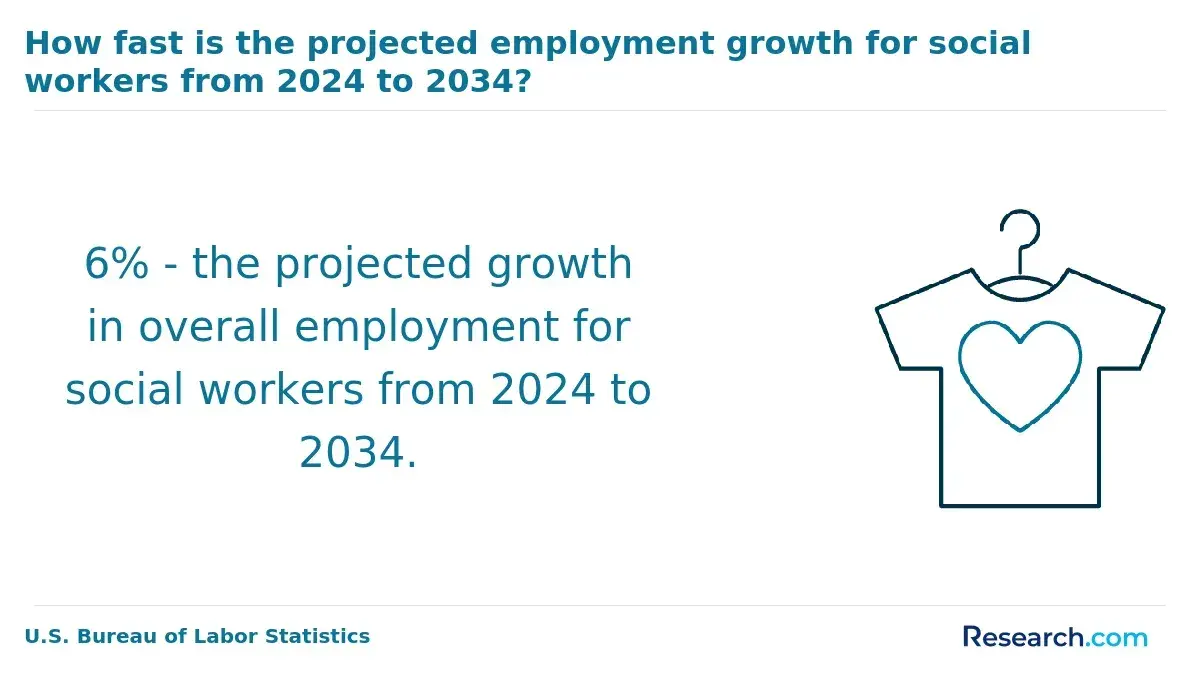
The job outlook for social workers remains strong, with an 11% growth projected from 2024 to 2034, outpacing many other professions. Demand is driven by needs in mental health services, healthcare support, schools, aging services, child and family programs, and community-based care.
Salary potential varies widely by role, employer, location, license level, and specialization. Entry- to mid-level social workers typically earn between $50,000 and $80,000 annually, while licensed clinical social workers (LCSWs) in healthcare or private practice can expect salaries above $90,000. These figures should be treated as broad ranges rather than guarantees, because compensation can differ significantly by region and setting.
Where demand and pay may differ
- Healthcare settings: Medical and healthcare social workers may earn more when they bring specialized knowledge of chronic illness, discharge planning, care coordination, or behavioral health integration.
- Schools: School social workers often benefit from consistent local demand, though pay may be tied to district budgets and public-sector salary schedules.
- Government agencies: Public-sector roles may offer stable benefits and advancement structures, but hiring processes can be competitive and slower.
- Clinical practice: LCSWs may access higher-paying roles, supervision responsibilities, or private practice opportunities after meeting licensure requirements.
- Nonprofit organizations: These roles can offer mission-driven work and varied responsibilities, though salaries may depend heavily on funding sources.
Ethical practice also affects employability and long-term career stability. Graduates from ethics-focused programs are 35% less likely to face sanctions, contributing to a 22% decrease in industry-wide ethical violations in 2025, according to the Association of Social Work Boards.
Prospective students should evaluate salary potential alongside licensure timelines, debt, field interests, and emotional sustainability. The highest-paying option is not always the best fit, but students should understand the financial implications of each pathway before enrolling.
How should prospective students evaluate and choose an accredited social work program?
Prospective students should start with accreditation, then compare field placement support, licensure alignment, cost, format, faculty expertise, student services, specialization options, and outcomes. A program can look appealing online, but students need evidence that it prepares graduates for the roles and licenses they actually want.
Program selection checklist
- CSWE accreditation: Confirm that the program is accredited by the Council on Social Work Education. Programs lacking CSWE accreditation may limit job prospects, licensure eligibility, and opportunities for advanced degrees.
- State licensure alignment: Ask whether the curriculum meets educational requirements in the state where you plan to practice.
- Field placement support: Find out who identifies placements, how supervisors are vetted, what populations and settings are available, and how placement problems are resolved.
- Format and schedule: Compare full-time, part-time, online, hybrid, and accelerated options based on your work, family, commuting, and learning needs.
- Faculty expertise: Look for instructors with relevant research, clinical, policy, or community practice experience.
- Student support: Review advising, writing help, mental health services, disability accommodations, career support, and licensure exam preparation.
- Cost and aid: Compare total cost of attendance, scholarships, assistantships, employer support, and expected borrowing.
- Outcomes: Ask for graduation rates, licensure pass information if available, employment data, and alumni perspectives.
Field education deserves special attention because it is where students build professional judgment, confidence, and employable skills. Research shows that students actively engaging in fieldwork complete their hours 15% faster and secure jobs 29% more often in competitive nonprofit sectors (Social Work Today 2025 Student Success Metrics). Quality supervision and diverse placements can make a meaningful difference in career readiness.
Students should also ask direct questions before enrolling: How are online students supported? What happens if a student’s placement site closes? Are evening or weekend placements available? How does the program support students who experience burnout or field-related stress? Does the curriculum include the specialization the student wants, or only a few related electives?
The best accredited social work program is the one that fits your licensure goals, financial limits, learning style, and preferred population or practice setting. A careful comparison before enrollment can prevent costly transfers, delayed licensure, weak field experiences, and mismatched career preparation.
Other Things You Should Know About Social Work
Effective communication in social work requires active listening, empathy, and clear verbal and written skills. Social workers must be adept at understanding clients' needs and articulating complex information sensitively and accurately to diverse audiences.
In 2027, self-awareness, adaptability, and empathy are crucial for success in social work education. These qualities help students navigate diverse client situations and ensure effective communication. Being open to feedback and showing resilience are also important as they face complex challenges and aspire to create impactful change.
Common challenges include managing emotional stress from processing traumatic client stories and balancing rigorous academic demands with fieldwork. Students often need strong time management strategies and access to support networks to handle these pressures effectively.
Yes, professional organizations like the National Association of Social Workers (NASW) provide valuable resources, networking opportunities, and continuing education for social work students. Membership can enhance professional development and connect students to a broader community within the field.
References
- What Are the Licensed Social Worker Requirements? https://www.tuw.edu/school-news/licensed-social-worker-requirements/
- Social Work Salaries https://www.socialworkers.org/careers/career-center/kickstart-your-job-hunt/social-work-salaries
- Faculty of Graduate and Postdoctoral Studies | University of Manitoba - Social Work (MSW) https://umanitoba.ca/graduate-studies/admissions/programs-of-study/social-work-msw
- High-demand social work roles in 2026: trends and opportunities https://socialwork.pacific.edu/blog/high-demand-social-work-roles-2026-trends-and-opportunities
- How Long Does it Take to Become a Social Worker? https://socialworklicensemap.com/become-a-social-worker/how-long-does-it-take/
- The Evolution of Online Social Work Education https://www.socialworktoday.com/news/enews_0317_1.shtml
- Role of School Social Worker | SSWAA https://www.sswaa.org/school-social-work
- Support for social workers https://support-for-social-workers.education.gov.uk/become-a-social-worker/ways-to-qualify-as-a-social-worker
- What can you do with a social work degree? Career options and next steps | University of East London https://www.uel.ac.uk/blog/what-can-you-do-social-work-degree-career-options-next-steps
- Key Skills for Social Work Students https://www.degreesforgood.org/online-degrees/social-work-programs/student-skills/