How to Appeal for More Financial Aid for College for 2027

Student Finance & Loan Expert
Securing financial aid for college is a complex process, and appealing for more can feel even more daunting. Inaccurate or outdated information online can leave you feeling lost. But fear not! As a financial aid and education expert, I'll guide you through the current landscape of appealing your financial aid offer. We'll navigate the challenges, identify qualifying situations, and craft a compelling case for additional support. Together, we'll unlock the secrets to a more affordable college experience. Let's get started!
Things You Need to Know About Appealing for More Financial Aid for College for 2027
- In the 2022-2023 academic year, a substantial number of families turned to borrowing to cover undergraduate education cost.
- The U.S. government has a lot of funding available for students, and much of it has remained unclaimed.
- The importance of promoting scholarship awareness and simplifying the application process to ensure students can access valuable financial aid cannot be overemphasized.
- The expectations for loan repayment among U.S. families involve both parents and students contributing to payment to varying degrees.
- There may be some potential shifts in how students are financing their education compared to previous years.
- Appealing for more financial aid takes a lot of planning and careful exception.
- A carefully-crafted appeal letter can increase your chances greatly.
- There are many myths, mistakes, and misconceptions about financial aid, so do check our list below for more information.
- How can I appeal for more financial aid for college for 2027?
- How do I craft a compelling appeal letter?
- How do I appeal a denial?
- What other financial aid opportunities should I explore alongside an appeal?
- How can I leverage student loans responsibly if needed?
- How can unexpected expenses during college justify an appeal for more financial aid?
- How can private student loans enhance your financial aid strategy?
- How do private student loans impact my long-term financial health?
- How can alternative education options influence my financial aid strategy?
- How can aligning my degree choice enhance my financial aid appeal?
- What factors do financial aid offices consider when reviewing an appeal?
- Are FAFSA-approved online colleges a viable option for enhancing financial aid offers?
- Should I balance appealing for more financial aid with taking on student loans?
- How can I compare student loan companies to optimize my borrowing strategy?
- What repayment options are available for student loans?
- What are some common myths about appealing for more financial aid for college?
- What are some common mistakes to avoid during the appeal process?
- Should I Consult a Financial Aid Advisor to Enhance My Appeal?
- How Can Alternative Career Certifications Boost My Financial Aid Appeal?
How can I appeal for more financial aid for college for 2027?
Appealing for more financial aid can feel overwhelming, but with the right approach, you can present a strong case. Here's a breakdown of how to appeal for financial aid for college to get you started:
1. Identify Qualifying Circumstances
Here are some of the most common qualifying circumstances for financial aid appeals:
- Change in marital status: A recent marriage, divorce, or widowhood can significantly impact your financial situation.
- Death in the family: The loss of a spouse or parent can create unexpected financial burdens.
- Dependency override: In special circumstances, students who are not considered independent by the FAFSA may request a dependency override to qualify for aid.
- End of financial support: If you lose child support, Social Security benefits, or alimony payments you were previously relying on, this can justify an appeal.
- Errors in FAFSA: Double-check your FAFSA information. Inaccuracies can lead to an underestimation of your financial need.
- High college costs: If your financial aid package doesn't cover the full cost of attending your chosen college, this might be grounds for an appeal, especially if you have a compelling reason for choosing that specific institution.
- High medical and dental expenses: Uncovered medical or dental bills can create a significant financial hardship.
- High unreimbursed dependent care costs: If you have high out-of-pocket costs for caring for a special needs child, disabled child, or elderly parent, this can be considered for an appeal.
- Job loss or decreased income: A recent layoff, job loss, or significant pay cut can create financial hardship.
- Natural disasters: Damages or losses from a natural disaster like a tornado, hurricane, flood, or even a pandemic can qualify for an appeal.
- Textbook costs: While not the strongest reason for an appeal on its own, exceptionally high textbook costs exceeding the standard allowance might be considered alongside other qualifying circumstances.
- Unexpected financial changes: Job loss, medical bills, or natural disasters can significantly impact your family's ability to contribute to college costs.
2. Gather Supporting Documentation
- Tax documents: Proof of income, recent pay stubs, or documentation of any benefits received.
- Bills: Medical expenses, unexpected costs, or documentation of a change in living situation.
- Letters of explanation: If applicable, a letter from your employer regarding a job loss or a doctor's note for medical expenses.
3. Contact the Financial Aid Office
- Every college has its own appeal process.
- Reach out to the financial aid office to understand their specific requirements and deadlines. They may have an appeal form or prefer a written letter.
4. Craft a Compelling Appeal Letter
- Explain your financial circumstances clearly and concisely.
- Focus on events beyond your control and the impact they have on your ability to contribute to college costs.
- Be professional and polite.
- Highlight your academic achievements and desire to attend their institution.
- Briefly mention the additional amount you're requesting and how it would bridge the gap in your financial aid package.
5. Follow Up and Be Patient
- The appeal process can take time.
- Maintain communication with the financial aid office and be patient while they review your request.
Additional Tips
- Explore scholarships and grants specific to your field of study or background.
- Consider federal student loans as a last resort and research repayment options thoroughly.
Remember, appealing for more financial aid is your right. By presenting a well-documented case and being professional, you increase your chances of a successful outcome.
Let us look at some recent stats on FAFSA applications and student aid. The number of FAFSA forms processed has shown a slight downward trend in recent years, with a decrease of over a million forms submitted between 2019 and 2023. According to data from the U.S. Department of Education (2024), 18 million FAFSA forms were processed in 2019, dropping to 17.5 million in 2023. This decrease coincides with a decline in the total number of students receiving financial aid. In 2019, 10.4 million students received aid, and that number fell to 9.7 million in 2023. While the reasons for this decline are complex, it suggests a potential shift in how students are financing their education.
These are shown in the graph below.
How do I craft a compelling appeal letter?
How to appeal for financial aid for college requires a compelling appeal letter. Increased financial aid hinges on presenting a clear and well-supported case. Here's how to craft one:
1. Introduction
- Start with your contact information and date.
- Address the letter to the appropriate person in the financial aid office.
- State your purpose clearly to appeal your financial aid award.
2. Briefly Express Gratitude
- Thank the committee for considering your appeal.
- Mention your excitement about attending their institution (optional but adds a positive tone).
3. Explain Your Circumstances
- This is the core of your letter. Explain the specific reasons why your financial aid package doesn't cover your full needs.
- Focus on unexpected changes that significantly impact your ability to contribute.
- Common examples of these include job loss, medical expenses, natural disasters, or a death in the family.
- Errors in your FAFSA application that might have misrepresented your financial need.
- High college costs exceeding your initial financial aid package, especially if you have a strong reason for choosing that specific college (e.g., a unique program not offered elsewhere).
4. Provide Supporting Evidence
- Don't just state your situation - back it up with documentation.
- Mention the documents you've attached (tax documents, bills, letters of explanation).
- Briefly explain how these documents support your claims.
5. Quantify Your Needs
- Don't be afraid to mention the additional amount you're requesting.
- Briefly explain how these funds will bridge the gap in your financial aid package.
6. Reiterate Your Academic Achievements and Commitment
- Briefly highlight your academic achievements (GPA, test scores, awards).
- Emphasize your desire and commitment to attend their college. Mention your future goals (optional).
7. Closing
- Thank the committee again for their time and consideration.
- State your contact information and willingness to provide any further information.
8. Proofread Carefully
- Typos and grammatical errors can diminish the professionalism of your letter.
- Proofread thoroughly before submitting.
Additional Tips
- Maintain a professional and respectful tone throughout the letter.
- Be clear and concise.
- Keep the letter within a page or two, ideally one page.
- Focus on facts and avoid emotional pleas.
By following these steps and providing strong evidence, you can craft a compelling appeal letter that increases your chances of receiving additional financial aid. See also if you can transfer to Title 1 schools if your financial need becomes dire.
How do I appeal a denial?
Is there any good way to appeal for financial aid for college after a denial? While receiving a denial for your initial financial aid appeal can be discouraging, there are still options to explore. Here's what you can do:
- Request a Review: You can request a review of the denial decision by contacting the financial aid office and inquiring about their process. They might have a specific form or require a written request.
- Strengthen Your Case: Gather any additional documentation that supports your financial hardship and wasn't included in the first appeal. This could be updated tax documents, recent medical bills, or a letter from your employer verifying a job loss.
- Consider Deadlines: There might be deadlines for submitting a second appeal. It's crucial to contact the financial aid office as soon as possible after receiving the denial to understand their specific timeframe.
- Seek Clarification: If you disagree with the outcome of the review, you can contact the financial aid office again. Speak with the appeals officer or a financial aid director to understand the reasoning behind the decision and see if there's any room for further discussion.
Remember, persistence and a well-documented case can increase your chances of a successful outcome in the second appeal.
What other financial aid opportunities should I explore alongside an appeal?
While appealing for more financial aid can be a helpful strategy, it's wise to explore other avenues to maximize your financial resources for college. Here are some additional financial aid opportunities to consider:
1. Scholarships
- Explore merit-based scholarships. These reward academic achievements, test scores, or specific talents.
- Explore national scholarships through organizations like the National Merit Scholarship Corporation or College Board.
- Research scholarships offered by your chosen college and ones specific to your major or background (e.g., scholarships for women in STEM fields, scholarships for first-generation college students).Need-based scholarships:
- Look for scholarships that target students with financial need.
- Utilize scholarship search engines like Fastweb or Scholarship America to find scholarships that match your profile.
2. Grants
- Federal Pell Grant: This need-based grant is awarded to undergraduate students demonstrating exceptional financial need.
- State Grants: Many states offer grants to residents attending in-state colleges. Check your state's education agency website for details.
- Institutional Grants: Colleges often offer their grants to students with academic merit or financial need. Explore the financial aid section of your chosen college's website.
3. Work-Study
- The Federal Work-Study program provides part-time jobs on campus or with approved employers to help students with financial needs earn money for college expenses.
4. College Savings Plans
- If you have a 529 college savings plan, these funds can be used for qualified college expenses with tax benefits.
5. Payment Plans
- Many colleges offer semester payment plans to help students and families manage college costs throughout the year.
Additional Tips
- Start your research early! Scholarship deadlines can vary greatly.
- Don't be afraid to apply for many scholarships. The more you apply for, the higher your chances of receiving an award.
- Keep track of deadlines and application requirements.
- Maintain good academic standing. Many scholarships and grants require a minimum GPA.
- Note- you can also avail of grants even in graduate school; MBA financial aid is quite common.
By combining an appeal for financial aid with these additional strategies, you can create a more comprehensive financial aid package to help you achieve your college goals. Remember, there's often money available, so don't hesitate to explore all the possibilities!
If you explore federal aid, there's a lot of money allotted to college students. In 2023, a total of $114.11 billion in federal financial aid was disbursed to students. Loan programs provided the majority of the funding, with $83.29 billion awarded through the William D. Ford Federal Direct Loan Program. The Federal Pell Grant Program was the next largest contributor at $28.69 billion. The remaining grant funding came from the Federal Supplemental Educational Opportunity Grant Program ($893.8 million), the Teacher Education Assistance for College and Higher Education Grant Program ($82.1 million), and the Iraq and Afghanistan Service Grant Program ($0.6 million). The Federal Work-Study Program provided an additional $1.15 billion in aid.
These are shown in the graph below.
How can I leverage student loans responsibly if needed?
Student loans can be a helpful tool to bridge the gap between financial aid and the total cost of attending college. However, it's crucial to leverage them responsibly to avoid a mountain of debt after graduation. Here are some key steps:
Borrow Only What You Need
- Carefully review your financial aid award letter and college costs to determine the exact amount you need to borrow.
- Don't be tempted to take out more than necessary, as you'll be responsible for repaying the entire amount with interest.
Choose Federal Loans First
- Federal loans typically offer lower interest rates and more flexible repayment options compared to private loans.
- Explore federal loan options like Stafford Loans and Direct PLUS Loans for parents before considering private lenders.
Understand the Different Loan Types
- There are various federal loan options with different interest rates and repayment terms.
- Research each type (subsidized vs. unsubsidized loans) and choose the one that best suits your financial situation and future goals.
Consider Work-Study and Scholarships
- Before relying solely on loans, maximize your financial aid package by exploring work-study programs and scholarships.
- This can reduce your overall loan burden.
Create a Budget and Track Spending
Develop a realistic budget that factors in living expenses and potential loan repayments. Track your spending habits to avoid unnecessary debt accumulation while in college.
Explore Repayment Options
- Familiarize yourself with different federal loan repayment plans.
- Income-based repayment plans can adjust your monthly payments based on your income after graduation.
Prioritize Loan Repayment
- Develop a plan to prioritize loan repayment after graduation.
- Consider setting aside a portion of your income specifically for loan payments to avoid delinquency and potential penalties.
Seek Help if Needed
- Don't hesitate to seek help from financial aid counselors at your college or loan servicers if you have questions or struggle with repayment.
By following these steps, you can leverage student loans responsibly to finance your education without getting overwhelmed by debt. Remember, student loans are an investment in your future, so borrow strategically and prioritize repayment to ensure a smooth financial journey after college.
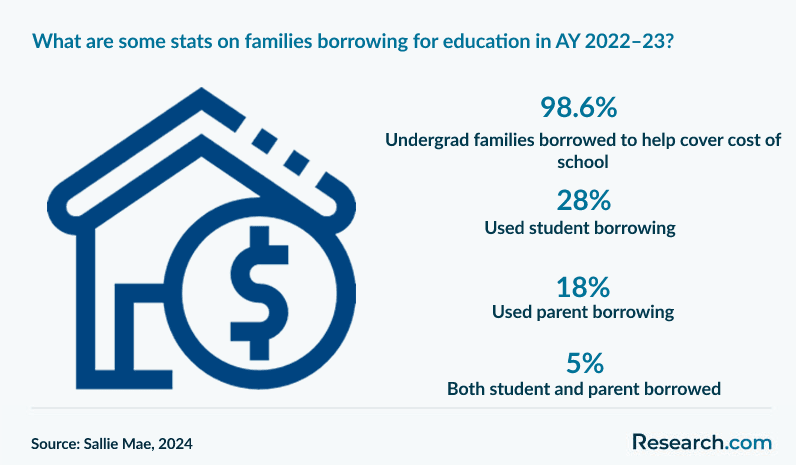
Let's look at some stats on borrowing for college in the USA. In the 2022-2023 academic year, a substantial number of families turned to borrowing to cover undergraduate education costs. Statistics show that 41% of families utilized some form of loan to help finance college. This borrowing came from various sources: 28% of families relied on student loans, where the student themself takes on the debt. An additional 18% utilized parent borrowing options like Parent PLUS loans. Finally, 5% of families employed a combination of both student and parent borrowing to manage the financial burden. These are shown in the graphic below.
How can unexpected expenses during college justify an appeal for more financial aid?
College life often comes with unanticipated expenses that can strain a student’s budget and financial resources. These unexpected costs can serve as a strong basis for a financial aid appeal if they significantly impact your ability to afford educational and living expenses. Here’s what you need to know:
Identify and Document the Expense
Before submitting an appeal, pinpoint the specific unexpected costs you've incurred. This could include medical emergencies, urgent car repairs, or losses caused by natural disasters. Be sure to provide supporting documentation, such as invoices, receipts, or letters from service providers.
Explain the Financial Impact
Clearly articulate how these expenses have affected your ability to pay for college. For example, unexpected medical bills may reduce your family’s available income for tuition, or car repairs could limit your ability to commute to campus or a part-time job. The more precise you are in quantifying the financial strain, the better the financial aid office can assess your case.
Link it to College Affordability
Make the connection between the unexpected expense and your need for additional aid. Highlight how the situation has made it harder to cover tuition, textbooks, or other living costs, such as rent or groceries. Colleges are more likely to adjust aid packages when they see that the change directly impacts your ability to remain enrolled.
Explore Other Resources
While appealing, consider combining additional support options, such as scholarships or student loans, to offset the financial burden. For instance, you may explore additional student loans for living expenses to temporarily bridge the gap for non-tuition-related costs. Doing so strengthens your case by demonstrating a proactive approach to managing the financial challenge.
Present a Professional Appeal
After compiling documentation and explaining its impact, write a concise and polite appeal letter to the financial aid office. Addressing the situation professionally and with sincerity can often make a positive impression.
By highlighting unforeseen financial challenges transparently and supplementing them with appropriate documentation, you increase the likelihood of a successful financial aid appeal. Remember, many colleges understand the realities of financial hardship and are willing to accommodate reasonable requests when presented with a well-supported case.
How can private student loans enhance your financial aid strategy?
Exploring private student loans can be an effective way to complement your financial aid portfolio, especially if there's still a gap after pursuing traditional financial aid options like federal loans, scholarships, and grants. Private student loans often provide flexible terms and personalized options that suit borrowers with varying financial needs.
Key Considerations When Choosing Private Student Loans
Before opting for private student loans, ensure you evaluate critical factors such as interest rates, repayment terms, and borrower benefits. Look for lenders offering competitive rates, no application fees, and the ability to prequalify without impacting your credit score.
Compare Reputable Lenders
While federal loans provide certain safeguards, researching well-reviewed private student loan options can unlock additional support for tuition or living expenses. For example, you can explore College Ave student loans reviews to better understand flexible repayment plans and potential borrower incentives tailored to different budgets and preferences.
Use Private Loans Strategically
It's important to use private student loans as a supplementary resource rather than a primary funding solution. Ideally, you should borrow only what you need to bridge the financing gap, ensuring manageable repayments upon graduation. Additionally, consider whether the lender offers deferment options, co-signer release programs, or interest rate discounts for autopay enrollment.
By incorporating private loans in a strategic and research-driven manner, you can create a robust financial aid strategy for achieving your educational goals. Whether you're supplementing other forms of aid or managing unplanned expenses, private loans can provide critical support when traditional options fall short.
How do private student loans impact my long-term financial health?
Private student loans, when used as part of a broader financial strategy, can influence your financial stability for years to come. It is essential to examine factors such as variable interest rates, repayment flexibility, and the potential impact on your credit score. Borrowers who carefully assess these elements can create a sustainable repayment plan without compromising future financial opportunities. Evaluating lenders’ terms and comparing offerings with the best student loans can empower you to make informed decisions. A comprehensive review of the long-term costs and benefits ensures that private loans support educational goals while maintaining financial health after graduation.
How can alternative education options influence my financial aid strategy?
Evaluating alternative education paths can provide a strategic edge when planning your financial aid appeal. By considering cost-effective options—such as those offered by online trade schools—you may find avenues for reducing overall tuition expenses, thereby strengthening the rationale for additional aid. Assessing these alternatives helps frame your financial needs within a broader context and supports a proactive approach to education financing.
How can aligning my degree choice enhance my financial aid appeal?
Integrating a clear vision for your academic and career trajectory can significantly support your financial aid appeal. Demonstrating that you have chosen a degree pathway with strong future earning potential signals to financial aid officers that their investment in you is sustainable. Presenting evidence—such as enrollment in programs known for their robust career outcomes like degrees that pay 100k a year—can strengthen your case by highlighting a commitment to long-term financial stability. This strategic alignment between your educational goals and career prospects helps underscore the validity of your request for additional aid without repeating previously mentioned steps.
What factors do financial aid offices consider when reviewing an appeal?
Financial aid offices evaluate a range of objective criteria when reviewing an appeal. They assess documented evidence of financial hardship by verifying recent income changes or unplanned expenses through clear, up-to-date financial records. Commitments to academic performance and progression are also reviewed as indicators of long-term stability. The evaluation further considers the alignment of the appeal request with the overall cost-of-attendance and alternative funding strategies—such as pursuing a fast associates degree online—to ensure that the appeal is part of a comprehensive educational plan. Additional focus is placed on the timeliness and clarity of the documentation submitted, reinforcing a transparent and well-supported case.
Are FAFSA-approved online colleges a viable option for enhancing financial aid offers?
Exploring online education alternatives can add a strategic layer to your financial aid approach. Institutions offering flexible tuition and innovative payment plans may present unique opportunities to strengthen your overall aid package. Evaluating key factors such as accreditation, program structure, and student support services is essential. For students considering these alternatives, reputable options, like FAFSA approved online colleges, can offer competitive aid opportunities and cost-effective solutions that align with modern financial planning strategies.
Should I balance appealing for more financial aid with taking on student loans?
When evaluating whether to rely on a successful financial aid appeal or to supplement funding with additional loans, it is essential to assess both the immediate financial relief and the long-term debt implications. Begin by reviewing your institution’s financial aid adjustments and estimating any remaining tuition gaps. Then, compare the benefits of increasing aid against the costs of borrowing, including future repayment terms and interest accrual. Understanding key differences in loan types is critical—learn how do subsidized and unsubsidized student loans differ to ensure you select an option that minimizes long-term financial burden. Evaluate your overall budget, career projections, and credit implications to decide if student loans are the right complement to your enhanced financial aid offer.
How can I compare student loan companies to optimize my borrowing strategy?
Evaluate key factors such as interest rates, origination fees, repayment terms, and borrower benefits to identify loan products that align with your financial needs. Leverage comprehensive research and data-driven resources to compare multiple providers and ensure transparency in fees and terms. Insights from reputable sources, including reviews from student loan companies, can help streamline this process. Prioritize options offering flexible repayment plans and robust customer support to enhance your overall financial aid strategy.
What repayment options are available for student loans?
Federal student loans offer a variety of repayment options to help borrowers manage their debt after graduation. Here's a breakdown of some common options:
- Standard Repayment Plan: This is the most common plan with a fixed monthly payment over a 10-year term. It's generally the fastest and cheapest way to repay your loans, as you'll pay less interest overall.
- Graduated Repayment Plan: This plan starts with lower monthly payments that gradually increase over time, typically 10 years. It can be helpful for recent graduates with lower starting salaries, but you'll end up paying more interest in the long run.
- Income-Based Repayment (IBR) Plan: This plan bases your monthly payment on a percentage of your discretionary income (your income minus the basic living expenses for your family size and location). Payments can be as low as $0 if you're unemployed, and any remaining balance is forgiven after 20 or 25 years of on-time payments.
- Pay As You Earn (PAYE) Plan: Similar to IBR, PAYE sets your monthly payment based on your income, but with a longer forgiveness period (20 years) and potentially lower monthly payments in the early years.
- Income-Contingent Repayment (ICR) Plan: This plan considers your total income when calculating your payment, potentially making it a better option for borrowers with high debt-to-income ratios. Like IBR, any remaining balance is forgiven after 25 years.
- Public Service Loan Forgiveness (PSLF): If you work full-time in a public service job (government, non-profit), and make 120 qualifying monthly payments under a specific repayment plan, the remaining balance of your federal direct loans may be forgiven.
Choosing the Right Plan
- The best repayment plan depends on your individual financial situation and future goals.
- Consider your income, expected salary growth, and overall debt burden.
- Many online resources can help you estimate your payments under different plans.
- You can also consult with your loan servicer or a financial advisor for personalized guidance.
Remember: Repayment options are available, so don't feel overwhelmed by student loans. By understanding your options and choosing the right plan, you can manage your debt effectively and achieve your financial goals.
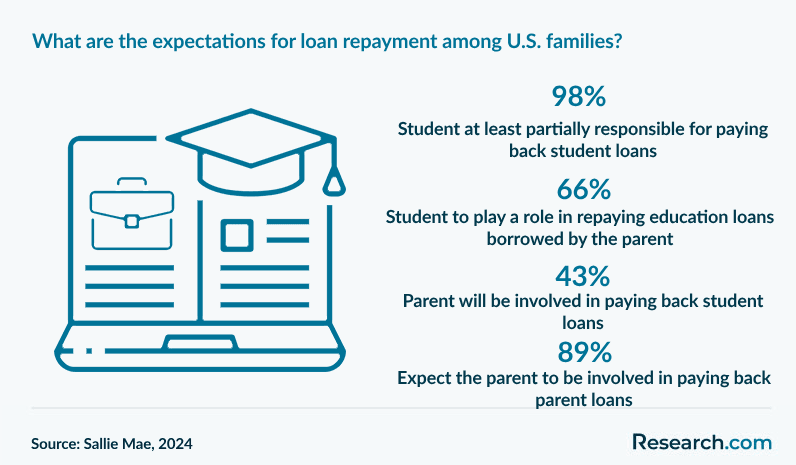
What are the expectations for loan repayment among U.S. families? Student loan repayment expectations fall on both students and parents. A whopping 98% believe students are at least partially responsible for their own loans. When it comes to Parent PLUS loans, 89% expect parents to repay them, but a significant 66% also believe the student should contribute. Interestingly, the expectation for parental involvement in repaying a student's direct loans is lower, with only 43% anticipating such help. These are shown in the graphic below.
What are some common myths about appealing for more financial aid for college?
Here are some common myths about appealing for more financial aid for college:
Myth #1: Only low-income students can appeal their financial aid offer.
Reality: Financial aid appeals are open to students from all income backgrounds. While need-based aid plays a role, unexpected circumstances can significantly impact any family's ability to contribute to college costs, making an appeal relevant.
Myth #2: Appealing is a waste of time and won't be successful.
Reality: While success rates vary, well-documented appeals with legitimate reasons can lead to increased financial aid. Many colleges have funds specifically designated for appeals.
Myth #3: You can't negotiate your financial aid offer.
Reality: Although not as common as appeals, some negotiation might be possible, especially if you receive a competing offer from another college. Focus on the value you bring as a student and how their increased support would solidify your decision to attend their institution.
Myth #4: Appealing means complaining about your financial aid package.
Reality: A successful appeal focuses on presenting your situation objectively. Explain the unexpected changes that impact your ability to contribute, not the inadequacy of the initial offer.
Myth #5: There's no point in appealing unless your circumstances are dire.
Reality: Significant financial changes, even if not dire, can justify an appeal. For example, medical bills or a parent's job loss can strain your resources and warrant additional support.
Myth #6: You can only appeal once.
Reality: While some colleges have limitations on appeals, others allow you to appeal again if your circumstances change or new information becomes available after an initial denial.
Myth #7: You need a perfect GPA to appeal your financial aid offer.
Reality: While academic merit can sometimes factor into financial aid appeals, the focus is usually on documented financial hardship, not academic performance. Maintaining good academic standing may be required to keep existing aid, but it's not always a determining factor for appeals.
Myth #8: The FAFSA is the only factor considered in a financial aid appeal.
Reality: The FAFSA is a starting point, but colleges may consider other factors during an appeal. This can include medical bills, unexpected expenses, or changes in your family's financial situation not fully reflected on the FAFSA.
Myth #9: Appealing delays your enrollment or financial aid award.
Reality: While processing an appeal can take time, it typically doesn't delay enrollment itself. Your financial aid award might be adjusted after the appeal is reviewed, but most colleges will ensure you have the resources needed to start on time.
Myth #10: Appealing hurts your chances of getting accepted to the college.
Reality: Appealing for more financial aid has no bearing on your admissions decision. Colleges understand that financial limitations are a reality for many students, and a well-documented appeal won't negatively impact your application.
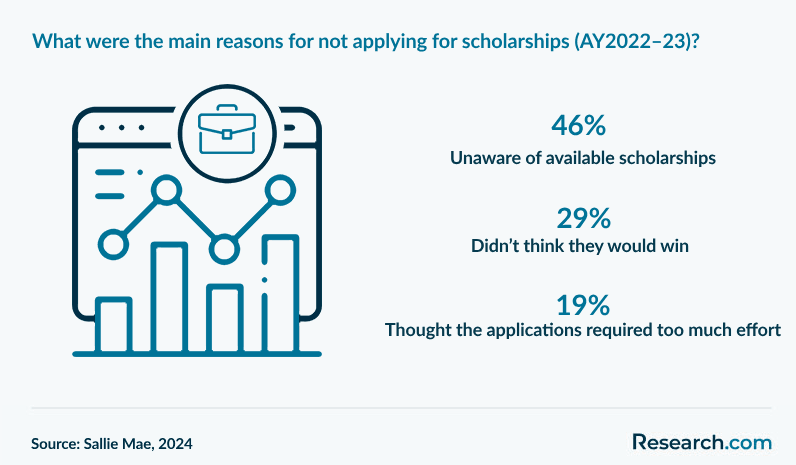
A significant number of students missed out on scholarship opportunities in the 2022-2023 academic year due to a lack of awareness and misconceptions. According to a 2024 Sallie Mae report, nearly half (46%) of students were unaware of scholarships available to them. Additionally, 29% felt discouraged by the perceived difficulty of winning scholarships, while 19% believed the application process itself was too much effort. These findings highlight the importance of promoting scholarship awareness and simplifying the application process to ensure students can access valuable financial aid. These are shown in the graphic below.
What are some common mistakes to avoid during the appeal process?
Here are some common mistakes to avoid during the financial aid appeal process:
Missing Deadlines
- Every college has its own deadlines for submitting appeals.
- Failing to submit your appeal on time can lead to an automatic denial.
- Make contacting the financial aid office and understanding their deadlines your first step.
Incomplete or Unorganized Documentation
- A strong appeal is backed by solid evidence.
- Gather all relevant documents (tax returns, bills, letters of explanation) and ensure they are well-organized and easy for the financial aid office to review.
- Don't wait until the last minute to gather this information.
Lack of Clear Communication
- Your appeal should clearly explain your circumstances and why you need additional aid.
- Avoid vague statements or emotional pleas.
- Focus on the facts and how unexpected financial changes have impacted your ability to contribute to college costs.
Not Proofreading Your Appeal Letter
- Typos and grammatical errors can create a negative impression.
- Carefully proofread your appeal letter before submitting it.
- If you're uncomfortable writing a formal letter, consider seeking help from a school counselor or writing center.
Unrealistic Expectations
- Financial aid appeals are not guaranteed to be successful.
- Don't expect a full ride or complete coverage of your financial need.
- Be realistic in your request and focus on the additional amount you genuinely need to bridge the gap.
Not Following Up
- After submitting your appeal, don't be afraid to follow up with the financial aid office.
- A polite inquiry about the status of your appeal shows continued interest and allows you to address any questions they might have.
Negotiating Without Leverage
- While negotiation might be possible in rare cases (e.g., competing offers from another college), appeals typically focus on documented financial hardship.
- Gather strong evidence to support your claim before attempting to negotiate.
By avoiding these mistakes and presenting a clear, well-supported case, you can increase your chances of a successful financial aid appeal. Remember, the financial aid office is there to help students. Don't hesitate to reach out and explain your situation in a professional and organized manner.
Should I Consult a Financial Aid Advisor to Enhance My Appeal?
Professional guidance can refine your appeal by ensuring that your documentation is well-organized, your unique circumstances are clearly communicated, and your case adheres to institutional policies. An experienced financial aid advisor can offer objective insights to identify overlooked criteria and streamline the presentation of your financial hardships. This support may also help you evaluate additional cost-effective education options, including pursuing an affordable bachelor's degree, to further optimize your overall financial planning.
How Can Alternative Career Certifications Boost My Financial Aid Appeal?
By strengthening your profile with targeted professional certifications, you demonstrate a commitment to long-term career success that can support your financial aid appeal. Including credentials that are highly regarded in your field conveys to decision-makers that additional aid is an investment in a future with strong earning potential. For instance, highlighting achievements in courses or programs that lead to the best certifications to get for high paying jobs can underscore your proactive approach toward financial stability. Present evidence of recently earned or in-progress certifications to complement your documented financial hardships and to emphasize a cohesive plan for future academic and professional success.
Here’s What Students Say About Appealing for More Financial Aid for College
Appealing my initial financial aid package was one of the best decisions I made. The process was straightforward, and the financial aid office was very helpful in guiding me through it. Thanks to the additional aid I received, I was able to focus on my studies without worrying about how I would cover the costs. The peace of mind was invaluable. Emily
When I learned that I could appeal my financial aid, I was hesitant at first, but I'm so glad I did. The extra support I received made a huge difference in my ability to afford college and graduate debt-free. The financial aid team reviewed my situation thoroughly and was genuinely invested in helping me succeed. I'm forever grateful for their support. Jamal
Appealing my financial aid package was a game changer. The additional funding allowed me to participate in valuable extracurricular activities and study abroad, experiences that enriched my college journey immensely. The process was straightforward, and the financial aid office was responsive and understanding of my needs. I highly recommend exploring this option. Sophia
Key Findings
- In 2023, a total of $114.11 billion in federal financial aid was disbursed to students.
- Loan programs provided the majority of the funding, with $83.29 billion awarded through the William D. Ford Federal Direct Loan Program.
- The Federal Pell Grant Program was the next largest contributor at $28.69 billion.
- The remaining grant funding came from the Federal Supplemental Educational Opportunity Grant Program ($893.8 million), the Teacher Education Assistance for College and Higher Education Grant Program ($82.1 million), and the Iraq and Afghanistan Service Grant Program ($0.6 million).
- The Federal Work-Study Program provided an additional $1.15 billion in aid.
- FAFSA forms processed have shown a slight downward trend in recent years, with a decrease of over a million forms submitted between 2019 and 2023.
- 18 million FAFSA forms were processed in 2019, dropping to 17.5 million in 2023.
- This coincides with a decline in the total number of students receiving financial aid - in 2019, 10.4 million students received aid, and that number fell to 9.7 million in 2023.
- In the 2022-2023, 41% of families utilized some form of loan to help finance college.
- 28% of families relied on student loans, where the student themself takes on the debt.
- An additional 18% utilized parent borrowing options like Parent PLUS loans.
- Finally, 5% of families employed a combination of both student and parent borrowing to manage the financial burden.
- A whopping 98% believe students are at least partially responsible for their own loans.
- When it comes to Parent PLUS loans, 89% expect parents to repay them, but a significant 66% also believe the student should contribute.
- The expectation for parental involvement in repaying a student's direct loans is lower, with only 43% anticipating such help.
- In AY2022-2023, 46% of students were unaware of scholarships available to them.
- 29% felt discouraged by the perceived difficulty of winning scholarships, while 19% believed the application process itself was too much effort.
References:
- Federal Student Aid. (2023). Fiscal Year 2023 Annual Report. U.S. Department of Education.
- Sallie Mae. (2023). How America Pays for College 2023. Sallie Mae.
Other Things You Should Know About Appealing for More Financial Aid for College
To improve your chances of a successful appeal, write a clear and concise letter explaining your financial changes. Include supporting documents like medical bills or unemployment notices. Reach out to the financial aid office for guidance, and follow their instructions meticulously.
To support a financial aid appeal for 2027, include recent tax returns, pay stubs, medical bills, or unemployment documentation that illustrate changes in financial status. Additionally, provide a formal letter detailing your family's circumstances and any other relevant documents specified by the financial aid office.