
2027 Different Types of Higher Education Degrees and Their Salaries

Co-Founder and Chief Data Scientist
The demand for skilled professionals in today's economy continues to grow rapidly, making the choice of the right educational path more critical than ever. According to recent labor market data, employment in occupations requiring higher education is projected to increase significantly over the next decade, reflecting a clear trend toward advanced qualifications driving career opportunities. Understanding the landscape of higher education degrees and the earning potential associated with each is vital for making informed decisions that align with long-term career goals. This article offers a comprehensive guide to the various types of higher education degrees and the salary expectations graduates can anticipate, equipping readers with expert insight to navigate their educational and professional journeys effectively.
Key Points About Different Types of Higher Education Degrees and Their Salaries
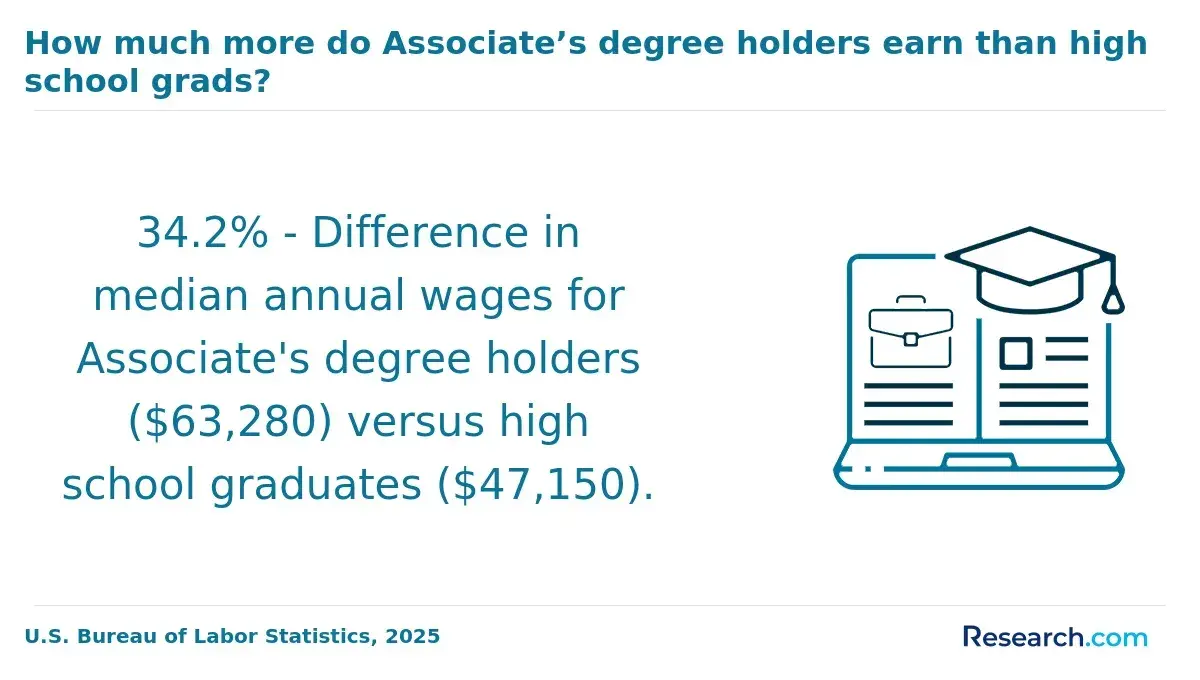
- Individuals with an associate degree in the U.S. typically earn about $9,000 more annually than those with only a high school diploma, improving access to roles in technical and administrative fields but often facing slower long-term salary growth compared to higher degrees.
- Bachelor's degree holders have a median weekly earning of approximately $1,200, which translates to a significant premium over both high school and associate degree salaries, and they benefit from greater career advancement opportunities across industries like business, technology, and healthcare.
- Master's degree graduates generally see even higher earnings with median annual salaries about 20% greater than those with bachelor's degrees, positioning them well for leadership roles and specialized positions in fields such as education, engineering, and management, which also tend to offer stronger job security.
What Are the Different Types of Higher Education Degrees Available?
Understanding the different types and levels of higher education degrees is crucial for students before selecting a program because each degree type aligns with specific career goals and educational backgrounds. This helps individuals make informed decisions about their academic paths and professional futures.
Below is an overview of the main types of higher education degrees and what makes each unique:
- Associate Degree in Higher Education: This foundational degree offers broad exposure to general education subjects alongside introductory coursework in specific areas. It emphasizes essential skills like critical thinking and communication.
- Bachelor's Degree in Higher Education: This degree focuses on comprehensive study within a chosen discipline, combining general education with in-depth major coursework. It helps students develop analytical, research, and problem-solving skills through core and elective classes.
- Master's Degree in Higher Education: Intended for advanced study, this degree deepens expertise by blending theoretical and applied coursework. It often requires significant projects or a thesis to enhance specialized knowledge and critical analysis.
- Doctoral Degree in Higher Education: Representing the highest academic credential, this degree emphasizes original research and scholarly inquiry. Students engage in advanced seminars and produce a dissertation or equivalent work demonstrating mastery of their field.
- Professional Degree in Higher Education: Designed for entry into regulated professions, this degree integrates academic and practical coursework to prepare for licensure. The curriculum is application-oriented to meet standards in fields like medicine, law, or pharmacy.
Exploring the fastest degree college options for working adults can be a strategic approach for those balancing career commitments while pursuing higher education.
What Specializations Are Available in Higher Education Degrees?
Choosing a specialization is a crucial factor when selecting a higher education degree, as it directly influences the skill set students develop and their alignment with specific career goals. A well-chosen specialization helps students deepen their expertise in their chosen field, increasing their employability and earning potential in competitive job markets.
Below are some of the most common higher education specializations that offer diverse career opportunities and essential skills for today's workforce:
- Business Administration: Focuses on leadership, management, finance, and organizational strategy. Students develop skills such as problem-solving, communication, and analytical thinking, preparing them for careers as managers, consultants, analysts, and entrepreneurs.
- Computer Science and Information Technology: Emphasizes programming, software development, cybersecurity, and data analysis. Key skills include coding, systems design, and logical reasoning, leading graduates to roles like software engineers, IT consultants, and data analysts.
- Health Sciences and Public Health: Covers biology, health policy, and epidemiology with a focus on research, data interpretation, and patient care. Graduates often work in healthcare administration, public health, and clinical positions, benefiting from growing demand in the healthcare sector.
- Engineering: Offers training in several disciplines such as mechanical, civil, and biomedical engineering. It develops problem-solving abilities, technical design, and innovation skills, enabling graduates to pursue engineering roles with strong job prospects and competitive salaries.
- Education: Prepares students for teaching, curriculum development, and educational leadership. Essential skills include instructional design, classroom management, and assessment, with career paths in teaching, administration, and consulting.
For those exploring credential options, considering the best certificate programs that pay well can supplement higher education degrees and enhance career advancement.
How Long Does It Take to Complete Each Type of Higher Education Degree?
Understanding the duration of different higher education programs is crucial for students as they plan their academic and career paths. Knowing how long each degree typically takes helps in setting realistic timelines and making informed decisions about education and work-life balance.
Below is an overview of the main types of higher education degrees and their average completion times:
- Associate Degree in Higher Education: An associate degree usually takes about two years of full-time study. However, factors like part-time enrollment or transfer credits can lengthen or shorten this period. Many institutions also offer accelerated or online options to accommodate different learning needs.
- Bachelor's Degree in Higher Education: Typically requiring four years of full-time study, a bachelor's degree may take longer if students attend part-time or change majors. Transfer credits from previous post-secondary education can reduce the time to completion, and numerous online and accelerated programs are available.
- Master's Degree in Higher Education: A master's program generally takes one to two years beyond the bachelor's degree. Some fields offer part-time study or online alternatives, allowing flexibility that can extend or shorten the overall duration depending on student pace and course load.
- Doctoral Degree in Higher Education: Doctoral degrees often require three to six years of study post-master's, including research and dissertation work. Timelines can vary significantly based on program structure, field of study, and whether the student attends full-time or part-time, with some programs offering hybrid or online components.
Breakdown of All 2-Year Online Title IV Institutions

Are There Accelerated Higher Education Degree Programs?
Yes, there are accelerated higher education degree programs designed specifically to help students complete their degrees much faster than traditional timelines.
These programs span from associate degrees up to doctoral levels, with some bachelor's degrees achievable in as little as one year, while many master's programs can be completed within 12 to 18 months.
Common formats that support this faster pace include condensed course schedules featuring five- to ten-week sessions instead of standard 16-week semesters, year-round enrollment options with summer and intersession classes, and credit transfer or degree-completion tracks for those who already have prior college credits or associate degrees.
Other innovative models include dual degree pathways such as "4+1" or "3+2" programs, allowing students to earn both bachelor's and master's degrees within five years, as well as competency-based tracks where advancement depends on demonstrated mastery rather than time spent attending classes.
While these accelerated programs can offer the appealing benefit of entering the workforce sooner and potentially unlocking higher lifetime earnings more quickly, they come with important considerations. The course loads tend to be more intense, demanding significant weekly time commitments alongside strong organizational and time management skills.
Eligibility criteria might limit enrollment to high-achieving students or those with non-traditional backgrounds, often requiring a minimum number of transferable credits or a certain GPA threshold.
Due to the compressed schedules, balancing work, study, and personal life can be particularly challenging, making these programs less suitable for some learners. Importantly, graduates receive the same accredited diplomas and qualify for the same licensure and financial aid as those following traditional routes.
When I spoke with a graduate of an accelerated bachelor's degree program, he reflected on the experience as both rewarding and demanding. He described a rigorous schedule where "every week felt like a sprint," juggling multiple condensed courses that required constant focus and rapid assimilation of material.
Despite the pressure, he valued how "the year-round classes actually kept momentum going" and reduced downtime that typically lengthens traditional degrees. His ability to transfer several credits from prior studies was a key advantage, accelerating progress even further.
Although "the workload was intense and sometimes overwhelming," he felt that "knowing I was finishing faster and entering my career early made those sacrifices worthwhile."
This graduate highlighted the importance of reliable time management and a clear goal in navigating the accelerated path successfully, underscoring that while not easy, these programs can be a powerful option for motivated students ready to commit fully.
Are Online Higher Education Degrees as Credible as Traditional Ones?
Both traditional and online higher education degree programs uphold rigorous academic standards through accreditation by independent agencies recognized by the U.S. Department of Education. These institutions must meet strict criteria involving curricula, faculty qualifications, and assessment methods to align with national expectations.
Research shows that learning outcomes in online programs are comparable to, and in some cases better than, traditional classroom instruction. For example, a meta-analysis referenced by Georgetown University found that students in online environments often perform slightly better due to more frequent assessments and engaging multimedia content.
Benefits of online degrees include increased flexibility and affordability, with 44% of online students reporting lower costs compared to traditional programs. Retention rates also vary, ranging from 25% to 60% in online programs, while traditional programs see rates between 8% and 10%.
Recent trends reveal growing employer acceptance of online degrees. According to a 2023 Champlain College survey, 84% of U.S. adults believe employers have become more receptive to online credentials since the pandemic, and 72% regard online education as more reputable than five years ago.
Additionally, 83% of HR leaders value online degrees from well-known institutions, and 92% prefer degrees from brick-and-mortar schools over online-only universities.
Overall, employers tend to emphasize the reputation and accreditation of the institution rather than the mode of learning. This means students and graduates can be confident that the credibility of their degree is determined far more by the institution's quality and standing than by whether courses were completed online or on campus.
How Much Does Each Type of Higher Education Degree Typically Cost?
Understanding tuition differences across degree levels is crucial for effective budgeting and long-term financial planning. Different higher education degrees come with varying costs that can significantly impact a student's financial obligations and career decisions.
Below is an overview of typical tuition ranges for each type of higher education degree to help guide your planning process:
- Associate Degree in Higher Education: Tuition and fees at public two-year colleges generally average around $4,150 per year for in-district students, though rates can vary widely by state, from about $1,440 in California to $8,900 in Vermont. Public community colleges are usually more affordable than private options, and many students benefit from grant aid such as federal Pell Grants to help cover these costs.
- Bachelor's Degree in Higher Education: At public four-year institutions, average in-state tuition is approximately $11,950 annually, while out-of-state students often face much higher rates near $31,880. Private nonprofit colleges can charge around $45,000 per year. Residency status, the public or private nature of the school, and geographic location play vital roles in determining costs. Substantial scholarship and grant aid frequently reduce the net expenses for many undergraduates.
- Master's in Higher Education: Graduate tuition varies considerably, with public universities typically charging between $9,000 and $20,000 annually, whereas private universities may exceed $30,000. Online programs sometimes offer lower tuition options. Financial support options for graduate students include assistantships, fellowships, and employer-sponsored tuition reimbursement, helping to offset costs.
- Doctoral Degree in Higher Education: Public universities charge between $12,000 and $30,000 per year for doctoral programs, and private universities often have tuition above $40,000 annually. Many doctoral candidates receive comprehensive funding packages, including stipends and tuition waivers in exchange for teaching or research duties. Competitive fellowships and federal loans also assist in managing these expenses.
When I spoke with a graduate of a higher education degree program about her experience managing tuition costs, she shared a thoughtful perspective. She explained that beyond the listed tuition fees, she carefully researched every available funding avenue, combining scholarships with part-time work and employer tuition assistance.
"It wasn't just the sticker price that mattered," she reflected, "but understanding how to leverage resources over time to make the investment feasible." Her strategic approach helped her graduate without unmanageable debt and ultimately opened doors to career advancement, confirming to her that thorough financial planning around tuition costs is not only necessary but empowering.
What Jobs Can You Get with Each Type of Higher Education Degree?
The level of your higher education degree plays a crucial role in determining your career opportunities and the types of roles for which you are qualified. Different degree types open doors to various positions within colleges, universities, and educational organizations, each with increasing responsibility and specialization as degree level rises.
Below is an outline of common jobs associated with each higher education degree type.
- Associate Degree in Higher Education: Graduates typically qualify for entry-level administrative and support roles such as admissions assistants, student services coordinators, and registration specialists. These jobs involve direct interaction with students, managing data, and supporting higher-level staff, forming a solid foundation for a career in higher education.
- Bachelor's Degree in Higher Education or Related Fields: This degree prepares individuals for mid-level administrative positions like admissions counselors, financial aid advisors, residence life coordinators, or marketing specialists. Jobs often require more responsibility and may include supervising support staff within various institutional departments.
- Master's Degree in Higher Education Administration: Graduates are positioned for leadership roles including directors of admissions, deans of students, registrars, or department heads in financial aid or career services. According to labor projections, demand for these roles is growing, and holders of master's degrees earn notably higher median wages than those with bachelor's degrees.
- Doctoral Degree (EdD or PhD) in Higher Education: Holding a doctorate qualifies graduates for top-level administrative positions such as provost, chief academic officer, or vice president. Many also become faculty members, teaching graduate courses and conducting research. For students seeking the highest academic credentials through cheap phd programs online, this level supports long-term academic leadership and tenure-track careers.
How Do Salaries Differ by Higher Education Degree Type?
Degree level often influences earning potential significantly, with higher education degrees generally leading to increased salaries. Understanding these differences can help students make informed decisions about their educational and career paths.
Below is a breakdown of typical salary ranges by degree type:
- Associate Degree in Higher Education: Graduates with an associate degree earn a median annual salary of about $57,148. Starting salaries vary widely by field, with technical and healthcare roles offering higher pay. While this degree improves earnings compared to a high school diploma, long-term growth is more limited unless further education is pursued.
- Bachelor's Degree in Higher Education: The average starting salary for bachelor's degree holders is $68,680, with a median annual salary of $80,236. Salaries are influenced by major, location, and industry demand, with engineering and computer science graduates typically earning the highest starting pay. Bachelor's degrees provide greater opportunities for salary growth over time.
- Master's Degree in Higher Education: Median earnings for those with a master's degree reach $95,680 annually. This degree often leads to management, specialized, or research roles with better pay. Fields such as business and STEM tend to offer the highest salary premiums for master's graduates.
- Doctoral and Professional Degrees: Doctoral degree holders have median salaries around $118,456, while professional degrees average $122,876 per year. These advanced degrees open doors to top-level positions in academia, law, medicine, and research, resulting in the highest earning potential among degree types.
When exploring options for higher education, students should also consider affordable pathways such as FAFSA accepted online colleges, which can provide flexible and cost-effective ways to advance their degrees while managing expenses.
Is There High Demand for Higher Education Degree Holders in the Job Market?
There is sustained demand for higher education degree holders in the U.S. job market, driven by evolving workforce needs and emerging technologies. Employers increasingly prioritize career-aligned programs and skill-based learning, with nearly two-thirds hiring based on specific competencies rather than degree titles alone.
Fields like health care, engineering, technology, and business tend to offer higher starting salaries and stronger employment prospects. For example, graduates holding a bachelor's degree in computer science or engineering often see median starting salaries exceeding $70,000. Meanwhile, degrees in education or liberal arts may provide lower initial compensation but remain crucial in certain regional job markets.
Several factors influence the demand for higher education degree holders, including advancements in technology and regional economic differences. Industries focused on data analytics, cybersecurity, and artificial intelligence seek graduates with relevant technical skills, while others emphasize strong communication and problem-solving abilities.
Geographic variations also affect demand: states with thriving technology or health care sectors often offer higher salaries and more job opportunities in these fields, whereas other regions may prioritize professionals in education or public service.
Despite challenges like financial pressures on colleges, a majority of Americans (73%) still believe higher education provides a positive return on investment. Flexible and competency-based programs are becoming increasingly popular to meet these shifting demands, creating a favorable outlook for degree holders who align their studies with market trends and workforce needs.
It's important to note that many students now also consider accelerated degrees and microcredentials, along with traditional paths, to maximize real-world applicability and return on investment. Some even explore certification courses that pay well as a strategic supplement to their education.
What Factors Should You Consider When Picking a Type of Higher Education Degree?
Choosing the right degree level in higher education is a critical decision that significantly impacts your career path and personal circumstances. Selecting a degree that aligns with your goals and resources ensures better job prospects and a more efficient educational investment.
To make an informed choice, students should carefully evaluate several key factors:
- Career Goals: Your intended profession largely determines the degree level needed. Many well-paying jobs, such as engineers or nurses, require specific degrees or certifications. Understanding the qualifications necessary for your desired role helps avoid pursuing unnecessary or insufficient education.
- Time Commitment: Degree programs vary in length, with associate degrees typically taking two years, bachelor's degrees four, and graduate degrees requiring additional years of study. Consider how quickly you want to enter the workforce and whether you're willing to invest extra time for advanced qualifications that could boost earnings.
- Program Cost: Tuition and fees generally increase with degree level and institution type. For example, public in-state bachelor's programs average around $10,940 per year, while graduate programs may exceed $30,000 annually. Weigh the potential student debt against expected salary and job security in your field.
- Academic Preparation and Personal Strengths: Assess whether your background and skills fit the academic demands of the degree. Choosing a program aligned with your strengths can improve your chances of success and timely completion.
- Job Placement Rates and Salary Outlook: Investigate employment rates and starting salaries for graduates in your field. STEM bachelor's degrees, for instance, often lead to higher starting salaries compared to non-STEM fields, which can influence your return on educational investment.
What Higher Education Graduates Say About Their Degree and Salary
- Steve: "Completing my bachelor's degree in environmental science has opened doors I never imagined. The rigorous curriculum not only equipped me with technical expertise but also instilled a deep sense of responsibility to protect our planet. Starting my career as a sustainability consultant has been incredibly rewarding, as I get to create real-world solutions for businesses aiming to reduce their ecological footprint. Beyond professional growth, the connections I made with professors and classmates have enriched my perspective and fueled my passion for lifelong learning. "
- Dwayne: "Having earned my master's degree in social work, I now appreciate how much this education shaped both my career and personal development. The program challenged me emotionally and intellectually, preparing me to advocate effectively for vulnerable populations. My role as a clinical social worker allows me to directly impact mental health within my community, which is deeply fulfilling. I am grateful for the advanced training that offers stability and growth, fostering confidence in the complex field of social services. "
- Hunter: "My doctorate in education was a transformative journey that pushed me to think critically about how we shape future generations. The opportunity to research innovative teaching methods and lead academic projects helped me develop a clear vision for improving educational systems. Professionally, this degree accelerated my advancement into leadership positions where I mentor new educators and influence policy. It's incredibly motivating to know my work contributes to a supportive environment where students and teachers alike can thrive. "
Other Things You Should Know About Higher Education Degree Programs & Salaries
On average, master's degree holders earn about 20% more than those with only a bachelor's degree. This difference varies by industry and occupation but generally reflects advanced skills and expertise gained through graduate study. Over a career, the cumulative salary gap can be significant.
In 2027, degrees like Bachelor's, Master's, and Doctorates remain prevalent. Bachelor's graduates earn between $50,000 - $70,000, Master's holders average $70,000 - $90,000, while Doctorates can exceed $100,000 annually, depending on the field of study.
In 2027, a bachelor's degree in computer science might yield an average salary of $85,000 annually, while an MBA could command $120,000. A nursing degree might offer around $75,000, whereas a doctorate in engineering might reach $95,000. Salary varies by degree type, field, and experience.
References
- 9 Factors to Consider When Choosing A University | Sage https://www.sageeducation.ae/blog/factors-to-consider-when-choosing-a-university
- Does College Pay Off? A Comprehensive Return On Investment Analysis - FREOPP https://freopp.org/whitepapers/does-college-pay-off-a-comprehensive-return-on-investment-analysis/
- Innovative Accreditation: Accelerated Degrees and Competency-Based Education https://changinghighered.com/innovative-accreditation-accelerated-degrees-and-competency-based-education/
- Choosing a Higher Education Institution https://www.careerhelp.org.za/content/parent/supporting-your-child-2
- Higher education https://www.skillsforcareers.education.gov.uk/pages/training-choice/higher-education
- How Credible Are Online Degrees? And are they worth it? https://potomac.edu/are-online-degrees-taken-seriously-by-employers/
- Types of degrees in the UK https://www.thecompleteuniversityguide.co.uk/student-advice/what-to-study/types-of-degrees-uk
- Are online degrees respected by employers? https://onlineprograms.uic.edu/news-stories/are-online-degrees-respected-by-employers/
- Interest in Higher Education Remains High https://news.gallup.com/poll/660134/interest-higher-education-remains-high.aspx
- Higher Education Specialization for Online Degrees | UAGC https://www.uagc.edu/online-degrees/specializations/higher-education


