
2027 What Does an IT Auditor Do: Responsibilities, Requirements, and Salary

Co-Founder and Chief Data Scientist
Becoming an IT auditor is a choice to work where technology, cybersecurity, compliance, accounting controls, and business risk meet. The role is for people who want to understand how systems actually operate, test whether safeguards are working, and explain the consequences when they are not.
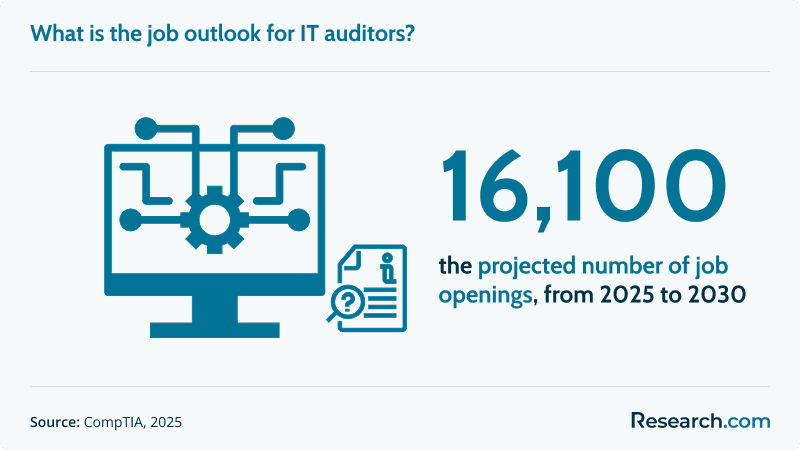
Demand is being pushed by cloud migration, privacy expectations, cyber incidents, vendor risk, automation, and the rising cost of technology failures. With a projected 16,100 new jobs opening up by 2030, IT auditing remains a practical career path for students, accounting professionals, IT workers, cybersecurity analysts, internal auditors, and career changers looking for a role with long-term relevance.
This 2026 guide explains what IT auditors do, what skills and tools matter, how much they can earn, which certifications are worth considering, and how to decide whether this career fits your strengths and goals.
Key Things You Should Know About What Does an IT Auditor Do
- An IT auditor evaluates and secures an organization's critical technology systems, acting as a vital bridge between technology and business risk.
- Success in the role depends on a balanced mix of technical expertise in areas like cybersecurity and professional skills like clear communication.
- Earning a key credential like the Certified Information Systems Auditor (CISA) is the globally recognized way to validate your expertise
- The field is projected to add 16,100 new jobs between 2025 and 2030, signaling strong and sustained career stability.
- The average annual salary for an IT auditor is $108,997, reflecting the high value organizations place on this role.
What is an IT auditor?
An IT auditor reviews an organization’s technology systems, processes, and controls to determine whether they are secure, reliable, efficient, and compliant with applicable requirements. The job is not simply about checking boxes or finding technical mistakes. It is about identifying technology risks that could lead to data exposure, fraud, inaccurate reporting, service disruption, regulatory problems, or financial loss.
IT auditors often sit between technical teams and business leaders. They examine areas such as user access, cloud configurations, cybersecurity controls, disaster recovery plans, vendor platforms, databases, system changes, and compliance documentation. Then they translate the results into clear findings that managers, executives, audit committees, or regulators can act on.
The role has become more important as organizations rely on digital systems for nearly every core activity. Leaders need assurance that cloud adoption, automation, data analytics, and new software deployments are not weakening internal controls. This is one reason technology, risk, and analytics increasingly appear in business education pathways, including many MBA specializations.
At its core, IT auditing answers a practical set of questions: Are systems protected? Are controls designed well? Are they operating as intended? Can the organization trust the technology and information it uses to make decisions?
What does an IT auditor do day-to-day?
Most IT auditor work is organized around audit engagements. Each engagement has a defined scope, risk area, testing plan, evidence requirements, findings, and follow-up actions. The daily work combines interviews, documentation, technical review, data analysis, evidence testing, and communication with stakeholders.
The work of an IT auditor commonly includes the following responsibilities:
- Plan and scope audits. IT auditors determine which systems, controls, departments, or risks will be reviewed. A project might focus on cloud access, a financial application, vendor security, disaster recovery, or a recent system implementation.
- Map business and technology processes. Auditors interview system owners, IT managers, finance teams, compliance staff, and end users to understand how a process works in practice, not just how it is described in policies.
- Test controls and collect evidence. Testing may include reviewing user access lists, checking whether former employees still have system access, inspecting system logs, confirming approvals for changes, or verifying whether security patches were applied on time.
- Analyze data for exceptions. IT auditors use data to find unusual transactions, duplicate records, excessive permissions, missing approvals, unauthorized changes, or patterns that suggest a control is not working.
- Document work clearly. Strong audit documentation explains what was tested, what evidence was reviewed, what exceptions were found, and why the issue matters.
- Write and present findings. A useful finding connects the condition to business risk. For example, “servers are unpatched” is less useful than explaining how unpatched servers increase the chance of unauthorized access or system downtime.
- Track remediation. After management agrees to corrective action, auditors verify whether the issue was fixed and whether the risk was reduced.
A realistic workday
A typical day might start with reviewing access logs for a financial system and comparing permissions against employee job responsibilities. Later, the auditor may meet with an IT manager to discuss how privileged accounts are requested, approved, and monitored. The afternoon may be spent drafting a finding that explains why weak access reviews could allow unauthorized changes to a critical application.
The work is detailed, but it is not solitary. IT auditors spend substantial time asking follow-up questions, challenging incomplete evidence, negotiating practical remediation timelines, and translating technical issues into business language.
How much can you earn as an IT auditor?
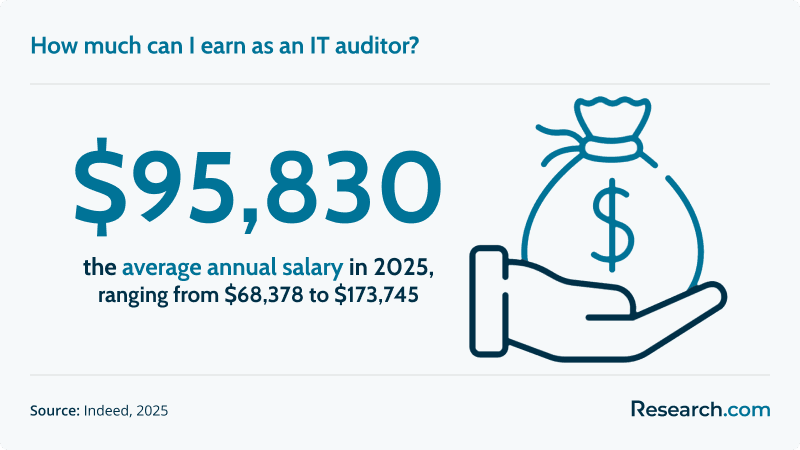
The average salary for an IT auditor is approximately $108,997 per year, with a typical range between $68,378 and $173,745. Pay varies by experience, certification, technical specialization, industry, location, employer size, and whether the role is internal audit, external audit, consulting, or cybersecurity-focused.
New professionals should be careful when interpreting average salary figures. Entry-level compensation is often below the average, while senior auditors, audit managers, consultants, and professionals with strong cybersecurity or cloud expertise may earn more.
What affects IT auditor salary?
- Experience level: Senior auditors and managers usually earn more because they lead engagements, review workpapers, manage client or executive relationships, and make higher-level risk judgments.
- Certifications: Credentials such as CISA, CISSP, and CISM can strengthen credibility and may be preferred for promotion or specialized roles.
- Technical depth: Professionals who can evaluate cloud security, identity and access management, network controls, cybersecurity programs, and data protection often compete for more specialized positions.
- Industry: Finance, technology, healthcare, consulting, and other regulated or technology-dependent sectors often place a high value on audit and risk expertise.
- Location: Major business and technology markets often pay more, but cost of living and remote-work policies should also be considered.
Where IT auditors earn the most
Location can have a major effect on compensation. IT auditors in Dallas can earn an average of $148,390, while those in New York City see averages around $129,407. These figures reflect demand from corporate headquarters, regulated industries, consulting firms, and technology-heavy organizations.
The chart below highlights the top-paying cities for IT auditors in 2025.
What is the job outlook for IT auditors?
The job outlook for IT auditors is strong, with a projected 16,100 new job openings between 2025 and 2030. Demand is being driven by cloud systems, cybersecurity threats, privacy obligations, third-party vendors, digital payments, automation, and executive pressure to show that technology risks are being governed.
IT audit is also resilient because it supports several business needs at once. Organizations need compliance testing, but they also need assurance over cybersecurity controls, data governance, business continuity, system implementations, financial applications, and operational resilience. That makes IT audit relevant across industries rather than tied to one type of employer.
Why IT specialization is key
The broader auditor job outlook is healthy with 5% growth, but IT-focused audit work is more specialized because it requires a working understanding of both technology and risk. Employers increasingly want auditors who can evaluate cloud environments, data privacy controls, cybersecurity programs, identity management, automated workflows, and system-generated evidence.
This specialization can improve career durability. As more business processes become digital, organizations need professionals who can judge whether the systems behind those processes are controlled, secure, and dependable.
What this means for job seekers
- Students should consider coursework in information systems, accounting, analytics, cybersecurity, computer science, or risk management.
- Accountants and internal auditors can improve their marketability by learning IT controls, system access, data analytics, and technology risk frameworks.
- IT professionals can transition by learning audit methodology, control testing, documentation standards, and business risk language.
- Career changers should look for bridge roles in compliance, technology risk, GRC, internal audit, cybersecurity governance, or data validation.
What key skills do you need to be an IT auditor?
IT auditors need a balanced skill set. Technical knowledge helps them understand systems and identify weaknesses. Business judgment helps them decide which weaknesses matter. Communication skills help them explain findings in a way that leads to action.
The role is not purely technical and not purely accounting-based. Strong IT auditors can investigate details, evaluate evidence, understand control design, and communicate risk without overstating or minimizing the issue.
Essential technical skills
- IT governance and control frameworks: IT auditors should understand how organizations assign technology responsibility, define controls, monitor risk, and evaluate accountability. Framework knowledge, including COBIT, helps auditors assess whether controls are properly designed and operating effectively.
- Cybersecurity fundamentals: Auditors need working knowledge of access control, vulnerability management, incident response, encryption, network security, security monitoring, and data protection.
- Systems and infrastructure: Familiarity with Windows, Linux, databases, enterprise applications, and cloud platforms such as AWS or Azure helps auditors interpret evidence and ask better technical questions.
- Identity and access management: Many audits focus on whether users have appropriate access, whether privileged accounts are controlled, and whether access is removed when employees leave or change roles.
- Change management: IT auditors often test whether system changes were requested, approved, tested, documented, and implemented correctly.
- Data analysis: The ability to analyze large data sets helps auditors identify outliers, duplicate records, missing approvals, control failures, and unusual activity.
Crucial professional skills
- Critical thinking: IT auditors must understand how a process could fail, how likely the failure is, and what impact it could have.
- Clear communication: The job requires concise writing and direct conversations with technical and nontechnical stakeholders. Findings must be understandable to the people responsible for fixing them.
- Professional skepticism: Auditors verify evidence rather than relying only on verbal explanations. This means confirming that controls work, not assuming that people are wrong.
- Attention to detail: Small exceptions, configuration errors, access problems, or missing approvals can reveal larger control weaknesses.
- Integrity and objectivity: Auditors must report issues accurately, even when findings are uncomfortable or unpopular.
- Relationship management: Effective auditors know how to challenge process owners respectfully while keeping the audit productive.
Aspiring auditors who want stronger exposure to technical security concepts sometimes build skills through an online ethical hacking course, especially if they want to understand vulnerabilities from an attacker’s perspective.
What tools and technologies do IT auditors use?
IT auditors use tools to gather evidence, analyze data, test controls, identify security weaknesses, document work, and monitor remediation. The exact software varies by employer, but most audit environments rely on several common categories.
Common tool categories
- Data analysis tools: Tools such as ACL, IDEA, and Alteryx help auditors test large data sets, compare records, identify exceptions, and automate parts of control testing.
- Security assessment tools: Vulnerability scanners and network analysis tools, including Nessus and Wireshark, help identify technical weaknesses. IT auditors may not always run these tools themselves, but they should understand what the results mean.
- GRC platforms: Governance, Risk, and Compliance platforms support audit planning, risk assessments, control libraries, issue tracking, evidence requests, and remediation monitoring. ServiceNow and Archer are common examples.
- Spreadsheet and reporting tools: Spreadsheet skills remain essential for organizing evidence, reconciling data, documenting tests, and preparing audit summaries.
- Cloud and system consoles: Auditors may review logs, access roles, configuration reports, and security settings from cloud platforms, databases, identity systems, and enterprise applications.
What beginners should focus on first
New IT auditors do not need to master every tool before applying for roles. A practical starting point is spreadsheet proficiency, basic data analysis, access control concepts, audit documentation, and the ability to interpret system-generated evidence. Specialized tools can be learned once you understand the audit environment and the controls being tested.
How do you become an IT auditor?
The most common route into IT audit combines relevant education, hands-on experience, audit fundamentals, technical fluency, and professional certification. There is no single required path, but employers usually want evidence that you understand both technology and business risk.
Typical steps to enter the field
- Earn a relevant bachelor’s degree. Common majors include information systems, accounting, computer science, finance, cybersecurity, and business analytics. The best choice depends on whether you want to approach IT audit from a technical, accounting, or risk management background.
- Build practical experience. Internships, help desk roles, IT support jobs, accounting positions, compliance work, business analyst roles, or internal audit experience can all provide useful exposure to real systems and processes.
- Learn audit fundamentals. IT auditors need to understand risk assessment, control design, control testing, evidence quality, audit documentation, and issue reporting. Technical knowledge alone is not enough.
- Develop technical fluency. Focus on access management, databases, operating systems, cloud platforms, cybersecurity basics, change management, and data analysis.
- Pursue certification when ready. A credential such as CISA can help validate your expertise and support advancement once you have relevant experience.
Choosing an education path
If you still need an undergraduate degree, an affordable online information technology degree can be a flexible way to build a foundation while working. Students interested in the accounting and controls side of the field may also compare an affordable accounting degree online with IT-focused options before choosing a program.
Useful coursework may include information systems, cybersecurity, databases, accounting systems, data analytics, risk management, business processes, and audit concepts.
Common entry-level job titles to search
- IT audit associate
- Technology risk analyst
- Internal audit associate
- Information systems auditor
- IT compliance analyst
- Risk advisory associate
- Cybersecurity compliance analyst
What are the top certifications for IT auditors?
Certifications can strengthen an IT auditor’s credibility because they provide a recognized signal of specialized knowledge. They are especially useful for professionals moving from accounting, general internal audit, IT support, cybersecurity, compliance, or risk management into dedicated IT audit roles.
The best certification depends on your target role. Some credentials focus directly on IT audit, while others support specialization in cybersecurity, security management, or risk leadership.
CISA: The core IT audit credential
The Certified Information Systems Auditor (CISA), offered by ISACA, is widely considered the primary certification for IT audit professionals. It focuses on information systems auditing, governance, systems acquisition and implementation, operations, business resilience, and protection of information assets. For many hiring managers, CISA is the most directly relevant credential for IT auditor positions.
CISSP: Strong for security-focused auditors
The Certified Information Systems Security Professional (CISSP) is a cybersecurity-focused credential. It is not strictly an audit certification, but it can be valuable for IT auditors who evaluate security architecture, technical controls, incident response, network security, and enterprise cybersecurity programs.
CISM: Useful for security management and leadership
The Certified Information Security Manager (CISM), also from ISACA, is designed for professionals who manage, design, and oversee information security programs. It can be a strong option for auditors who want to move toward security governance, risk leadership, or management roles.
How to choose a certification
- Choose CISA if your main goal is IT audit, technology risk, systems assurance, or control testing.
- Choose CISSP if you want stronger credibility in cybersecurity and technical security assessment.
- Choose CISM if you are targeting security management, governance, or leadership responsibilities.
Certifications are most valuable when they are backed by practical experience. Passing an exam can help you get noticed, but employers still want evidence that you can test controls, evaluate documentation, write findings, and explain risk clearly.
What professional organizations can IT auditors join?
Professional organizations help IT auditors keep up with emerging risks, earn certifications, access training, learn from peers, and build networks beyond their current employer. Membership is most useful when you attend events, complete continuing education, and participate in local or virtual communities.
- ISACA: ISACA is one of the most important organizations for IT audit, technology risk, cybersecurity governance, and information systems assurance. It is closely associated with certifications such as CISA, CISM, and CRISC and offers research, guidance, training, local chapters, and professional events.
- The Institute of Internal Auditors (IIA): The IIA is the leading professional organization for internal auditors broadly. It is useful for IT auditors who want deeper understanding of internal audit standards, audit committee expectations, enterprise risk, operational audit, and financial controls.
How membership can help your career
- Connect with local chapters, networking events, and professional communities.
- Access continuing education and certification preparation resources.
- Learn how other organizations address similar audit and technology risk challenges.
- Meet mentors, hiring managers, consultants, and peers.
- Stay informed about changes in audit standards, cybersecurity governance, and technology risk practices.
For students and career changers, these organizations can also clarify what employers expect, which certifications matter, and which skills are worth building first.
What are the alternative paths to becoming an IT auditor?
You do not need to begin your career in IT audit to become an IT auditor. Many professionals enter the field from accounting, finance, internal audit, IT support, cybersecurity, network administration, compliance, business analysis, data analysis, or risk management. Prior experience can be an advantage if you can connect it to systems, controls, evidence, and risk.
The key is to translate your background into audit language. Employers want to see that you can understand how a process works, identify where it can fail, test whether controls are effective, and explain the risk clearly.
Common transition paths
- From accounting or internal audit: You may already understand controls, documentation, testing, and risk. Add knowledge of systems, access management, cybersecurity basics, and IT governance.
- From IT support or systems administration: You understand how systems operate, how users access them, and where operational issues occur. Add audit methodology, control frameworks, and formal reporting skills.
- From cybersecurity: You may already understand threats, vulnerabilities, and technical controls. Add governance, compliance, audit evidence, and business process risk.
- From compliance or risk management: You understand regulatory pressure and control expectations. Add technical fluency and learn how IT controls are tested.
- From business analysis or data analysis: You understand processes, workflows, and data. Add knowledge of systems controls, audit documentation, and technology risk.
How to make the switch credible
- Study IT audit concepts and control frameworks before applying.
- Reframe your resume around risk, controls, systems, evidence, and process improvement.
- Seek projects involving access reviews, system implementations, compliance testing, data validation, or security documentation.
- Consider certification preparation, especially for CISA, when you have relevant experience or are ready to formalize your knowledge.
- Apply for bridge roles such as IT compliance analyst, technology risk analyst, internal audit associate, or GRC analyst.
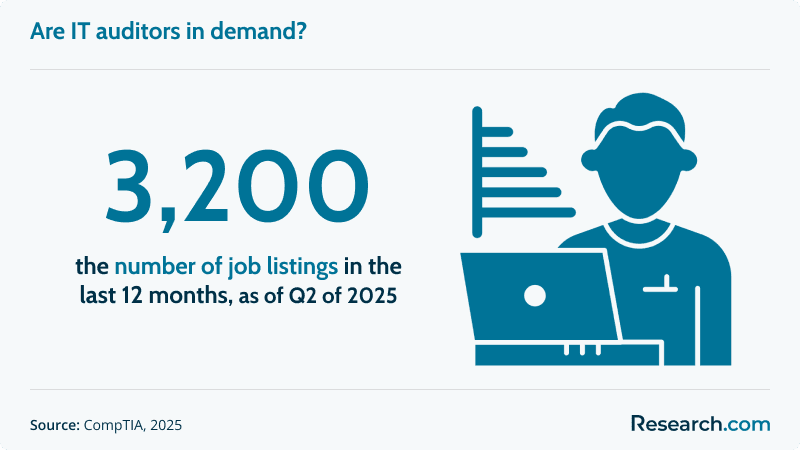
The high demand for these skills—evidenced by over 3,200 job listings in the last year alone—means professionals with adjacent experience may have a realistic path into IT audit if they can demonstrate the right mix of technical awareness, audit discipline, and business judgment.
What career paths can an IT auditor pursue?
IT audit can lead to several career directions because the role provides exposure to business operations, technology systems, cybersecurity, governance, compliance, and executive priorities. Used strategically, it can be a launchpad into audit leadership, risk management, cybersecurity advisory, consulting, or technology governance.
The traditional audit career ladder
The most direct path is advancement within the audit function. A professional may move from IT Auditor to Senior IT Auditor, then to IT Audit Manager, Director, and potentially Chief Audit Executive (CAE). This path suits people who enjoy assurance work, stakeholder management, audit committee reporting, and enterprise risk oversight.
Technology risk and GRC roles
Many IT auditors move into IT risk management, enterprise risk, third-party risk, privacy, compliance, or governance, risk, and compliance roles. These positions often focus on designing, improving, and monitoring controls rather than independently testing them.
Cybersecurity and consulting roles
IT audit experience can also support a move into cybersecurity advisory, control assessment, security governance, or consulting. Some professionals become a Cybersecurity Consultant, especially if they develop deeper technical security skills and client-facing experience.
Leadership and executive pathways
Because IT auditors learn how technology affects finance, operations, compliance, and strategy, the role can support long-term movement into leadership. Professionals targeting roles such as Chief Information Officer may benefit from advanced business and technology education, including an MBA in information technology management.
Targeting high-value industries
Industry choice can influence both compensation and specialization. Highly regulated or technology-dependent sectors often need strong audit, risk, and cybersecurity oversight. These environments can be demanding, but they may offer more complex work, stronger career development, and higher earning potential.
The chart below shows some of the most profitable industries for auditors.
Is a career in IT auditing right for you?
A career in IT auditing may be a strong fit if you enjoy investigating how systems work, asking precise questions, analyzing evidence, and explaining risk to people who make decisions. It suits people who are curious, ethical, detail-oriented, and comfortable working with both technical teams and business leaders.
You may enjoy IT auditing if you:
- Like solving problems that involve both systems and people.
- Can remain objective when stakeholders disagree with your findings.
- Enjoy writing clear explanations, not just performing technical analysis.
- Are willing to keep learning as technology and cyber risks change.
- Want a career that exposes you to many parts of an organization.
You may find the role frustrating if you:
- Prefer building systems rather than reviewing, testing, or evaluating them.
- Dislike documentation, evidence collection, and formal reporting.
- Are uncomfortable challenging managers or asking detailed follow-up questions.
- Want work that is purely technical with little stakeholder interaction.
- Do not enjoy regulatory, compliance, or control-focused environments.
The financial rewards
The profession offers meaningful earning potential, with an average salary of approximately $108,997 per year and a typical range between $68,378 and $173,745. Those earnings reflect the importance of the work: organizations need professionals who can validate that critical technology is secure, reliable, and properly controlled.
For the right person, IT auditing can be stable, intellectually engaging, and flexible enough to support multiple long-term career paths. The trade-off is that the role requires continuous learning, disciplined documentation, and the confidence to report findings that may be uncomfortable but necessary.
Here’s What IT Auditors Have To Say About What They Do
- : "The biggest surprise for me was how much you learn about the entire business. You aren't stuck in one department; you get to see how technology impacts everything from finance to marketing. This "big picture" view is incredible for career growth. I feel like I have so many more options for my future now than I ever did before. —Benedict"
- : "What surprised me most coming out of college is the level of trust you're given in this role. Within my first year, I was auditing major systems that the entire company depends on. Knowing that my findings help keep our data and our customers safe gives me a huge sense of responsibility and purpose, which is more than I ever expected from a first job. —Rick"
- : "Every time I see a headline about another company getting hacked, it reinforces why my job matters. I’m on the front lines, helping to make sure that doesn't happen to us. That sense of being in an essential, future-proof career provides a level of stability that’s hard to find anywhere else. —Oliver"
Key Findings
- IT auditors evaluate technology systems, controls, security practices, and compliance evidence to help organizations manage digital risk.
- The role combines technical knowledge with business judgment, writing, interviewing, evidence testing, and stakeholder communication.
- The average salary for an IT auditor is approximately $108,997 per year, with a typical range between $68,378 and $173,745.
- The job outlook is strong, with a projected 16,100 new job openings between 2025 and 2030.
- CISA is the most directly relevant certification for IT audit, while CISSP and CISM can support cybersecurity-focused or management-oriented career paths.
- Common entry paths include information systems, accounting, computer science, finance, IT support, internal audit, cybersecurity, compliance, and business analysis.
- IT audit can lead to senior audit roles, IT risk management, GRC, cybersecurity consulting, governance leadership, and executive technology positions.
- The career is best suited to people who are analytical, objective, detail-oriented, ethical, and comfortable translating technical issues into business risk.
Other Things You Should Know About What an IT Auditor Does
In 2027, AI is expected to significantly enhance the IT audit profession by automating routine tasks, improving accuracy in data analysis, and allowing auditors to focus on more strategic, risk-based assessments. This transformation will require auditors to develop new skills in data analytics and AI tools.
The amount of travel for an IT auditor depends heavily on the role. Auditors working in consulting or for large, global corporations may travel frequently to different client sites or company offices. Conversely, a role at a smaller, single-location company might involve very little travel. Job descriptions will usually specify the expected travel percentage.
References
- CompTIA. (2025). IT auditor. Retrieved November 3, 2025, from CompTIA.
- Indeed. (2025). IT auditor salary in United States. Retrieved November 3, 2025, from Indeed.
- International Audit Foundation. (2023, October 10). IT auditors identify cyber risks, data privacy and talent shortages among the biggest technology challenges companies Face. Retrieved November 3, 2025, from International Audit Foundation.
- U.S. Bureau of Labor Statistics. (2025). Accountants and auditors. Occupational Outlook Handbook. Retrieved November 3, 2025, from BLS.


