
2027 How to Become a Fitness Trainer: Education, Salary, and Job Outlook

Co-Founder and Chief Data Scientist
Becoming a fitness trainer is a career decision that combines coaching, exercise science, client service, and business development. The work can be rewarding, but it is not simply about enjoying workouts or spending time in a gym. Trainers assess client goals, design safe exercise plans, teach proper technique, track progress, and help people stay consistent when motivation drops.
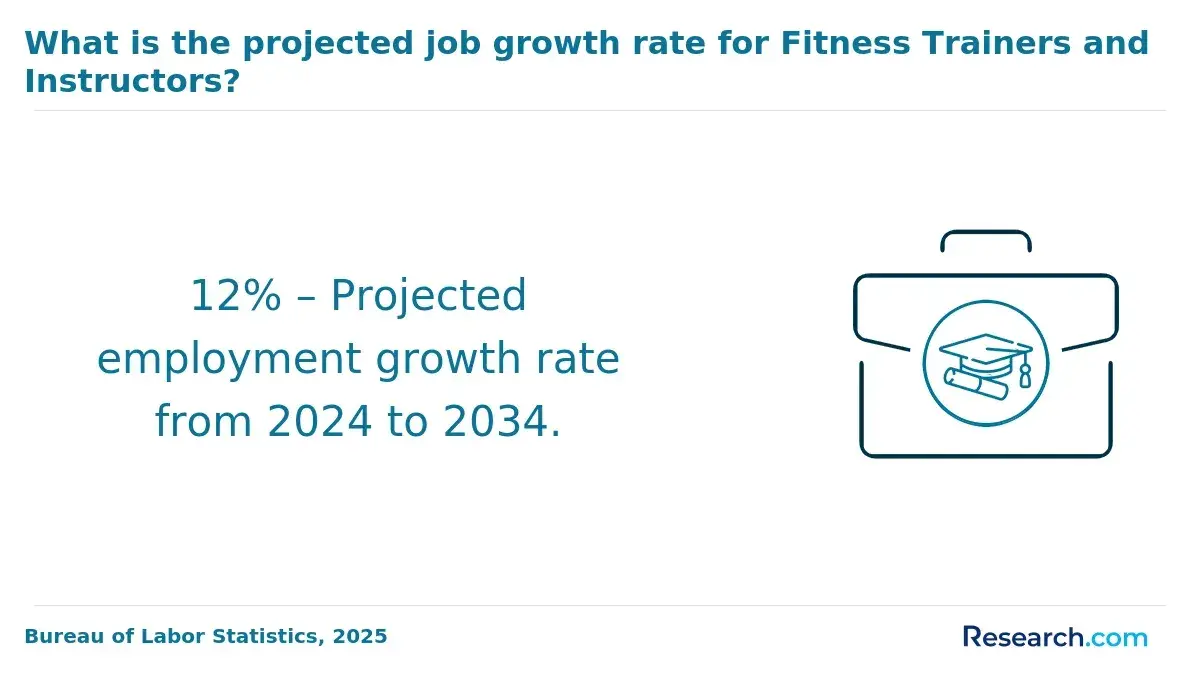
This guide is for students, career changers, athletes, wellness professionals, and anyone considering personal training as a full-time job, part-time role, or stepping stone into health and fitness. Demand for fitness support has been shaped by greater interest in preventive health, workplace wellness, virtual coaching, and personalized exercise programs. An estimated 10% job growth projected through 2025 reflects that broader shift.
Below, you will learn what credentials are typically required, which skills matter most, where fitness trainers work, how earnings vary, what challenges to expect, and how to decide whether this profession fits your personality, lifestyle, and long-term goals.
What are the benefits of becoming a fitness trainer?
- Employment for fitness trainers is projected to grow 15% by 2025, faster than average, reflecting rising health awareness and demand for personalized training.
- The median annual salary is approximately $40,510, with top earners exceeding $75,000, highlighting opportunities for financial growth in specialized roles.
- Choosing this career challenges traditional job stability notions, offering dynamic work environments and direct impact on clients' wellness and lifestyles.
What credentials do you need to become a fitness trainer?
Most fitness trainer roles do not require a college degree, but they do require credible proof that you can train clients safely. In the United States, the usual entry point is a high school diploma or GED, current emergency-response training, and a nationally recognized personal training certification. Employers may set additional requirements depending on the setting, especially in sports performance, rehabilitation-adjacent roles, or corporate wellness.
The most important credential is a certification from a reputable organization that tests exercise science, client assessment, program design, safety, and professional practice. A degree can strengthen your resume, but certification is usually the practical gatekeeper for entry-level personal training jobs.
- High school diploma or GED: Major certifying bodies such as ACSM, NASM, and NSCA commonly require this as the minimum education level before you can pursue certification.
- CPR and AED certification: Current CPR and AED certification for personal trainers is typically required before sitting for certification exams. This matters because trainers may be the first person responding to a medical emergency during exercise.
- National certification: A recognized certification shows employers and clients that you understand movement, training principles, safety, and basic client management. It is one of the core fitness trainer certification requirements in the United States.
- Bachelor's degree, when useful: A degree in exercise science, kinesiology, or a related field is optional for many personal training jobs, but it can help if you want to work in sports performance, strength and conditioning, wellness management, or roles that prefer advanced academic preparation.
- Continuing education: Most certifications require renewal every 1-2 years. Continuing education helps trainers stay current, avoid outdated methods, and maintain professional credibility.
If you want a faster academic pathway that can support certification preparation, a program such as a top online associate degree in 6 months may be worth comparing with standalone certification options.
What skills do you need to have as a fitness trainer?
A strong fitness trainer needs both technical competence and coaching ability. Clients do not only pay for a list of exercises; they pay for safe instruction, accountability, motivation, and a plan that fits their goals, limitations, schedule, and experience level.
The best trainers combine exercise knowledge with communication, observation, and judgment. They know when to progress a client, when to slow down, when to refer someone to a qualified healthcare professional, and how to keep a client engaged without making unrealistic promises.
- Anatomy: Trainers need a working understanding of muscles, joints, movement patterns, and common limitations so they can choose exercises that fit each client's body and goals.
- Exercise programming: Effective programming includes goal setting, exercise selection, progression, recovery, and modifications. A beginner seeking general fitness needs a different plan from an athlete, older adult, or client returning after time away from exercise.
- Nutrition guidance: Trainers may discuss general, research-informed nutrition habits that support energy, recovery, and consistency. They should not prescribe medical diets or treat nutrition-related conditions unless they hold the appropriate professional license or credential.
- Equipment mastery: Clients need clear demonstrations and safety cues for free weights, machines, resistance bands, cardio equipment, suspension trainers, and fitness technology. Poor instruction can increase injury risk and damage trust.
- Stretching and injury prevention: Trainers should understand warmups, mobility work, flexibility methods, recovery basics, and when discomfort may signal a problem that needs referral.
- Active listening and communication: Good coaching starts with understanding what a client says and what they may not say directly. Body language, hesitation, fatigue, and frustration all provide useful information.
- Adaptability and problem-solving: Sessions rarely go exactly as planned. A client may arrive tired, sore, stressed, or short on time. Trainers need backup options that still move the client toward the goal.
- Empathy and emotional intelligence: Many clients feel vulnerable about their bodies, fitness level, or health history. A trainer who is respectful, patient, and encouraging is more likely to retain clients and help them make lasting changes.
What is the typical career progression for a fitness trainer?
A fitness training career is not a single straight ladder. Some trainers move into management, some specialize, some build independent businesses, and others use training as a foundation for careers in wellness, coaching, athletics, or health education. The best path depends on your income goals, preferred work environment, risk tolerance, and interest in entrepreneurship.
Many trainers begin by learning the floor, building confidence with clients, and developing a reputation for reliability. Over time, career growth usually comes from specialization, client retention, leadership, or ownership.
- Fitness floor staff or junior personal trainer: New trainers often start by supervising equipment areas, assisting members, teaching basic technique, and learning how a facility operates. This stage builds confidence and practical communication skills.
- Personal trainer: Trainers then take on more responsibility for assessments, customized workouts, progress tracking, and client relationships. This is also when many begin building a stable book of clients.
- Specialized trainer: With experience, trainers may focus on areas such as strength training, weight management, older adult fitness, corrective exercise, group training, youth fitness, or sports performance. Specialized certifications can help clarify expertise.
- Senior trainer, fitness manager, or program director: These roles involve mentoring staff, overseeing programming, managing schedules, improving member experience, and supporting business operations.
- Entrepreneur or online coach: Experienced trainers may open studios, run mobile training businesses, sell online coaching packages, or create hybrid services that combine in-person and digital support.
- Adjacent career paths: Some trainers move into corporate wellness, group fitness, fitness education, digital content, equipment sales, or wellness program coordination.
The practical takeaway is simple: early success depends on coaching quality and dependability, while long-term growth depends on positioning. Trainers who define a niche and build strong client outcomes usually have more room to advance.
How much can you earn as a fitness trainer?
Fitness trainer pay varies widely because compensation depends on location, employer type, certification status, experience, schedule, client retention, and whether the trainer works for a facility or independently. Hourly rates can look attractive, but trainers should also consider unpaid time spent on sales, programming, travel, marketing, cancellations, and continuing education.
Average personal trainer salary in the US sits between $23.96 and $28.85 per hour in 2025, while reported real earnings extend from $14.99 up to $55.55 hourly. That range shows why a single average does not fully describe the profession.
Experience helps, but income growth is not always automatic. Entry-level trainers with less than a year's experience earn about $18.42 per hour, rising to $20.61 for those with 1-4 years. Senior trainers can command as high as $49.74 hourly or $116,116 annually, especially when they combine expertise, strong retention, premium services, or leadership responsibilities.
Certification can also affect earning potential. Certified professionals average $62,840 yearly, with top earners reaching $68,486. This does not mean a certification guarantees high income, but it can improve credibility with employers and clients. If you are comparing credentials for advancement, reviewing certifications online that pay well can help you evaluate return on investment.
Location is another major factor. The fitness trainer salary in California aligns with top urban markets, while cities like Chicago report $38.26 per hour. Washington D.C. and New York also show how dense urban markets can support higher pay for experienced trainers. In contrast, states such as New Mexico and Kentucky earn 10-15% less than the national average.
To estimate your realistic income, look beyond the hourly number. Ask how many paid sessions you can consistently book each week, whether the employer provides leads, how cancellations are handled, whether benefits are included, and how much time you will spend on unpaid client preparation or marketing.
What internships can you apply for to gain experience as a fitness trainer?
Internships can help aspiring fitness trainers turn certification knowledge into practical skill. The best internship is not always the one at the most recognizable gym; it is the one that gives you supervised practice with real clients, clear feedback, and exposure to the type of work you may want after certification.
When comparing internships for aspiring fitness trainers, pay attention to the setting, population served, mentorship quality, and whether you will observe only or actively assist with assessments, programming, coaching, and client communication.
- Corporate wellness programs: These internships expose you to employee health initiatives, group facilitation, wellness challenges, and coaching for busy professionals. They are useful if you are interested in workplace wellness or preventive health.
- Nonprofits and community centers: Programs such as the Timpany Center at San Jose State University can introduce interns to adapted physical activity and recreation. These settings may involve older adults, individuals with disabilities, and clients who need thoughtful modifications.
- Healthcare providers and rehabilitation facilities: Internships such as COR's Physical Therapy & Personal Training Internship can help students observe assessment, communication, exercise prescription, and safe progression in a more clinical or rehabilitation-adjacent environment.
- Schools and youth organizations: These placements help interns learn how to design age-appropriate activities, keep younger participants engaged, and support healthy movement habits for children and teens.
- Industry-specific organizations: Equipment manufacturers, boutique studios, and fitness businesses can teach interns about customer experience, marketing, sales, programming, and member retention.
Strong personal training internships in the US should help you build confidence in coaching, not just add a line to your resume. Before accepting a placement, ask who will supervise you, what tasks you will perform, whether liability coverage is addressed, and how performance feedback is delivered.
For those who later want advanced academic options beyond entry-level training, pathways such as doctorate degrees without dissertation may be relevant depending on long-term career goals.
How can you advance your career as a fitness trainer?
Career advancement as a fitness trainer usually comes from one of four moves: becoming more specialized, serving higher-value clients, taking on leadership responsibilities, or building an independent brand or business. Simply working more sessions can increase income temporarily, but it can also lead to burnout if you do not improve your systems, pricing, or professional positioning.
To move forward, focus on skills and credentials that match a clear market need rather than collecting random certificates.
- Continue education strategically: Advanced certifications and specialized courses can help you work with specific populations or goals, such as strength training, older adult fitness, corrective exercise, group coaching, or performance training.
- Use technology well: Wearables, virtual coaching tools, workout apps, and client-tracking platforms can improve accountability and help you serve clients outside traditional gym hours.
- Build a professional digital presence: A clear online profile, educational content, client testimonials where appropriate, and simple booking systems can make it easier for potential clients to understand what you offer.
- Network with related professionals: Relationships with physical therapists, dietitians, physicians, massage therapists, coaches, and wellness managers can lead to referrals and better client support. Stay within your scope of practice when collaborating.
- Seek mentorship: Experienced trainers can help you avoid common mistakes in pricing, programming, client boundaries, and career planning.
- Develop business skills: Sales, retention, scheduling, budgeting, marketing, and customer service are essential if you want to work independently or move into management.
A practical advancement plan should answer three questions: Who do you want to serve, what problem can you solve better than a generalist, and what proof can you show that your coaching works?
Where can you work as a fitness trainer?
Fitness trainers can work in far more places than traditional gyms. Your work setting affects your schedule, income model, client population, career stability, and daily responsibilities. A commercial gym may offer a steady stream of potential clients, while independent coaching may offer more flexibility but require stronger marketing and business skills.
- Health clubs and gyms: Facilities such as LA Fitness, Equinox, and Anytime Fitness offer personal training, group training, and member support. These environments are common entry points because they provide equipment, leads, and an established client base.
- Boutique studios: Studios such as SoulCycle, Pure Barre, and CorePower Yoga focus on specific formats or training styles. Trainers in these settings often need strong group instruction, brand consistency, and a polished client experience.
- Corporate wellness programs: Companies such as Google, Apple, and Goldman Sachs, along with government agencies, may use trainers for on-site or virtual fitness classes, wellness events, and employee health initiatives.
- Healthcare systems: Organizations such as Kaiser Permanente and the Mayo Clinic may integrate fitness professionals into wellness, rehabilitation-adjacent, or chronic disease management programs. These roles may require stronger documentation, collaboration, and scope-of-practice awareness.
- Educational institutions: Schools, colleges, and universities may employ trainers as athletic coaches, recreation staff, wellness coordinators, or fitness center professionals for students and employees.
- Digital platforms and mobile apps: Services such as Peloton, Mirror, and Trainerize allow trainers to deliver remote coaching, video workouts, habit tracking, or hybrid programs that combine online and in-person support.
For those planning an education route into the field, comparing colleges online that accept FAFSA can help identify flexible options that may fit work and training schedules.
The right workplace depends on whether you want structure, autonomy, specialized clients, predictable hours, or entrepreneurial upside. New trainers often benefit from starting in a supervised environment before moving into independent or hybrid models.
What challenges will you encounter as a fitness trainer?
Fitness training can be meaningful work, but new trainers should understand the difficult parts before investing time and money. The job often combines coaching, sales, scheduling, customer service, physical stamina, and emotional support. Certification is only the starting point.
- Unusual work hours: Many clients train before work, after work, or on weekends. Early mornings and evenings are common, especially when building a client base.
- Income instability: The average hourly rate of $27 and an annual salary around $58,000 may not reflect the early months of finding clients, dealing with cancellations, or working part-time hours.
- Client acquisition pressure: Some employers expect trainers to sell packages, renew clients, and generate leads. Trainers who dislike sales may find this part of the job stressful.
- Online coaching competition: Digital training can expand your reach, but it is crowded. Success requires clear positioning, reliable systems, content skills, and client accountability methods.
- Regulatory ambiguity: There is no single federal licensing system for personal trainers. Credibility often depends on voluntary certifications, employer standards, state rules, and careful adherence to scope of practice.
- Expanding client expectations: Clients may expect guidance on nutrition, mental health, sleep, recovery, and lifestyle change. Trainers should provide general support where qualified and refer out when the issue requires a licensed professional.
- Continuous education commitment: Staying effective requires ongoing learning in exercise science, coaching, technology, behavior change, and safety. This requires time and money beyond the initial certification.
The trainers who last tend to treat these challenges as business realities rather than surprises. They set boundaries, track finances, maintain professional standards, and keep improving their coaching process.
What tips do you need to know to excel as a fitness trainer?
Excellent trainers are not just exercise demonstrators. They are coaches who make clients feel understood, capable, and accountable. Technical knowledge matters, but client results often depend on consistency, trust, communication, and realistic planning.
- Coach the person, not just the program: Start with the client's goals, fitness history, schedule, preferences, injuries, confidence level, and barriers. Avoid using the same template for everyone.
- Set measurable and realistic goals: Clear goals help clients see progress and prevent frustration. Break large goals into smaller milestones that can be reviewed regularly.
- Track more than weight or strength: Monitor adherence, energy, sleep quality, confidence, mobility, pain signals, mood, and motivation when relevant. These indicators can show whether the plan is sustainable.
- Communicate clearly and respectfully: Explain why an exercise is included, what proper form feels like, and how the client should adjust effort. Avoid jargon when simple language works better.
- Build trust through consistency: Be punctual, prepared, professional, and honest. Clients notice whether you remember their goals, follow up, and adjust sessions thoughtfully.
- Create accountability without shame: Clients may miss sessions, struggle with habits, or lose motivation. Supportive problem-solving usually works better than criticism.
- Encourage community where appropriate: Small groups, challenges, and peer support can improve retention and referrals when they are well managed.
- Keep learning: Update your knowledge in nutrition basics, behavioral science, recovery, strength training, mobility, and coaching technologies. Avoid relying on trends that are not supported by sound practice.
The strongest trainers combine professionalism with genuine care. They help clients build confidence, not dependence.
How do you know if becoming a fitness trainer is the right career choice for you?
Becoming a fitness trainer may be a good fit if you enjoy helping people change habits, can communicate with patience, and are comfortable with a schedule that may not look like a traditional office job. Loving fitness is helpful, but it is not enough. You also need to enjoy coaching people through slow progress, setbacks, and different levels of motivation.
Use the factors below to assess whether the career matches your strengths and expectations.
- Personality and communication: You should be comfortable working closely with people, giving feedback, listening carefully, and motivating clients without being judgmental.
- Work style preferences: Fitness trainers often work flexible but nontraditional hours, including evenings and weekends. If you need a predictable 9-to-5 schedule, this may be challenging.
- Income variability: Pay can fluctuate, especially early in your career. Income may range from $14 to $36 per hour depending on experience and location, so budgeting and client-building skills matter.
- Interest in continuous learning: You will need to keep up with exercise science, safety standards, coaching methods, and professional boundaries.
- Comfort with sales and retention: Many roles require trainers to attract clients, renew packages, and build relationships that support long-term business.
- Alignment with lifestyle and values: If you enjoy teaching, public speaking, teamwork, coaching, and watching people gain confidence, the work may feel meaningful.
If you are balancing work, family, and education while preparing for this field, researching low cost online colleges for working students can help you compare flexible learning options.
A good next step is to shadow a trainer, interview professionals in different settings, and try coaching under supervision before committing fully. Seeing the daily work will give you a clearer answer than job descriptions alone.
What Professionals Who Work as a Fitness Trainer Say About Their Careers
- Apollo: "Becoming a fitness trainer has given me incredible job stability and a reliable income. With gyms and wellness centers always in demand, I feel secure in my career choice, and the potential to increase my salary through certifications is a huge bonus. I'm grateful for the financial freedom this profession has provided."
- Yael: "The fitness industry is constantly evolving, which keeps my work exciting and challenging. Every client brings unique goals and obstacles, pushing me to stay creative and adaptive. It's rewarding to grow alongside the industry and face each day with enthusiasm."
- Emiliano: "As a fitness trainer, I've found ample opportunities for professional growth, from advanced training programs to leadership roles within wellness organizations. The continuous learning and career advancement paths have truly broadened my horizons and kept me motivated throughout. This profession offers more than just a job-it's a lifelong journey of development."
Other Things You Should Know About Becoming a Fitness Trainer
To become a fitness trainer in 2027, a high school diploma or GED is typically required. Many employers prefer candidates with certifications from recognized organizations, such as NASM or ACE. Some trainers pursue a degree in exercise science or a related field to enhance career prospects.
The licensing requirements for fitness trainers vary by state and locality, but most areas do not mandate formal licensure. Instead, clients and employers typically look for trainers with recognized certifications from accredited organizations. However, some jurisdictions require trainers to hold certifications in CPR and first aid as a minimum standard.
To succeed in 2027, fitness trainers need strong communication skills, knowledge of exercise science, the ability to motivate clients, and adaptability. Additionally, an understanding of digital fitness tools and business acumen will be increasingly important as virtual training and entrepreneurship continue to grow in popularity.
References
- Should I Become a Personal Trainer? 12 Reasons https://www.origym.co.uk/blog/should-i-become-a-personal-trainer/
- Top 8 Fitness Certifications That Can Make You A Successful Fitness Instructor! - Kenko https://www.gokenko.com/articles/8-fitness-certifications-for-instructors
- Career Development Strategies for PT's • Fitness Business Blog https://www.trainerize.com/blog/career-development-strategies/
- How to Become a Personal Trainer | ACE https://www.acefitness.org/fitness-certifications/personal-trainer-certification/how-to-become-a-personal-trainer.aspx
- Benefits of Becoming a Certified Personal Trainer | NASM https://www.nasm.org/resource-center/blog/benefits-of-becoming-a-certified-personal-trainer
- 7 Things You Should Know Before Working as a Personal Trainer | Academy Of Fitness https://aof.edu.au/7-things-you-should-know-before-working-as-a-personal-trainer/
- How To Become a Personal Trainer Online https://www.afpafitness.com/blog/becoming-a-personal-trainer/
- Online ACE Personal Trainer with Fitness and Health Internship from The University of Texas at El Paso https://careertraining.utep.edu/training-programs/ace-personal-trainer-with-fitness-health-internship/
- NSCA-CPT | NSCA-Certified Personal Trainer https://www.nsca.com/certification/nsca-cpt/
- What Skills Are Needed to Be a Personal Trainer? | ISSA https://www.issaonline.com/blog/post/what-skills-are-needed-to-be-a-personal-trainer


