
2027 Nursing MSN/MBA Careers: Skills, Education, Salary & Job Outlook

Co-Founder and Chief Data Scientist
Choosing a Nursing MSN/MBA career is not just a question of earning two graduate credentials. It is a decision to move from primarily clinical practice into roles where patient care, staffing, finance, compliance, quality improvement, and organizational strategy intersect. This path is best suited for registered nurses who want broader influence than bedside or unit-level practice alone can provide.
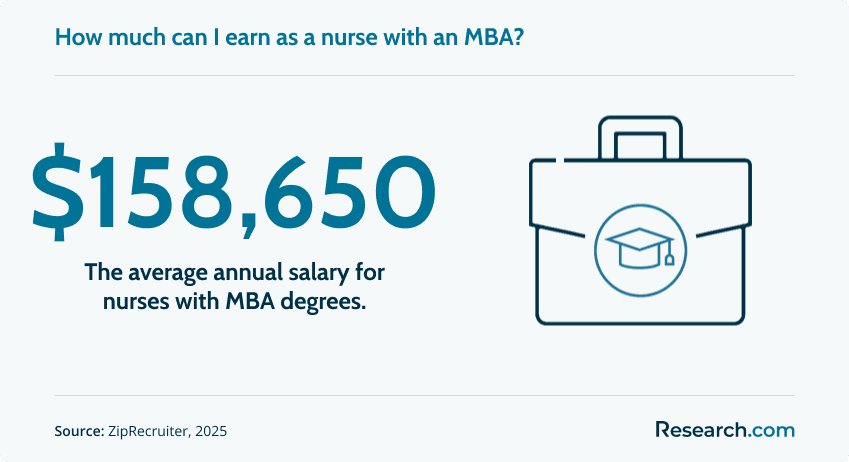
The appeal is clear: Nursing MSN/MBA careers can lead to senior healthcare leadership roles, salary benchmarks around $158,650 annually, and job growth cited at 35%. The trade-off is that these roles require comfort with high-stakes decisions, competing priorities, and accountability for both care outcomes and business performance.
This guide explains what Nursing MSN/MBA graduates do, the skills and credentials employers look for, how much graduates can earn, where the strongest opportunities are, and how to decide whether this demanding but versatile career path fits your goals.
Key Things You Should Know About Nursing MSN/MBA Career
- Nursing MSN/MBA graduates typically earn around $158,650 annually, with most salaries ranging between $127,500 and $192,000 depending on experience and role, while MSN-only nurses generally earn about $102,000.
- This field has a strong and growing demand, with advanced practice registered nurse positions expected to grow by 26% over the next decade, well above the average for all occupations.
- Starting a career in this area requires a Master of Science in Nursing plus a Master of Business Administration, usually obtained sequentially or through a dual-degree program, along with an active RN license and clinical experience.
- Success depends on healthcare leadership, strategic planning, financial management, clinical expertise, communication, problem-solving, adaptability, and valuable technical skills in informatics, policy, and administration.
- Career growth often begins with clinical nurse leader or nurse manager roles, advancing to director-level positions such as director of nursing or chief nursing officer, and can extend to executive roles like vice president of patient services or hospital CEO.
What do Nursing MSN/MBA Graduate do?
Nursing MSN/MBA graduates work at the intersection of clinical leadership and healthcare business management. They use nursing expertise to understand patient care realities and business training to manage budgets, staffing models, operations, strategy, and organizational change.
Unlike nurses whose work is centered on direct patient care, MSN/MBA graduates often influence care through systems-level decisions. They may lead nursing departments, manage service lines, direct quality improvement programs, oversee clinical operations, or move into executive roles within hospitals, healthcare systems, ambulatory care organizations, consulting firms, insurers, or health technology companies.
What this role looks like in practice
A typical day may include reviewing performance dashboards, meeting with nurse managers, analyzing staffing costs, addressing compliance issues, planning quality initiatives, coordinating with finance or IT teams, and presenting recommendations to senior leaders. The work is usually collaborative and decision-heavy. Success depends on translating clinical realities into operational plans that executives, frontline staff, and patients can trust.
The main value of the MSN/MBA combination is credibility across both sides of healthcare: clinical teams know the leader understands patient care, while administrators know the leader can speak the language of finance, strategy, and organizational performance.
What are the key responsibilities of Nursing MSN/MBA Graduate?
Nursing MSN/MBA graduates are typically responsible for improving how healthcare organizations deliver care, use resources, manage people, and meet regulatory expectations. Their responsibilities vary by employer and title, but most roles combine leadership, operations, finance, quality, and risk management.
- Oversee daily operations for healthcare facilities, nursing departments, or clinical service lines, including staffing, scheduling, resource allocation, workflow design, and patient care delivery.
- Develop and implement quality management systems, process improvement initiatives, and multi-campus programs that support safer, more consistent care.
- Manage fiscal operations such as budgeting, cost control, employee retention strategies, and resource planning to support financial performance without weakening care standards.
- Identify, investigate, and correct legal, operational, documentation, and compliance problems that could affect patient safety or organizational risk.
- Coordinate administrative work across IT, billing, medical records, and clinical departments to improve data accuracy, reporting, cost control, and process efficiency.
- Lead, mentor, and evaluate clinical staff, including RNs, LPNs, and other healthcare professionals, while aligning teams around organizational priorities.
The hardest part of the job
The most difficult responsibility is often balancing financial constraints with patient care needs. MSN/MBA leaders may need to make staffing, technology, or process decisions that affect both the budget and the bedside. These choices require strong judgment, transparent communication, and the ability to defend decisions with data.
The most rewarding part of the job
The strongest reward is seeing a leadership decision improve care at scale. A better staffing model, safer handoff process, stronger documentation system, or successful quality initiative can affect thousands of patients and make work more manageable for nursing teams. For nurses who want broader impact, this system-level influence is a major reason to pursue the field.
If you are still comparing educational paths, it can help to review how this graduate route fits into broader planning around the best college degree to get for your long-term goals.
What are the key skills for Nursing MSN/MBA Graduate?
Nursing MSN/MBA graduates need more than clinical experience and management theory. Employers look for leaders who can interpret data, manage budgets, guide teams through change, communicate with executives, and keep patient outcomes central to business decisions.
Hard skills
- Evidence-based decision making: Use research, clinical outcomes, and operational data to revise care policies, improve protocols, and support safer patient care.
- Healthcare financial management: Build budgets, monitor expenses, evaluate cost-effectiveness, and make resource decisions that protect both quality and sustainability.
- Nursing informatics: Work with electronic health records, reporting tools, health information systems, and data workflows that support documentation, compliance, and clinical decision-making.
- Strategic planning: Set long-term goals, define measurable initiatives, lead cross-functional teams, and align nursing priorities with organizational strategy.
Soft skills
- Critical thinking: Evaluate complex clinical, operational, and financial information before recommending a practical course of action.
- Leadership: Motivate teams, develop staff, hold people accountable, and create a work environment where nurses can perform well.
- Communication: Explain complex issues clearly to clinicians, administrators, executives, patients, and community stakeholders.
- Complex problem solving: Balance patient needs, workforce limits, regulatory requirements, budgets, and organizational politics when making decisions.
The overlooked skill that separates strong candidates
Change management is often the skill that distinguishes effective MSN/MBA graduates from those who struggle. Healthcare organizations constantly adopt new technologies, payment models, compliance requirements, staffing approaches, and care delivery processes. A leader who cannot manage resistance, uncertainty, and communication gaps may have good ideas that never become sustainable improvements.
For example, during an electronic health record rollout, strong change management can reduce staff frustration, prevent documentation errors, and keep workflows from breaking down. The technical system matters, but the leadership strategy behind adoption often determines whether the project succeeds.
Professionals building these skills may also compare related learning options, including top college degrees for seniors online, if they are returning to school or planning a later-career transition.
Nursing MSN/MBA Careers: A Step-by-Step Guide to Getting Started
The path to an MSN/MBA nursing career is usually sequential: first build a nursing foundation, then gain clinical credibility, then add graduate-level leadership and business preparation. Skipping the experience-building stage can make the transition into management harder, even with strong academic credentials.
- Complete foundational nursing education. Start with the nursing education required for RN licensure and future graduate admission.
- Gain clinical experience. Work in nursing roles long enough to understand staffing, patient flow, interdisciplinary communication, safety issues, and frontline operational challenges.
- Maintain professional licensure. Hold the required RN license and keep it active and unrestricted according to your state board of nursing requirements.
- Pursue the dual MSN/MBA. Choose a program that integrates advanced nursing leadership with finance, strategy, operations, organizational behavior, and healthcare administration.
- Use practicums and leadership experiences strategically. Select placements, projects, or residencies that match your target role, such as nurse administration, quality improvement, informatics, operations, or executive leadership.
Before enrolling, compare programs carefully. Look at accreditation, clinical or practicum requirements, faculty experience, online or hybrid format, tuition, employer partnerships, and whether the curriculum matches your desired career path. A program focused on nurse administration may feel different from one designed for broader healthcare executive leadership.
What education, training, or certifications are required?
A typical Nursing MSN/MBA career begins with a Bachelor of Science in Nursing (BSN) from a regionally and nationally accredited program. The BSN is commonly required for admission to a dual MSN/MBA program, which combines graduate nursing leadership coursework with business management training.
Candidates must also hold an active, unrestricted Registered Nurse (RN) license issued by their state board of nursing. Most programs expect 1-2 years of professional nursing work experience before admission, because leadership coursework is more useful when students can connect it to real clinical and operational challenges.
Basic Life Support (BLS), often through the American Heart Association or Red Cross, is a common clinical requirement. Graduate programs may also include practicums, residencies, capstone projects, or supervised leadership experiences that allow students to apply business and nursing concepts in healthcare settings.
Are advanced degrees or niche certifications worth it?
Additional credentials can be valuable, but they should match a specific career goal. A Doctor of Nursing Practice (DNP) may make sense for nurses pursuing the highest levels of clinical leadership, systems improvement, or executive practice. Specialty credentials such as the Nurse Executive, Advanced Certification (NEA-BC) may strengthen a candidate's profile for senior nursing administration roles.
The investment is not automatic. Tuition, time away from work, certification maintenance, and licensing requirements all matter. Before adding another credential, ask whether it is preferred or required for your target role, whether your employer offers tuition support, and whether the credential will help you compete for promotion within your region or specialty.
If you are still early in your education planning, reviewing options such as a fast online associates degree can help you understand how different entry points may fit into a longer nursing and leadership pathway.
What is the earning potential for Nursing MSN/MBA Graduate?
The earning potential for Nursing MSN/MBA graduates is strong because the degree combination prepares nurses for leadership roles that affect staffing, budgets, operations, quality, and organizational strategy. Pay depends heavily on role, employer type, location, years of experience, and the scope of responsibility.
The median Nursing MSN/MBA Salary stands at $158,650 annually. Entry-level positions start at about $127,500, while senior-level salaries can rise to $192,000. These figures are best viewed as benchmarks rather than guarantees. A nurse manager in a smaller facility may earn less than an executive leader in a large health system, even if both hold the same degrees.
What affects compensation most?
- Role level: Director, administrator, chief nursing officer, and executive positions generally pay more than first-line management roles.
- Employer setting: Large hospitals, private-sector healthcare organizations, consulting firms, and system-level roles may offer higher compensation than smaller facilities.
- Location: Urban and high-cost-of-living areas often pay more, though expenses may also be higher.
- Experience: Prior leadership, budgeting responsibility, quality improvement results, and operational achievements can increase market value.
- Specialization: Informatics, finance, quality improvement, operations, and executive leadership can each shape salary potential differently.
When evaluating an offer, look beyond base salary. Bonus eligibility, retirement contributions, tuition support, relocation benefits, schedule expectations, and on-call responsibilities can change the real value of a position.
What is the job outlook for Nursing MSN/MBA Graduate?
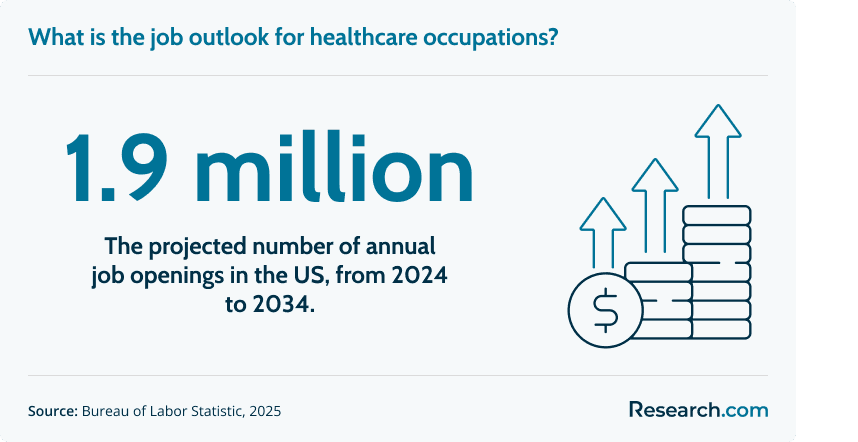
The job outlook for Nursing MSN/MBA graduates is strong, with a projected growth rate of 28% from 2022 to 2032. That rate is far above the typical 3-5% growth expected across most occupations and reflects continued demand for healthcare leaders who understand both clinical practice and business operations.
Why demand is growing
Healthcare organizations are under pressure to deliver better outcomes while managing costs, workforce shortages, regulatory demands, technology adoption, and patient experience expectations. Leaders with both nursing and business training are well positioned to help organizations make decisions that are clinically sound and financially realistic.
Demographic change is another major driver. An aging population and the rise of chronic conditions increase demand for healthcare services, which in turn increases the need for managers who can coordinate care delivery, improve efficiency, and support staff performance.
Where graduates may find opportunity
- Hospitals and health systems that need nurse executives, operations leaders, and department directors.
- Ambulatory care organizations managing growth in outpatient and coordinated care models.
- Consulting, insurance, and health technology organizations that value clinical insight paired with business analysis.
- Quality, compliance, and informatics teams focused on measurable performance improvement.
Because program quality matters in competitive leadership hiring, prospective students should compare accredited options carefully. Reviewing the best accredited online colleges can be a useful starting point for evaluating flexible education pathways.
What is the typical work environment for Nursing MSN/MBA Graduate?
Nursing MSN/MBA graduates usually work in collaborative, meeting-intensive environments where decisions require input from clinical, financial, administrative, and technology teams. The work is rarely isolated. Even when a role includes independent analysis, implementation depends on building trust across departments.
Common workplaces include hospitals, outpatient clinics, healthcare systems, physician group practices, nursing care facilities, consulting organizations, insurers, and health technology companies. Around 33% are employed in hospitals, while 20% combined work in ambulatory healthcare services and nursing care facilities.
The typical schedule is closer to standard business hours than shift-based bedside nursing, often Monday through Friday. However, leadership roles may require early meetings, evening events, weekend coverage, emergency response, or availability during major operational issues. Some consulting, insurance, informatics, and administrative positions may offer remote or hybrid work, but many leadership roles remain onsite because they involve direct oversight of people, workflows, and patient care operations.
Team-based vs. independent work
The role is highly team-based. MSN/MBA graduates regularly interact with nurses, physicians, executives, finance leaders, HR staff, IT teams, compliance officers, and external stakeholders. Independent judgment matters, but the ability to align people around a decision is often more important than technical expertise alone.
What are the pros and cons of Nursing MSN/MBA Graduates careers?
Nursing MSN/MBA careers can be highly rewarding, but they are not the right fit for every nurse. The path suits professionals who want leadership responsibility, organizational influence, and complex problem-solving. It may be less appealing to those who prefer direct patient care, predictable duties, or minimal administrative pressure.
Pros
- Opportunity to combine clinical expertise with business strategy in ways that improve patient care and organizational performance.
- Access to leadership roles in nursing administration, healthcare management, operations, quality improvement, and executive leadership.
- Potential to influence staffing models, workplace culture, patient safety, and care delivery across entire departments or organizations.
- Strong earning potential compared with many traditional nursing roles.
- Versatility across hospitals, ambulatory care, consulting, insurance, informatics, and health system leadership.
Cons
- Frequent tension between patient care priorities and financial limitations.
- High accountability for decisions that affect staff, budgets, compliance, and patient outcomes.
- Less direct patient care, which may feel like a loss for nurses who value bedside practice.
- Possible long hours, urgent issues, difficult meetings, and decision fatigue.
- Ongoing need to stay current in healthcare policy, finance, technology, workforce trends, and leadership practices.
The best way to evaluate this path is to be honest about what energizes you. If you enjoy leading teams, solving operational problems, and influencing systems, the role can be a strong fit. If your main priority is hands-on clinical care or a more defined schedule, other healthcare or even high paying jobs with trade school paths may offer a better lifestyle match.
What are the opportunities for advancement for Nursing MSN/MBA Graduate?
An MSN/MBA can support advancement from unit-level leadership to department, system, and executive roles. Progression depends on performance, experience, organizational size, networking, and the ability to show measurable results in areas such as quality, retention, patient experience, cost control, and operational efficiency.
Common advancement pathway
- Entry-level or junior leadership: Nurse manager or healthcare manager roles focused on team supervision, scheduling, workflow, and unit performance.
- Mid-level leadership: Nurse administrator, nursing director, or clinical manager roles with broader responsibility for departments, budgets, policies, and service outcomes.
- Senior or executive leadership: Chief nursing officer (CNO), chief executive officer (CEO), chief operating officer (COO), or chief financial officer (CFO) roles guiding strategy, performance, and organizational direction.
Specialization options
- Healthcare administration and leadership: Manage facilities, departments, or service lines with responsibility for operations and strategic planning.
- Health information and data management: Focus on informatics, clinical data, reporting systems, analytics, and technology-supported care improvement.
- Policy and advocacy: Influence healthcare regulations, resource allocation, public health initiatives, and organizational policy.
- Innovation and quality improvement: Lead work in patient safety, telehealth, population health, care redesign, and performance improvement.
To advance, graduates should document outcomes, not just responsibilities. Examples include reduced turnover, improved patient satisfaction, better compliance performance, shorter wait times, stronger documentation, or measurable budget improvements. Leadership promotions are often awarded to professionals who can prove impact.
What other careers should you consider?
If an MSN/MBA appeals to you, you may also want to compare closely related healthcare leadership careers. The right choice depends on whether you prefer nursing-specific leadership, broad operations, data and technology, executive strategy, or policy influence.
- Nurse Administrator: Oversees nursing departments, staffing, policies, and clinical operations while keeping patient care quality central.
- Healthcare Manager: Manages healthcare services, teams, budgets, and operational processes across clinical or administrative settings.
- Health Information Manager: Focuses on health data, documentation systems, analytics, privacy, compliance, and reporting accuracy.
- Chief Nursing Officer (CNO) / Chief Nursing Executive (CNE): Leads nursing strategy, workforce planning, care standards, and executive-level nursing policy.
- Chief Operating Officer (COO) / Chief Executive Officer (CEO) in Healthcare: Oversees broad organizational operations, strategy, performance, and institutional growth.
When comparing these options, consider how much direct nursing identity you want in your leadership role. A CNO path keeps nursing at the center. A COO or CEO path may broaden your influence but move you further from nursing-specific work. Informatics and health information roles may suit professionals who prefer systems, data, and technology over personnel-heavy management.
Here's What Professionals Say About Their Nursing MSN/MBA Careers
- : "Balancing patient care with administrative responsibilities can be challenging, but my Nursing MSN/MBA degree gave me the tools to navigate that complexity. I apply business strategies to improve workflows, which has helped reduce wait times and enhance overall patient satisfaction in my unit. Being able to integrate clinical knowledge with financial planning has truly transformed how I approach leadership. It is rewarding to see both patients and staff benefit from these improvements every day. — Cordelia"
- : "What I value most is how my dual degree empowered me to influence healthcare policies that impact vulnerable populations. Combining nursing expertise with business acumen allows me to advocate effectively for equitable resource allocation and support programs that address health disparities. I feel a genuine purpose knowing my efforts contribute not only to individual patient outcomes but also to broader social change. It is fulfilling to know that the work I do reaches far beyond the bedside. — Jamir"
- : "Taking on dual roles in clinical practice and organizational management meant mastering a steep learning curve, especially managing budgets while ensuring top-notch care standards. The leadership and problem-solving skills I developed during my MSN/MBA studies were crucial when I led a team through a complex EHR implementation. Seeing the positive impact on both efficiency and patient care reinforced why I chose this path. Every challenge sharpened my confidence in making thoughtful decisions that really matter. — Liana"
Key Findings
- Nursing MSN/MBA graduates combine advanced nursing knowledge with business training to lead healthcare teams, departments, operations, and strategy.
- The role is best for nurses who want systems-level impact rather than a career focused mainly on direct bedside care.
- Key responsibilities include staffing, budgeting, quality improvement, compliance, informatics coordination, risk management, and organizational leadership.
- Important skills include financial management, evidence-based decision-making, nursing informatics, strategic planning, communication, critical thinking, and change management.
- Typical preparation includes a BSN, an active unrestricted RN license, 1-2 years of professional nursing work experience, BLS, and completion of a dual MSN/MBA program.
- The median Nursing MSN/MBA Salary stands at $158,650 annually, with entry-level positions starting at about $127,500 and senior-level salaries reaching $192,000.
- The job outlook is strong, with a projected growth rate of 28% from 2022 to 2032.
- Common advancement paths include nurse manager, healthcare manager, nurse administrator, nursing director, chief nursing officer, COO, CEO, and related executive roles.
- The biggest trade-off is responsibility: these careers offer influence and earning potential, but they also bring pressure, complex decisions, and less direct patient care.
Other Things You Should Know About Nursing MSN/MBA
In 2027, nursing MSN/MBA professionals need a blend of clinical and business skills. Critical thinking, leadership, financial management, and strategic planning are crucial. Proficiency in health informatics and data analysis is also vital to leverage healthcare technologies effectively.
In 2027, professionals with an MSN/MBA are hired by healthcare systems, pharmaceutical companies, consulting firms, biotechnology firms, and government healthcare agencies. They occupy leadership roles, manage operations, or engage in health policy development, leveraging their dual expertise in nursing and business.
References
- Most Common Career Changes for Nurses https://nurse.org/education/career-change-nurse/
- Discover Job Opportunities With an Online MSN MBA Dual Degree https://online.suu.edu/degrees/nursing/msn/administration-leadership-mba-dual-program/careers/
- An MSN Degree Can Boost Your Knowledge and Earnings https://www.allnursingschools.com/msn/salary/
- Highest Paying Nursing Jobs and APRN Salary Guide by Specialty https://degree.astate.edu/online-programs/healthcare/msn/salary-guide-earning-potential/
- 6 Reasons to Choose an MSN-MBA Dual Degree for Career Growth https://www.euroeducation.net/articles/6-reasons-to-choose-an-msn-mba-dual-degree-for-career-growth.htm
- How to Advance Your Nursing Career with an MSN https://onlinedegrees.nku.edu/programs/healthcare/msn/nursing-career-advancement-guide/
- What Can You Do With an MSN in Nursing Administration? https://www.onlineeducation.com/nursing/faqs/msn-in-nursing-administration
- Online M.S.N./M.B.A. Dual Degree Career Outlook - BenU https://online.ben.edu/programs/dual-degrees/msn-mba/careers/
- What can I do with an MSN and an MBA? https://www.bestmasterofscienceinnursing.com/faq/msn-mba/


