
2027 Online Communication Degree Programs Costs: Tuition & Fees

Co-Founder and Chief Data Scientist
Choosing an online Communication degree is not just an academic decision; it is a cost, time, and career-return decision. Tuition is usually the largest expense, but the real price also depends on fees, textbooks, software, residency rules, transfer credits, and whether the program qualifies for financial aid.
This guide explains what students can expect to pay for an online Communication degree, what tuition usually covers, why prices vary so widely, and how online programs compare with campus-based options. It also highlights affordability differences across schools, potential return on investment, and the funding options students should check before enrolling.
Key Points About Online Communication Degree Costs
- Online Communication degree tuition typically ranges from $10,000 to $40,000, varying by institution type, program length, and residency status.
- Costs are influenced by credit hours, technology fees, and access to specialized resources like media labs or internships.
- Investment is often justified by strong career prospects in PR, marketing, and media, with average salary growth exceeding 6% annually in communication fields.
What Is the Average Cost of an Online Communication Degree?
The typical cost for an online bachelor's degree in Communication in the U.S. ranges from approximately $22,000 to $51,000 for the entire program. That estimate is generally based on a program requiring around 120 credits and may include tuition, textbooks, and required fees depending on the school. Per-credit tuition commonly falls between $300 and $500, although the actual amount can be lower or much higher.
The biggest pricing differences usually come from institution type and residency status. Public universities often offer the lowest rates to in-state students, sometimes charging between $180 and $257 per credit. Private institutions and for-profit colleges may charge more than $700 per credit, which can push the full degree cost above $80,000.
Online Communication degrees are generally priced in a similar range to other bachelor's programs in the humanities and social sciences. Still, students should not compare programs by tuition headline alone. One school may quote a per-credit price, while another may list annual tuition, flat-rate tuition, or tuition that excludes online fees. Before applying, calculate the total estimated cost using the number of credits you still need to complete.
| Cost item | Typical range or issue to check |
| Total online bachelor's degree cost | Approximately $22,000 to $51,000 for the entire program |
| Common per-credit tuition | Generally between $300 and $500 |
| Lower-cost public university rates | Sometimes between $180 and $257 per credit for in-state students |
| Higher-cost private or for-profit rates | May exceed $700 per credit and drive total cost above $80,000 |
What Is Typically Included in the Tuition for an Online Communication Degree?
Tuition for an online Communication degree usually pays for instruction and access to the academic systems needed to complete the program. It does not always cover every required cost, so students should review the full cost-of-attendance estimate rather than assuming the tuition rate is the final price.
Most programs include the following core services in tuition or mandatory institutional charges:
- Course instruction: Faculty-led courses delivered through live online meetings, recorded lectures, discussion boards, projects, papers, presentations, or a mix of formats.
- Learning management system access: Use of platforms such as Canvas or Blackboard for assignments, quizzes, exams, messages, grades, and class discussions.
- Academic advising and tutoring: Support with course sequencing, degree planning, writing, research, and communication skill development.
- Career services: Resume support, interview preparation, job-search tools, and in some cases internship guidance or employer connections.
- Library resources: Online access to journals, e-books, databases, citation tools, and research support relevant to communication studies.
Common costs that may not be included in tuition are textbooks, digital course materials, required software, a computer, reliable internet access, application fees, graduation fees, proctoring fees, transcript fees, and optional travel for campus events or residencies. Some schools bundle more of these costs into tuition, while others charge them separately.
Full online bachelor's programs in Communication often range from $24,600 and $71,000, with per-credit fees from $300 to $500. Public institutions are typically less expensive, especially for in-state students. The safest comparison method is to ask each school for a written estimate that separates tuition, required fees, books and supplies, and any one-time charges.
What Factors Influence the Cost of Pursuing an Online Communication Degree?
The price of an online Communication degree is shaped by more than the tuition rate listed on a program page. A lower per-credit cost can become less affordable if the school accepts fewer transfer credits, charges significant fees, or requires extra materials. A higher-cost program may become more reasonable if it offers strong aid, transfer flexibility, or included certifications.
- Institution type: Public universities generally charge lower tuition than private schools. For example, The University of Texas Permian Basin charges $2,530 annually for in-state tuition, while private institutions like Trine University have flat rates around $9,576 per year regardless of residency.
- Residency status: In-state and out-of-state tuition can create a major price gap at public universities. Out-of-state students at The University of Texas Permian Basin pay nearly triple the in-state rate, $7,438 annually compared to $2,530.
- Credit-hour requirements and program length: Most Communication degrees require about 120 credit hours, though some accelerated programs finish in two years. Per-credit costs also vary by school, such as $282 per credit hour at Arkansas State University.
- Transfer credits: Students who bring in approved general education, associate degree, military, or prior college credits may reduce the number of credits they must pay for at the degree-granting institution.
- Additional program components: Some programs include industry certifications like HubSpot, Amazon, or Salesforce credentials in tuition, while others charge extra. Technology fees and required course materials can also raise total costs.
- Financial aid availability: Institutional financial aid can significantly lower out-of-pocket expenses, with average awards ranging between $4,518 and $11,509.
Geographic location matters most when a public university charges different online tuition based on residency. Private programs often use the same tuition rate for all online students, but public schools may charge different rates by state. Students comparing online communication degree tuition by state should look first at residency rules, then at fees and transfer-credit policies.
Students who want to reduce time in school should also compare accelerated formats carefully. Faster options can lower opportunity costs, but they may require heavier course loads and less scheduling flexibility. More information on accelerated pathways is available in this guide to fast track college courses.
Are Online Communication Programs Cheaper Than Traditional Programs?
Online Communication programs are often cheaper than traditional on-campus programs, mainly because students can avoid housing, meal plans, commuting, parking, and some campus-based fees. Tuition can also be lower, although this depends on the institution and whether online students pay a separate rate.
For the 2025-26 academic year, the average online bachelor's program in Communication costs about $12,216 annually, compared to $18,981 for traditional on-campus programs. In that comparison, online options cost roughly 64% of the price of attending in person. Tuition per credit hour also differs, averaging $509 for online study versus $791 for on-campus programs at four-year institutions.
The savings are not automatic. Some public universities charge higher online tuition for out-of-state students, and some programs add technology, online course, or proctoring fees. Students should compare the full annual cost, not only tuition, and should include living expenses if they would need to relocate for an on-campus program.
| Cost comparison | Online Communication program | Traditional on-campus program |
| Average annual cost for 2025-26 | About $12,216 | $18,981 |
| Average tuition per credit hour | $509 | $791 |
| Major potential savings | No campus housing, commuting, parking, or meal plan costs | May require housing, transportation, and campus fees |
| Key caution | Online fees and out-of-state rates may apply | Campus costs can vary widely by location |
For students who need flexibility and want to control expenses, an online Communication degree can be a practical route. Those comparing workload and accessibility may also want to review options described in this guide to an easy bachelor degree.
Are There In-state and Out-of-state Tuition for Online Communication Programs?
Yes. Many public universities charge different tuition rates for in-state and out-of-state students, even for online Communication programs. Other schools use one flat online tuition rate for all students. This distinction can change the total cost by thousands of dollars, so it should be one of the first questions students ask.
At public institutions, residency rules often determine whether a student receives a lower in-state rate. For example, the University of Texas Permian Basin charges undergraduates $2,530 annually for in-state tuition, while out-of-state students pay $7,438. That difference can substantially affect the full cost of a degree.
Some universities simplify pricing for fully online students by charging the same rate regardless of state residency. The University of Wisconsin-Milwaukee, for instance, charges a flat rate of $395 per credit without extra campus fees or state distinctions.
Regional tuition agreements may also help. Programs such as the Western Undergraduate Exchange can lower out-of-state tuition for students from participating states, but discounts vary and may not apply to every online program. Students should confirm eligibility directly with the school because tuition policies, exceptions, and annual rates can change.
Which Schools Offer the Most Affordable Communication Degree Programs?
The most affordable online Communication programs are usually found at public universities with low per-credit tuition, flat online pricing, generous transfer-credit policies, or reduced rates for in-state students. Affordability should still be evaluated alongside accreditation, curriculum fit, graduation requirements, student support, and career services.
Examples of affordable accredited online Communication degree options include the following:
- Florida International University: Offers a BA in Communication Arts with coursework in communication theory, rhetorical communication, and leadership communication. Tuition is $146 per credit hour for in-state students and $264 for out-of-state students, making it a notably accessible option.
- Fort Hays State University: Offers a flexible program with specialization options in Applied Communication, Organizational Communication, and Public Relations. Tuition costs $257 per credit, with annual tuition around $7,719.
- Eastern New Mexico University: Has a total annual tuition of just $6,174, making it a strong low-cost option for students focused on minimizing overall expenses.
Students can often reduce costs further by choosing fully online formats that eliminate housing and commuting expenses. Some institutions also include student benefits that lower indirect costs; for example, the University of Arkansas Grantham offers laptops at no extra cost for degree-seeking students.
When comparing affordable programs, ask three practical questions: How many of my credits will transfer? Are online fees included in the quoted tuition? What financial aid or scholarships can I realistically receive? Students thinking beyond the bachelor's level can also review easy master's degrees that pay well as part of long-term academic planning.
Which Schools Offer the Most Expensive Communication Degree Programs?
The most expensive online Communication degree programs are often offered by well-known public research universities and select private institutions. Higher tuition may reflect institutional reputation, specialized coursework, large alumni networks, experienced faculty, or expanded student services. However, a higher price does not automatically mean a better fit or stronger career outcome for every student.
Examples of higher-cost online Communication bachelor's programs include the following:
- Penn State World Campus: Charges out-of-state students approximately $24,413 annually for its online Bachelor of Arts in Communication, while in-state students pay about $15,025. Its pricing reflects factors such as brand recognition, research-driven faculty, and a broad alumni network.
- Eastern Washington University: Offers an online Bachelor of Arts in Communication with out-of-state tuition around $24,676 per year. The program includes specialized tracks such as Public Relations and covers topics including social media and political communication.
- Private Institutions: Elite private schools like Syracuse University and the University of Southern California typically charge upwards of $30,000 per year for online Communication degrees, reflecting their industry connections, specialized faculty, and institutional reputation.
Before choosing a higher-cost program, students should compare what the additional tuition actually provides. Useful questions include: Does the program offer stronger internship access? Are career services specialized for communication careers? Are alumni outcomes relevant to your goals? Will the school accept transfer credits? Does the brand carry value in your intended region or industry?
Students who need to manage costs should compare expensive programs with accredited lower-cost public options and verify aid eligibility before enrolling. This list of online schools accept fafsa may help students identify programs that can be financed through federal aid options.
How Long Does It Take to See a Return on an Online Communication Degree?
The return on an online Communication degree depends on how much the student pays, how much debt they take on, how quickly they graduate, and what kind of job they secure after completing the program. Communication degrees can lead to roles in public relations, marketing, media, corporate communication, content strategy, and related fields, but earnings vary by location, experience, industry, and job level.
Using the figures cited for this type of ROI estimate, graduates typically see their degree pay off after about 15 years working in the field. This estimate reflects an average starting salary of approximately $58,364 and an overall cost of obtaining the degree often around $131,323 for tuition and fees.
Several factors can shorten or lengthen that timeline. Scholarships, grants, employer tuition assistance, transfer credits, and lower-cost public tuition can reduce the amount a student must recover through future earnings. On the other hand, higher debt, part-time enrollment, repeated courses, or choosing a high-cost program without a clear career plan can delay the payoff.
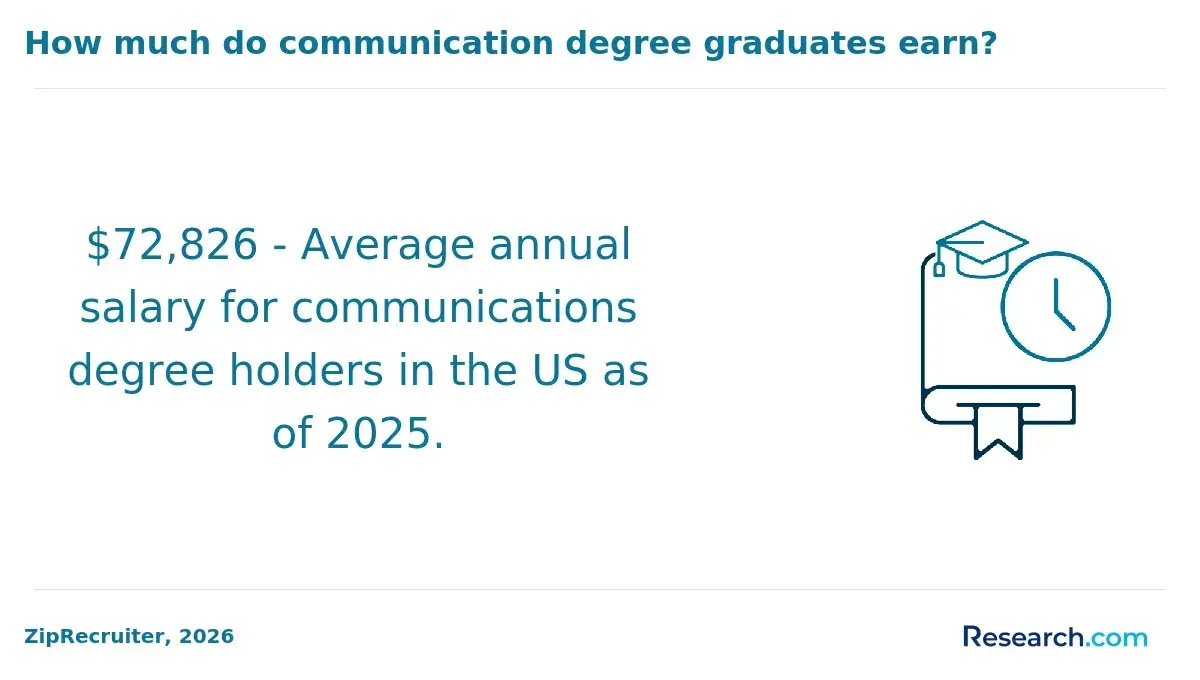
Communication jobs offer median wages near $66,320 but have slightly higher unemployment rates compared to other bachelor's degree holders. Career advancement into management, strategic communication, public relations leadership, or specialized digital roles may improve income over time.
Graduate study can boost lifetime earnings by about 18%, but it also increases upfront costs and may delay full-time workforce participation. Students considering a master's degree should weigh the additional cost against the specific roles they want and whether those roles require or reward graduate education.
Are Online Communication Students Eligible for Financial Aid?
Yes. Online Communication students can be eligible for financial aid if they enroll in an accredited program and meet the aid provider's requirements. In many cases, students in eligible online programs can access the same federal aid opportunities as on-campus students.
The first step for most students is completing the FAFSA. FAFSA eligibility for online Communication students can help determine access to federal grants, federal student loans, and some school-based aid. Students should confirm that the institution and program are eligible before enrolling, because accreditation and institutional participation matter.
- Federal grants: Programs like the Pell Grant can cover thousands of dollars in tuition for students demonstrating financial need, and they do not require repayment.
- Federal student loans: Federal loans may offer more favorable terms than many private loans, but they still require repayment and should be borrowed carefully.
- Discipline-specific scholarships: Schools, foundations, and professional associations may offer scholarships for Communication majors based on merit, financial need, academic focus, or career goals such as journalism, public relations, marketing, or media.
- Employer tuition assistance: Some employers help pay for degrees that support an employee's current role or future advancement, potentially covering part or all of the cost.
- Institutional aid: Colleges may provide need-based grants, merit awards, transfer scholarships, military benefits, or adult learner support depending on the student profile.
Eligibility usually depends on factors such as enrollment status, financial need, satisfactory academic progress, citizenship or eligible noncitizen status for federal aid, and the school's accreditation and participation in aid programs. Students should request a full aid package and compare net price, not just published tuition.
To evaluate schools that meet recognized standards, students can review this resource on top online colleges with national accredited status.
Are Online Communication Program Costs Expected to Increase in the Coming Years?
Online Communication program costs are expected to continue increasing moderately in the coming years. Tuition increases are commonly influenced by inflation, faculty and staffing costs, technology investments, student support services, and institutional budget pressures. At the same time, competition for online students may encourage some schools to keep pricing stable or offer flat-rate online tuition.
Current tuition rates for online Communication degrees vary widely by school type, location, residency policy, and program format. Public universities generally provide more affordable options than private institutions, although out-of-state tuition can reduce that advantage. Some schools charge in-state rates to all online students, which can make a program more budget-friendly.
Students should not assume that online learning will remain the cheapest option at every institution. As demand for online education grows, some colleges may raise tuition, add technology fees, or bundle services into higher program costs. Others may use competitive pricing, transfer-friendly policies, or online-only rates to attract remote learners.
The best way to manage future cost increases is to plan early. Students should ask whether tuition is locked for enrolled students, whether fees are expected to change, how many credits are required after transfer evaluation, and what aid can be renewed each year. Scholarships, financial aid, and employer tuition reimbursement remain important tools for reducing out-of-pocket costs.
What Students Say About The Cost of Pursuing Online Communication Programs
- Jake: "Enrolling in an online Communication degree changed how I thought about both cost and career growth. The average cost of attendance felt manageable, and the skills I gained helped me move toward opportunities in marketing and media. For me, the investment was worthwhile because it supported real professional progress."
- Amir: "The cost of my online Communication degree was a serious commitment, but the flexibility made it possible to keep working while studying. Compared with many on-campus options, the tuition felt more realistic for my budget. It gave me more confidence in my career direction and made the investment easier to justify."
- Loucia: "I approached the degree from a practical standpoint: total cost, likely return, and career value. The expenses were manageable when weighed against the skills and opportunities the program provided. Completing the degree has strengthened my marketability in corporate communications."
Other Things You Should Know About Communication Degree Program Costs
Financial aid for 2027 online Communication degree programs includes federal grants, scholarships, and student loans. Students should complete the FAFSA by June 30, 2027, to qualify for aid. Additionally, many universities offer specific scholarships for Communication majors, with application deadlines varying by institution.
Students can budget for a 2026 online Communication degree by evaluating all costs, including tuition, fees, and materials. Creating a detailed plan that includes securing financial aid, considering scholarships, and tracking monthly expenses can help manage finances effectively throughout the program.
References
- affordable communications degree online: Top Picks 2025 https://www.accio.com/biz-cheap/affordable-communications-degree-online
- Unlocking ROI of Communications with Omnichannel Strategies | Guide https://www.doxim.com/guide/the-roi-of-communications-a-hidden-opportunity/
- Online Communication Studies Degree | LSU Online https://online.lsu.edu/online-degree-programs/undergraduate/communication-studies/
- Strategic Communication, Online (MA) Estimated Costs - Domestic https://grad.admissions.uiowa.edu/cost/strategic-communication-online-ma-estimated-costs-domestic
- Major in Communication (Bachelor’s) https://online.ucdenver.edu/programs/undergraduate/online-major-communication-bachelors
- 30 Most Affordable Online Bachelor's in Communications: Small Private Colleges - Best Degree Programs https://www.bestdegreeprograms.org/top-schools/affordable-bachelors-communications-online-private/
- Online and on-campus colleges | University of Phoenix https://www.phoenix.edu/blog/cost-of-online-vs-traditional-college.html
- The 10 Most Affordable Online Master's in Communications Degree Programs - Best Marketing Degrees https://www.bestmarketingdegrees.org/the-most-affordable-online-masters-in-communications-degree-programs/
- Calculate the ROI of online communication - Geo Content Creators https://geo-marketingsolutions.com/2024/02/02/return-on-investment-of-an-online-presence/
- Medical Billing and Coding Fundamentals https://www.coursera.org/specializations/medical-billing-coding-fundamentals


